Seminar topic:
General aspects and steps involved in
neurotransmission
PRESENTED BY: SIRAJUDDIN MOLLA
M.Phram, 1st Semester
DEPARTMENT OF PHARMACOLOGY
SPER, JAMIA HAMDARD
12-12-2022
1
INDEX
• Introduction
• Aspects of neurotransmitter
• Steps involved in neurotransmission
12-12-2022
2
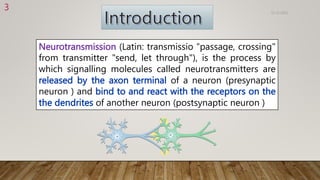
Neurotransmission (Latin: transmissio ā€œpassage, crossing"
from transmitter "send, let through"), is the process by
which signalling molecules called neurotransmitters are
released by the axon terminal of a neuron (presynaptic
neuron ) and bind to and react with the receptors on the
the dendrites of another neuron (postsynaptic neuron )
12-12-2022
3
ļ‚§ The aspects of chemical neurotransmission was primarily
to explain the transmission of impulses from
postganglionic autonomic fibres to effector cells.
ļ‚§ A neurotransmitter is a chemical messenger that carries,
boosts, and balances signals between neurons (also
as nerve cells) and target cells throughout the body.
These target cells may be in glands, muscles, or other
neurons.
Aspects of Neurotransmission
12-12-2022
4
12-12-2022
5
ļ‚§ Evidence supporting this aspect includes the
following:
• Demonstration of the presence of a physiologically
active compound and its biosynthetic enzymes at
appropriate sites;
• Recovery of the compound from the perfusate of an
innervated structure during periods of nerve
stimulation but not in the absence of stimulation;
• Demonstration that the compound is capable of
producing responses identical to responses to nerve
stimulation.
Contd…
12-12-
2022
6
• Neurohumoral transmission implies that nerves
transmit their message across synapses and
neuroeffector junctions by the release of humoral
(chemical) messengers.
• Junctional transmission was thought to be
electrical (it does occur in some lower animals and
probably in certain areas of mammalian brain) but
observations at the turn of last century
prompted……
Contd…
12-12-2022
7
• Elliott (1905): to suggest that sympathetic nerves functioned by
the release of an adrenaline-like substance.
• Dixon (1907): to propose that vagus released a muscarine like
chemical.
• Otto Loewi (1921): provided direct proof of humoral transmission
by perfusing two frog hearts in series. Stimulation of vagus nerve
of the first heart caused arrest of both.
Thus, a chemical must have been released by vagal stimulation in the first
heart which passed in the perfusate and arrested the second heart.
• Dale (1914): This vagusstoff was found in 1926 to be
acetylcholine, which earlier he had characterised as
ā€˜parasympathomimetic’.
• Von Euler (1946): The sympathetic transmitter was eventually
shown to be noradrenaline.
Contd…
12-12-2022
8
To be considered as a postjunctionally acting neurohumoral
transmitter a substance must fulfill the following criteria:
(i) It should be present in the presynaptic neurone
(usually along with enzymes synthesizing it).
(ii) It should be released in the medium following nerve
stimulation.
(iii)Its application should produce responses identical to
those produced by nerve stimulation.
(iv)Its effects should be antagonized or potentiated by
other substances which similarly alter effects of nerve
stimulation.
Many humoral transmitters (dopamine, 5-HT, GABA,
glutamic acid, purines, peptides, etc.) are now
known.
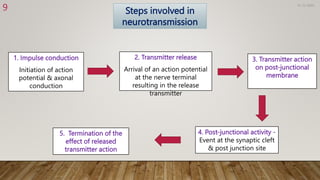
Steps involved in
neurotransmission
5. Termination of the
effect of released
transmitter action
1. Impulse conduction
Initiation of action
potential & axonal
conduction
2. Transmitter release
Arrival of an action potential
at the nerve terminal
resulting in the release
transmitter
3. Transmitter action
on post-junctional
membrane
4. Post-junctional activity -
Event at the synaptic cleft
& post junction site
12-12-2022
9
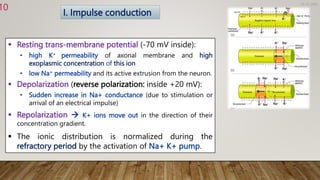
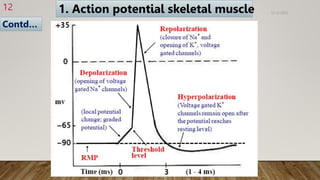
I. Impulse conduction
ļ‚§ Resting trans-membrane potential (-70 mV inside):
• high K+ permeability of axonal membrane and high
exoplasmic concentration of this ion
• low Na+ permeability and its active extrusion from the neuron.
ļ‚§ Depolarization (reverse polarization: inside +20 mV):
• Sudden increase in Na+ conductance (due to stimulation or
arrival of an electrical impulse)
ļ‚§ Repolarization  K+ ions move out in the direction of their
concentration gradient.
ļ‚§ The ionic distribution is normalized during the
refractory period by the activation of Na+ K+ pump.
12-12-2022
10
12-12-2022
11
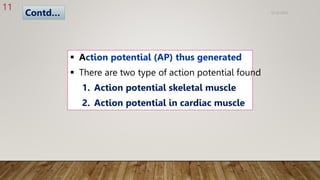
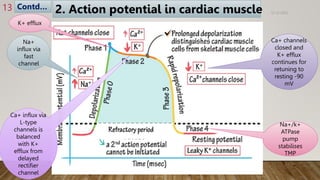
ļ‚§ Action potential (AP) thus generated
ļ‚§ There are two type of action potential found
1. Action potential skeletal muscle
2. Action potential in cardiac muscle
Contd…
12-12-2022
12 1. Action potential skeletal muscle
Contd…
12-12-2022
13 2. Action potential in cardiac muscle
Na+
influx via
fast
channel
K+ efflux
Ca+ influx via
L-type
channels is
balanced
with K+
efflux from
delayed
rectifier
channel
Ca+ channels
closed and
K+ efflux
continues for
retuning to
resting -90
mV
Na+/k+
ATPase
pump
stabilises
TMP
Contd…
• Tetrodotoxin (from puffer fish) and saxitoxin
(from certain shell-fish) selectively abolish
increase in Na+ conductance in nerve fibres
and thus block impulse conduction.
• The action potential (AP) thus generated sets up
local circuit currents which activate ionic channels
at the next excitable part of the membrane (next
node of Ranvier in myelinated fibre) and the AP is
propagated without decrement.
Contd…
12-12-2022
14
II. Transmitter release
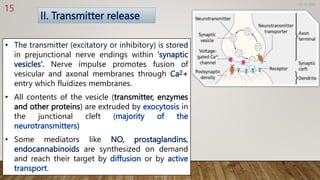
• The transmitter (excitatory or inhibitory) is stored
in prejunctional nerve endings within 'synaptic
vesicles'. Nerve impulse promotes fusion of
vesicular and axonal membranes through Ca2+
entry which fluidizes membranes.
• All contents of the vesicle (transmitter, enzymes
and other proteins) are extruded by exocytosis in
the junctional cleft (majority of the
neurotransmitters)
• Some mediators like NO, prostaglandins,
endocannabinoids are synthesized on demand
and reach their target by diffusion or by active
transport.
12-12-2022
15
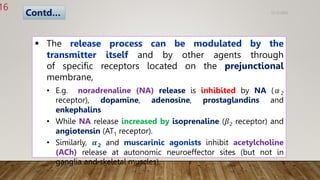
ļ‚§ The release process can be modulated by the
transmitter itself and by other agents through
of specific receptors located on the prejunctional
membrane,
• E.g. noradrenaline (NA) release is inhibited by NA (š›¼ 2
receptor), dopamine, adenosine, prostaglandins and
enkephalins
• While NA release increased by isoprenaline (š›½2 receptor) and
angiotensin (AT1 receptor).
• Similarly, šœ¶2 and muscarinic agonists inhibit acetylcholine
(ACh) release at autonomic neuroeffector sites (but not in
ganglia and skeletal muscles).
12-12-2022
16
Contd…
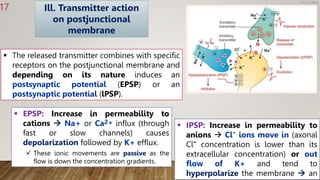
ļ‚§ The released transmitter combines with specific
receptors on the postjunctional membrane and
depending on its nature induces an
postsynaptic potential (EPSP) or an
postsynaptic potential (lPSP).
Ill. Transmitter action
on postjunctional
membrane
ļ‚§ EPSP: Increase in permeability to
cations  Na+ or Ca2+ influx (through
fast or slow channels) causes
depolarization followed by K+ efflux.
 These ionic movements are passive as the
flow is down the concentration gradients.
ļ‚§ IPSP: Increase in permeability to
anions  Cl- ions move in (axonal
Cl- concentration is lower than its
extracellular concentration) or out
flow of K+ and tend to
hyperpolarize the membrane  an
12-12-2022
17
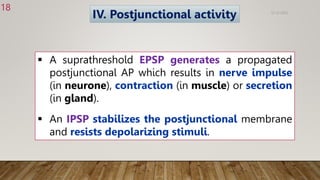
ļ‚§ A suprathreshold EPSP generates a propagated
postjunctional AP which results in nerve impulse
(in neurone), contraction (in muscle) or secretion
(in gland).
ļ‚§ An IPSP stabilizes the postjunctional membrane
and resists depolarizing stimuli.
IV. Postjunctional activity 12-12-2022
18
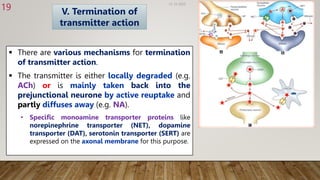
ļ‚§ There are various mechanisms for termination
of transmitter action.
ļ‚§ The transmitter is either locally degraded (e.g.
ACh) or is mainly taken back into the
prejunctional neurone by active reuptake and
partly diffuses away (e.g. NA).
• Specific monoamine transporter proteins like
norepinephrine transporter (NET), dopamine
transporter (DAT), serotonin transporter (SERT) are
expressed on the axonal membrane for this purpose.
V. Termination of
transmitter action
12-12-2022
19
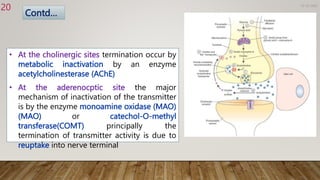
• At the cholinergic sites termination occur by
metabolic inactivation by an enzyme
acetylcholinesterase (AChE)
• At the aderenocptic site the major
mechanism of inactivation of the transmitter
is by the enzyme monoamine oxidase (MAO)
(MAO) or catechol-O-methyl
transferase(COMT) principally the
termination of transmitter activity is due to
reuptake into nerve terminal
12-12-2022
20
Contd…
ļ‚§ Amino acid transmitters (glutamate, GABA) are
also partly taken up by active transport into
neuronal and neighbouring glial cell
ļ‚§ peptide neurotransmitters (VIP, NPY,
enkephalins, etc.)  no active reuptake
occurs.
ļ‚§ The rate of termination  rate at which
respones can be transmitted across a
junction ( I to I000/sec).
Vasoactive intestinal peptide (VIP)
Neuropeptide Y (NPY)
12-12-2022
21
Contd…
12-12-2022
22
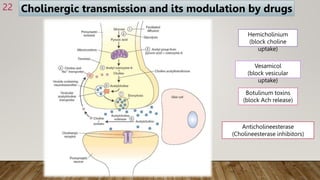
Hemicholinium
(block choline
uptake)
Vesamicol
(block vesicular
uptake)
Botulinum toxins
(block Ach release)
Anticholineesterase
(Cholineesterase inhibitors)
Cholinergic transmission and its modulation by drugs
12-12-2022
23
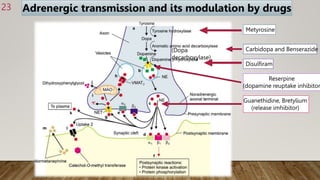
Metyrosine
Carbidopa and Benserazide
Reserpine
(dopamine reuptake inhibitor
Disulfiram
Guanethidine, Bretylium
(release imhibitor)
(Dopa
decarboxylase)
Adrenergic transmission and its modulation by drugs
References
1. ESSENTIALS OF MEDICAL PHARMACOLOGY, KD TRIPATHI 8TH
EDITION, JAYPEE BROTHERS MEDICAL PUBLISHERS PVT. LTD.,
2019
2. RANG AND DALE'S PHARMACOLOGY, HP RANG, JM RITTER, RJ
FLOWER AND G. HENDERSON, 8TH EDITION, ELSEVIER LTD., 2016
3. https://quizlet.com/265919934/action-potential-diagram/
4. https://ankiweb.net/shared/info/9487919
5. https://www.researchgate.net/figure/Diagram-of-a-
noradrenergic-axonal-terminal-showing-the-release-and-
reuptake-of_fig2_6915741
12-12-2022
24
12-12-2022
25