SCREENING METHODS FOR
ANTI-ATHEROSCLEROTIC
AGENTS
Presented by,
Prajitha. P
First year M.Pharm- Pharmacology
Devaki Amma Memorial College of Pharmacy, Malappuram
ATHEROSCLEROSIS
• Atherosclerosis is a disease in which fatty plaque build up in
the walls of arteries.
• The fatty plaque deposition is due to the increased level of
cholesterol and other triglycerides in the blood which is
characterized as hyperlipidemia.
• So the hyperlipidemia is the main cause of atherosclerosis.
• So the treatment include against hyperlipidemia and
atherosclerosis.
1.Induction of experimental animals
• Cholesterol diet induced atherosclerosis in rabbits and
other species.
• Evaluation of endothelial function in rabbits with
atherosclerosis.
• Hereditary hypercholesterolemia in rats.
• Hereditary hyperlipidemia in rabbits.
• Studies in transgenic mice.
• Intimal reactions .
1.1 Cholesterol – diet induced atherosclerosis
Purpose and rationale
• Excessive feeding of cholesterol in diet can produce
severe hypercholesterolemia and atherosclerosis in
rabbits.
• This method is used for the evaluation of potential
anti arteriosclerotic drugs.
 This method is useful only for the detection of drugs
which may interfere with the absorption, degradation
and excretion of cholesterol.
 Drugs which interfere the synthesis of cholesterol
may not be effective in this test.
Procedure ;
• Male inbred New Zealand White rabbits at the age of
8-10 weeks are taken.
• Body weight variation in these animal should be kept
as low as possible.
• At the beginning of the experiment blood is
withdrawn from the marginal ear vein and the base
line values of total serum cholesterol, triglycerides
and blood sugar are estimated.
• Groups of 10 animals are used for treatment with test
compounds or as controls.
• The rabbits are switched from the normal diet to a
diet supplemented with 2% cholesterol and
maintained on this regimen for 10-12 weeks.
• One group kept in normal diet.
• At the end of the test period the blood from all the
group is withdrawn and analyzed.
• In the control cholesterol diet group the levels of
cholesterol and triglycerides show a highly
significant rise as compared to the rabbits
maintained in a normal diet.
• For the histological reference of atherosclerosis
the animals are sacrificed with high dose of
anesthetic ether.
• The thoracic aorta is dissected out , cleaned of
surrounding tissues , longitudinally cut and opened for
fixation with formaldehyde.
• it is then stained with oil red.
• The percentage of internal surface covered by oil red
positive lesions is calculated with a computerized
planimeter.
• In the normal animal the aorta does not show any
staining but in the cholesterol diet fed animals the aorta
exhibits severe atherosclerotic lesions stained with oil red.
• Evaluation;
• Data are expressed as mean ± standard deviation.
• Statistical evaluation is performed by Dunnet’s or
Scheffe’s test for significance. p- value of ≤ 0.05 is
regarded as statically significant.
1.2Evaluation of endothelial function in rabbits
with atherosclerosis
• Purpose and rationale ;
Cholesterol feeding of rabbits impairs the endothelium
dependent relaxation evoked by acetylcholine in the
aorta.
The phenomenon can be used to study the influence of
vasodilators as well as the prevention by the ACE-
inhibitors.
Procedure;
• Male white Newzealand rabbits weighing 3-4 kg are
maintained on a hypercholesteremic diet containing
0.25 to 1% cholesterol and 3% coconut oil.
• The normal rabbits received the standard diet and
served as control.
• After 10-12 weeks the serum cholesterol level in the
cholesterol fed rabbits rise more than of the normal
control rabbits.
• At the end of the treatment the animal were
sacrificed using high dose of ether.
• Proximal part of the aorta was removed and
cleaned .
• Aorta then sectioned in to 2mm wide rings, cut
off to strips and suspended in a 25ml organ bath
containing physiological ringer solution and
maintained at 35°c and gassed with carbogen.
• After 2hrs when a stable contractile tone is
established, norepinephrine is added which produces
a stable submaximal isotonic contraction.
• Then Ach is added .
• Relaxation of aortic strips is assessed as percentage
decrease in contraction.
Evaluation;
• The data are expressed as ±SEM and compared by
students t-test for unpaired data.
2.Influence on lipid metabolism
• Triton induced hyperlipidemia
• Fructose induced hypertriglyceridemia in rats
• Hypolipidemic activity in syrian hamster
• Hypolipidemic activity in rats
• Intravenous lipid tolerence test in rats
• Influence on lipoprotein lipase activity
• Influence on several steps of cholesterol absorption
and formation
2.1Triton induced hyperlipidemia
Purpose and rationale;
The systemic administration of the surfactant triton
to rats results in a biphasic elevation of plasma
cholesterol and triglycerides.
Procedure;
 Male wistar rats weighing between 250-350 g maintained
in a standard chow diet.
 The animals are fasted for18hr prior to an iv of 200g/kg of
triton.
• After 24hr serum cholesterol is recorded, ie; considered as
phase 1 response.
• There after , the hypercholesteremia decreases to almost
normal within the next 24hrs,i.e. the phase2 response.
• The test drugs are injected simultaneously with triton.
Serum cholesterol levels are measured at 6, 24, and
48 h after triton injection.
• The phase 1 hypercholestrolemia after triton has been
attributed to the increase in cholesterol synthesis by
the liver.
• Triton also inhibits the uptake of plasma lipids by
other tissues of the body.
• Drugs interfering with the cholesterol biosynthesis
were shown to be active in phase1 while those
interfering with cholesterol excretion and metabolism
active in phase 2.
Evaluation;
• mean values of serum cholesterol and standard error
are calculated for each group and subjected to
analysis for statistical significance.
2.2Hypolipidemic activity in syrian hamster
• Purpose and rationale
• The syrian hamster is a widely used animal to study
the effects of drugs and diet on lipoprotein
metabolism.
• Approved lipid lowering drugs like HMG CoA
reductase inhibitor , cholestyramine, ezetemibe
lowers plasma cholesterol in hamster .
• The lipoprotein and bile acid metabolism in hamster
is similar to that of humans than the rats and mice.
Procedure;
• Male syrian hamster weighing 95-125 g are taken.
• Test and control group are administered with
cholesterol rich food.
• Along with food in test group the test compound is
mixed with the food and given.(0.3-0.4% of test drug
with food)
• After 1-2 weeks of this diet the animals are
anesthetised with isoflurane.
• Blood is withdrwan from retro orbital vein plexus.
Evaluation;
• Dose–response curves of standard and test drug are
compared .
2.3Fructose induced hypertriglyceridemia in rats
• Purpose and rationale;
• Rats kept in low carbohydrate diet and high protein
and fructose intake develop an acute
hypertriglyceridemia.
• Procedure;
• Male sprauge dawley rats weighing 200-250g are taken.
• They are given with a diet of high protein and low
carbohydrate.
• The animals are treated for 3days with test compound or
the standard by oral gavage.
• From the second to third day the water is with held for
24hr.
• immediately afterwards the animals were offered 20% of
fructose solution.
• After the 20hr of test drug administration the animals
are anesthetized with isoflurane.
• 1.2ml blood is withdrawn from retrorbital cavity.
• The blood was centrifuged and serum removed.
• The serum was analyzed for the total cholesterol and
triglycerides by colorimetric method.
Evaluation;
• the average values of total glycerol ,triglycerides for
treated and control group are compared and
calculated by ANOVA method.
3.Inhibition of cholesterol biosynthesis
• Determination of HMG-CoA- Reductase inhibitory
activity
• Inhibition of the isolated enzyme HMG-CoA
Reductase in Vitro
• Ex vivo inhibition of cholesterol biosynthesis in
isolated rat liver slices
• Effect of HMG CoA- reductase inhibition in invivo
• Inhibition of squalene synthase
• inhibition of squalene epoxidase
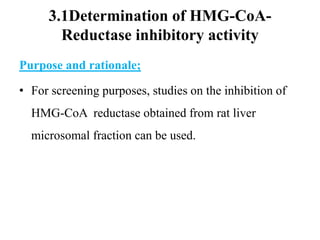
3.1Determination of HMG-CoA-
Reductase inhibitory activity
Purpose and rationale;
• For screening purposes, studies on the inhibition of
HMG-CoA reductase obtained from rat liver
microsomal fraction can be used.
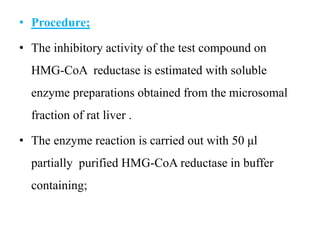
• Procedure;
• The inhibitory activity of the test compound on
HMG-CoA reductase is estimated with soluble
enzyme preparations obtained from the microsomal
fraction of rat liver .
• The enzyme reaction is carried out with 50 μl
partially purified HMG-CoA reductase in buffer
containing;
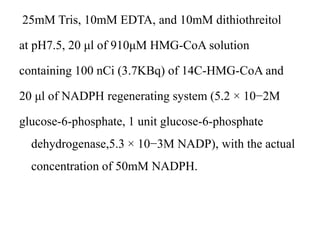
25mM Tris, 10mM EDTA, and 10mM dithiothreitol
at pH7.5, 20 μl of 910μM HMG-CoA solution
containing 100 nCi (3.7KBq) of 14C-HMG-CoA and
20 μl of NADPH regenerating system (5.2 × 10⁻²M
glucose-6-phosphate, 1 unit glucose-6-phosphate
dehydrogenase,5.3 × 10−3M NADP), with the actual
concentration of 50mM NADPH.
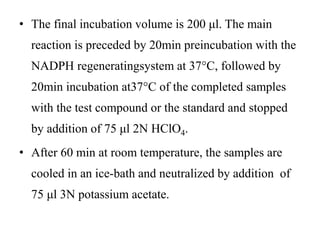
• The final incubation volume is 200 μl. The main
reaction is preceded by 20min preincubation with the
NADPH regeneratingsystem at 37°C, followed by
20min incubation at37°C of the completed samples
with the test compound or the standard and stopped
by addition of 75 μl 2N HClO4.
• After 60 min at room temperature, the samples are
cooled in an ice-bath and neutralized by addition of
75 μl 3N potassium acetate.
• Supplementing the volume with water to 500 μl, the
precipitate is centrifuged and 250 μl of the clear
supernatant are applied to a column (0.6 × 8.0 cm) of
BIORAD AG 1-X8 (100–200mesh).
• Mevalonolactone is eluted with water discarding the
first 750 μl and collecting the next3500 μl.
• Five hundred μl of the eluate are used for
measurement in duplicate, mixed in vials with 10 ml
Quickscint (Zinsser) and measured in a liquid
scintillation counter (Beckman).
• The assay is generally performed in triplicate.
Lovastatin sodium is used as standard
• Evaluation
• The mean values with and without inhibitors are
compared for the calculation of inhibition. IC50
values are calculated.
3.2Ex vivo inhibition of cholesterol
biosynthesis in isolated rat liver slices
• Purpose and rationale;
Inhibition of cholesterol biosynthesis in rat livers can
be measured in an ex vivo assay after oral treatment
with HMG-CoA reductase inhibitors by cholesterol
synthesis from labelled sodium octanoate.
• procedure
• Male Sprague Dawley rats weighing 110–130 g are
kept on a reverse light cycle (lights 3:00 P.M. to
3:00A.M.) for 14 days prior to use.
• Throughout the period of adaptation, the rats have
free access to a low cholesterol diet and tap water.
• On the day of the experiment, the test compounds are
given orally between 9:00 and 11:00 A.M. as
suspensions in 0.5% methylcellulose.
• After one hour, the rats are sacrificed, the livers
removed and transferred to chilled oxygenated Krebs-
Ringer-bicarbonate buffer (pH 7.4).
• The livers are then chopped into 0.8-mm pieces using
a tissue chopper and are suspended in the same
buffer.
• Aliquots of the suspension are pipetted, in triplicate,
into culture tubes which contain [14C]sodium
octanoate
• The assay volume is 1 ml. The tubes are gassed with
95% CO2 for 10 s, stoppered with a serum cap, and
incubated at 37°C in a metabolic shaker at 150
oscillations/min for 90min.
• The reaction is stopped by addition of 1 ml 15%
KOH in ethanol. An aliquot of the mixture is assayed
for protein concentration.
• The tubes are saponified at 75°C for 2 h and then
extracted with 10 ml of petroleum ether for 30min.
• The lower aqueous phase is frozen in a dry
ice/alcohol mixture, and the ether phase is removed,
washed with 2ml distilled water and then evaporated
to dryness.
• The cholesterol synthesized is separated by thin layer
chromatography on plastic silica gel plates using
chloroform as eluent.
• After visualization with iodine, the Inhibition of
Cholesterol Biosynthesis, cholesterol spots are cut
out, and radioactivity quantified by liquid
scintillation counter.
Evaluation;
• Results are expressed as percentage inhibition
compared to vehicle-treated control values.
• ED50 values of inhibition can be calculated from
dose-response curves.
4.Inhibition of cholesterol absorpton
• Inhibition of ACAT( Acyl Coenzyme A; cholestero
acyl transferase)
1. invitro ACAT inhibitory activity
2. invivo test for ACAT inhibitory activity
• Lymph fistula model for cholesterol absorption
• Acyl coenzyme A:cholesterol acyl transferase
(ACAT), which catalyses the intracellular
formation of cholesteryl esters, plays an
important role in the intestinal absorption of
cholesterol, foam cell formation within the
arterial wall and VLDL production in the liver.
Inhibition of ACAT( Acyl Coenzyme A;
cholestero acyl transferase)
1. in vitro ACAT inhibitory activity
• Purpose and rationale
• In vitro ACAT inhibitory activity can be determined
in microsomal preparations from liver or intestine of
rabbits.
• PROCEDURE
• Hepatic or intestinal microsomes are prepared from
rabbits.
• Prior to sacrifice, the animals receive chow
supplemented with 2% cholesterol and 10%
sunflower oil for 6 weeks.
• Each assay contains 0.2mg of microsomal protein and
fatty acid-poor bovine serum albumin (3mg/ml) in
0.04M KH2PO4 buffer, pH7.4, containing 0.05MKCl,
0.03MEDTA, and 0.3Msucrose.
• Drug dilutions are made in DMSO.
• The reaction is started by the addition of oleyl CoA .
• After 3 min the reaction is stopped by the addition of
chloroform-methanol 2:1.
• Cholesteryl oleate is used as an internal standard. Lipid
extracts are dissolved in chloroform, spotted on TLC
plates (silica gel G) and developed in hexane-petroleum
ether-acetic acid 80:20:1.
• Unlabeled, carrier cholesterol oleate is added to the
internal standard to aid band visualization with iodine
vapor. The band corresponding to cholesteryl esters is
then scraped into scintillation vials and radioactivity
is determined by liquid scintillation spectroscopy.
evaluation
• For each compound four concentrations are evaluated
in duplicate. IC50 values are determined by
performing a nonlinear least-squares fit of the data to
a log dose response curve.
2. invivo test for ACAT inhibitory
activity
• purpose and rationale
• Most authors test the in vivo anti-atherosclerotic and
antihyperlipemic effect of ACAT inhibitors in
cholesterol-fed hypercholesterolemic animals
procedure;
• Male Sprague-Dawley rats weighing 200–225 g are fed
with a diet containing 5.5% peanut oil, 0.5% cholic acid
and 1.5% cholesterol with or without (controls)drugs
for 1 week.
• On the last day, food is removed at 8:00 A.M. and the
isotopes are administered beginning at 2:00 P.M.
[3H]cholesterol is given by oral gavage and
[14C]cholesterol is given is given by tail vein injection.
• The [3H]cholesterol is prepared as an emulsion by
dissolving 125 mg cholesterol in 1625mg olive oil.
The oil phase is suspended by sonication in 25ml of
water containing 156 mg taurocholate(sodium salt).
Each animal receives 1 ml
The rats are allowed to take their food and sacrificed
after by isotop administration
• evaluation
• The percentage of an oral dose of cholesterol
absorbed is calculated from the plasma isotope ratio
(% of the oral dose in 2 ml plasma/of the intravenous
dose in2ml plasma × 100).
5.Interruption of bile acid recirculation
• 1. cholestyramine binding
• Inhibition of lipid peroxidation of isolated plasma
low –density lipoprotein
6.Inhibition of lipid oxidation
7.Internalization of labeled LDL into hepG2 cells
• Influence of peroxisome proliferator activated receptors
(PPARs). And liver X receptors (LXRs) on development
of atherosclerosis
1.Effect of PPAR ALFA agonist in mice
2. Influence of liver X receptor agonist
3. Stimulation of cholesterol efflux
4. Liver x- receptor binding
THANK YOU…..

screening methods for anti-atherosclerotic agents

  • 1.
    SCREENING METHODS FOR ANTI-ATHEROSCLEROTIC AGENTS Presentedby, Prajitha. P First year M.Pharm- Pharmacology Devaki Amma Memorial College of Pharmacy, Malappuram
  • 2.
    ATHEROSCLEROSIS • Atherosclerosis isa disease in which fatty plaque build up in the walls of arteries. • The fatty plaque deposition is due to the increased level of cholesterol and other triglycerides in the blood which is characterized as hyperlipidemia. • So the hyperlipidemia is the main cause of atherosclerosis. • So the treatment include against hyperlipidemia and atherosclerosis.
  • 3.
    1.Induction of experimentalanimals • Cholesterol diet induced atherosclerosis in rabbits and other species. • Evaluation of endothelial function in rabbits with atherosclerosis. • Hereditary hypercholesterolemia in rats. • Hereditary hyperlipidemia in rabbits. • Studies in transgenic mice. • Intimal reactions .
  • 4.
    1.1 Cholesterol –diet induced atherosclerosis Purpose and rationale • Excessive feeding of cholesterol in diet can produce severe hypercholesterolemia and atherosclerosis in rabbits. • This method is used for the evaluation of potential anti arteriosclerotic drugs.
  • 5.
     This methodis useful only for the detection of drugs which may interfere with the absorption, degradation and excretion of cholesterol.  Drugs which interfere the synthesis of cholesterol may not be effective in this test.
  • 6.
    Procedure ; • Maleinbred New Zealand White rabbits at the age of 8-10 weeks are taken. • Body weight variation in these animal should be kept as low as possible. • At the beginning of the experiment blood is withdrawn from the marginal ear vein and the base line values of total serum cholesterol, triglycerides and blood sugar are estimated.
  • 7.
    • Groups of10 animals are used for treatment with test compounds or as controls. • The rabbits are switched from the normal diet to a diet supplemented with 2% cholesterol and maintained on this regimen for 10-12 weeks. • One group kept in normal diet. • At the end of the test period the blood from all the group is withdrawn and analyzed.
  • 8.
    • In thecontrol cholesterol diet group the levels of cholesterol and triglycerides show a highly significant rise as compared to the rabbits maintained in a normal diet. • For the histological reference of atherosclerosis the animals are sacrificed with high dose of anesthetic ether.
  • 9.
    • The thoracicaorta is dissected out , cleaned of surrounding tissues , longitudinally cut and opened for fixation with formaldehyde. • it is then stained with oil red. • The percentage of internal surface covered by oil red positive lesions is calculated with a computerized planimeter. • In the normal animal the aorta does not show any staining but in the cholesterol diet fed animals the aorta exhibits severe atherosclerotic lesions stained with oil red.
  • 10.
    • Evaluation; • Dataare expressed as mean ± standard deviation. • Statistical evaluation is performed by Dunnet’s or Scheffe’s test for significance. p- value of ≤ 0.05 is regarded as statically significant.
  • 11.
    1.2Evaluation of endothelialfunction in rabbits with atherosclerosis • Purpose and rationale ; Cholesterol feeding of rabbits impairs the endothelium dependent relaxation evoked by acetylcholine in the aorta. The phenomenon can be used to study the influence of vasodilators as well as the prevention by the ACE- inhibitors.
  • 12.
    Procedure; • Male whiteNewzealand rabbits weighing 3-4 kg are maintained on a hypercholesteremic diet containing 0.25 to 1% cholesterol and 3% coconut oil. • The normal rabbits received the standard diet and served as control. • After 10-12 weeks the serum cholesterol level in the cholesterol fed rabbits rise more than of the normal control rabbits.
  • 13.
    • At theend of the treatment the animal were sacrificed using high dose of ether. • Proximal part of the aorta was removed and cleaned . • Aorta then sectioned in to 2mm wide rings, cut off to strips and suspended in a 25ml organ bath containing physiological ringer solution and maintained at 35°c and gassed with carbogen.
  • 14.
    • After 2hrswhen a stable contractile tone is established, norepinephrine is added which produces a stable submaximal isotonic contraction. • Then Ach is added . • Relaxation of aortic strips is assessed as percentage decrease in contraction. Evaluation; • The data are expressed as ±SEM and compared by students t-test for unpaired data.
  • 15.
    2.Influence on lipidmetabolism • Triton induced hyperlipidemia • Fructose induced hypertriglyceridemia in rats • Hypolipidemic activity in syrian hamster • Hypolipidemic activity in rats • Intravenous lipid tolerence test in rats • Influence on lipoprotein lipase activity • Influence on several steps of cholesterol absorption and formation
  • 16.
    2.1Triton induced hyperlipidemia Purposeand rationale; The systemic administration of the surfactant triton to rats results in a biphasic elevation of plasma cholesterol and triglycerides.
  • 17.
    Procedure;  Male wistarrats weighing between 250-350 g maintained in a standard chow diet.  The animals are fasted for18hr prior to an iv of 200g/kg of triton. • After 24hr serum cholesterol is recorded, ie; considered as phase 1 response. • There after , the hypercholesteremia decreases to almost normal within the next 24hrs,i.e. the phase2 response.
  • 18.
    • The testdrugs are injected simultaneously with triton. Serum cholesterol levels are measured at 6, 24, and 48 h after triton injection. • The phase 1 hypercholestrolemia after triton has been attributed to the increase in cholesterol synthesis by the liver. • Triton also inhibits the uptake of plasma lipids by other tissues of the body.
  • 19.
    • Drugs interferingwith the cholesterol biosynthesis were shown to be active in phase1 while those interfering with cholesterol excretion and metabolism active in phase 2. Evaluation; • mean values of serum cholesterol and standard error are calculated for each group and subjected to analysis for statistical significance.
  • 20.
    2.2Hypolipidemic activity insyrian hamster • Purpose and rationale • The syrian hamster is a widely used animal to study the effects of drugs and diet on lipoprotein metabolism. • Approved lipid lowering drugs like HMG CoA reductase inhibitor , cholestyramine, ezetemibe lowers plasma cholesterol in hamster .
  • 21.
    • The lipoproteinand bile acid metabolism in hamster is similar to that of humans than the rats and mice. Procedure; • Male syrian hamster weighing 95-125 g are taken. • Test and control group are administered with cholesterol rich food. • Along with food in test group the test compound is mixed with the food and given.(0.3-0.4% of test drug with food)
  • 22.
    • After 1-2weeks of this diet the animals are anesthetised with isoflurane. • Blood is withdrwan from retro orbital vein plexus. Evaluation; • Dose–response curves of standard and test drug are compared .
  • 23.
    2.3Fructose induced hypertriglyceridemiain rats • Purpose and rationale; • Rats kept in low carbohydrate diet and high protein and fructose intake develop an acute hypertriglyceridemia.
  • 24.
    • Procedure; • Malesprauge dawley rats weighing 200-250g are taken. • They are given with a diet of high protein and low carbohydrate. • The animals are treated for 3days with test compound or the standard by oral gavage. • From the second to third day the water is with held for 24hr. • immediately afterwards the animals were offered 20% of fructose solution.
  • 25.
    • After the20hr of test drug administration the animals are anesthetized with isoflurane. • 1.2ml blood is withdrawn from retrorbital cavity. • The blood was centrifuged and serum removed. • The serum was analyzed for the total cholesterol and triglycerides by colorimetric method.
  • 26.
    Evaluation; • the averagevalues of total glycerol ,triglycerides for treated and control group are compared and calculated by ANOVA method.
  • 27.
    3.Inhibition of cholesterolbiosynthesis • Determination of HMG-CoA- Reductase inhibitory activity • Inhibition of the isolated enzyme HMG-CoA Reductase in Vitro • Ex vivo inhibition of cholesterol biosynthesis in isolated rat liver slices • Effect of HMG CoA- reductase inhibition in invivo
  • 28.
    • Inhibition ofsqualene synthase • inhibition of squalene epoxidase
  • 29.
    3.1Determination of HMG-CoA- Reductaseinhibitory activity Purpose and rationale; • For screening purposes, studies on the inhibition of HMG-CoA reductase obtained from rat liver microsomal fraction can be used.
  • 30.
    • Procedure; • Theinhibitory activity of the test compound on HMG-CoA reductase is estimated with soluble enzyme preparations obtained from the microsomal fraction of rat liver . • The enzyme reaction is carried out with 50 μl partially purified HMG-CoA reductase in buffer containing;
  • 31.
    25mM Tris, 10mMEDTA, and 10mM dithiothreitol at pH7.5, 20 μl of 910μM HMG-CoA solution containing 100 nCi (3.7KBq) of 14C-HMG-CoA and 20 μl of NADPH regenerating system (5.2 × 10⁻²M glucose-6-phosphate, 1 unit glucose-6-phosphate dehydrogenase,5.3 × 10−3M NADP), with the actual concentration of 50mM NADPH.
  • 32.
    • The finalincubation volume is 200 μl. The main reaction is preceded by 20min preincubation with the NADPH regeneratingsystem at 37°C, followed by 20min incubation at37°C of the completed samples with the test compound or the standard and stopped by addition of 75 μl 2N HClO4. • After 60 min at room temperature, the samples are cooled in an ice-bath and neutralized by addition of 75 μl 3N potassium acetate.
  • 33.
    • Supplementing thevolume with water to 500 μl, the precipitate is centrifuged and 250 μl of the clear supernatant are applied to a column (0.6 × 8.0 cm) of BIORAD AG 1-X8 (100–200mesh). • Mevalonolactone is eluted with water discarding the first 750 μl and collecting the next3500 μl.
  • 34.
    • Five hundredμl of the eluate are used for measurement in duplicate, mixed in vials with 10 ml Quickscint (Zinsser) and measured in a liquid scintillation counter (Beckman). • The assay is generally performed in triplicate. Lovastatin sodium is used as standard
  • 35.
    • Evaluation • Themean values with and without inhibitors are compared for the calculation of inhibition. IC50 values are calculated.
  • 36.
    3.2Ex vivo inhibitionof cholesterol biosynthesis in isolated rat liver slices • Purpose and rationale; Inhibition of cholesterol biosynthesis in rat livers can be measured in an ex vivo assay after oral treatment with HMG-CoA reductase inhibitors by cholesterol synthesis from labelled sodium octanoate.
  • 37.
    • procedure • MaleSprague Dawley rats weighing 110–130 g are kept on a reverse light cycle (lights 3:00 P.M. to 3:00A.M.) for 14 days prior to use. • Throughout the period of adaptation, the rats have free access to a low cholesterol diet and tap water. • On the day of the experiment, the test compounds are given orally between 9:00 and 11:00 A.M. as suspensions in 0.5% methylcellulose.
  • 38.
    • After onehour, the rats are sacrificed, the livers removed and transferred to chilled oxygenated Krebs- Ringer-bicarbonate buffer (pH 7.4). • The livers are then chopped into 0.8-mm pieces using a tissue chopper and are suspended in the same buffer. • Aliquots of the suspension are pipetted, in triplicate, into culture tubes which contain [14C]sodium octanoate
  • 39.
    • The assayvolume is 1 ml. The tubes are gassed with 95% CO2 for 10 s, stoppered with a serum cap, and incubated at 37°C in a metabolic shaker at 150 oscillations/min for 90min. • The reaction is stopped by addition of 1 ml 15% KOH in ethanol. An aliquot of the mixture is assayed for protein concentration. • The tubes are saponified at 75°C for 2 h and then extracted with 10 ml of petroleum ether for 30min.
  • 40.
    • The loweraqueous phase is frozen in a dry ice/alcohol mixture, and the ether phase is removed, washed with 2ml distilled water and then evaporated to dryness. • The cholesterol synthesized is separated by thin layer chromatography on plastic silica gel plates using chloroform as eluent.
  • 41.
    • After visualizationwith iodine, the Inhibition of Cholesterol Biosynthesis, cholesterol spots are cut out, and radioactivity quantified by liquid scintillation counter. Evaluation; • Results are expressed as percentage inhibition compared to vehicle-treated control values. • ED50 values of inhibition can be calculated from dose-response curves.
  • 42.
    4.Inhibition of cholesterolabsorpton • Inhibition of ACAT( Acyl Coenzyme A; cholestero acyl transferase) 1. invitro ACAT inhibitory activity 2. invivo test for ACAT inhibitory activity • Lymph fistula model for cholesterol absorption
  • 43.
    • Acyl coenzymeA:cholesterol acyl transferase (ACAT), which catalyses the intracellular formation of cholesteryl esters, plays an important role in the intestinal absorption of cholesterol, foam cell formation within the arterial wall and VLDL production in the liver.
  • 44.
    Inhibition of ACAT(Acyl Coenzyme A; cholestero acyl transferase) 1. in vitro ACAT inhibitory activity • Purpose and rationale • In vitro ACAT inhibitory activity can be determined in microsomal preparations from liver or intestine of rabbits.
  • 45.
    • PROCEDURE • Hepaticor intestinal microsomes are prepared from rabbits. • Prior to sacrifice, the animals receive chow supplemented with 2% cholesterol and 10% sunflower oil for 6 weeks. • Each assay contains 0.2mg of microsomal protein and fatty acid-poor bovine serum albumin (3mg/ml) in 0.04M KH2PO4 buffer, pH7.4, containing 0.05MKCl, 0.03MEDTA, and 0.3Msucrose.
  • 46.
    • Drug dilutionsare made in DMSO. • The reaction is started by the addition of oleyl CoA . • After 3 min the reaction is stopped by the addition of chloroform-methanol 2:1. • Cholesteryl oleate is used as an internal standard. Lipid extracts are dissolved in chloroform, spotted on TLC plates (silica gel G) and developed in hexane-petroleum ether-acetic acid 80:20:1.
  • 47.
    • Unlabeled, carriercholesterol oleate is added to the internal standard to aid band visualization with iodine vapor. The band corresponding to cholesteryl esters is then scraped into scintillation vials and radioactivity is determined by liquid scintillation spectroscopy. evaluation • For each compound four concentrations are evaluated in duplicate. IC50 values are determined by performing a nonlinear least-squares fit of the data to a log dose response curve.
  • 48.
    2. invivo testfor ACAT inhibitory activity • purpose and rationale • Most authors test the in vivo anti-atherosclerotic and antihyperlipemic effect of ACAT inhibitors in cholesterol-fed hypercholesterolemic animals
  • 49.
    procedure; • Male Sprague-Dawleyrats weighing 200–225 g are fed with a diet containing 5.5% peanut oil, 0.5% cholic acid and 1.5% cholesterol with or without (controls)drugs for 1 week. • On the last day, food is removed at 8:00 A.M. and the isotopes are administered beginning at 2:00 P.M. [3H]cholesterol is given by oral gavage and [14C]cholesterol is given is given by tail vein injection.
  • 50.
    • The [3H]cholesterolis prepared as an emulsion by dissolving 125 mg cholesterol in 1625mg olive oil. The oil phase is suspended by sonication in 25ml of water containing 156 mg taurocholate(sodium salt). Each animal receives 1 ml The rats are allowed to take their food and sacrificed after by isotop administration
  • 51.
    • evaluation • Thepercentage of an oral dose of cholesterol absorbed is calculated from the plasma isotope ratio (% of the oral dose in 2 ml plasma/of the intravenous dose in2ml plasma × 100).
  • 52.
    5.Interruption of bileacid recirculation • 1. cholestyramine binding • Inhibition of lipid peroxidation of isolated plasma low –density lipoprotein 6.Inhibition of lipid oxidation
  • 53.
    7.Internalization of labeledLDL into hepG2 cells • Influence of peroxisome proliferator activated receptors (PPARs). And liver X receptors (LXRs) on development of atherosclerosis 1.Effect of PPAR ALFA agonist in mice 2. Influence of liver X receptor agonist 3. Stimulation of cholesterol efflux 4. Liver x- receptor binding
  • 54.