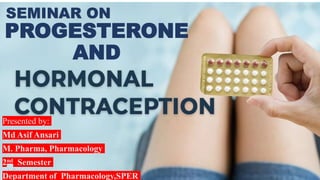
PROGESTERONE
AND
Presented by:
Md Asif Ansari
M. Pharma, Pharmacology
2nd Semester
Department of Pharmacology,SPER
1
SEMINAR ON
PRESENTATION OUTLINE
• INTRODUCTION
• NATURAL PROGESTIN
• SYNTHETHIC PROGESTIN
• PHYSIOLOGICAL ACTIONS
• MECHANISM OF ACTION
• USES
• ADVERSE EFFECTS
• ANTI PROGESTINS
• CONTRACEPTION
• REFERENCES
2
INTRODUCTION
• Progestins are substances which convert the estrogen primed
proliferative endometrium to secretory and maintains pregnancy.
• In addition to estrogens, progestins are important female sex
hormones. Progesterone is main hormone produced in the ovaries,
testes and the adrenal glands.
• Progestins are hormones which favors pregnancy.
3
NATURAL PROGESTIN
• PROGESTERONE (21 CARBON STEROID) is derived from cholesterol .
• It was first isolated in 1929. It is secreted by corpus luteum (10-
20mg/day) in later half of menstrual cycle under influence of LH.
• If ovum gets fertilized and implants-the blastocyst immediately starts
producing chorionic gonadotropin which is absorbed and sustains the
corpus luteum in early pregnancy. Secretion of progesterone starts
from placenta from 2nd trimester till term. 4
• Males also produce 1-5mg progesterone per day from adrenals and
testes.
[BUT ROLE IN MALES IS NOT KNOWN]
5
SYNTHETIC PROGESTINS
6
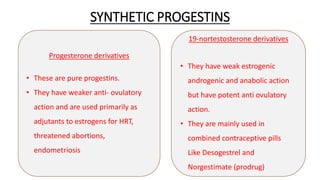
Progesterone derivatives
• These are pure progestins.
• They have weaker anti- ovulatory
action and are used primarily as
adjutants to estrogens for HRT,
threatened abortions,
endometriosis
19-nortestosterone derivatives
• They have weak estrogenic
androgenic and anabolic action
but have potent anti ovulatory
action.
• They are mainly used in
combined contraceptive pills
Like Desogestrel and
Norgestimate (prodrug)
7
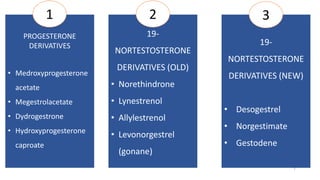
PROGESTERONE
DERIVATIVES
• Medroxyprogesterone
acetate
• Megestrolacetate
• Dydrogestrone
• Hydroxyprogesterone
caproate
19-
NORTESTOSTERONE
DERIVATIVES (NEW)
• Desogestrel
• Norgestimate
• Gestodene
19-
NORTESTOSTERONE
DERIVATIVES (OLD)
• Norethindrone
• Lynestrenol
• Allylestrenol
• Levonorgestrel
(gonane)
1 3
2
ACTIONS
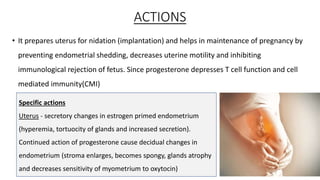
• It prepares uterus for nidation (implantation) and helps in maintenance of pregnancy by
preventing endometrial shedding, decreases uterine motility and inhibiting
immunological rejection of fetus. Since progesterone depresses T cell function and cell
mediated immunity(CMI)
8
Specific actions
Uterus - secretory changes in estrogen primed endometrium
(hyperemia, tortuocity of glands and increased secretion).
Continued action of progesterone cause decidual changes in
endometrium (stroma enlarges, becomes spongy, glands atrophy
and decreases sensitivity of myometrium to oxytocin)
• Cervix - converts watery secretion (estrogen produced) to viscid, scanty and
cellular which is hostile to sperm penetration.
• Vagina - induces pregnancy like changes in the mucosa- leukocyte
infiltration of cornified epithelium.
• Breast - it causes proliferation of acini in the mammary gland. Acting along
with estrogen which prepares the breast for lactation.
• CNS - may have sedative effect
9
• Body temperature - causes slight (0.5 C) rise in body temperature.
• Respiration - may stimulate respiration at high doses.
• Metabolism - prolonged use of OCP impairs glucose tolerance. They also
tend to raise LDL and lower HDL(i.e. 19 -nortestosterone derivatives)
• Pituitary gland - progesterone is a weak inhibitor of Gonadotrophin
secretion.
10
MECHANISM OF ACTION
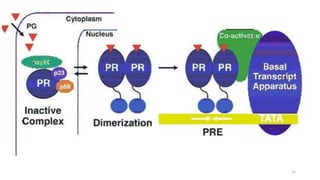
The progesterone receptors (PR) has limited distribution in the
body confined mainly to the female genital tract, breast, CNS
and pituitary. Upon hormone binding PR undergoes
dimerization, attaches to progesterone response element
(PRE) of target genes and regulate transcription through
coactivators.
11
12
PHARMACOKINETICS
• Progesterone is orally inactive because of high first pass metabolism
in liver. Hence mostly given by i.m in oily solution. i.m doses are
rapidly cleared from plasma with a short t1/2 (5-7 mins) and nearly
completely degraded in liver (major product pregnanediol excreted in
urine as glucuronide and sulphate conjugates). However the effects of
progesterone lasts longer.
13
• Micronized formulation has been developed for oral administration
which contains micro fine particles of progesterone suspended in oil
and dispensed in gelatin capsules. Its absorption occurs through
lymphatics.
• Most synthetic progestins are orally active, metabolized slowly, and
have plasma t1/2 btw 8-24hrs.
14
ADVERSE EFFECTS
• Breast engorgement, head ache, rise in body temp, edema, esophageal
reflex, acne and mood swings may occur with higher doses.
• Irregular bleeding (amenorrhoea) may occur if given continuously.
• Long term use in HRT may increase risk of breast cancer Blood sugar may
rise and diabetes may be precipitated by long term use
(levonorgestrel)Intramuscular injections of progesterone are painful
• If given in early pregnancy they can cause masculinization of female foetus
or other congenital abnormalities.
15
USES
• As contraceptive- postcoital contraceptive (mifepristone- 600mg within
72hrs), once a month contraceptive (mifepristone- 200mg 2 days after mid
cycle)
• Hormone replacement therapy (HRT)-used in non- hysterectomised post
menopausal women estrogen therapy is supplemented with a progestin for
10-12 days each month to reduce the risk of endometrial carcinoma
• DUB (dysfunctional uterine bleeding) - progestin in large dose
(norethindrone 20-40mg/day) promptly stops the bleeding and keeps it
abeyance as long as thearpy is given Cyclic treatment regularizes and
normalizes menstrual flow. 16
• Threatened habitual abortion - a pure progestin without estrogenic or androgenic
activity may show efficacy in preventing premature delivery in high risk pregnancy.
• Endometriosis- mainly manifests as dysmenorrhea, painful pelvic swellings and
infertility. Progestin's induce anovulatory hypoestrogenic state by suppressing Gn
release. Direct action on endometrium prevents bleeding from the ectopic sites by
suppressing menstruation.
• Premenstrual syndrome - manifested as headache ,irritability, fluid retention,
distension and breast tenderness a few days preceding menstruation.
• Endometrial carcinoma - progestin's are palliative in about 50% cases of advanced
or metastatic endometrial carcinoma.
17
ANTIPROGESTINS
• The antiprogestin (mifepristone) is available for the termination of
pregnancy.
• Antiprogestins have several other potential applications, including
uses as
Contraceptives
to induce labor
treat uterine leiomyomas
Endometriosis
Meningiomas
breast cancer. 18
THERAPEUTIC USES
• Mifepristone (MIFEPREX) is used to terminate early pregnancy.
• A prostaglandin (eg, intramuscular sulprostone, intravaginal gemeprost, or
oral misoprostol) is given 48 hours after the mifepristone (600mg oral) to
ensure expulsion of the detached blastocyst.
• The success rate with such regimens is 90% among women with
pregnancies of 7 weeks duration.
• Side effects : failed abortion, prolonged bleeding, vomiting,etc
19
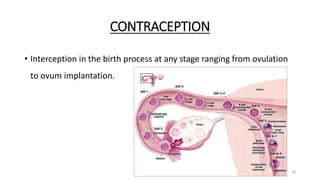
CONTRACEPTION
• Interception in the birth process at any stage ranging from ovulation
to ovum implantation.
20
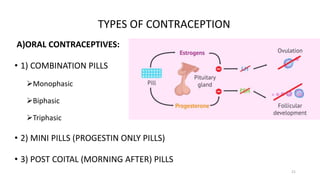
TYPES OF CONTRACEPTION
A)ORAL CONTRACEPTIVES:
• 1) COMBINATION PILLS
Monophasic
Biphasic
Triphasic
• 2) MINI PILLS (PROGESTIN ONLY PILLS)
• 3) POST COITAL (MORNING AFTER) PILLS
21
B) INJECTABLE CONTRACEPTIVES:
• 1) ESTRADIOL VALARATE+17-HYDROXYPROGESTERONE CAPROATE
• 2) ESTRADIOL CYPIONATE+MEDROXYPROGESTERONE ACETATE
• 3) DEPOT MEDROXYPROGESTERONE ACETATEC)
C) RECENT CONTRACEPTIVE METHODS:
• LEVONORGESTREL subcutaneous implant
• LEVONORGESTREL intrauterine inserts
22
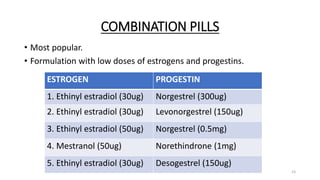
COMBINATION PILLS
• Most popular.
• Formulation with low doses of estrogens and progestins.
23
ESTROGEN PROGESTIN
1. Ethinyl estradiol (30ug) Norgestrel (300ug)
2. Ethinyl estradiol (30ug) Levonorgestrel (150ug)
3. Ethinyl estradiol (50ug) Norgestrel (0.5mg)
4. Mestranol (50ug) Norethindrone (1mg)
5. Ethinyl estradiol (30ug) Desogestrel (150ug)
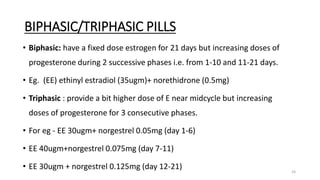
BIPHASIC/TRIPHASIC PILLS
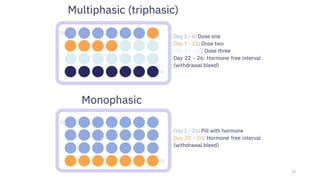
• Biphasic: have a fixed dose estrogen for 21 days but increasing doses of
progesterone during 2 successive phases i.e. from 1-10 and 11-21 days.
• Eg. (EE) ethinyl estradiol (35ugm)+ norethidrone (0.5mg)
• Triphasic : provide a bit higher dose of E near midcycle but increasing
doses of progesterone for 3 consecutive phases.
• For eg - EE 30ugm+ norgestrel 0.05mg (day 1-6)
• EE 40ugm+norgestrel 0.075mg (day 7-11)
• EE 30ugm + norgestrel 0.125mg (day 12-21) 24
25
26
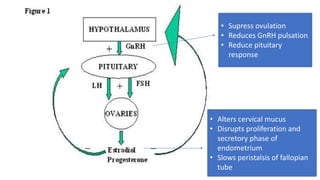
• Supress ovulation
• Reduces GnRH pulsation
• Reduce pituitary
response
• Alters cervical mucus
• Disrupts proliferation and
secretory phase of
endometrium
• Slows peristalsis of fallopian
tube
Minipill (progestin only pill)
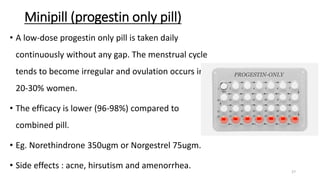
• A low-dose progestin only pill is taken daily
continuously without any gap. The menstrual cycle
tends to become irregular and ovulation occurs in
20-30% women.
• The efficacy is lower (96-98%) compared to
combined pill.
• Eg. Norethindrone 350ugm or Norgestrel 75ugm.
• Side effects : acne, hirsutism and amenorrhea.
27
Postcoital (emergency) contraception
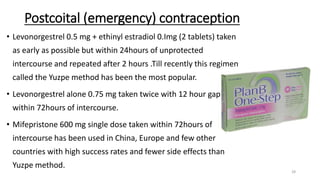
• Levonorgestrel 0.5 mg + ethinyl estradiol 0.Img (2 tablets) taken
as early as possible but within 24hours of unprotected
intercourse and repeated after 2 hours .Till recently this regimen
called the Yuzpe method has been the most popular.
• Levonorgestrel alone 0.75 mg taken twice with 12 hour gap
within 72hours of intercourse.
• Mifepristone 600 mg single dose taken within 72hours of
intercourse has been used in China, Europe and few other
countries with high success rates and fewer side effects than
Yuzpe method.
28
INJECTABLES
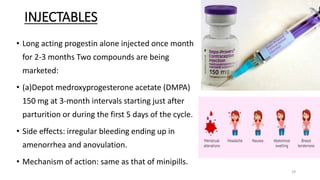
• Long acting progestin alone injected once month
for 2-3 months Two compounds are being
marketed:
• (a)Depot medroxyprogesterone acetate (DMPA)
150 mg at 3-month intervals starting just after
parturition or during the first 5 days of the cycle.
• Side effects: irregular bleeding ending up in
amenorrhea and anovulation.
• Mechanism of action: same as that of minipills.
29
RECENT CONTRACEPTIVE METHODS
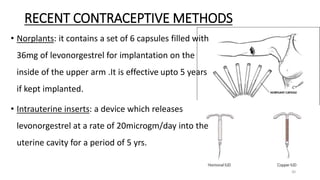
• Norplants: it contains a set of 6 capsules filled with
36mg of levonorgestrel for implantation on the
inside of the upper arm .It is effective upto 5 years
if kept implanted.
• Intrauterine inserts: a device which releases
levonorgestrel at a rate of 20microgm/day into the
uterine cavity for a period of 5 yrs.
30
REFERENCES
i. ESSENTIALS OF MEDICAL PHARMACOLOGY BY KD TRIPATHI.,8TH EDITION ,
JAYPEE BROTHERS MEDICAL PUBLISHERS PVT. LTD.,2019
ii. GOODMAN AND GILLMAN, THE PHARMACOLOGICAL BASIS OF
THERAPEUTICS,13TH EDITION McGRAW - HILL EDUCATION ,2018
iii. RANG AND DALE’S PHARMACOLOGY, BY HP RANG,JM RITTER,RJ FLOWER AND
G.HENDERSON , 8TH EDITION ,ELSEVIER LTD. , 2016
iv. GOOGLE PHOTOS
31

progesterone receptor.pptx

  • 1.
    PROGESTERONE AND Presented by: Md AsifAnsari M. Pharma, Pharmacology 2nd Semester Department of Pharmacology,SPER 1 SEMINAR ON
  • 2.
    PRESENTATION OUTLINE • INTRODUCTION •NATURAL PROGESTIN • SYNTHETHIC PROGESTIN • PHYSIOLOGICAL ACTIONS • MECHANISM OF ACTION • USES • ADVERSE EFFECTS • ANTI PROGESTINS • CONTRACEPTION • REFERENCES 2
  • 3.
    INTRODUCTION • Progestins aresubstances which convert the estrogen primed proliferative endometrium to secretory and maintains pregnancy. • In addition to estrogens, progestins are important female sex hormones. Progesterone is main hormone produced in the ovaries, testes and the adrenal glands. • Progestins are hormones which favors pregnancy. 3
  • 4.
    NATURAL PROGESTIN • PROGESTERONE(21 CARBON STEROID) is derived from cholesterol . • It was first isolated in 1929. It is secreted by corpus luteum (10- 20mg/day) in later half of menstrual cycle under influence of LH. • If ovum gets fertilized and implants-the blastocyst immediately starts producing chorionic gonadotropin which is absorbed and sustains the corpus luteum in early pregnancy. Secretion of progesterone starts from placenta from 2nd trimester till term. 4
  • 5.
    • Males alsoproduce 1-5mg progesterone per day from adrenals and testes. [BUT ROLE IN MALES IS NOT KNOWN] 5
  • 6.
    SYNTHETIC PROGESTINS 6 Progesterone derivatives •These are pure progestins. • They have weaker anti- ovulatory action and are used primarily as adjutants to estrogens for HRT, threatened abortions, endometriosis 19-nortestosterone derivatives • They have weak estrogenic androgenic and anabolic action but have potent anti ovulatory action. • They are mainly used in combined contraceptive pills Like Desogestrel and Norgestimate (prodrug)
  • 7.
    7 PROGESTERONE DERIVATIVES • Medroxyprogesterone acetate • Megestrolacetate •Dydrogestrone • Hydroxyprogesterone caproate 19- NORTESTOSTERONE DERIVATIVES (NEW) • Desogestrel • Norgestimate • Gestodene 19- NORTESTOSTERONE DERIVATIVES (OLD) • Norethindrone • Lynestrenol • Allylestrenol • Levonorgestrel (gonane) 1 3 2
  • 8.
    ACTIONS • It preparesuterus for nidation (implantation) and helps in maintenance of pregnancy by preventing endometrial shedding, decreases uterine motility and inhibiting immunological rejection of fetus. Since progesterone depresses T cell function and cell mediated immunity(CMI) 8 Specific actions Uterus - secretory changes in estrogen primed endometrium (hyperemia, tortuocity of glands and increased secretion). Continued action of progesterone cause decidual changes in endometrium (stroma enlarges, becomes spongy, glands atrophy and decreases sensitivity of myometrium to oxytocin)
  • 9.
    • Cervix -converts watery secretion (estrogen produced) to viscid, scanty and cellular which is hostile to sperm penetration. • Vagina - induces pregnancy like changes in the mucosa- leukocyte infiltration of cornified epithelium. • Breast - it causes proliferation of acini in the mammary gland. Acting along with estrogen which prepares the breast for lactation. • CNS - may have sedative effect 9
  • 10.
    • Body temperature- causes slight (0.5 C) rise in body temperature. • Respiration - may stimulate respiration at high doses. • Metabolism - prolonged use of OCP impairs glucose tolerance. They also tend to raise LDL and lower HDL(i.e. 19 -nortestosterone derivatives) • Pituitary gland - progesterone is a weak inhibitor of Gonadotrophin secretion. 10
  • 11.
    MECHANISM OF ACTION Theprogesterone receptors (PR) has limited distribution in the body confined mainly to the female genital tract, breast, CNS and pituitary. Upon hormone binding PR undergoes dimerization, attaches to progesterone response element (PRE) of target genes and regulate transcription through coactivators. 11
  • 12.
  • 13.
    PHARMACOKINETICS • Progesterone isorally inactive because of high first pass metabolism in liver. Hence mostly given by i.m in oily solution. i.m doses are rapidly cleared from plasma with a short t1/2 (5-7 mins) and nearly completely degraded in liver (major product pregnanediol excreted in urine as glucuronide and sulphate conjugates). However the effects of progesterone lasts longer. 13
  • 14.
    • Micronized formulationhas been developed for oral administration which contains micro fine particles of progesterone suspended in oil and dispensed in gelatin capsules. Its absorption occurs through lymphatics. • Most synthetic progestins are orally active, metabolized slowly, and have plasma t1/2 btw 8-24hrs. 14
  • 15.
    ADVERSE EFFECTS • Breastengorgement, head ache, rise in body temp, edema, esophageal reflex, acne and mood swings may occur with higher doses. • Irregular bleeding (amenorrhoea) may occur if given continuously. • Long term use in HRT may increase risk of breast cancer Blood sugar may rise and diabetes may be precipitated by long term use (levonorgestrel)Intramuscular injections of progesterone are painful • If given in early pregnancy they can cause masculinization of female foetus or other congenital abnormalities. 15
  • 16.
    USES • As contraceptive-postcoital contraceptive (mifepristone- 600mg within 72hrs), once a month contraceptive (mifepristone- 200mg 2 days after mid cycle) • Hormone replacement therapy (HRT)-used in non- hysterectomised post menopausal women estrogen therapy is supplemented with a progestin for 10-12 days each month to reduce the risk of endometrial carcinoma • DUB (dysfunctional uterine bleeding) - progestin in large dose (norethindrone 20-40mg/day) promptly stops the bleeding and keeps it abeyance as long as thearpy is given Cyclic treatment regularizes and normalizes menstrual flow. 16
  • 17.
    • Threatened habitualabortion - a pure progestin without estrogenic or androgenic activity may show efficacy in preventing premature delivery in high risk pregnancy. • Endometriosis- mainly manifests as dysmenorrhea, painful pelvic swellings and infertility. Progestin's induce anovulatory hypoestrogenic state by suppressing Gn release. Direct action on endometrium prevents bleeding from the ectopic sites by suppressing menstruation. • Premenstrual syndrome - manifested as headache ,irritability, fluid retention, distension and breast tenderness a few days preceding menstruation. • Endometrial carcinoma - progestin's are palliative in about 50% cases of advanced or metastatic endometrial carcinoma. 17
  • 18.
    ANTIPROGESTINS • The antiprogestin(mifepristone) is available for the termination of pregnancy. • Antiprogestins have several other potential applications, including uses as Contraceptives to induce labor treat uterine leiomyomas Endometriosis Meningiomas breast cancer. 18
  • 19.
    THERAPEUTIC USES • Mifepristone(MIFEPREX) is used to terminate early pregnancy. • A prostaglandin (eg, intramuscular sulprostone, intravaginal gemeprost, or oral misoprostol) is given 48 hours after the mifepristone (600mg oral) to ensure expulsion of the detached blastocyst. • The success rate with such regimens is 90% among women with pregnancies of 7 weeks duration. • Side effects : failed abortion, prolonged bleeding, vomiting,etc 19
  • 20.
    CONTRACEPTION • Interception inthe birth process at any stage ranging from ovulation to ovum implantation. 20
  • 21.
    TYPES OF CONTRACEPTION A)ORALCONTRACEPTIVES: • 1) COMBINATION PILLS Monophasic Biphasic Triphasic • 2) MINI PILLS (PROGESTIN ONLY PILLS) • 3) POST COITAL (MORNING AFTER) PILLS 21
  • 22.
    B) INJECTABLE CONTRACEPTIVES: •1) ESTRADIOL VALARATE+17-HYDROXYPROGESTERONE CAPROATE • 2) ESTRADIOL CYPIONATE+MEDROXYPROGESTERONE ACETATE • 3) DEPOT MEDROXYPROGESTERONE ACETATEC) C) RECENT CONTRACEPTIVE METHODS: • LEVONORGESTREL subcutaneous implant • LEVONORGESTREL intrauterine inserts 22
  • 23.
    COMBINATION PILLS • Mostpopular. • Formulation with low doses of estrogens and progestins. 23 ESTROGEN PROGESTIN 1. Ethinyl estradiol (30ug) Norgestrel (300ug) 2. Ethinyl estradiol (30ug) Levonorgestrel (150ug) 3. Ethinyl estradiol (50ug) Norgestrel (0.5mg) 4. Mestranol (50ug) Norethindrone (1mg) 5. Ethinyl estradiol (30ug) Desogestrel (150ug)
  • 24.
    BIPHASIC/TRIPHASIC PILLS • Biphasic:have a fixed dose estrogen for 21 days but increasing doses of progesterone during 2 successive phases i.e. from 1-10 and 11-21 days. • Eg. (EE) ethinyl estradiol (35ugm)+ norethidrone (0.5mg) • Triphasic : provide a bit higher dose of E near midcycle but increasing doses of progesterone for 3 consecutive phases. • For eg - EE 30ugm+ norgestrel 0.05mg (day 1-6) • EE 40ugm+norgestrel 0.075mg (day 7-11) • EE 30ugm + norgestrel 0.125mg (day 12-21) 24
  • 25.
  • 26.
    26 • Supress ovulation •Reduces GnRH pulsation • Reduce pituitary response • Alters cervical mucus • Disrupts proliferation and secretory phase of endometrium • Slows peristalsis of fallopian tube
  • 27.
    Minipill (progestin onlypill) • A low-dose progestin only pill is taken daily continuously without any gap. The menstrual cycle tends to become irregular and ovulation occurs in 20-30% women. • The efficacy is lower (96-98%) compared to combined pill. • Eg. Norethindrone 350ugm or Norgestrel 75ugm. • Side effects : acne, hirsutism and amenorrhea. 27
  • 28.
    Postcoital (emergency) contraception •Levonorgestrel 0.5 mg + ethinyl estradiol 0.Img (2 tablets) taken as early as possible but within 24hours of unprotected intercourse and repeated after 2 hours .Till recently this regimen called the Yuzpe method has been the most popular. • Levonorgestrel alone 0.75 mg taken twice with 12 hour gap within 72hours of intercourse. • Mifepristone 600 mg single dose taken within 72hours of intercourse has been used in China, Europe and few other countries with high success rates and fewer side effects than Yuzpe method. 28
  • 29.
    INJECTABLES • Long actingprogestin alone injected once month for 2-3 months Two compounds are being marketed: • (a)Depot medroxyprogesterone acetate (DMPA) 150 mg at 3-month intervals starting just after parturition or during the first 5 days of the cycle. • Side effects: irregular bleeding ending up in amenorrhea and anovulation. • Mechanism of action: same as that of minipills. 29
  • 30.
    RECENT CONTRACEPTIVE METHODS •Norplants: it contains a set of 6 capsules filled with 36mg of levonorgestrel for implantation on the inside of the upper arm .It is effective upto 5 years if kept implanted. • Intrauterine inserts: a device which releases levonorgestrel at a rate of 20microgm/day into the uterine cavity for a period of 5 yrs. 30
  • 31.
    REFERENCES i. ESSENTIALS OFMEDICAL PHARMACOLOGY BY KD TRIPATHI.,8TH EDITION , JAYPEE BROTHERS MEDICAL PUBLISHERS PVT. LTD.,2019 ii. GOODMAN AND GILLMAN, THE PHARMACOLOGICAL BASIS OF THERAPEUTICS,13TH EDITION McGRAW - HILL EDUCATION ,2018 iii. RANG AND DALE’S PHARMACOLOGY, BY HP RANG,JM RITTER,RJ FLOWER AND G.HENDERSON , 8TH EDITION ,ELSEVIER LTD. , 2016 iv. GOOGLE PHOTOS 31