Objective Of Project
• Our objective is to make this device simple as well as
cheap so that it could be mass produced and can be used
for a number of purposes
MotivationFor Project
• Our motivation to work on this project came from a disabled
person who was driving his wheel chair by hand with quite a
lot of difficulty. So we wanted to make a device which would
help such people drive their chairs without even having the
need to touch the wheels of their chairs.
Introduction
• Recently, strong efforts have been carried out to
develop intelligent and natural interfaces
• between users and computer based systems based on
human gestures.
• Gestures provide an
• intuitive interface to both human and computer. Thus,
such gesture
• based interfaces can not only
• substitute the common interface devices, but can also
be exploited to extend their functionality.
Robot
• A robot is usually an electro-mechanical machine that can
perform tasks automatically. Some robots require some
degree of guidance, which may be done using a remote
control or with a computer interface. Robots can be
autonomous, semi-autonomous or remotely controlled.
Robots have evolved so much and are capable of mimicking
humans that they seem to have a mind of their own.
Human Machine Interaction
• An important aspect of a successful robotic system is the
Human-Machine interaction. In the early years the only way
to communicate with a robot was to program which required
extensive hard work. With the development in science and
robotics, gesture based recognition came into life. Gestures
originate from any bodily motion or state but commonly
originate from the face or hand. Gesture recognition can be
considered as a way for computer to understand human
body language. This has minimized the need for text
interfaces and GUIs (Graphical User Interface).
Gesture
• A gesture is an action that has to be seen by someone else
and has to convey some piece of information. Gesture is
usually considered as a movement of part of the body, esp. a
hand or the head, to express an idea or meaning.
Material Required
1. For transmitter-
• Arduino Uno
• ADXL335 accelerometer
• 433 MHz RF transmitter
• Breadboard
• Of course you will also need
jumper wires and 9V batteries
• 2. For receiver and
robot-
• Arduino Uno
• 433 MHz RF receiver
• L293D motor driver IC
• Chassis and wheels
• 2 DC motors
• Breadboard
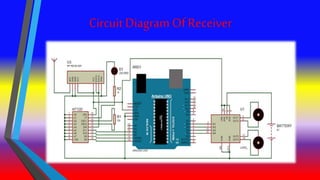
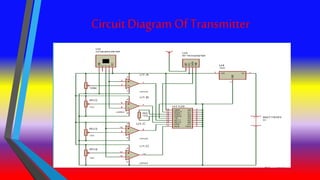
We will divide entire robot into three parts are transmitter, receiver and
the programmable robot
CircuitDiagram Of Receiver
Circuit Diagram Of Transmitter
Working Principle
• Our gesture controlled robot works on the principle of
accelerometer which records hand movements and sends
that data to the comparator which assigns proper voltage
levels to the recorded movements. That information is then
transferred to a encoder which makes it ready for RF
transmission. On the receiving end, the information is
received wirelessly via RF, decoded and then passed onto the
microcontroller which takes various decisions based on the
received information. These decisions are passed to the
motor driver ic which triggers the motors in different
configurations to make the robot move in a specific
direction. With the help block diagram to understand the
working of the robot:
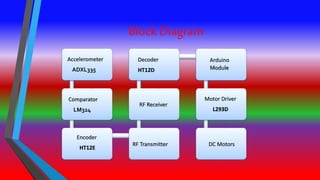
Block Diagram
Accelerometer
ADXL335
Comparator
LM324
Encoder
HT12E
RF Transmitter
RF Receiver
Decoder
HT12D
Arduino
Module
Motor Driver
L293D
DC Motors
IntroductionTo Arduino
- Based on AVR microcontrollers that are
widely popular for their RISC architecture,
high flash memory, inbuilt different features
- Arduino Uses C and C++ programming(E A S Y)……
Introduction To Arduino
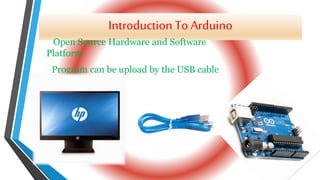
Open Source Hardware and Software
Platform
Program can be upload by the USB cable
What is Arduino?
A microcontroller board, contains on-board power
supply, USB port to communicate with PC, and an Atmel
microcontroller chip.
It simplify the process of creating any control system by
providing the standard board that can be programmed
and connected to the system without the need to any
sophisticated PCB design and implementation.
It is an open source hardware, any one can get the details
of its design and modify it or make his own one himself.
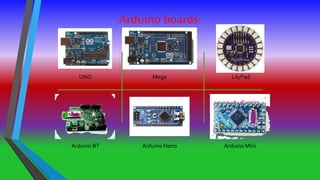
Arduinoboards:
UNO Mega LilyPad
Arduino BT Arduino Nano Arduino Mini
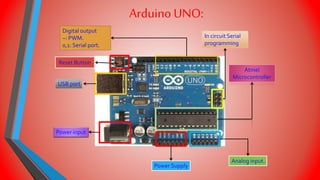
ArduinoUNO:
Digital output
~: PWM.
0,1: Serial port.
In circuit Serial
programming
Atmel
Microcontroller
Analog input.
Power Supply
USB port
Power input
Reset Button
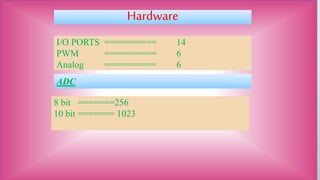
Hardware
I/O PORTS ========== 14
PWM ========== 6
Analog ========== 6
8 bit =======256
10 bit ======= 1023
ADC
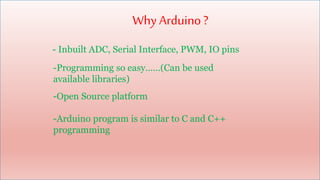
Why Arduino?
- Inbuilt ADC, Serial Interface, PWM, IO pins
-Programming so easy……(Can be used
available libraries)
-Open Source platform
-Arduino program is similar to C and C++
programming
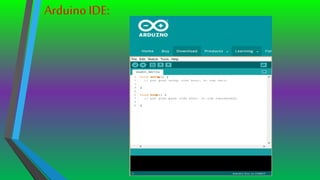
ArduinoIDE:
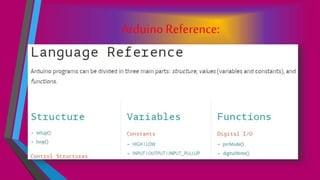
ArduinoReference:
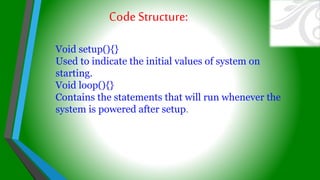
Void setup(){}
Used to indicate the initial values of system on
starting.
Void loop(){}
Contains the statements that will run whenever the
system is powered after setup.
CodeStructure:
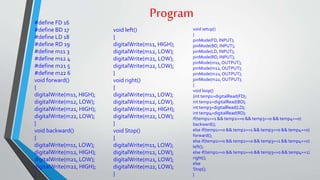
Program#define FD 16
#define BD 17
#define LD 18
#define RD 19
#define m11 3
#define m12 4
#define m21 5
#define m22 6
void forward()
{
digitalWrite(m11, HIGH);
digitalWrite(m12, LOW);
digitalWrite(m21, HIGH);
digitalWrite(m22, LOW);
}
void backward()
{
digitalWrite(m11, LOW);
digitalWrite(m12, HIGH);
digitalWrite(m21, LOW);
digitalWrite(m22, HIGH);
}
void left()
{
digitalWrite(m11, HIGH);
digitalWrite(m12, LOW);
digitalWrite(m21, LOW);
digitalWrite(m22, LOW);
}
void right()
{
digitalWrite(m11, LOW);
digitalWrite(m12, LOW);
digitalWrite(m21, HIGH);
digitalWrite(m22, LOW);
}
void Stop()
{
digitalWrite(m11, LOW);
digitalWrite(m12, LOW);
digitalWrite(m21, LOW);
digitalWrite(m22, LOW);
}
void setup()
{
pinMode(FD, INPUT);
pinMode(BD, INPUT);
pinMode(LD, INPUT);
pinMode(RD, INPUT);
pinMode(m11, OUTPUT);
pinMode(m12,OUTPUT);
pinMode(m21,OUTPUT);
pinMode(m22,OUTPUT);
}
void loop()
{int temp1=digitalRead(FD);
int temp2=digitalRead(BD);
int temp3=digitalRead(LD);
int temp4=digitalRead(RD);
if(temp1==1 && temp2==0 && temp3==0 && temp4==0)
backward();
else if(temp1==0 && temp2==1 && temp3==0 && temp4==0)
forward();
else if(temp1==0 && temp2==0 && temp3==1 && temp4==0)
left();
else if(temp1==0 && temp2==0 && temp3==0 && temp4==1)
right();
else
Stop();
}
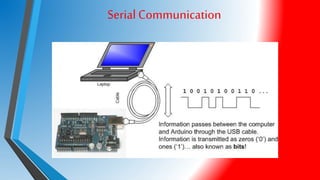
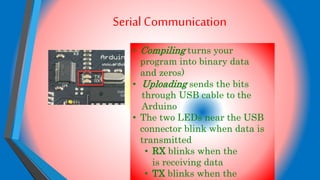
Serial Communication
• Compiling turns your
program into binary data
and zeros)
• Uploading sends the bits
through USB cable to the
Arduino
• The two LEDs near the USB
connector blink when data is
transmitted
• RX blinks when the
is receiving data
• TX blinks when the
APPLICATIONS
• Through the use of gesture recognition, remote control with the wave
of a hand of various devices is possible.
• Gesture controlling is very helpful for handicapped and physically
disabled people to achieve certain tasks, such as driving a vehicle.
• Gestures can be used to control interactions for entertainment
purposes such as gaming to make the game player's experience more
interactive or immersive.
CONCLUSION
We achieved our objective without any hurdles i.e. the control of a
robot using gestures. The robot is showing proper responses whenever
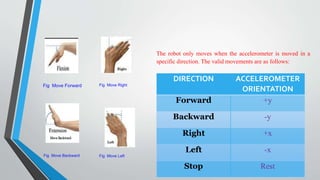
we move our hand. Different Hand gestures to make the robot move in
specific directions are as follow:
Fig Move Forward
Fig Move Backward
Fig Move Right
Fig Move Left
The robot only moves when the accelerometer is moved in a
specific direction. The valid movements are as follows:
DIRECTION ACCELEROMETER
ORIENTATION
Forward +y
Backward -y
Right +x
Left -x
Stop Rest
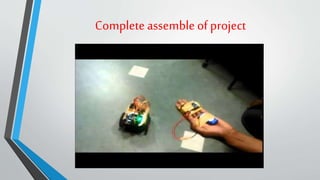
Completeassembleof project
Gesture control robot using by Ardiuno

Gesture control robot using by Ardiuno

  • 3.
    Objective Of Project •Our objective is to make this device simple as well as cheap so that it could be mass produced and can be used for a number of purposes
  • 4.
    MotivationFor Project • Ourmotivation to work on this project came from a disabled person who was driving his wheel chair by hand with quite a lot of difficulty. So we wanted to make a device which would help such people drive their chairs without even having the need to touch the wheels of their chairs.
  • 5.
    Introduction • Recently, strongefforts have been carried out to develop intelligent and natural interfaces • between users and computer based systems based on human gestures. • Gestures provide an • intuitive interface to both human and computer. Thus, such gesture • based interfaces can not only • substitute the common interface devices, but can also be exploited to extend their functionality.
  • 6.
    Robot • A robotis usually an electro-mechanical machine that can perform tasks automatically. Some robots require some degree of guidance, which may be done using a remote control or with a computer interface. Robots can be autonomous, semi-autonomous or remotely controlled. Robots have evolved so much and are capable of mimicking humans that they seem to have a mind of their own.
  • 7.
    Human Machine Interaction •An important aspect of a successful robotic system is the Human-Machine interaction. In the early years the only way to communicate with a robot was to program which required extensive hard work. With the development in science and robotics, gesture based recognition came into life. Gestures originate from any bodily motion or state but commonly originate from the face or hand. Gesture recognition can be considered as a way for computer to understand human body language. This has minimized the need for text interfaces and GUIs (Graphical User Interface).
  • 8.
    Gesture • A gestureis an action that has to be seen by someone else and has to convey some piece of information. Gesture is usually considered as a movement of part of the body, esp. a hand or the head, to express an idea or meaning.
  • 9.
    Material Required 1. Fortransmitter- • Arduino Uno • ADXL335 accelerometer • 433 MHz RF transmitter • Breadboard • Of course you will also need jumper wires and 9V batteries • 2. For receiver and robot- • Arduino Uno • 433 MHz RF receiver • L293D motor driver IC • Chassis and wheels • 2 DC motors • Breadboard We will divide entire robot into three parts are transmitter, receiver and the programmable robot
  • 10.
  • 11.
    Circuit Diagram OfTransmitter
  • 12.
    Working Principle • Ourgesture controlled robot works on the principle of accelerometer which records hand movements and sends that data to the comparator which assigns proper voltage levels to the recorded movements. That information is then transferred to a encoder which makes it ready for RF transmission. On the receiving end, the information is received wirelessly via RF, decoded and then passed onto the microcontroller which takes various decisions based on the received information. These decisions are passed to the motor driver ic which triggers the motors in different configurations to make the robot move in a specific direction. With the help block diagram to understand the working of the robot:
  • 13.
    Block Diagram Accelerometer ADXL335 Comparator LM324 Encoder HT12E RF Transmitter RFReceiver Decoder HT12D Arduino Module Motor Driver L293D DC Motors
  • 14.
    IntroductionTo Arduino - Basedon AVR microcontrollers that are widely popular for their RISC architecture, high flash memory, inbuilt different features - Arduino Uses C and C++ programming(E A S Y)……
  • 15.
    Introduction To Arduino OpenSource Hardware and Software Platform Program can be upload by the USB cable
  • 16.
    What is Arduino? Amicrocontroller board, contains on-board power supply, USB port to communicate with PC, and an Atmel microcontroller chip. It simplify the process of creating any control system by providing the standard board that can be programmed and connected to the system without the need to any sophisticated PCB design and implementation. It is an open source hardware, any one can get the details of its design and modify it or make his own one himself.
  • 17.
    Arduinoboards: UNO Mega LilyPad ArduinoBT Arduino Nano Arduino Mini
  • 18.
    ArduinoUNO: Digital output ~: PWM. 0,1:Serial port. In circuit Serial programming Atmel Microcontroller Analog input. Power Supply USB port Power input Reset Button
  • 19.
    Hardware I/O PORTS ==========14 PWM ========== 6 Analog ========== 6 8 bit =======256 10 bit ======= 1023 ADC
  • 20.
    Why Arduino? - InbuiltADC, Serial Interface, PWM, IO pins -Programming so easy……(Can be used available libraries) -Open Source platform -Arduino program is similar to C and C++ programming
  • 21.
  • 22.
  • 23.
    Void setup(){} Used toindicate the initial values of system on starting. Void loop(){} Contains the statements that will run whenever the system is powered after setup. CodeStructure:
  • 24.
    Program#define FD 16 #defineBD 17 #define LD 18 #define RD 19 #define m11 3 #define m12 4 #define m21 5 #define m22 6 void forward() { digitalWrite(m11, HIGH); digitalWrite(m12, LOW); digitalWrite(m21, HIGH); digitalWrite(m22, LOW); } void backward() { digitalWrite(m11, LOW); digitalWrite(m12, HIGH); digitalWrite(m21, LOW); digitalWrite(m22, HIGH); } void left() { digitalWrite(m11, HIGH); digitalWrite(m12, LOW); digitalWrite(m21, LOW); digitalWrite(m22, LOW); } void right() { digitalWrite(m11, LOW); digitalWrite(m12, LOW); digitalWrite(m21, HIGH); digitalWrite(m22, LOW); } void Stop() { digitalWrite(m11, LOW); digitalWrite(m12, LOW); digitalWrite(m21, LOW); digitalWrite(m22, LOW); } void setup() { pinMode(FD, INPUT); pinMode(BD, INPUT); pinMode(LD, INPUT); pinMode(RD, INPUT); pinMode(m11, OUTPUT); pinMode(m12,OUTPUT); pinMode(m21,OUTPUT); pinMode(m22,OUTPUT); } void loop() {int temp1=digitalRead(FD); int temp2=digitalRead(BD); int temp3=digitalRead(LD); int temp4=digitalRead(RD); if(temp1==1 && temp2==0 && temp3==0 && temp4==0) backward(); else if(temp1==0 && temp2==1 && temp3==0 && temp4==0) forward(); else if(temp1==0 && temp2==0 && temp3==1 && temp4==0) left(); else if(temp1==0 && temp2==0 && temp3==0 && temp4==1) right(); else Stop(); }
  • 25.
  • 26.
    Serial Communication • Compilingturns your program into binary data and zeros) • Uploading sends the bits through USB cable to the Arduino • The two LEDs near the USB connector blink when data is transmitted • RX blinks when the is receiving data • TX blinks when the
  • 27.
    APPLICATIONS • Through theuse of gesture recognition, remote control with the wave of a hand of various devices is possible. • Gesture controlling is very helpful for handicapped and physically disabled people to achieve certain tasks, such as driving a vehicle. • Gestures can be used to control interactions for entertainment purposes such as gaming to make the game player's experience more interactive or immersive.
  • 28.
    CONCLUSION We achieved ourobjective without any hurdles i.e. the control of a robot using gestures. The robot is showing proper responses whenever we move our hand. Different Hand gestures to make the robot move in specific directions are as follow:
  • 29.
    Fig Move Forward FigMove Backward Fig Move Right Fig Move Left The robot only moves when the accelerometer is moved in a specific direction. The valid movements are as follows: DIRECTION ACCELEROMETER ORIENTATION Forward +y Backward -y Right +x Left -x Stop Rest
  • 30.