Servo motor controller
Using Arduino
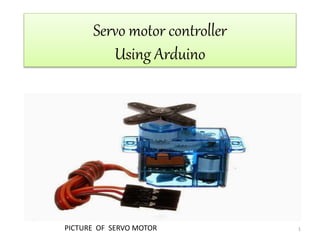
1PICTURE OF SERVO MOTOR
PRESENTED BY:-
JITENDRA SUWASIYA (2013/IEE/001)
AMIT KUMAR (2013/IEE/036)
ANIL KUMAR (2013/IEE/042)
GUIDED BY:-
Mr, Bishnu mohan Jha sir
2
Introduction to Arduino
Arduino is an open-source prototyping platform
based on easy-to-use hardware & software and
are able to read Inputs.
 Arduino Boards has mainly 3 types of signal
ports:
• (i)Digital ports : means something is either on or
off
• (ii)Analog ports : means it can have a continuous
range of values.
• (iii)Power ports : it provides the power supply.
3
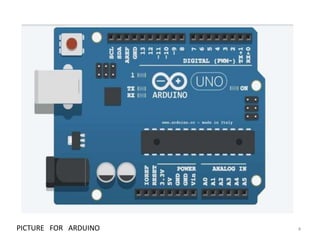
4PICTURE FOR ARDUINO
Introduction to Servo Motors Control &
Arduino
A servo is a motor that we can command to
go to particular angle .
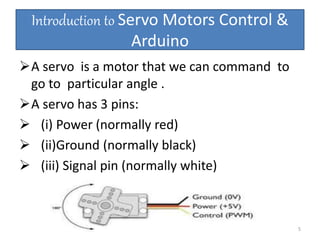
A servo has 3 pins:
 (i) Power (normally red)
 (ii)Ground (normally black)
 (iii) Signal pin (normally white)
5
 Servos are given a command of what angle to
be turn (between 0 deg. & 180 deg.) and turn
precisely to that location.
The Arduino language has support for servos
built-in which makes the servos really easy to
use.
6
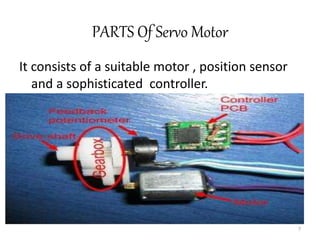
PARTS Of Servo Motor
It consists of a suitable motor , position sensor
and a sophisticated controller.
7
Working Principle Of Servo Motor
 Servo-motors are used to control position and
speed very precisely , but in a simple case ,
position may be controlled.
Mechanical position of the shaft can be sensed
by using a potentiometer , which is coupled with
the motor shaft through gears .
The current position of the shaft is converted in
to electrical signal by the potentiometer , and
compared with command input signal.
If the feedback signal differs from the given input,
an error signal is generated.
8
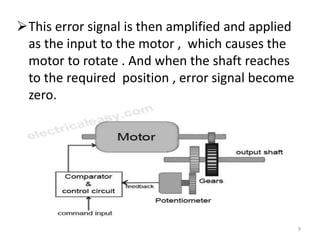
This error signal is then amplified and applied
as the input to the motor , which causes the
motor to rotate . And when the shaft reaches
to the required position , error signal become
zero.
9
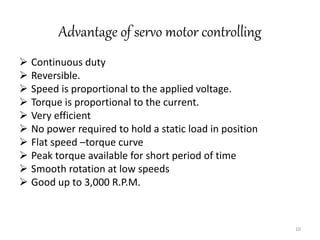
Advantage of servo motor controlling
 Continuous duty
 Reversible.
 Speed is proportional to the applied voltage.
 Torque is proportional to the current.
 Very efficient
 No power required to hold a static load in position
 Flat speed –torque curve
 Peak torque available for short period of time
 Smooth rotation at low speeds
 Good up to 3,000 R.P.M.
10
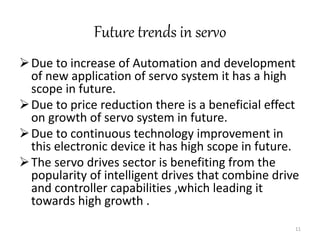
Future trends in servo
Due to increase of Automation and development
of new application of servo system it has a high
scope in future.
Due to price reduction there is a beneficial effect
on growth of servo system in future.
Due to continuous technology improvement in
this electronic device it has high scope in future.
The servo drives sector is benefiting from the
popularity of intelligent drives that combine drive
and controller capabilities ,which leading it
towards high growth .
11
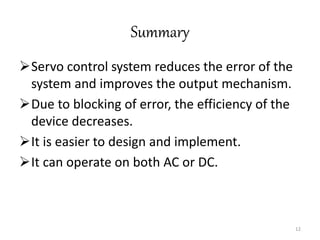
Summary
Servo control system reduces the error of the
system and improves the output mechanism.
Due to blocking of error, the efficiency of the
device decreases.
It is easier to design and implement.
It can operate on both AC or DC.
12
Reference
Introduction to servo system : By I.A. Getting.
Servo control system :By Elke Laubwald
www.uotechnology.edu.in
www.toolingu.com
Arduino software library (Programming)
13
14

SERVO MOTOR CONTROLLER

  • 1.
    Servo motor controller UsingArduino 1PICTURE OF SERVO MOTOR
  • 2.
    PRESENTED BY:- JITENDRA SUWASIYA(2013/IEE/001) AMIT KUMAR (2013/IEE/036) ANIL KUMAR (2013/IEE/042) GUIDED BY:- Mr, Bishnu mohan Jha sir 2
  • 3.
    Introduction to Arduino Arduinois an open-source prototyping platform based on easy-to-use hardware & software and are able to read Inputs.  Arduino Boards has mainly 3 types of signal ports: • (i)Digital ports : means something is either on or off • (ii)Analog ports : means it can have a continuous range of values. • (iii)Power ports : it provides the power supply. 3
  • 4.
  • 5.
    Introduction to ServoMotors Control & Arduino A servo is a motor that we can command to go to particular angle . A servo has 3 pins:  (i) Power (normally red)  (ii)Ground (normally black)  (iii) Signal pin (normally white) 5
  • 6.
     Servos aregiven a command of what angle to be turn (between 0 deg. & 180 deg.) and turn precisely to that location. The Arduino language has support for servos built-in which makes the servos really easy to use. 6
  • 7.
    PARTS Of ServoMotor It consists of a suitable motor , position sensor and a sophisticated controller. 7
  • 8.
    Working Principle OfServo Motor  Servo-motors are used to control position and speed very precisely , but in a simple case , position may be controlled. Mechanical position of the shaft can be sensed by using a potentiometer , which is coupled with the motor shaft through gears . The current position of the shaft is converted in to electrical signal by the potentiometer , and compared with command input signal. If the feedback signal differs from the given input, an error signal is generated. 8
  • 9.
    This error signalis then amplified and applied as the input to the motor , which causes the motor to rotate . And when the shaft reaches to the required position , error signal become zero. 9
  • 10.
    Advantage of servomotor controlling  Continuous duty  Reversible.  Speed is proportional to the applied voltage.  Torque is proportional to the current.  Very efficient  No power required to hold a static load in position  Flat speed –torque curve  Peak torque available for short period of time  Smooth rotation at low speeds  Good up to 3,000 R.P.M. 10
  • 11.
    Future trends inservo Due to increase of Automation and development of new application of servo system it has a high scope in future. Due to price reduction there is a beneficial effect on growth of servo system in future. Due to continuous technology improvement in this electronic device it has high scope in future. The servo drives sector is benefiting from the popularity of intelligent drives that combine drive and controller capabilities ,which leading it towards high growth . 11
  • 12.
    Summary Servo control systemreduces the error of the system and improves the output mechanism. Due to blocking of error, the efficiency of the device decreases. It is easier to design and implement. It can operate on both AC or DC. 12
  • 13.
    Reference Introduction to servosystem : By I.A. Getting. Servo control system :By Elke Laubwald www.uotechnology.edu.in www.toolingu.com Arduino software library (Programming) 13
  • 14.