STP 1101
GeophysicalApplicationsfor
GeotechnicalInvestigations
Frederick L. Paillet and Wayne R. Saunders, editors
As M
1916 Race Street
Philadelphia, PA 19103
Library of Congress Cataloging-in-PublicationData
Geophysical applications for geotechnical investigations / Frederick L. Paillet and Wayne
R. Saunders, editors.
p. cm.--(STP ; 1101)
Papers from the Symposium on Geophysical Methods for Geotechnical Investigations,
held in St. Louis, Mo., June 29, 1989, sponsored by ASTM Committee D-18 on Soil and
Rock.
"ASTM publication code number (PCN) 04-011010-38"--T.p. verso.
Includes bibliographical references and index.
ISBN 0-8031-1403-6
1. Engineering geology--Congresses, 2. Geophysics--Congresses. I. Paillet,
Frederick L., 1948- . II. Saunders, Wayne R., 1946- III. Symposium on
Geophysical Methods for Geotechnical Investigations (1989 : Si. Louis,
Mo.) IV. ASTM Committee D-18 on Soil and Rock. V. Series: ASTM special
technical publication ; 1101.
TA703.5.G45 1990
624.1 '51--dc20 90-40924
CIP
Copyright 9 by AMERICAN SOCIETY FOR TESTING AND MATERIALS 1990
NOTE
The Society is not responsible, as a body,
for the statements and opinions
advanced in this publication.
Peer Review Policy
Each paper published in this volume was evaluated by three peer reviewers. The authors
addressed all of the reviewers' comments to the satisfaction of both the technical editor(s)
and the ASTM Committee on Publications.
The quality of the papers in this publication reflects not only the obvious efforts of the
authors and the technical editor(s), but also the work of these peer reviewers. The ASTM
Committee on Publications acknowledges with appreciation their dedication and contribution
of time and effort on behalf of ASTM.
Printedin Baltimore
October 1990
Foreword
The symposium on Geophysical Methods for Geotechnical Investigations was presented
at St. Louis, Missouri, on 29 June 1989. ASTM Committee D-18 on Soil and Rock sponsored
the symposium. Frederick L. Paillet, U.S. Geological Survey, and Wayne R. Saunders,
ICF-Kaiser Inc., served as co-chairmen of the symposium and co-editors of the resulting
publication.
Contents
Overview 1
SURFACE GEOPHYSICS
Surface Geophysical Investigations for Hazardous Waste Sites--DAVID CUMMINGS 9
A Case Study of Geotomography Applied to a Detailed Investigation of a Highway
Bridge Foundation--HIDEKI SAITO, HIROMASA SHIMA, TETSUMA TOSHIOKA,
SHIN-ICHI KAINO, AND HIDEO OHTOMO 17
BOREHOLE GEOPHYSICS
Economic Considerations of Borehole Geophysics for Hazardous Waste Projects--
ROBERT E. CROWDER, LARRY A. IRONS, AND ELLIOT N. YEARSLEY 37
Estimating Water Quality from Geophysical Logs--DONALD G. JORGENSEN 47
Acoustic Waveform Logs and the In-Situ Measurement of Permeability--A
Review--DANIEL R. BURNS 65
Low-Frequency Shear Wave Logging in Unconsolidated Formations for Geotechnical
Applications--FUMIO KANEKO, TAKASHI KANEMORI, AND KEIJI TONOUCHI 79
Applications of the Thermal-Pulse Fiowmeter in the Hydraulic Characterization of
Fractured Rocks--ALFRED E. HESS AND FREDERICK L. PAILLET 99
STP1101-EB/Oct. 1990
Overview
The latest environmental concerns related to contamination from landfills and other dis-
posal sites, along with the need for improved evaluation of the mechanical properties of
soils and other geological substrates in civil engineering, have greatly increased the interest
in the application of geophysics in geotechnical investigations. Geophysics provides the
means to probe the properties of soils, sediments, and rock outcrops without costly exca-
vation. The nonintrusive sampling of geological formations is important because extensive
disturbance of these deposits could compromise the integrity of a natural geological migration
barrier or foundation site. Moreover, many physical properties of importance in engineering
such as density, porosity, permeability, and shear modulus are highly sensitive to in-situ
conditions. Relief of overburden stress, shearing, and desiccation associated with sample
retrieval can significantly alter the measured properties of sediments. On the other hand,
most geophysical methods involve the measurement of physical properties such as acoustic
velocity or electrical conductivity that are. different from those needed for engineering
studies. In the ideal situation, laboratory analysis of a finite number Of carefully extracted
samples can be used in conjunction with continuous geophysical surveys to produce a two-
or three-dimensional map of the area of interest.
More than 25 years ago, ASTM Committee D-18 on Soil and Rock indicated an interest
in geophysical methods by including several papers on both borehole and surface geophysical
applications in a symposium on Soil Exploration [1]. Even earlier (1951), ASTM Committee
D-18 sponsored a symposium on Surface and Subsurface Reconnaissance [2] in which the
subsequent STP contained 8 papers and a panel discussion related to surface geophysics
techniques and applications in engineering site investigations.
This present volume presents a series of papers originally given at the ASTM Symposium
on Geophysical Methods for Geotechnical Investigations held on 29 June 1989 in St. Louis,
Missouri. The papers were selected to provide a broad overview of the latest geophysical
techniques being applied to environmental and geotechnical engineering problems. Such
geophysical methods have traditionally been divided into those applied at the land surface
to generate two-dimensional maps of geophysical properties and those applied in boreholes
to generate one-dimensional maps, or "logs," of geophysical properties along the length of
the borehole. The two approaches yield complementary results because the geophysical well
logs provide much greater spatial resolution (usually on the order of a metre) in comparison
with the surface soundings (where resolution is on the order of 10 to 100 m). When surface
methods result in soundings plotted as a vertical cross section of the formation, geophysical
logs can be used to calibrate the depth scale in the surface-generated data section.
In the latest geophysical technology, the distinction between surface and borehole methods
has become somewhat blurred. Borehole-to-borehole and surface-to-borehole soundings are
now being used to generate three-dimensional images of the rock volume between boreholes
Copyright* 1990by ASTM International
1
www.astm.org
2 GEOPHYSICALAPPLICATIONS FOR GEOTECHNICAL INVESTIGATIONS
on spatial scales intermediate between those traditionally assigned to either surface geo-
physics or well logging. We can expect the scale disparities between surface and borehole
geophysics to become even more indistinct in the near future. The papers included in this
volume are but a sample of the many different kinds of investigations that may soon be
used to probe the properties of geological formations on scales ranging all the way from
small volumes immediately adjacent to individual boreholes to the entire rock mass con-
taining a potential repository site or building foundation.
Surface Geophysics
Surface geophysical methods provide valuable information in geotechnical studies in the
form of horizontal maps of subsurface properties or vertical profiles or "'soundings" along
sections of interest. The paper by Cummings in this volume gives a broad overview of the
various geophysical techniques applicable in studies at hazardous waste sites, but it also
serves as a useful sampling of the many techniques available for other applications. Saito
et al.'s paper gives an excellent example of the state of the art in application of both seismic
and electromagnetic (resistivity) methods to three-dimensional mapping (known in the lit-
erature as "tomography") of the properties of a volume of rock and sediment located beneath
a proposed bridge foundation.
Both of these papers demonstrate the importance of using different methods for the
investigation in that the seismic and electromagnetic methods respond to different properties
of geological formations. The seismic methods are closely tied to the compressional and
shear velocities, related in turn to rock bulk and shear moduli, whereas the electrical methods
are related to the degree of saturation, presence of clay minerals, and quality of saturating
fluids. The non-uniqueness associated with the interpretation of any given geophysical in-
vestigation is one of the most important issues in geophysical applications. The planning of
such investigation almost always prescribes the use of more than one technique or makes
provisions for other investigations such as drilling and sampling to calibrate the geophysical
interpretation or to verify the assumptions required to implement the interpretation.
Borehole Geophysics
Borehole geophysics or "well logging" was originally developed as a way to apply the
techniques of surface sounding to the volume of rock adjacent to the borehold. The log
consists of the continuous recording of a specific geophysical measurement such as electrical
resistivity or natural radioactivity along the length of the borehole. Although the measure-
ment is almost always related to a physicat property of the formation other than those of
direct interest to the hydrologist or civil engineer, the log has the advantage of providing a
single continuous measurement associated with a uniform depth scale. The advantages of
such a reliable depth scale become apparent when compared to a limited set of laboratory
tests performed on a few samples recovered during drilling, each a "part" measurement
associated with a certain finite depth error. In the ideal situation, the core sample analyses
can be used to calibrate the continuous logs in terms of parameters of interest, so that the
log is used to generate a vertical profile of the geological formation or the contaminated
ground water within the formation. This approach is evidently best suited for locating the
edges of plumes, geologic boundaries, or the local maxima or minima of specific properties
of interest.
Almost all of the earliest applications of well logging were developed for the petroleum
industry. After 1960, there were a number of programs designed to apply the petroleum-
OVERVIEW 3
orientated logging technology to environmental and hydrological studies. A decade later
the accelerating interest in environmental issues and radioactive waste disposal prompted
interest in designing logging equipment for various specific environmental and engineering
applications. The recent proliferation of microprocessors and solid state electronics has
further increased the flexibility available in logging for geotechnical applications. Today,
geotechnical logging equipment includes sources and transducers designed to measure prop-
erties of interest in engineering and hydrology, compensated probe configurations equivalent
to the most sophisticated used in the petroleum industry, downhole digitization of geophysical
measurements, and uphole processing of log data. All of these trends indicate that in the
future geophysical logging will become an important tool in many kinds of geotechnical
studies in which logging has not usually been considered relevant in the past.
The papers included in this volume were selected to give a representative cross section
of the latest equipment designs and data analysis techniques being made available to the
hydrologist and civil engineer. The overview of logging logistics and economics by Crowder
provides an instructive introduction into the role of borehole geophysics in environmental
studies. One of the most important issues is related to time and efficiency. Complete coring
provides a direct sampling of formations, but simple drilling and logging provides most of
the information in a fraction of the time and at substantially reduced costs. A carefully
thought-out combination of sampling, drilling, and logging clearly has an important role in
such studies and may sometimes be the only way in which a study can be completed to meet
schedules imposed by legal and operational constraints.
The papers by Jorgensen and Burns describe some of the most recent developments in
relating geophysical measurements in boreholes to the specific sediments properties of in-
terest in engineering and hydrology. Burns describes the information that can be derived
from the most advanced acoustic logging techniques. Not only are the seismic velocities of
sediments directly related to the mechanical properties (dynamic rather than static), but
acoustic measurements can sometimes be related to formation permeability. The latest
acoustic studies show that new transducer designs may greatly improve the ability to make
mechanical property and permeability measurements in situ. The paper by Jorgensen pre-
sents a review of the methods which may be used to infer the quality of water present in
the formation. In many situations, these methods can be used to produce a qualitative or
semi-quantitative profile of contaminant distribution adjacent to the borehole. If additional
information is available under the proper circumstances, these qualitative measurements
can be turned into estimates of solute content. The interested reader can consult the ref-
erences listed by these papers, especially the earlier review by Alger [3], the case study by
Dyck et al. [4], or the recent review by Alger and Harrison [5].
The papers by Kaneko et al. and Hess and Paillet each present a specific logging tool
developed to address geotechnical applications. Hess and Paillet describe a recently devel-
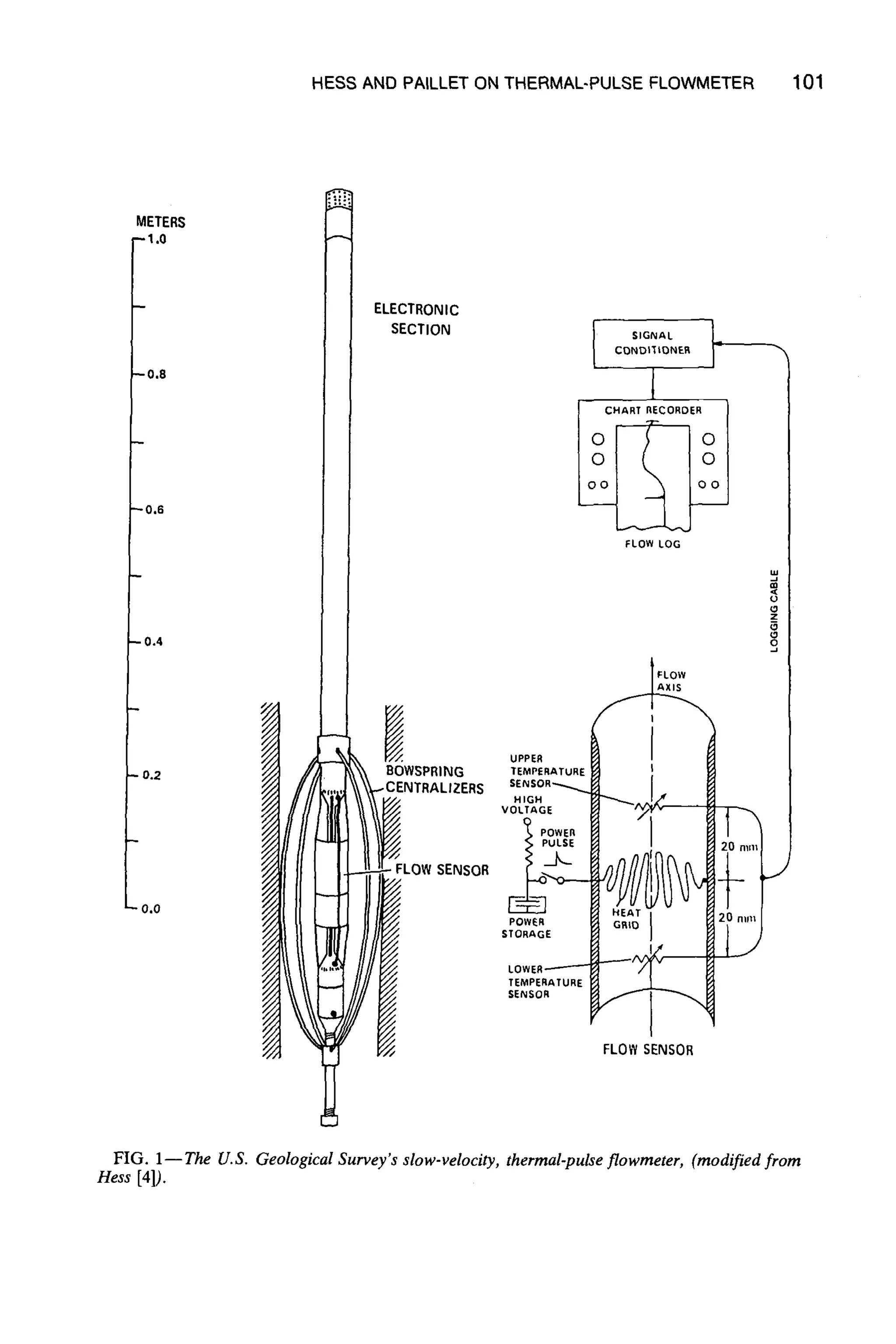
oped flowmeter logging system capable of measuring vertical flows in boreholes with much
greater resolution than available by means of conventional spinner flowmeters. This device
has important applications in identifying the location of inflows and exit flows in boreholes
under stressed and unstressed conditions, providing useful information on the source of
waters sampled from test wells and on the distribution of permeability in tight or fractured
formations. The significance of high-resolution flowmeter data in identifying the movement
of water in fractured crystalline rocks is indicated by such studies as Hess [6], Paillet et al.
[7], and Paillet [8].
The paper by Kaneko et al. emphasizes the interpretation of the shear modulus of soils
in situ by what appears to be standard geophysical logging methods. However, the approach
is based on a relatively new transducer design [9] developed especially for such engineering
4 GEOPHYSICALAPPLICATIONSFOR GEOTECHNICALINVESTIGATIONS
applications. This source configuration was but the first of many such applications of acoustic
logging with nonaxisymmetric sources [10,11]. The paper in this volume indicates the use
of these low-frequency shear measurements in boreholes; some of the future applications
for this developing method are also mentioned by Burns.
The five papers on borehole geophysics applications in geotechnical studies included in
this volume are but a small sample of the proliferating technologies becoming available to
modern geoscientists and engineers. Additional information on geotechnical applications of
logging can be found in the two recent monographs by Keys [12] and Hearst and Nelson
[13] and in the paper by Keys [14]. We hope that these four papers in this volume serve as
examples indicating a number of important ways in which borehole geophysics can contribute
to geotechnical studies, and that they stimulate the reader to investigate the broader pos-
sibilities of geophysical logging in the future.
Contributions made by the authors and technical reviewers are gratefully acknowledged.
The editors also express appreciation to the ASTM staff and officers of ASTM Committee
D-18 for their assistance and support in organizing and publishing these papers resulting
from the symposium.
Frederick L. Paillet
U.S. Geological Survey
Denver, CO; symposium
co-chairman and co-editor
Wayne R. Saunders
ICF-Kaiser Inc.
Fairfax, VA; symposium
co-chairman and co-editor
References
[1] Gnaedinger, G. P. and Johnson, A. I., Eds., Symposium on Soil Exploration, ASTM STP 351,
American Society for Testing and Materials, Philadelphia, 1964.
[2] McAlpin, G. W. and Gregg, L. E., Eds., Symposium on Surface and Subsurface Reconnaissance,
ASTM STP 122, American Society for Testing and Materials, Philadelphia, 1951.
[3] Alger, REP., "Interpretationof Electric Logs inFresh Water Wellsin Unconsolidated Formation,"
Society of Professional Well Log Analysts 7th Annual Logging Symposium, Transactions, Tulsa,
OK, 1966, pp. CC1-CC25.
[4] Dyck, J. H., Keys, W. S., and Meneley, W. A., "Application of Geophysical Loggingto Ground-
water Studies in Southern Saskatchewan," Canadian Journal of Earth Sciences, Vol. 9, No. 1,
1972, pp. 78-94.
[5] Alger, REP. and Harrison, C. W., "Improved Fresh Water Assessment in Sand Aquifers Utilizing
Geophysical Well Logs," The Log Analyst, Vol. 30, No. 1, 1989, pp. 31-44.
[61 Hess, A. E., "Identifying Hydraulically-Conductive Fractures with a Low-VelocityBorehole Flow-
meter," Canadian Geotechnical Journal, Vol. 23, 1986, pp. 69-78.
[7] Paillet, F. L., Hess, A. E., Cheng, C. H., and Hardin, E. L., "Characterization of Fracture
Permeabilitywith High-ResolutionVerticalFlowMeasurements during Borehole Pumping," Ground
Water, Vol. 25, No. 1, 1987, pp. 28-40.
[8] Paillet, F. L., "Analysis of Geophysical Well Logs and Flowmeter Measurements in Boreholes
Penetrating Subhorizontal Fracture Zones: Lac Du Bonnet Batholith, Manitoba, Canada," Water
Resources Investigations Report 89-4211, U.S. Geological Survey, Denver, CO, 1990, in press.
[9] Kitsunesaki, C., "A New Method for Shear Wave Logging," Geophysics, Vol. 45, 1980,pp. 1489-
1506.
OVERVIEW 5
[10] Winbow, G. A., "Compressional and Shear Arrivals in a Multiple Sonic Log," Geophysics, Vol.
50, 1985, pp. 119-126.
[11] Chen, S. T., "Shear-Wave Logging with Dipole Sources," Geophysics, Vol. 53, No. 5, 1988,
pp. 659-667.
[12] Keys, S. W., Borehole Geophysics Applied to Ground-Water Investigations, National Water Well
Association, Dublin, OH, 1990.
[13] Hearst, J. R. and Nelson, P. M., Well Logging for Physical Properties, McGraw-Hill, New York,
1985.
[14] Keys, S. W., "Analysis of Geophysical Logs of Water Wells with a Microcomputer," Ground
Water, Vol. 24, No. 3, 1986, pp. 750-760.
Surface Geophysics
David Cummings 1
Surface Geophysical Investigations
Hazardous Waste Sites
for
REFERENCE: Cummings, D., "Surface GeophysicalInvestigationsfor HazardousWaste Sites,"
GeophysicalApplications for GeotechnicalInvestigations, ASTM STP 1101,Frederick L. Paillet
and Wayne R. Saunders, Eds., American Society for Testing and Materials, Philadelphia,
1990, pp. 9-16.
ABSTRACT: Surface geophysical surveys provide regional and site-specificsubsurface infor-
mation for hazardous waste investigations. The surveys can be used: (1) during the recon-
naissance phase of an investigation, (2) for obtaining detailed site-specific information, and
(3) for monitoring purposes after detailed investigations have been completed.
The choice of the geophysical method used in a survey depends on: (1) a knowledge of the
geologic and hydrologic conditions and (2) the type of contaminant and its suspected depth.
The different methods measure different physical properties which can be interpreted as
geologic features or, if the target is man-made, as cultural features. The ambiguity inherent
in geophysical methods can be reduced by conducting two or more surveys that measure
different physical properties.
KEY WORDS: geophysics, hazardous waste, surveys, physical properties
The purpose of this paper is to provide some general information on the use of surface
geophysical methods for hazardous waste investigations. Although borehole and airborne
methods may be used, they are not discussed here because they are beyond the scope of
this paper.
Geophysical surveys are a cost-effective way of providing regional and site-specific sub-
surface information for hazardous waste investigations. Geophysical methods measure phys-
ical properties of the subsurface and can distinguish between layers of sand and clay, alluvium
and bedrock, saturated and unsaturated soil, and contaminated and uncontaminated soils
and can locate underground tanks and pipes. The surveys can be used: (1) during the
reconnaissance phase of an investigation, (2) for obtaining detailed site-specific information,
and (3) for monitoring purposes after detailed investigations have been completed. A major
advantage of geophysical surveys is that they are nondestructive.
Typical assignments for geophysical surveys include:
9 determining subsurface geology;
9 determining depth to the water table and its gradient;
9 locating buried metal drums, canisters, and metal or plastic pipes;
9 defining boundaries of landfills; and
9 outlining the three-dimensional configuration of a contaminant plume as well as its
direction and rate of migration.
aSenior geophysicist, Science Applications International Corp., Inc., 3351 S. Highland Dr.,
Suite 206, Las Vegas, NV 89109.
9
Copyright91990byASTMInternational www.astm.org
10 GEOPHYSICALAPPLICATIONSFOR GEOTECHNICALINVESTIGATIONS
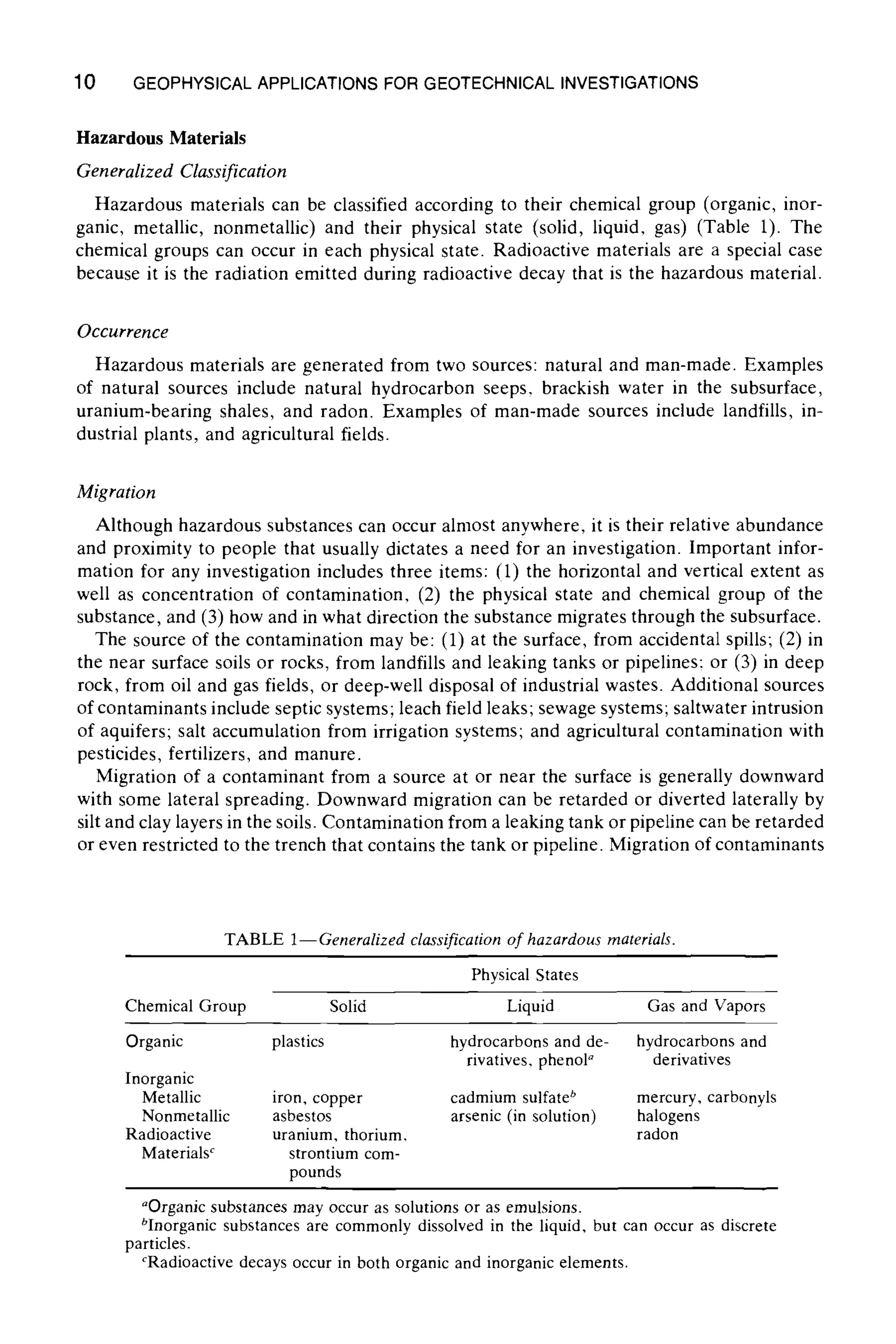
Hazardous Materials
Generalized Classification
Hazardous materials can be classified according to their chemical group (organic, inor-
ganic, metallic, nonmetallic) and their physical state (solid, liquid, gas) (Table 1). The
chemical groups can occur in each physical state. Radioactive materials are a special case
because it is the radiation emitted during radioactive decay that is the hazardous material.
Occurrence
Hazardous materials are generated from two sources: natural and man-made. Examples
of natural sources include natural hydrocarbon seeps, brackish water in the subsurface,
uranium-bearing shales, and radon. Examples of man-made sources include landfills, in-
dustrial plants, and agricultural fields.
Migration
Although hazardous substances can occur almost anywhere, it is their relative abundance
and proximity to people that usually dictates a need for an investigation. Important infor-
mation for any investigation includes three items: (1) the horizontal and vertical extent as
well as concentration of contamination, (2) the physical state and chemical group of the
substance, and (3) how and in what direction the substance migrates through the subsurface.
The source of the contamination may be: (1) at the surface, from accidental spills; (2) in
the near surface soils or rocks, from landfills and leaking tanks or pipelines; or (3) in deep
rock, from oil and gas fields, or deep-well disposal of industrial wastes. Additional sources
of contaminants include septic systems; leach field leaks; sewage systems; saltwater intrusion
of aquifers; salt accumulation from irrigation systems; and agricultural contamination with
pesticides, fertilizers, and manure.
Migration of a contaminant from a source at or near the surface is generally downward
with some lateral spreading. Downward migration can be retarded or diverted laterally by
silt and clay layers in the soils. Contaminationfrom a leaking tank or pipeline can be retarded
or even restricted to the trench that contains the tank or pipeline. Migration of contaminants
TABLE I--Generalized classification of hazardous materials.
Physical States
Chemical Group Solid Liquid Gas and Vapors
Organic plastics hydrocarbons and de- hydrocarbons and
rivatives, phenola derivatives
Inorganic
Metallic iron, copper cadmium sulfateb mercury, carbonyls
Nonmetallic asbestos arsenic (in solution) halogens
Radioactive uranium, thorium, radon
MaterialsC strontium com-
pounds
aOrganic substances may occur as solutions or as emulsions.
bInorganic substances are commonly dissolved in the liquid, but can occur as discrete
particles.
CRadioactivedecays occur in both organic and inorganic elements.
CUMMINGS ON HAZARDOUS WASTE SITES 11
from deep sources is generally upward, but the contaminants also spread laterally when
they come in contact with the impermeable layer.
The interaction of the contaminant with ground water is a major concern because of the
value of the water. To understand this interaction, it is necessary to determine: (1) how
water moves through the ground and (2) how the contaminants occur in the ground water.
Using simplifying assumptions, ground-water flow is considered to be laminar and, with
distance from its source, the contaminant becomes diluted. Dilution occurs by physical
process (for example, hydrodynamic dispersion) or chemical process (adsorption or cation
exchange) or both. Physical dispersion occurs by both mechanical mixing and molecular
diffusion. As the contaminant moves through the soil or rock, the chemical process of
adsorption or cation exchange occurs, thus retarding its migration.
The velocity of gasses through the unsaturated soil and rock depend primarily on: (1) the
density of the gas and (2) the vertical and horizontal hydraulic conductivity of the soil or
rock. Methane, generated from decaying organic matter in a landfill or from thermogenic
processes related to oil and gas fields, is lighter than air and migrates both laterally and
upward through the soils and rocks. If an impermeable barrier to the upward migration of
the gas does not exist, then the gas escapes at ground surface. But, if a barrier exists, then
the gas accumulates at the base of the barrier, migrates laterally, and updips along the base
of the barrier. Because methane is potentially explosive, drilling through this barrier and
into a pocket of unsuspected methane can be dangerous. If methane occurs below or in the
water table, some of this gas is dissolved in the water and migrates in the same direction
as the hydraulic gradient. However, some of the gas molecules are adsorbed on the soil or
rock particles. Because methane is reactive with the soils, it generally travels at a slower
rate than the water.
Liquid contaminants entering the soil from the ground surface (or slightly below) migrate
downward provided the soil has a high value of vertical hydraulic conductivity. Sands and
gravels are examples of such soils. If an impermeable layer, such as clay, impedes the
downward migration, then the liquid migrates laterally on the layer and downdips. A high
viscosity liquid, such as heavy crude oil, migrates only a few feet from the source because
of the adsorptive capacity and capillary attraction related to the soils. On the other hand,
gasoline can migrate relatively long distances underground. If the liquid contaminant reaches
the water table, the contaminant can either float on, sink in, or form a solution or an
emulsion with the water. Migration of the contaminant is in the same direction as the flow
of water.
By understanding the types of contaminants in the subsurface, how they occur, and how
they migrate, a geophysical program can be developed to locate the contaminants and
determine their three-dimensional configuration. Maximum benefits from a geophysical
program are obtained through continuous communication among all participants: the client,
the geologist, the engineer, and the geophysicist.
Surface Geophysical Method
Phases of GeophysicalSurveys
Geophysical methods are used for hazardous waste investigations in three phases:
(1) during the reconnaissance phase to obtain the general and detailed site characteristics
of geology and hydrogeology, (2) during the detailed site investigation phase to obtain the
three-dimensional configuration of the contaminant and the direction and rate of its migra-
tion, and (3) during the post-site investigation phase and for monitoring purposes. In general,
geophysical surveys must be a part of an overall investigation program which includes drilling.
Borings are generally needed to provide definitive information about contaminants; the
12 GEOPHYSICALAPPLICATIONS FOR GEOTECHNICAL INVESTIGATIONS
geophysical surveys are used to interpolate between the drill holes and extrapolate beyond
the drilled areas. The interpretations of the geophysical data provide insight into the limits
and three-dimensional configuration of contamination.
Reconnaissance
Geophysical surveys are commonly used in the reconnaissance phase to provide sufficient
general information so that more detailed investigations can be adequately planned. Re-
connaissance surveys are used to optimize drilling programs, either for detailed investigations
or to locate extraction wells. During the reconnaissance phase, the geophysical surveys can
be used to locate underground utilities for avoidance during drilling or trenching.
Detailed Site Investigation
During the detailed site investigation phase, the geophysical information from the recon-
naissance phase is integrated and correlated with site-specific geologic and drill hole infor-
mation. Using the geologic information, the reconnaissance geophysical interpretations are
modified where appropriate. Other geophysical surveys may then be conducted between
drill holes to obtain additional subsurface information at the site. The type of subsurface
information commonly required in the detailed investigation is: (1) continuity of soil or rock
layers, (2) three-dimensional configuration of contaminant plume, and (3) changes in hy-
draulic gradient and the existence of barriers in the path of contaminant migrations.
Monitoring
After the detailed site investigation has been completed, geophysical investigations are
used to monitor the area for the purposes of assessing the effectiveness of cleanup and to
act as an early warning system for future contamination.
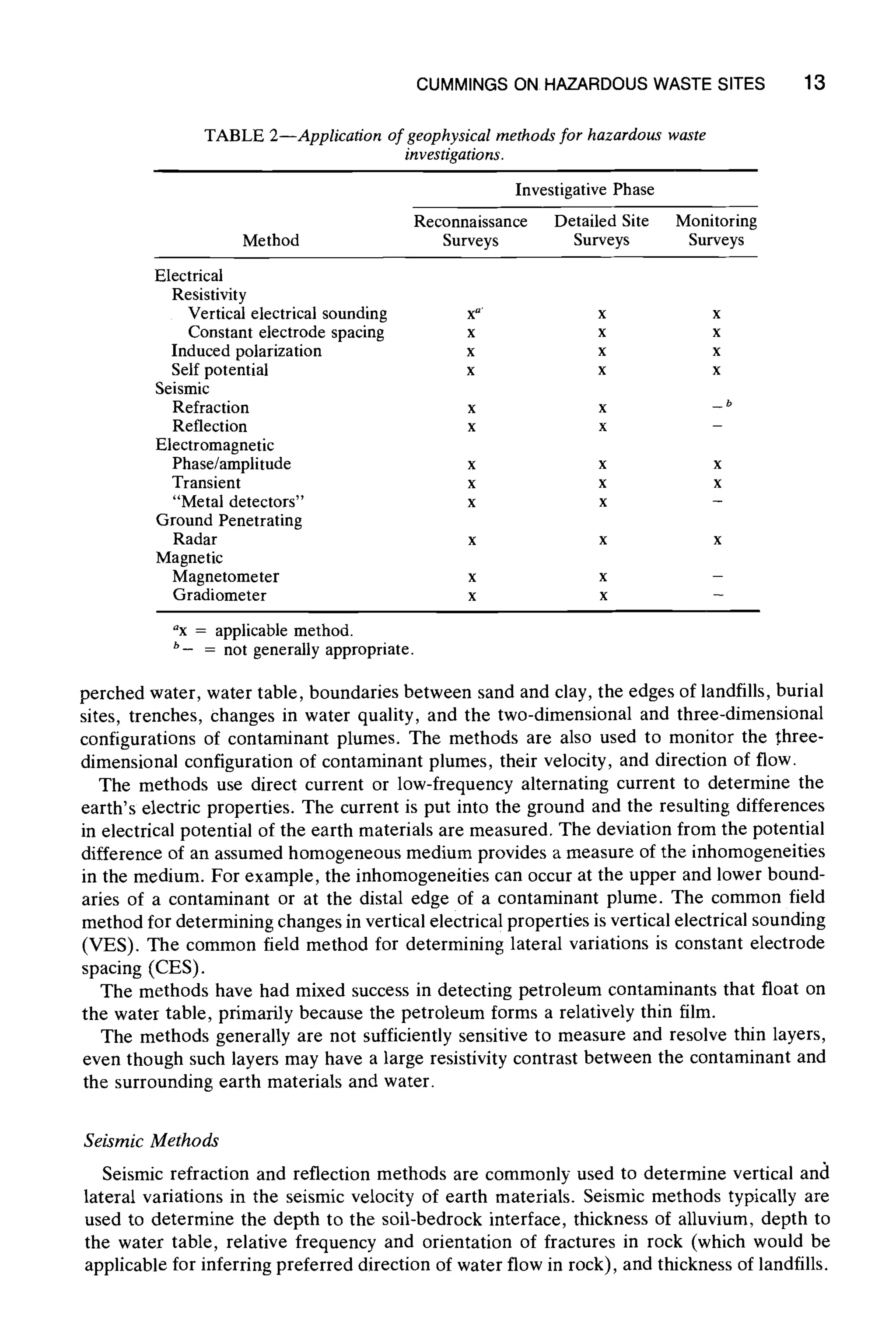
Application of Geophysical Methods
The use of geophysical methods to hazardous waste investigations is summarized in Ta-
ble 2. The choice of the appropriate method depends on: (1) a general knowledge of the
geologic conditions, (2) the hydrogeologic conditions, (3) the type of the contaminant, and
(4) the suspected depth of the contaminant. Some of this information is generally available
before the investigation begins and is used to design the geophysical program.
Because of the inherent ambiguities in interpreting geophysical data, several different but
complementary geophysical methods are used to reduce the ambiguities and provide more
reliable information. The increase in reliability is related to the types and combinations of
methods used and their abilities to detect changes in physical properties at specific sites and
for specific targets.
The following is a brief discussion of the applications of geophysical methods commonly
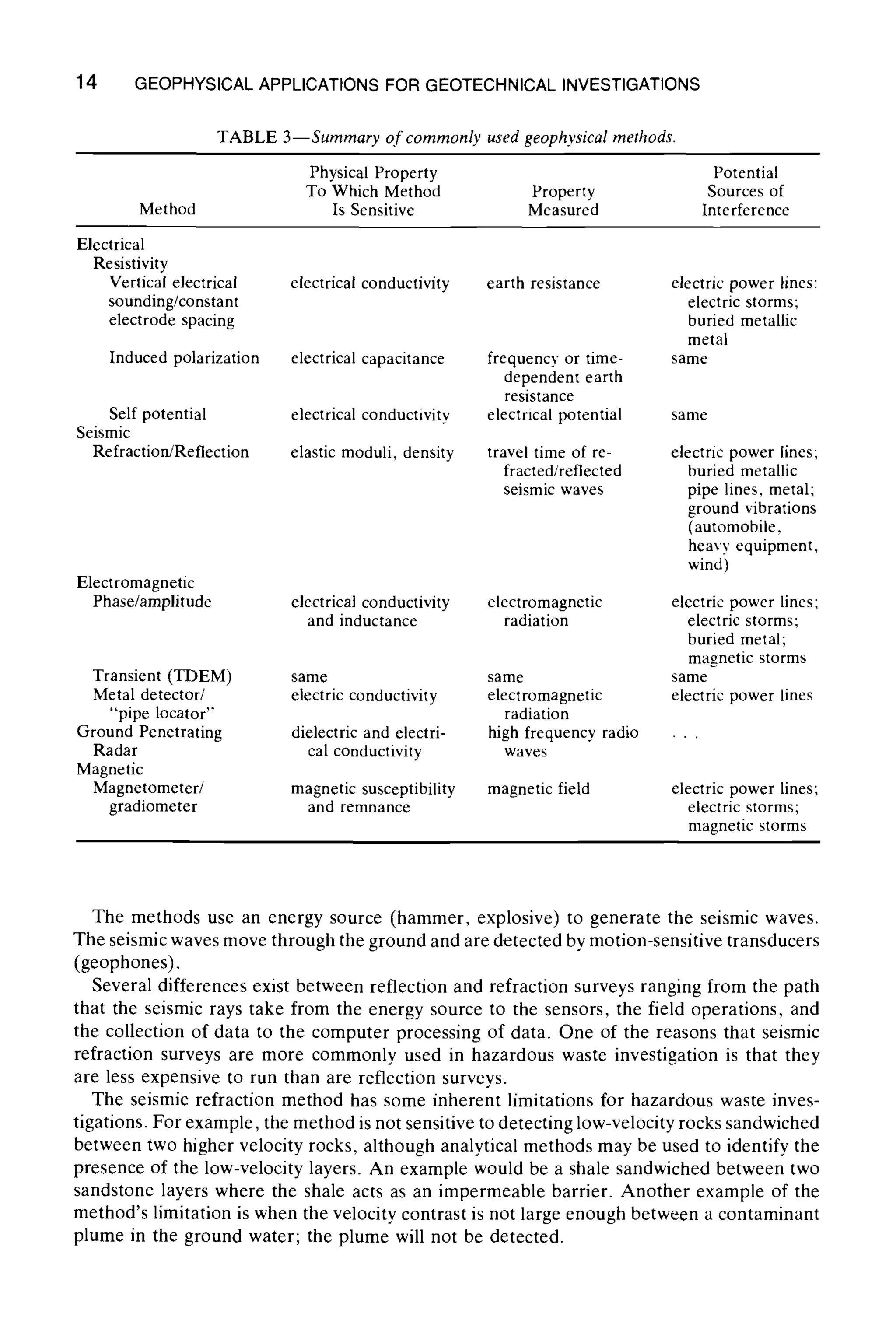
used in hazardous waste investigations. A summary of the methods is listed in Table 3 along
with the physical properties measured and the potential sources of interference that may
cause spurious data. The theory and field operations of the methods are beyond the scope
of this paper and are given in standard textbooks on geophysics and in technical manuals.
Electrical Methods
Electrical methods are commonly used to locate lateral and vertical discontinuities in the
electrical properties of earth materials. The methods typically are used to determine depth to
CUMMINGS ON HAZARDOUS WASTE SITES
TABLE 2--Appfication of geophysical methods for hazardous waste
investigations.
13
Investigative Phase
Reconnaissance Detailed Site Monitoring
Method Surveys Surveys Surveys
Electrical
Resistivity
Vertical electrical sounding x" x x
Constant electrode spacing x x x
Induced polarization x x x
Self potential x x x
Seismic
Refraction x x _ b
Reflection x x -
Electromagnetic
Phase/amplitude x x x
Transient x x x
"Metal detectors" x x -
Ground Penetrating
Radar x x x
Magnetic
Magnetometer x x -
Gradiometer x x -
"x = applicable method.
b_ = not generally appropriate.
perched water, water table, boundaries between sand and clay, the edges of landfills, burial
sites, trenches, changes in water quality, and the two-dimensional and three-dimensional
configurations of contaminant plumes. The methods are also used to monitor the three-
dimensional configuration of contaminant plumes, their velocity, and direction of flow.
The methods use direct current or low-frequency alternating current to determine the
earth's electric properties. The current is put into the ground and the resulting differences
in electrical potential of the earth materials are measured. The deviation from the potential
difference of an assumed homogeneous medium provides a measure of the inhomogeneities
in the medium. For example, the inhomogeneities can occur at the upper and lower bound-
aries of a contaminant or at the distal edge of a contaminant plume. The common field
method for determining changes in vertical electrica! properties is vertical electrical sounding
(VES). The common field method for determining lateral variations is constant electrode
spacing (CES).
The methods have had mixed success in detecting petroleum contaminants that float on
the water table, primarily because the petroleum forms a relatively thin film.
The methods generally are not sufficiently sensitive to measure and resolve thin layers,
even though such layers may have a large resistivity contrast between the contaminant and
the surrounding earth materials and water.
Seismic Methods
Seismic refraction and reflection methods are commonly used to determine vertical and
lateral variations in the seismic velocity of earth materials. Seismic methods typically are
used to determine the depth to the soil-bedrock interface, thickness of alluvium, depth to
the water table, relative frequency and orientation of fractures in rock (which would be
applicable for inferring preferred direction of water flow in rock), and thickness of landfills.
14 GEOPHYSICALAPPLICATIONSFOR GEOTECHNICALINVESTIGATIONS
TABLE 3--Summary of commonly used geophysicalmethods.
Physical Property
To Which Method Property
Method Is Sensitive Measured
Potential
Sources of
Interference
Electrical
Resistivity
Vertical electrical
sounding/constant
electrode spacing
electrical conductivity earth resistance
Induced polarization electrical capacitance frequency or time-
dependent earth
resistance
Self potential electrical conductivity electrical potential
Seismic
Refraction/Reflection elastic moduli, density travel time of re-
fracted/reflected
seismic waves
electrical conductivity electromagnetic
and inductance radiation
Electromagnetic
Phase/amplitude
Transient (TDEM) same same
Metal detector/ electric conductivity electromagnetic
"pipe locator" radiation
Ground Penetrating dielectric and electri- high frequency radio
Radar cal conductivity waves
Magnetic
Magnetometer/ magnetic susceptibility magnetic field
gradiometer and remnance
electric power lines:
electric storms;
buried metallic
metal
same
same
electric power lines;
buried metallic
pipe lines, metal;
ground vibrations
(automobile,
heavy equipment,
wind)
electric power lines;
electric storms;
buried metal;
magnetic storms
same
electric power lines
electric power lines;
electric storms;
magnetic storms
The methods use an energy source (hammer, explosive) to generate the seismic waves.
The seismic waves move through the ground and are detected by motion-sensitive transducers
(geophones).
Several differences exist between reflection and refraction surveys ranging from the path
that the seismic rays take from the energy source to the sensors, the field operations, and
the collection of data to the computer processing of data. One of the reasons that seismic
refraction surveys are more commonly used in hazardous waste investigation is that they
are less expensive to run than are reflection surveys.
The seismic refraction method has some inherent limitations for hazardous waste inves-
tigations. For example, the method is not sensitive to detecting low-velocity rocks sandwiched
between two higher velocity rocks, although analytical methods may be used to identify the
presence of the low-velocity layers. An example would be a shale sandwiched between two
sandstone layers where the shale acts as an impermeable barrier. Another example of the
method's limitation is when the velocity contrast is not large enough between a contaminant
plume in the ground water; the plume will not be detected.
CUMMINGSON HAZARDOUSWASTE SITES 15
As with the electrical methods, the field design of the seismic survey can provide infor-
mation on both vertical and horizontal variations of the physical properties. Conventional
refraction and reflection surveys can provide information on both vertical and horizontal
variations, but if lateral (horizontal) variations are of primary interest, the common offset
method (constant spacing) in both types of surveys is likely to provide greater sensitivity to
detect lateral variations.
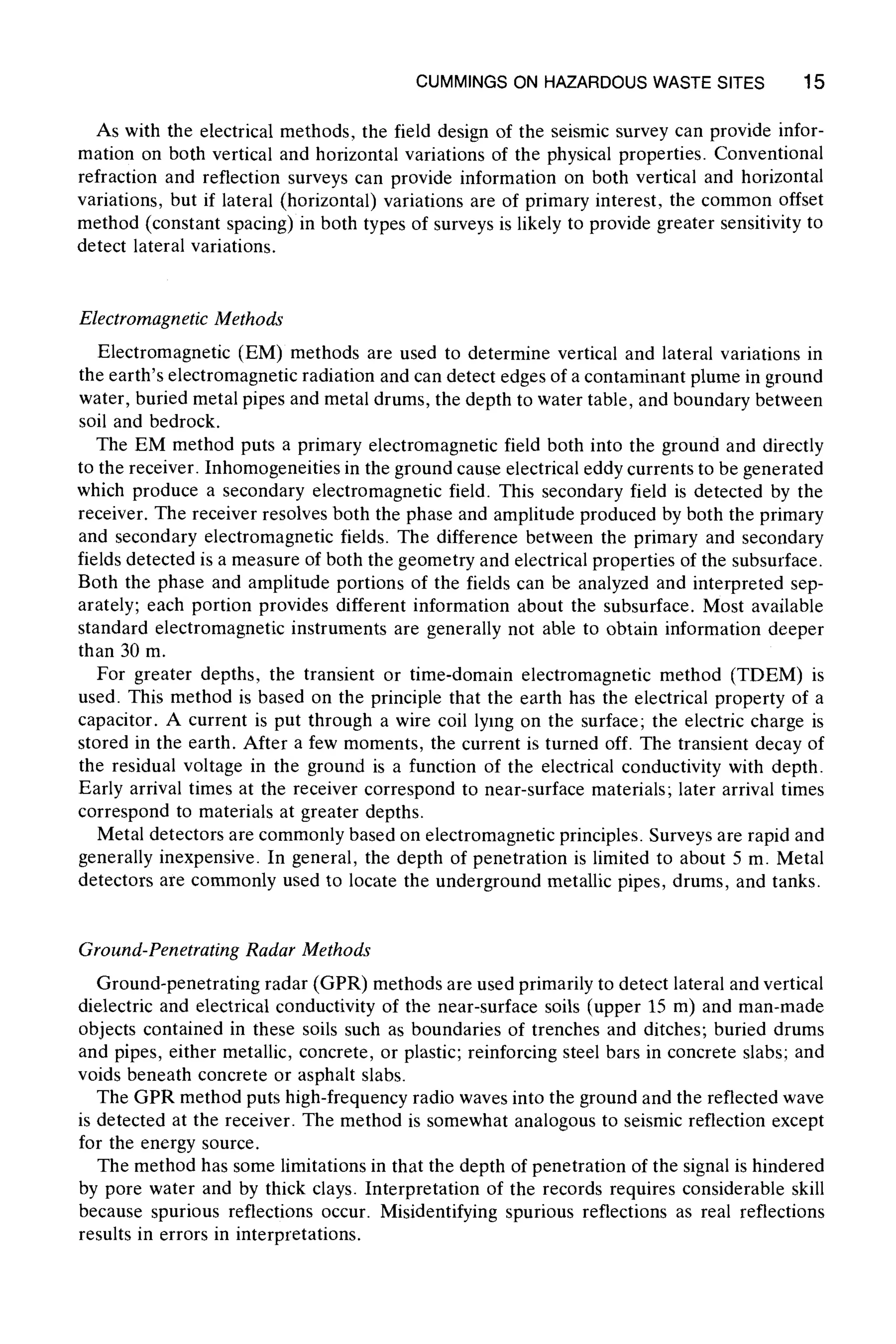
Electromagnetic Methods
Electromagnetic (EM) methods are used to determine vertical and lateral variations in
the earth's electromagnetic radiation and can detect edges of a contaminant plume in ground
water, buried metal pipes and metal drums, the depth to water table, and boundary between
soil and bedrock.
The EM method puts a primary electromagnetic field both into the ground and directly
to the receiver. Inhomogeneities in the ground cause electrical eddy currents to be generated
which produce a secondary electromagnetic field. This secondary field is detected by the
receiver. The receiver resolves both the phase and amplitude produced by both the primary
and secondary electromagnetic fields. The difference between the primary and secondary
fields detected is a measure of both the geometry and electrical properties of the subsurface.
Both the phase and amplitude portions of the fields can be analyzed and interpreted sep-
arately; each portion provides different information about the subsurface. Most available
standard electromagnetic instruments are generally not able to obtain information deeper
than 30 m.
For greater depths, the transient or time-domain electromagnetic method (TDEM) is
used. This method is based on the principle that the earth has the electrical property of a
capacitor. A current is put through a wire coil lying on the surface; the electric charge is
stored in the earth. After a few moments, the current is turned off. The transient decay of
the residual voltage in the ground is a function of the electrical conductivity with depth.
Early arrival times at the receiver correspond to near-surface materials; later arrival times
correspond to materials at greater depths.
Metal detectors are commonly based on electromagnetic principles. Surveys are rapid and
generally inexpensive. In general, the depth of penetration is limited to about 5 m. Metal
detectors are commonly used to locate the underground metallic pipes, drums, and tanks.
Ground-Penetrating Radar Methods
Ground-penetrating radar (GPR) methods are used primarily to detect lateral and vertical
dielectric and electrical conductivity of the near-surface soils (upper 15 m) and man-made
objects contained in these soils such as boundaries of trenches and ditches; buried drums
and pipes, either metallic, concrete, or plastic; reinforcing steel bars in concrete slabs; and
voids beneath concrete or asphalt slabs.
The GPR method puts high-frequency radio waves into the ground and the reflected wave
is detected at the receiver. The method is somewhat analogous to seismic reflection except
for the energy source.
The method has some limitations in that the depth of penetration of the signal is hindered
by pore water and by thick clays. Interpretation of the records requires considerable skill
because spurious reflections occur. Misidentifying spurious reflections as real reflections
results in errors in interpretations.
16 GEOPHYSICAL APPLICATIONS FOR GEOTECHNICAL INVESTIGATIONS
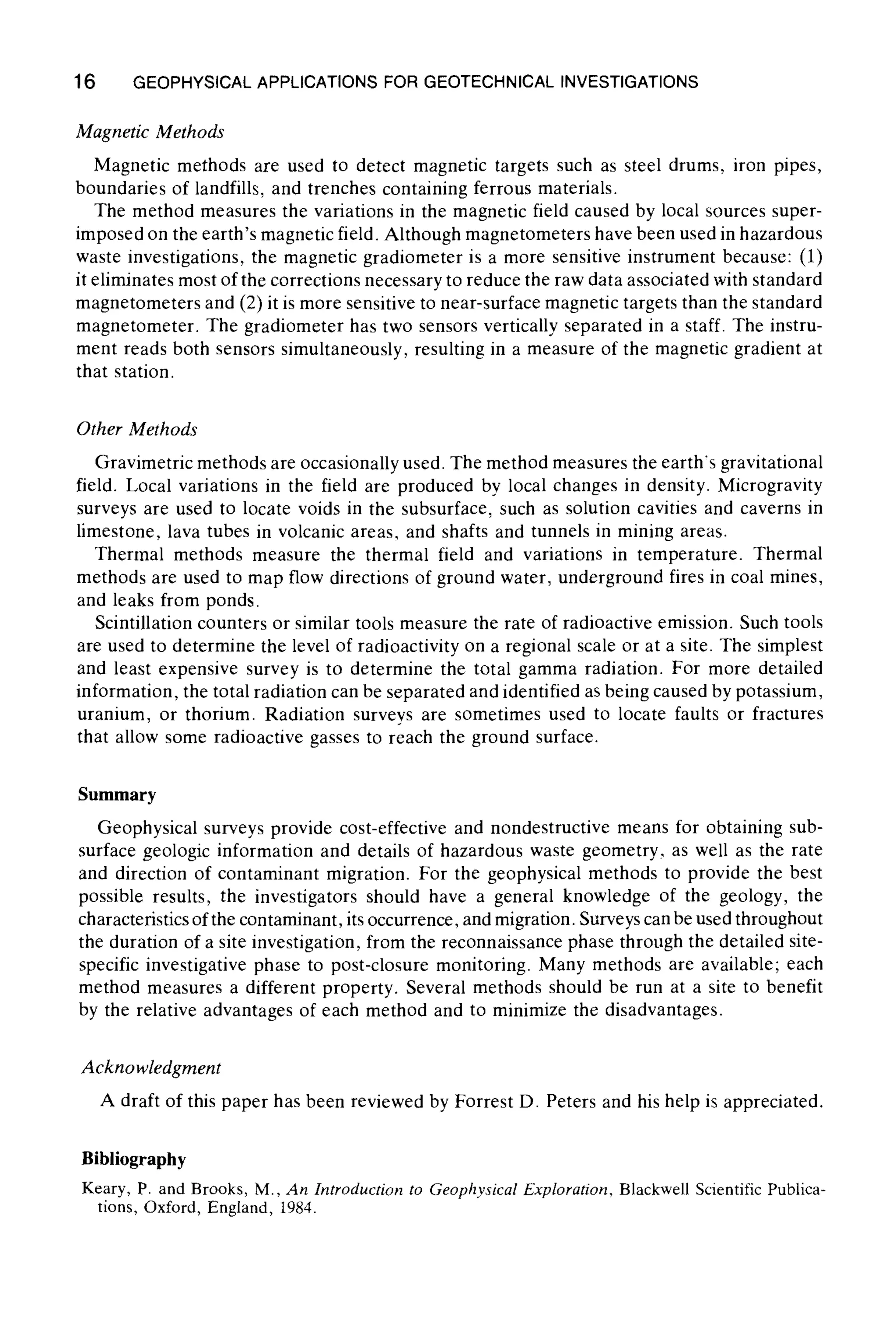
Magnetic Methods
Magnetic methods are used to detect magnetic targets such as steel drums, iron pipes,
boundaries of landfills, and trenches containing ferrous materials.
The method measures the variations in the magnetic field caused by local sources super-
imposed on the earth's magnetic field. Although magnetometers have been used in hazardous
waste investigations, the magnetic gradiometer is a more sensitive instrument because: (1)
it eliminates most of the corrections necessary to reduce the raw data associated with standard
magnetometers and (2) it is more sensitive to near-surface magnetic targets than the standard
magnetometer. The gradiometer has two sensors vertically separated in a staff. The instru-
ment reads both sensors simultaneously, resulting in a measure of the magnetic gradient at
that station.
Other Methods
Gravimetric methods are occasionally used. The method measures the earth's gravitational
field. Local variations in the field are produced by local changes in density. Microgravity
surveys are used to locate voids in the subsurface, such as solution cavities and caverns in
limestone, lava tubes in volcanic areas, and shafts and tunnels in mining areas.
Thermal methods measure the thermal field and variations in temperature. Thermal
methods are used to map flow directions of ground water, underground fires in coal mines,
and leaks from ponds.
Scintillation counters or similar tools measure the rate of radioactive emission. Such tools
are used to determine the level of radioactivity on a regional scale or at a site. The simplest
and least expensive survey is to determine the total gamma radiation. For more detailed
information, the total radiation can be separated and identified as being caused by potassium,
uranium, or thorium. Radiation surveys are sometimes used to locate faults or fractures
that allow some radioactive gasses to reach the ground surface.
Summary
Geophysical surveys provide cost-effective and nondestructive means for obtaining sub-
surface ~eologic information and details of hazardous waste geometry, as well as the rate
and direction of contaminant migration. For the geophysical methods to provide the best
possible results, the investigators should have a general knowledge of the geology, the
characteristics of the contaminant,its occurrence, and migration. Surveyscan be used throughout
the duration of a site investigation, from the reconnaissance phase through the detailed site-
specific investigative phase to post-closure monitoring. Many methods are available; each
method measures a different property. Several methods should be run at a site to benefit
by the relative advantages of each method and to minimize the disadvantages.
Acknowledgment
A draft of this paper has been reviewed by Forrest D. Peters and his help is appreciated.
Bibliography
Keary, P. and Brooks, M., An Introduction to GeophysicalExploration, Blackwel[ Scientific Publica-
tions, Oxford, England, 1984.
Hideki Saito, 1 Hiromasa Shima, 2 Tetsuma Toshioka, 3 Shin-ichi
Kaino, 4 and Hideo Ohtomo 5
A Case Study of Geotomography Applied to
a Detailed Investigation of a Highway Bridge
Foundation
REFERENCE: Saito, H., Shima, H., Toshioka, T., Kaino, S., and Ohtomo, H., "A Case
Study of Geotomography Applied to a Detailed Investigation of a Highway Bridge Foundation,"
GeophysicalApplications for GeotechnicalInvestigations, ASTM STP 1101,Frederick L. Paillet
and Wayne R. Saunders, Eds., American Society for Testing and Materials, Philadelphia,
1990, pp. 17-34.
ABSTRACT: Three types of geotomographic surveys (seismic tomography, resistivity tomog-
raphy, and radar tomography) were conducted at a highway bridge pier construction site to
investigate rock characteristics. After the geophysicalinvestigation, bedrock was excavated to
construct the bridge foundation. Geological surveys and plate-loading tests were carried out
on the excavated surface. The geophysical and geological results were generally in good
agreement.
Seismic tomography can distinguish highly fractured rock from unfractured rock, and re-
sistivity tomography and radar tomography can classify rock according to different water
contents. The combined use of these three geotomographic surveys made it possible to detect
the anomalous zone whichwas highly fractured and saturated.
KEY WORDS: geotomography, seismic tomography, resistivity tomography, radar tomogra-
phy, bridge pier, fracture zone, geotechnical investigation, rock quality
A geological survey and drilling at a proposed highway bridge pier indicated that a vertical
fault existed at this site and that the rhyolite bedrock contained a fracture zone associated
with the fault. The fracture zone was not a desirable foundation for the bridge pier, but it
was difficult to change the proposed site of the pier because of topographic conditions and
the existence of other structures (a pier of another bridge, houses, and so forth) around the
site.
To design and construct the foundation of the bridge pier properly, the fracture zone had
to be located precisely and the in-situ mechanical strength of the surrounding rock had to
be obtained. Three types of geotomography, seismic tomography, resistivity tomography,
1Geophysicist, Geotechnical Institute, OYO Corp., c/o Earth Resources Lab., M.I.T., E34-408, 42
Carleton St., Cambridge, MA 02142. Member of SEG, EAEG, IEEE, SEG Japan.
2Geophysicist, Geotechnical Institute, OYO Corp., 2-2-19Daitakubo, Urawa, Saitama 336, Japan.
Member of SEG, EAEG, SSJ, SEG Japan.
3Geophysicist, Geotechnical Institute, OYO Corp., 2-2-19Daitakubo, Urawa, Saitama 336, Japan.
Member of SSJ, SEG Japan, IEICE.
4Geologist, Kansai Branch Office, OYO Corp., 2-36-27Tarumicho, Suita, Osaka 564, Japan.
5Senior geophysicist, Head Office, OYO Corp., 4-2-6 Kudankita, Chiyoda-ku, Tokyo 102, Japan.
Member of SEG, IEEE, SEG Japan, JSSMFE, JSCE.
17
Copyright91990byASTMInternational www.astm.org
18 GEOPHYSICALAPPLICATIONS FOR GEOTECHNICAL INVESTIGATIONS
and radar tomography, were conducted to obtain information on the physical properties
and distribution of the fracture zones. These methods were adequate to obtain information
about rock quality.
This paper describes the features of geotomography, presents results of the investigation,
and indicates the applicability of geotomography to rock investigations.
Features of Geotomography
Geotomography has attracted a great deal of attention as a method of investigating in
detail the distribution of underground physical properties [1]. Geotomography reconstructs
images of underground structures using a large data set. For this reason, geotomography
provides more information than surface geophysical survey methods. The three specific
advantages of geotomography over conventional surface surveys are: (1) the target area is
illuminated from several different angles, (2) the application of source transducers at points
in boreholes near the target allow for increased spatial resolution, and (3) the application
of sources in boreholes means that measurements are not degraded by propagation through
the shallow, extensively weathered zone.
Three kinds of geotomographic methods were used: (1) seismic tomography, (2) resistivity
tomography, and (3) radar tomography. The seismic wave velocity, the resistivity, or the
electromagnetic wave velocity are influenced by physical (rock) properties such as hardness,
condition of cracks, water content, or clay content. Because the response obtained by one
method may not be adequate to characterize all physical properties, it is effective to combine
different geotomographic methods to obtain a good image of the ground structure.
Characteristics of each geotomographic method are as follows.
Seismic Tornography
Seismic tomography reconstructs the seismic wave velocity distribution in the ground.
Seismic wave velocity varies according to rock type, degree of weathering, degree of meta-
morphism, number of cracks, and so forth. In this survey, the fracture zones are expected
to have lower seismic velocities than unfractured rock.
Resistivity Tomography
Resistivity tomography obtains the distribution of resistivity in the ground. Resistivity in
the ground changes according to rock type, mineral content, porosity, degree of saturation,
and the resistivity of water contained in the rock. In this survey, faults or fracture zones
are expected to have lower resistivity values than unfractured rock.
Radar Tomography
Radar tomography obtains the distribution of the propagation velocity of electromagnetic
waves in the ground. The propagation velocity of electromagnetic waves changes mainly
according to the water content of the rock. In this survey, the fracture zones are expected
to have lower velocities than unfractured rock.
Field Measurements and Results
Borehole Arrangernent
The previous geological survey indicated that the dip angle of the fracture zone was almost
vertical. When the predominant direction of the geological structure is nearly vertical,
SAITO ET AL. ON HIGHWAY BRIDGEFOUNDATION 19
tomography using only vertical boreholes cannot provide a good reconstruction image [2].
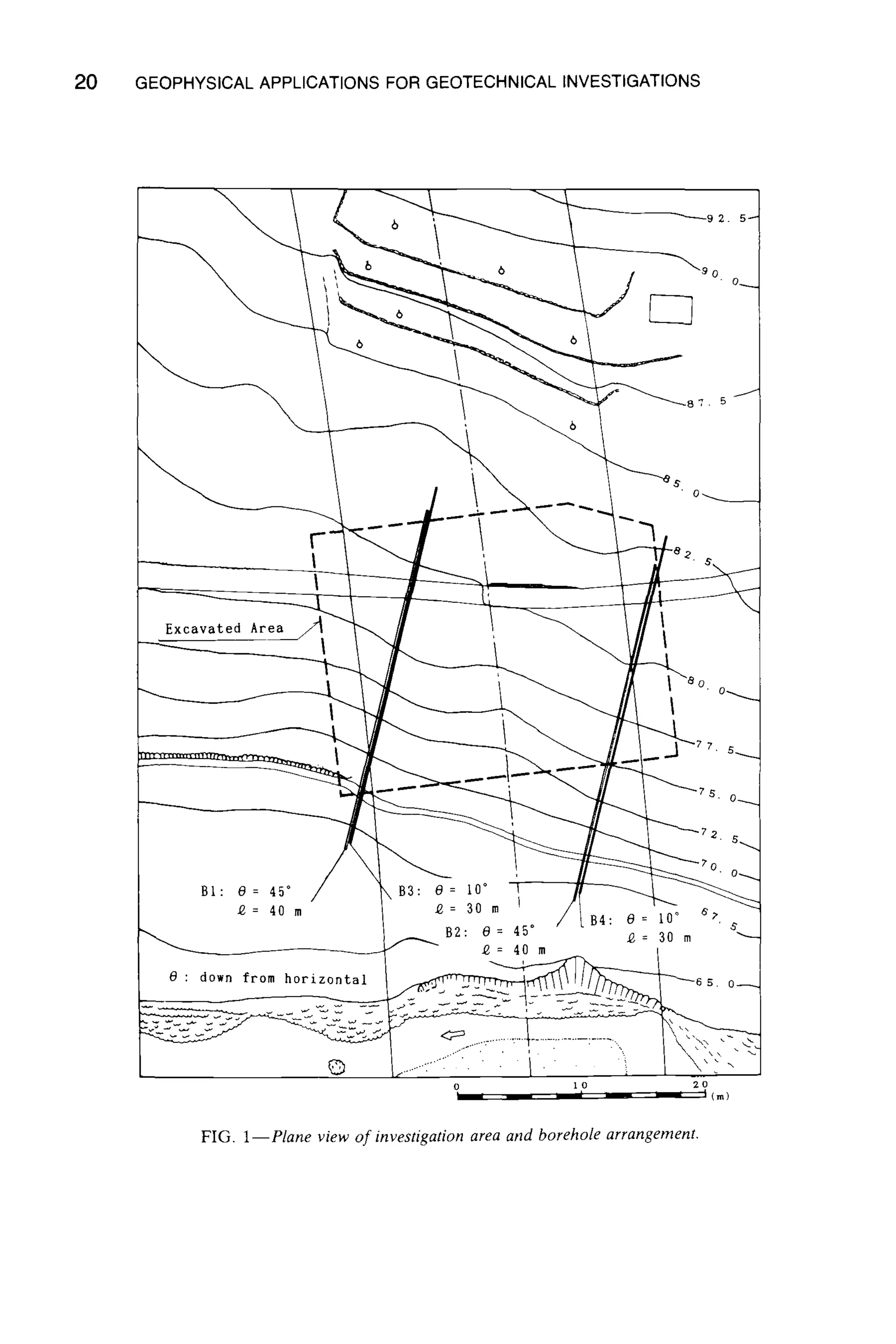
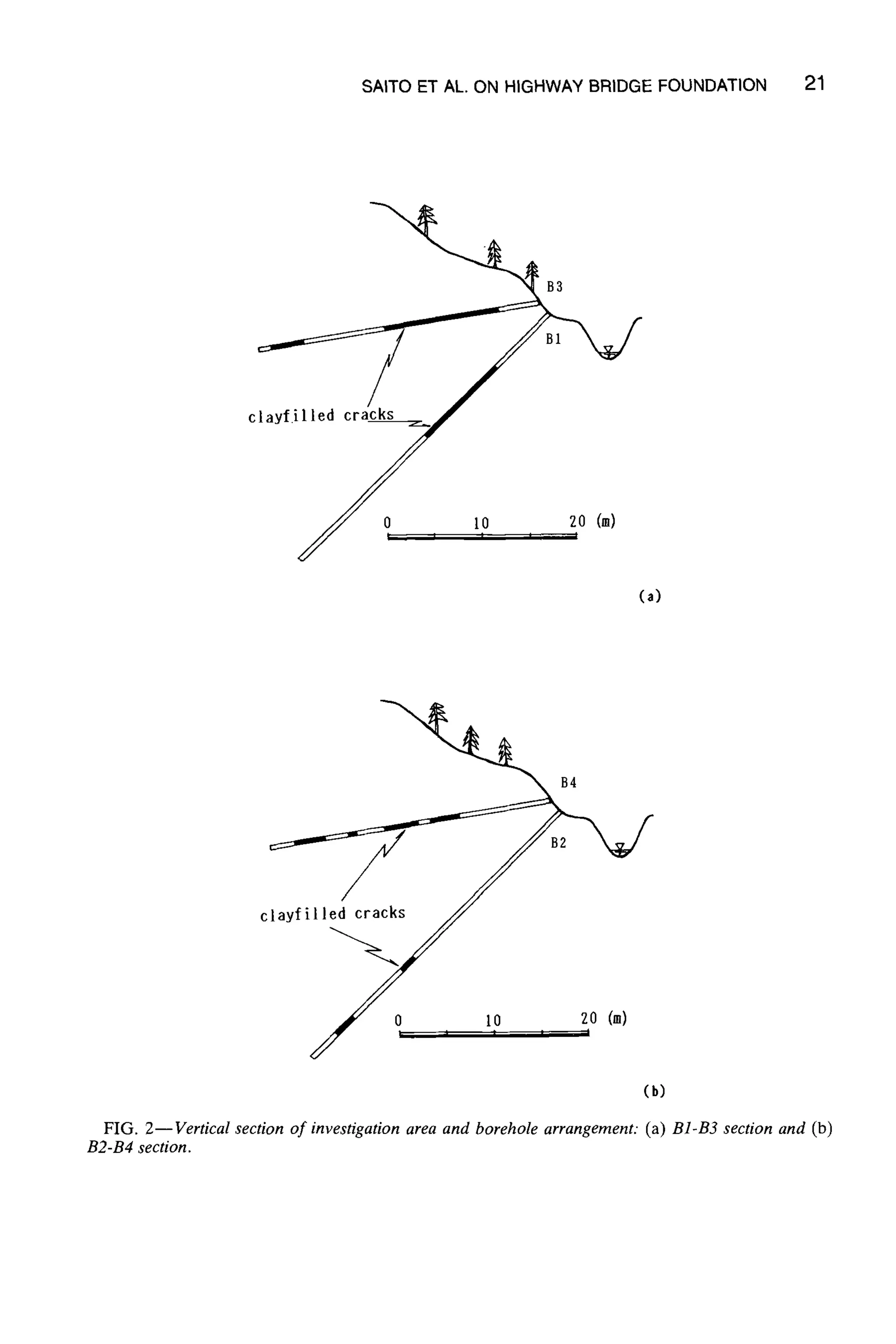
Therefore, four boreholes were drilled as shown in Figs. 1 and 2. Boreholes B1 and B2
were drilled at 45~ down from the horizontal and were 40 m long. Boreholes B3 and B4
were drilled at 10~ and were 30 m long.
Seismic Tomography
The measurements for seismic tomography were conducted by surrounding the objective
section with source points and receiver points placed in boreholes and on the ground surface
between boreholes. Both source and receiver intervals were 2 m. About 50 g of dynamite
was used as the seismic source. Three sets of twelve-channel borehole geophones and eleven
geophones on the ground surface were used for measurements. A forty-eight-channel digital
data acquisition system (OYO's McSEIS 1600 System) was used.
The objective area was divided into a number of rectangular cells, and the velocity value
for each cell was obtained by an iterative method. In the iterative method, the velocity
(value) for each cell was corrected to minimize the root mean squares of residuals between
calculated and observed travel times. To prevent the divergence of the correction values,
the damped least squares technique was used [3]. The damping parameters were determined
by taking account of the number and directionality of seismic rays passing through each
cell [4].
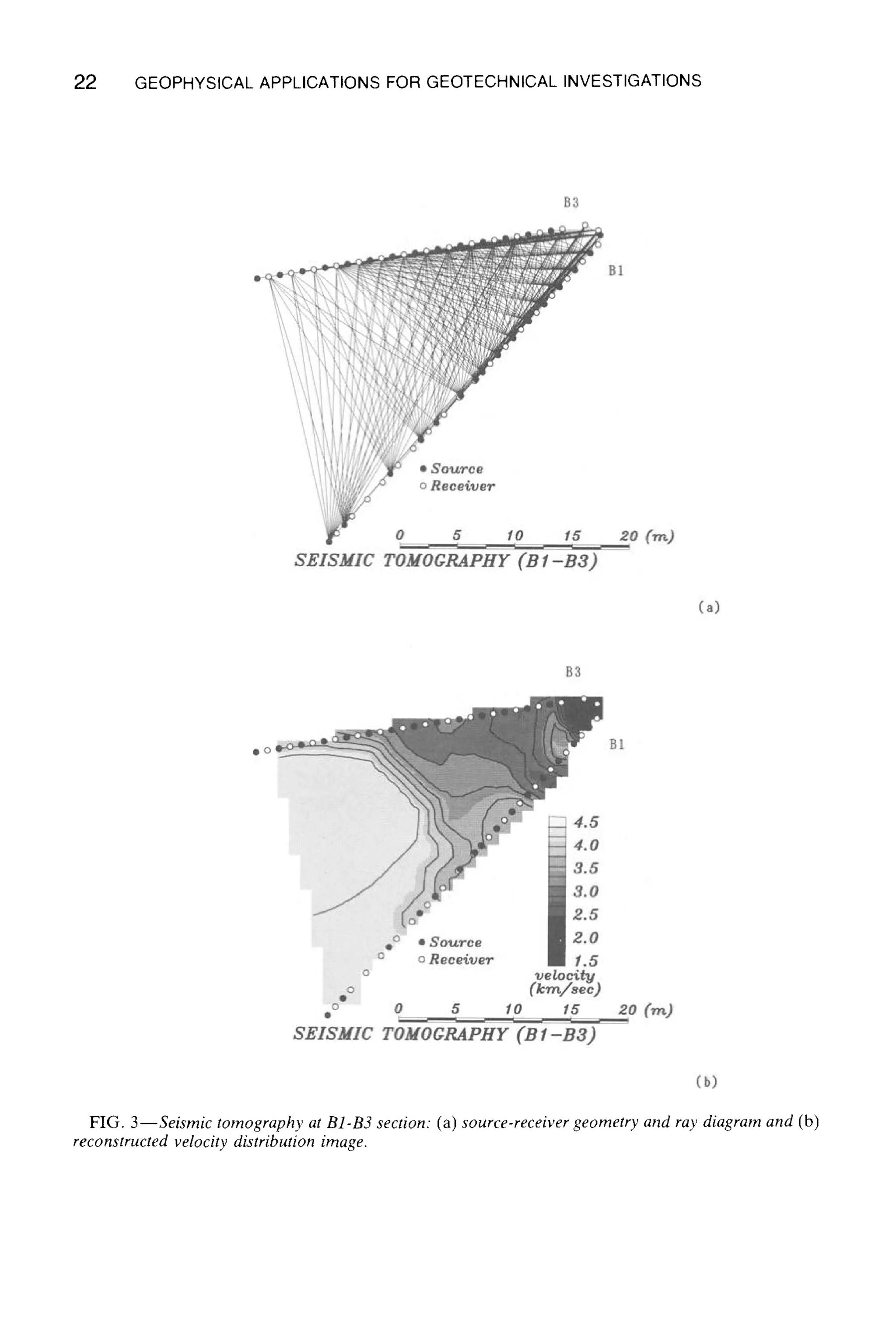
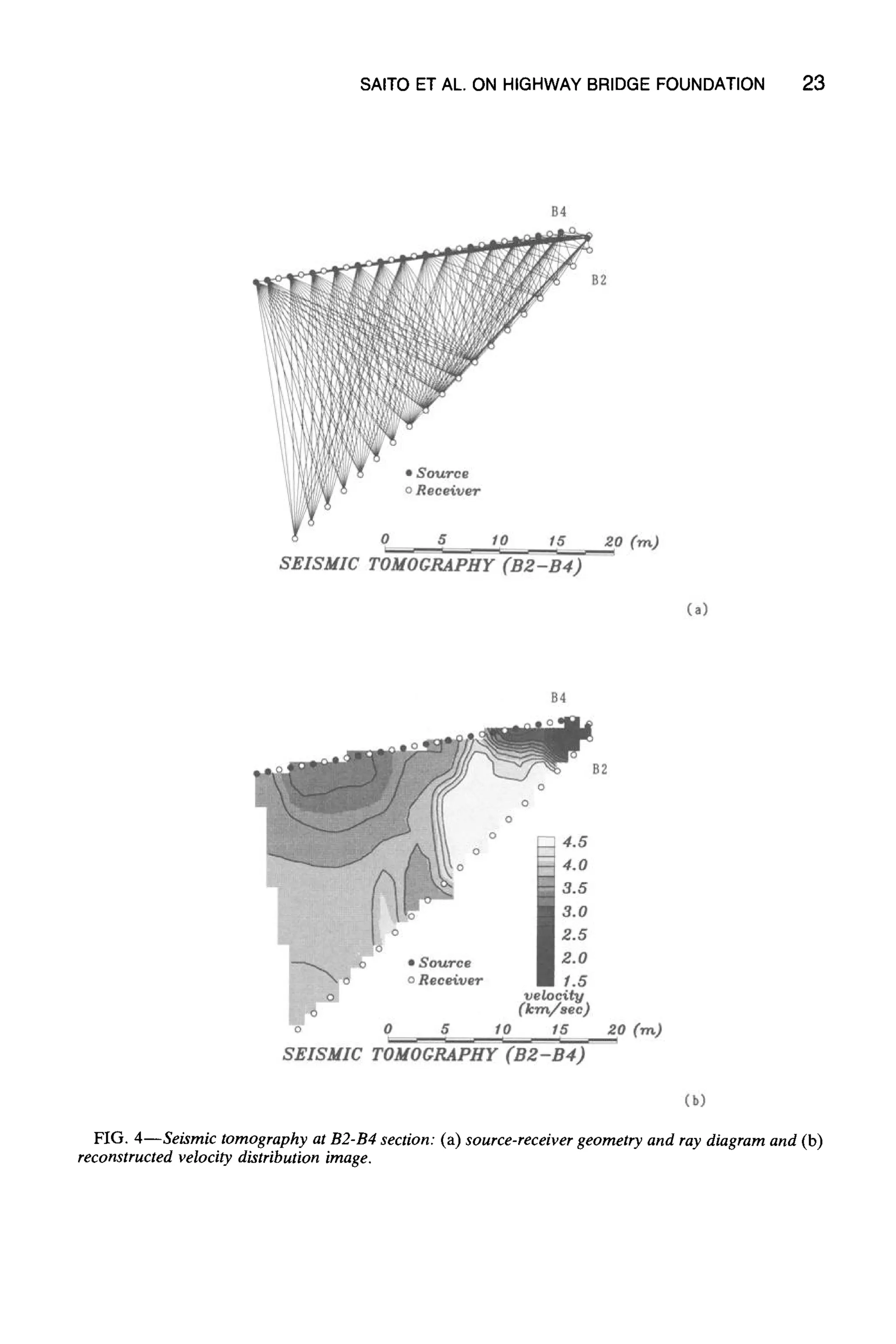
The measurements were conducted at two vertical sections (B1-B3 and B2-B4), a 10~
section (B3-B4), and a 45~section (B1-B2). The results for the two vertical sections and the
10~ section are compared with the results of another tomographic techniques. Figures 3
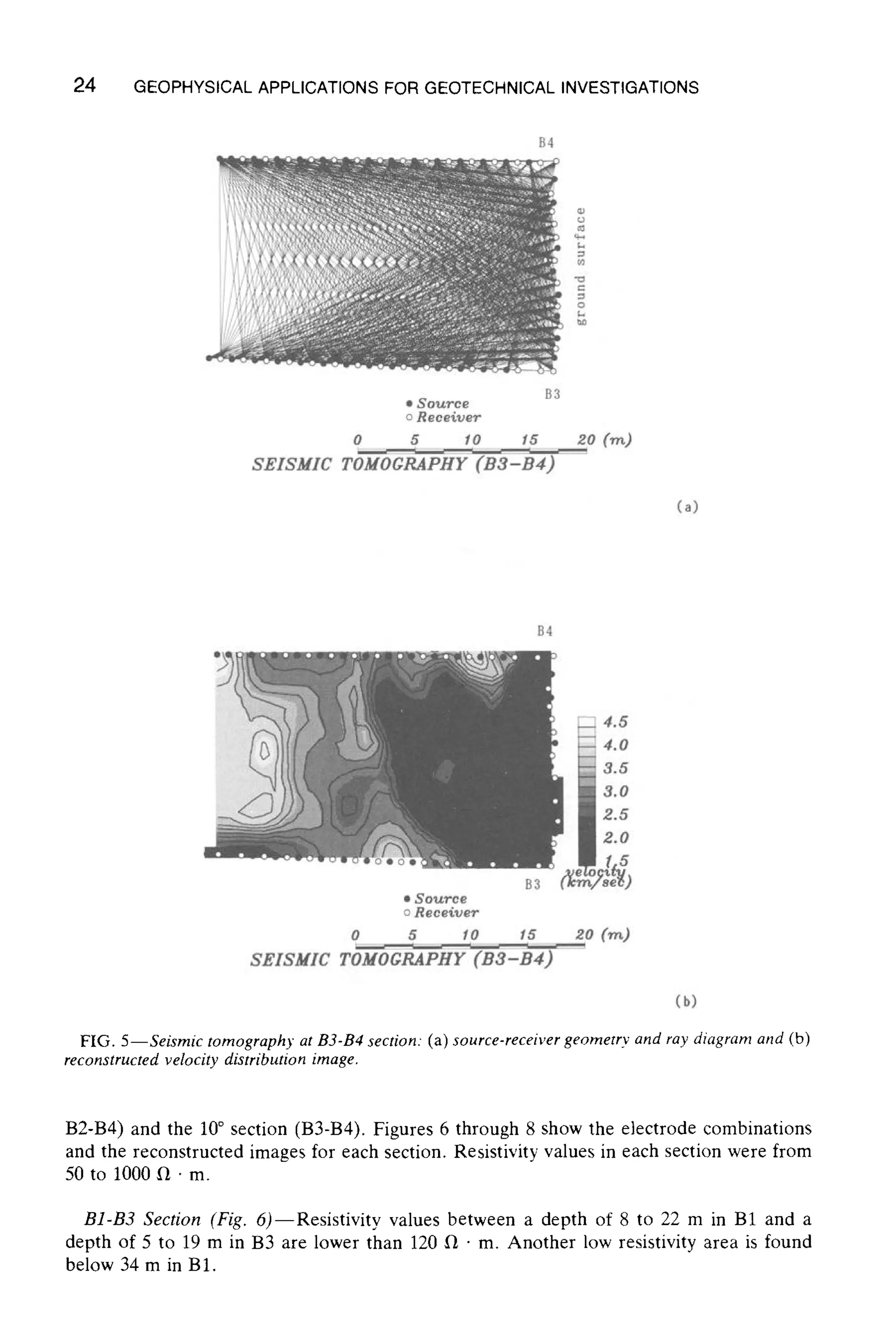
through 5 show source-receiver geometries, ray diagrams, and reconstructed velocity dis-
tribution images for each section.
B1-B3 Section (Fig. 3)--The P-wave velocity distribution of the B1-B3 section is shown
in Fig. 3b. Velocity values are indicated by shades of gray. Low velocity zones occur closer
to the surface-and between 8 to 19 m in Section B1 and 5 to 22 m in Section B3.
B2-B4 Section (Fig. 4)--Low velocity zones are found near the tops of the boreholes and
around the center of the area vertically. Between these low velocity zones, there is an
extremely high velocity zone.
B3-B4 Section (Fig. 5)--Nearly half of this section is a low velocity area with a velocity
of 2.5 km/s or lower.
Resistivity Tomography
Resistivity tomography is a two-dimensional resistivity exploration method having higher
resolution than the conventional resistivity exploration method [5].
Electrodes were placed at 2-m intervals in the borehol.es and on the ground surface between
boreholes surrounding the objective area. Electric potential was measured by the pole-pole
array method using OYO's McOHM resistivity meter.
Analysis was conducted by a combination of the alpha centers method and the nonlinear
least squares method [5]. The electric potential at each potential electrode was theoretically
calculated by the alpha centers method. The resistivity distribution was corrected to minimize
the root mean squares of the residuals between calculated and observed electric potentials
by the nonlinear least squares method.
The objective sections for resistivity tomography were two vertical sections (B1-B3 and
20 GEOPHYSICALAPPLICATIONSFOR GEOTECHNICALINVESTIGATIONS
2. 5~
/
98 7 . 5
Excavated Area
5 0 ~
BI: 0 = 45 ~
= 40 m
0 : down from horizontal
@
B3: e = 10 ~ 9
= 30 m I /
/
B2: 9 = 45*
= 40 m
4Y2
[ B4 e = ' $
9~= 30 m
@ ..........
),.....,-- , , ,
......" /.
~ I(m )
FIG. 1--Plane view of investigation area and borehole arrangement.
SAITO ET AL. ON HIGHWAY BRIDGE FOUNDATION 21
B3
c
(a)
B4
s
(b)
FIG. 2--Vertical section of investigation area and borehole arrangement." (a) BI-B3 section and (b)
B2-B4 section.
22 GEOPHYSICAL APPLICATIONS FOR GEOTECHNICAL INVESTIGATIONS
FIG. 3--Seismic tomography at B1-B3 section: (a) source-receiver geometry and ray diagram and (b)
reconstructed velocity distribution image.
SAITO ET AL. ON HIGHWAY BRIDGE FOUNDATION 23
FIG. 4--Seismic tomography at B2-B4 section: (a) source-receiver geometry and ray diagram and (b)
reconstructed velocity distribution image.
24 GEOPHYSICALAPPLICATIONSFOR GEOTECHNICALINVESTIGATIONS
FIG. 5--Seismic tomography at B3-B4 section: (a) source-receiver geometry and ray diagram and (b)
reconstructed velocity distribution image.
B2-B4) and the 10° section (B3-B4). Figures 6 through 8 show the electrode combinations
and the reconstructed images for each section. Resistivity values in each section were from
50 to 1000 f~ • m.
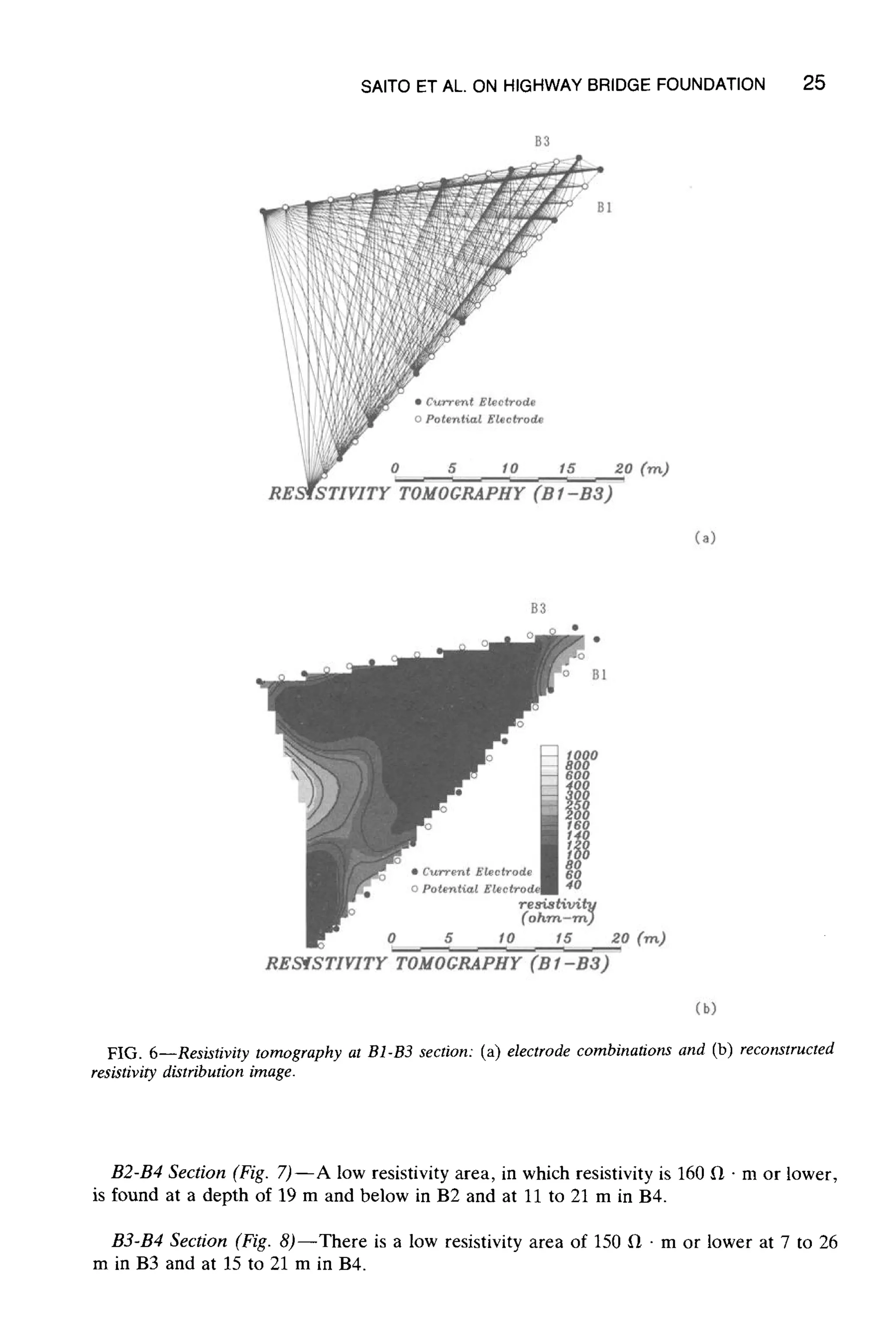
B1-B3 Section (Fig. 6)--Resistivity values between a depth of 8 to 22 m in B1 and a
depth of 5 to 19 m in B3 are lower than 120 f~ • m. Another low resistivity area is found
below 34 m in B 1.
SAITO ET AL. ON HIGHWAY BRIDGE FOUNDATION 25
FIG. 6--Resistivity tomography at B1-B3 section: (a) electrode combinations and (b) reconstructed
resistivity distribution image.
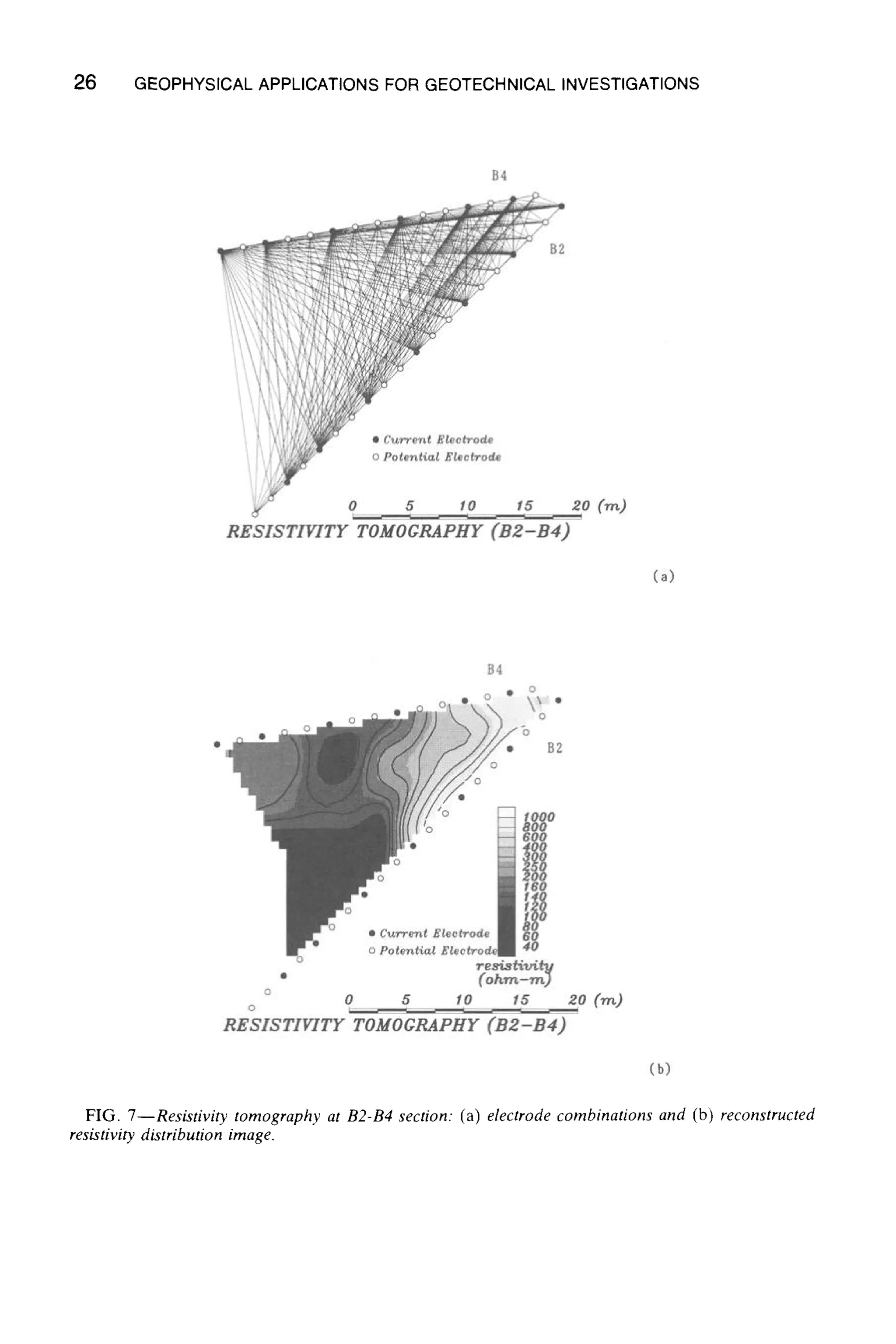
B2-B4 Section (Fig. 7)--A low resistivity area, in which resistivity is 160 ~ - m or lower,
is found at a depth of 19 m and below in B2 and at 11 to 21 m in B4.
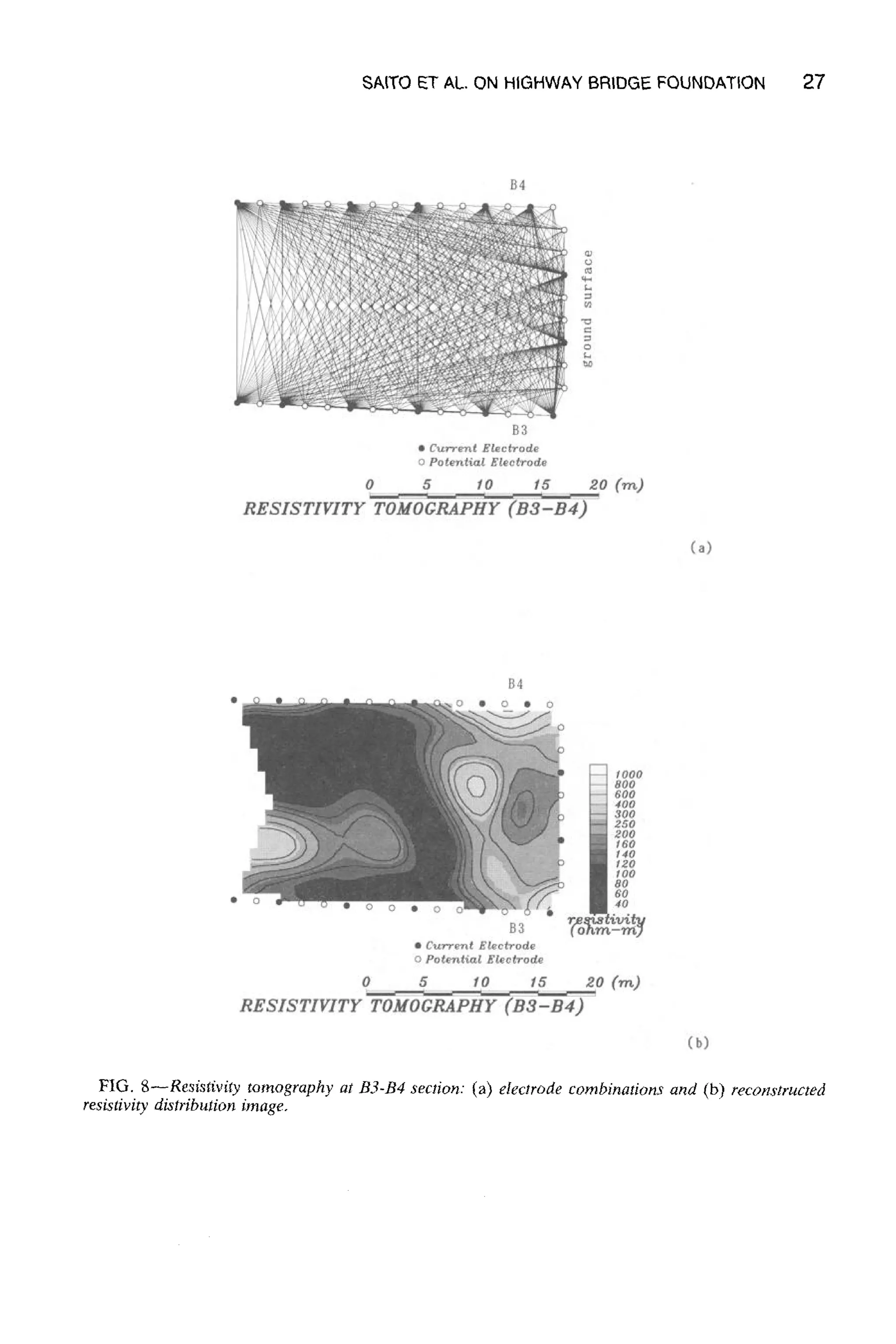
B3-B4 Section (Fig. 8)--There is a low resistivity area of 150 ~ - m or lower at 7 to 26
m in B3 and at 15 to 21 m in B4.
26 GEOPHYSICALAPPLICATIONSFOR GEOTECHNICALINVESTIGATIONS
FIG. 7--Resistivity tomography at B2-B4 section. (a) electrode combinations and (b) reconstructed
resistivity distribution image.
SA,ITO ET AL. ON HIGHWAY BRIDGE FOUNDATION 27
FIG. 8--Resistivity tomography at B3-B4 section." (a) electrode combinations and (b) reco~lstructed
resistivity distribution image.
28 GEOPHYSICALAPPLICATIONS FOR GEOTECHNICAL INVESTIGATIONS
Radar Tomography
In radar tomography, electromagnetic pulse waves are transmitted from one antenna
located in a borehole to a receiving antenna in another borehole. Each antenna was moved
at 2-m intervals. The measurement system used was OYO's YL-R2 Georadar system. The
borehole antennas were especially constructed for experimental use. The center frequency
of the antennas was about 100 MHz and transmitted power was 50 W [6]. The same analysis
procedure as that used in seismic tomography was used in radar tomography.
Attenuation of electromagnetic waves at this site was so high that significant signals could
not be received in horizontal sections. Therefore. the measurements were conducted only
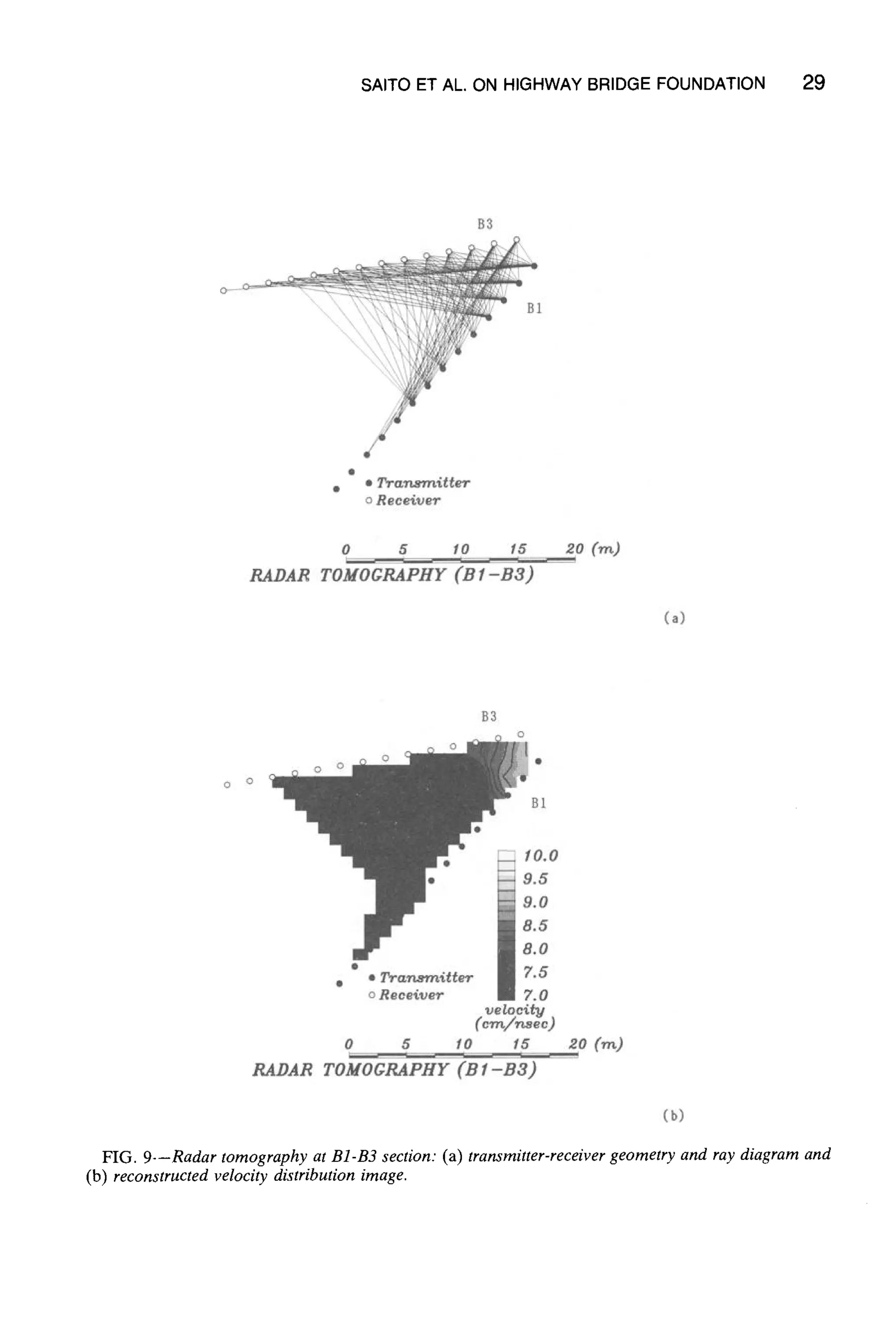
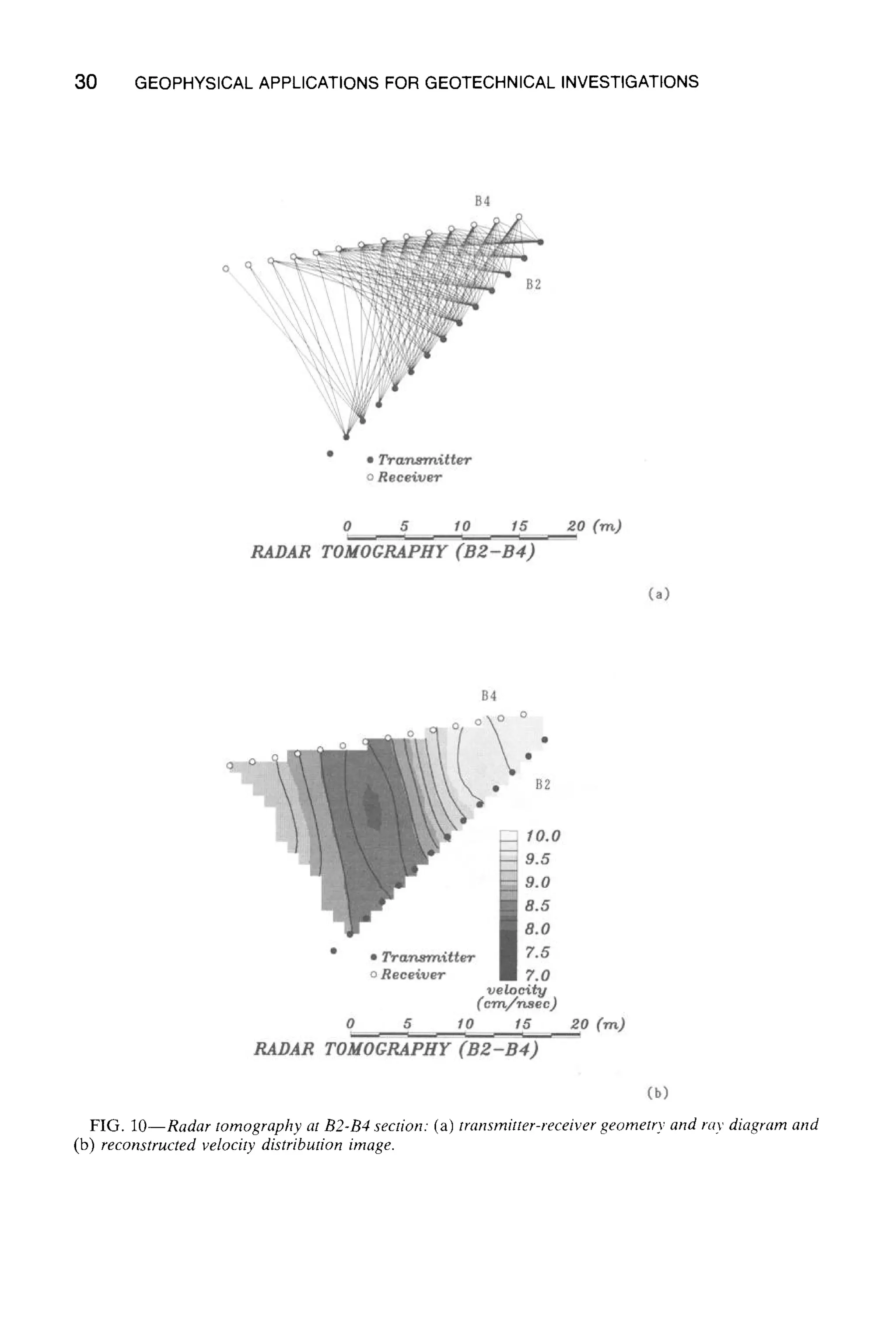
at two vertical sections. Figures 9 and 10 show the transmitting and receiving points, ray
diagrams, and the electromagnetic wave velocity distribution.
B1-B3 Section (Fig. 9)--Electromagnetic wave velocity is relatively lower than the velocity
values in the B2-B4 section. It is estimated, therefore, that water content in the bedrock at
the B1-B3 section is rather high. The area at the depth of 7 m or below has low velocity
and is estimated to be a fracture zone having high water content.
B2-B4 Section (Fig. lO)--The zone, below 16 m in B2 and from 13 to 21 m in B4, is a
low velocity zone that continues vertically and is considered to be bedrock having high water
content.
Consideration
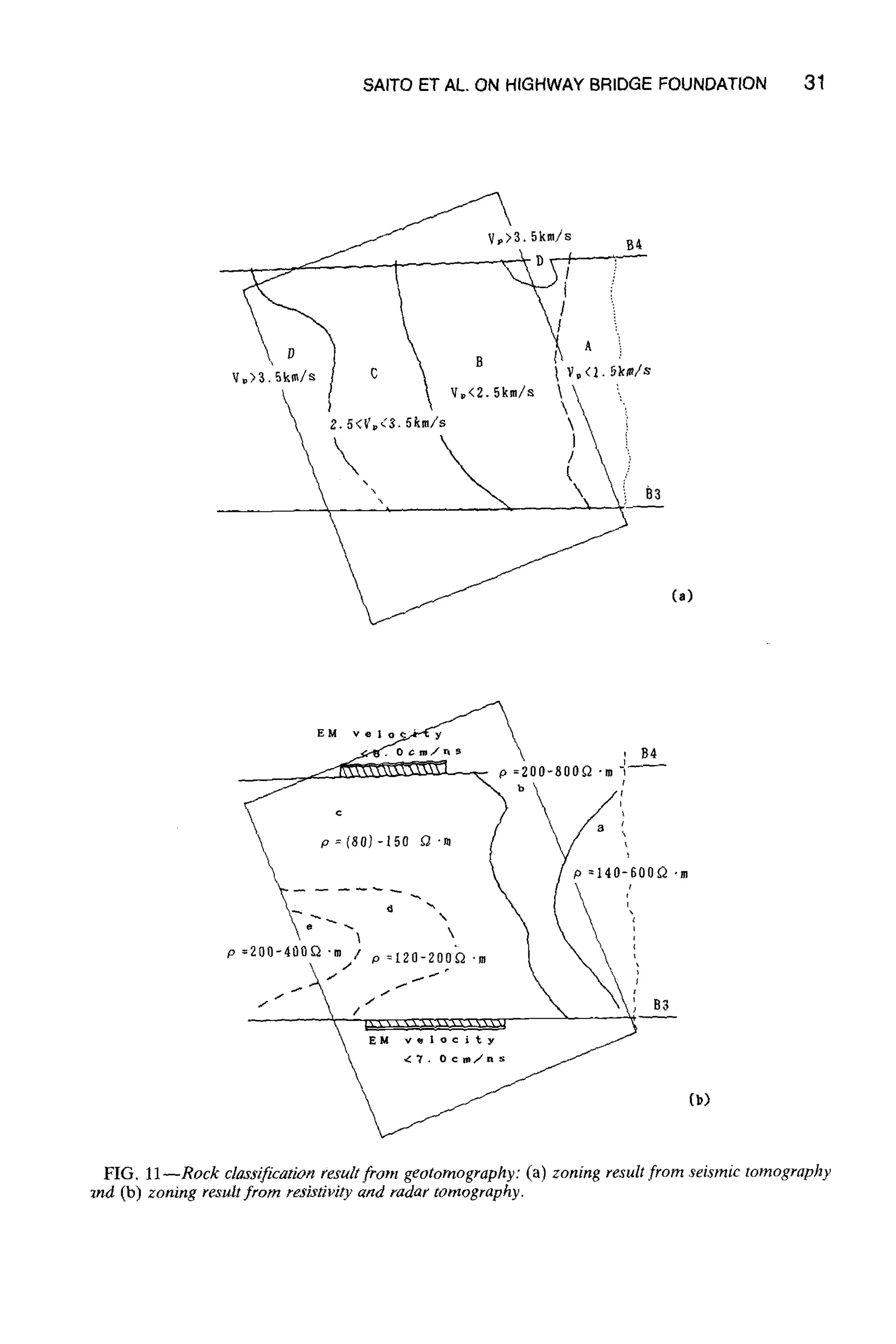
Based on the results of geotomography, we conducted an analysis of rock quality in the
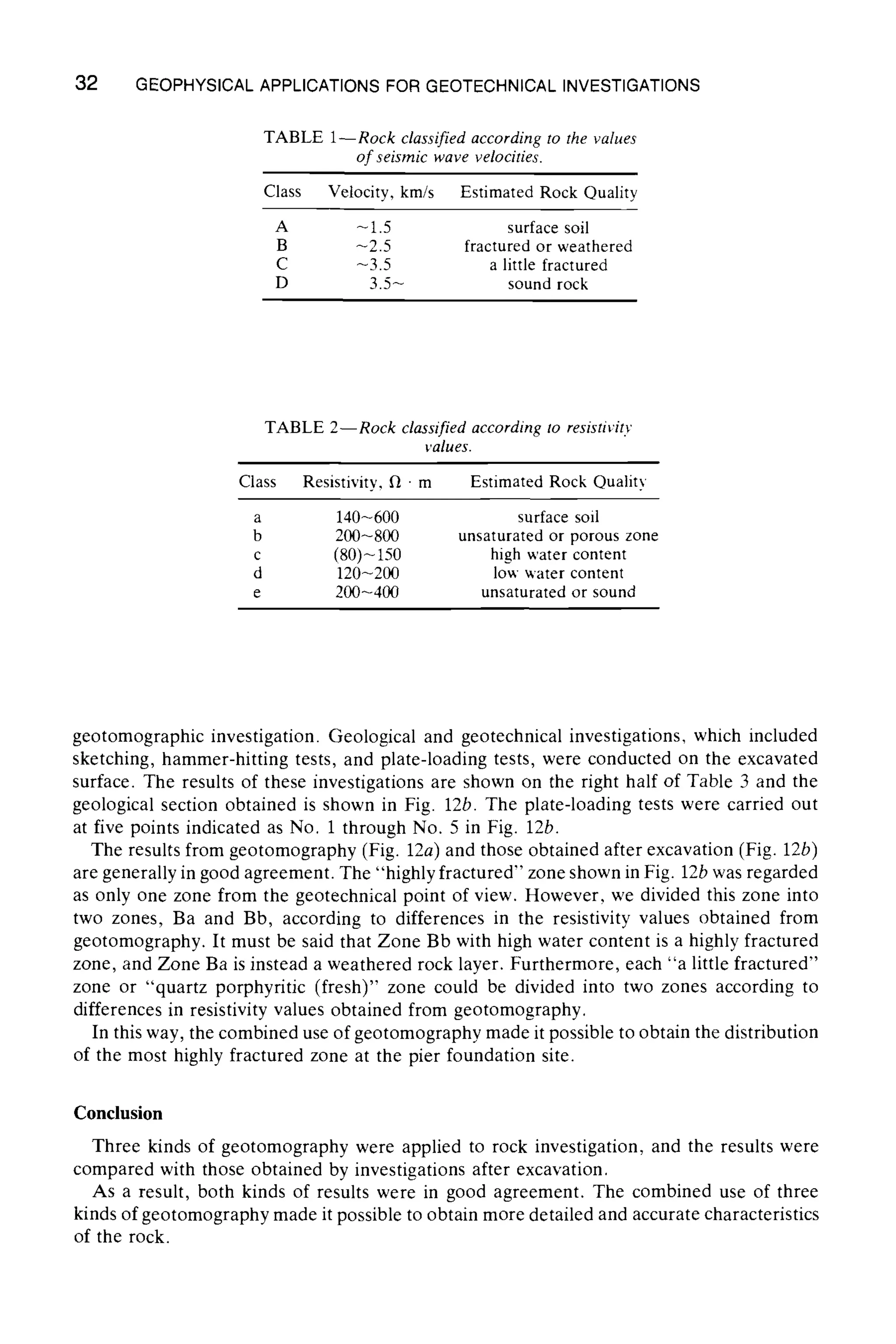
B3-B4 section. We tried to classify the rock according to the values of seismic wave velocities
as shown in Fig. 11a and Table 1.
Since the seismic wave velocity is closely related to the mechanical strength of rock, it
can be said that this figure shows the distribution of mechanical properties of rock.
In this investigation site, the relative variation of resistivity depends mainly on water
content and the quantity of clay that was formed through alteration or fracturing. We tried
to classify the rock according to resistivity values, as shown in Fig. llb and Table 2.
Next, we tried to analyze the rock quality by using the results of seismic tomography
along with the results of resistivity tomography. The final analysis result of tomographic
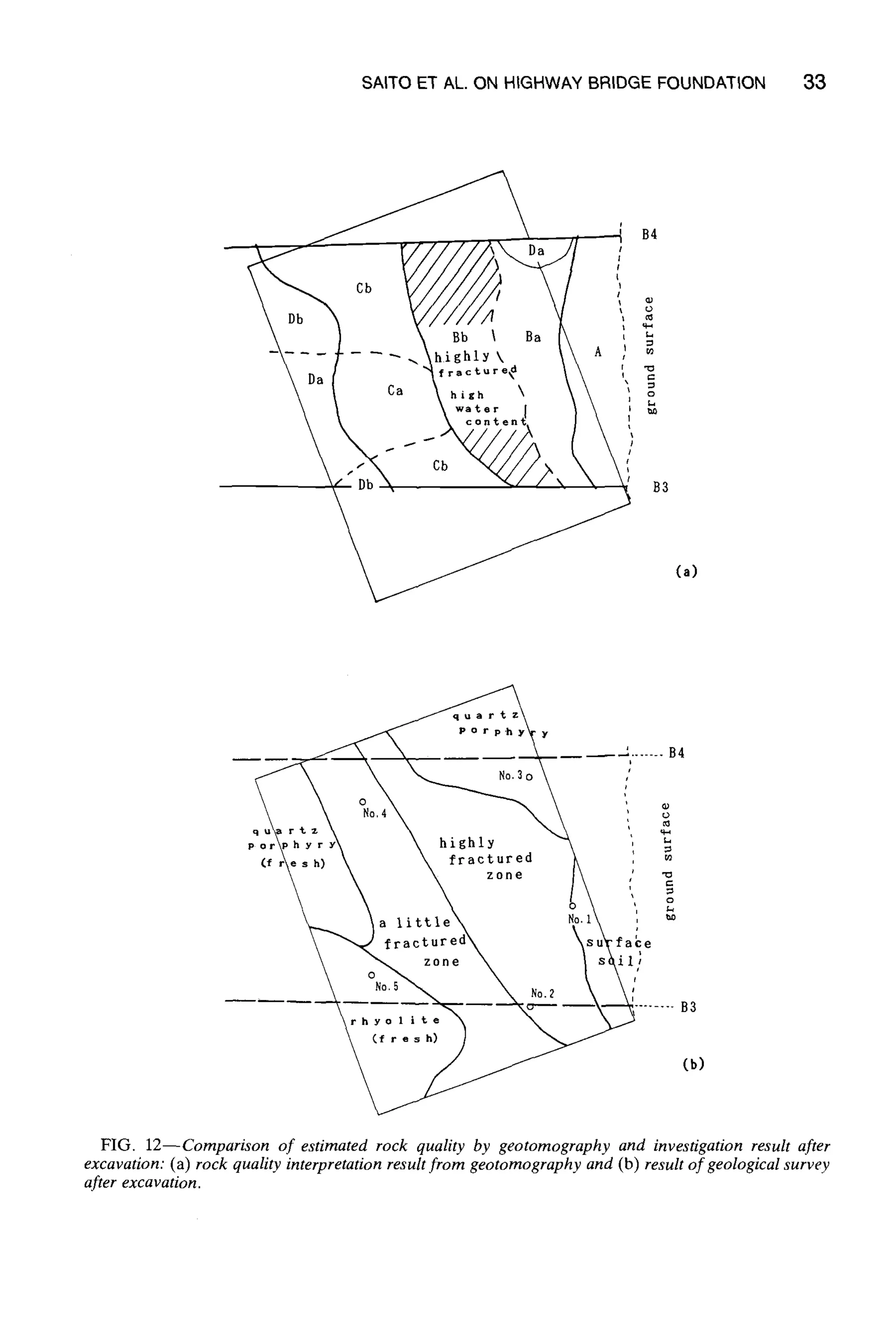
investigations is shown in Fig. 12a.
Zone A was considered to be the surface soil layer having low seismic wave velocity and
high resistivity. Zones B, C, and D were each divided into two areas of high resistivity or
low resistivity. Zone Ba was considered to be weathered but unsaturated rock distributed
near the surface which had low seismic wave velocity and relatively high resistivity. Zone
Bb was considered to be a highly fractured zone of high water content which had low seismic
wave velocity and low resistivity. Both Zones Ca and Cb were considered to be a little
fractured, but the water content differed from each other. Zone Ca was considered to have
rather low water content which had rather low seismic wave velocity and a little low resistivity.
Zone Cb was considered to have high water content which had rather low seismic wave
velocity and low resistivity. Both Zones Da and Db were relatively fresh and sound rock,
however, Zone Db had rather high water content.
Consequently, it can be said that Zones Bb, Ca, and Cb correspond to fracture zones.
In particular, Zone Bb is considered to correspond to the most highly fractured zone having
high water content. The results mentioned above are shown in the left half of Table 3.
Excavation for the construction of the bridge pier foundation was carried out after the
SAITO ET AL. ON HIGHWAYBRIDGEFOUNDATION 29
FIG. 9--Radar tomography at B1-B3 section: (a) transmitter-receiver geometry and ray diagram and
(b) reconstructed velocity distribution image.
30 GEOPHYSICAL APPLICATIONS FOR GEOTECHNICAL INVESTIGATIONS
FIG. lO--Radar tomography at B2-B4 section: (a) transmitter-receiver geometry and ray diagram and
(b) reconstructed velocity distribution image.
SAITO ET AL. ON HIGHWAY BRIDGE FOUNDATION 31
.5kra/s B~
/ i
Ca)
EM velor "
I B4
 ' ~ / ,o--140-600(2 'm
p=200-400ff2,m / r t20 200" - ~ ~ ~
(b)
FIG. 11--Rock classification resultfront geotomography: (a) zoning resultfrom seismic tomography
~nd (b) zoning resultfrom resistivity and radar tomography.
32 GEOPHYSICALAPPLICATIONSFOR GEOTECHNICALINVESTIGATIONS
TABLE 1--Rock classified according to the values
of seismic wave velocities.
Class Velocity, km/s Estimated Rock Quality
A - 1.5 surface soil
B -2.5 fractured or weathered
C -3.5 a little fractured
D 3.5- sound rock
TABLE 2--Rock classified according to resistivity
values.
Class Resistivity, fl 9m Estimated Rock Quality
a 140-600 surface soil
b 200-800 unsaturated or porous zone
c (80)-150 high water content
d 120-200 low water content
e 200-400 unsaturated or sound
geotomographic investigation. Geological and geotechnical investigations, which included
sketching, hammer-hitting tests, and plate-loading tests, were conducted on the excavated
surface. The results of these investigations are shown on the right half of Table 3 and the
geological section obtained is shown in Fig. 12b. The plate-loading tests were carried out
at five points indicated as No. 1 through No. 5 in Fig. 12b.
The results from geotomography (Fig. 12a) and those obtained after excavation (Fig. 12b)
are generally in good agreement. The "highly fractured" zone shown in Fig. 12b was regarded
as only one zone from the geotechnical point of view. However, we divided this zone into
two zones, Ba and Bb, according to differences in the resistivity values obtained from
geotomography. It must be said that Zone Bb with high water content is a highly fractured
zone, and Zone Ba is instead a weathered rock layer. Furthermore, each "a little fractured"
zone or "quartz porphyritic (fresh)" zone could be divided into two zones according to
differences in resistivity values obtained from geotomography.
In this way, the combined use of geotomography made it possible to obtain the distribution
of the most highly fractured zone at the pier foundation site.
Conclusion
Three kinds of geotomography were applied to rock investigation, and the results were
compared with those obtained by investigations after excavation.
As a result, both kinds of results were in good agreement. The combined use of three
kinds of geotomography made it possible to obtain more detailed and accurate characteristics
of the rock.
SAITO ET AL. ON HIGHWAY BRIDGE FOUNDATION 33
~ a4
Ba L
' g
I o
contens i
water [
c
-- 83
(a)
__ ~-- ...... B4
por i ~
, m
g
fai:e
Cb)
FIG. 12--Comparison of estimated rock quality by geotomography and investigation result after
excavation: (a) rock quality interpretation resultfrom geotomography and (b) result of geological survey
after excavation.
34 GEOPHYSICAL APPLICATIONS FOR GEOTECHNICAL INVESTIGATIONS
TABLE 3--Results from geotomography and investigationsafter excavation
Results from Geotomography
Results from Investigations after
Excavation
Seismic Deformation
Velocity, Resistivity, Estimated Constant,
Class km/s ~ 9m Quality Quality kgf/cmz
A -1.5 140-600 surface soil surface soil
weathered
Ba 200-800 (unsaturated)
-2.5 highly fractured
highly fractured
Bb 80-150 and high
water content
a little fractured
and rather
Ca 120~200
low water
content
-3.5 a little fractured
a little fractured
Cb 80-150 and high
water content
290
(No. 1 point)
160
(No. 2 point)
650
(No. 4 point)
quartz porphyry 1900
Da 200-400 sound or fresh (fresh) (No. 3 point)
3.5-
sound and rhyolite (fresh)
Db 80-150 rather high 840
water content (No. 5 point)
In the future, we intend to apply geotomography to many other sites having various
geological conditions and to conduct further studies on the applicability of geotomography
for civil engineering purposes.
References
[1] Sassa, K., "Suggested Methods for Seismic Testing Within and Between Boreholes,'" International
Journal of Rock Mechanic Sciences and Geomechanics Abstracts, Vol. 25, No. 6, 1988, pp. 447-
472.
[2] Sakayama, T., Ohtomo, H., Saito, H., and Shima. H., "Applicability and Some Problems Of
Geophysical Tomography Techniques in Estimation of Underground Structure and Physical Prop-
erties of Rock," presented at the 2nd International Symposium on Field Measurements in Geo-
mechanics, Kobe, Japan, April 1987.
[3] Aki, K. and Lee, W. H. K., "Determination of Three-Dimensional Velocity Anomalies Under a
Seismic Array Using First P Arrival Times from Local Earthquakes," Journal of Geophysical
Research, Vol. 81, 1976, pp. 4381-4399.
[4] Saito, H. and Ohtomo, H., "Seismic Ray Tomography Using the Method of Damped Least Squares,"
Exploration Geophysics. Vol. 19, Nos. 1/2, 1988. pp. 348-351.
[5} Shima, H. and Sakayama, T., "Resistivity Tomography: An Approach to 2-D Resistivity Inverse
Problems," presented at the 57th SEG Annual International Meeting, New Orleans, Oct. 1987.
[6] Toshioka, T. and Sakayama, T., "Preliminary Description of Borehole Radar and First Results,"
presented at the 76th SEGJ Conference, Tokyo, Japan, April 1987.
Borehole Geophysics
Robert E. Crowder, 1 Larry A. Irons, 2 and Elliot N. Yearsley ~
Economic Considerations of Borehole
Geophysics for Hazardous Waste Projects
REFERENCE: Crowder, R. E., Irons, L. A., and Yearsley, E. N., "Economic Considerations
of Borehole Geophysics for Hazardous Waste Projects," Geophysical Applications for Geo-
technical Investigations, ASTM STP 1101, Frederick L. Paillet and Wayne R. Saunders, Eds.,
American Society for Testing and Materials, Philadelphia, 1990, pp. 37-46.
ABSTRACT: In environmental or hazardous waste investigations, simple homogenous sub-
surface geologic conditions have historically been assumed. In reality, heterogeneous condi-
tions predominate. The costs of remediation and the consequences of incorrect remediation
are increasing rapidly. These investigations often require the collection of extensive amounts
of data to evaluate the problems sufficientlyto recommend and execute appropriate remedial
action.
Borehole geophysics can be used to obtain valuable data including information on geologic
conditions and in-situ physical parameters in drill holes. The amount and benefit of this
information is determined by the logging suite, borehole conditions, geologic parameters,
interpreter experience, and application of current technology.
Typical costs for drilling and geophysical logging associated with different types of environ-
mental investigations vary considerably. These costs are a function of the types and quantity
of the desired data, whether the geophysical logging and analysis will be performed in-house
or by an outside consultant, and the operational field environment.
Five case histories demonstrate the application of borehole geophysics to hazardous waste
investigations and provide qualitative evidence as to its cost-effectiveness. The primary con-
clusionsindicated by these case histories are that: (1) geophysical logs assist in well construction
efforts; (2) borehole geophysical logs provide in-situphysical measurements not available from
other methods; and (3) costs associated with borehole loggingcan be justified by consideration
of the total cost of drilling, completion, and monitoring and the implications of inadequate
understanding of the subsurface in a remediation program.
KEY WORDS: borehole geophysics, monitor well, cost, hazardous waste site investigations
In environmental investigations for ground-water contamination problems, simple, ho-
mogenous subsurface geologic conditions have historically been assumed. These site char-
acterizations are proving to be more difficult than originally anticipated, and a number of
prior investigations appear to be flawed. A U.S. Environmental Protection Agency (EPA)
study [1] of 22 Resource Conservation and Recovery Act (RCRA) sites showed problems
including:
(1) incorrect screening in 50% of the monitoring wells,
(2) incorrect placement of 30% of the wells, and
(3) on 10% of the sites, Wells were placed before determining the direction of ground-
water flow.
1President and geological engineer, respectively, Colog, Inc., 10198th St., Golden, CO 80401.
2Senior associate geophysicist, Ebasco/Envirosphere Co., 143 Union Blvd,, Suite 1010, Lakewood,
CO 80228.
37
Copyright91990by ASTM International www.astm.org
38 GEOPHYSICALAPPLICATIONS FOR GEOTECHNICAL INVESTIGATIONS
The geologic conditions encountered on most of these sites are complex and often require
collecting extensive amounts of data to evaluate the problems sufficiently to recommend
and execute the appropriate remedial action. The costs of remediation and the consequences
of incorrect remediation are increasing rapidly [2]. Each project is unique in certain respects
because the particular environment, potential contaminant, and goals will all be somewhat
different.
The purpose of this paper is to convey experience and information regarding the economic
considerations involved in obtaining subsurface data relevant to hazardous waste investi-
gations. Discussions contained herein outline the benefits of the application of borehole
geophysics to the problem of subsurface interpretation. These discussions provide guidelines
and considerations for geophysical logging operations and costs and review historical prac-
tices and costs of drilling, coring, testing, and geochemical analyses.
The common thread in these topics is their application toward the investigation and
characterization of hazardous (or potentially hazardous) waste sites. The relative cost-
effectiveness of borehole geophysics in these efforts is addressed. The thesis of this paper
is that borehole geophysics provides a cost-effective means for the subsurface investigations
of these sites. Furthermore, that the existential measurements provided by borehole geo-
physics complement core data, support surface geophysics, and offer geologic and hydro-
geologic information not otherwise available.
Borehole Geophysical Logging Considerations and Benefits
There is no uniform logging suite applicable to every project, and no unambiguous rules
for log interpretation exist. Most log analyses in ground-water investigations are based upon
techniques developed by the petroleum industry. These techniques may not be directly
applicable when applied to shallow ground-water investigations, and less experience and
scientific literature is available in this area. Many ground-water engineers and geologists
have no formal training in the use of borehole geophysics, whereas their counterparts in
the petroleum industry are well trained in the use of these logs.
Furthermore, logging tools developed for the petroleum industry are inadequate for the
shallow depth and small-diameter applications encountered in most environmental inves-
tigations. Many monitoring wells are drilled and completed with hollow-stem auger tech-
niques in the vadose zone. Logging in the vadose or unsaturated zone is feasible and provides
valuable information not available elsewhere, but disturbances to the formation from drilling
in this zone may produce large changes on the logs. Quantitative analysis usually requires
information from several types of logs. Sometimes the drill holes are not stable enough for
open-hole logging or to allow more than one open hole pass by a geophysical probe, and
the selection of probes for the initial pass requires careful consideration. Radioactive sources
required for some measurements are regulated, and the use of these sources may not be
feasible to use on some projects.
Many environmental projects are located in areas distant with respect to the historical
petroleum and mineral industry service companies, often requiring expensive mobilization.
Environmental projects frequently have a low production rate for drilling.new wells, both
in number and depth. The time lapse between wells may be several days. These factors
increase the logging costs. Health and safety training requirements can be a major burden
for many of the smaller slimhole logging contractors and may prevent them from entering
the environmental market.
Historically, only a few simple logs have been used in nonpetroleum applications. Many
people expect slimhole nonpetroleum logs for environmental applications to be inexpensive
CROWDER ET AL. ON BOREHOLE GEOPHYSICS
TABLE 1--Direct benefits of borehole geophysics.
39
Broad Category Specific Aspects
Well construction
Physical properties
Stratigraphic
correlation
depth and identification of lithologicbeds, borehole size and volume,
water table
porosity, density, resistivity, temperature, fluid flow, water quality,
fracture identification, rock strength parameters
continuity of aquifers and confining beds based on cross-hole
correlation, facies changes
and accordingly do not budget for the necessary logs and interpretation. Many firms do not
have staff expertise to use much of the advanced geophysical information. For example,
knowledge may be limited to recognition of apparent sand-shale zones for screen selection
and may not include proper interpretation of the remaining data. The economics of running
a complex suite that cannot be properly used would appear questionable.
In spite of the above perceptions and hindrances to slimhole logging, borehole geophysics
has important benefits in hazardous waste investigations when interpreted properly [3].
These benefits can be classified as direct and indirect [4,5], as shown in Tables 1 and 2.
Borehole GeophysicalLogging Costs
Traditional logging costs were based upon a low service charge (base time rate), a footage
charge (based upon the types of probes and total project footage logged), and miscellaneous
expenses for such items as per diem and standby. Costs per foot were kept low by logging
high footages in many wells. Typically, the drill rig was not incurring standby charges on
energy/mineral exploration projects and the standby charges for the petroleum applications
were generally well understood by everyone involved with those projects.
The primary cost factor for most environmental logging programs is personnel and equip-
ment time. This time factor includes mobilization/demobilization to and from the project
area, standby waiting for a well to be finished, pre- and post-log calibration, data acquisition,
data processing, interpretation, and decontamination of personnel and equipment. For the
typical shallow wells encountered on most environmental investigations, actual data acqui-
sition time is the least significant aspect. Footage charges are difficult to compare to the
classical slimhole logging industry and tend to be a minor element in the overall cost. The
number and type of logs affect the overall costs in that it takes as long or longer to pre-
and post-calibrate, setup, and decontaminate on a shallow well as it does on a deep well.
However, on many projects, the cost to run one or several extra logs may be insignificant
TABLE 2--Indirect benefits of borehole geophysics.
1. Objective, repeatable data collected over a continuous vertical interval.
2. Digital data is conveniently stored, processed, and transmitted.
3. Log results are available at well site or shortly thereafter.
4. Borehole geophysical data is synergistic with core data, surface geophysics, and other
borehole geophysical data.
5. Borehole logs can be standardized to facilitate correlation between different phases of an
investigation by different firms.
40 GEOPHYSICALAPPLICATIONSFOR GEOTECHNICALINVESTIGATIONS
to the overall logging costs. A detailed interpretation of log data requires at least 1 h/h of
data acquisition.
In an effort to minimize logging costs and to collect data inexpensively, many companies
are renting portable logging equipment. Rental equipment is available from several sources
for measurements such as natural gamma, spontaneous potential (SP), single-point resist-
ance, normal resistivity, induction, temperature, borehole video, fluid resistivity, flowmeter,
and caliper in both analog and digital mode. Normally, measurements requiring the use of
radioactive sources or more complex measurements such as sonic are not rented. Rental
costs start at less than $100 per day.
A number of companies with sufficient work load to maintain the necessary staff and
equipment have in-house logging capabilities. Unlike the conventional energy industry, it
is more difficult to schedule environmental drilling programs between different offices of a
company. These in-house logging capabilities tend either to be simple in nature with the
staff sharing other duties or are primarily available from only one base of operation. Logging
costs include the capitalization of the logging equipment (from $15 000 to hundreds of
thousands of dollars) including spares, maintenance costs, labor costs including training,
and benefits, such as vacation, insurance costs, and operational expenses.
Contract-logging costs range from less than $1000 per day to approximately $3500 or more
per day when logging. Standby time waiting for well or testhole availability is usually at a
lower rate. The number of logs, amount of decontamination, availability of wells, and access
affect the amount of logging that can be performed in one day. A simple suite of one to
two probes in Level D protective clothing with minimal decontamination may allow for a
number of 30- to 60-m (100- to 200-ft) wells or testholes to be logged in one day. Conversely,
it may be difficult to get even one 30- to 60-m (100- to 200-ft) testhole well logged in a day
on some projects.
Environmental Drilling and Testing Costs and Considerations
Sampling, drilling, and testing programs are necessary for every subsurface environmental
investigation. They are not without problems or concerns. For instance, sample descriptions
are subjective depending upon the experience and goals of the describing scientist. Core
samples are point measurements, hopefully representative of the zone of interest. Sample
recovery is not guaranteed, and the sample frequently is altered by the drilling process.
Sample and drilling problems are typified as follows:
(1) cross contamination from upper formations,
(2) contamination from drilling fluid,
(3) incorrect interval sampled as a result of inexperience or carelessness,
(4) no sample recovery and zones of loss circulation,
(5) chemical changes caused by oxidation when the sample is exposed to air and dehy-
dration of samples,
(6) errors in sample description and analysis, and
(7) lack of solid samples for petrophysical and geotechnical analysis.
While all of the aforementioned errors do not occur all of the time, they do happen often
enough to constitute significant problems with respect to quantitative interpretations. An-
other consideration is handling and storage of hazardous samples. The cost of treatment
and storage of these samples may limit the number of samples collected.
Aquifer tests provide information on the horizontal hydraulic conductivity and storage
CROWDER ET AL. ON BOREHOLE GEOPHYSICS 41
capacity of the aquifer. The hydraulic conductivity data obtained from aquifer testing may
be of limited value because of the spatial variability of aquifer properties that greatly affect
the transport of contaminants. Aquifer tests may also be of limited use as a result of vertical
variations because they produce hydraulic conductivity values that are integrated over the
vertical domain. Testing of individual strata can be done if the strata are horizontally
extensive, but this is usually not the case in shallow, unconsolidated sediments. Measurement
of the hydraulic conductivity tensor requires a minimum of three observation wells. The
aquifer must be homogeneous over the area of these observation wells, which is usually a
poor assumption for shallow, unconsolidated sediments.
Aquifer testing is often further complicated with the necessity of handling large quantities
of hazardous liquids. These liquids often must be treated, stored, and disposed offsite.
Under such conditions, most tests are made as simple as possible, and thus, the results may
be questionabl e at best.
A survey of some domestic engineering companies for average costs concerning the major
phases of drilling, well installation, and basic testing of commonly designed monitoring wells
was done informally. The diversity of environmental projects and the fact that different
costing methods were used by the various firms made this task difficult. Although every
project was unique, the following cost ranges are typical.
The costs for a 30-m (100-ft) deep well with Level D protective clothing, with a competent
borewall, completed with a single screen at the bottom of the well, and with a 10.8-cm (4.25-
in.) inner diameter (ID) hollow-stem auger with a 5.08-cm (2-in.) ID polyvinyl chloride
(PVC) well screen and riser averaged from $4500 to $5500. Split-spoon sampling added $500
to $1000 per well. Increasing the well diameter using a 21-cm (8.254-in.) ID hollow-stem
auger added $200 to $1000 per well. Changing from PVC to a stainless steel screen and riser
added $2000 to $3000 per well. Increasing the depth to 60 m (200 ft) nearly doubled the
costs. Going from Level D to Level C increased the costs by approximately 25%. Adverse
drilling conditions such as gravel or cobbles may increase the costs by 50% or more. Some-
times drilling conditions prevent completion of the well at all. The drive and wash (percussion
drilling) drilling method approximately doubles the costs over auger drilling. Typically, these
costs are roughly $1000 to $1500 more per 30-m (100-ft) well. The costs of a mud rotary
with a 15.24-cm (6-in.) hole are similar to those of a hollow-stem auger. Continuous-core
drilling can more than double the drilling costs on most projects.
The average 46-m (150-ft) well on eight large environmental investigations located on the
east and west coasts and in Colorado was $8500. The average for a 60-m (200-ft) well was
nearly $11 500. The high was for several 76-m (250-ft) wells with multiple completions in
difficult drilling conditions that cost up to approximately $25 000. None of these costs include
project management.
In-hole permeability testing costs are quite variable ranging from simple "slug" tests for
a single interval costing approximately $500 to $1000/test to drawdown tests ranging from
$4000 to $5000 minimum. One company constructed a special water treatment plant costing
$100 000 to handle the effluent from a number of long-term pump tests on one project.
Many environmental engineering firms try to perform all tasks possible in-house. This
frequently results in the specification of capabilities that are available within the company
as opposed to more suited measurements. Often these firms lack the experience to record
or interpret these measurements properly. Additionally, many of the engineering firms are
not accustomed to standard logging service contractor terms and conditions, especially
regarding liability for radioactive materials. As a result, they frequently have not included
the appropriate terms in their contracts with the primary client and cannot use measurements
that may be applicable for their project.
42 GEOPHYSICALAPPLICATIONSFOR GEOTECHNICALINVESTIGATIONS
Geochemical Sample Analysis Cost Considerations
The economic implication of a poorly constructed monitoring well is not limited to the
cost of constructing this well. The costs related to the geochemical analysis of water samples
over the life of the well are much more significant expenses even though thev may come
from a different budget.
It is a general practice to sample each water-bearing zone on most hazardous waste
investigations quarterly until remediation is demonstrated after which time these wells are
usually sampled semiannually for another ten or more years to demonstrate that the problem
will not return. The cost of the analysis of these samples varies per project, but typically
ranges from $800 per sample for inorganic analysis to more than $1500 per sample for volatile
and organic analysis.
Considering the life of an average monitoring well may be 20 to 30 years or longer, the
cost of geochemical analysis for samples taken from this well may easily exceed $100 000
over its life. This does not include the cost to collect the sample, project management, and
so forth. Ideally, a poorly or incorrectly completed monitoring well will be identified early
in its life and corrected or abandoned. This process frequently takes a number of years, and
all too often these wells are not recognized ~t all. At one large site characterization project,
the addition of one sample analysis of each well cost $1 000 000. Geochemical sampling and
analysis over many years is very expensive: thus. the importance of using geophysical logs
to aid in design of a properly completed monitoring well cannot be overstated.
Design and Cost Analysis for Borehole Geophysical Surveys
The first step in design and analysis of a borehole-geophysical logging program is to
determine the short- and long-term goals for the project. The geophysical logs will be used
for one or more of the following:
(1) screen location and well construction;
(2) regulatory requirements;
(3) future integration and reinterpretation;
(4) lithologic data;
(5) in-situ parameter analysis needed for porosity, permeability, elastic moduli, fracture
evaluation, and so forth; and
(6) parameters for modeling surface geophysical methods.
The second step is to establish the options or techniques that exist for collection of the
required data. For instance:
(1) lithology information is available from drill samples including auger, rotary, and core,
as well as surface geophysics, and various well logs;
(2) porosity information can be obtained from laboratory testing of core samples, his-
torical data, and various logs;
(3) permeability information can be obtained for laboratory testing of core samples, pump
testing, and well logs; and
(4) fracture analysis is available from core data, borehole video, different well togs, pump
data, and so forth.
CROWDER ET AL. ON BOREHOLE GEOPHYSICS 43
After establishing the options that are available, consider which limitations and site con-
ditions may affect survey design:
(1) the need to standardize data;
(2) hole conditions--open, cased, dry, wet, type of casing, and so forth;
(3) level of interpreter/analyst's expertise;
(4) project time schedule; and
(5) project budget.
Talk with your client about your project goals and also with your logging group (in-house,
service company, consultant, and so forth) before starting your project. They can both
provide you with valuable information affecting your program.
After thinking through these steps, prioritize the different options and choose accordingly.
Remember that the money you are spending is no better than the results that you receive.
Try not to be "penny wise and pound foolish." The following brief case histories typify this
design and cost analysis procedure.
Case History l
This investigation involved a detailed lithologic and hydrogeologic characterization in-
cluding the planned continuous coring of five wells with subsequent observation well ficlds
around the core holes for aquifer testing and monitoring in the central United States. It was
decided before the start of the project to attempt to collect as much information as possible
from these wells. A borehole-geophysical logging program including compensated density,
full waveform sonic, focused resistivity, gamma, SP, normal resistivity, temperature, fluid
resistivity, caliper, and neutron was planned on the core holcs. This was significantly more
logs than had been used on previous work in the project arca.
As an immediate benefit, the log data were used to help construct the monitoring wells.
The log analyst recommended completion zones in several cases that were not evident in
the geologic descriptions. Over the longer term. this program helped determine in-situ
porosity and refined the lithology. For instance, it was difficult to classify many of the
carbonaceous units until a density log was made. Correlation was made in a complicated
stream channel sequence over 1 mile (1.6 km) in distance confirming what was previously
speculated. The data provided model parameters for several surfacc geophysical surveys
before expensive field testing. The core hole data were correlated to data from previous
monitoring wells that had been completed over the last 20 years and allowed for a better
understanding of the geologic setting.
Cost of the logging program was approximately 15% of the construction of the core holes.
The project was curtailed before completion of the subsequent aquifer testing. This project
demonstrated that borehole logging of rotary holes could replace continuous coring on many
wells in this area. Each of the 13 logs recorded on each boreholc were used in the final
interpretation.
Case History 2
This project involved a large hydrocarbon spill and investigation in a limestone environ-
ment in the eastern United States. Originally, the engineering company chose continuous
core drilling of approximately 35 holes with no well logging. After starting the project, it
44 GEOPHYSICALAPPLICATIONS FOR GEOTECHNICAL INVESTIGATIONS
became clear that the core drilling was going to take substantially longer than the allowable
term of the project and at a much higher cost. Therefore, the drilling technique was changed
to allow hammer drilling with a logging suite of gamma, SP, normal resistivity, single-point
resistance (SPR), temperature, fluid resistivity, and caliper using rental equipment. Not all
of the information desired was obtained from the well logs; however, correct screen place-
ment was determined on most wells, and the logs helped with the packer test locations. The
hammer-drilling costs with the logging costs were less than 50% of the core-drilling costs,
and the project was finished within the time constraint. The combination of drilling with
geophysical logging provided more information than from core drilling alone.
Log interpretation ability and the availability of additional log information were critical
limiting factors on this project. Several additional logs such as density and full waveform
acoustic would have provided valuable information to help understand some apparent am-
biguous conclusions. It may also be possible to use video or an acoustic televiewer successfully
on this project in the future. The heat-pulse flowmeter would have been desirable to dem-
onstrate on this project to evaluate permeable fractures.
Case History 3
This project involves the site characterization of a large hazardous waste site. Site char-
acterization has been ongoing on this project for several years, however, there is still not a
good understanding of the geologic environment, and therefore, more drilling and testing
are being performed. Well logging with a sophisticated logging suite (14 log parameters) in
rotary drilled holes was accepted instead of continuous core and split-spoon sampling. The
initial goal of the logging project was to aid in well construction by identifying the appropriate
screen intervals and provide additional lithologic information and well construction hazards
such as washouts and borehole constrictions.
The logging suite selected for this project was larger than absolutely necessary for these
goals. The selected logging suite provides additional information that allows for in-situ
parameter analysis. This comprehensive logging process is cheaper than the continuous
sampling log evaluation and much quicker, and the data are more objective. The logs allow
for team evaluation, interpretation, and well design immediately after logging and before
construction of the well. This program allows for optimization of the number of the wells
and the optimum placement of the monitoring wells.
Logging costs were 25 to 30% of the drilling and completion costs. Additionally, a surface-
geophysical program is being correlated to the well logs and thus increases the database. If
the additional information collected for in-situ parameter analysis is used over the long term,
the logging program will be even more cost-effective.
Case History 4
The objective of the drilling and logging program on this project was to find and evaluate
paleo-stream channels because they represent possible migration paths for a contaminate
plume. This project was the fourth phase of the drilling program but was the initial phase
of logging. Most of the earlier monitoring wells were of questionable value both in location
and in construction. For instance, one drilling phase had inadvertently used drilling water
from a nearby gravel quarry. This contaminated the installed monitoring wells. The drilling
plan for this phase consisted of 40 wells with predetermined inflexible drill locations and
depths.
A paleochannel sequence was interpreted from the geophysical log data early in this
CROWDER ET AL. ON BOREHOLE GEOPHYSICS 45
drilling phase. The staked locations of most of the new monitoring wells were located outside
this channel. Unfortunately, the drilling program could not be changed on-site. This resulted
in wasting more than 50% of the monitoring wells on this phase and dictated an additional
phase of drilling at a later date.
The logs were used to select the screened interval of the monitoring wells and to design
the new drill program. Because the drilling program could not be changed once the project
was started, the most cost-effective contribution of the logging program was lost.
Case History 5
This project has not been started, but demonstrates the process of considering a borehole-
geophysical logging program. It is for remediation of a large hydraulic oil spill that had
occurred over a number of years at a manufacturing site. The spill is contained on and near
the water table at a depth of less than 15 ft (4.5 m) in a very permeable formation. Estimates
of the magnitude of the spill range from several hundred to 1 million gal (3.78 million L)
of oil. A number of conventional monitoring wells have been previously installed, yet it has
not been possible to determine in-situ porosity. Borehole geophysics is being considered for
this project for the single purpose of determining porosity across the project site. If the
porosity can be determined, and the hydrocarbon saturation determined from core samples,
then the volume bf the total spill can be more accurately estimated and the remediation can
be evaluated. The value of porosity information is considered enough to alter the drilling
methods for future monitoring wells to maximize the borehole geophysical log accuracy.
Conclusions
Table 3 places in perspective the relative cost of geophysical logs with respect to the total
cost of drilling, completing, and monitoring drill holes. This underscores a primary con-
clusion of this paper, which is that the costs of borehole geophysics are relatively minor
components in the total cost of subsurface investigations and monitoring.
Furthermore, it can be reiterated here that the direct and indirect benefits provided by
geophysical logs in terms of well construction, subsurface interpretation, and optimum
monitor well placement compare extremely well to the expense of acquisition and inter-
pretation of those logs.
The consequences of environmental investigations are becoming better known as the
remediation programs are coming under more scrutiny in terms of cost and scope, and the
need to collect as much information as possible early on in a project is increasingly apparent.
Companies are beginning to question the "we can engineer around anything" approach with
regard to remediation programs and the associated requirement for unlimited funds. Bore-
TABLE 3--Relative cost of geophysical logs with respect to the total cost of drilling, complet-
ing, and monitoring drill holes.
Average cost to drill and complete one 60-m well $11 500
Estimated cost to monitor over 25 years in 1989 dollarsa $53 000
Average cost for acquisition and interpretation of geophysical logs (per well) $1 350
Percent of total for geophysical logs 2%
"Average $5000/year, discounted 8% per year (without inflation).
46 GEOPHYSICALAPPLICATIONS FOR GEOTECHNICAL INVESTIGATIONS
hole geophysics is a tool that has been underused on many of these projects: however, it
can be cost-effective in site investigation and also in long-term monitoring.
Primary reasons for the lack of use of borehole geophysics include a lack of understanding
of the methods, the availability of the services, the availability of log interpreters/analysts,
and a lack of understanding of the goals of the projects. As these goals become better
defined, the value of more objective log data increases. Education and experience are starting
to overcome some of this lack of understanding, and regulations are now stipulating minimal
geophysical logs on many projects. A better understanding of the limitations of the log data,
especially during acquisition, also aids in evaluating the information effectively.
Acknowledgments
The authors of this paper wish to thank Mr. Larry Dearborn with CE Environmental,
Ebasco Services, Inc., and the other engineering companies contacted for the sharing of
cost information used in this paper.
References
[1] Wheatcraft, S. W.. Taylor, K. C., Hess, J. W.. and Morris, T. M., 'Borehole Sensing Methods
for Ground-Water Investigations at Hazardous Waste Sites." Water Resources Center, Desert
Research Institute, University of Nevada System. Cooperative Agreement CR 810t)52 for Envi-
ronmental Monitoring Systems Laboratory, Office of Research and Development. U.S. EPA, Las
Vegas, NV 89114, Dec. 1986. Reproduced bv U.S. Department of Commerce. National Technical
Information Service, Springfield, VA 22161.
[2] Crowder, R. E. and Irons, L., "Economic Considerations of Borehole Geophysics for Engineering
and EnvironmentalProjects," in Proceedings of the Symposium on the Application of Geophysics
to Engineeringand Environmental Problems. Colorado School of Mines, Golden, CO. 1989.
[3] Crowder, R. E., "Cost Effectiveness of Drill Hole Geophysical Logging For Coal Exploration,"
paper presented at the Third InternationalCoal Exploration Symposium,Calgary, Alberta, Canada,
1981.
[4] Keys, S., "Borehole GeophysicsApplied to Ground-WaterInvestigations,'"U.S. Geological Survey,
Open-File Report 87-539, Dec. 1988.
[5] Stegner, R. and Becker, A., "Borehole Geophysical Methodology: Analysis and Comparison of
New TechnologiesFor GroundWater Investigation," in Proceedingsof the Second National Outdoor
Action Conference and Aquifer Restoration, Ground Water Monitoring and Geophysical Methods,
Vol. II, 1988.
Donald G. Jorgensen I
Estimating Water Quality from Geophysical
Logs
REFERENCE: Jorgensen, D. G., "Estimating Water Quality from Geophysical Logs," Geo-
physicalApplicationsfor GeotechnicalInvestigations,ASTM STP 1101, Frederick L. Paillet
and Wayne R. Saunders, Eds., American Society for Testing and Materials, Philadelphia,
1990, pp. 47-64.
ABSTRACT: Borehole-geophysical logs can be used to obtain information on water quality
and water chemistry: Water quality characteristics that normally are measured directly in water-
filled holes or wells include chloride, dissolved oxygen, pH, temperature, and conductivity.
In-situ ground water may exist at some distance adjacent to the borehole, and estimates of
water quality or water chemistry can be made by measuring the resistivity or specific electrical
conductivity of the water in pore spaces. Most geophysical logs, however, are made in test
holes filled with drilling fluid. In this environment, logs enabling estimates of water resistivity
(Rw) are useful. Relations among Rw and dissolved solids, sodium chloride solutions, and
temperature are well established for saline waters; for freshwater, however, the activities of
other dissolved ions also need to be considered. The spontaneous potential (SP) is a function
of activity of the mud filtrate and water resistivity and, thus, can be used to estimate Rw.
Two methods of estimating Rw are useful: the spontaneous potential (SP) method, which
uses data from a spontaneous potential log and a resistivity log, and the cross-plot method,
which uses log-derived porosity and resistivity-log data. The application of SP logs depends
upon the water quality contrast between the water in the pores (Rw)and the mud filtrate on
the borehole wall. Both methods estimate Rw to about a half order of magnitude. However,
the accuracy of both methods can be greatly improved if additional data, such as a chemical
analysis, can be correlated to a log.
KEY WORDS: geophysical logging, spontaneous potential, resistivity, ground-water quality
The chemical constituents of water affect the responses of nearly all borehole-geophysical
logs. Thus, borehole-geophysical logs normally contain information on water quality that
can be extracted by using various methods of analysis.
This paper describes how borehole-geophysical logs can be used to estimate water chem-
istry; however, the scope of this paper excludes a description of logging tools, except in a
very general way, and the physics that affect the responses measured by the wireline tool.
Detailed information of various geophysical logs can be obtained from textbooks such as
Log Analysis of Subsurface Geology [1] and WellLogging of Physical Properties [2], industry
manuals such as Log Interpretation Principles/Applications [3] and Log Interpretation
Fundamentals [4], or special texts such as Borehole Geophysics Applied to Ground-Water
Investigations [5]. In general, the problems of quantitatively evaluating clay content or
"shaleyness" from borehole-geophysical logs is beyond the scope of this paper. However,
1Hydrologist, U.S. Geological Survey, P.O. Box 25046, Mail Stop 421, Denver Federal Center,
Denver, CO 80225-0046.
2R. Leonard, written communication, U.S. Geological Survey, 1984.
47
Copyright9 1990by ASTM International www.astm.org
48 GEOPHYSICALAPPLICATIONSFOR GEOTECHNICALINVESTIGATIONS
qualitative evaluation of clay content generally can be made from the response recorded by
a gamma-ray log.
The techniques presented in this paper greatly rely on relations among temperature,
density, and resistivity to water chemistry properties, such as concentrations of dissolved
solids, sodium chloride, and chloride. These relations are given in the appendices. Material
presented herein relies heavily on the material published in the U.S. Geological Survey
Water Supply Paper 2321, "Some Uses of Geophysical Logs to Estimate Porosity, Water
Resistivity, and Intrinsic Permeability" [6].
Direct measurements of formation water quality or water chemistry can be made only in
water wells, provided the water in the well is the same as that in the adjacent formation.
Thus, a direct-measuring borehole-geophysical probe can measure the variation with the
depth of different water quality or water chemistry properties. However, because of slight
differences in head that exist in any transient ground-water flow system, the well bore causes
a "short circuit" and water flows into the borehole. This flow complicates the interpretation
of direct-measuring geophysical logs made by probes used in the downhole measurements
of chemistry and water quality in a particular geohydrologic zone penetrated by the borehole.
Water chemistry information can be obtained indirectly from borehole-geophysical logs
run in holes filled with drilling fluids. Under these conditions, unaltered or uncontaminated
aquifer water typically is found adjacent to the annulus of the borehole. In addition to
drilling fluid in the borehole, it is likely there is a mud cake or mud filter formed on the
borehole wall. Drilling fluid typically is forced through the mud filter and invades the adjacent
formations for various distances; that is, mud filtrate invades the formation, Thus, water
chemistry cannot be measured directly. To determine water chemistry in the formation (or
aquifer) by using borehole-geophysical logs, it is necessary to differentiate among the effects
of the drilling fluid, mud filter, invading mud filtrate, and the effects of the rock material
that contains the ground water.
Direct Measurement Methods
A small number of borehole probes (tools) directly measure certain water chemistry
properties. For example, special probes have been developed that measure chloride and
dissolved oxygen. Other special probes directly measure water quality properties such as
pH, temperature, and conductivity.
Other borehole tools include water-sampling mechanisms (thief samplers); although not
strictly borehole geophysical probes, these devices commonly are associated with geophysical
logging and often use the same wireline as is used to support geophysical probes. Unfor-
tunately, direct-measuring chemistry probes are few, and, accordingly, indirect methods,
such as correlation of resistivity to water chemistry, are used as surrogates.
Indirect Measurement Methods
Numerous data have been collected that relate resistivity of water to the concentrations
of dissolved solids, sodium, or chloride. In general, these relations are appropriate for saline
water (herein, water with dissolved solids concentrations exceeding 700 mg/L is considered
slightly saline and water exceeding 2000 mg/L is considered saline). Nearly all borehole-
geophysical logging interpretive techniques developed for the oil industry are based on
sodium chloride (NaC1) saline water. Numerous interpretive techniques are available from
the oil industry. Many of these techniques use a resistivity measurement of water based on
a saline, NaC1 water.
JORGENSEN ON ESTIMATINGWATER QUALITY 49
Resistivity and Water Chemistry
Water resistivity is a measure of the resistance of a unit volume of water to electric flow
and is related to water chemistry and temperature. Water that contains a small concentration
of dissolved material has a large electrical resistance. Water that contains a large concen-
tration of dissolved solids has a smaller resistance. Quantitative techniques are available for
identifying water resistivity, which is a characteristic that can be related to the chemistry of
the water. The relation of dissolved solids and common chemical constituents to water
resistivity commonly is known (see Appendixes A and B) or can be determined experi-
mentally for the specific water.
The relation of reslstwlty to water chemistry in freshwater (dissolved solids less than 700
mg/L) is a function of specific ions present and has been described by Biella et al. [7], Jones
and Buford [8], Alger [9], Pfannkuch [10], Worthington [11], Urish [12], and others.
Thus, to use oil industry techniques, the relation between resistivity of freshwater and
the resistivity of equivalent NaCI water needs to be developed. Investigators such as Jones
and Buford [8], Alger [9], Turcan [13], and Desai and Moore [14]related the dissolved ions
of naturally occurring ground water to the properties of an equivalent NaCl water. Because
ionic activities are inversely proportional to the water resistivity, they can be used to estimate
resistivity. Alger [9] states:
The relationship between concentration for other ions (other than Na and C1), differ from
that of NaCt. Listed below are multipliers required to convert concentrations of commonly
encountered ions to equivalent NaC1 concentrations.
Na + = 1.0 C1- = 1.0
Ca ++ = 0.95 SO;- = 0.5
Mg ++ = 2.0 CO~-- = 1.26
HC03 = 0.27
These multipliers are based on activity of ions in dilute aqueous solutions. For the above
ion relations, the parts per million concentration (ppm) of the ion in the water is multiplied
by the appropriate factor. The resulting calculated concentration is the equivalent concen-
tration of sodium chloride (C~qN~a) that would have the same resistivity as the freshwater
(RWeq) or:
Rweq = Rw a Cfw (1)
CeqNaCl
where Cfw is the concentration of dissolved solids of the freshwater and Rwa is the apparent
Rw of the freshwater obtained by using values in Fig. 1 [15].
For example, if the sum of the concentration of the dissolved ions (dissolved solids
concentration) in a solution at 75~ (24~ is 500 ppm, the apparent resistivity of the water
(Rw~) would be 10 II 9m. If the sum of NaCI equivalent dissolved ions is 280 ppm, the
water resistivity of an equivalent NaCI solution would be:
RWeq = l0 X 500/280 = 17.6 f~" m
50 GEOPHYSICALAPPLICATIONS FOR GEOTECHNICAL INVESTIGATIONS
-__c~!_._w-c~t.~ C(~e~ENT~TION (r PARTSPER Jm.LX~ (PPU)
" ' d~.~ I IAI/I){/ //V,'/i/', ////I.'/i,/I/~:
ZI lYb , , , ,/IIXD ! II/i/Y/J/IMD4
: "'-_.,.-<,''~ ~t~l//,~/ffi~2/'l//t/i(/~if~i~Xlll
i,| ' ~, II 1t/,/i/k
iS
2~ g
i7S
~ " . . . i i...'~ . . . i . . . . , , . . . . . _~
RESiSTiViTYOF SOLUTX~. iN ~METERS
FIG. 1--Resistivity of water as a function of salinity and temperature (modified from Schlurnberger
[151).
Thus, many of the techniques from the oil industry that use Rw as a parameter can be
adapted to freshwater by substituting Rweq.
If it is necessary to have a chemical analysis of the ions in freshwater to interpret the
chemistry, the surrogate Rw that is determined in some manner from a borehole-geophysical
log seemingly is of limited value. However, some naturally occurring ground water is a
mixture of two waters. For this water, the Rw would be a function of the proportion of the
two waters in the mixture. Additionally, it is sometimes observed that the chemistry of
ground water in an area may, in essence, vary as the concentration of only one (or a few)
select ions, such as those related to a contaminant. Thus, information as to water quality
based on Rw determined by borehole-geophysical logs has useful applications.
Estimating Resistivity from Borehole-Geophysical Logs
Resistivity and spontaneous potential (SP) logs contain information useful in estimating
ground-water resistivity. Resistivity logs are the most widely used and most commonly
available type of geophysical log. A resistivity log is a resistance record of the electrical
current flow in rock material with depth. There are numerous variations of resistivity logs.
Most variations refer to the measuring technique, such as a lateral log, an induction log, or
a conductivity log. A typical resistivity log is shown in Fig. 2. The SP log is a record of the
spontaneous potential of the fluid-filled borehole (Fig. 2). The measured SP largely is an
electromotive potential developed between the mud filtrate and the water within the rock
or the adjacent saturated rock materials.
The combined SP log and resistivity log is the most common and will be termed an
"electric" log herein. A hypothetical electric log of a sandstone and shale sequence is shown
JORGENSEN ON ESTIMATING WATER QUALITY 51
SPONTANEOUS
POTENTIAL
20+
~,~ ~g-MILLNOI.TS
,
.ES,STM~. I. O..-.ErERs ~rE~J.toa
Q2 ~.o ~o ,oo loooz ~o
m i I / i
z MEDIUM IND~ICTION
0.2 ~.o, ,o ,p ,~._~.
DEEP INOIJCTION
'l 0.2 ~O 10 100 1000 2r
t~
~Mecliumi~ tu~on
/,
2,000

..J
2,100-
pinduction./
FIG. 2--Electric logs (spontaneouspotential and resistivity) (fromJorgensen [6]).
in Fig. 3. Each deeper sandstone contains water of increased salinity. Two resistivity traces
are shown--a "deep" and a "shallow" trace. "Deep" implies the resistivity measurement
is of material at some distance from the well bore. In addition, it is commonly accepted
that deep resistivity measurements are more representative of undisturbed formation water
and rock. The "shallow" trace measures the resistivity of the material adjacent to the
borehole. Similarly, it is commonly accepted that this resistivity is most likely to be affected
by the invading drilling fluid. Several methods can be used to estimate water resistivity;
they are discussed below.
Qualitative Methods
Two little-known but easy-to-apply methods for qualitatively estimating relative water
resistivity use the resistivity log and the spontaneous potential log. Within Sandstone D,
the resistivity results as measured by both the shallow and deep traces are equal (Fig. 3).
52 GEOPHYSICAL APPLICATIONS FOR GEOTECHNICAL INVESTIGATIONS
ELECTRICLOG
Spontaneouspotentia,_~Depth,~ Resistivity__
t Shale I i
t~-
SandstoneI
wmf I W=~ j
IS4mdmo~ T---"
ShakD Sat~eh~i I
fresh
,,,~ i __1 J
I Sa~ll /
/
D
,,w, I ~
FIG. 3--1dealized electriclog of shale and sandstone section containingfresh and saline water (from
Jorgensen [6]).
If invasion of drilling fluid occurs, the formation water resistivity can be assumed to be
equal to the invading fluid resistivity (mud filtrate) as measured by the shallow curve. If
the resistivity of the mud filtrate and the invading fluid are equal, then the formation water
resistivity is equal to the mud filtrate resistivity. Mud filtrate resistivity usually is measured,
and its value can be obtained by correcting the value reported on the log heading for
temperature. The unique condition described above is useful in quickly determining Rw at
one point and qualitatively evaluating Rw for the overlying and underlying aquifer material
if other factors affecting Rw are equal each formation.
Spontaneous potential (SP) largely is a function of the logarithm of the ratio of the ionic
activity of the formation water to the mud filtrate. Therefore, for the SP deflection to be 0
as shown for Sandstone D in Fig. 3, the ratio is 1 and the activities are equal. If resistivity
and ionic activities are assumed to be inversely proportional, which is the usual assumption
in interpreting SP logs, it follows that the resistivity of the water equals the resistivity of
the mud filtrate, which usually is recorded in the log heading. This unique condition is useful
in quickly estimating the water resistivity at one point and for qualitatively evaluating the
relative water resistivity in overlying or underlying permeable material if other conditions
are equal.
Spontaneous Potential Method
The two quantitative techniques typically used to estimate water resistivity are: (1) the
spontaneous potential method and (2) the cross-plot method. Both methods usually are
JORGENSEN ON ESTIMATINGWATER QUALITY 53
presented in well-logging manuals and texts. However, information as to the accuracy of
the methods is not presented. The SP method is most commonly used and will be presented
first. A comparison of estimated to measured water resistivity values will be made to evaluate
the use and accuracy of the method.
The SP method is reported to be useful in estimating the resistivity of sodium chloride
water. The method is widely known and described in nearly all texts and well-logging
manuals, such as the Application of Borehole Geophysics to Water-ResourcesInvestigations
[16], and is based on the equation:
SP = - K log Rmf 2mrRw K log (2)
where SP is the spontaneous potential, in millivolts, at the in-situ or formation temperature;
K, in millivolts, is a constant proportional to its absolute temperature within the formation;
Rw is resistivity of water, in ohm-metres, at in-situ temperature; Rmf is the resistivity of
mud filtrate in ohm-metres; Aw is the ionic activity of the formation water; and Amf is the
ionic activity of the mud filtrate, also at the in-situ temperature. This method requires SP
values from an electric log and the mud filtrate resistance measurement, which usually is
recorded on the log heading. The SP value is the deflection difference between the shale
line and the adjacent permeable material and can be either positive or negative.
The SP method commonly is used because of the ready availability of SP logs (there are
more electric logs available than any other type of geophysical log). This method of estimating
water resistivity is reportedly useful in sand-shale sections in which good SP differences
exist, and, reportedly, it is not usable or works poorly in carbonate sections [17, p. 3].
However, the assumption that the SP method works poorly in carbonate is questionable
because no terms exist in Eq 1 that refer to lithology. The suitability of the method depends
on the SP difference not on a specific lithology.
An algorithm similar to the one presented by Bateman and Konen [18]for using SP to
determine Rw is shown in Fig. 4 [6]. Mud filtrate resistivity values (Rmf) at a specific
temperature (Tmf) and the in-situ temperature of the permeable material (Tf) at which the
SP is measured are necessary. The SP value, in millivolts, is the signed ( + or - ) difference
between the potential of the aquifer material and the potential at the reference shale line
(vertical line along which most shale or clay sections plot). If the value of Rmf is not known,
an estimate of Rrnf may be made from the mud resistivity (Rm):
Rmf ~ 0.75 nm (3)
The in-situ or formational temperature (Tf) is seldom known unless a temperature survey
has been made in the borehole sometime after drilling has been completed. However, 7f
may be estimated if the temperature between the mean annual temperature existing near
surface (Tma) and the temperature at the bottom of the borehole (BHT) is increased linearly
with depth; mathematically it can be shown as:
Tf ~ Tma + (BHT - Tma)(Df)
Dt (4)
where Dfis the formation depth and Dt is the total hole depth at which BHT was measured.
A second and similar method of estimating Tf uses information on the geothermal gradient
in degrees per unit depth of the area:
Tf ~ Tma + (geothermal gradient)(Df) (5)
54 GEOPHYSICALAPPLICATIONSFOR GEOTECHNICALINVESTIGATIONS
Rm~, Tmt SP, "/']
L ,(Tml+7) g
Rm[75=RmI~ Rm[
Rmte
NO ~ YES Rra/75
,,.g, 146.mXTs-sl. ~ I . . . . 2_
_. I __ SP
K=00+0 133 TI
Rw~'-Rml~ lOSP/K T/
Tm]
I''~- ~ 12'~--I ..... )t
[ - - I
-- i
L .-=,-,,(8~/(T1+7)) I
EXPLANATION
Spontaneous potential constant at 9 opecl~ teml~rature
Resistivity of mud filtrate, in ohm-meters
Resistivity of mud filtrate equivalent, in ohm-m~ters
Rersistlvlty o| mud at 75"F. in ohm-meters
Reslstlvlly o| water, in ohm-meters
Resistivity of water equivalent, in ohm-meters
Resistivity of water at 75"F, in ohm-meteN
Spontaneous potential, in mlllivolts
TenpeTalvre ol Iormatlo~ in dcg~re~sFahre~helt ('F)
Temperature ol mud filtrate, in d ~ Fahrenlwit ('F)
FIG. 4--Spontaneous potentialmethod of estimating resistiritv of formation water ffrom Jorgensen
[61).
The procedure for the SP method to evaluate the water resistivity is:
1. Determine Rmf and Tmf. The values are read from the log heading. (If Rmf is not
available, estimate from Rm by using Eq 3.)
2. Determine SP from the spontaneous potential trace on the electric log.
3. Determine Tf from the temperature log or estimate by using either Eq 4 or Eq 5.
4. Determine the formation water resistivity (Rw) by using the algorithm shown in
Fig. 4.
Jorgensen [6] used the SP method to estimate Rw for eleven rock sections for which the
formation water resistivity had been measured. The eleven saturated rock sections tested
were mostly carbonates, which are reportedly not suitable for the SP method. No evidence
was observed to indicate that the method was better suited to sandstone than any other type
of rock material if the shale line for the SP curve could be established; however, only a few
sandstone rock sections were used in the test. Maximum or true static spontaneous potential
(SSP) is not always developed especially when the logged section includes thin layers of clay
and sand. Additionally, if there is considerable clay material in a sand, the log SP will not
represent the SSP.
Results of comparing the Rw estimated from the SP method versus the measured Rw
from the chemical analyses are shown in Fig. 5. A least-squares analysis for a linear relation
indicates a coefficient of determination (r2) of 0.66 for the SP data. A coefficient of deter-
mination of 0 indicates no correlation, and a value of 1 indicates perfect correlation. The
value of 0.66 indicates that some correlation exists. A scatter of about one order of magnitude
might be expected, as shown in Fig. 5. The coefficient of determination of 0.66 may be
typical for the method if the logs usually available from the petroleum industry are used.
This might be interpreted as a very inaccurate estimator of resistivity. However, water
JORGENSEN ON ESTIMATINGWATER QUALITY 55
100
o_ I
>_
c~ 1.0-
.=,
0.1--
==
0.01
0.01
I
Method of Delermination
Cross pie!
o Spontaneous potential
I i
,~15
z~3
~1 ~4 ~12 0 2
91o~2 o3 ~ ~13o4
8~, o~.14 6~10
5~,7
8,9 ~ ~ o12
I I I
0.1 1.0 10
MEASUREDWATERRESISTIVITY,IN OHM-METERS
lO0
FIG. 5--Measured and estimated resistivity of water (from Jorgensen [6]).
resistivity that occurs in nature ranges from about 0.01 to more than 10 Ft 9m or more than
three orders of magnitude. Thus, for areas that have no measured data and if an estimate
of water resistivity of plus or minus a half order of magnitude is an acceptable range of
accuracy, the method may be used with caution. If additional information from a chemical
analysis of water at a specific zone in the logged hole is available, the correlation between
water resistivity and SP responses can be greatly improved as was demonstrated by Alger
[9].
The accuracy of the method is dependent on the accuracy of the SP measurement. Spon-
taneous potential is difficult to measure accurately because spurious electromotive forces
inadvertentlyare included in the measurement. Equation 2 is most applicable if the formation
water is saline, sodium and chloride are the predominant ions, and the mud is relatively
fresh and contains no unusual additives.
Because water resistivity is a surrogate water quality parameter, its relation to the water
chemistry parameter of interest should be considered in any evaluation of its value as a
water chemistry indicator. For example, Fig. 1 shows that the relation between the con-
centration of NaC1 and resistivityis inverse and not linear. The accuracy of Rw as an indicator
of NaC1 concentration depends on what log cycle Rw exists in, as also shown in Fig. 1.
Cross-Plot Method
The cross-plot method is reported in most logging texts and manuals; however, little or
no discussion is made of the accuracy of this method. The method is discussed in some
detail by MacCary [19]. The cross-plot method is sometimes referred to as the "carbonate"
method or the "Pickett" cross-plot method. This method is not as widely used as the
previously discussed SP method because it requires one or more porosity logs in addition
to a resistivity log.
As the name indicates, the method is based on a cross plot of resistivity and effective
porosity values. (Unless specified otherwise, porosity reported herein is effective or inter-
connected porosity.) Values of porosity and resistivity of saturated material are plotted on
56 GEOPHYSICALAPPLICATIONS FOR GEOTECHNICAL INVESTIGATIONS
log-log graph paper and a line is fitted to the points. Ideally, the points will define a straight
line, and the intercept of the line projected to the 100% porosity value would represent the
Rw. Assuming Archies law is applicable, this hypothesis was tested using data from two
carefully conducted tests on limestone cores (DC & FA #1 and Geis #1) from Douglas and
Saline Counties, Kansas. The cores were saturated with water of a known resistivity. The
results, as shown in Fig. 6, were useful because the projection of a line that fitted most of
the data from the Geis #1 core intercepted the 100% porosity line close to the measured
Rw value. However, DCA & FA #1 core results show that most or nine of eleven data
points fall below the straight line, probably because the Ro values for porosity values less
than 3% may be affected by surface conductance along the grains. (Ro is the combined
resistance of water and the saturated rock.) For formations saturated with freshwater,
Archies law, which is based on the assumption that the matrix is nonconductive and that
surface conductance along grains and ionic exchange are slight, is not accurate. However,
the cross-plot method of observed log resistivity values plotted against porosity values still
should define a curve, which projected to the 100~k porosity intercept will define Rw.
Porosity and resistivity values for the cross plot can be obtained from geophysical logs.
Homogeneous lithology, constant water resistivity, and 100% water saturation are assumed.
Logging devices that "look deep" into a formation provide better Ro values. Suitable logs
might be a deep-induction log (as shown in Fig. 2), a long-lateral log, a deep-conductivity
log, and so forth. (Conductivity is the inverse of resistivity, generally recorded in units of
milliohms per metre or microohms per metre, on geophysical logs.)
Porosity values are best determined from a dual-porosity log (density and neutron), such
as the log shown in Fig. 7. However, other single-porosity logs, such as sonic, neutron,
density, or dielectric logs, could also be used. Porosity determinations using a resistivity log
cannot be used.
100
10
Z
s
1.0
o
Is PL~A130N
D DC~FA BI, Core, doloaoee
o Ge~ 9 I, Core, dokxaoee
x Meamared water r~detNtty
m Cementltlcm (actor
o.1 I 1 I
0.1 1.0 1 0 100 1,00~
RIESlSTfVITYOF ROCK WATER SYSTEM (Ro), I~NOHM-METERS
FIG. 6--Cross plot of resistivity and porosity measured on dolostone cores (from Jorgensen [6]).
JORGENSEN ON ESTIMATING WATER QUALITY 57
CALIPER ~ i POROSITY.IN PERCENT(LIMESTONEMATRIX)
DIAMETERIN INCHES 13 i COMPENSATEDFORMATION-DENSfTYPOROSITY
GAMMARAY,INAPi UNITS Z ~_ 20 10 0 "10
150 ~ I COMPENSATED-NEUTRONPOROSITY
300 ~ 130 20 lo o -1090 ~ ~ ........................L
j 1,900 '
ii I
~'Caliper l
r i
I
I'
_-
,~Gamma ray
_
P
__ L
2,000
i
i
+] 2,100
i
iI
i
I
i
Sandstone
i -)
Densityporosity~ ~ ~.
i !% 5
i ~Neutron Porosity
FIG. 7--Dual porosity, gamma-ray, and caliper logs (from Jorgensen [6]).
When the cross-plot procedure is used after determining porosity with a graph like
Fig. 8, it is not always possible to select points defining a straight line to the degree of
desired accuracy. Logs that have expanded depth scales are more easily used in selecting
suitable porosity and resistivity value sets because it is possible to locate the same point on
all the logs more accurately. An example of the method is shown in Fig. 9. The data plotted
in Fig. 9 were picked from the logs shown in Figs. 2 and 7.
If the rock section is not 100% saturated with water, the rock-water system resistivity
(Ro) values obtained from the log will be larger than the Ro values of the aquifer material
if it had been 100% saturated. The values would plot to the right of the line defining n
compared to Ro for a 100% water-saturated section. The unusually large resistivity values
may indicate an unsaturated zone, hydrocarbons, gases, or unconnected porosity. Unusually
small resistivity values might indicate that clay minerals occurred in some rock sections.
Because the cross plot of porosity and resistivity logarithms defines a straight line, standard
least-squares techniques can be applied to determine the standard estimate of error. Ac-
58 GEOPHYSICAL APPLICATIONS FOR GEOTECHNICAL INVESTIGATIONS
2o]
~Sulfur
] ~s=,
221
,,=,
2.3,-
o=
2.4;
'
2.6
== i
2 7 ~
i
28!
i
301
FRESHWATER,LIQUID-RLLEDHOLES
i
i
EXkMPI.E
D~emmlM Porosi~r(;i~en:
nS=9
n~=t9
n=14
dl'l 0
Langm~eirtitli
&
Polyhliitl
tJ
o m ~o -3o
PO~IOSITYFROM NEUTRON LOG (nn), IN PERCENT (APPARENTLIMESTONE POROSITY)
24o
d
~2s
w
-2o~.
x
E'o ~,
-- 8
:o g=
~-10
4
~-15
FIG. 8--Porosity and lithology from the formation density log and compensated neutron log (modified
from Schlumberger [20]).
cordingly, the standard estimate of error for Rw can also be defined. Note the estimated
Rw that is determined is for formation conditions.
Jorgensen [6] tested the accuracy of the method by estimating Rw for 15 rock sections
for which Rw had been measured. The coefficient of determination of 0.88 was determined
from a least-squares analysis. The value of 0.88 may be typical of estimates that are based
on usually available logs. Inspection of Fig. 5 shows variations or scatter of about one order
of magnitude in a range of more than three orders of magnitude that can be expected in
nature. Thus, based on the results shown in Fig. 5, the method did not accurately estimate
Rw; however, the method can be used to estimate formation water resistivity for areas that
have no data if an estimated accuracy of plus or minus a half order of magnitude is acceptable.
The accuracy of the method is, in general, proportional to the extent of the range in
porosity that is measured within the section of interest. The wider the range, the more
accurately the line can be defined. Accuracy of reading the recorded measurement from
the log (trace) is improved if the scale is expanded.
Q.
_Z
O
o_
JORGENSENON ESTIMATINGWATERQUALITY 59
Dala Deplh, R,.
poml mleet tf.g2l(hg7
10--
1 2,020 g 5 g 5
2 2026 12 10
3 2.036 18 6
4 2,041 26 3 5
5 2059 6 13
6 2.071 45 16
j 7 2.0~2 6 7
0 ~ L _ ~0
o h m - m e t e r s ~
EX J,'~lI'I,FZ
Determine: Waterre$tstivtty(Rw),r factor(rn),
and formationtemperature(Tt)
Given: Geothermaigradient=6.0[33~Fahrenheii
6 perfoot
Averagedepth= 2055 feet
1c2 o
P Meanannualtemperature=55 Fshrenhelt -
~7 ~ Solution: Rw=Ro at |O0-percentpor =0.38
rn~ 1.37/I = 1.37
Fahrenheit
RESISTIVITY OF THE RCCK-WATER SYSTEM (Ro). IN OHM-METERS
FIG. 9--Cross plot of geophysical log values of Ro and n (from Jorgensen [6]).
The Rw value may be used to estimate water chemistry if the relation has been established.
For example, the sodium chloride content can be estimated for many saline waters if the
in-situ temperature of the water is available or can be estimated. Turcan [13] used resistivity
logs to determine Rw, which were in turn correlated with chloride or dissolved solids con-
centrations. Turcan's analysis indicates that a high degree of correlation can be established
if some water chemistry data are available.
The dissolved solids concentration can be estimated from specific conductance (conduc-
tance at 75~ [24~ usually in units of microsiemens or micromohs per centimetre, if the
relation between the specific conductance and dissolved solids is known. A method of
estimating the dissolved solids concentration in water from specific conductance is given in
Appendix A.
Formation Factor Methods
Sethi [21] presented a comprehensive review of the work of many researchers in defining
formation factor relations. The relation of rock resistivity, water resistivity, porosity, and
tortuosity were first described by Archie [22, p. 56]. Archie, assuming that rock was non-
conductive, gave:
F = n-" (6)
where F is the formation factor (dimensionless), n is porosity (dimensionless), and m is the
cementation factor (dimensionless).
The relation of the formation factor to pressure and temperature is not completely known.
In reference to the temperature effect, Somerton [23, Fig. 12, p. 188] showed that the
logarithm of the ratio of the formation factor at a specific temperature to the formation
factor at a specified reference temperature for the Mississippian Berea Sandstone varied
nonlinearly with temperature change.
60 GEOPHYSICALAPPLICATIONSFOR GEOTECHNICALINVESTIGATIONS
For increasing pressure, Helander and Campbell [24, p. 1], in relation to the formation
factor, report: (1) the formation factor changes as the mean free path for current increases
as constriction closes pores; (2) the degree of constriction, which causes change of the
formation factor, is mostly due to the closing of the smallest pores; and (3) the effect of the
double layer on the formation factor is increased as the pore throat areas decrease with
decreasing porosity.
The cementation factor (m) largely is a function of tortuosity and pore geometry. Tor-
tuosity is the ratio of the fluid path length to the sample length. Aquilera [25] studied the
effect of fractured rock on the formation and cementation factor. He used a double-porosity
model in defining m. The model development implies that m will be near to 1 for a rock
mass in which all porosity is the result of fractures (that is. there is no interconnected primary
porosity). Because the length of the flow path in a fractured medium is much shorter than
the length of the flow path in a porous medium, the tortuositv of the fractured medium is
relatively small, and the cementation factor also is small and is near to 1. The relation of
porosity (n), the formation factor (F), and the tortuosity factor (T)of Bear [26, p. 115] is:
1
F = Tnn (7)
where Tis the square of the ratio of the length of the sample to the length of the electrical
flow path. Archie [22] further defined:
F = Ro/Rw (8)
where Ro is resistivity observed (log resistivity) and Rw is the formation water resistivity.
(Herein, Ro is assumed to be the bulk water and rock resistivity unaffected by fluid invasion,
sometimes termed true resistivity or Rt.)
Accordingly, an estimate of Rw can be made if F is known and a measurement of Ro is
available because:
Rw = Ro/F (Sa)
For example, if Eqs 6 and 8a are combined, the equation becomes:
Rw = Ro n" (9)
If Rw is constant, Eq 9 will produce a straight line with the slope of -m on a log-log plot
of n versus Ro.
Techniques or methods that produce a formation factor can be used to estimate an Rw
value. Pirson [27, p. 24] relates for "clean" rock:
Rxo
F ~ .... (10)
Rmf
where Rxo is the resistivity of the invaded zone of the porous formations around the well
bore. Rxo can be obtained from a microresistivity log, "laterolog 8," spherically focused
micro-laterolog, or a "proximity" log and sometimes a short normal. Rmf is a resistivity
measurement of the mud filtrate. Combining Eqs 8 and 10 yields:
Rw ~ Ro Rmf (11)
Rxo
JORGENSEN ON ESTIMATING WATER QUALITY 61
Equation 11 is a useful indicator because all terms are available from a suite of modern
resistivity logs.
In aquifers that contain very fresh water (Rw greater than 10 ~ - m), the formation factor
assumptions of Archie [22] are inaccurate. This is because the resistivity of the saturated
formation is in part a function of surface conductance along the grains and ionic exchange
between the rock grains and water. Additionally, formation factor relations for the for-
mations that have significant clay or shale content may differ from the Archie relations.
Accordingly investigators, such as Biella et al. [7] use an apparent formation factor concept.
Jorgensen [28] and some other investigators have correlated F with intrinsic permeability,
porosity, and the cementation factor. Thus, if permeability and other properties, such as
porosity, the cementation factor, and observed log resistivity, are available, Rw can be
estimated. These methods, however, are beyond the scope of this paper.
Summary
Borehole-geophysical logs can be used to provide information on water quality. Most
information is obtained indirectly from various geophysical logs. Little information can be
obtained by direct measurement of water quality properties. However, in water wells, direct
measurements of chloride, dissolved oxygen, pH, and water conductivity are sometimes
made by using special borehole-geophysical probes.
Most geophysical logs are made in test holes filled with drilling fluid. Geophysical logs
in test holes measure properties, such as combined water and rock resistivity values, which
can be related to water quality. Relations between water resistivity and water chemistry
enable data from borehole-geophysical logs to be correlated to water chemistry.
Water resistivity largely is a function of water chemistry and temperature. In freshwater
aquifers, resistivity is inversely proportional to the activity of ions, such as Ca + +, Mg ++,
SO4 , CO3 , and HCOs as well as Na + and C1-. (This is the usual case for most water
wells.)
In most deep boreholes, such as those used for petroleum exploration, saline water is
encountered in which sodium and chloride are the dominant ions. Accordingly, the oil
industry has developed many interpretive techniques based on relations among sodium
chloride concentration, dissolved solids concentration, temperature, and resistivity. Many
of these techniques can be used in freshwater aquifers if the resistivity of an equivalent
NaC1 solution can be determined.
The spontaneous potential (SP) log along with a resistivity log can be used to determine
Rw from the equation
SP = - K log(Rmf/Rw)
Rw also can be determined from a cross plot of observed log resistivity and porosity.
Values of Ro are read from deep-looking resistivity logs, and porosity is determined from
logs, such as neutron, gamma-gamma, sonic, and dielectric logs. The slope of the plot is
the negative of the cementation factor (- m).
The SP method and the cross-plot method of estimating Rw are both crude estimators
because an accuracy of plus or minus a half order of magnitude may result. However,
because naturally occurring resistivity values are in a range of about three orders of mag-
nitude, estimates of Rw may be useful if data are scarce. If additional data, such as a
chemical analyses, can be correlated to a log, accuracy of estimates is greatly increased.
The concept of the formation factor (F) relates porosity (n), the cementation factor,
62 GEOPHYSICALAPPLICATIONS FOR GEOTECHNICAL INVESTIGATIONS
resistivity water (Rw) observed log resistivity of the formation material (Ro), resistivity of
mud filtrate (Rmf), and resistivity of invaded zone (Rxo). The equations are:
F = Ro/Rw -~ Rxo/Rmf
and
Rw = Ro nm
Logs such as "formation factor" logs and microresistivity logs can be used to estimate F
or Rw or both.
Acknowledgments
The impetus for this study was the need for water quality information for aquifers for
which few data are available. The study was made as part of the U.S. Geological Survey's
Regional Aquifer System Analysis Program. The assistance and encouragement of Fred
Paillet, U.S. Geological Survey, Denver, Colorado; George Asquith. Mesa Operating Lim-
ited Partnership, Amarillo, Texas; and John Doveton, Kansas Geological Survey, Lawrence,
Kansas, are appreciated. Data and information provided by Alan Duton, Bureau of Eco-
nomic Geology, Austin, Texas; Schlumberger Co.. Houston, Texas: and the U.S. Geological
Survey offices in Lawrence, Kansas. and Denver. Colorado, were essential to the study.
APPENDIX A
Estimating the Dissolved Solids Concentration
The dissolved solids concentration can be estimated from resistivity or specific conductance meas-
urements. Specific conductance is a measure of the conductance of electrical current through a fluid
and usually is expressed in units of microsiemens or micromhos per centimetre. A specific conductance
measurement is referenced to a specified temperature, usually 25~ (77~
Specific conductance in microsiemens per centimetre, which is the resistivity reciprocal at 25~ (77~
can be calculated from the equation (Jorgensen [6]):
1 x 10⁴
SC - - - (A1)
RW77
where Rw77is the water resistivity at 25~ (77~ in ohm-metres.
Resistivity of water (Rw• at any temperature, (Tx) in degrees Fahrenheit, can be converted to Rwv7
by the Arps equation [29]:
(Tx + 7)
Rw77 = R w ~ - [61 (A2)
84
The resistivity of water (Rw• at any temperature x (Tx) in degrees Fahrenheit can be calculated if
the resistivity of that water at temperature y (Ty) is known:
RwX = Rw, Ty + 7 (A3)
rx+7
The relation between the dissolved solids concentration, in parts per million (ppm), and specific
conductance, in microsiemens per centimetre, is:
DS ~ (P) (SC) (A4)
JORGENSEN ON ESTIMATINGWATER QUALITY 63
where P is a factor to be determined for each water but typically is about 0.67 for many ground waters
if specific conductance is in units of microsiemens per centimetre [6].
The dissolved solids concentration also can be estimated from the sodium chloride concentration.
The empirical relation between sodium chloride concentration (CNao) and dissolved solids concentration
(DS) is:
DS ~ (A) (CNaCI) (A5)
where DS and Cnac~ are both in the same units. The coefficient A needs to be determined for each
water type; however, the value of A has been determined to be about 1.04 for many natural waters
[6].
APPENDIX B
Estimating Sodium Chloride Concentration
Many useful interpretations of geophysical log data are based on relations for sodium chloride
solutions. Relations among water resistivity, temperature, and dissolved solids concentration are shown
in Fig. 1 and reported by Jorgensen [6]. Most of the curves on Fig. 1 can be approximated by the
equation:
CNaCl,ppm ~ (2500/Rw75) Hz5 (BI)
where CNaCl,ppm is the sodium chloride concentration in parts per million and Rw75is the resistivity in
ohm-metres of the solution at 75~ (23.8~ which is the usual reference temperature in geophysical
logging.
Values of resistivity, in ohm-metres, at any temperature, Tx, in degrees Fahrenheit, can be converted
to resistivity at 75~ (23.8~ by the equation:
Rw75 = (RWx) (Tx + 7)/(82) (B2)
Sodium chloride concentration, in milligrams per litre (mg/L) can be converted to concentration in
parts per million by:
CNaCl,ppm = (CNaCI,mg/L)/(G) (B3)
where G is specific gravity and is the solution density divided by pure water density.
Concentration of a sodium chloride solution in milligrams per litre (CNao,mgm) can be converted to
estimated concentrations in parts per million (CNao,ppm) by the following equations
CNaCi,ppm ~ CNaCI,mWL/(1 + 6.7 • 10 -7 CNaCI,mg/L) (B4)
Investigators, such as Alger [9], Turcan [13],and Desai and Moore [14],list multipliers that enable
resistivity of equivalent sodium chloride solutions to be estimated for solutions that contain ions other
than Na and C1.
References
[1] Doveton, J. H., Log Analysis of Subsurface Geology--Concepts and ComputerMethods, John
Wiley, New York, 1986.
[2] Hearst, J. R. and Nelson, P. W., WellLoggingof PhysicalProperties, McGraw-Hill, New York,
1985.
[3] Log InterpretationPrinciples~Applications, Schlumberger Educational Services, Houston, Texas,
1987.
[4] Log InterpretationFundamentals,Dresser Atlas, Houston, Texas, 1975.
64 GEOPHYSICAL APPLICATIONS FOR GEOTECHNICAL INVESTIGATIONS
[5] Keys, W. S., "Borehole Geophysics Applied to Ground-Water Investigations," U.S. Geological
Survey Open-File Report 87-539, 1988.
[6] Jorgensen, D. G., "Some Uses of Geophysical Logs to Estimate Porosity, Water Resistivity, and
Intrinsic Permeability," U.S. Geological Survey Water-Supply Paper 2321, 1989.
[7] Biella, G., Lozei, A., and Tabacco, I., "Experimental Study of Some Hydrogeophysical Properties
of Unconsolidated Porous Media," Ground Water, Vol. 21. No. 6, 1983. pp. 741-751.
[8] Jones, P. H. and Buford, T. B., "Electric Logging Applied to Ground-Water Exploration,"
Geophysics, Vol. 16, No. 1, 1951, pp. 115-139.
[9] Alger, R. P., "Interpretation of Electric Logs in Fresh Water in Unconsolidated Formations,"
Transactions of the 7th Annual Logging Symposium, Society of Professional Well Log Analysts,
Tulsa, OK, 1966, pp. CC1-CC25.
[10] Pfannkuch, H. O,, "On the Correlation of Electrical Conductivity Properties of Porous Systems
with Viscous Flow Transport Coefficients," paper presented at First International Symposium of
the Fundamentals of Transport Phenomena in Porous Media, International Association Hydraulic
Research, 1969, pp. 42-54.
[111 Worthington, P. F., "Hydrogeophysical Equivalence of Water Salinity. Porosity, and Matrix Con-
duction in Arenaceous Aquifers," Ground Water, Vol. 14. No. 4. 1976, pp. 224-232.
[12] Urish, D. W., "Electrical Resistivity-Hydraulic Conductivity Relationships in Glacial Outwash
Aquifers," Water Resources Research, Vol. 17. No. 5. 1981. pp. 1401-1408.
[13] Turcan, A. N., Jr., "Calculation of Water Quality from Electrical Logs--Theory and Practice,"
Louisiana Geological Survey Water Resources Pamphlet 19. 1966.
[14] Desai, K. P. and Moore. E. J., "Equivalent NaCI Solutions from Ionic Concentrations," Log
Analyst, Vol. 10, No. 3. 1969.
[15] Log Interpretation, Volume 1--Principles, Schlumberger Limited. New York. 1972.
[16] Keys, S. W. and MacCary. L. M.. "Application of Borehole Geophysics to Water-Resources
Investigation,'" U.S. Geological Survey Techniques qf Water-Resources Investigations, Bk. 2, U.S.
Geological Survey, 1971, Chap. El.
[17] MacCary, L. M., "Use of Geophysical Logs to Estimate Water-Quality Trends in Carbonate
Aquifers," U.S. Geological Survey Water-Resources Investigation Report 80-57. 1980.
[18] Bateman, R. M. and Konen, C. E., "The Log Analyst and the Programmable Pocket Calculator,"
Log Analyst, Vol. 18, No. 5, 1977, pp. 3-10.
[19] MacCary, L. M., "Interpretation of Well Logs in a Carbonate Aquifer.'" U.S. Geological Survey
Water-Resources Investigation Report 78-88, 1978.
[20] Log Interpretation Charts, Schlumberger Well Surveying Corp., Houston, 1979.
[21] Sethi, D. K., "Some Consideration about Formation Resistivity Factor-Porosity Relations," 20th
Annual Logging Symposium, Transactions of Society Professional Well Log Analysts, 1979.
[22] Archie, G. E., "The Electrical Resistivity Log as an Aid in Determining Some Reservoir Char-
acteristics," American Institute of Mining and Metallurgical Engineers Transactions, Vol. 146, 1942,
pp. 54-62.
[23] Somerton, W. H.. "Porous Rock-Fluid Systems at Elevated Temperatures and Pressures.'" Geo-
logical Society of America Special Paper 189, 1982, pp. 183-197.
[24] Helander, D. P. and Campbell, J. M., "The Effect of Pore Configuration, Pressure, and Tem-
perature on Rock Resistivity," Transactions of 7th Annual Logging Symposium, Society Profes-
sional Well Log Analysts, 1966.
[25] Aquilera, R., "Analysis of Naturally Fractured Reservoirs from Conventional Well Logs," Journal
of Petroleum Technology, Vol. 28, 1976, pp. 764-772.
[26] Bear, J., Dynamics of Fluids in Porosity Media, Elsevier. New York. 1972.
[27] Pirson, S. J., "Quick Qualitative Wellsite Log Evaluation with the Rxo/Rt Curve," Log Analyst,
Vol. 19, No. 1, 1978, pp. 21-25.
[28] Jorgensen, D. G., "Estimating Permeability in Water-Saturated Formations," Log Analyst, Vol.
29, No. 6, 1988, pp. 401-409.
[29] Arps, J. J., "The Effect of Temperature on the Density and Electrical Resistivity of Sodium
Chloride Solutions," Journal of Petroleum Technology, Vol. 5, No. 10, Section 1, Technical Note
195, 1953, pp. 17-20.
Daniel R. Burns I
Acoustic Waveform Logs and the In-Situ
Measurement of Permeability A Review
REFERENCE: Burns, D. R., "Acoustic Waveform Logs and the In-Situ Measurement of
Permeability--A Review," Geophysical Applications for Geotechnical Investigations, ASTM
STP 1101, Frederick L. Paillet and Wayne R. Saunders, Eds., American Society for Testing
and Materials, Philadelphia, 1990, pp. 65-78.
ABSTRACT: Full waveform acoustic logs are composed of two propagating head waves, the
P and S waves, and two guided waves, the pseudo-Rayleigh and tube (Stoneley) waves. The
measurement of P and S wave slowness provides information on the subsurface lithology as
well as estimates of the in-situ dynamic compressibility and rigidity of those formations. Strong
correlations exist between measured in-situ permeability and the slowness and attenuation of
the tube wave. The tube wave slowness can provide a measure of permeability variations if
corrections are made for any changes in the formation shear wave velocity and borehole radius,
both of which also affect the tube wave slowness. The Biot model of wave propagation in a
porous and permeable formation can be used to estimate absolute in-situ permeability values
from tube wave attenuation measurements if all of the model parameters are accurately known.
Permeability estimates obtained by using both of these methods on field data sets in two
different lithologies are in good agreement with smoothed core permeability measurements.
Because heavy drilling fluids are not used in most geotechnical boreholes, there is no mudcake
buildup along the borehole wall, thereby removing one of the greatest causes of uncertainty
in using tube waves to estimate in-situ permeability.
KEY WORDS: acoustic logs, permeability estimation, tube waves, in-situ properties
Borehole geophysical logging is used extensively in the oil and gas industry to provide
information on the subsurface lithology, porosity, pore fluid distribution, and fluid produ-
cibility. These parameters of interest are inferred from the measurement of physical prop-
erties such as natural gamma ray activity, electrical conductivity, and sonic velocity to
mention a few. One of the more recent logging advances is the full waveform acoustic log.
Unlike the conventional sonic tool which measures the arrival time of the primary or com-
pressional energy (P wave) generated by a transducer in the borehole, the full waveform
log records the entire waveform generated by the downhole sonic source. This waveform
contains velocity and amplitude information for the P wave as well as the other propagating
waves: shear wave (S wave), pseudo-Rayleigh wave, and the Stoneley or tube wave. Each
of these waves is sensitive to different properties of the formation and will be discussed in
more detail in the following section. Of particular interest is the Stoneley or tube wave
which is sensitive to the formation permeability. Most of this paper will focus on the use of
the tube wave velocity and amplitude to provide estimates of in-situ permeability.
1Assistant scientist, Geology and Geophysics Department, Woods Hole Oceanographic Institution,
Woods Hole, MA 02543.
65
Copyright* 1990by ASTM International www.astm.org
66 GEOPHYSICALAPPLICATIONSFOR GEOTECHNICALINVESTIGATIONS
Full Waveform Acoustic Logs
The conventional full waveform acoustic logging tool consists of an axisymmetric source
and two or more receivers. The source generates a pressure pulse in the 1- to 20-kHz range
within the fluid contained in the borehole. The waveform at each receiver is recorded for
later velocity and amplitude analysis. These logs can also be run in air-filled boreholes, but
this paper will only treat the fluid-filledborehole situation. In air-filled holes, the wave types
and relationships will be somewhat different.
In fluid-filled boreholes, the waveforms generally consist of four arrivals: the P wave, the
S wave, the pseudo-Rayleigh wave, and the Stoneley (tube) wave. The P wave corresponds
to energy which is critically refracted along the borehole wall and propagates at the P wave
velocity of the formation. Leaky P waves arrive after the initial P wave energy and before
the S wave energy. These waves correspond to compressional energy that is partially trapped
in the borehole and can be conceptually thought of as acoustic energy reverberating inside
the borehole which generates compressional head waves in the formation each time it hits
the borehole wall [1,2].
The S wave is generated when the pressure pulse in the fluid is critically refracted as shear
energy at the borehole wall. The S wave propagates at the shear wave velocity of the
formation, but the amplitude of this arrival is very small and it is usually overwhelmed by
the larger amplitude pseudo-Rayleigh wavetrain.
The pseudo-Rayleigh wave represents the constructive interference of a Rayleigh wave
in the formation and reflected pressure waves inside the borehole [3]. This wave is dispersive,
but its first arrival (low frequencies) travels at the shear wave velocity of the formation. At
higher frequencies, the velocity approaches the P wave velocity in the fluid. Any number
of pseudo-Rayleigh modes can exist, corresponding to the fundamental and harmonic res-
onances of the borehole, although only one or two are generally present for the normal
frequency range used in logging.
The final propagating wave is the Stoneley or tube wave. The Stoneley wave is a slightly
dispersive surface wave which propagates along the borehole wall. It propagates at a velocity
less than the lowest velocity of the fluid or formation. In hard rock situations, the Stoneley
wave velocity is less than the borehole fluid velocity. In soft rock settings, however, the
velocity is less than the shear wave velocity of the formation. The Stoneley wave behavior
will be more fully described in later sections.
Figure 1 is a schematic of the propagation behavior of the major wave types.
The difference between soft and hard rock settings is a quantitative one. A hard formation,
also known as a fast formation, refers to the situation in which the shear wave velocity of
the formation is greater than the sonic velocity in the fluid. In these cases, shear waves can
be critically refracted at the borehole wall, and all wave types will be generated. A soft
formation (or slow formation), on the other hand, refers to the case in which the formation
shear wave velocity is less than the fluid sonic velocity. In this situation, shear energy cannot
be critically refracted at the borehole wall, and therefore no S or pseudo-Rayleigh wave is
generated, only the P and Stoneley waves exist. In each of these situations, the wave types
are sensitive to certain properties of the formation and borehole fluid. Figure 2 shows a
typical recorded trace obtained in hard and soft formation situations, with the different wave
types identified. More detailed descriptions of the various wave types and their propagation
behavior can be found in the literature [1-3].
Formation Properties
In addition to the sensitivity of the Stoneley wave to permeability variations, each of the
propagating waves are sensitive to other properties of the formation and borehole fluid. In
BURNS ON ACOUSTIC WAVEFORM LOGS 67
R i
T
R
p
.~/fl
/ $
3" ,
t
r
t
P-Leaky P Wave S; pseudo-Ray|eigh Waves Tube Wave
FIG. 1--Schematic diagram of the acoustic modes that propagate in a borehole. T and R refer to the
transmitter and receiver positions, respectively.
hard rock situations, the P wave provides a measure of the P wave velocity of the formation,
and the pseudo-Rayleigh wave provides a measure of the shear wave velocity of the for-
mation. These velocity values, together with density information obtained from other meas-
urements, can provide estimates of the dynamic compressibility and rigidity of the subsurface
formations. P and S velocity can also be used to help identify lithologic variations in the
subsurface [4]. The velocity and amplitude of the Stoneley wave in these situations are most
sensitive to the borehole fluid properties and the formation permeability. To a lesser degree,
the Stoneley wave is also sensitive to the formation shear wave velocity. All of the waves
TUBE
PSEUDO-
p r RAYLEIGH 1
I FAST BAND
TUBE
P f 1
i i FLUID
ARRIVAL
O 8.75
TIME (msec)
FIG. 2--Example offull waveform acoustic log datafrom a "fast" and "slow" formation (also referred
to as "'hard" and "soft" formations). The arrivals are identified on each trace (after Williams et al. [13]).
68 GEOPHYSICAL APPLICATIONS FOR GEOTECHNICAL INVESTIGATIONS
can be greatly affected by changes in the borehole diameter, such as those caused by
washouts. When using the Stoneley wave to estimate permeability variations, these other
factors that can affect its behavior must be kept in mind.
When full waveform acoustic log data is collected in a soft or slow formation, such as
might be expected in shallow, poorly consolidated sediments, the sensitivity of the arrivals
is much different. In soft formations, the P wavetrain becomes longer in duration and higher
in amplitude relative to the other arrivals. The P wave arrival still provides a measure of
the formation P wave velocity. The amplitude of the wavetrain, however, becomes much
more sensitive to the Poisson's ratio of the formation (and hence the shear wave velocity
of the formation) [1]. As mentioned above, no S or pseudo-Rayleigh waves are generated
in soft formation situations, so no direct measure of the formation shear wave velocity is
possible from the data. The Stoneley wave. however, is very sensitive to the formation shear
wave velocity (Vs)in this case and can be used to obtain an estimate of (Vs) [5]. The Stoneley
wave is also sensitive to formation permeability and variations in the borehole diameter.
The discussion up to this point has focused on the velocity of the different wave types.
The amplitudes of the different waves are also sensitive to formation properties. The P wave
amplitudes may provide estimates of the compressional wave attenuation of the formation
in some settings. The pseudo-Rayleigh wave is most sensitive to the formation shear wave
attenuation at low frequencies and the borehole fluid attenuation at high frequencies [6].
The Stoneley wave amplitude is sensitive to the borehole fluid attenuation when the for-
mation is hard and the formation shear wave attenuation when the formation is soft [6]. In
addition, in both hard and soft formations, the Stoneley wave attenuation is very sensitive
to the formation permeability. In all cases, the amplitudes of the different arrivals are
extremely sensitive to variations in the borehole diameter. The remainder of this paper will
be devoted to the use of the Stoneley wave to estimate in-situ permeability.
In-Situ Permeability Estimation
Background
In the oil and gas industry, the primary goal of a geophysical logging program is to identify
pore fluid variations and estimate the producibility of those fluids. Permeability is the critical
parameter in this estimation and it is also the most elusive. In ground-water-related inves-
tigations, a knowledge of the in-situ permeability is also critical. One of the most promising
applications of full waveform acoustic logs is to obtain estimates of in-situ permeability.
Even the identificationof relative permeability variations in a given well would be extremely
useful in understanding the flow of subsurface fluids. If absolute values could be estimated,
or relative variations compared between boreholes, the benefit to ground-water and haz-
ardous waste problems would be enormous.
Most conventional permeability estimation techniques use empirical correlations between
core-measured porosity and permeability, which can then be used in conjunction with a
porosity log to obtain a continuous "permeability" log. In many situations this approach
works quite well, but in others it does not. Extensive core data is also required, and the
resulting porosity-permeability relationships are generally only valid in specific locations
and for specific rock types. The accuracy of core-measured permeability values can also be
questioned. The inability to sample fully the subsurface, together with the potential damage
to rock samples during coring and retrieval, could impact the accuracy of core permeability
values. This is particularly true in shallow geotechnical boreholes containing poorly con-
solidated sediments. Highly permeable zones can often be undersampled, resulting in a
porosity-permeabilityfunction that underestimates the high permeability values. As a result
of these problems, empirical porosity-permeability functions may provide reasonably good
BURNS ON ACOUSTIC WAVEFORM LOGS 69
estimates of average permeability variations, but be a very poor predictor of the permeability
extremes which control the fluid flow. Scale differences must also be taken into consideration.
Core-measured permeability values, for example, may vary from packer test measurements
by as much as two orders of magnitude [7].
Another approach to estimating permeability is through the use of simple capillary tube
models of a permeable rock. One such model is the Carmen-Kozeny model which treats
the rock as a solid containing capillary tubes of various cross-sectional area and length which
control the flow of fluids. This model relates permeability to the porosity, formation factor,
and hydraulic radius (the ratio of pore volume to pore surface area). Brace [7] used this
model to estimate permeability for a wide range of rock types, but it is difficult to apply to
the in-situ situation because the hydraulic radius parameter cannot be measured directly.
Full waveform acoustic logging provides one of the few opportunities to estimate in-situ
permeability from conventional wireline tools. The most promising aspect of using full
waveform acoustic logs for permeability estimation is that a large body of theoretical and
laboratory research indicates that a model exists for prediction. Although some questions
remain to be answered before it can be routinely applied to field data, the theoretical model
is accepted as valid by most workers in the field [8-12]. In addition to using the theoretical
model to estimate absolute permeability values, it also appears that simpler approaches can
be used to estimate relative permeability variations. The full waveform acoustic logging
approach to permeability estimation focuses on the tube wave or Stoneley wave portion of
the waveform. Observations in permeable formations indicate that the tube wave velocity
(or its reciprocal, the tube wave slowness) and attenuation are sensitive to permeability
variations. Theoretical models predict similar behavior. The other wave modes in full wave-
form acoustic logs, the P-wave packet and pseudo-Rayleigh waves, do not seem to be as
sensitive to permeability variations.
Tube Wave Behavior in Permeable Formations
Williams et al. [13] and Zemanek et al. [14] have shown significant correlations between
core-measured permeabilities and tube (Stoneley) wave attenuation and slowness. The tube
wave attenuation and slowness increase as permeability increases. Figures 3 and 4 show
1.5
1.0
~. 0.5
0.0
-0.5
-1.0 ....... ' 1200
150 175 200 225 250 275 300
Depth
0 Slowness
. . . . . . . I .... I .... i . /~.~,,.
215 0.5
0.6
~ o
0.7
FIG. 3--Measured Stoneley wave phase velocity and amplitude ratio (peak frequency) plotted against
core measured permeability (smoothed) for a limestone formation. Data is from Williams et al. [13];
figure from Burns et al. [11].
70 GEOPHYSICALAPPLICATIONS FOR GEOTECHNICAL INVESTIGATIONS
250
O S~o,,,ness
9 AmplitudeRal]o
-- Perme~ty 230
o , I , I , I , I ,
1980 2000 2020 2040 2060 2080 2100
Depth
0,5
o.6
0.7
FIG. 4--Measured Stoneley wave phase velocity and amplitude ratio (peak t?equenc3) plotted against
core measured permeability (smoothed) for a sand-shale sequence. Data is from Williams et al. [13];
figure from Burns et al. [11].
some of the data reported by Williams et al. [13]. In these figures, the ratio of tube wave
peak frequency amplitudes at two receivers separated by 1.57 m (5 ft) is used as a measure
of attenuation. The tube wave data in these figures appear to be sensitive to a wide range
of permeability values (10 4 to 3 darcy [9.86 • 10-'7 to 29.6 x 10 13 m2]). Other workers
have also noted variations in the amplitude of arrivals in permeable formations [15,16].
Figure 5 shows a schematic of the tube wave propagating past a permeable formation.
The tube wave pressure pulse excites fluid flow from the borehole to the formation. The
flow is controlled by the permeability of the formation as well as the pore fluid compressibility
and formation rigidity. Fluid flow increases the tube wave attenuation and slowness, but
they are also affected by other parameters unrelated to permeability (for example, the
formation shear wave velocity and attenuation). The challenge in estimating permeability
from the tube wave behavior is to separate the permeabilityfrom the nonpermeabilityeffects.
The sensitivity of the tube wave to formation rigidity can be used to help explain the
observed permeability effects. As the tube wave propagates past a subsurface formation,
the borehole wall deforms in response to the pressure disturbance. If the formation is hard,
r ;4
FIG. 5--Schematic diagram of a tube wavepropagating past apermeable formation. Fluidflow between
the borehole and formation results in increased slowness and attenuation of the tube wave.
BURNS ON ACOUSTICWAVEFORM LOGS 71
this deformation is small and the tube wave velocity is only slightly reduced from the borehole
fluid velocity value. If the formation is very soft, however, the deformation is larger and
the tube wave velocity is significantly reduced from the borehole fluid velocity value. If the
formation is also permeable, then the passing tube wave not only deforms the solid formation,
but also moves the fluid in the formation. As a result, the formation appears to be softer
than the nonpermeable situation, and the tube wave velocity is reduced by a greater amount.
The tube wave attenuation is controlled by the borehole fluid attenuation and the formation
shear wave attenuation factors. In a permeable formation situation, the tube wave atten-
uation is increased relative to the nonpermeable formation situation because the movement
of the pore fluid dissipates additional tube wave energy (as a result of viscous losses).
Modelling of Tube Wave Behavior
The theoretical basis of wave propagation in porous and permeable media was developed
by Biot [17,18]. The Biot model represents a permeable formation as a solid elastic medium
containing a compressible viscous fluid. The relative motion between the solid skeleton and
the viscous pore fluid results in the attenuation and dispersion of the propagating waves.
Rosenbaum [8] applied the Biot theory to the logging problem by modelling acoustic logs
in fluid-filled boreholes surrounded by a porous and permeable formation. The parameters
used in the theory fall into several groups: (1) the solid matrix properties (bulk modulus
and density); (2) the framework or skeleton properties that is, the "dry rock" properties
(P and S velocity and P and S quality (Q) factors); (3) the pore fluid properties (bulk
modulus, density, viscosity, and quality factor); and (4) the "flow" properties (porosity and
permeability). A detailed description of the Biot theory is beyond the scope of this overview.
The Biot/Rosenbaum model predicts that the tube wave velocity will decrease and atten-
uation will increase as permeability increases, and that the tube wave is most sensitive to
permeability at low frequencies [12]. This predicted tube wave behavior is in general agree-
ment with the field data results as shown in Williams et al. [13] and Zemanek et al. [14].
Winkler et al. [9] measured Stoneley wave propagation in an ultrasonic scale model in the
Massilon Sandstone and in a synthetic porous medium (glass beads). They found excellent
agreement between the Biot model predictions and the measured lab data in both cases.
Permeability Estimation Techniques
There are two approaches to using full waveform acoustic logging data to estimate in-situ
permeability. The first is an empirical approach based on the observed tube wave behavior
shown in Williams et al. [13]. Such an approach has been used by Burns and Cheng [19],
Cheng et al. [10], and Burns et al. [11]. The approach is based on the observed increase in
tube wave slowness in the presence of a permeable formation. The tube wave slowness,
however, would also increase if the formation shear wave velocity decreased. In addition,
the tube wave slowness is affected by changes in the borehole radius and, to a lesser extent,
by changes in the formation density. Because of the sensitivity of the tube wave to these
"nonpermeability" factors, the tube wave slowness cannot be used as a permeability indicator
unless some corrections are made. By using the measured P and S velocity and density as
a function of depth together with the caliper data and borehole fluid parameters (velocity
and density), the "elastic" or nonpermeable tube wave slowness can be predicted [1,12].
The difference between the measured and predicted tube wave slowness values (referred
to as the AnT value) is assumed to be caused by permeability. Figures 6 and 7 show results
for data from limestone and sandstone formations as reported in Williams et al. [13] and
analyzed in Burns et al. [11].Details concerning the formations and data sets can be obtained
in these references.
72 GEOPHYSICAL APPLICATIONS FOR GEOTECHNICAL INVESTIGATIONS
1.5
1.0
~. 0.5
0.0
-0.5
-1.0
150
-- permeability i 1 ~ 
. ...Tvaluo. ,. ,
/ ',/
i I! d "1'
I I[
l
, , , ~ .... I .... I .... I ,, , I~/, ,
175 200 225 250 275~ 300
Depth
FIG. 6--Comparison of the difference between the measured slowness and the calculated elastic slow-
ness (AAT)for the tube wave and the core permeability values .for the limestone data in Fig. 3. Figure
from Burns et al. [11].
This corrected slowness approach appears to provide a useful relative permeability esti-
mation technique. Figure 8 is a cross-plot of the tube wave travel time difference (AAT)
versus permeability for the sandstone and limestone data given in Figs. 6 and 7. Based on
these two data sets, it also appears that the tube wave travel time difference measure may
allow comparisons of data from different boreholes to be made. More data is needed to
substantiate this possibility. Figure 9 shows that the travel time difference approach provides
a better linear trend for the limestone data than the conventionalporosity versus permeability
cross-plot (note: porosity information was not available for the sandstone data). Winkler et
al. [9] extrapolated their lab results to field data frequencies and suggested that the perme-
2
~J
1
-- Permeability
~T Values
o , I , I
1980 2000 2020
- 20
, 15 "~1
/- o
/
/
/ 10
/
/
A
, , I , I , 5
2040 2060 2080 2100
Depth
FIG. 7--Comparison of the difference between the measured slowness and the calculated elastic slow-
ness (AAT)for the tube wave and the core permeability values for the sandstone data in Fig. 4. Figure
from Burns et al. [11].
BURNS ON ACOUSTIC WAVEFORM LOGS 73
1000
100
E
-- 10cO
cc
xY
X
X
O / ~ Log k(md) = 0.2 .",AT-0.28
/
o
0 X -- SANDSTONE
O- LIMESTONE/DOLOMITE
0 5 110 115 20 2t5
,~AT (,usec/ft)
FIG. 8--Plot of the tube wave traveltime difference (AAT)against the core permeability values for the
limestone and sandstone data given in Figs. 6 and 7. Figure from Burns et al. [11].
ability related tube wave velocity changes could reach as high as about 10% for very perme-
able formations (1 darcy [9.86 x 10⁻¹³ m2]). They also felt that this measure would have
a lower limit of about 10-2 darcy (9.86 x 10 15m2). Below this value, the tube wave velocity
changes would be too small to be accurately measured.
A similar empirical approach based on tube wave amplitude variations has been used by
Paillet [20] and Hardin et al. [21] in fractured hard rock applications. Their approach has
been to use variations in tube wave amplitude across fractures to estimate relative variations
in fracture transmissivity. Field data observations and simple fluid flow models suggest that
higher transmissivity fractures cause an increase in tube wave attenuation (lower tube wave
amplitude). In this application, tube wave amplitude variations that are not related to fracture
flow are eliminated from consideration by using the borehole televiewer (BHTV) log to
identify fractures. Only fractures indicated on the BHTV log are then analyzed in terms of
tube wave amplitude variations.
The second permeability estimation approach is to use the Biot model as a means of
quantitatively estimating in-situ permeability variations. Ideally, in such an approach, the
tube wave attenuation and slowness information would be used simultaneously in an in-
version scheme to estimate permeability. Burns et al. [11] found that the Biot model under-
estimated the tube wave velocity variations measured in real data, but did a fairly good job
of estimating the tube wave attenuation. In addition, the tube wave attenuation, although
more difficult to measure, is more sensitive to permeability variations [8,9,11,22]. Based on
74 GEOPHYSICALAPPLICATIONSFOR GEOTECHNICALINVESTIGATIONS
100
.0 1
0.01
Porosity (0)
4 8 12 16
I I I I I i I
S ~-/ /
/
/ 9 X '/ X
X Porosity (0) Values
-2 0 2 4
AAT (//sec/ft)
FIG. 9--Cross-plots of porosity and traveltime difference (..k,..kT)versus core permeability for the
limestone data of Figs. 1 and 8. The travehime difference measure defines a somewhat better linear trend
than the conventional porosity-permeability plot for this data set.
this observation, Burns et al. [11] inverted measured tube wave attenuation data for for-
mation permeability values and did not use the velocity data.
Before describing the results of this inversion, some additional background information
about the model is needed. Burns et al. [11] used the Rosenbaum [8] formulation of the
Biot theory to model the acoustic logging geometry. A key parameter in this formulation
is the "acoustic impedance factor" (K). Rosenbaum [8] used this factor to model the effect
of a mudcake layer along the borehole wall. K is a factor that controls the pressure com-
munication between the borehole fluid and the pore fluid. If K = 0, the two fluid systems
are in complete communication, while K = ~c corresponds to a sealed borehole wall and
no pressure communication. In most geotechnical boreholes, heavy drilling fluid is not used,
and therefore, mudcake buildup along the borehole wall should not be a problem. In such
situations, complete pressure communication between the borehole and pore fluid is ex-
pected, and the K factor should be equal to zero.
In Burns et al. [11], two data sets, the data from the sandstone and limestone formations
of Williams et al. [13], were inverted for permeability. The resulting permeability estimates
are compared to core-measured values in Fig. 10. The core-measured values were obtained
every foot throughout the intervals studied. To compare the tube wave results to the core
data, a 5-ft (1.5-m) centered running average of the core data was used. The 5-ft (1.5-m)
interval corresponds to the receiver spacing of the full waveform acoustic logging tool. All
potential core permeability errors discussed in the introduction can also apply to this data.
BURNS ON ACOUSTIC WAVEFORM LOGS 75
1.8 ~*
9 .,+
q
0.0
-0.5
-1.0 . . . . . I . . . .
150 175 200 225 250 275 ~'~ 300
DEPTH
FIG. lOa--lnversion results for the limestone data. The circles are the permeability values predicted
by Biot theory, based on the tube wave attenuation data. The open circles represent fair to poor resolution
(<0.5), filled circles represent results with good resolution (>0.65), and asterisks indicate nonconvergence
based on the criteria used in the inversion. Error bars are given for those values with good resolution
and indicate the range for + or - one standard deviation. Figure from Burns et al. [ll].
"o
E
2
(5
o
0
1980
DEPTH
FIG. lOb--lnversion results for the sand-shale data. The circles are the permeability values predicted
by Biot theory, based on the tube wave attenuation data. The open circles represent fair to poor resolution
(<0.5), filled circles represent results with good resolution (>0.65), and asterisks indicate nonconvergence
based on the criteria used in the inversion. Error bars are given for those values with good resolution
and indicate the range for + or - one standard deviation. Figure from Burns et al. [11].
I ~ t I , I ~ I ,
2000 2020 2040 2060 2080 2100
76 GEOPHYSICALAPPLICATIONS FOR GEOTECHNICAL INVESTIGATIONS
Details concerning the inversion method are given in the original paper. Also note that the
~andstone data set inversion used a nonzero K value (K = 20), while the limestone inversion
was performed with a K value of zero. The K values used in these inversions were the
smallest values that would provide a reasonable fit to the measured tube wave attenuation
data [11]. The nonzero K value used in the sandstone example may have been required to
account for mudcake effects, but more likely was due to insufficient knowledge of the
formation properties (no porosity information was available and no fluid parameters were
known). These results are promising, but large uncertainties are associated with the
estimates.
Another problem that must be faced in using the Biot model is to estimate the input
parameters. The most difficult are the "framework" or skeleton velocities. The normal
procedure for estimating these values is to use Gassmann's relation as described in White
[12]. The Gassmann equations, which are the zero frequency (static) equivalent to the Biot
theory, are used to predict the dry rock velocity values based on the measured saturated
velocities from the full waveform acoustic logs. Burns et al. [11] used Biot theorv to estimate
the dry velocities. In either case, iteration will be necessary because of the lack of exact
knowledge about the matrix and pore fluid moduli. The intrinsic (nonpermeability) atten-
uation (Q) values for the formation are also required by the model, with the shear wave Q
value being the most critical. Estimation of the shear wave Q value from the pseudo-Rayleigh
wave and estimation of the borehole fluid Q value from the tube wave in nonpermeable
sections of the borehole seem to work reasonably well [6]. Pore fluid parameters are also
important in the model. In most applications, the pore fluid is water and the viscosity value
can be estimated by knowing the in-situ temperature in the zone of interest. However, if
any gas is present, the fluid compressibility and viscosity will be dramatically altered, having
a large effect on the model results.
Recent developments in shear wave logging may help constrain the permeability estimation
techniques, Such logs were first proposed by White [23] and have been designed and tested
by Kitzunezaki [24] and Zemanek et al. [25]. These logs use nonsymmetricsource transducers
to generate low-frequency shear waves which can provide shear wave velocity measurements
even in soft formation. Schmitt et al. [26] modelled the effect of permeable formations on
shear wave logs and found that at low frequencies the shear wave arrivals are unaffected
by permeability. Based on these results, then, it may be possible to use the shear wave log
to obtain accurate shear wave velocity and attenuation information, two of the key param-
eters in the permeability estimation problem. At higher frequencies, it appears that the
permeability effect is larger. This higher frequency shear wave data, then, could also be
used in the inversion problem for permeability. The simultaneous use of conventional full
waveform acoustic logs and the more recent shear wave acoustic logs, together with other
logs, should provide a very strong data set for constraining the permeability values estimated
from tube wave behavior.
Although there is still much work to be done before full wave acoustic data can be routinely
used to estimate permeability, it is clear that the approaches outlined here are a good
beginning. Field data, lab data, and theoretical modelling are all in basic agreement, and
the application of the theoretical model to field data results in reasonably good absolute
permeability values.
Conclusions
Full waveform acoustic logs provide an in-situ measurement of the compressional and
shear wave velocity. These velocity values can be used to estimate the dynamic compress-
ibility and rigidity of subsurface formations. Field data, lab data, and theoretical predictions
BURNS ON ACOUSTICWAVEFORM LOGS 77
all suggest that the tube wave arrival in full waveform acoustic logs can be used to estimate
in-situ permeability variations. The tube wave slowness, corrected for nonpermeable effects,
provides a measure of permeability variations. Estimates of the absolute permeability values
based on the Biot-Rosenbaum model are promising, but have large uncertainties most likely
a result of inaccurate knowledge of the model parameters. The simultaneous use of shear
wave acoustic log measurements should provide accurate formation shear wave velocity and
attenuation information which will remove one source of uncertainty in the permeability
estimation problem. Use of the shear wave data within the permeability inversion procedure
should help constrain the permeability estimates as well. In most shallow geotechnical
boreholes, mudcake buildup on the borehole will not be a problem, removing one of the
largest sources of uncertainty in permeability estimation.
Acknowledgments
I would like to thank Mike Williams, Joe Zemanek, and Denis Schmitt of Mobil Research
for the use of their data and for the many stimulating discussions of permeability estimation.
Thanks also to Nail Toksoz and Arthur Cheng of MIT for many helpful discussions on
borehole wave propagation and the effects of permeability. Suggestions provided by three
anonymous reviewers helped clarify and improve the manuscript. Supported in part by NSF
Grant OCE-8900316. WHOI contribution number 7141.
References
[1] Cheng, C. H. and Toksoz, M. N., "Elastic Wave Propagation in a Fluid-Filled Borehole and
Synthetic Acoustic Logs," Geophysics, Vol. 46, 1981,pp. 1042-1053.
[2] Paillet, F. L. and Cheng, C. H., "A Numerical Investigation of Head Waves and Leaky Modes
in Fluid-Filled Boreholes," Geophysics, Vol. 51, 1986, pp. 1438-1449.
[3] Paillet, F. L. and White, J. E., "Acoustic Modes of Propagation in the Borehole and Their
Relationship to Rock Properties," Geophysics, Vol. 47, 1982, pp. 1215-1228.
[4] Castagna, J. P., Batzie, M. L., and Eastwood, R. L., "Relationships Between Compressional
Wave and Shear Wave Velocities in Clastic Silicate Rocks," Geophysics, Vol. 50, 1985,pp. 571-
581.
[5] Stevens, J. L. and Day, S. M., "Shear Velocity Logging in Slow Formations Using the Stoneley
Wave," Geophysics, Vol. 51, 1986, pp. 137-147.
[6] Burns, D. R. and Cheng, C. H., "Inversionof Borehole Guided Wave Amplitudes for Formation
Shear Wave Attenuation," Journal of Geophysical Research, Vol. 92, 1987,pp. 12713-12725.
[7] Brace, W. F., "Permeability from Resistivity and Pore Shape," Journal of Geophysical Research,
Vol. 82, 1977,pp. 3343-3349.
[8] Rosenbaum, J. H., "Synthetic Microseismograms: Logging in Porous Formations," Geophysics,
Vol. 39, 1974, pp. 14-32.
[9] Winkler, K. W., Liu, H. L., and Johnson, D. L., "Permeability and Borehole Stoneley Waves:
Comparison Between Experiment and Theory," Geophysics, Vol. 54, 1989, pp. 66-75.
[10] Cheng, C. H., Zhang, J., and Burns, D. R., "Effects of In-Situ Permeability on the Propagation
of Stoneley (Tube) Waves in a Borehole," Geophysics, Vol. 52, 1987, pp. 1279-1289.
[11] Burns, D. R., Cheng, C. H., Schmitt, D. P., and Toksoz, M. N., "Permeability Estimation from
Full Waveform Acoustic Logging Data," The Log Analyst, 1988,pp. 112-122.
[12] White, J. E., Underground Sound, Elsevier, New York, 1983.
[13] Williams, D. M., Zemanek, J., Angona, F. A., Dennis, C. L., and Caldwell, R. L., "The Long
Spaced Acoustic Logging Tool," Paper T, SPWLA Transactions, 25th Annual Log. Symposium,
1984.
[14] Zemanek, J., Williams, D. M., Caldwell, R. L., Dennis, C. L., and Angona, F. A., "New
Developments in Acoustic Logging," Transactions of the 14th Annual Convention of the Indonesian
Petroleum Association, Jakarta, 1985.
[15] Bamber, C. L. and Evans, J. R., "Porosity-k Log (Permeability Definition from Acoustic Am-
plitude and Porosity Logs)," Paper SPE 1971, American Institute of Mining, Metallurgical and
Petroleum Engineers, Midway U.S.A. Oil and Gas Symposium, 1967.
78 GEOPHYSICALAPPLICATIONSFOR GEOTECHNICALINVESTIGATIONS
[16] Staal, J. J. and Robinson, J. D., "Permeability Profiles from Acoustic Logging," 52nd Annual
Fall Conference of the Society of Petroleum Engineers of A.I.M.E., Paper SPE 6821, 1977.
[17] Biot, M. A., "Theory of Propagation of Elastic Waves in a Fluid Saturated Porous Rock: I Low
Frequency Range," Journal of the Acoustical Society of America, Vol. 28, 1956, pp. 168-178.
[18] Biot, M. A., "Theory of Propagation of Elastic Waves in a Fluid Saturated Porous Rock: If Low
Frequency Range," Journal of the Acoustical Society of America, Vol. 28, 1956, pp. 179-191.
[19] Burns, D. R. and Cheng, C. H., "Determination of In-Situ Permeability from Tube Wave Velocity
and Attenuation," Paper XX, SPWLA Transactions, 27th Annual Log. Symposium, 1986.
[20] Paillet, F. L., "Qualitative and Quantitative Estimation of Fracture Permeability from Full Wave-
form Acoustic Logs," The Log Analyst, in press.
[21] Hardin, E. L., Cheng, C. H., Paillet, F. L., and Mendelson, J. D.. "'Fracture Characterization
by Means of Attenuation and Generation of Tube Waves in Fractured Crystalline Rocks at Mirror
Lake, N. H.," Journal of Geophysical Research, Vol. 92, 1987, pp. 7989-8006.
[22] Hsui, A. T., Zhang, J., Cheng, C. H., and Toksoz, M. N.. "Tube Wave Attenuation and In-Situ
Permeability," Paper CC, SPWLA Transactions. 26th Annual Log. Symposium, 1985.
[23] White, J. E., "The Hula Log: a Proposed Shear Wave Logging Tool,'" SPWLA Transactions,
Annual Symposium, 1967.
[24] Kitsunezaki, C., "A New Method for Shear Wave Logging." Geophysics. Vol. 45. 1980, pp. 1489-
1506.
[25] Zemanek, J., Angona. F. A., Williams, D. M.. and Caldweil, R. L.. "'Continuous Acoustic Shear
Wave Logging," Paper U, SPWLA Transactions, 25th Annual Log. Symposium. 1984.
[26] Schmitt, D. P., Zhu, Z., and Cheng, C. H., "'Shear Wave Logging in Semi-Infinite Saturated
Porous Formations," Journal of the Acoustical Society of America, Vol. 84. 1988. pp. 2230-2244.
Fumio Kaneko, 1 Takashi Kanemori, 2 and Keiji Tonouchi 3
Low-Frequency Shear Wave Logging in
Unconsolidated Formations for Geotechnical
Applications
REFERENCE: Kaneko, F., Kancmori, T., and Tonouchi, K., "Low-Frequency Shear Wave
Logging in Unconsolidated Formations for Geotechnieal Applications," Geophysical Applica-
tions for Geotechnical Investigations, ASTM STP 1101, Frederick L. Paillet and Wayne R.
Saunders, Eds., American Society for Testing and Materials, Philadelphia, 1990, pp. 79-98.
ABSTRACT: There are four kinds of methods used in low-frequency shear wave logging. They
are the downhole method, uphole method, cross-hole method, and suspension PS logging.
Among these methods, the downhole method is commonly used in Japan. Hundreds of shear
wave measurements using the downhole method have been carried out since it was established
in the 1970s.
Suspension PS logging is a recently developed method in which a nonsymmetric seismic
source and two receivers arc built into a single probe. Source-to-receiver spacing is 2 and 3
m and the logging frequency ranges from 100 to 1000Hz. Shear waves generated by the seismic
source in the probe are detected with the receivers installed 1 m apart, and the shear wave
velocityis calculated from the difference of the arrival time between the two receivers. Because
the distance between the two receivers is fixed in the probe and the shear wave source produces
a repeatable signal, velocityvalues obtained by suspension PS logginghave less errors.compared
with the other methods.
Shear wave velocity measurements have important applications in earthquake engineering.
In this paper, shear wave velocity measurements are shown to give a useful indication of soil
liquefaction potential and shear moduli that can be used to predict the amplitude of surface
soil motions during earthquakes.
KEY WORDS: shear wave velocity logging, downhole method, suspension PS logging, plank
hammering, aseismic design, response analysis, liquefaction, seismic microzonation
Japan is located in a region in which many earthquakes occur. Moreover, it is a ~mall
country, many of whose cities are located on soft plain ground. The Japanese have suffered
from earthquake disasters since ancient times. For this reason, much effort is devoted to
earthquake disaster prevention programs. Therefore, it is important to be able to measure
shear wave velocities, as these values are an indispensable element for evaluating seismic
motion. Historically, the most common methods for obtaining the shear wave velocity
structure of the ground are the surface refraction and reflection methods. In the 1970s, the
advent of borehole receivers and the development of shear wave sources made shear wave
velocity logging a practical reality. In one very simple method used to produce shear waves,
the plank hammering method, a thick plank is weighted down against the ground and both
1Senior geophysicist, OYO Corp., 2-19 Daitakubo 2-chome, Urawa, Saitama, 336 Japan.
2Senior geophysicist, OYO Geospace Corp., 7334 N. Gessner Rd., Itouston, TX 77040.
3Senior geophysicist, OYO Corp., 2-6 Kudankita 4-chome, Chiyoda-Ku, Tokyo, 102 Japan.
79
Copyright9 1990by ASTM lntcrnational www.astm.org
80 GEOPHYSICALAPPLICATIONS FOR GEOTECHNICAL INVESTIGATIONS
ends are struck by a wooden hammer. This yields very nicely defined shear waves which
can be detected by downhole receivers [1,2].
In recent years, downhole receivers have been developed as an effective method of directly
obtaining shear wave velocity structure. Using these receivers, it is possible to log waves
produced by surface plank hammering down to hundreds of metres. The most recent shear
wave logging method to reach the stage of practical use is suspension logging, which uses
a downhole probe containing both a seismic source and receivers. With suspension logging,
it is possible to measure shear wave velocity down to depths of over 1000 m.
Data obtained by these shear wave velocity logging methods are used in Japan's archi-
tectural engineering and civil engineering fields for aseismic design. The data are also used
in seismic microzonation, which aids in earthquake disaster prevention planning. This paper
covers these shear wave velocity logging methods and their applications.
Shear Wave Velocity Measurement Methods
The methods used for measuring shear wave velocity in situ are downhole shear wave
logging, surface refraction, and reflection methods. Table 1shows the shear logging methods.
These are the downhole, uphole, cross-hole, and the suspension methods. Because compres-
sion wave (P-wave) velocity can also be obtained at the same time, these methods are called
PS logging in Japan. With the exception of the cross-hole method, only one borehole is
necessary in PS logging. The downhole method and the suspension PS logging, which are
used frequently, are described in detail as follows.
Downhole Method
The downhole method is the most common of the PS logging methods. Figure 1 shows a
schematic of the downhole method. A downhole receiver containing three component geo-
phones (two horizontal and one vertical) is firmly clamped to the borehole wall. Surface
plank hammering is commonly used as the shear wave source. Shear wave records shown
in Fig. 2 are obtained at each measuring depth. The upper record is a shear wave record
obtained by striking one side of the plank, and the middle is obtained by striking the other
side. The bottom one is a P-wave record using weight dropping as a seismic source. Com-
paring both shear wave records, polarity is reversed for each other. The property of the
reversed polarity can be used to confirm that it is a shear wave.
Usually, source frequencies are 10 to 50 Hz in unconsolidated soils or sediments. In more
consolidated or partially cemented sediments, the source generates higher frequencies. The
downhole method is normally used at depths of 100 m or less, but useful results can sometimes
be obtained at much greater depths.
Records obtained at each depth are traced up in order of depth. Figure 3 shows the trace-
up records. In the figure, it can be seen that the shear wave propagates downward. Reading
the arrival time of the shear wave at each depth, a travel time curve is made to determine
the velocity layer structure as shown in Fig. 4. Results of the analysis are summarized as
shown in Fig. 5, comparing geological and physical property values. Dynamic elastic coef-
ficients (Poisson's ratio, rigidity factor or shear modulus, Young's modulus, and so forth)
can be calculated from compression and shear wave velocities by using the following equa-
tions [3].
Rigidity factor G = I/52
Young's modulus E = 2(1 + v)G
Poisson's ratio v = [(V/Vs)2/2 - 1]/[(Vp/Vs) 2- 1]
KANEKO ET AL. ON LOW-FREQUENCY SHEAR WAVE LOGGING 81
<
~ ~.~ .-~.~
~ .~
o
"~.~ ~:m~ ~"~
r=~~ -~~
.~.~ .~ o~ o
O O
82 GEOPHYSICAL APPLICATIONS FOR GEOTECHNICAL INVESTIGATIONS
J
Shot mark .~1 I [
_ ~ Amp. ~)~Recorder
P wave shot mark
source S wave
S wave
SOUFCe
A: Weight dropping
B: Striking horizontally
C: Blasting
Receiver
(Borehole pick)
Borehole
FIG. 1--Measuring system of the downholemethod.
where
Vp = compression wave velocity,
V~ = shear wave velocity, and
p = density.
Suspension PS Logging
Suspension PS logging is a recently developed method [4]. Figure 6 shows a schematic of
a suspension PS logging system. A seismic source and two receivers are built in one probe.
Compression and shear waves generated by the seismic source are recorded by the receivers.
Velocity values are calculated from the difference of arrival time between the two receivers.
A solenoid hammer is used as a mechanism of the seismic source. The hammer hits the
borehole wall through the borehole fluid and generates a seismic wave. The hammer can
work back and forth horizontally by changing the polarity of the current flow in a coil. The
KANEKO ET AL. ON LOW-FREQUENCY SHEAR WAVE LOGGING 83
S wave
right
S1
m~
S wave
left
P w ..ive
FIG. 2--Example of wave records by the downhole method at each measuring depth.
frequency of the shear wave generated by the source is 100 to 1000 Hz, depending on
formation moduli.
The receiver contains two component geophones. One is a vertical geophone for recording
the compression wave and the other is a horizontal geophone for recording the shear wave.
The source and two receivers are connected with rubber tubes, called filter tubes, to isolate
vibration between them. Spacing between two receivers is usually 1 m.
Figure 7 shows example records obtained by the suspension PS logging system. In the
figure, records of V1 and H1 are recorded by Receiver 1 and those of V2 and H2 by Receiver
2. "V" means a vertical component and "H" means a horizontal component. Records
indicated as "normal" are obtained when forcing the solenoid hammer to hit one side of
the borehole wall, and those of "reverse" are hit the other side. When comparing records
of "normal" and "reverse," the polarity of the shear waves are reversed. This property can
be used to identify the shear wave phase in a record.
84 GEOPHYSICAL APPLICATIONS FOR GEOTECHNICAL INVESTIGATIONS
0.0 0.~ 0.2 0.3 0,4 0.5 0.6
Time (seco~s)
0.7 O.e
right
left
<
FIG. 3--Example of trace-up by the downhole method.
KANEKO ET AL. ON LOW-FREQUENCYSHEARWAVE LOGGING 85
FIG. 4--Example of travel time curves by the downhole method.
One of the most important features of the suspension PS logging is that it is not necessary
to clamp the probe against the borehole wall. Specific gravity of the probe is around 1.0,
so that the probe behaves in the same way as the borehole fluid. Because the wave length
of excited shear waves is much greater than the borehole diameter, shear excitation is almost
independent of borehole fluid [5,6], or behavior of the borehole fluid is also the same as
the borehole wall. Therefore, geophones in the probe can record the behavior of the borehole
wall without clamping the probe. At the same time, source excitation is highly repeatable
because the source signature does not depend on the efficiency of geophone clamping. The
86 GEOPHYSICAL APPLICATIONS FOR GEOTECHNICAL INVESTIGATIONS
a) -c "Ve2~
o r ~ ( g/ ') |
.~_ (In) 10 1ON 0 (re~s) 2000 (kg/cm'l
. .. -.- ~=513.:::.-'~_ Sandy 5 GL ! u,.t.,4)
clay b -3,,
5.o I I c-ls~
5
7.o'----~ Silti~-IGL_6n::(p = l . .qMi)
-- I
GL-8n
~:~
10- ~ t. ~GL-IIm {#-1.231
15- ' =~" 1 ~-0.4)9G- 36
Clay i, ~::loe
~ i .......'
- - 1
20- __ 'I
IGL-21.5m ~
G= 61
~ [. 2O7
25- ! i (~-'-a')
.___--Silt with
:_-_~volcanic G=I/Or_ J
29.0 "vv'4'~ glas~ E=362
30- 31.0 Clay ~ ~1GL- 30m 1o- I. 11@1
.... i v=o.4?e
io G. 16114
.... Silt '~ i t''~9~la
i
Clay '= I t i ,.ez~
39,0 L~CL L_
4 O- "---------:.... i-:9m
I
..... II
45- _---_-~- Silt ).:
I
50-
55-
FIG. 5--Surnrnarized soil column using the downhole method's result.
use of a suspension-type source increases logging speed, making procedures simpler than
with other conventional methods.
The other advantage of suspension PS logging is accuracy of the measured shear velocity
values. Generally, the velocity value is calculated by dividing the propagation path by the
propagation time. In suspension PS logging, spacing between two receivers is fixed me-
chanically in the probe, so there is no error in the propagation path. Also. because the
frequency of the shear wave generated bv the source is higher than the other methods,
wavelengths are shorter and propagation time measurements are more accurate [5, 7]. Fur-
ther, the short measuring interval increases vertical resolution.
KANEKO ET AL. ON LOW-FREQUENCYSHEARWAVE LOGGING 87
9~ ~ Winch
(Meter drive)
Pre amp.
P and S
waves
Receiver 1
/
Tube
Source
Driver
for source
Weight
Borehole
FIG. 6--Measuring systemof suspension PS logging.
Shear Wave Velocities in the Ground in Japan
In Japan, the downhole method is most commonly conducted in the disciplines of archi-
tectural engineering and civil engineering. A great volume of data has been accumulated
by this method and has been categorized according to different types of geology. Figure 8
shows the relationship between shear wave velocities and different types of geologic struc-
tures [8]. There is a certain range of values within each type of geology, but the values well
express geological characteristics, and the differences among types of geology are clear.
Figure 9 shows the N value, defined as the number of blows for a 30-era penetration of a
Raymond Sampler driven by dropping a 63.5-kg weight, obtained by standard penetration
tests conducted during drilling investigations. The data is arranged according to type of
geology. Relationships have also been established between shear wave velocity and other
soil constants. When a shear wave velocity measurement cannot be conducted, those re-
lationships with soil properties, such as N value and so forth, are used to estimate shear
wave velocity values.
88 GEOPHYSICAL APPLICATIONS FOR GEOTECHNICAL INVESTIGATIONS
Normal -
1t2 ~
Reverse ~.
,'2 ~
Normal
Reverse ~/.:
V1 ~
FIG. 7--Example of wave records by suspension PS logging at each measuring depth.
FIG. 8--Distributions of P- and S-wave velocities (soil type) [8].
KANEKO ET AL. ON LOW-FREQUENCY SHEAR WAVE LOGGING 89
FIG. 9--S-wave velocity and N-value (soil type) [8].
N ~uau)
Application
Use of Shear Wave Velocity for Aseismic Design
It is very common to estimate ground behavior during an earthquake and subject it to
response analysis for use in the aseismic design of structures. The methods used for cal-
culation are the wave theory method, the lumped mass method, the finite element method,
and so forth. Figure 10 shows an example of response analysis results according to the wave
theory. In this calculation, shear wave velocity, density, damping factor, and thickness are
90 GEOPHYSICAL APPLICATIONS FOR GEOTECHNICAL INVESTIGATIONS
I
<
i
~c
%
cb
L
KANEKO ET AL. ON LOW-FREQUENCY SHEAR WAVE LOGGING 91
assigned to each layer for the case of seismic waves vertically incidental to the base layer.
Response acceleration and shear stress waveforms at each depth are calculated. Thus, shear
wave velocities are one of the most important factors for evaluation of soils in response to
seismic forcing.
Use of Shear Wave Velocity for Liquefaction Evaluation
Liquefaction of sandy ground during an earthquake is one major cause of earthquake
damage. For this reason, evaluation of liquefaction potential, taking seismic force into
account, is conducted in sandy layers. Figure 11 shows the evaluation procedure. Figure 12
is an example of the evaluation of the liquefaction potential of the ground at Showa Ohashi
Bridge, where liquefaction caused major damage during the 1964 Niigata earthquake [9].
In the figure, FL is the liquefaction resistance coefficient. When FL < 1, liquefaction is
considered possible. In evaluating the liquefaction potential, shear wave velocity values in
the ground are indispensable in evaluating the shear strength of soils during an earthquake.
Application to Seismic Microzonation
Earthquakes affect not only structures but also the surrounding area, and thus, forecasting
of expected damage during earthquakes is conducted over wide areas. This is necessary for
countermeasures against earthquake disasters. In recent years, seismic microzonation is often
Dynamicproperties~
of the ground Groundmodelincludingshear
wave velocity
Liquefaction may
not occur
Dynamic shear stress
due to earthquake
Iinc:d;ntW:V:I ....]
tion at base layer]
i
I
I
Seismic response
analysis
Dynamic shear stress
in situ
I
Drillingin situ I
l
I
Undisturbedsand 1
sampling
ICyclic undrained ]
triaxialtest in
laboratory
Dynamicshear LiqUefaction
stress resistance
I I
FIG. ll--Scheme o/liquefaction assessment.
I Correctionof dynamic
triaxial test results
due to in situcondition
Liguefactlo~may
occur
92 GEOPHYSICALAPPLICATIONS FOR GEOTECHNICAL INVESTIGATIONS
N-value
5o 30 lO I
~l,: i
9 .,,,......
I> I ,-,,,o, 5o ,o o , 2 :, - " . I , "
1 -:.::~.1 ' i !t . . "'.: . '. --7 .'. 1-
~ . ~ x ~ i ~ i .i.i!i! iilli "~ . ~.', i , .... :'J :':";" """ 9 ::i "' ;ii'i: ~
J-40
FIG. 12--A resultof evaluation ~t liqus ,~otential[9].
conducted to classify soils according to characteristics of seismic motion during an earth-
quake. Large areas are divided into small meshes consisting of squares 500 m on a side,
and response analyses are performed for representative soil types within each mesh. The
distribution of seismic motion during an earthquake is determined in this way.
When calculating seismic motion of the ground surface during an earthquake, source
location, propagation of seismic waves, and the response of the surface layers are important
elements. Since the number of meshes runs to the thousands, it is difficult to obtain shear
velocity measurements to cover the whole area to be mapped. Therefore, geological materials
are collected, and on the basis of a geology descriptions, N values, and so forth, correlated
with measured shear wave velocities and representative locations.
Figure 13 is an example of distribution of seismic motion of the ground surface calculated
as described above for Kanagawa Prefecture, which lies to the south of metropolitan Tokyo
[10]. Figure 14 is an example of evaluation of liquefaction potential [10]. In Kanagawa
prefecture, damage predictions were based on these results, and present anti-earthquake
disaster countermeasures are now being considered.
Use of Shear Wave Velocity in the Evaluation of Seismic Behavior of the Ground During
an Earthquake in Mexico City
During the Michoacan earthquake (Ms = 8.1; surface wave magnitude) of September
1985, there was a great deal of damage in Mexico City, 400 km from the epicenter region.
Mexico City has an extremely soft lake deposit layer underlying it and is surrounded by a
mountainous region. PS loggings were conducted here to determine the reasons for the
cause of damage and formulate an earthquake disaster countermeasure plan. Figures 15 and
16 are a map and profile of Mexico City [11]. As shown in Fig. 17, earthquake observation
has been conducted in Mexico City. The greatest acceleration has been recorded at Point
SCT. Figure 3 is a shear wave velocity measurement record obtained at SCT by the downhole
method [121. Figure 18 is measurement results obtained by the downhole and suspension
methods. In this figure, the cone index, qc, the resistance value during penetration of the
KANEKO ET AL. ON LOW-FREQUENCY SHEAR WAVE LOGGING 93
FIG. 13--Estimation of suiJhce acceleration distribution at Kanagawa Pre[i,cture caused by the hy-
pothetical Minami-kanto earthquake [10].
FIG. 14--Evaluation of liquefaction potential distribution at Kanagawa Prefecture caused by the
hypothetical Minami-kanto earthquake [10].
94 GEOPHYSICAL APPLICATIONS FOR GEOTECHNICAL INVESTIGATIONS
l lake deposit
transftion zone
volcanic rock
~K~ maln road
z~:7:5 Severelydamaoed areai . . y
4~ ~ by 1985 Michoacan EQ,
(~ StrongMotion Observatory
aF---~ location of profile
(Fig.17)
FIG. 15--Plane of Mexico Basin [11].
0 [0 m FAS
I'~176~-'~-AL- 40 FAI
DP
6o BB
?, t,2, ~,
fill
upper clay formation
hard deposit
lower clay formation
deep deposits
Basalt
FIG. 16--Profile of Mexico Basin [11].
NS NS
QJUNAM ~ (~)Frigorifico
Sitet ~ E W
NS NS
Site2 EW
(structure) ~ ' - "
NS NS
~) ~ ~)Viveros
Site3 EW EW
1} 20 40 60 (sec) 0 20 40 60(sec)
1200g~l
NS
(~)Oficina
NS
(~Tacabaya ---~ ~-~'~A~"-----~
EW
0 20 40 r~ 80 I00 ;2~ 140 160(see)
FIG. 17--Observed accelerograms at Mexico City [l 1].
KANEKO ET AL. ON LOW-FREQUENCYSHEARWAVE LOGGING 95
38
Q
35
48
45
58
g5
I
28i
v8 vp
downhole
qc - -
5usperlslon ~ + +
Uolocit~ (m/~oc)
58 188 288 588 1888 2888
J P-wave
s .... e -~
L~
28 '~~
)-
i I i i i , I i i i i i i
qc (k9/r
]*
12
1.
9l ~
I:
L
I'
)
['.
[~
I ~
I"
89
r.
*l ~
,J"
I
I
I
I
I
z~e
FIG. 18--Resuh of PS logging at SCT.
cone penetrometer, is also given, Cone index qc shows a very good correlation with shear
wave velocity Vs. Compared to the results from the downhole method, the results from the
suspension method give a greatly detailed velocity structure,
As these figures show, at the depth range of 6 to 30 m, the ground consists of a very soft
clay deposit having shear wave velocity values of less than 100 m/s and including values as
low as 33 mJs. Soft layers like these amplify seismic motion and are thought to have greatly
contributed to the damage to buildings.
To confirm this, observed waveforms obtained at SCT were compared with waveforms
obtained by response analysis. Table 2 shows a ground model and Fig. 19 shows a simplified
profile model. Figure 20 shows calculation results. 'First, vertical incidental seismic waves
from the bottom were calculated by the wave theory using observed waves at a rock site.
This is result b. This well accounts for the first half of the observed waveform on the soft
ground (e). But in the latter half, a difference can be seen. Since this can be thought to be
due to soft layers near SCT, the ray-tracing method [13] was used to calculate seismic motion
propagated in surface layers from the edge of the basin (c) (see Fig. 19). The result (c) was
superimposed on the seismic wave directly and vertically incidental from the bottom (b).
96 GEOPHYSICAL APPLICATIONS FOR GEOTECHNICAL INVESTIGATIONS
TABLE 2--Ground model of SCT.
S-Wave
Velocity, Density, Thickness, Depth,
No. m/s g/cm3 m m
0.0
1 97 1.7 6.0
6.0
2 47 1.3 2.0
8.0
3 33 1.2 3.0
11.0
4 54 1.3 9.5
20.5
5 74 1.3 5.5
26.0
6 95 1.3 4.0
30.0
7 320 1.8 6.0
36.0
8 140 1.8 3.0
390
9 540 1.9 zc
VIVERO$ S C T
O Hf,, ....... < 1.5k* >O
FIG. 19--Simplified profile model around SCT.
T
3~
•
These results reconstruct the actual seismic motion with considerable accuracy. In this
way, by knowing shear wave velocity structure, it becomes possible to estimate motion of
the ground during an earthquake, and the effectiveness of PS logging is clearly' shown.
Afterword
In this paper, the uses of the PS logging methods in Japan; the effectiveness of the
downhole method, in which plank hammering is used as the seismic source; and the sus-
pension method were explained. There is still an inadequate database of shear wave velocity
measurement results which are indispensable for the evaluation of seismic motion. It is
necessary to increase the store of these kinds of data.
In Japan, the effects of seismic motion on surface geology have long been studied. In
recent years, this research is being conducted by other countries as well. This is seen in the
joint research by the International Association of Seismology and Physics of the Earth's
Interior (IASPEI) and the International Association for Earthquake Engineering (IAEE).
Parkfield, in California and the Ashigara Valley in Kanagawa Prefecture in Japan have been
KANEKO ET AL. ON LOW-FREQUENCY SHEAR WAVE LOGGING 97
(GhL)
{a] oDserved : Vlveros EW
CO0.O-
4Z'~'20
i
-COO,O-
I
0.0 40,0 80,0 120,0
]
160,0
($EC)
({;AL)
COQ.0~
.27
[b] estlmated : vertical multi
103,1
; - - v v , y ~ V V v V ~ V ~ v w . . . . . . .
200,0~
[C] ~stlmated : horizontally multl
V-
-I~IoS
I
0.0 40,0 80,0 IL~O,O 160.0
SEC
(GAL) [d] estimated : It)] + Cc]
200*0/~ J ] 9
-162.4
(GAL) ~] observed ~n~ should be Comnated : SET EW
167.S
I----"- I ~ - - I T I ~ 1 ~ I "l
0.0 40.0 80,0 120.0 lg0.0
(SEC}
FIG. 20--Results of response analysis at SCT.
designated as test sites for investigations and earthquake observation now being conducted.
At present, the stage of considering various forecasting methods has been reached. Hope-
fully, these methods will be carried out on a worldwide scale and they will serve to identify
dynamic characteristics of the ground and promote earthquake disaster planning.
References
[I] Uchiyama, S.,"P and S-Wave Velocity Measurement Using Boreholes," Butsurimnko, Vol. 36,
No. 5, 1983 (in Japanese).
[2] Uchiyama, S., Tonouchi, K., and Imai, T., "Measurement of S-Wave Velocity of the Ground and
Application of S-Wave Velocity Data for Civil Engineering," OYO TechnicalNote, No. 52, 1984.
[3] White, J. E., UndergroundSound-Applications of Seismic Waves, Elsevier, New York, 1983.
98 GEOPHYSICAL APPLICATIONS FOR GEOTECHNICAL INVESTIGATIONS
[4] Kitsunezaki, C., "A New Method for Shear Wave Logging," Geophysics, Vol. 45. 1980.
[5] Chen, S. T., "Shear-Wave Logging with Dipole Sources," Geophysics, Vol. 53, 1988.
[6] Schmitt, D. P., "Shear Wave Logging in Elastic Formations," Journal of the Acoustical Societv
of America, Vol. 84, 1988.
[7] Chert, S. T. and Willen, D. E., "Shear Wave Logging in a Slow Formation," paper presented at
the Society of Professional Well Log Analysis 25th Annual Logging Symposium, New Orleans,
1984.
[8] Imai, T. and Tonouchi, K., "Correlation of N-Value with S-Wave Velocity and Shear Modulus,"
in Proceedings of the 2nd European Symposium on Penetration Testing, 1982.
[9] Iwasaki, T. and Tokita, K., "The Earthquake Proof Investigation of the Ground at Showa-Ohashi
Bridge, Niigata City." presented at the 15th Japan National Conference on Soil Mechanics and
Foundation Engineering, 1980 (in Japanese).
[10] "Report of Earthquake Countermeasures in Kanagawa Prefecture." Kanagawa Prefecture. 1985
(in Japanese).
[11] "Report on Survey of Damage Caused by the September 19. 1985 Mexico (Michoacan) Earth-
quake," OYO Corp., Hirata Structural Engineers Co.. 1986 (in Japanese ~ith abstract in English).
[12] Jaime, A. and Romo, M. P., "The Mexico Earthquake of September 19, 1985--Correlations
Between Dynamic and Static Properties of Mexico City Clay.'" Earthquake Spectra. Vol. 4, No.
4, 1988.
[13] Seo, K., "Interpretation of Strong Motion Accelerographs Based on Underground Structure."
presented at the 14th Symposium on Seismic Ground Motion. A.I.J.. 1986 (in Japanese).
Alfred E. Hess1 and Frederick L. Paillet'
Applications of the Thermal-Pulse
Flowmeter in the Hydraulic Characterization
of Fractured Rocks
REFERENCE: Hess, A. E. and Paillet, F. L., "Applications of the Thermal-Pulse Flowmeter
in the Hydraulic Characterization of Fractured Rocks," Geophysical Applications for Geo-
technical Investigations, ASTM STP 1101, Frederick L. Paillet and Wayne R. Saunders, Eds.,
American Society for Testing and Materials, Philadelphia, 1990, pp. 99-112.
ABSTRACT: The U.S. Geological Survey has developed a thermal-pulse flowmeter capable
of detecting borehole flows to as small as 0.04 L/min. This new flowmeter provides much
greater sensitivity to slow vertical flow than that available using conventional spinner flow-
meters. This paper describes five applications of the thermal-pulse flowmeter in the charac-
terization of the hydrology of fractured rocks. These applications include measurement of
flows in boreholes driven by ambient hydraulic-head differences, identification of fractures
contributingflow during production tests, inference of fracture interconnections during aquifer
tests, interpretation of water-quality contrasts in boreholes, and identification of fractures
affected by hydraulic stimulation procedures. Each of the five applications is illustrated by
specific examples selected from ongoing research activities at various fracture hydrologystudy
sites.
KEY WORDS: boreholes, fracture flow, logging, hydrology, thermal-pulse flowmeter
Flowmeter logging is recognized as an effective method for the identification of formations
or fracture zones that produce water during aquifer tests [1,2]. In some situations, the vertical
profile of discharge obtained by using conventional spinner flowmeters can be analyzed to
determine the vertical distribution of permeability adjacent to the borehole [3]. However,
conventional spinner flowmeters cannot be used to measure discharges in boreholes that
produce water from relatively impermeable formations because such formations do not
produce enough flow to turn the blades or vanes of the spinner. Alternative borehole flow-
sensing equipment capable of detecting very small borehole discharges may have useful
applications in the characterization of fracture permeability distributions in low-permeability
fractured formations.
The U.S. Geological Survey has developed a thermal-pulse (TP) flowmeter capable of
measuring borehole discharges as small as 0.04 L/min. This paper describes some of the
applications that have been found for the TP flowmeter in the hydraulic characterization of
fractured rocks. We present brief examples of flowmeter applications at five different field
sites. These examples illustrate applications including: (1) measurement of flows in boreholes
driven by ambient hydraulic-head differences between separate fracture zones, (2) identi-
fication of individual fractures that produce flow during production tests, (3) fracture in-
1Electronic engineer and project chief, respectively, U.S. Geological Survey, Box 25046, MS 403,
Denver Federal Center, Denver, CO 80225-0046.
99
Copyright91990by ASTMlntcrnational www.astm.org
100 GEOPHYSICALAPPLICATIONSFOR GEOTECHNICALINVESTIGATIONS
terconnections indicated by flowmeter measurements obtained during cross-hole pumping
tests, (4) interpretation of water-quality contrasts in boreholes, and (5) identification of
fractures affected by hydraulic fracture stimulation. Each of these examples represents
hydrologic information that could not have been obtained by using conventional spinner
flowmeters, and each has made a significant contribution to an ongoing study of fractured
rock hydrology.
Thermal.Pulse Flowmeter
The need for a flowmeter with slow-velocity sensitivity prompted the U.S. Geological
Survey to develop a small-diameter TP flowmeter that would operate to depths of 3000 m
or more through 5000 m or longer lengths of conventional four-conductor logging cable
(Fig. 1). The TP flowmeter that was developed by the U.S. Geological Survey has inter-
changeable flow sensors, 41 and 64 mm in diameter, and slow-flow sensitivity from 0.04 to
6.1 m/rain in boreholes with diameters that range from 50 to 125 mm. The vertical velocity
of the water in a borehole is measured with the TP flowmeter by measuring the time between
the trigger pulse and the response peak of a relative-temperature sensor (Fig. 2) and de-
termining the velocity (or volume flow) from calibration charts that were developed in the
laboratory using tubes with diameters similar to those of the boreholes under investigation
[4].
After the TP flowmeter was tested at several sites, the U.S. Geological Survey determined
that there was a need for, and subsequently developed, a wireline-powered, inflatable, flow-
concentrating packer [5]. The packer decreases the measurement uncertainties caused by
geothermally induced convection currents within the borehole [6] and increases flow sen-
sitivity in larger diameter holes. The TP flowmeter and packer have been integrated into a
single probe that operates on logging lines with four or more electrical conductors (Fig. 3).
The packer system requires only a single conductor (plus the cable armor). The packer
system also may be used with other borehole probes, such as spinner flowmeters and pressure
transducers, whose function would be enhanced with the use of an easily inflatable packer.
The TP flowmeter, with and without the packer, has been used to measure natural and
artificially induced flow distributions in boreholes with diameters ranging from 75 to 250
mm, at temperatures from 6 to 60~ and in a variety of lithologies including basalt, dolomite,
gneiss, granite, limestone, sandstone, and shale. When the inflated packer is used to direct
all borehole flow through the flow-sensor section, the measured thermal travel times correlate
with borehole discharge, rather than average vertical velocity. When the packer is inflated,
the TP flowmeter measures borehole flows in the range of 0.04 to 8 L/rain. A representative
flow-calibration chart for the thermal flowmeter, with separate curves for operation when
the flow-concentrating packer is inflated, deflated, or absent, is shown in Fig, 4. The inverse
of the travel time is used in the calibration chart to simplify the plotting and reading of the
calibration curves [6].
The TP flowmeter initially was used to define flows in boreholes occurring under ambient
conditions. However, additional applications have been determined for the TP flowmeter,
such as locating fractures that produce water during aquifer tests and identifying flows
induced in adjacent boreholes during such tests. The capability of rapid measurement of
slow flow provided by the TP flowmeter means that a few hours of flow measurements have
the potential for saving many days of investigation using conventional hydraulic testing and
tracer techniques.
HESS AND PAILLET ON THERMAL-PULSE FLOWMETER 101
METERS
~1.0
~0.8
~0~
0,4
- 0.2
40~
ELECTRONIC
SECTION
BOWSPRING
.CENTRALIZERS
- FLOWSENSOR
SIGNAL
CON1~I'~tONER
9 9
FLOW LOG
FLOW
AXIS
POWER m ;R'~D 20 ..... [
TEMPERATURE r~J ~J~
sENso. ~
FLOWSENSOR
FIG. 1--The U.S. Geological Survey's slow-velocity, thermal-pulse flowmeter, (modified from
Hess [41).
102 GEOPHYSICALAPPLICATIONSFOR GEOTECHNICALINVESTIGATIONS
A 13
V-
TRIGGER UPFLOW RESPONSE PEAK
PULSE I
0LSETR L,,ME
1 I [ I
L ,~, d
"f~IGGER
PULSE
1
I
DOWNFLOW RESPONSE PEAK
PULSE 3T~AVELTIME ~!
I I I
FIG. 2--Typical thermal-pulseflowmeter output responses."(a) upflow responseand (b) downflow
response (modifiedfrom Hess [4]).
Flowmeter Applications
Measurement of Ambient Flow in Boreholes
Fractures provide discrete pathways for fluid flow in otherwise nearly impermeable for-
mations. The relative isolation of permeable fracture conduits within the rock mass can
enable natural hydraulic-head differences between different sets of fractures to develop.
When a borehole intersects two or more such isolated or poorly connected fracture flow
systems, the existing hydraulic-head differences cause fluid to flow through the borehole
between the fractures. In other situations, regional drawdowns produced by pumping from
fractured aquifers are propagated to different radii in different fracture zones, which produce
measurable hydraulic-head differences in which separate fracture zones are intersected by
a single observation borehole. In either of these situations, the measurement of flows driven
by the ambient head differences and the properties of the fractures in which fluid enters or
exits the borehole can provide useful information about fracture hydraulics.
An example of the type of information that one can obtain from the identification of
convection flow under ambient conditions in boreholes is illustrated in Fig. 5. These vertical
flow measurements illustrate the natural convection in a borehole drilled into the gabbroic
rocks of a small upland area near the southern limit of the Canadian Shield in central
Ontario. The distribution of fractures indicated by core observations demonstrates that a
number of apparently permeable fractures and fracture zones intersect the borehole. Fluid
enters the borehole at several of the shallow fractures and exits at a single large fracture
zone near the bottom of the borehole. Subsequent study at this site indicated that the deep
fracture zone is one of several regional fracture zones located near the base of the gabbroic
rock mass. Shallow fractures apparently had been recharged by recent rainfall, while the
deep fracture zone was still characterized by decreased hydraulic heads associated with an
earlier period of drought and discharged into topographically low areas along the periphery
of the upland. Information about the naturally occurring hydraulic-head differences between
shallow and deep fracture zones such as that shown in Fig. 5 was helpful in describing the
fracture flow systems involved in ground-water circulation through this gabbroic rock
mass [7].
Production Tests in Tight Formations
The relatively small discharges produced by the drawdown in boreholes penetrating low-
permeability formations made it nearly impossible to use conventional spinner flowmeter
:~ONIC
"ION
HESS AND PAILLET ON THERMAL-PULSE FLOWMETER 103
METERS
-1.0
--0,8
0.6
0.4
FLOWSENSORWITH
INFLATEDPACKER
0.2
o.o
VALVE
BOX
FIG. 3 -- The U,S. Geological Survey's thermal-pulse flowmeter with inflatedflow-concentrating packer
(modified from Hess [5]).
104 GEOPHYSICAL APPLICATIONS FOR GEOTECHNICAL INVESTIGATIONS
z
z*
g
EXAMPLE OF A TP-ELOWMETER CALIBRATION
IN A 152 mm DJA, COLUMN
1.0 u =
0,8
// i,~~ # , ~
o. // ,8
" // .. s'" 9 z
-0,2 ,...- ;]I 4
.0,4 ...... ,/~' '._8 ~o
-o,o- /1 t .-I:, o
-0.8 . /I/"_ 1
,O,o o8 o'o DO o, o~
INVERSE RESPONSE TIME, IN 1/SEC
-- NO PACKER --~ DEFLATED PAC .... INFLATED PAC
FIG. 4--Example of a thermal-pulse flowmeter calibration m a 152-ram-diameter calibration column
(modified from Hess and Paillet [14]).
10c
<
~, 20c
o
~- 30Ci.u
z
I
40C
50(
i i k I
9 9 go 9
DOWN FLOW, IN MILLILITERS PER MINUTE
i
1000 5 10
NUMBER OF OPEN
FRACTURES PER
METER OF DEPTH
FIG, 5--Distribution of natural vertical flow in a borehole penetrating .t)'actured gabbroic rocks on
the Canadian Shield in central Ontario compared to the distribution of open fractures identified in core
samples (modified from Paillet and Hess [7]).
HESS AND PAILLETON THERMAL-PULSEFLOWMETER 105
measurements to determine depths at which water flowed into the borehole. The improved
sensitivity and resolution of the TP flowmeter enables identification of the individual frac-
tures or sets of fractures producing inflow during simple drawdown or aquifer tests using
low-capacity pumps in tight formations.
An example of the application of the TP flowmeter to the identification of inflow fractures
and borehole productivity is illustrated in Fig. 6. A series of five boreholes was drilled along
a 2000-m profile in the White Mountains of New Hampshire (Fig. 6a). Although all five of
the boreholes intersected numerous fractures (Fig. 6c), well yield estimated from aquifer
tests varied greatly between the boreholes (Fig. 6b). Furthermore, flowmeter measurements
indicated that the inflow to each of the boreholes occurred through a limited number of
individual fractures. These results indicate that only a few of the apparently permeable
fractures intersected by these boreholes produced flow during drawdown. Of special interest
was that in the three boreholes in which more than 10 L/min were produced during drawdown
tests, all the flow came from a single set of fractures intersected in the depth interval from
25 to 45 m. This information is needed by hydrologists attempting to develop models for
the circulation of ground water in fractures beneath the studied lake basin [8,9].
Cross-Hole Pumping Tests
Numerous studies of the hydrology of fractured rocks have indicated that regional flow
occurs by means of transmissive zones, many of which correspond to faults or shear zones
[10-12]. The physical factors that control the rate of flow within these zones and the identity
of the individual fracture segments conducting flow within the zone are of special interest
to the hydrologist. Borehole flow measurements in the pumped borehole and adjacent
observation boreholes can provide important information about the interconnectivity of
fractures within the fracture zones intersecting the boreholes.
Examples of the value of TP flowmeter measurements during cross-borehole pumping
tests in southeastern Manitoba are illustrated in Figs. 7 and 8. The distribution of fracture
permeability in the region of two boreholes (URL-14 and URL-15) was estimated from
interpretation of acoustic-televiewer and acoustic-waveform logs [13]. These logs were an-
alyzed by comparing log data with the calculated response of various fracture models, giving
a qualitative estimate of fracture permeability in terms of the aperture of an equivalent
plane fracture (Fig. 7). The profiles of relative transmissivity in these two boreholes indicate
that permeability is concentrated in a single fracture zone that intersects both boreholes.
However, a number of permeable fractures that do not project between the two boreholes
also occur a few metres above and below the major fracture zone. The two boreholes are
approximately 130 m apart. Individual borehole production tests indicated that Borehole
URL-15 produced 19 L/min from the major fracture zone with 1.5 m of drawdown, while
Borehole URL-14 produced only 0.25 L/min with 80 m of drawdown.
The results of a cross-borehole pumping and flow measurement for this pair of boreholes
are illustrated in Fig. 8. The pattern of fracture interconnection in and adjacent to the major
permeability zone is indicated by the pattern of vertical flow induced in Borehole URL-15
by a drawdown in Borehole URL-14. The near equality of the induced downflow in URL-
15 with the production from Borehole URL-14 (about 0.25 L/rain) indicates that the only
connection between the two boreholes occurs by means of secondary fractures that splay
off of the main fracture zone. The conduction of all cross-borehole flow by fractures splaying
off the main fracture zone was an entirely unexpected result and one with important con-
sequences for the modeling of ground-water circulation at this site where major fracture
zones are assumed to provide the primary subsurface flow pathways.
106 GEOPHYSICAL APPLICATIONS FOR GEOTECHNICAL INVESTIGATIONS
~" 3O0 a b
uJ e
A ~ 200 .... t,,,
~oo
,~ o I I
~ a b c d
Om~ 0 200 aO0 600 8~:~ 1000 1200 1400 1600 1800
DISTM'~E ~N METERS
F
/
Y
f, .,,
L__ ~ j,,"-
NEW HAMPSHIRE
a b c d e
NUMBER OF FRACTLRES It,, ~ t,~ETE~ CP BOaERO_E
9 /
)
60- ~
J
o4
1:
I
;ID i84
i r
I
J ~
tl Denotes depth
where one or
~-S ~ more fractures
producing less
~ than 10 liters
per minute
i "Jr Denotes fracture
i or fractures
producing 10 or
i more liters per
~ mlnu(e
i
i i,
4 84
I
, i, 9 i'
FIG. 6--Example of distribution of yields .for adjacent bedrock wells in the White Mountain~ of New
Hampshire: (a) depth and separation of five wells along a 2000-m profile, (b) well yield determined 1"rein
pumping tests, and (c) distribution of permeable fractures idenIified from televiewer logs (modified from
Paillet et al. [15]).
HESS AND PAILLET ON THERMAL-PULSE FLOWMETER 107
BOREHOLE BOREHOLE
URL15 URL14
---- '230
240
25O
FRACTURE
........ ZONE ....... ]260 ~=
I,.
I I
0.0 0.2 0.4
270 0
u./
280 ~;
Z
29O
300
I
310
mmm
o.o ol.2 0,4 320
ESTIMATED FRACTURE
APERTURE, IN
MILLIMETERS
FIG. 7--Distribution of estimatedfracture aperture in Boreholes URL14 and URL15 in southeastern
Manitoba deterrninedfrorn acoustic-waveform and othergeophysical logs (modified from Hess and Paillet
[14]).
Water-Quality Applications
Various geophysical logs and fluid samples can be used to indicate the solute content of
water in boreholes. However, the presence of water of a given quality at a certain depth in
a borehole does not always indicate that similar water is present in the formation at that
depth. High-resolution flowmeter logs can be used to determine the location of fractures
or beds producing the water sampled in the borehole.
An example of the application of flowmeter logs in the interpretation of water quality in
situ is illustrated in Fig. 9. A borehole drilled in fractured dolomite in northeastern Illinois
was logged with acoustic televiewer, caliper, single-point resistance, and flowmeter probes.
The caliper and televiewer logs indicated the location of numerous fractures and other
openings intersecting the borehole. The resistance log indicated two abrupt changes in
108 GEOPHYSICAL APPLICATIONS FOR GEOTECHNICAL INVESTIGATIONS
URL15 URL14
025 LJmm
PROJECTIONS
OUTFLOW ~.
0 25 IJrnin
/
INFLOW
;.EC.
C~
m
C
t.
3C3
_z
350
FIG. 8--Distribution of vertical flow measured in Boreholes URL14 and URL15 in southeastern
Manitoba that was induced by pumping from URL14. Fracture planes were identified with an acoustic
televiewer (modified from Hess and Paillet [14]).
ACOUSTIC CALIPERLOG RELATIVESINGLE-POrNT FLOWtl,4ETERLOG
TELEVI~E~ LOG RESISTANCELOG
==
w
za 40
5
o~
_z 5O
(3
I I
T5 25
DIAMETERIN CENT}METERS
INCREASING
F~ES STANCE I~
"1
/(
[ i , ~ i i
INFLO% --
40
I
5O
OUTFLOW
60
230 2~0 // 015 00
DOWNFLOW.INLITERS
PERMINUTE
FIG. 9--Acoustic-televiewer, caliper, single-point-resistance, and flowmeter logs from a borehole in
northeastern Illinois (modified from Hess and Paillet [14]).
HESS AND PAILLETON THERMAL-PULSEFLOWMETER 109
average resistivity (at about 38 and 54 m in depth) which were interpreted as changes in
the solute content of water in the borehole. However, the fractures or fracture sets producing
these different quality waters could not be determined from these logs alone. The flowmeter
log provided the information required to identify the sources of the different solute contents
in the borehole. The ambient flow consisted of relatively fresh water entering through the
shallow fracture zone (A) just below the bottom of casing, and most of that water exited
at a major fracture at about 33 m in depth (B). A small portion of water from (A) continued
downhole to another large fracture near 38 m in depth (C), where additional water entered
the borehole. This incoming water that has greater solute content mixed with the downflow
from above and produced an intermediate resistivity value on the electric log. All of this
downflow then exited at a fracture near 54 m in depth (D). Below this depth, the single-
point resistance log indicated a further increase in borehole-fluid solute content. The elec-
trical conductivity of this deep water may represent the properties of ground water entering
the borehole at fracture (C) before dilution with the downflow from above. Hess and Paillet
[14]indicate that this pattern of fluid mixing from different depths within the dolomite would
have been nearly impossible to interpret without the flowmeter data.
Identification of FracturesAffected by Hydraulic Fracture Stimulation
Numerous small-capacity water supplies developed for single-family or livestock use rely
upon wells produced from transmissive fractures within otherwise nearly impermeable crys-
talline rocks. In many situations the fractures intersecting the borehole do not produce
adequate water. Hydraulic stimulation of fractures [15]can substantially increase the water
production from most of these boreholes [16,17].
An example of the application of the TP flowmeter in the evaluation of hydraulic fracture
stimulation of water production from a crystalline rock borehole is illustrated in Figs. 10
and 11. The distribution of fractures in a borehole that initially produced less than
0.5 L/min is illustrated in Fig. 10. This well then was stimulated by increasing the hydraulic
pressure below a single packer until the response of a borehole pressure transducer indicated
the opening or inflation of one or more fractures. The procedure was repeated with the
packer set at five increasing depths ranging from 12 to 107 m. The distribution of vertical
flow during constant hydraulic-head recharge before and after hydraulic fracture stimulation
is illustrated in Fig. 11. Before stimulation, most of the recharge was accepted by four
relatively minor fractures (B, C, F, and G in Fig. 10) and by a large fracture (A) located
just above the initial water level. The two very large fractures intersecting the borehole near
45 and 80 m in depth (D and E in Fig. 10) did not accept any of the flow and otherwise
seemed to be completely nonproductive.
After hydraulic fracture stimulation, two of the previously productive fractures, B and
G, accepted about ten times as much flow under the same recharge hydraulic head. The
water level was permanently raised by about 20 cm, which saturated the large fracture (A)
that had been above initial water level and had previously accepted most of the recharge
during the prestimulation flow test. The water level change may have been caused by changes
in the hydraulic conditions in the stimulated fractures or by the saturation of fracture (A)
by the injection of fluid during hydraulic stimulation. The saturation of fracture (A) appears
to account for the large decrease in the volume of flow accepted by that fracture after
stimulation. The increase in production associated with the two fractures at B and G in Fig.
10, seem to account for all of the poststimulation increase in the ground-water production
from 0.5 to 2 L/min that was subsequently measured by the well owner.
110 GEOPHYSICALAPPLICATIONSFOR GEOTECHNICALINVESTIGATIONS
ACOUSTIC
TELEVIEWER CALIPER LOG
LOG
~ BOREHOLEDIAMETER,
CASING IN CENTIMETERS
D
/
F
G
~c
E
FIG. lO--Acoustic televiewer and caliper logs indicating the distribution or fractures in a crystalline
rock borehole.
These results provide useful information about the importance of fracture interconnectivity
and the effects of hydraulic fracturing in opening or extending otherwise minor fractures.
This example also indicates the usefulness of the TP flowmeter in identifying the individual
fractures that have been affected by stimulation. The characteristics of the changes in fracture
connections can then be studied by using tracer tests and other methods which are capable
of measuring changes at some distance from the borehole.
Conclusions
The thermal-pulse flowmeter developed by the U.S. Geological Survey is a valuable new
tool for the investigation of the hydrology of low-permeability formations. The five brief
examples described in this paper were selected to represent the wide range of potential
applications for this relatively new geophysical-logging device. The TP flowmeter provides
for the direct measurement of vertical velocity distribution in boreholes that penetrate
relatively impermeable formations in which steady pumping (or recharge) with modest
drawdowns (or hydraulic-head level increases) would not produce enough flow to be meas-
ured by conventional spinner flowmeters. Relatively rapid measurements with the TP flow-
meter also provide useful information about the depth or depths in which water of differing
quality enters or leaves the borehole.
HESS AND PAILLET ON THERMAL-PULSE FLOWMETER 111
o !21 I~
A, 1!: i
..............i B -
2o i 1 o
~, c
i
I
i
1
40 ,1
t
,
z_ , ~. z_
zff O' -
E6o ~', g .o~
= 1
80 [ 0
~ E "r
i
"F
i
I
i o
100 G ~ . o
i
12o ~ i ~LO 0 ~0 0 ~ 0 ~
oi ai ,-: .-: 6 d
DOWNFLOW,IN LITERS
FIG. 11--Verticalflow distribution in Borehole MO-1 determined with thermal-pulse flowmeter meas-
urements during constant-head injection before and after hydraulic fracture stimulation.
References
[1] Keys, W. S. and Sullivan, J. K., Geophysics, Vol. 44, No. 6, 1979, pp. 1116-1141.
[2] Schimschal, U., Ground Water, Vol. 19, No. 1, 1981, pp. 93-97.
[3] Morin, R. H., Hess, A. E., and Paillet, F. L., Ground Water, Vol. 26, No. 5, 1988, pp. 587-595.
[4] Hess, A. E., Canadian Geotechnical Journal, Vol. 23, No. 1, 1986, pp. 69-78.
[5] Hess, A. E., "Characterizing Fracture Hydrology Using a Sensitive Borehole Flowmeter with a
Wireline-Powered Packer," in Proceedings, American Geophysical Union/U.S. Geological Survey
Symposium on Fracture Hydrology, U.S. Geological Survey, Atlanta, GA, 1988, in press.
[6] Hess, A. E., "A Heat-Pulse Flowmeter for Measuring Low Velocities in Boreholes," U.S. Geo-
logical Survey Open-File Report 82-699, U.S. Geological Survey, Denver, 1982.
[7] Paillet, F. L. and Hess, A. E., "Geophysical Well-Log Analysis of Fractured Crystalline Rocks
at East Bull Lake, Ontario, Canada," U.S. Geological Survey Water Resources Investigations
Report 86-4052, U.S. Geological Survery, Denver, 1986.
[8] Paillet, F. L., Hess, A. E., Cheng, C. H., and Hardin, E. L., Ground Water, Vol. 25, No. 1,
1987, pp. 28-40.
[9] Paillet, F. L. and Kapucu, K., "Fracture Characterization and Fracture-Permeability Estimates
from Geophysical Logs in the Mirror Lake Watershed, New Hampshire," U.S. Geological Survey
Water Resources Investigations Report 89-4058, U.S. Geological Survey, Denver, 1989.
112 GEOPHYSICALAPPLICATIONS FOR GEOTECHNICAL INVESTIGATIONS
[10] Davison, C. C., Groundwater Monitoring Review, Vol. 4. No. 4, 1984, pp. 95-102.
[11] Paillet, F. L., Log Analyst, Vol. 26, No. 6, 1985, pp. 26-41.
[12] Trainer, F. W., in The Geology of North America, Hydrogeology, Vol. 0-2, W. Back, J. S.
Rosenshein, and P. R. Seaber, Eds., 1988, pp. 367-380.
[13] Paillet, F. L., "Fracture Characterization and Fracture-Permeability Estimation at the Under-
ground Research Laboratory in Southeastern Manitoba, Canada." U.8. Geological Survey Water-
Resources Investigations Report 88-4009, U.S. Geological Survey, Denver. 1988.
[14] Hess, A. E. and Paillet, F. L., "Characterizing Flow Paths and Permeability Distributions in
Fractured-Rock Aquifers Using a Sensitive, Thermal Borehole Flowmeter." in New Field Tech-
niques for Quantifying the Physical and Chemical Properties of Heterogeneous Aquifers Conference,
Proceedings, F. J. Molz, J. G. Melville, and O. Guven, Eds., National Water Well Association,
Columbus, OH, 1989, pp. 445-461.
[15] Paillet, F. L., Waltz, J., and Boyle, R. E., "Geophysical Log Investigation of Formation Changes
Produced by Hydraulic Fracture Stimulation in a Crystalline-Bedrock Aquifer," in Proceedings,
Minerals and Geotechnical Logging Symposium, 1989, Minerals and Geotechnical Society. Las
Vegas, in press.
[16] Bredehoeft, J. D., Wolff, R. G., Keys, W. S., and Shuter, E., "Hydraulic Fracturing to Determine
the Regional In-Situ Stress Field, Piceance Basin, Colorado," Geological Society of America,
Bulletin, Vol. 87, 1976, pp. 250-258.
[17] Zoback, M. D. and Haimson, B. C., "Status of the Hydraulic Fracturing Method for In-Situ Stress
Measurements," in Proceedings of the 23rd Symposium on Rock Mechanics. American Institute
of Mining, Metallurgical, and Petroleum Engineers, Berkeley, CA, 1982. pp. 143-156.
ISBN0-8031-1403-6

Geotechnical Geophysics

  • 2.
    STP 1101 GeophysicalApplicationsfor GeotechnicalInvestigations Frederick L.Paillet and Wayne R. Saunders, editors As M 1916 Race Street Philadelphia, PA 19103
  • 3.
    Library of CongressCataloging-in-PublicationData Geophysical applications for geotechnical investigations / Frederick L. Paillet and Wayne R. Saunders, editors. p. cm.--(STP ; 1101) Papers from the Symposium on Geophysical Methods for Geotechnical Investigations, held in St. Louis, Mo., June 29, 1989, sponsored by ASTM Committee D-18 on Soil and Rock. "ASTM publication code number (PCN) 04-011010-38"--T.p. verso. Includes bibliographical references and index. ISBN 0-8031-1403-6 1. Engineering geology--Congresses, 2. Geophysics--Congresses. I. Paillet, Frederick L., 1948- . II. Saunders, Wayne R., 1946- III. Symposium on Geophysical Methods for Geotechnical Investigations (1989 : Si. Louis, Mo.) IV. ASTM Committee D-18 on Soil and Rock. V. Series: ASTM special technical publication ; 1101. TA703.5.G45 1990 624.1 '51--dc20 90-40924 CIP Copyright 9 by AMERICAN SOCIETY FOR TESTING AND MATERIALS 1990 NOTE The Society is not responsible, as a body, for the statements and opinions advanced in this publication. Peer Review Policy Each paper published in this volume was evaluated by three peer reviewers. The authors addressed all of the reviewers' comments to the satisfaction of both the technical editor(s) and the ASTM Committee on Publications. The quality of the papers in this publication reflects not only the obvious efforts of the authors and the technical editor(s), but also the work of these peer reviewers. The ASTM Committee on Publications acknowledges with appreciation their dedication and contribution of time and effort on behalf of ASTM. Printedin Baltimore October 1990
  • 4.
    Foreword The symposium onGeophysical Methods for Geotechnical Investigations was presented at St. Louis, Missouri, on 29 June 1989. ASTM Committee D-18 on Soil and Rock sponsored the symposium. Frederick L. Paillet, U.S. Geological Survey, and Wayne R. Saunders, ICF-Kaiser Inc., served as co-chairmen of the symposium and co-editors of the resulting publication.
  • 5.
    Contents Overview 1 SURFACE GEOPHYSICS SurfaceGeophysical Investigations for Hazardous Waste Sites--DAVID CUMMINGS 9 A Case Study of Geotomography Applied to a Detailed Investigation of a Highway Bridge Foundation--HIDEKI SAITO, HIROMASA SHIMA, TETSUMA TOSHIOKA, SHIN-ICHI KAINO, AND HIDEO OHTOMO 17 BOREHOLE GEOPHYSICS Economic Considerations of Borehole Geophysics for Hazardous Waste Projects-- ROBERT E. CROWDER, LARRY A. IRONS, AND ELLIOT N. YEARSLEY 37 Estimating Water Quality from Geophysical Logs--DONALD G. JORGENSEN 47 Acoustic Waveform Logs and the In-Situ Measurement of Permeability--A Review--DANIEL R. BURNS 65 Low-Frequency Shear Wave Logging in Unconsolidated Formations for Geotechnical Applications--FUMIO KANEKO, TAKASHI KANEMORI, AND KEIJI TONOUCHI 79 Applications of the Thermal-Pulse Fiowmeter in the Hydraulic Characterization of Fractured Rocks--ALFRED E. HESS AND FREDERICK L. PAILLET 99
  • 6.
    STP1101-EB/Oct. 1990 Overview The latestenvironmental concerns related to contamination from landfills and other dis- posal sites, along with the need for improved evaluation of the mechanical properties of soils and other geological substrates in civil engineering, have greatly increased the interest in the application of geophysics in geotechnical investigations. Geophysics provides the means to probe the properties of soils, sediments, and rock outcrops without costly exca- vation. The nonintrusive sampling of geological formations is important because extensive disturbance of these deposits could compromise the integrity of a natural geological migration barrier or foundation site. Moreover, many physical properties of importance in engineering such as density, porosity, permeability, and shear modulus are highly sensitive to in-situ conditions. Relief of overburden stress, shearing, and desiccation associated with sample retrieval can significantly alter the measured properties of sediments. On the other hand, most geophysical methods involve the measurement of physical properties such as acoustic velocity or electrical conductivity that are. different from those needed for engineering studies. In the ideal situation, laboratory analysis of a finite number Of carefully extracted samples can be used in conjunction with continuous geophysical surveys to produce a two- or three-dimensional map of the area of interest. More than 25 years ago, ASTM Committee D-18 on Soil and Rock indicated an interest in geophysical methods by including several papers on both borehole and surface geophysical applications in a symposium on Soil Exploration [1]. Even earlier (1951), ASTM Committee D-18 sponsored a symposium on Surface and Subsurface Reconnaissance [2] in which the subsequent STP contained 8 papers and a panel discussion related to surface geophysics techniques and applications in engineering site investigations. This present volume presents a series of papers originally given at the ASTM Symposium on Geophysical Methods for Geotechnical Investigations held on 29 June 1989 in St. Louis, Missouri. The papers were selected to provide a broad overview of the latest geophysical techniques being applied to environmental and geotechnical engineering problems. Such geophysical methods have traditionally been divided into those applied at the land surface to generate two-dimensional maps of geophysical properties and those applied in boreholes to generate one-dimensional maps, or "logs," of geophysical properties along the length of the borehole. The two approaches yield complementary results because the geophysical well logs provide much greater spatial resolution (usually on the order of a metre) in comparison with the surface soundings (where resolution is on the order of 10 to 100 m). When surface methods result in soundings plotted as a vertical cross section of the formation, geophysical logs can be used to calibrate the depth scale in the surface-generated data section. In the latest geophysical technology, the distinction between surface and borehole methods has become somewhat blurred. Borehole-to-borehole and surface-to-borehole soundings are now being used to generate three-dimensional images of the rock volume between boreholes Copyright* 1990by ASTM International 1 www.astm.org
  • 7.
    2 GEOPHYSICALAPPLICATIONS FORGEOTECHNICAL INVESTIGATIONS on spatial scales intermediate between those traditionally assigned to either surface geo- physics or well logging. We can expect the scale disparities between surface and borehole geophysics to become even more indistinct in the near future. The papers included in this volume are but a sample of the many different kinds of investigations that may soon be used to probe the properties of geological formations on scales ranging all the way from small volumes immediately adjacent to individual boreholes to the entire rock mass con- taining a potential repository site or building foundation. Surface Geophysics Surface geophysical methods provide valuable information in geotechnical studies in the form of horizontal maps of subsurface properties or vertical profiles or "'soundings" along sections of interest. The paper by Cummings in this volume gives a broad overview of the various geophysical techniques applicable in studies at hazardous waste sites, but it also serves as a useful sampling of the many techniques available for other applications. Saito et al.'s paper gives an excellent example of the state of the art in application of both seismic and electromagnetic (resistivity) methods to three-dimensional mapping (known in the lit- erature as "tomography") of the properties of a volume of rock and sediment located beneath a proposed bridge foundation. Both of these papers demonstrate the importance of using different methods for the investigation in that the seismic and electromagnetic methods respond to different properties of geological formations. The seismic methods are closely tied to the compressional and shear velocities, related in turn to rock bulk and shear moduli, whereas the electrical methods are related to the degree of saturation, presence of clay minerals, and quality of saturating fluids. The non-uniqueness associated with the interpretation of any given geophysical in- vestigation is one of the most important issues in geophysical applications. The planning of such investigation almost always prescribes the use of more than one technique or makes provisions for other investigations such as drilling and sampling to calibrate the geophysical interpretation or to verify the assumptions required to implement the interpretation. Borehole Geophysics Borehole geophysics or "well logging" was originally developed as a way to apply the techniques of surface sounding to the volume of rock adjacent to the borehold. The log consists of the continuous recording of a specific geophysical measurement such as electrical resistivity or natural radioactivity along the length of the borehole. Although the measure- ment is almost always related to a physicat property of the formation other than those of direct interest to the hydrologist or civil engineer, the log has the advantage of providing a single continuous measurement associated with a uniform depth scale. The advantages of such a reliable depth scale become apparent when compared to a limited set of laboratory tests performed on a few samples recovered during drilling, each a "part" measurement associated with a certain finite depth error. In the ideal situation, the core sample analyses can be used to calibrate the continuous logs in terms of parameters of interest, so that the log is used to generate a vertical profile of the geological formation or the contaminated ground water within the formation. This approach is evidently best suited for locating the edges of plumes, geologic boundaries, or the local maxima or minima of specific properties of interest. Almost all of the earliest applications of well logging were developed for the petroleum industry. After 1960, there were a number of programs designed to apply the petroleum-
  • 8.
    OVERVIEW 3 orientated loggingtechnology to environmental and hydrological studies. A decade later the accelerating interest in environmental issues and radioactive waste disposal prompted interest in designing logging equipment for various specific environmental and engineering applications. The recent proliferation of microprocessors and solid state electronics has further increased the flexibility available in logging for geotechnical applications. Today, geotechnical logging equipment includes sources and transducers designed to measure prop- erties of interest in engineering and hydrology, compensated probe configurations equivalent to the most sophisticated used in the petroleum industry, downhole digitization of geophysical measurements, and uphole processing of log data. All of these trends indicate that in the future geophysical logging will become an important tool in many kinds of geotechnical studies in which logging has not usually been considered relevant in the past. The papers included in this volume were selected to give a representative cross section of the latest equipment designs and data analysis techniques being made available to the hydrologist and civil engineer. The overview of logging logistics and economics by Crowder provides an instructive introduction into the role of borehole geophysics in environmental studies. One of the most important issues is related to time and efficiency. Complete coring provides a direct sampling of formations, but simple drilling and logging provides most of the information in a fraction of the time and at substantially reduced costs. A carefully thought-out combination of sampling, drilling, and logging clearly has an important role in such studies and may sometimes be the only way in which a study can be completed to meet schedules imposed by legal and operational constraints. The papers by Jorgensen and Burns describe some of the most recent developments in relating geophysical measurements in boreholes to the specific sediments properties of in- terest in engineering and hydrology. Burns describes the information that can be derived from the most advanced acoustic logging techniques. Not only are the seismic velocities of sediments directly related to the mechanical properties (dynamic rather than static), but acoustic measurements can sometimes be related to formation permeability. The latest acoustic studies show that new transducer designs may greatly improve the ability to make mechanical property and permeability measurements in situ. The paper by Jorgensen pre- sents a review of the methods which may be used to infer the quality of water present in the formation. In many situations, these methods can be used to produce a qualitative or semi-quantitative profile of contaminant distribution adjacent to the borehole. If additional information is available under the proper circumstances, these qualitative measurements can be turned into estimates of solute content. The interested reader can consult the ref- erences listed by these papers, especially the earlier review by Alger [3], the case study by Dyck et al. [4], or the recent review by Alger and Harrison [5]. The papers by Kaneko et al. and Hess and Paillet each present a specific logging tool developed to address geotechnical applications. Hess and Paillet describe a recently devel- oped flowmeter logging system capable of measuring vertical flows in boreholes with much greater resolution than available by means of conventional spinner flowmeters. This device has important applications in identifying the location of inflows and exit flows in boreholes under stressed and unstressed conditions, providing useful information on the source of waters sampled from test wells and on the distribution of permeability in tight or fractured formations. The significance of high-resolution flowmeter data in identifying the movement of water in fractured crystalline rocks is indicated by such studies as Hess [6], Paillet et al. [7], and Paillet [8]. The paper by Kaneko et al. emphasizes the interpretation of the shear modulus of soils in situ by what appears to be standard geophysical logging methods. However, the approach is based on a relatively new transducer design [9] developed especially for such engineering
  • 9.
    4 GEOPHYSICALAPPLICATIONSFOR GEOTECHNICALINVESTIGATIONS applications.This source configuration was but the first of many such applications of acoustic logging with nonaxisymmetric sources [10,11]. The paper in this volume indicates the use of these low-frequency shear measurements in boreholes; some of the future applications for this developing method are also mentioned by Burns. The five papers on borehole geophysics applications in geotechnical studies included in this volume are but a small sample of the proliferating technologies becoming available to modern geoscientists and engineers. Additional information on geotechnical applications of logging can be found in the two recent monographs by Keys [12] and Hearst and Nelson [13] and in the paper by Keys [14]. We hope that these four papers in this volume serve as examples indicating a number of important ways in which borehole geophysics can contribute to geotechnical studies, and that they stimulate the reader to investigate the broader pos- sibilities of geophysical logging in the future. Contributions made by the authors and technical reviewers are gratefully acknowledged. The editors also express appreciation to the ASTM staff and officers of ASTM Committee D-18 for their assistance and support in organizing and publishing these papers resulting from the symposium. Frederick L. Paillet U.S. Geological Survey Denver, CO; symposium co-chairman and co-editor Wayne R. Saunders ICF-Kaiser Inc. Fairfax, VA; symposium co-chairman and co-editor References [1] Gnaedinger, G. P. and Johnson, A. I., Eds., Symposium on Soil Exploration, ASTM STP 351, American Society for Testing and Materials, Philadelphia, 1964. [2] McAlpin, G. W. and Gregg, L. E., Eds., Symposium on Surface and Subsurface Reconnaissance, ASTM STP 122, American Society for Testing and Materials, Philadelphia, 1951. [3] Alger, REP., "Interpretationof Electric Logs inFresh Water Wellsin Unconsolidated Formation," Society of Professional Well Log Analysts 7th Annual Logging Symposium, Transactions, Tulsa, OK, 1966, pp. CC1-CC25. [4] Dyck, J. H., Keys, W. S., and Meneley, W. A., "Application of Geophysical Loggingto Ground- water Studies in Southern Saskatchewan," Canadian Journal of Earth Sciences, Vol. 9, No. 1, 1972, pp. 78-94. [5] Alger, REP. and Harrison, C. W., "Improved Fresh Water Assessment in Sand Aquifers Utilizing Geophysical Well Logs," The Log Analyst, Vol. 30, No. 1, 1989, pp. 31-44. [61 Hess, A. E., "Identifying Hydraulically-Conductive Fractures with a Low-VelocityBorehole Flow- meter," Canadian Geotechnical Journal, Vol. 23, 1986, pp. 69-78. [7] Paillet, F. L., Hess, A. E., Cheng, C. H., and Hardin, E. L., "Characterization of Fracture Permeabilitywith High-ResolutionVerticalFlowMeasurements during Borehole Pumping," Ground Water, Vol. 25, No. 1, 1987, pp. 28-40. [8] Paillet, F. L., "Analysis of Geophysical Well Logs and Flowmeter Measurements in Boreholes Penetrating Subhorizontal Fracture Zones: Lac Du Bonnet Batholith, Manitoba, Canada," Water Resources Investigations Report 89-4211, U.S. Geological Survey, Denver, CO, 1990, in press. [9] Kitsunesaki, C., "A New Method for Shear Wave Logging," Geophysics, Vol. 45, 1980,pp. 1489- 1506.
  • 10.
    OVERVIEW 5 [10] Winbow,G. A., "Compressional and Shear Arrivals in a Multiple Sonic Log," Geophysics, Vol. 50, 1985, pp. 119-126. [11] Chen, S. T., "Shear-Wave Logging with Dipole Sources," Geophysics, Vol. 53, No. 5, 1988, pp. 659-667. [12] Keys, S. W., Borehole Geophysics Applied to Ground-Water Investigations, National Water Well Association, Dublin, OH, 1990. [13] Hearst, J. R. and Nelson, P. M., Well Logging for Physical Properties, McGraw-Hill, New York, 1985. [14] Keys, S. W., "Analysis of Geophysical Logs of Water Wells with a Microcomputer," Ground Water, Vol. 24, No. 3, 1986, pp. 750-760.
  • 11.
  • 12.
    David Cummings 1 SurfaceGeophysical Investigations Hazardous Waste Sites for REFERENCE: Cummings, D., "Surface GeophysicalInvestigationsfor HazardousWaste Sites," GeophysicalApplications for GeotechnicalInvestigations, ASTM STP 1101,Frederick L. Paillet and Wayne R. Saunders, Eds., American Society for Testing and Materials, Philadelphia, 1990, pp. 9-16. ABSTRACT: Surface geophysical surveys provide regional and site-specificsubsurface infor- mation for hazardous waste investigations. The surveys can be used: (1) during the recon- naissance phase of an investigation, (2) for obtaining detailed site-specific information, and (3) for monitoring purposes after detailed investigations have been completed. The choice of the geophysical method used in a survey depends on: (1) a knowledge of the geologic and hydrologic conditions and (2) the type of contaminant and its suspected depth. The different methods measure different physical properties which can be interpreted as geologic features or, if the target is man-made, as cultural features. The ambiguity inherent in geophysical methods can be reduced by conducting two or more surveys that measure different physical properties. KEY WORDS: geophysics, hazardous waste, surveys, physical properties The purpose of this paper is to provide some general information on the use of surface geophysical methods for hazardous waste investigations. Although borehole and airborne methods may be used, they are not discussed here because they are beyond the scope of this paper. Geophysical surveys are a cost-effective way of providing regional and site-specific sub- surface information for hazardous waste investigations. Geophysical methods measure phys- ical properties of the subsurface and can distinguish between layers of sand and clay, alluvium and bedrock, saturated and unsaturated soil, and contaminated and uncontaminated soils and can locate underground tanks and pipes. The surveys can be used: (1) during the reconnaissance phase of an investigation, (2) for obtaining detailed site-specific information, and (3) for monitoring purposes after detailed investigations have been completed. A major advantage of geophysical surveys is that they are nondestructive. Typical assignments for geophysical surveys include: 9 determining subsurface geology; 9 determining depth to the water table and its gradient; 9 locating buried metal drums, canisters, and metal or plastic pipes; 9 defining boundaries of landfills; and 9 outlining the three-dimensional configuration of a contaminant plume as well as its direction and rate of migration. aSenior geophysicist, Science Applications International Corp., Inc., 3351 S. Highland Dr., Suite 206, Las Vegas, NV 89109. 9 Copyright91990byASTMInternational www.astm.org
  • 13.
    10 GEOPHYSICALAPPLICATIONSFOR GEOTECHNICALINVESTIGATIONS HazardousMaterials Generalized Classification Hazardous materials can be classified according to their chemical group (organic, inor- ganic, metallic, nonmetallic) and their physical state (solid, liquid, gas) (Table 1). The chemical groups can occur in each physical state. Radioactive materials are a special case because it is the radiation emitted during radioactive decay that is the hazardous material. Occurrence Hazardous materials are generated from two sources: natural and man-made. Examples of natural sources include natural hydrocarbon seeps, brackish water in the subsurface, uranium-bearing shales, and radon. Examples of man-made sources include landfills, in- dustrial plants, and agricultural fields. Migration Although hazardous substances can occur almost anywhere, it is their relative abundance and proximity to people that usually dictates a need for an investigation. Important infor- mation for any investigation includes three items: (1) the horizontal and vertical extent as well as concentration of contamination, (2) the physical state and chemical group of the substance, and (3) how and in what direction the substance migrates through the subsurface. The source of the contamination may be: (1) at the surface, from accidental spills; (2) in the near surface soils or rocks, from landfills and leaking tanks or pipelines; or (3) in deep rock, from oil and gas fields, or deep-well disposal of industrial wastes. Additional sources of contaminants include septic systems; leach field leaks; sewage systems; saltwater intrusion of aquifers; salt accumulation from irrigation systems; and agricultural contamination with pesticides, fertilizers, and manure. Migration of a contaminant from a source at or near the surface is generally downward with some lateral spreading. Downward migration can be retarded or diverted laterally by silt and clay layers in the soils. Contaminationfrom a leaking tank or pipeline can be retarded or even restricted to the trench that contains the tank or pipeline. Migration of contaminants TABLE I--Generalized classification of hazardous materials. Physical States Chemical Group Solid Liquid Gas and Vapors Organic plastics hydrocarbons and de- hydrocarbons and rivatives, phenola derivatives Inorganic Metallic iron, copper cadmium sulfateb mercury, carbonyls Nonmetallic asbestos arsenic (in solution) halogens Radioactive uranium, thorium, radon MaterialsC strontium com- pounds aOrganic substances may occur as solutions or as emulsions. bInorganic substances are commonly dissolved in the liquid, but can occur as discrete particles. CRadioactivedecays occur in both organic and inorganic elements.
  • 14.
    CUMMINGS ON HAZARDOUSWASTE SITES 11 from deep sources is generally upward, but the contaminants also spread laterally when they come in contact with the impermeable layer. The interaction of the contaminant with ground water is a major concern because of the value of the water. To understand this interaction, it is necessary to determine: (1) how water moves through the ground and (2) how the contaminants occur in the ground water. Using simplifying assumptions, ground-water flow is considered to be laminar and, with distance from its source, the contaminant becomes diluted. Dilution occurs by physical process (for example, hydrodynamic dispersion) or chemical process (adsorption or cation exchange) or both. Physical dispersion occurs by both mechanical mixing and molecular diffusion. As the contaminant moves through the soil or rock, the chemical process of adsorption or cation exchange occurs, thus retarding its migration. The velocity of gasses through the unsaturated soil and rock depend primarily on: (1) the density of the gas and (2) the vertical and horizontal hydraulic conductivity of the soil or rock. Methane, generated from decaying organic matter in a landfill or from thermogenic processes related to oil and gas fields, is lighter than air and migrates both laterally and upward through the soils and rocks. If an impermeable barrier to the upward migration of the gas does not exist, then the gas escapes at ground surface. But, if a barrier exists, then the gas accumulates at the base of the barrier, migrates laterally, and updips along the base of the barrier. Because methane is potentially explosive, drilling through this barrier and into a pocket of unsuspected methane can be dangerous. If methane occurs below or in the water table, some of this gas is dissolved in the water and migrates in the same direction as the hydraulic gradient. However, some of the gas molecules are adsorbed on the soil or rock particles. Because methane is reactive with the soils, it generally travels at a slower rate than the water. Liquid contaminants entering the soil from the ground surface (or slightly below) migrate downward provided the soil has a high value of vertical hydraulic conductivity. Sands and gravels are examples of such soils. If an impermeable layer, such as clay, impedes the downward migration, then the liquid migrates laterally on the layer and downdips. A high viscosity liquid, such as heavy crude oil, migrates only a few feet from the source because of the adsorptive capacity and capillary attraction related to the soils. On the other hand, gasoline can migrate relatively long distances underground. If the liquid contaminant reaches the water table, the contaminant can either float on, sink in, or form a solution or an emulsion with the water. Migration of the contaminant is in the same direction as the flow of water. By understanding the types of contaminants in the subsurface, how they occur, and how they migrate, a geophysical program can be developed to locate the contaminants and determine their three-dimensional configuration. Maximum benefits from a geophysical program are obtained through continuous communication among all participants: the client, the geologist, the engineer, and the geophysicist. Surface Geophysical Method Phases of GeophysicalSurveys Geophysical methods are used for hazardous waste investigations in three phases: (1) during the reconnaissance phase to obtain the general and detailed site characteristics of geology and hydrogeology, (2) during the detailed site investigation phase to obtain the three-dimensional configuration of the contaminant and the direction and rate of its migra- tion, and (3) during the post-site investigation phase and for monitoring purposes. In general, geophysical surveys must be a part of an overall investigation program which includes drilling. Borings are generally needed to provide definitive information about contaminants; the
  • 15.
    12 GEOPHYSICALAPPLICATIONS FORGEOTECHNICAL INVESTIGATIONS geophysical surveys are used to interpolate between the drill holes and extrapolate beyond the drilled areas. The interpretations of the geophysical data provide insight into the limits and three-dimensional configuration of contamination. Reconnaissance Geophysical surveys are commonly used in the reconnaissance phase to provide sufficient general information so that more detailed investigations can be adequately planned. Re- connaissance surveys are used to optimize drilling programs, either for detailed investigations or to locate extraction wells. During the reconnaissance phase, the geophysical surveys can be used to locate underground utilities for avoidance during drilling or trenching. Detailed Site Investigation During the detailed site investigation phase, the geophysical information from the recon- naissance phase is integrated and correlated with site-specific geologic and drill hole infor- mation. Using the geologic information, the reconnaissance geophysical interpretations are modified where appropriate. Other geophysical surveys may then be conducted between drill holes to obtain additional subsurface information at the site. The type of subsurface information commonly required in the detailed investigation is: (1) continuity of soil or rock layers, (2) three-dimensional configuration of contaminant plume, and (3) changes in hy- draulic gradient and the existence of barriers in the path of contaminant migrations. Monitoring After the detailed site investigation has been completed, geophysical investigations are used to monitor the area for the purposes of assessing the effectiveness of cleanup and to act as an early warning system for future contamination. Application of Geophysical Methods The use of geophysical methods to hazardous waste investigations is summarized in Ta- ble 2. The choice of the appropriate method depends on: (1) a general knowledge of the geologic conditions, (2) the hydrogeologic conditions, (3) the type of the contaminant, and (4) the suspected depth of the contaminant. Some of this information is generally available before the investigation begins and is used to design the geophysical program. Because of the inherent ambiguities in interpreting geophysical data, several different but complementary geophysical methods are used to reduce the ambiguities and provide more reliable information. The increase in reliability is related to the types and combinations of methods used and their abilities to detect changes in physical properties at specific sites and for specific targets. The following is a brief discussion of the applications of geophysical methods commonly used in hazardous waste investigations. A summary of the methods is listed in Table 3 along with the physical properties measured and the potential sources of interference that may cause spurious data. The theory and field operations of the methods are beyond the scope of this paper and are given in standard textbooks on geophysics and in technical manuals. Electrical Methods Electrical methods are commonly used to locate lateral and vertical discontinuities in the electrical properties of earth materials. The methods typically are used to determine depth to
  • 16.
    CUMMINGS ON HAZARDOUSWASTE SITES TABLE 2--Appfication of geophysical methods for hazardous waste investigations. 13 Investigative Phase Reconnaissance Detailed Site Monitoring Method Surveys Surveys Surveys Electrical Resistivity Vertical electrical sounding x" x x Constant electrode spacing x x x Induced polarization x x x Self potential x x x Seismic Refraction x x _ b Reflection x x - Electromagnetic Phase/amplitude x x x Transient x x x "Metal detectors" x x - Ground Penetrating Radar x x x Magnetic Magnetometer x x - Gradiometer x x - "x = applicable method. b_ = not generally appropriate. perched water, water table, boundaries between sand and clay, the edges of landfills, burial sites, trenches, changes in water quality, and the two-dimensional and three-dimensional configurations of contaminant plumes. The methods are also used to monitor the three- dimensional configuration of contaminant plumes, their velocity, and direction of flow. The methods use direct current or low-frequency alternating current to determine the earth's electric properties. The current is put into the ground and the resulting differences in electrical potential of the earth materials are measured. The deviation from the potential difference of an assumed homogeneous medium provides a measure of the inhomogeneities in the medium. For example, the inhomogeneities can occur at the upper and lower bound- aries of a contaminant or at the distal edge of a contaminant plume. The common field method for determining changes in vertical electrica! properties is vertical electrical sounding (VES). The common field method for determining lateral variations is constant electrode spacing (CES). The methods have had mixed success in detecting petroleum contaminants that float on the water table, primarily because the petroleum forms a relatively thin film. The methods generally are not sufficiently sensitive to measure and resolve thin layers, even though such layers may have a large resistivity contrast between the contaminant and the surrounding earth materials and water. Seismic Methods Seismic refraction and reflection methods are commonly used to determine vertical and lateral variations in the seismic velocity of earth materials. Seismic methods typically are used to determine the depth to the soil-bedrock interface, thickness of alluvium, depth to the water table, relative frequency and orientation of fractures in rock (which would be applicable for inferring preferred direction of water flow in rock), and thickness of landfills.
  • 17.
    14 GEOPHYSICALAPPLICATIONSFOR GEOTECHNICALINVESTIGATIONS TABLE3--Summary of commonly used geophysicalmethods. Physical Property To Which Method Property Method Is Sensitive Measured Potential Sources of Interference Electrical Resistivity Vertical electrical sounding/constant electrode spacing electrical conductivity earth resistance Induced polarization electrical capacitance frequency or time- dependent earth resistance Self potential electrical conductivity electrical potential Seismic Refraction/Reflection elastic moduli, density travel time of re- fracted/reflected seismic waves electrical conductivity electromagnetic and inductance radiation Electromagnetic Phase/amplitude Transient (TDEM) same same Metal detector/ electric conductivity electromagnetic "pipe locator" radiation Ground Penetrating dielectric and electri- high frequency radio Radar cal conductivity waves Magnetic Magnetometer/ magnetic susceptibility magnetic field gradiometer and remnance electric power lines: electric storms; buried metallic metal same same electric power lines; buried metallic pipe lines, metal; ground vibrations (automobile, heavy equipment, wind) electric power lines; electric storms; buried metal; magnetic storms same electric power lines electric power lines; electric storms; magnetic storms The methods use an energy source (hammer, explosive) to generate the seismic waves. The seismic waves move through the ground and are detected by motion-sensitive transducers (geophones). Several differences exist between reflection and refraction surveys ranging from the path that the seismic rays take from the energy source to the sensors, the field operations, and the collection of data to the computer processing of data. One of the reasons that seismic refraction surveys are more commonly used in hazardous waste investigation is that they are less expensive to run than are reflection surveys. The seismic refraction method has some inherent limitations for hazardous waste inves- tigations. For example, the method is not sensitive to detecting low-velocity rocks sandwiched between two higher velocity rocks, although analytical methods may be used to identify the presence of the low-velocity layers. An example would be a shale sandwiched between two sandstone layers where the shale acts as an impermeable barrier. Another example of the method's limitation is when the velocity contrast is not large enough between a contaminant plume in the ground water; the plume will not be detected.
  • 18.
    CUMMINGSON HAZARDOUSWASTE SITES15 As with the electrical methods, the field design of the seismic survey can provide infor- mation on both vertical and horizontal variations of the physical properties. Conventional refraction and reflection surveys can provide information on both vertical and horizontal variations, but if lateral (horizontal) variations are of primary interest, the common offset method (constant spacing) in both types of surveys is likely to provide greater sensitivity to detect lateral variations. Electromagnetic Methods Electromagnetic (EM) methods are used to determine vertical and lateral variations in the earth's electromagnetic radiation and can detect edges of a contaminant plume in ground water, buried metal pipes and metal drums, the depth to water table, and boundary between soil and bedrock. The EM method puts a primary electromagnetic field both into the ground and directly to the receiver. Inhomogeneities in the ground cause electrical eddy currents to be generated which produce a secondary electromagnetic field. This secondary field is detected by the receiver. The receiver resolves both the phase and amplitude produced by both the primary and secondary electromagnetic fields. The difference between the primary and secondary fields detected is a measure of both the geometry and electrical properties of the subsurface. Both the phase and amplitude portions of the fields can be analyzed and interpreted sep- arately; each portion provides different information about the subsurface. Most available standard electromagnetic instruments are generally not able to obtain information deeper than 30 m. For greater depths, the transient or time-domain electromagnetic method (TDEM) is used. This method is based on the principle that the earth has the electrical property of a capacitor. A current is put through a wire coil lying on the surface; the electric charge is stored in the earth. After a few moments, the current is turned off. The transient decay of the residual voltage in the ground is a function of the electrical conductivity with depth. Early arrival times at the receiver correspond to near-surface materials; later arrival times correspond to materials at greater depths. Metal detectors are commonly based on electromagnetic principles. Surveys are rapid and generally inexpensive. In general, the depth of penetration is limited to about 5 m. Metal detectors are commonly used to locate the underground metallic pipes, drums, and tanks. Ground-Penetrating Radar Methods Ground-penetrating radar (GPR) methods are used primarily to detect lateral and vertical dielectric and electrical conductivity of the near-surface soils (upper 15 m) and man-made objects contained in these soils such as boundaries of trenches and ditches; buried drums and pipes, either metallic, concrete, or plastic; reinforcing steel bars in concrete slabs; and voids beneath concrete or asphalt slabs. The GPR method puts high-frequency radio waves into the ground and the reflected wave is detected at the receiver. The method is somewhat analogous to seismic reflection except for the energy source. The method has some limitations in that the depth of penetration of the signal is hindered by pore water and by thick clays. Interpretation of the records requires considerable skill because spurious reflections occur. Misidentifying spurious reflections as real reflections results in errors in interpretations.
  • 19.
    16 GEOPHYSICAL APPLICATIONSFOR GEOTECHNICAL INVESTIGATIONS Magnetic Methods Magnetic methods are used to detect magnetic targets such as steel drums, iron pipes, boundaries of landfills, and trenches containing ferrous materials. The method measures the variations in the magnetic field caused by local sources super- imposed on the earth's magnetic field. Although magnetometers have been used in hazardous waste investigations, the magnetic gradiometer is a more sensitive instrument because: (1) it eliminates most of the corrections necessary to reduce the raw data associated with standard magnetometers and (2) it is more sensitive to near-surface magnetic targets than the standard magnetometer. The gradiometer has two sensors vertically separated in a staff. The instru- ment reads both sensors simultaneously, resulting in a measure of the magnetic gradient at that station. Other Methods Gravimetric methods are occasionally used. The method measures the earth's gravitational field. Local variations in the field are produced by local changes in density. Microgravity surveys are used to locate voids in the subsurface, such as solution cavities and caverns in limestone, lava tubes in volcanic areas, and shafts and tunnels in mining areas. Thermal methods measure the thermal field and variations in temperature. Thermal methods are used to map flow directions of ground water, underground fires in coal mines, and leaks from ponds. Scintillation counters or similar tools measure the rate of radioactive emission. Such tools are used to determine the level of radioactivity on a regional scale or at a site. The simplest and least expensive survey is to determine the total gamma radiation. For more detailed information, the total radiation can be separated and identified as being caused by potassium, uranium, or thorium. Radiation surveys are sometimes used to locate faults or fractures that allow some radioactive gasses to reach the ground surface. Summary Geophysical surveys provide cost-effective and nondestructive means for obtaining sub- surface ~eologic information and details of hazardous waste geometry, as well as the rate and direction of contaminant migration. For the geophysical methods to provide the best possible results, the investigators should have a general knowledge of the geology, the characteristics of the contaminant,its occurrence, and migration. Surveyscan be used throughout the duration of a site investigation, from the reconnaissance phase through the detailed site- specific investigative phase to post-closure monitoring. Many methods are available; each method measures a different property. Several methods should be run at a site to benefit by the relative advantages of each method and to minimize the disadvantages. Acknowledgment A draft of this paper has been reviewed by Forrest D. Peters and his help is appreciated. Bibliography Keary, P. and Brooks, M., An Introduction to GeophysicalExploration, Blackwel[ Scientific Publica- tions, Oxford, England, 1984.
  • 20.
    Hideki Saito, 1Hiromasa Shima, 2 Tetsuma Toshioka, 3 Shin-ichi Kaino, 4 and Hideo Ohtomo 5 A Case Study of Geotomography Applied to a Detailed Investigation of a Highway Bridge Foundation REFERENCE: Saito, H., Shima, H., Toshioka, T., Kaino, S., and Ohtomo, H., "A Case Study of Geotomography Applied to a Detailed Investigation of a Highway Bridge Foundation," GeophysicalApplications for GeotechnicalInvestigations, ASTM STP 1101,Frederick L. Paillet and Wayne R. Saunders, Eds., American Society for Testing and Materials, Philadelphia, 1990, pp. 17-34. ABSTRACT: Three types of geotomographic surveys (seismic tomography, resistivity tomog- raphy, and radar tomography) were conducted at a highway bridge pier construction site to investigate rock characteristics. After the geophysicalinvestigation, bedrock was excavated to construct the bridge foundation. Geological surveys and plate-loading tests were carried out on the excavated surface. The geophysical and geological results were generally in good agreement. Seismic tomography can distinguish highly fractured rock from unfractured rock, and re- sistivity tomography and radar tomography can classify rock according to different water contents. The combined use of these three geotomographic surveys made it possible to detect the anomalous zone whichwas highly fractured and saturated. KEY WORDS: geotomography, seismic tomography, resistivity tomography, radar tomogra- phy, bridge pier, fracture zone, geotechnical investigation, rock quality A geological survey and drilling at a proposed highway bridge pier indicated that a vertical fault existed at this site and that the rhyolite bedrock contained a fracture zone associated with the fault. The fracture zone was not a desirable foundation for the bridge pier, but it was difficult to change the proposed site of the pier because of topographic conditions and the existence of other structures (a pier of another bridge, houses, and so forth) around the site. To design and construct the foundation of the bridge pier properly, the fracture zone had to be located precisely and the in-situ mechanical strength of the surrounding rock had to be obtained. Three types of geotomography, seismic tomography, resistivity tomography, 1Geophysicist, Geotechnical Institute, OYO Corp., c/o Earth Resources Lab., M.I.T., E34-408, 42 Carleton St., Cambridge, MA 02142. Member of SEG, EAEG, IEEE, SEG Japan. 2Geophysicist, Geotechnical Institute, OYO Corp., 2-2-19Daitakubo, Urawa, Saitama 336, Japan. Member of SEG, EAEG, SSJ, SEG Japan. 3Geophysicist, Geotechnical Institute, OYO Corp., 2-2-19Daitakubo, Urawa, Saitama 336, Japan. Member of SSJ, SEG Japan, IEICE. 4Geologist, Kansai Branch Office, OYO Corp., 2-36-27Tarumicho, Suita, Osaka 564, Japan. 5Senior geophysicist, Head Office, OYO Corp., 4-2-6 Kudankita, Chiyoda-ku, Tokyo 102, Japan. Member of SEG, IEEE, SEG Japan, JSSMFE, JSCE. 17 Copyright91990byASTMInternational www.astm.org
  • 21.
    18 GEOPHYSICALAPPLICATIONS FORGEOTECHNICAL INVESTIGATIONS and radar tomography, were conducted to obtain information on the physical properties and distribution of the fracture zones. These methods were adequate to obtain information about rock quality. This paper describes the features of geotomography, presents results of the investigation, and indicates the applicability of geotomography to rock investigations. Features of Geotomography Geotomography has attracted a great deal of attention as a method of investigating in detail the distribution of underground physical properties [1]. Geotomography reconstructs images of underground structures using a large data set. For this reason, geotomography provides more information than surface geophysical survey methods. The three specific advantages of geotomography over conventional surface surveys are: (1) the target area is illuminated from several different angles, (2) the application of source transducers at points in boreholes near the target allow for increased spatial resolution, and (3) the application of sources in boreholes means that measurements are not degraded by propagation through the shallow, extensively weathered zone. Three kinds of geotomographic methods were used: (1) seismic tomography, (2) resistivity tomography, and (3) radar tomography. The seismic wave velocity, the resistivity, or the electromagnetic wave velocity are influenced by physical (rock) properties such as hardness, condition of cracks, water content, or clay content. Because the response obtained by one method may not be adequate to characterize all physical properties, it is effective to combine different geotomographic methods to obtain a good image of the ground structure. Characteristics of each geotomographic method are as follows. Seismic Tornography Seismic tomography reconstructs the seismic wave velocity distribution in the ground. Seismic wave velocity varies according to rock type, degree of weathering, degree of meta- morphism, number of cracks, and so forth. In this survey, the fracture zones are expected to have lower seismic velocities than unfractured rock. Resistivity Tomography Resistivity tomography obtains the distribution of resistivity in the ground. Resistivity in the ground changes according to rock type, mineral content, porosity, degree of saturation, and the resistivity of water contained in the rock. In this survey, faults or fracture zones are expected to have lower resistivity values than unfractured rock. Radar Tomography Radar tomography obtains the distribution of the propagation velocity of electromagnetic waves in the ground. The propagation velocity of electromagnetic waves changes mainly according to the water content of the rock. In this survey, the fracture zones are expected to have lower velocities than unfractured rock. Field Measurements and Results Borehole Arrangernent The previous geological survey indicated that the dip angle of the fracture zone was almost vertical. When the predominant direction of the geological structure is nearly vertical,
  • 22.
    SAITO ET AL.ON HIGHWAY BRIDGEFOUNDATION 19 tomography using only vertical boreholes cannot provide a good reconstruction image [2]. Therefore, four boreholes were drilled as shown in Figs. 1 and 2. Boreholes B1 and B2 were drilled at 45~ down from the horizontal and were 40 m long. Boreholes B3 and B4 were drilled at 10~ and were 30 m long. Seismic Tomography The measurements for seismic tomography were conducted by surrounding the objective section with source points and receiver points placed in boreholes and on the ground surface between boreholes. Both source and receiver intervals were 2 m. About 50 g of dynamite was used as the seismic source. Three sets of twelve-channel borehole geophones and eleven geophones on the ground surface were used for measurements. A forty-eight-channel digital data acquisition system (OYO's McSEIS 1600 System) was used. The objective area was divided into a number of rectangular cells, and the velocity value for each cell was obtained by an iterative method. In the iterative method, the velocity (value) for each cell was corrected to minimize the root mean squares of residuals between calculated and observed travel times. To prevent the divergence of the correction values, the damped least squares technique was used [3]. The damping parameters were determined by taking account of the number and directionality of seismic rays passing through each cell [4]. The measurements were conducted at two vertical sections (B1-B3 and B2-B4), a 10~ section (B3-B4), and a 45~section (B1-B2). The results for the two vertical sections and the 10~ section are compared with the results of another tomographic techniques. Figures 3 through 5 show source-receiver geometries, ray diagrams, and reconstructed velocity dis- tribution images for each section. B1-B3 Section (Fig. 3)--The P-wave velocity distribution of the B1-B3 section is shown in Fig. 3b. Velocity values are indicated by shades of gray. Low velocity zones occur closer to the surface-and between 8 to 19 m in Section B1 and 5 to 22 m in Section B3. B2-B4 Section (Fig. 4)--Low velocity zones are found near the tops of the boreholes and around the center of the area vertically. Between these low velocity zones, there is an extremely high velocity zone. B3-B4 Section (Fig. 5)--Nearly half of this section is a low velocity area with a velocity of 2.5 km/s or lower. Resistivity Tomography Resistivity tomography is a two-dimensional resistivity exploration method having higher resolution than the conventional resistivity exploration method [5]. Electrodes were placed at 2-m intervals in the borehol.es and on the ground surface between boreholes surrounding the objective area. Electric potential was measured by the pole-pole array method using OYO's McOHM resistivity meter. Analysis was conducted by a combination of the alpha centers method and the nonlinear least squares method [5]. The electric potential at each potential electrode was theoretically calculated by the alpha centers method. The resistivity distribution was corrected to minimize the root mean squares of the residuals between calculated and observed electric potentials by the nonlinear least squares method. The objective sections for resistivity tomography were two vertical sections (B1-B3 and
  • 23.
    20 GEOPHYSICALAPPLICATIONSFOR GEOTECHNICALINVESTIGATIONS 2.5~ / 98 7 . 5 Excavated Area 5 0 ~ BI: 0 = 45 ~ = 40 m 0 : down from horizontal @ B3: e = 10 ~ 9 = 30 m I / / B2: 9 = 45* = 40 m 4Y2 [ B4 e = ' $ 9~= 30 m @ .......... ),.....,-- , , , ......" /. ~ I(m ) FIG. 1--Plane view of investigation area and borehole arrangement.
  • 24.
    SAITO ET AL.ON HIGHWAY BRIDGE FOUNDATION 21 B3 c (a) B4 s (b) FIG. 2--Vertical section of investigation area and borehole arrangement." (a) BI-B3 section and (b) B2-B4 section.
  • 25.
    22 GEOPHYSICAL APPLICATIONSFOR GEOTECHNICAL INVESTIGATIONS FIG. 3--Seismic tomography at B1-B3 section: (a) source-receiver geometry and ray diagram and (b) reconstructed velocity distribution image.
  • 26.
    SAITO ET AL.ON HIGHWAY BRIDGE FOUNDATION 23 FIG. 4--Seismic tomography at B2-B4 section: (a) source-receiver geometry and ray diagram and (b) reconstructed velocity distribution image.
  • 27.
    24 GEOPHYSICALAPPLICATIONSFOR GEOTECHNICALINVESTIGATIONS FIG.5--Seismic tomography at B3-B4 section: (a) source-receiver geometry and ray diagram and (b) reconstructed velocity distribution image. B2-B4) and the 10° section (B3-B4). Figures 6 through 8 show the electrode combinations and the reconstructed images for each section. Resistivity values in each section were from 50 to 1000 f~ • m. B1-B3 Section (Fig. 6)--Resistivity values between a depth of 8 to 22 m in B1 and a depth of 5 to 19 m in B3 are lower than 120 f~ • m. Another low resistivity area is found below 34 m in B 1.
  • 28.
    SAITO ET AL.ON HIGHWAY BRIDGE FOUNDATION 25 FIG. 6--Resistivity tomography at B1-B3 section: (a) electrode combinations and (b) reconstructed resistivity distribution image. B2-B4 Section (Fig. 7)--A low resistivity area, in which resistivity is 160 ~ - m or lower, is found at a depth of 19 m and below in B2 and at 11 to 21 m in B4. B3-B4 Section (Fig. 8)--There is a low resistivity area of 150 ~ - m or lower at 7 to 26 m in B3 and at 15 to 21 m in B4.
  • 29.
    26 GEOPHYSICALAPPLICATIONSFOR GEOTECHNICALINVESTIGATIONS FIG.7--Resistivity tomography at B2-B4 section. (a) electrode combinations and (b) reconstructed resistivity distribution image.
  • 30.
    SA,ITO ET AL.ON HIGHWAY BRIDGE FOUNDATION 27 FIG. 8--Resistivity tomography at B3-B4 section." (a) electrode combinations and (b) reco~lstructed resistivity distribution image.
  • 31.
    28 GEOPHYSICALAPPLICATIONS FORGEOTECHNICAL INVESTIGATIONS Radar Tomography In radar tomography, electromagnetic pulse waves are transmitted from one antenna located in a borehole to a receiving antenna in another borehole. Each antenna was moved at 2-m intervals. The measurement system used was OYO's YL-R2 Georadar system. The borehole antennas were especially constructed for experimental use. The center frequency of the antennas was about 100 MHz and transmitted power was 50 W [6]. The same analysis procedure as that used in seismic tomography was used in radar tomography. Attenuation of electromagnetic waves at this site was so high that significant signals could not be received in horizontal sections. Therefore. the measurements were conducted only at two vertical sections. Figures 9 and 10 show the transmitting and receiving points, ray diagrams, and the electromagnetic wave velocity distribution. B1-B3 Section (Fig. 9)--Electromagnetic wave velocity is relatively lower than the velocity values in the B2-B4 section. It is estimated, therefore, that water content in the bedrock at the B1-B3 section is rather high. The area at the depth of 7 m or below has low velocity and is estimated to be a fracture zone having high water content. B2-B4 Section (Fig. lO)--The zone, below 16 m in B2 and from 13 to 21 m in B4, is a low velocity zone that continues vertically and is considered to be bedrock having high water content. Consideration Based on the results of geotomography, we conducted an analysis of rock quality in the B3-B4 section. We tried to classify the rock according to the values of seismic wave velocities as shown in Fig. 11a and Table 1. Since the seismic wave velocity is closely related to the mechanical strength of rock, it can be said that this figure shows the distribution of mechanical properties of rock. In this investigation site, the relative variation of resistivity depends mainly on water content and the quantity of clay that was formed through alteration or fracturing. We tried to classify the rock according to resistivity values, as shown in Fig. llb and Table 2. Next, we tried to analyze the rock quality by using the results of seismic tomography along with the results of resistivity tomography. The final analysis result of tomographic investigations is shown in Fig. 12a. Zone A was considered to be the surface soil layer having low seismic wave velocity and high resistivity. Zones B, C, and D were each divided into two areas of high resistivity or low resistivity. Zone Ba was considered to be weathered but unsaturated rock distributed near the surface which had low seismic wave velocity and relatively high resistivity. Zone Bb was considered to be a highly fractured zone of high water content which had low seismic wave velocity and low resistivity. Both Zones Ca and Cb were considered to be a little fractured, but the water content differed from each other. Zone Ca was considered to have rather low water content which had rather low seismic wave velocity and a little low resistivity. Zone Cb was considered to have high water content which had rather low seismic wave velocity and low resistivity. Both Zones Da and Db were relatively fresh and sound rock, however, Zone Db had rather high water content. Consequently, it can be said that Zones Bb, Ca, and Cb correspond to fracture zones. In particular, Zone Bb is considered to correspond to the most highly fractured zone having high water content. The results mentioned above are shown in the left half of Table 3. Excavation for the construction of the bridge pier foundation was carried out after the
  • 32.
    SAITO ET AL.ON HIGHWAYBRIDGEFOUNDATION 29 FIG. 9--Radar tomography at B1-B3 section: (a) transmitter-receiver geometry and ray diagram and (b) reconstructed velocity distribution image.
  • 33.
    30 GEOPHYSICAL APPLICATIONSFOR GEOTECHNICAL INVESTIGATIONS FIG. lO--Radar tomography at B2-B4 section: (a) transmitter-receiver geometry and ray diagram and (b) reconstructed velocity distribution image.
  • 34.
    SAITO ET AL.ON HIGHWAY BRIDGE FOUNDATION 31 .5kra/s B~ / i Ca) EM velor " I B4 ' ~ / ,o--140-600(2 'm p=200-400ff2,m / r t20 200" - ~ ~ ~ (b) FIG. 11--Rock classification resultfront geotomography: (a) zoning resultfrom seismic tomography ~nd (b) zoning resultfrom resistivity and radar tomography.
  • 35.
    32 GEOPHYSICALAPPLICATIONSFOR GEOTECHNICALINVESTIGATIONS TABLE1--Rock classified according to the values of seismic wave velocities. Class Velocity, km/s Estimated Rock Quality A - 1.5 surface soil B -2.5 fractured or weathered C -3.5 a little fractured D 3.5- sound rock TABLE 2--Rock classified according to resistivity values. Class Resistivity, fl 9m Estimated Rock Quality a 140-600 surface soil b 200-800 unsaturated or porous zone c (80)-150 high water content d 120-200 low water content e 200-400 unsaturated or sound geotomographic investigation. Geological and geotechnical investigations, which included sketching, hammer-hitting tests, and plate-loading tests, were conducted on the excavated surface. The results of these investigations are shown on the right half of Table 3 and the geological section obtained is shown in Fig. 12b. The plate-loading tests were carried out at five points indicated as No. 1 through No. 5 in Fig. 12b. The results from geotomography (Fig. 12a) and those obtained after excavation (Fig. 12b) are generally in good agreement. The "highly fractured" zone shown in Fig. 12b was regarded as only one zone from the geotechnical point of view. However, we divided this zone into two zones, Ba and Bb, according to differences in the resistivity values obtained from geotomography. It must be said that Zone Bb with high water content is a highly fractured zone, and Zone Ba is instead a weathered rock layer. Furthermore, each "a little fractured" zone or "quartz porphyritic (fresh)" zone could be divided into two zones according to differences in resistivity values obtained from geotomography. In this way, the combined use of geotomography made it possible to obtain the distribution of the most highly fractured zone at the pier foundation site. Conclusion Three kinds of geotomography were applied to rock investigation, and the results were compared with those obtained by investigations after excavation. As a result, both kinds of results were in good agreement. The combined use of three kinds of geotomography made it possible to obtain more detailed and accurate characteristics of the rock.
  • 36.
    SAITO ET AL.ON HIGHWAY BRIDGE FOUNDATION 33 ~ a4 Ba L ' g I o contens i water [ c -- 83 (a) __ ~-- ...... B4 por i ~ , m g fai:e Cb) FIG. 12--Comparison of estimated rock quality by geotomography and investigation result after excavation: (a) rock quality interpretation resultfrom geotomography and (b) result of geological survey after excavation.
  • 37.
    34 GEOPHYSICAL APPLICATIONSFOR GEOTECHNICAL INVESTIGATIONS TABLE 3--Results from geotomography and investigationsafter excavation Results from Geotomography Results from Investigations after Excavation Seismic Deformation Velocity, Resistivity, Estimated Constant, Class km/s ~ 9m Quality Quality kgf/cmz A -1.5 140-600 surface soil surface soil weathered Ba 200-800 (unsaturated) -2.5 highly fractured highly fractured Bb 80-150 and high water content a little fractured and rather Ca 120~200 low water content -3.5 a little fractured a little fractured Cb 80-150 and high water content 290 (No. 1 point) 160 (No. 2 point) 650 (No. 4 point) quartz porphyry 1900 Da 200-400 sound or fresh (fresh) (No. 3 point) 3.5- sound and rhyolite (fresh) Db 80-150 rather high 840 water content (No. 5 point) In the future, we intend to apply geotomography to many other sites having various geological conditions and to conduct further studies on the applicability of geotomography for civil engineering purposes. References [1] Sassa, K., "Suggested Methods for Seismic Testing Within and Between Boreholes,'" International Journal of Rock Mechanic Sciences and Geomechanics Abstracts, Vol. 25, No. 6, 1988, pp. 447- 472. [2] Sakayama, T., Ohtomo, H., Saito, H., and Shima. H., "Applicability and Some Problems Of Geophysical Tomography Techniques in Estimation of Underground Structure and Physical Prop- erties of Rock," presented at the 2nd International Symposium on Field Measurements in Geo- mechanics, Kobe, Japan, April 1987. [3] Aki, K. and Lee, W. H. K., "Determination of Three-Dimensional Velocity Anomalies Under a Seismic Array Using First P Arrival Times from Local Earthquakes," Journal of Geophysical Research, Vol. 81, 1976, pp. 4381-4399. [4] Saito, H. and Ohtomo, H., "Seismic Ray Tomography Using the Method of Damped Least Squares," Exploration Geophysics. Vol. 19, Nos. 1/2, 1988. pp. 348-351. [5} Shima, H. and Sakayama, T., "Resistivity Tomography: An Approach to 2-D Resistivity Inverse Problems," presented at the 57th SEG Annual International Meeting, New Orleans, Oct. 1987. [6] Toshioka, T. and Sakayama, T., "Preliminary Description of Borehole Radar and First Results," presented at the 76th SEGJ Conference, Tokyo, Japan, April 1987.
  • 38.
  • 39.
    Robert E. Crowder,1 Larry A. Irons, 2 and Elliot N. Yearsley ~ Economic Considerations of Borehole Geophysics for Hazardous Waste Projects REFERENCE: Crowder, R. E., Irons, L. A., and Yearsley, E. N., "Economic Considerations of Borehole Geophysics for Hazardous Waste Projects," Geophysical Applications for Geo- technical Investigations, ASTM STP 1101, Frederick L. Paillet and Wayne R. Saunders, Eds., American Society for Testing and Materials, Philadelphia, 1990, pp. 37-46. ABSTRACT: In environmental or hazardous waste investigations, simple homogenous sub- surface geologic conditions have historically been assumed. In reality, heterogeneous condi- tions predominate. The costs of remediation and the consequences of incorrect remediation are increasing rapidly. These investigations often require the collection of extensive amounts of data to evaluate the problems sufficientlyto recommend and execute appropriate remedial action. Borehole geophysics can be used to obtain valuable data including information on geologic conditions and in-situ physical parameters in drill holes. The amount and benefit of this information is determined by the logging suite, borehole conditions, geologic parameters, interpreter experience, and application of current technology. Typical costs for drilling and geophysical logging associated with different types of environ- mental investigations vary considerably. These costs are a function of the types and quantity of the desired data, whether the geophysical logging and analysis will be performed in-house or by an outside consultant, and the operational field environment. Five case histories demonstrate the application of borehole geophysics to hazardous waste investigations and provide qualitative evidence as to its cost-effectiveness. The primary con- clusionsindicated by these case histories are that: (1) geophysical logs assist in well construction efforts; (2) borehole geophysical logs provide in-situphysical measurements not available from other methods; and (3) costs associated with borehole loggingcan be justified by consideration of the total cost of drilling, completion, and monitoring and the implications of inadequate understanding of the subsurface in a remediation program. KEY WORDS: borehole geophysics, monitor well, cost, hazardous waste site investigations In environmental investigations for ground-water contamination problems, simple, ho- mogenous subsurface geologic conditions have historically been assumed. These site char- acterizations are proving to be more difficult than originally anticipated, and a number of prior investigations appear to be flawed. A U.S. Environmental Protection Agency (EPA) study [1] of 22 Resource Conservation and Recovery Act (RCRA) sites showed problems including: (1) incorrect screening in 50% of the monitoring wells, (2) incorrect placement of 30% of the wells, and (3) on 10% of the sites, Wells were placed before determining the direction of ground- water flow. 1President and geological engineer, respectively, Colog, Inc., 10198th St., Golden, CO 80401. 2Senior associate geophysicist, Ebasco/Envirosphere Co., 143 Union Blvd,, Suite 1010, Lakewood, CO 80228. 37 Copyright91990by ASTM International www.astm.org
  • 40.
    38 GEOPHYSICALAPPLICATIONS FORGEOTECHNICAL INVESTIGATIONS The geologic conditions encountered on most of these sites are complex and often require collecting extensive amounts of data to evaluate the problems sufficiently to recommend and execute the appropriate remedial action. The costs of remediation and the consequences of incorrect remediation are increasing rapidly [2]. Each project is unique in certain respects because the particular environment, potential contaminant, and goals will all be somewhat different. The purpose of this paper is to convey experience and information regarding the economic considerations involved in obtaining subsurface data relevant to hazardous waste investi- gations. Discussions contained herein outline the benefits of the application of borehole geophysics to the problem of subsurface interpretation. These discussions provide guidelines and considerations for geophysical logging operations and costs and review historical prac- tices and costs of drilling, coring, testing, and geochemical analyses. The common thread in these topics is their application toward the investigation and characterization of hazardous (or potentially hazardous) waste sites. The relative cost- effectiveness of borehole geophysics in these efforts is addressed. The thesis of this paper is that borehole geophysics provides a cost-effective means for the subsurface investigations of these sites. Furthermore, that the existential measurements provided by borehole geo- physics complement core data, support surface geophysics, and offer geologic and hydro- geologic information not otherwise available. Borehole Geophysical Logging Considerations and Benefits There is no uniform logging suite applicable to every project, and no unambiguous rules for log interpretation exist. Most log analyses in ground-water investigations are based upon techniques developed by the petroleum industry. These techniques may not be directly applicable when applied to shallow ground-water investigations, and less experience and scientific literature is available in this area. Many ground-water engineers and geologists have no formal training in the use of borehole geophysics, whereas their counterparts in the petroleum industry are well trained in the use of these logs. Furthermore, logging tools developed for the petroleum industry are inadequate for the shallow depth and small-diameter applications encountered in most environmental inves- tigations. Many monitoring wells are drilled and completed with hollow-stem auger tech- niques in the vadose zone. Logging in the vadose or unsaturated zone is feasible and provides valuable information not available elsewhere, but disturbances to the formation from drilling in this zone may produce large changes on the logs. Quantitative analysis usually requires information from several types of logs. Sometimes the drill holes are not stable enough for open-hole logging or to allow more than one open hole pass by a geophysical probe, and the selection of probes for the initial pass requires careful consideration. Radioactive sources required for some measurements are regulated, and the use of these sources may not be feasible to use on some projects. Many environmental projects are located in areas distant with respect to the historical petroleum and mineral industry service companies, often requiring expensive mobilization. Environmental projects frequently have a low production rate for drilling.new wells, both in number and depth. The time lapse between wells may be several days. These factors increase the logging costs. Health and safety training requirements can be a major burden for many of the smaller slimhole logging contractors and may prevent them from entering the environmental market. Historically, only a few simple logs have been used in nonpetroleum applications. Many people expect slimhole nonpetroleum logs for environmental applications to be inexpensive
  • 41.
    CROWDER ET AL.ON BOREHOLE GEOPHYSICS TABLE 1--Direct benefits of borehole geophysics. 39 Broad Category Specific Aspects Well construction Physical properties Stratigraphic correlation depth and identification of lithologicbeds, borehole size and volume, water table porosity, density, resistivity, temperature, fluid flow, water quality, fracture identification, rock strength parameters continuity of aquifers and confining beds based on cross-hole correlation, facies changes and accordingly do not budget for the necessary logs and interpretation. Many firms do not have staff expertise to use much of the advanced geophysical information. For example, knowledge may be limited to recognition of apparent sand-shale zones for screen selection and may not include proper interpretation of the remaining data. The economics of running a complex suite that cannot be properly used would appear questionable. In spite of the above perceptions and hindrances to slimhole logging, borehole geophysics has important benefits in hazardous waste investigations when interpreted properly [3]. These benefits can be classified as direct and indirect [4,5], as shown in Tables 1 and 2. Borehole GeophysicalLogging Costs Traditional logging costs were based upon a low service charge (base time rate), a footage charge (based upon the types of probes and total project footage logged), and miscellaneous expenses for such items as per diem and standby. Costs per foot were kept low by logging high footages in many wells. Typically, the drill rig was not incurring standby charges on energy/mineral exploration projects and the standby charges for the petroleum applications were generally well understood by everyone involved with those projects. The primary cost factor for most environmental logging programs is personnel and equip- ment time. This time factor includes mobilization/demobilization to and from the project area, standby waiting for a well to be finished, pre- and post-log calibration, data acquisition, data processing, interpretation, and decontamination of personnel and equipment. For the typical shallow wells encountered on most environmental investigations, actual data acqui- sition time is the least significant aspect. Footage charges are difficult to compare to the classical slimhole logging industry and tend to be a minor element in the overall cost. The number and type of logs affect the overall costs in that it takes as long or longer to pre- and post-calibrate, setup, and decontaminate on a shallow well as it does on a deep well. However, on many projects, the cost to run one or several extra logs may be insignificant TABLE 2--Indirect benefits of borehole geophysics. 1. Objective, repeatable data collected over a continuous vertical interval. 2. Digital data is conveniently stored, processed, and transmitted. 3. Log results are available at well site or shortly thereafter. 4. Borehole geophysical data is synergistic with core data, surface geophysics, and other borehole geophysical data. 5. Borehole logs can be standardized to facilitate correlation between different phases of an investigation by different firms.
  • 42.
    40 GEOPHYSICALAPPLICATIONSFOR GEOTECHNICALINVESTIGATIONS tothe overall logging costs. A detailed interpretation of log data requires at least 1 h/h of data acquisition. In an effort to minimize logging costs and to collect data inexpensively, many companies are renting portable logging equipment. Rental equipment is available from several sources for measurements such as natural gamma, spontaneous potential (SP), single-point resist- ance, normal resistivity, induction, temperature, borehole video, fluid resistivity, flowmeter, and caliper in both analog and digital mode. Normally, measurements requiring the use of radioactive sources or more complex measurements such as sonic are not rented. Rental costs start at less than $100 per day. A number of companies with sufficient work load to maintain the necessary staff and equipment have in-house logging capabilities. Unlike the conventional energy industry, it is more difficult to schedule environmental drilling programs between different offices of a company. These in-house logging capabilities tend either to be simple in nature with the staff sharing other duties or are primarily available from only one base of operation. Logging costs include the capitalization of the logging equipment (from $15 000 to hundreds of thousands of dollars) including spares, maintenance costs, labor costs including training, and benefits, such as vacation, insurance costs, and operational expenses. Contract-logging costs range from less than $1000 per day to approximately $3500 or more per day when logging. Standby time waiting for well or testhole availability is usually at a lower rate. The number of logs, amount of decontamination, availability of wells, and access affect the amount of logging that can be performed in one day. A simple suite of one to two probes in Level D protective clothing with minimal decontamination may allow for a number of 30- to 60-m (100- to 200-ft) wells or testholes to be logged in one day. Conversely, it may be difficult to get even one 30- to 60-m (100- to 200-ft) testhole well logged in a day on some projects. Environmental Drilling and Testing Costs and Considerations Sampling, drilling, and testing programs are necessary for every subsurface environmental investigation. They are not without problems or concerns. For instance, sample descriptions are subjective depending upon the experience and goals of the describing scientist. Core samples are point measurements, hopefully representative of the zone of interest. Sample recovery is not guaranteed, and the sample frequently is altered by the drilling process. Sample and drilling problems are typified as follows: (1) cross contamination from upper formations, (2) contamination from drilling fluid, (3) incorrect interval sampled as a result of inexperience or carelessness, (4) no sample recovery and zones of loss circulation, (5) chemical changes caused by oxidation when the sample is exposed to air and dehy- dration of samples, (6) errors in sample description and analysis, and (7) lack of solid samples for petrophysical and geotechnical analysis. While all of the aforementioned errors do not occur all of the time, they do happen often enough to constitute significant problems with respect to quantitative interpretations. An- other consideration is handling and storage of hazardous samples. The cost of treatment and storage of these samples may limit the number of samples collected. Aquifer tests provide information on the horizontal hydraulic conductivity and storage
  • 43.
    CROWDER ET AL.ON BOREHOLE GEOPHYSICS 41 capacity of the aquifer. The hydraulic conductivity data obtained from aquifer testing may be of limited value because of the spatial variability of aquifer properties that greatly affect the transport of contaminants. Aquifer tests may also be of limited use as a result of vertical variations because they produce hydraulic conductivity values that are integrated over the vertical domain. Testing of individual strata can be done if the strata are horizontally extensive, but this is usually not the case in shallow, unconsolidated sediments. Measurement of the hydraulic conductivity tensor requires a minimum of three observation wells. The aquifer must be homogeneous over the area of these observation wells, which is usually a poor assumption for shallow, unconsolidated sediments. Aquifer testing is often further complicated with the necessity of handling large quantities of hazardous liquids. These liquids often must be treated, stored, and disposed offsite. Under such conditions, most tests are made as simple as possible, and thus, the results may be questionabl e at best. A survey of some domestic engineering companies for average costs concerning the major phases of drilling, well installation, and basic testing of commonly designed monitoring wells was done informally. The diversity of environmental projects and the fact that different costing methods were used by the various firms made this task difficult. Although every project was unique, the following cost ranges are typical. The costs for a 30-m (100-ft) deep well with Level D protective clothing, with a competent borewall, completed with a single screen at the bottom of the well, and with a 10.8-cm (4.25- in.) inner diameter (ID) hollow-stem auger with a 5.08-cm (2-in.) ID polyvinyl chloride (PVC) well screen and riser averaged from $4500 to $5500. Split-spoon sampling added $500 to $1000 per well. Increasing the well diameter using a 21-cm (8.254-in.) ID hollow-stem auger added $200 to $1000 per well. Changing from PVC to a stainless steel screen and riser added $2000 to $3000 per well. Increasing the depth to 60 m (200 ft) nearly doubled the costs. Going from Level D to Level C increased the costs by approximately 25%. Adverse drilling conditions such as gravel or cobbles may increase the costs by 50% or more. Some- times drilling conditions prevent completion of the well at all. The drive and wash (percussion drilling) drilling method approximately doubles the costs over auger drilling. Typically, these costs are roughly $1000 to $1500 more per 30-m (100-ft) well. The costs of a mud rotary with a 15.24-cm (6-in.) hole are similar to those of a hollow-stem auger. Continuous-core drilling can more than double the drilling costs on most projects. The average 46-m (150-ft) well on eight large environmental investigations located on the east and west coasts and in Colorado was $8500. The average for a 60-m (200-ft) well was nearly $11 500. The high was for several 76-m (250-ft) wells with multiple completions in difficult drilling conditions that cost up to approximately $25 000. None of these costs include project management. In-hole permeability testing costs are quite variable ranging from simple "slug" tests for a single interval costing approximately $500 to $1000/test to drawdown tests ranging from $4000 to $5000 minimum. One company constructed a special water treatment plant costing $100 000 to handle the effluent from a number of long-term pump tests on one project. Many environmental engineering firms try to perform all tasks possible in-house. This frequently results in the specification of capabilities that are available within the company as opposed to more suited measurements. Often these firms lack the experience to record or interpret these measurements properly. Additionally, many of the engineering firms are not accustomed to standard logging service contractor terms and conditions, especially regarding liability for radioactive materials. As a result, they frequently have not included the appropriate terms in their contracts with the primary client and cannot use measurements that may be applicable for their project.
  • 44.
    42 GEOPHYSICALAPPLICATIONSFOR GEOTECHNICALINVESTIGATIONS GeochemicalSample Analysis Cost Considerations The economic implication of a poorly constructed monitoring well is not limited to the cost of constructing this well. The costs related to the geochemical analysis of water samples over the life of the well are much more significant expenses even though thev may come from a different budget. It is a general practice to sample each water-bearing zone on most hazardous waste investigations quarterly until remediation is demonstrated after which time these wells are usually sampled semiannually for another ten or more years to demonstrate that the problem will not return. The cost of the analysis of these samples varies per project, but typically ranges from $800 per sample for inorganic analysis to more than $1500 per sample for volatile and organic analysis. Considering the life of an average monitoring well may be 20 to 30 years or longer, the cost of geochemical analysis for samples taken from this well may easily exceed $100 000 over its life. This does not include the cost to collect the sample, project management, and so forth. Ideally, a poorly or incorrectly completed monitoring well will be identified early in its life and corrected or abandoned. This process frequently takes a number of years, and all too often these wells are not recognized ~t all. At one large site characterization project, the addition of one sample analysis of each well cost $1 000 000. Geochemical sampling and analysis over many years is very expensive: thus. the importance of using geophysical logs to aid in design of a properly completed monitoring well cannot be overstated. Design and Cost Analysis for Borehole Geophysical Surveys The first step in design and analysis of a borehole-geophysical logging program is to determine the short- and long-term goals for the project. The geophysical logs will be used for one or more of the following: (1) screen location and well construction; (2) regulatory requirements; (3) future integration and reinterpretation; (4) lithologic data; (5) in-situ parameter analysis needed for porosity, permeability, elastic moduli, fracture evaluation, and so forth; and (6) parameters for modeling surface geophysical methods. The second step is to establish the options or techniques that exist for collection of the required data. For instance: (1) lithology information is available from drill samples including auger, rotary, and core, as well as surface geophysics, and various well logs; (2) porosity information can be obtained from laboratory testing of core samples, his- torical data, and various logs; (3) permeability information can be obtained for laboratory testing of core samples, pump testing, and well logs; and (4) fracture analysis is available from core data, borehole video, different well togs, pump data, and so forth.
  • 45.
    CROWDER ET AL.ON BOREHOLE GEOPHYSICS 43 After establishing the options that are available, consider which limitations and site con- ditions may affect survey design: (1) the need to standardize data; (2) hole conditions--open, cased, dry, wet, type of casing, and so forth; (3) level of interpreter/analyst's expertise; (4) project time schedule; and (5) project budget. Talk with your client about your project goals and also with your logging group (in-house, service company, consultant, and so forth) before starting your project. They can both provide you with valuable information affecting your program. After thinking through these steps, prioritize the different options and choose accordingly. Remember that the money you are spending is no better than the results that you receive. Try not to be "penny wise and pound foolish." The following brief case histories typify this design and cost analysis procedure. Case History l This investigation involved a detailed lithologic and hydrogeologic characterization in- cluding the planned continuous coring of five wells with subsequent observation well ficlds around the core holes for aquifer testing and monitoring in the central United States. It was decided before the start of the project to attempt to collect as much information as possible from these wells. A borehole-geophysical logging program including compensated density, full waveform sonic, focused resistivity, gamma, SP, normal resistivity, temperature, fluid resistivity, caliper, and neutron was planned on the core holcs. This was significantly more logs than had been used on previous work in the project arca. As an immediate benefit, the log data were used to help construct the monitoring wells. The log analyst recommended completion zones in several cases that were not evident in the geologic descriptions. Over the longer term. this program helped determine in-situ porosity and refined the lithology. For instance, it was difficult to classify many of the carbonaceous units until a density log was made. Correlation was made in a complicated stream channel sequence over 1 mile (1.6 km) in distance confirming what was previously speculated. The data provided model parameters for several surfacc geophysical surveys before expensive field testing. The core hole data were correlated to data from previous monitoring wells that had been completed over the last 20 years and allowed for a better understanding of the geologic setting. Cost of the logging program was approximately 15% of the construction of the core holes. The project was curtailed before completion of the subsequent aquifer testing. This project demonstrated that borehole logging of rotary holes could replace continuous coring on many wells in this area. Each of the 13 logs recorded on each boreholc were used in the final interpretation. Case History 2 This project involved a large hydrocarbon spill and investigation in a limestone environ- ment in the eastern United States. Originally, the engineering company chose continuous core drilling of approximately 35 holes with no well logging. After starting the project, it
  • 46.
    44 GEOPHYSICALAPPLICATIONS FORGEOTECHNICAL INVESTIGATIONS became clear that the core drilling was going to take substantially longer than the allowable term of the project and at a much higher cost. Therefore, the drilling technique was changed to allow hammer drilling with a logging suite of gamma, SP, normal resistivity, single-point resistance (SPR), temperature, fluid resistivity, and caliper using rental equipment. Not all of the information desired was obtained from the well logs; however, correct screen place- ment was determined on most wells, and the logs helped with the packer test locations. The hammer-drilling costs with the logging costs were less than 50% of the core-drilling costs, and the project was finished within the time constraint. The combination of drilling with geophysical logging provided more information than from core drilling alone. Log interpretation ability and the availability of additional log information were critical limiting factors on this project. Several additional logs such as density and full waveform acoustic would have provided valuable information to help understand some apparent am- biguous conclusions. It may also be possible to use video or an acoustic televiewer successfully on this project in the future. The heat-pulse flowmeter would have been desirable to dem- onstrate on this project to evaluate permeable fractures. Case History 3 This project involves the site characterization of a large hazardous waste site. Site char- acterization has been ongoing on this project for several years, however, there is still not a good understanding of the geologic environment, and therefore, more drilling and testing are being performed. Well logging with a sophisticated logging suite (14 log parameters) in rotary drilled holes was accepted instead of continuous core and split-spoon sampling. The initial goal of the logging project was to aid in well construction by identifying the appropriate screen intervals and provide additional lithologic information and well construction hazards such as washouts and borehole constrictions. The logging suite selected for this project was larger than absolutely necessary for these goals. The selected logging suite provides additional information that allows for in-situ parameter analysis. This comprehensive logging process is cheaper than the continuous sampling log evaluation and much quicker, and the data are more objective. The logs allow for team evaluation, interpretation, and well design immediately after logging and before construction of the well. This program allows for optimization of the number of the wells and the optimum placement of the monitoring wells. Logging costs were 25 to 30% of the drilling and completion costs. Additionally, a surface- geophysical program is being correlated to the well logs and thus increases the database. If the additional information collected for in-situ parameter analysis is used over the long term, the logging program will be even more cost-effective. Case History 4 The objective of the drilling and logging program on this project was to find and evaluate paleo-stream channels because they represent possible migration paths for a contaminate plume. This project was the fourth phase of the drilling program but was the initial phase of logging. Most of the earlier monitoring wells were of questionable value both in location and in construction. For instance, one drilling phase had inadvertently used drilling water from a nearby gravel quarry. This contaminated the installed monitoring wells. The drilling plan for this phase consisted of 40 wells with predetermined inflexible drill locations and depths. A paleochannel sequence was interpreted from the geophysical log data early in this
  • 47.
    CROWDER ET AL.ON BOREHOLE GEOPHYSICS 45 drilling phase. The staked locations of most of the new monitoring wells were located outside this channel. Unfortunately, the drilling program could not be changed on-site. This resulted in wasting more than 50% of the monitoring wells on this phase and dictated an additional phase of drilling at a later date. The logs were used to select the screened interval of the monitoring wells and to design the new drill program. Because the drilling program could not be changed once the project was started, the most cost-effective contribution of the logging program was lost. Case History 5 This project has not been started, but demonstrates the process of considering a borehole- geophysical logging program. It is for remediation of a large hydraulic oil spill that had occurred over a number of years at a manufacturing site. The spill is contained on and near the water table at a depth of less than 15 ft (4.5 m) in a very permeable formation. Estimates of the magnitude of the spill range from several hundred to 1 million gal (3.78 million L) of oil. A number of conventional monitoring wells have been previously installed, yet it has not been possible to determine in-situ porosity. Borehole geophysics is being considered for this project for the single purpose of determining porosity across the project site. If the porosity can be determined, and the hydrocarbon saturation determined from core samples, then the volume bf the total spill can be more accurately estimated and the remediation can be evaluated. The value of porosity information is considered enough to alter the drilling methods for future monitoring wells to maximize the borehole geophysical log accuracy. Conclusions Table 3 places in perspective the relative cost of geophysical logs with respect to the total cost of drilling, completing, and monitoring drill holes. This underscores a primary con- clusion of this paper, which is that the costs of borehole geophysics are relatively minor components in the total cost of subsurface investigations and monitoring. Furthermore, it can be reiterated here that the direct and indirect benefits provided by geophysical logs in terms of well construction, subsurface interpretation, and optimum monitor well placement compare extremely well to the expense of acquisition and inter- pretation of those logs. The consequences of environmental investigations are becoming better known as the remediation programs are coming under more scrutiny in terms of cost and scope, and the need to collect as much information as possible early on in a project is increasingly apparent. Companies are beginning to question the "we can engineer around anything" approach with regard to remediation programs and the associated requirement for unlimited funds. Bore- TABLE 3--Relative cost of geophysical logs with respect to the total cost of drilling, complet- ing, and monitoring drill holes. Average cost to drill and complete one 60-m well $11 500 Estimated cost to monitor over 25 years in 1989 dollarsa $53 000 Average cost for acquisition and interpretation of geophysical logs (per well) $1 350 Percent of total for geophysical logs 2% "Average $5000/year, discounted 8% per year (without inflation).
  • 48.
    46 GEOPHYSICALAPPLICATIONS FORGEOTECHNICAL INVESTIGATIONS hole geophysics is a tool that has been underused on many of these projects: however, it can be cost-effective in site investigation and also in long-term monitoring. Primary reasons for the lack of use of borehole geophysics include a lack of understanding of the methods, the availability of the services, the availability of log interpreters/analysts, and a lack of understanding of the goals of the projects. As these goals become better defined, the value of more objective log data increases. Education and experience are starting to overcome some of this lack of understanding, and regulations are now stipulating minimal geophysical logs on many projects. A better understanding of the limitations of the log data, especially during acquisition, also aids in evaluating the information effectively. Acknowledgments The authors of this paper wish to thank Mr. Larry Dearborn with CE Environmental, Ebasco Services, Inc., and the other engineering companies contacted for the sharing of cost information used in this paper. References [1] Wheatcraft, S. W.. Taylor, K. C., Hess, J. W.. and Morris, T. M., 'Borehole Sensing Methods for Ground-Water Investigations at Hazardous Waste Sites." Water Resources Center, Desert Research Institute, University of Nevada System. Cooperative Agreement CR 810t)52 for Envi- ronmental Monitoring Systems Laboratory, Office of Research and Development. U.S. EPA, Las Vegas, NV 89114, Dec. 1986. Reproduced bv U.S. Department of Commerce. National Technical Information Service, Springfield, VA 22161. [2] Crowder, R. E. and Irons, L., "Economic Considerations of Borehole Geophysics for Engineering and EnvironmentalProjects," in Proceedings of the Symposium on the Application of Geophysics to Engineeringand Environmental Problems. Colorado School of Mines, Golden, CO. 1989. [3] Crowder, R. E., "Cost Effectiveness of Drill Hole Geophysical Logging For Coal Exploration," paper presented at the Third InternationalCoal Exploration Symposium,Calgary, Alberta, Canada, 1981. [4] Keys, S., "Borehole GeophysicsApplied to Ground-WaterInvestigations,'"U.S. Geological Survey, Open-File Report 87-539, Dec. 1988. [5] Stegner, R. and Becker, A., "Borehole Geophysical Methodology: Analysis and Comparison of New TechnologiesFor GroundWater Investigation," in Proceedingsof the Second National Outdoor Action Conference and Aquifer Restoration, Ground Water Monitoring and Geophysical Methods, Vol. II, 1988.
  • 49.
    Donald G. JorgensenI Estimating Water Quality from Geophysical Logs REFERENCE: Jorgensen, D. G., "Estimating Water Quality from Geophysical Logs," Geo- physicalApplicationsfor GeotechnicalInvestigations,ASTM STP 1101, Frederick L. Paillet and Wayne R. Saunders, Eds., American Society for Testing and Materials, Philadelphia, 1990, pp. 47-64. ABSTRACT: Borehole-geophysical logs can be used to obtain information on water quality and water chemistry: Water quality characteristics that normally are measured directly in water- filled holes or wells include chloride, dissolved oxygen, pH, temperature, and conductivity. In-situ ground water may exist at some distance adjacent to the borehole, and estimates of water quality or water chemistry can be made by measuring the resistivity or specific electrical conductivity of the water in pore spaces. Most geophysical logs, however, are made in test holes filled with drilling fluid. In this environment, logs enabling estimates of water resistivity (Rw) are useful. Relations among Rw and dissolved solids, sodium chloride solutions, and temperature are well established for saline waters; for freshwater, however, the activities of other dissolved ions also need to be considered. The spontaneous potential (SP) is a function of activity of the mud filtrate and water resistivity and, thus, can be used to estimate Rw. Two methods of estimating Rw are useful: the spontaneous potential (SP) method, which uses data from a spontaneous potential log and a resistivity log, and the cross-plot method, which uses log-derived porosity and resistivity-log data. The application of SP logs depends upon the water quality contrast between the water in the pores (Rw)and the mud filtrate on the borehole wall. Both methods estimate Rw to about a half order of magnitude. However, the accuracy of both methods can be greatly improved if additional data, such as a chemical analysis, can be correlated to a log. KEY WORDS: geophysical logging, spontaneous potential, resistivity, ground-water quality The chemical constituents of water affect the responses of nearly all borehole-geophysical logs. Thus, borehole-geophysical logs normally contain information on water quality that can be extracted by using various methods of analysis. This paper describes how borehole-geophysical logs can be used to estimate water chem- istry; however, the scope of this paper excludes a description of logging tools, except in a very general way, and the physics that affect the responses measured by the wireline tool. Detailed information of various geophysical logs can be obtained from textbooks such as Log Analysis of Subsurface Geology [1] and WellLogging of Physical Properties [2], industry manuals such as Log Interpretation Principles/Applications [3] and Log Interpretation Fundamentals [4], or special texts such as Borehole Geophysics Applied to Ground-Water Investigations [5]. In general, the problems of quantitatively evaluating clay content or "shaleyness" from borehole-geophysical logs is beyond the scope of this paper. However, 1Hydrologist, U.S. Geological Survey, P.O. Box 25046, Mail Stop 421, Denver Federal Center, Denver, CO 80225-0046. 2R. Leonard, written communication, U.S. Geological Survey, 1984. 47 Copyright9 1990by ASTM International www.astm.org
  • 50.
    48 GEOPHYSICALAPPLICATIONSFOR GEOTECHNICALINVESTIGATIONS qualitativeevaluation of clay content generally can be made from the response recorded by a gamma-ray log. The techniques presented in this paper greatly rely on relations among temperature, density, and resistivity to water chemistry properties, such as concentrations of dissolved solids, sodium chloride, and chloride. These relations are given in the appendices. Material presented herein relies heavily on the material published in the U.S. Geological Survey Water Supply Paper 2321, "Some Uses of Geophysical Logs to Estimate Porosity, Water Resistivity, and Intrinsic Permeability" [6]. Direct measurements of formation water quality or water chemistry can be made only in water wells, provided the water in the well is the same as that in the adjacent formation. Thus, a direct-measuring borehole-geophysical probe can measure the variation with the depth of different water quality or water chemistry properties. However, because of slight differences in head that exist in any transient ground-water flow system, the well bore causes a "short circuit" and water flows into the borehole. This flow complicates the interpretation of direct-measuring geophysical logs made by probes used in the downhole measurements of chemistry and water quality in a particular geohydrologic zone penetrated by the borehole. Water chemistry information can be obtained indirectly from borehole-geophysical logs run in holes filled with drilling fluids. Under these conditions, unaltered or uncontaminated aquifer water typically is found adjacent to the annulus of the borehole. In addition to drilling fluid in the borehole, it is likely there is a mud cake or mud filter formed on the borehole wall. Drilling fluid typically is forced through the mud filter and invades the adjacent formations for various distances; that is, mud filtrate invades the formation, Thus, water chemistry cannot be measured directly. To determine water chemistry in the formation (or aquifer) by using borehole-geophysical logs, it is necessary to differentiate among the effects of the drilling fluid, mud filter, invading mud filtrate, and the effects of the rock material that contains the ground water. Direct Measurement Methods A small number of borehole probes (tools) directly measure certain water chemistry properties. For example, special probes have been developed that measure chloride and dissolved oxygen. Other special probes directly measure water quality properties such as pH, temperature, and conductivity. Other borehole tools include water-sampling mechanisms (thief samplers); although not strictly borehole geophysical probes, these devices commonly are associated with geophysical logging and often use the same wireline as is used to support geophysical probes. Unfor- tunately, direct-measuring chemistry probes are few, and, accordingly, indirect methods, such as correlation of resistivity to water chemistry, are used as surrogates. Indirect Measurement Methods Numerous data have been collected that relate resistivity of water to the concentrations of dissolved solids, sodium, or chloride. In general, these relations are appropriate for saline water (herein, water with dissolved solids concentrations exceeding 700 mg/L is considered slightly saline and water exceeding 2000 mg/L is considered saline). Nearly all borehole- geophysical logging interpretive techniques developed for the oil industry are based on sodium chloride (NaC1) saline water. Numerous interpretive techniques are available from the oil industry. Many of these techniques use a resistivity measurement of water based on a saline, NaC1 water.
  • 51.
    JORGENSEN ON ESTIMATINGWATERQUALITY 49 Resistivity and Water Chemistry Water resistivity is a measure of the resistance of a unit volume of water to electric flow and is related to water chemistry and temperature. Water that contains a small concentration of dissolved material has a large electrical resistance. Water that contains a large concen- tration of dissolved solids has a smaller resistance. Quantitative techniques are available for identifying water resistivity, which is a characteristic that can be related to the chemistry of the water. The relation of dissolved solids and common chemical constituents to water resistivity commonly is known (see Appendixes A and B) or can be determined experi- mentally for the specific water. The relation of reslstwlty to water chemistry in freshwater (dissolved solids less than 700 mg/L) is a function of specific ions present and has been described by Biella et al. [7], Jones and Buford [8], Alger [9], Pfannkuch [10], Worthington [11], Urish [12], and others. Thus, to use oil industry techniques, the relation between resistivity of freshwater and the resistivity of equivalent NaCI water needs to be developed. Investigators such as Jones and Buford [8], Alger [9], Turcan [13], and Desai and Moore [14]related the dissolved ions of naturally occurring ground water to the properties of an equivalent NaCl water. Because ionic activities are inversely proportional to the water resistivity, they can be used to estimate resistivity. Alger [9] states: The relationship between concentration for other ions (other than Na and C1), differ from that of NaCt. Listed below are multipliers required to convert concentrations of commonly encountered ions to equivalent NaC1 concentrations. Na + = 1.0 C1- = 1.0 Ca ++ = 0.95 SO;- = 0.5 Mg ++ = 2.0 CO~-- = 1.26 HC03 = 0.27 These multipliers are based on activity of ions in dilute aqueous solutions. For the above ion relations, the parts per million concentration (ppm) of the ion in the water is multiplied by the appropriate factor. The resulting calculated concentration is the equivalent concen- tration of sodium chloride (C~qN~a) that would have the same resistivity as the freshwater (RWeq) or: Rweq = Rw a Cfw (1) CeqNaCl where Cfw is the concentration of dissolved solids of the freshwater and Rwa is the apparent Rw of the freshwater obtained by using values in Fig. 1 [15]. For example, if the sum of the concentration of the dissolved ions (dissolved solids concentration) in a solution at 75~ (24~ is 500 ppm, the apparent resistivity of the water (Rw~) would be 10 II 9m. If the sum of NaCI equivalent dissolved ions is 280 ppm, the water resistivity of an equivalent NaCI solution would be: RWeq = l0 X 500/280 = 17.6 f~" m
  • 52.
    50 GEOPHYSICALAPPLICATIONS FORGEOTECHNICAL INVESTIGATIONS -__c~!_._w-c~t.~ C(~e~ENT~TION (r PARTSPER Jm.LX~ (PPU) " ' d~.~ I IAI/I){/ //V,'/i/', ////I.'/i,/I/~: ZI lYb , , , ,/IIXD ! II/i/Y/J/IMD4 : "'-_.,.-<,''~ ~t~l//,~/ffi~2/'l//t/i(/~if~i~Xlll i,| ' ~, II 1t/,/i/k iS 2~ g i7S ~ " . . . i i...'~ . . . i . . . . , , . . . . . _~ RESiSTiViTYOF SOLUTX~. iN ~METERS FIG. 1--Resistivity of water as a function of salinity and temperature (modified from Schlurnberger [151). Thus, many of the techniques from the oil industry that use Rw as a parameter can be adapted to freshwater by substituting Rweq. If it is necessary to have a chemical analysis of the ions in freshwater to interpret the chemistry, the surrogate Rw that is determined in some manner from a borehole-geophysical log seemingly is of limited value. However, some naturally occurring ground water is a mixture of two waters. For this water, the Rw would be a function of the proportion of the two waters in the mixture. Additionally, it is sometimes observed that the chemistry of ground water in an area may, in essence, vary as the concentration of only one (or a few) select ions, such as those related to a contaminant. Thus, information as to water quality based on Rw determined by borehole-geophysical logs has useful applications. Estimating Resistivity from Borehole-Geophysical Logs Resistivity and spontaneous potential (SP) logs contain information useful in estimating ground-water resistivity. Resistivity logs are the most widely used and most commonly available type of geophysical log. A resistivity log is a resistance record of the electrical current flow in rock material with depth. There are numerous variations of resistivity logs. Most variations refer to the measuring technique, such as a lateral log, an induction log, or a conductivity log. A typical resistivity log is shown in Fig. 2. The SP log is a record of the spontaneous potential of the fluid-filled borehole (Fig. 2). The measured SP largely is an electromotive potential developed between the mud filtrate and the water within the rock or the adjacent saturated rock materials. The combined SP log and resistivity log is the most common and will be termed an "electric" log herein. A hypothetical electric log of a sandstone and shale sequence is shown
  • 53.
    JORGENSEN ON ESTIMATINGWATER QUALITY 51 SPONTANEOUS POTENTIAL 20+ ~,~ ~g-MILLNOI.TS , .ES,STM~. I. O..-.ErERs ~rE~J.toa Q2 ~.o ~o ,oo loooz ~o m i I / i z MEDIUM IND~ICTION 0.2 ~.o, ,o ,p ,~._~. DEEP INOIJCTION 'l 0.2 ~O 10 100 1000 2r t~ ~Mecliumi~ tu~on /, 2,000 ..J 2,100- pinduction./ FIG. 2--Electric logs (spontaneouspotential and resistivity) (fromJorgensen [6]). in Fig. 3. Each deeper sandstone contains water of increased salinity. Two resistivity traces are shown--a "deep" and a "shallow" trace. "Deep" implies the resistivity measurement is of material at some distance from the well bore. In addition, it is commonly accepted that deep resistivity measurements are more representative of undisturbed formation water and rock. The "shallow" trace measures the resistivity of the material adjacent to the borehole. Similarly, it is commonly accepted that this resistivity is most likely to be affected by the invading drilling fluid. Several methods can be used to estimate water resistivity; they are discussed below. Qualitative Methods Two little-known but easy-to-apply methods for qualitatively estimating relative water resistivity use the resistivity log and the spontaneous potential log. Within Sandstone D, the resistivity results as measured by both the shallow and deep traces are equal (Fig. 3).
  • 54.
    52 GEOPHYSICAL APPLICATIONSFOR GEOTECHNICAL INVESTIGATIONS ELECTRICLOG Spontaneouspotentia,_~Depth,~ Resistivity__ t Shale I i t~- SandstoneI wmf I W=~ j IS4mdmo~ T---" ShakD Sat~eh~i I fresh ,,,~ i __1 J I Sa~ll / / D ,,w, I ~ FIG. 3--1dealized electriclog of shale and sandstone section containingfresh and saline water (from Jorgensen [6]). If invasion of drilling fluid occurs, the formation water resistivity can be assumed to be equal to the invading fluid resistivity (mud filtrate) as measured by the shallow curve. If the resistivity of the mud filtrate and the invading fluid are equal, then the formation water resistivity is equal to the mud filtrate resistivity. Mud filtrate resistivity usually is measured, and its value can be obtained by correcting the value reported on the log heading for temperature. The unique condition described above is useful in quickly determining Rw at one point and qualitatively evaluating Rw for the overlying and underlying aquifer material if other factors affecting Rw are equal each formation. Spontaneous potential (SP) largely is a function of the logarithm of the ratio of the ionic activity of the formation water to the mud filtrate. Therefore, for the SP deflection to be 0 as shown for Sandstone D in Fig. 3, the ratio is 1 and the activities are equal. If resistivity and ionic activities are assumed to be inversely proportional, which is the usual assumption in interpreting SP logs, it follows that the resistivity of the water equals the resistivity of the mud filtrate, which usually is recorded in the log heading. This unique condition is useful in quickly estimating the water resistivity at one point and for qualitatively evaluating the relative water resistivity in overlying or underlying permeable material if other conditions are equal. Spontaneous Potential Method The two quantitative techniques typically used to estimate water resistivity are: (1) the spontaneous potential method and (2) the cross-plot method. Both methods usually are
  • 55.
    JORGENSEN ON ESTIMATINGWATERQUALITY 53 presented in well-logging manuals and texts. However, information as to the accuracy of the methods is not presented. The SP method is most commonly used and will be presented first. A comparison of estimated to measured water resistivity values will be made to evaluate the use and accuracy of the method. The SP method is reported to be useful in estimating the resistivity of sodium chloride water. The method is widely known and described in nearly all texts and well-logging manuals, such as the Application of Borehole Geophysics to Water-ResourcesInvestigations [16], and is based on the equation: SP = - K log Rmf 2mrRw K log (2) where SP is the spontaneous potential, in millivolts, at the in-situ or formation temperature; K, in millivolts, is a constant proportional to its absolute temperature within the formation; Rw is resistivity of water, in ohm-metres, at in-situ temperature; Rmf is the resistivity of mud filtrate in ohm-metres; Aw is the ionic activity of the formation water; and Amf is the ionic activity of the mud filtrate, also at the in-situ temperature. This method requires SP values from an electric log and the mud filtrate resistance measurement, which usually is recorded on the log heading. The SP value is the deflection difference between the shale line and the adjacent permeable material and can be either positive or negative. The SP method commonly is used because of the ready availability of SP logs (there are more electric logs available than any other type of geophysical log). This method of estimating water resistivity is reportedly useful in sand-shale sections in which good SP differences exist, and, reportedly, it is not usable or works poorly in carbonate sections [17, p. 3]. However, the assumption that the SP method works poorly in carbonate is questionable because no terms exist in Eq 1 that refer to lithology. The suitability of the method depends on the SP difference not on a specific lithology. An algorithm similar to the one presented by Bateman and Konen [18]for using SP to determine Rw is shown in Fig. 4 [6]. Mud filtrate resistivity values (Rmf) at a specific temperature (Tmf) and the in-situ temperature of the permeable material (Tf) at which the SP is measured are necessary. The SP value, in millivolts, is the signed ( + or - ) difference between the potential of the aquifer material and the potential at the reference shale line (vertical line along which most shale or clay sections plot). If the value of Rmf is not known, an estimate of Rrnf may be made from the mud resistivity (Rm): Rmf ~ 0.75 nm (3) The in-situ or formational temperature (Tf) is seldom known unless a temperature survey has been made in the borehole sometime after drilling has been completed. However, 7f may be estimated if the temperature between the mean annual temperature existing near surface (Tma) and the temperature at the bottom of the borehole (BHT) is increased linearly with depth; mathematically it can be shown as: Tf ~ Tma + (BHT - Tma)(Df) Dt (4) where Dfis the formation depth and Dt is the total hole depth at which BHT was measured. A second and similar method of estimating Tf uses information on the geothermal gradient in degrees per unit depth of the area: Tf ~ Tma + (geothermal gradient)(Df) (5)
  • 56.
    54 GEOPHYSICALAPPLICATIONSFOR GEOTECHNICALINVESTIGATIONS Rm~,Tmt SP, "/'] L ,(Tml+7) g Rm[75=RmI~ Rm[ Rmte NO ~ YES Rra/75 ,,.g, 146.mXTs-sl. ~ I . . . . 2_ _. I __ SP K=00+0 133 TI Rw~'-Rml~ lOSP/K T/ Tm] I''~- ~ 12'~--I ..... )t [ - - I -- i L .-=,-,,(8~/(T1+7)) I EXPLANATION Spontaneous potential constant at 9 opecl~ teml~rature Resistivity of mud filtrate, in ohm-meters Resistivity of mud filtrate equivalent, in ohm-m~ters Rersistlvlty o| mud at 75"F. in ohm-meters Reslstlvlly o| water, in ohm-meters Resistivity of water equivalent, in ohm-meters Resistivity of water at 75"F, in ohm-meteN Spontaneous potential, in mlllivolts TenpeTalvre ol Iormatlo~ in dcg~re~sFahre~helt ('F) Temperature ol mud filtrate, in d ~ Fahrenlwit ('F) FIG. 4--Spontaneous potentialmethod of estimating resistiritv of formation water ffrom Jorgensen [61). The procedure for the SP method to evaluate the water resistivity is: 1. Determine Rmf and Tmf. The values are read from the log heading. (If Rmf is not available, estimate from Rm by using Eq 3.) 2. Determine SP from the spontaneous potential trace on the electric log. 3. Determine Tf from the temperature log or estimate by using either Eq 4 or Eq 5. 4. Determine the formation water resistivity (Rw) by using the algorithm shown in Fig. 4. Jorgensen [6] used the SP method to estimate Rw for eleven rock sections for which the formation water resistivity had been measured. The eleven saturated rock sections tested were mostly carbonates, which are reportedly not suitable for the SP method. No evidence was observed to indicate that the method was better suited to sandstone than any other type of rock material if the shale line for the SP curve could be established; however, only a few sandstone rock sections were used in the test. Maximum or true static spontaneous potential (SSP) is not always developed especially when the logged section includes thin layers of clay and sand. Additionally, if there is considerable clay material in a sand, the log SP will not represent the SSP. Results of comparing the Rw estimated from the SP method versus the measured Rw from the chemical analyses are shown in Fig. 5. A least-squares analysis for a linear relation indicates a coefficient of determination (r2) of 0.66 for the SP data. A coefficient of deter- mination of 0 indicates no correlation, and a value of 1 indicates perfect correlation. The value of 0.66 indicates that some correlation exists. A scatter of about one order of magnitude might be expected, as shown in Fig. 5. The coefficient of determination of 0.66 may be typical for the method if the logs usually available from the petroleum industry are used. This might be interpreted as a very inaccurate estimator of resistivity. However, water
  • 57.
    JORGENSEN ON ESTIMATINGWATERQUALITY 55 100 o_ I >_ c~ 1.0- .=, 0.1-- == 0.01 0.01 I Method of Delermination Cross pie! o Spontaneous potential I i ,~15 z~3 ~1 ~4 ~12 0 2 91o~2 o3 ~ ~13o4 8~, o~.14 6~10 5~,7 8,9 ~ ~ o12 I I I 0.1 1.0 10 MEASUREDWATERRESISTIVITY,IN OHM-METERS lO0 FIG. 5--Measured and estimated resistivity of water (from Jorgensen [6]). resistivity that occurs in nature ranges from about 0.01 to more than 10 Ft 9m or more than three orders of magnitude. Thus, for areas that have no measured data and if an estimate of water resistivity of plus or minus a half order of magnitude is an acceptable range of accuracy, the method may be used with caution. If additional information from a chemical analysis of water at a specific zone in the logged hole is available, the correlation between water resistivity and SP responses can be greatly improved as was demonstrated by Alger [9]. The accuracy of the method is dependent on the accuracy of the SP measurement. Spon- taneous potential is difficult to measure accurately because spurious electromotive forces inadvertentlyare included in the measurement. Equation 2 is most applicable if the formation water is saline, sodium and chloride are the predominant ions, and the mud is relatively fresh and contains no unusual additives. Because water resistivity is a surrogate water quality parameter, its relation to the water chemistry parameter of interest should be considered in any evaluation of its value as a water chemistry indicator. For example, Fig. 1 shows that the relation between the con- centration of NaC1 and resistivityis inverse and not linear. The accuracy of Rw as an indicator of NaC1 concentration depends on what log cycle Rw exists in, as also shown in Fig. 1. Cross-Plot Method The cross-plot method is reported in most logging texts and manuals; however, little or no discussion is made of the accuracy of this method. The method is discussed in some detail by MacCary [19]. The cross-plot method is sometimes referred to as the "carbonate" method or the "Pickett" cross-plot method. This method is not as widely used as the previously discussed SP method because it requires one or more porosity logs in addition to a resistivity log. As the name indicates, the method is based on a cross plot of resistivity and effective porosity values. (Unless specified otherwise, porosity reported herein is effective or inter- connected porosity.) Values of porosity and resistivity of saturated material are plotted on
  • 58.
    56 GEOPHYSICALAPPLICATIONS FORGEOTECHNICAL INVESTIGATIONS log-log graph paper and a line is fitted to the points. Ideally, the points will define a straight line, and the intercept of the line projected to the 100% porosity value would represent the Rw. Assuming Archies law is applicable, this hypothesis was tested using data from two carefully conducted tests on limestone cores (DC & FA #1 and Geis #1) from Douglas and Saline Counties, Kansas. The cores were saturated with water of a known resistivity. The results, as shown in Fig. 6, were useful because the projection of a line that fitted most of the data from the Geis #1 core intercepted the 100% porosity line close to the measured Rw value. However, DCA & FA #1 core results show that most or nine of eleven data points fall below the straight line, probably because the Ro values for porosity values less than 3% may be affected by surface conductance along the grains. (Ro is the combined resistance of water and the saturated rock.) For formations saturated with freshwater, Archies law, which is based on the assumption that the matrix is nonconductive and that surface conductance along grains and ionic exchange are slight, is not accurate. However, the cross-plot method of observed log resistivity values plotted against porosity values still should define a curve, which projected to the 100~k porosity intercept will define Rw. Porosity and resistivity values for the cross plot can be obtained from geophysical logs. Homogeneous lithology, constant water resistivity, and 100% water saturation are assumed. Logging devices that "look deep" into a formation provide better Ro values. Suitable logs might be a deep-induction log (as shown in Fig. 2), a long-lateral log, a deep-conductivity log, and so forth. (Conductivity is the inverse of resistivity, generally recorded in units of milliohms per metre or microohms per metre, on geophysical logs.) Porosity values are best determined from a dual-porosity log (density and neutron), such as the log shown in Fig. 7. However, other single-porosity logs, such as sonic, neutron, density, or dielectric logs, could also be used. Porosity determinations using a resistivity log cannot be used. 100 10 Z s 1.0 o Is PL~A130N D DC~FA BI, Core, doloaoee o Ge~ 9 I, Core, dokxaoee x Meamared water r~detNtty m Cementltlcm (actor o.1 I 1 I 0.1 1.0 1 0 100 1,00~ RIESlSTfVITYOF ROCK WATER SYSTEM (Ro), I~NOHM-METERS FIG. 6--Cross plot of resistivity and porosity measured on dolostone cores (from Jorgensen [6]).
  • 59.
    JORGENSEN ON ESTIMATINGWATER QUALITY 57 CALIPER ~ i POROSITY.IN PERCENT(LIMESTONEMATRIX) DIAMETERIN INCHES 13 i COMPENSATEDFORMATION-DENSfTYPOROSITY GAMMARAY,INAPi UNITS Z ~_ 20 10 0 "10 150 ~ I COMPENSATED-NEUTRONPOROSITY 300 ~ 130 20 lo o -1090 ~ ~ ........................L j 1,900 ' ii I ~'Caliper l r i I I' _- ,~Gamma ray _ P __ L 2,000 i i +] 2,100 i iI i I i Sandstone i -) Densityporosity~ ~ ~. i !% 5 i ~Neutron Porosity FIG. 7--Dual porosity, gamma-ray, and caliper logs (from Jorgensen [6]). When the cross-plot procedure is used after determining porosity with a graph like Fig. 8, it is not always possible to select points defining a straight line to the degree of desired accuracy. Logs that have expanded depth scales are more easily used in selecting suitable porosity and resistivity value sets because it is possible to locate the same point on all the logs more accurately. An example of the method is shown in Fig. 9. The data plotted in Fig. 9 were picked from the logs shown in Figs. 2 and 7. If the rock section is not 100% saturated with water, the rock-water system resistivity (Ro) values obtained from the log will be larger than the Ro values of the aquifer material if it had been 100% saturated. The values would plot to the right of the line defining n compared to Ro for a 100% water-saturated section. The unusually large resistivity values may indicate an unsaturated zone, hydrocarbons, gases, or unconnected porosity. Unusually small resistivity values might indicate that clay minerals occurred in some rock sections. Because the cross plot of porosity and resistivity logarithms defines a straight line, standard least-squares techniques can be applied to determine the standard estimate of error. Ac-
  • 60.
    58 GEOPHYSICAL APPLICATIONSFOR GEOTECHNICAL INVESTIGATIONS 2o] ~Sulfur ] ~s=, 221 ,,=, 2.3,- o= 2.4; ' 2.6 == i 2 7 ~ i 28! i 301 FRESHWATER,LIQUID-RLLEDHOLES i i EXkMPI.E D~emmlM Porosi~r(;i~en: nS=9 n~=t9 n=14 dl'l 0 Langm~eirtitli & Polyhliitl tJ o m ~o -3o PO~IOSITYFROM NEUTRON LOG (nn), IN PERCENT (APPARENTLIMESTONE POROSITY) 24o d ~2s w -2o~. x E'o ~, -- 8 :o g= ~-10 4 ~-15 FIG. 8--Porosity and lithology from the formation density log and compensated neutron log (modified from Schlumberger [20]). cordingly, the standard estimate of error for Rw can also be defined. Note the estimated Rw that is determined is for formation conditions. Jorgensen [6] tested the accuracy of the method by estimating Rw for 15 rock sections for which Rw had been measured. The coefficient of determination of 0.88 was determined from a least-squares analysis. The value of 0.88 may be typical of estimates that are based on usually available logs. Inspection of Fig. 5 shows variations or scatter of about one order of magnitude in a range of more than three orders of magnitude that can be expected in nature. Thus, based on the results shown in Fig. 5, the method did not accurately estimate Rw; however, the method can be used to estimate formation water resistivity for areas that have no data if an estimated accuracy of plus or minus a half order of magnitude is acceptable. The accuracy of the method is, in general, proportional to the extent of the range in porosity that is measured within the section of interest. The wider the range, the more accurately the line can be defined. Accuracy of reading the recorded measurement from the log (trace) is improved if the scale is expanded.
  • 61.
    Q. _Z O o_ JORGENSENON ESTIMATINGWATERQUALITY 59 DalaDeplh, R,. poml mleet tf.g2l(hg7 10-- 1 2,020 g 5 g 5 2 2026 12 10 3 2.036 18 6 4 2,041 26 3 5 5 2059 6 13 6 2.071 45 16 j 7 2.0~2 6 7 0 ~ L _ ~0 o h m - m e t e r s ~ EX J,'~lI'I,FZ Determine: Waterre$tstivtty(Rw),r factor(rn), and formationtemperature(Tt) Given: Geothermaigradient=6.0[33~Fahrenheii 6 perfoot Averagedepth= 2055 feet 1c2 o P Meanannualtemperature=55 Fshrenhelt - ~7 ~ Solution: Rw=Ro at |O0-percentpor =0.38 rn~ 1.37/I = 1.37 Fahrenheit RESISTIVITY OF THE RCCK-WATER SYSTEM (Ro). IN OHM-METERS FIG. 9--Cross plot of geophysical log values of Ro and n (from Jorgensen [6]). The Rw value may be used to estimate water chemistry if the relation has been established. For example, the sodium chloride content can be estimated for many saline waters if the in-situ temperature of the water is available or can be estimated. Turcan [13] used resistivity logs to determine Rw, which were in turn correlated with chloride or dissolved solids con- centrations. Turcan's analysis indicates that a high degree of correlation can be established if some water chemistry data are available. The dissolved solids concentration can be estimated from specific conductance (conduc- tance at 75~ [24~ usually in units of microsiemens or micromohs per centimetre, if the relation between the specific conductance and dissolved solids is known. A method of estimating the dissolved solids concentration in water from specific conductance is given in Appendix A. Formation Factor Methods Sethi [21] presented a comprehensive review of the work of many researchers in defining formation factor relations. The relation of rock resistivity, water resistivity, porosity, and tortuosity were first described by Archie [22, p. 56]. Archie, assuming that rock was non- conductive, gave: F = n-" (6) where F is the formation factor (dimensionless), n is porosity (dimensionless), and m is the cementation factor (dimensionless). The relation of the formation factor to pressure and temperature is not completely known. In reference to the temperature effect, Somerton [23, Fig. 12, p. 188] showed that the logarithm of the ratio of the formation factor at a specific temperature to the formation factor at a specified reference temperature for the Mississippian Berea Sandstone varied nonlinearly with temperature change.
  • 62.
    60 GEOPHYSICALAPPLICATIONSFOR GEOTECHNICALINVESTIGATIONS Forincreasing pressure, Helander and Campbell [24, p. 1], in relation to the formation factor, report: (1) the formation factor changes as the mean free path for current increases as constriction closes pores; (2) the degree of constriction, which causes change of the formation factor, is mostly due to the closing of the smallest pores; and (3) the effect of the double layer on the formation factor is increased as the pore throat areas decrease with decreasing porosity. The cementation factor (m) largely is a function of tortuosity and pore geometry. Tor- tuosity is the ratio of the fluid path length to the sample length. Aquilera [25] studied the effect of fractured rock on the formation and cementation factor. He used a double-porosity model in defining m. The model development implies that m will be near to 1 for a rock mass in which all porosity is the result of fractures (that is. there is no interconnected primary porosity). Because the length of the flow path in a fractured medium is much shorter than the length of the flow path in a porous medium, the tortuositv of the fractured medium is relatively small, and the cementation factor also is small and is near to 1. The relation of porosity (n), the formation factor (F), and the tortuosity factor (T)of Bear [26, p. 115] is: 1 F = Tnn (7) where Tis the square of the ratio of the length of the sample to the length of the electrical flow path. Archie [22] further defined: F = Ro/Rw (8) where Ro is resistivity observed (log resistivity) and Rw is the formation water resistivity. (Herein, Ro is assumed to be the bulk water and rock resistivity unaffected by fluid invasion, sometimes termed true resistivity or Rt.) Accordingly, an estimate of Rw can be made if F is known and a measurement of Ro is available because: Rw = Ro/F (Sa) For example, if Eqs 6 and 8a are combined, the equation becomes: Rw = Ro n" (9) If Rw is constant, Eq 9 will produce a straight line with the slope of -m on a log-log plot of n versus Ro. Techniques or methods that produce a formation factor can be used to estimate an Rw value. Pirson [27, p. 24] relates for "clean" rock: Rxo F ~ .... (10) Rmf where Rxo is the resistivity of the invaded zone of the porous formations around the well bore. Rxo can be obtained from a microresistivity log, "laterolog 8," spherically focused micro-laterolog, or a "proximity" log and sometimes a short normal. Rmf is a resistivity measurement of the mud filtrate. Combining Eqs 8 and 10 yields: Rw ~ Ro Rmf (11) Rxo
  • 63.
    JORGENSEN ON ESTIMATINGWATER QUALITY 61 Equation 11 is a useful indicator because all terms are available from a suite of modern resistivity logs. In aquifers that contain very fresh water (Rw greater than 10 ~ - m), the formation factor assumptions of Archie [22] are inaccurate. This is because the resistivity of the saturated formation is in part a function of surface conductance along the grains and ionic exchange between the rock grains and water. Additionally, formation factor relations for the for- mations that have significant clay or shale content may differ from the Archie relations. Accordingly investigators, such as Biella et al. [7] use an apparent formation factor concept. Jorgensen [28] and some other investigators have correlated F with intrinsic permeability, porosity, and the cementation factor. Thus, if permeability and other properties, such as porosity, the cementation factor, and observed log resistivity, are available, Rw can be estimated. These methods, however, are beyond the scope of this paper. Summary Borehole-geophysical logs can be used to provide information on water quality. Most information is obtained indirectly from various geophysical logs. Little information can be obtained by direct measurement of water quality properties. However, in water wells, direct measurements of chloride, dissolved oxygen, pH, and water conductivity are sometimes made by using special borehole-geophysical probes. Most geophysical logs are made in test holes filled with drilling fluid. Geophysical logs in test holes measure properties, such as combined water and rock resistivity values, which can be related to water quality. Relations between water resistivity and water chemistry enable data from borehole-geophysical logs to be correlated to water chemistry. Water resistivity largely is a function of water chemistry and temperature. In freshwater aquifers, resistivity is inversely proportional to the activity of ions, such as Ca + +, Mg ++, SO4 , CO3 , and HCOs as well as Na + and C1-. (This is the usual case for most water wells.) In most deep boreholes, such as those used for petroleum exploration, saline water is encountered in which sodium and chloride are the dominant ions. Accordingly, the oil industry has developed many interpretive techniques based on relations among sodium chloride concentration, dissolved solids concentration, temperature, and resistivity. Many of these techniques can be used in freshwater aquifers if the resistivity of an equivalent NaC1 solution can be determined. The spontaneous potential (SP) log along with a resistivity log can be used to determine Rw from the equation SP = - K log(Rmf/Rw) Rw also can be determined from a cross plot of observed log resistivity and porosity. Values of Ro are read from deep-looking resistivity logs, and porosity is determined from logs, such as neutron, gamma-gamma, sonic, and dielectric logs. The slope of the plot is the negative of the cementation factor (- m). The SP method and the cross-plot method of estimating Rw are both crude estimators because an accuracy of plus or minus a half order of magnitude may result. However, because naturally occurring resistivity values are in a range of about three orders of mag- nitude, estimates of Rw may be useful if data are scarce. If additional data, such as a chemical analyses, can be correlated to a log, accuracy of estimates is greatly increased. The concept of the formation factor (F) relates porosity (n), the cementation factor,
  • 64.
    62 GEOPHYSICALAPPLICATIONS FORGEOTECHNICAL INVESTIGATIONS resistivity water (Rw) observed log resistivity of the formation material (Ro), resistivity of mud filtrate (Rmf), and resistivity of invaded zone (Rxo). The equations are: F = Ro/Rw -~ Rxo/Rmf and Rw = Ro nm Logs such as "formation factor" logs and microresistivity logs can be used to estimate F or Rw or both. Acknowledgments The impetus for this study was the need for water quality information for aquifers for which few data are available. The study was made as part of the U.S. Geological Survey's Regional Aquifer System Analysis Program. The assistance and encouragement of Fred Paillet, U.S. Geological Survey, Denver, Colorado; George Asquith. Mesa Operating Lim- ited Partnership, Amarillo, Texas; and John Doveton, Kansas Geological Survey, Lawrence, Kansas, are appreciated. Data and information provided by Alan Duton, Bureau of Eco- nomic Geology, Austin, Texas; Schlumberger Co.. Houston, Texas: and the U.S. Geological Survey offices in Lawrence, Kansas. and Denver. Colorado, were essential to the study. APPENDIX A Estimating the Dissolved Solids Concentration The dissolved solids concentration can be estimated from resistivity or specific conductance meas- urements. Specific conductance is a measure of the conductance of electrical current through a fluid and usually is expressed in units of microsiemens or micromhos per centimetre. A specific conductance measurement is referenced to a specified temperature, usually 25~ (77~ Specific conductance in microsiemens per centimetre, which is the resistivity reciprocal at 25~ (77~ can be calculated from the equation (Jorgensen [6]): 1 x 10⁴ SC - - - (A1) RW77 where Rw77is the water resistivity at 25~ (77~ in ohm-metres. Resistivity of water (Rw• at any temperature, (Tx) in degrees Fahrenheit, can be converted to Rwv7 by the Arps equation [29]: (Tx + 7) Rw77 = R w ~ - [61 (A2) 84 The resistivity of water (Rw• at any temperature x (Tx) in degrees Fahrenheit can be calculated if the resistivity of that water at temperature y (Ty) is known: RwX = Rw, Ty + 7 (A3) rx+7 The relation between the dissolved solids concentration, in parts per million (ppm), and specific conductance, in microsiemens per centimetre, is: DS ~ (P) (SC) (A4)
  • 65.
    JORGENSEN ON ESTIMATINGWATERQUALITY 63 where P is a factor to be determined for each water but typically is about 0.67 for many ground waters if specific conductance is in units of microsiemens per centimetre [6]. The dissolved solids concentration also can be estimated from the sodium chloride concentration. The empirical relation between sodium chloride concentration (CNao) and dissolved solids concentration (DS) is: DS ~ (A) (CNaCI) (A5) where DS and Cnac~ are both in the same units. The coefficient A needs to be determined for each water type; however, the value of A has been determined to be about 1.04 for many natural waters [6]. APPENDIX B Estimating Sodium Chloride Concentration Many useful interpretations of geophysical log data are based on relations for sodium chloride solutions. Relations among water resistivity, temperature, and dissolved solids concentration are shown in Fig. 1 and reported by Jorgensen [6]. Most of the curves on Fig. 1 can be approximated by the equation: CNaCl,ppm ~ (2500/Rw75) Hz5 (BI) where CNaCl,ppm is the sodium chloride concentration in parts per million and Rw75is the resistivity in ohm-metres of the solution at 75~ (23.8~ which is the usual reference temperature in geophysical logging. Values of resistivity, in ohm-metres, at any temperature, Tx, in degrees Fahrenheit, can be converted to resistivity at 75~ (23.8~ by the equation: Rw75 = (RWx) (Tx + 7)/(82) (B2) Sodium chloride concentration, in milligrams per litre (mg/L) can be converted to concentration in parts per million by: CNaCl,ppm = (CNaCI,mg/L)/(G) (B3) where G is specific gravity and is the solution density divided by pure water density. Concentration of a sodium chloride solution in milligrams per litre (CNao,mgm) can be converted to estimated concentrations in parts per million (CNao,ppm) by the following equations CNaCi,ppm ~ CNaCI,mWL/(1 + 6.7 • 10 -7 CNaCI,mg/L) (B4) Investigators, such as Alger [9], Turcan [13],and Desai and Moore [14],list multipliers that enable resistivity of equivalent sodium chloride solutions to be estimated for solutions that contain ions other than Na and C1. References [1] Doveton, J. H., Log Analysis of Subsurface Geology--Concepts and ComputerMethods, John Wiley, New York, 1986. [2] Hearst, J. R. and Nelson, P. W., WellLoggingof PhysicalProperties, McGraw-Hill, New York, 1985. [3] Log InterpretationPrinciples~Applications, Schlumberger Educational Services, Houston, Texas, 1987. [4] Log InterpretationFundamentals,Dresser Atlas, Houston, Texas, 1975.
  • 66.
    64 GEOPHYSICAL APPLICATIONSFOR GEOTECHNICAL INVESTIGATIONS [5] Keys, W. S., "Borehole Geophysics Applied to Ground-Water Investigations," U.S. Geological Survey Open-File Report 87-539, 1988. [6] Jorgensen, D. G., "Some Uses of Geophysical Logs to Estimate Porosity, Water Resistivity, and Intrinsic Permeability," U.S. Geological Survey Water-Supply Paper 2321, 1989. [7] Biella, G., Lozei, A., and Tabacco, I., "Experimental Study of Some Hydrogeophysical Properties of Unconsolidated Porous Media," Ground Water, Vol. 21. No. 6, 1983. pp. 741-751. [8] Jones, P. H. and Buford, T. B., "Electric Logging Applied to Ground-Water Exploration," Geophysics, Vol. 16, No. 1, 1951, pp. 115-139. [9] Alger, R. P., "Interpretation of Electric Logs in Fresh Water in Unconsolidated Formations," Transactions of the 7th Annual Logging Symposium, Society of Professional Well Log Analysts, Tulsa, OK, 1966, pp. CC1-CC25. [10] Pfannkuch, H. O,, "On the Correlation of Electrical Conductivity Properties of Porous Systems with Viscous Flow Transport Coefficients," paper presented at First International Symposium of the Fundamentals of Transport Phenomena in Porous Media, International Association Hydraulic Research, 1969, pp. 42-54. [111 Worthington, P. F., "Hydrogeophysical Equivalence of Water Salinity. Porosity, and Matrix Con- duction in Arenaceous Aquifers," Ground Water, Vol. 14. No. 4. 1976, pp. 224-232. [12] Urish, D. W., "Electrical Resistivity-Hydraulic Conductivity Relationships in Glacial Outwash Aquifers," Water Resources Research, Vol. 17. No. 5. 1981. pp. 1401-1408. [13] Turcan, A. N., Jr., "Calculation of Water Quality from Electrical Logs--Theory and Practice," Louisiana Geological Survey Water Resources Pamphlet 19. 1966. [14] Desai, K. P. and Moore. E. J., "Equivalent NaCI Solutions from Ionic Concentrations," Log Analyst, Vol. 10, No. 3. 1969. [15] Log Interpretation, Volume 1--Principles, Schlumberger Limited. New York. 1972. [16] Keys, S. W. and MacCary. L. M.. "Application of Borehole Geophysics to Water-Resources Investigation,'" U.S. Geological Survey Techniques qf Water-Resources Investigations, Bk. 2, U.S. Geological Survey, 1971, Chap. El. [17] MacCary, L. M., "Use of Geophysical Logs to Estimate Water-Quality Trends in Carbonate Aquifers," U.S. Geological Survey Water-Resources Investigation Report 80-57. 1980. [18] Bateman, R. M. and Konen, C. E., "The Log Analyst and the Programmable Pocket Calculator," Log Analyst, Vol. 18, No. 5, 1977, pp. 3-10. [19] MacCary, L. M., "Interpretation of Well Logs in a Carbonate Aquifer.'" U.S. Geological Survey Water-Resources Investigation Report 78-88, 1978. [20] Log Interpretation Charts, Schlumberger Well Surveying Corp., Houston, 1979. [21] Sethi, D. K., "Some Consideration about Formation Resistivity Factor-Porosity Relations," 20th Annual Logging Symposium, Transactions of Society Professional Well Log Analysts, 1979. [22] Archie, G. E., "The Electrical Resistivity Log as an Aid in Determining Some Reservoir Char- acteristics," American Institute of Mining and Metallurgical Engineers Transactions, Vol. 146, 1942, pp. 54-62. [23] Somerton, W. H.. "Porous Rock-Fluid Systems at Elevated Temperatures and Pressures.'" Geo- logical Society of America Special Paper 189, 1982, pp. 183-197. [24] Helander, D. P. and Campbell, J. M., "The Effect of Pore Configuration, Pressure, and Tem- perature on Rock Resistivity," Transactions of 7th Annual Logging Symposium, Society Profes- sional Well Log Analysts, 1966. [25] Aquilera, R., "Analysis of Naturally Fractured Reservoirs from Conventional Well Logs," Journal of Petroleum Technology, Vol. 28, 1976, pp. 764-772. [26] Bear, J., Dynamics of Fluids in Porosity Media, Elsevier. New York. 1972. [27] Pirson, S. J., "Quick Qualitative Wellsite Log Evaluation with the Rxo/Rt Curve," Log Analyst, Vol. 19, No. 1, 1978, pp. 21-25. [28] Jorgensen, D. G., "Estimating Permeability in Water-Saturated Formations," Log Analyst, Vol. 29, No. 6, 1988, pp. 401-409. [29] Arps, J. J., "The Effect of Temperature on the Density and Electrical Resistivity of Sodium Chloride Solutions," Journal of Petroleum Technology, Vol. 5, No. 10, Section 1, Technical Note 195, 1953, pp. 17-20.
  • 67.
    Daniel R. BurnsI Acoustic Waveform Logs and the In-Situ Measurement of Permeability A Review REFERENCE: Burns, D. R., "Acoustic Waveform Logs and the In-Situ Measurement of Permeability--A Review," Geophysical Applications for Geotechnical Investigations, ASTM STP 1101, Frederick L. Paillet and Wayne R. Saunders, Eds., American Society for Testing and Materials, Philadelphia, 1990, pp. 65-78. ABSTRACT: Full waveform acoustic logs are composed of two propagating head waves, the P and S waves, and two guided waves, the pseudo-Rayleigh and tube (Stoneley) waves. The measurement of P and S wave slowness provides information on the subsurface lithology as well as estimates of the in-situ dynamic compressibility and rigidity of those formations. Strong correlations exist between measured in-situ permeability and the slowness and attenuation of the tube wave. The tube wave slowness can provide a measure of permeability variations if corrections are made for any changes in the formation shear wave velocity and borehole radius, both of which also affect the tube wave slowness. The Biot model of wave propagation in a porous and permeable formation can be used to estimate absolute in-situ permeability values from tube wave attenuation measurements if all of the model parameters are accurately known. Permeability estimates obtained by using both of these methods on field data sets in two different lithologies are in good agreement with smoothed core permeability measurements. Because heavy drilling fluids are not used in most geotechnical boreholes, there is no mudcake buildup along the borehole wall, thereby removing one of the greatest causes of uncertainty in using tube waves to estimate in-situ permeability. KEY WORDS: acoustic logs, permeability estimation, tube waves, in-situ properties Borehole geophysical logging is used extensively in the oil and gas industry to provide information on the subsurface lithology, porosity, pore fluid distribution, and fluid produ- cibility. These parameters of interest are inferred from the measurement of physical prop- erties such as natural gamma ray activity, electrical conductivity, and sonic velocity to mention a few. One of the more recent logging advances is the full waveform acoustic log. Unlike the conventional sonic tool which measures the arrival time of the primary or com- pressional energy (P wave) generated by a transducer in the borehole, the full waveform log records the entire waveform generated by the downhole sonic source. This waveform contains velocity and amplitude information for the P wave as well as the other propagating waves: shear wave (S wave), pseudo-Rayleigh wave, and the Stoneley or tube wave. Each of these waves is sensitive to different properties of the formation and will be discussed in more detail in the following section. Of particular interest is the Stoneley or tube wave which is sensitive to the formation permeability. Most of this paper will focus on the use of the tube wave velocity and amplitude to provide estimates of in-situ permeability. 1Assistant scientist, Geology and Geophysics Department, Woods Hole Oceanographic Institution, Woods Hole, MA 02543. 65 Copyright* 1990by ASTM International www.astm.org
  • 68.
    66 GEOPHYSICALAPPLICATIONSFOR GEOTECHNICALINVESTIGATIONS FullWaveform Acoustic Logs The conventional full waveform acoustic logging tool consists of an axisymmetric source and two or more receivers. The source generates a pressure pulse in the 1- to 20-kHz range within the fluid contained in the borehole. The waveform at each receiver is recorded for later velocity and amplitude analysis. These logs can also be run in air-filled boreholes, but this paper will only treat the fluid-filledborehole situation. In air-filled holes, the wave types and relationships will be somewhat different. In fluid-filled boreholes, the waveforms generally consist of four arrivals: the P wave, the S wave, the pseudo-Rayleigh wave, and the Stoneley (tube) wave. The P wave corresponds to energy which is critically refracted along the borehole wall and propagates at the P wave velocity of the formation. Leaky P waves arrive after the initial P wave energy and before the S wave energy. These waves correspond to compressional energy that is partially trapped in the borehole and can be conceptually thought of as acoustic energy reverberating inside the borehole which generates compressional head waves in the formation each time it hits the borehole wall [1,2]. The S wave is generated when the pressure pulse in the fluid is critically refracted as shear energy at the borehole wall. The S wave propagates at the shear wave velocity of the formation, but the amplitude of this arrival is very small and it is usually overwhelmed by the larger amplitude pseudo-Rayleigh wavetrain. The pseudo-Rayleigh wave represents the constructive interference of a Rayleigh wave in the formation and reflected pressure waves inside the borehole [3]. This wave is dispersive, but its first arrival (low frequencies) travels at the shear wave velocity of the formation. At higher frequencies, the velocity approaches the P wave velocity in the fluid. Any number of pseudo-Rayleigh modes can exist, corresponding to the fundamental and harmonic res- onances of the borehole, although only one or two are generally present for the normal frequency range used in logging. The final propagating wave is the Stoneley or tube wave. The Stoneley wave is a slightly dispersive surface wave which propagates along the borehole wall. It propagates at a velocity less than the lowest velocity of the fluid or formation. In hard rock situations, the Stoneley wave velocity is less than the borehole fluid velocity. In soft rock settings, however, the velocity is less than the shear wave velocity of the formation. The Stoneley wave behavior will be more fully described in later sections. Figure 1 is a schematic of the propagation behavior of the major wave types. The difference between soft and hard rock settings is a quantitative one. A hard formation, also known as a fast formation, refers to the situation in which the shear wave velocity of the formation is greater than the sonic velocity in the fluid. In these cases, shear waves can be critically refracted at the borehole wall, and all wave types will be generated. A soft formation (or slow formation), on the other hand, refers to the case in which the formation shear wave velocity is less than the fluid sonic velocity. In this situation, shear energy cannot be critically refracted at the borehole wall, and therefore no S or pseudo-Rayleigh wave is generated, only the P and Stoneley waves exist. In each of these situations, the wave types are sensitive to certain properties of the formation and borehole fluid. Figure 2 shows a typical recorded trace obtained in hard and soft formation situations, with the different wave types identified. More detailed descriptions of the various wave types and their propagation behavior can be found in the literature [1-3]. Formation Properties In addition to the sensitivity of the Stoneley wave to permeability variations, each of the propagating waves are sensitive to other properties of the formation and borehole fluid. In
  • 69.
    BURNS ON ACOUSTICWAVEFORM LOGS 67 R i T R p .~/fl / $ 3" , t r t P-Leaky P Wave S; pseudo-Ray|eigh Waves Tube Wave FIG. 1--Schematic diagram of the acoustic modes that propagate in a borehole. T and R refer to the transmitter and receiver positions, respectively. hard rock situations, the P wave provides a measure of the P wave velocity of the formation, and the pseudo-Rayleigh wave provides a measure of the shear wave velocity of the for- mation. These velocity values, together with density information obtained from other meas- urements, can provide estimates of the dynamic compressibility and rigidity of the subsurface formations. P and S velocity can also be used to help identify lithologic variations in the subsurface [4]. The velocity and amplitude of the Stoneley wave in these situations are most sensitive to the borehole fluid properties and the formation permeability. To a lesser degree, the Stoneley wave is also sensitive to the formation shear wave velocity. All of the waves TUBE PSEUDO- p r RAYLEIGH 1 I FAST BAND TUBE P f 1 i i FLUID ARRIVAL O 8.75 TIME (msec) FIG. 2--Example offull waveform acoustic log datafrom a "fast" and "slow" formation (also referred to as "'hard" and "soft" formations). The arrivals are identified on each trace (after Williams et al. [13]).
  • 70.
    68 GEOPHYSICAL APPLICATIONSFOR GEOTECHNICAL INVESTIGATIONS can be greatly affected by changes in the borehole diameter, such as those caused by washouts. When using the Stoneley wave to estimate permeability variations, these other factors that can affect its behavior must be kept in mind. When full waveform acoustic log data is collected in a soft or slow formation, such as might be expected in shallow, poorly consolidated sediments, the sensitivity of the arrivals is much different. In soft formations, the P wavetrain becomes longer in duration and higher in amplitude relative to the other arrivals. The P wave arrival still provides a measure of the formation P wave velocity. The amplitude of the wavetrain, however, becomes much more sensitive to the Poisson's ratio of the formation (and hence the shear wave velocity of the formation) [1]. As mentioned above, no S or pseudo-Rayleigh waves are generated in soft formation situations, so no direct measure of the formation shear wave velocity is possible from the data. The Stoneley wave. however, is very sensitive to the formation shear wave velocity (Vs)in this case and can be used to obtain an estimate of (Vs) [5]. The Stoneley wave is also sensitive to formation permeability and variations in the borehole diameter. The discussion up to this point has focused on the velocity of the different wave types. The amplitudes of the different waves are also sensitive to formation properties. The P wave amplitudes may provide estimates of the compressional wave attenuation of the formation in some settings. The pseudo-Rayleigh wave is most sensitive to the formation shear wave attenuation at low frequencies and the borehole fluid attenuation at high frequencies [6]. The Stoneley wave amplitude is sensitive to the borehole fluid attenuation when the for- mation is hard and the formation shear wave attenuation when the formation is soft [6]. In addition, in both hard and soft formations, the Stoneley wave attenuation is very sensitive to the formation permeability. In all cases, the amplitudes of the different arrivals are extremely sensitive to variations in the borehole diameter. The remainder of this paper will be devoted to the use of the Stoneley wave to estimate in-situ permeability. In-Situ Permeability Estimation Background In the oil and gas industry, the primary goal of a geophysical logging program is to identify pore fluid variations and estimate the producibility of those fluids. Permeability is the critical parameter in this estimation and it is also the most elusive. In ground-water-related inves- tigations, a knowledge of the in-situ permeability is also critical. One of the most promising applications of full waveform acoustic logs is to obtain estimates of in-situ permeability. Even the identificationof relative permeability variations in a given well would be extremely useful in understanding the flow of subsurface fluids. If absolute values could be estimated, or relative variations compared between boreholes, the benefit to ground-water and haz- ardous waste problems would be enormous. Most conventional permeability estimation techniques use empirical correlations between core-measured porosity and permeability, which can then be used in conjunction with a porosity log to obtain a continuous "permeability" log. In many situations this approach works quite well, but in others it does not. Extensive core data is also required, and the resulting porosity-permeability relationships are generally only valid in specific locations and for specific rock types. The accuracy of core-measured permeability values can also be questioned. The inability to sample fully the subsurface, together with the potential damage to rock samples during coring and retrieval, could impact the accuracy of core permeability values. This is particularly true in shallow geotechnical boreholes containing poorly con- solidated sediments. Highly permeable zones can often be undersampled, resulting in a porosity-permeabilityfunction that underestimates the high permeability values. As a result of these problems, empirical porosity-permeability functions may provide reasonably good
  • 71.
    BURNS ON ACOUSTICWAVEFORM LOGS 69 estimates of average permeability variations, but be a very poor predictor of the permeability extremes which control the fluid flow. Scale differences must also be taken into consideration. Core-measured permeability values, for example, may vary from packer test measurements by as much as two orders of magnitude [7]. Another approach to estimating permeability is through the use of simple capillary tube models of a permeable rock. One such model is the Carmen-Kozeny model which treats the rock as a solid containing capillary tubes of various cross-sectional area and length which control the flow of fluids. This model relates permeability to the porosity, formation factor, and hydraulic radius (the ratio of pore volume to pore surface area). Brace [7] used this model to estimate permeability for a wide range of rock types, but it is difficult to apply to the in-situ situation because the hydraulic radius parameter cannot be measured directly. Full waveform acoustic logging provides one of the few opportunities to estimate in-situ permeability from conventional wireline tools. The most promising aspect of using full waveform acoustic logs for permeability estimation is that a large body of theoretical and laboratory research indicates that a model exists for prediction. Although some questions remain to be answered before it can be routinely applied to field data, the theoretical model is accepted as valid by most workers in the field [8-12]. In addition to using the theoretical model to estimate absolute permeability values, it also appears that simpler approaches can be used to estimate relative permeability variations. The full waveform acoustic logging approach to permeability estimation focuses on the tube wave or Stoneley wave portion of the waveform. Observations in permeable formations indicate that the tube wave velocity (or its reciprocal, the tube wave slowness) and attenuation are sensitive to permeability variations. Theoretical models predict similar behavior. The other wave modes in full wave- form acoustic logs, the P-wave packet and pseudo-Rayleigh waves, do not seem to be as sensitive to permeability variations. Tube Wave Behavior in Permeable Formations Williams et al. [13] and Zemanek et al. [14] have shown significant correlations between core-measured permeabilities and tube (Stoneley) wave attenuation and slowness. The tube wave attenuation and slowness increase as permeability increases. Figures 3 and 4 show 1.5 1.0 ~. 0.5 0.0 -0.5 -1.0 ....... ' 1200 150 175 200 225 250 275 300 Depth 0 Slowness . . . . . . . I .... I .... i . /~.~,,. 215 0.5 0.6 ~ o 0.7 FIG. 3--Measured Stoneley wave phase velocity and amplitude ratio (peak frequency) plotted against core measured permeability (smoothed) for a limestone formation. Data is from Williams et al. [13]; figure from Burns et al. [11].
  • 72.
    70 GEOPHYSICALAPPLICATIONS FORGEOTECHNICAL INVESTIGATIONS 250 O S~o,,,ness 9 AmplitudeRal]o -- Perme~ty 230 o , I , I , I , I , 1980 2000 2020 2040 2060 2080 2100 Depth 0,5 o.6 0.7 FIG. 4--Measured Stoneley wave phase velocity and amplitude ratio (peak t?equenc3) plotted against core measured permeability (smoothed) for a sand-shale sequence. Data is from Williams et al. [13]; figure from Burns et al. [11]. some of the data reported by Williams et al. [13]. In these figures, the ratio of tube wave peak frequency amplitudes at two receivers separated by 1.57 m (5 ft) is used as a measure of attenuation. The tube wave data in these figures appear to be sensitive to a wide range of permeability values (10 4 to 3 darcy [9.86 • 10-'7 to 29.6 x 10 13 m2]). Other workers have also noted variations in the amplitude of arrivals in permeable formations [15,16]. Figure 5 shows a schematic of the tube wave propagating past a permeable formation. The tube wave pressure pulse excites fluid flow from the borehole to the formation. The flow is controlled by the permeability of the formation as well as the pore fluid compressibility and formation rigidity. Fluid flow increases the tube wave attenuation and slowness, but they are also affected by other parameters unrelated to permeability (for example, the formation shear wave velocity and attenuation). The challenge in estimating permeability from the tube wave behavior is to separate the permeabilityfrom the nonpermeabilityeffects. The sensitivity of the tube wave to formation rigidity can be used to help explain the observed permeability effects. As the tube wave propagates past a subsurface formation, the borehole wall deforms in response to the pressure disturbance. If the formation is hard, r ;4 FIG. 5--Schematic diagram of a tube wavepropagating past apermeable formation. Fluidflow between the borehole and formation results in increased slowness and attenuation of the tube wave.
  • 73.
    BURNS ON ACOUSTICWAVEFORMLOGS 71 this deformation is small and the tube wave velocity is only slightly reduced from the borehole fluid velocity value. If the formation is very soft, however, the deformation is larger and the tube wave velocity is significantly reduced from the borehole fluid velocity value. If the formation is also permeable, then the passing tube wave not only deforms the solid formation, but also moves the fluid in the formation. As a result, the formation appears to be softer than the nonpermeable situation, and the tube wave velocity is reduced by a greater amount. The tube wave attenuation is controlled by the borehole fluid attenuation and the formation shear wave attenuation factors. In a permeable formation situation, the tube wave atten- uation is increased relative to the nonpermeable formation situation because the movement of the pore fluid dissipates additional tube wave energy (as a result of viscous losses). Modelling of Tube Wave Behavior The theoretical basis of wave propagation in porous and permeable media was developed by Biot [17,18]. The Biot model represents a permeable formation as a solid elastic medium containing a compressible viscous fluid. The relative motion between the solid skeleton and the viscous pore fluid results in the attenuation and dispersion of the propagating waves. Rosenbaum [8] applied the Biot theory to the logging problem by modelling acoustic logs in fluid-filled boreholes surrounded by a porous and permeable formation. The parameters used in the theory fall into several groups: (1) the solid matrix properties (bulk modulus and density); (2) the framework or skeleton properties that is, the "dry rock" properties (P and S velocity and P and S quality (Q) factors); (3) the pore fluid properties (bulk modulus, density, viscosity, and quality factor); and (4) the "flow" properties (porosity and permeability). A detailed description of the Biot theory is beyond the scope of this overview. The Biot/Rosenbaum model predicts that the tube wave velocity will decrease and atten- uation will increase as permeability increases, and that the tube wave is most sensitive to permeability at low frequencies [12]. This predicted tube wave behavior is in general agree- ment with the field data results as shown in Williams et al. [13] and Zemanek et al. [14]. Winkler et al. [9] measured Stoneley wave propagation in an ultrasonic scale model in the Massilon Sandstone and in a synthetic porous medium (glass beads). They found excellent agreement between the Biot model predictions and the measured lab data in both cases. Permeability Estimation Techniques There are two approaches to using full waveform acoustic logging data to estimate in-situ permeability. The first is an empirical approach based on the observed tube wave behavior shown in Williams et al. [13]. Such an approach has been used by Burns and Cheng [19], Cheng et al. [10], and Burns et al. [11]. The approach is based on the observed increase in tube wave slowness in the presence of a permeable formation. The tube wave slowness, however, would also increase if the formation shear wave velocity decreased. In addition, the tube wave slowness is affected by changes in the borehole radius and, to a lesser extent, by changes in the formation density. Because of the sensitivity of the tube wave to these "nonpermeability" factors, the tube wave slowness cannot be used as a permeability indicator unless some corrections are made. By using the measured P and S velocity and density as a function of depth together with the caliper data and borehole fluid parameters (velocity and density), the "elastic" or nonpermeable tube wave slowness can be predicted [1,12]. The difference between the measured and predicted tube wave slowness values (referred to as the AnT value) is assumed to be caused by permeability. Figures 6 and 7 show results for data from limestone and sandstone formations as reported in Williams et al. [13] and analyzed in Burns et al. [11].Details concerning the formations and data sets can be obtained in these references.
  • 74.
    72 GEOPHYSICAL APPLICATIONSFOR GEOTECHNICAL INVESTIGATIONS 1.5 1.0 ~. 0.5 0.0 -0.5 -1.0 150 -- permeability i 1 ~ . ...Tvaluo. ,. , / ',/ i I! d "1' I I[ l , , , ~ .... I .... I .... I ,, , I~/, , 175 200 225 250 275~ 300 Depth FIG. 6--Comparison of the difference between the measured slowness and the calculated elastic slow- ness (AAT)for the tube wave and the core permeability values .for the limestone data in Fig. 3. Figure from Burns et al. [11]. This corrected slowness approach appears to provide a useful relative permeability esti- mation technique. Figure 8 is a cross-plot of the tube wave travel time difference (AAT) versus permeability for the sandstone and limestone data given in Figs. 6 and 7. Based on these two data sets, it also appears that the tube wave travel time difference measure may allow comparisons of data from different boreholes to be made. More data is needed to substantiate this possibility. Figure 9 shows that the travel time difference approach provides a better linear trend for the limestone data than the conventionalporosity versus permeability cross-plot (note: porosity information was not available for the sandstone data). Winkler et al. [9] extrapolated their lab results to field data frequencies and suggested that the perme- 2 ~J 1 -- Permeability ~T Values o , I , I 1980 2000 2020 - 20 , 15 "~1 /- o / / / 10 / / A , , I , I , 5 2040 2060 2080 2100 Depth FIG. 7--Comparison of the difference between the measured slowness and the calculated elastic slow- ness (AAT)for the tube wave and the core permeability values for the sandstone data in Fig. 4. Figure from Burns et al. [11].
  • 75.
    BURNS ON ACOUSTICWAVEFORM LOGS 73 1000 100 E -- 10cO cc xY X X O / ~ Log k(md) = 0.2 .",AT-0.28 / o 0 X -- SANDSTONE O- LIMESTONE/DOLOMITE 0 5 110 115 20 2t5 ,~AT (,usec/ft) FIG. 8--Plot of the tube wave traveltime difference (AAT)against the core permeability values for the limestone and sandstone data given in Figs. 6 and 7. Figure from Burns et al. [11]. ability related tube wave velocity changes could reach as high as about 10% for very perme- able formations (1 darcy [9.86 x 10⁻¹³ m2]). They also felt that this measure would have a lower limit of about 10-2 darcy (9.86 x 10 15m2). Below this value, the tube wave velocity changes would be too small to be accurately measured. A similar empirical approach based on tube wave amplitude variations has been used by Paillet [20] and Hardin et al. [21] in fractured hard rock applications. Their approach has been to use variations in tube wave amplitude across fractures to estimate relative variations in fracture transmissivity. Field data observations and simple fluid flow models suggest that higher transmissivity fractures cause an increase in tube wave attenuation (lower tube wave amplitude). In this application, tube wave amplitude variations that are not related to fracture flow are eliminated from consideration by using the borehole televiewer (BHTV) log to identify fractures. Only fractures indicated on the BHTV log are then analyzed in terms of tube wave amplitude variations. The second permeability estimation approach is to use the Biot model as a means of quantitatively estimating in-situ permeability variations. Ideally, in such an approach, the tube wave attenuation and slowness information would be used simultaneously in an in- version scheme to estimate permeability. Burns et al. [11] found that the Biot model under- estimated the tube wave velocity variations measured in real data, but did a fairly good job of estimating the tube wave attenuation. In addition, the tube wave attenuation, although more difficult to measure, is more sensitive to permeability variations [8,9,11,22]. Based on
  • 76.
    74 GEOPHYSICALAPPLICATIONSFOR GEOTECHNICALINVESTIGATIONS 100 .01 0.01 Porosity (0) 4 8 12 16 I I I I I i I S ~-/ / / / 9 X '/ X X Porosity (0) Values -2 0 2 4 AAT (//sec/ft) FIG. 9--Cross-plots of porosity and traveltime difference (..k,..kT)versus core permeability for the limestone data of Figs. 1 and 8. The travehime difference measure defines a somewhat better linear trend than the conventional porosity-permeability plot for this data set. this observation, Burns et al. [11] inverted measured tube wave attenuation data for for- mation permeability values and did not use the velocity data. Before describing the results of this inversion, some additional background information about the model is needed. Burns et al. [11] used the Rosenbaum [8] formulation of the Biot theory to model the acoustic logging geometry. A key parameter in this formulation is the "acoustic impedance factor" (K). Rosenbaum [8] used this factor to model the effect of a mudcake layer along the borehole wall. K is a factor that controls the pressure com- munication between the borehole fluid and the pore fluid. If K = 0, the two fluid systems are in complete communication, while K = ~c corresponds to a sealed borehole wall and no pressure communication. In most geotechnical boreholes, heavy drilling fluid is not used, and therefore, mudcake buildup along the borehole wall should not be a problem. In such situations, complete pressure communication between the borehole and pore fluid is ex- pected, and the K factor should be equal to zero. In Burns et al. [11], two data sets, the data from the sandstone and limestone formations of Williams et al. [13], were inverted for permeability. The resulting permeability estimates are compared to core-measured values in Fig. 10. The core-measured values were obtained every foot throughout the intervals studied. To compare the tube wave results to the core data, a 5-ft (1.5-m) centered running average of the core data was used. The 5-ft (1.5-m) interval corresponds to the receiver spacing of the full waveform acoustic logging tool. All potential core permeability errors discussed in the introduction can also apply to this data.
  • 77.
    BURNS ON ACOUSTICWAVEFORM LOGS 75 1.8 ~* 9 .,+ q 0.0 -0.5 -1.0 . . . . . I . . . . 150 175 200 225 250 275 ~'~ 300 DEPTH FIG. lOa--lnversion results for the limestone data. The circles are the permeability values predicted by Biot theory, based on the tube wave attenuation data. The open circles represent fair to poor resolution (<0.5), filled circles represent results with good resolution (>0.65), and asterisks indicate nonconvergence based on the criteria used in the inversion. Error bars are given for those values with good resolution and indicate the range for + or - one standard deviation. Figure from Burns et al. [ll]. "o E 2 (5 o 0 1980 DEPTH FIG. lOb--lnversion results for the sand-shale data. The circles are the permeability values predicted by Biot theory, based on the tube wave attenuation data. The open circles represent fair to poor resolution (<0.5), filled circles represent results with good resolution (>0.65), and asterisks indicate nonconvergence based on the criteria used in the inversion. Error bars are given for those values with good resolution and indicate the range for + or - one standard deviation. Figure from Burns et al. [11]. I ~ t I , I ~ I , 2000 2020 2040 2060 2080 2100
  • 78.
    76 GEOPHYSICALAPPLICATIONS FORGEOTECHNICAL INVESTIGATIONS Details concerning the inversion method are given in the original paper. Also note that the ~andstone data set inversion used a nonzero K value (K = 20), while the limestone inversion was performed with a K value of zero. The K values used in these inversions were the smallest values that would provide a reasonable fit to the measured tube wave attenuation data [11]. The nonzero K value used in the sandstone example may have been required to account for mudcake effects, but more likely was due to insufficient knowledge of the formation properties (no porosity information was available and no fluid parameters were known). These results are promising, but large uncertainties are associated with the estimates. Another problem that must be faced in using the Biot model is to estimate the input parameters. The most difficult are the "framework" or skeleton velocities. The normal procedure for estimating these values is to use Gassmann's relation as described in White [12]. The Gassmann equations, which are the zero frequency (static) equivalent to the Biot theory, are used to predict the dry rock velocity values based on the measured saturated velocities from the full waveform acoustic logs. Burns et al. [11] used Biot theorv to estimate the dry velocities. In either case, iteration will be necessary because of the lack of exact knowledge about the matrix and pore fluid moduli. The intrinsic (nonpermeability) atten- uation (Q) values for the formation are also required by the model, with the shear wave Q value being the most critical. Estimation of the shear wave Q value from the pseudo-Rayleigh wave and estimation of the borehole fluid Q value from the tube wave in nonpermeable sections of the borehole seem to work reasonably well [6]. Pore fluid parameters are also important in the model. In most applications, the pore fluid is water and the viscosity value can be estimated by knowing the in-situ temperature in the zone of interest. However, if any gas is present, the fluid compressibility and viscosity will be dramatically altered, having a large effect on the model results. Recent developments in shear wave logging may help constrain the permeability estimation techniques, Such logs were first proposed by White [23] and have been designed and tested by Kitzunezaki [24] and Zemanek et al. [25]. These logs use nonsymmetricsource transducers to generate low-frequency shear waves which can provide shear wave velocity measurements even in soft formation. Schmitt et al. [26] modelled the effect of permeable formations on shear wave logs and found that at low frequencies the shear wave arrivals are unaffected by permeability. Based on these results, then, it may be possible to use the shear wave log to obtain accurate shear wave velocity and attenuation information, two of the key param- eters in the permeability estimation problem. At higher frequencies, it appears that the permeability effect is larger. This higher frequency shear wave data, then, could also be used in the inversion problem for permeability. The simultaneous use of conventional full waveform acoustic logs and the more recent shear wave acoustic logs, together with other logs, should provide a very strong data set for constraining the permeability values estimated from tube wave behavior. Although there is still much work to be done before full wave acoustic data can be routinely used to estimate permeability, it is clear that the approaches outlined here are a good beginning. Field data, lab data, and theoretical modelling are all in basic agreement, and the application of the theoretical model to field data results in reasonably good absolute permeability values. Conclusions Full waveform acoustic logs provide an in-situ measurement of the compressional and shear wave velocity. These velocity values can be used to estimate the dynamic compress- ibility and rigidity of subsurface formations. Field data, lab data, and theoretical predictions
  • 79.
    BURNS ON ACOUSTICWAVEFORMLOGS 77 all suggest that the tube wave arrival in full waveform acoustic logs can be used to estimate in-situ permeability variations. The tube wave slowness, corrected for nonpermeable effects, provides a measure of permeability variations. Estimates of the absolute permeability values based on the Biot-Rosenbaum model are promising, but have large uncertainties most likely a result of inaccurate knowledge of the model parameters. The simultaneous use of shear wave acoustic log measurements should provide accurate formation shear wave velocity and attenuation information which will remove one source of uncertainty in the permeability estimation problem. Use of the shear wave data within the permeability inversion procedure should help constrain the permeability estimates as well. In most shallow geotechnical boreholes, mudcake buildup on the borehole will not be a problem, removing one of the largest sources of uncertainty in permeability estimation. Acknowledgments I would like to thank Mike Williams, Joe Zemanek, and Denis Schmitt of Mobil Research for the use of their data and for the many stimulating discussions of permeability estimation. Thanks also to Nail Toksoz and Arthur Cheng of MIT for many helpful discussions on borehole wave propagation and the effects of permeability. Suggestions provided by three anonymous reviewers helped clarify and improve the manuscript. Supported in part by NSF Grant OCE-8900316. WHOI contribution number 7141. References [1] Cheng, C. H. and Toksoz, M. N., "Elastic Wave Propagation in a Fluid-Filled Borehole and Synthetic Acoustic Logs," Geophysics, Vol. 46, 1981,pp. 1042-1053. [2] Paillet, F. L. and Cheng, C. H., "A Numerical Investigation of Head Waves and Leaky Modes in Fluid-Filled Boreholes," Geophysics, Vol. 51, 1986, pp. 1438-1449. [3] Paillet, F. L. and White, J. E., "Acoustic Modes of Propagation in the Borehole and Their Relationship to Rock Properties," Geophysics, Vol. 47, 1982, pp. 1215-1228. [4] Castagna, J. P., Batzie, M. L., and Eastwood, R. L., "Relationships Between Compressional Wave and Shear Wave Velocities in Clastic Silicate Rocks," Geophysics, Vol. 50, 1985,pp. 571- 581. [5] Stevens, J. L. and Day, S. M., "Shear Velocity Logging in Slow Formations Using the Stoneley Wave," Geophysics, Vol. 51, 1986, pp. 137-147. [6] Burns, D. R. and Cheng, C. H., "Inversionof Borehole Guided Wave Amplitudes for Formation Shear Wave Attenuation," Journal of Geophysical Research, Vol. 92, 1987,pp. 12713-12725. [7] Brace, W. F., "Permeability from Resistivity and Pore Shape," Journal of Geophysical Research, Vol. 82, 1977,pp. 3343-3349. [8] Rosenbaum, J. H., "Synthetic Microseismograms: Logging in Porous Formations," Geophysics, Vol. 39, 1974, pp. 14-32. [9] Winkler, K. W., Liu, H. L., and Johnson, D. L., "Permeability and Borehole Stoneley Waves: Comparison Between Experiment and Theory," Geophysics, Vol. 54, 1989, pp. 66-75. [10] Cheng, C. H., Zhang, J., and Burns, D. R., "Effects of In-Situ Permeability on the Propagation of Stoneley (Tube) Waves in a Borehole," Geophysics, Vol. 52, 1987, pp. 1279-1289. [11] Burns, D. R., Cheng, C. H., Schmitt, D. P., and Toksoz, M. N., "Permeability Estimation from Full Waveform Acoustic Logging Data," The Log Analyst, 1988,pp. 112-122. [12] White, J. E., Underground Sound, Elsevier, New York, 1983. [13] Williams, D. M., Zemanek, J., Angona, F. A., Dennis, C. L., and Caldwell, R. L., "The Long Spaced Acoustic Logging Tool," Paper T, SPWLA Transactions, 25th Annual Log. Symposium, 1984. [14] Zemanek, J., Williams, D. M., Caldwell, R. L., Dennis, C. L., and Angona, F. A., "New Developments in Acoustic Logging," Transactions of the 14th Annual Convention of the Indonesian Petroleum Association, Jakarta, 1985. [15] Bamber, C. L. and Evans, J. R., "Porosity-k Log (Permeability Definition from Acoustic Am- plitude and Porosity Logs)," Paper SPE 1971, American Institute of Mining, Metallurgical and Petroleum Engineers, Midway U.S.A. Oil and Gas Symposium, 1967.
  • 80.
    78 GEOPHYSICALAPPLICATIONSFOR GEOTECHNICALINVESTIGATIONS [16]Staal, J. J. and Robinson, J. D., "Permeability Profiles from Acoustic Logging," 52nd Annual Fall Conference of the Society of Petroleum Engineers of A.I.M.E., Paper SPE 6821, 1977. [17] Biot, M. A., "Theory of Propagation of Elastic Waves in a Fluid Saturated Porous Rock: I Low Frequency Range," Journal of the Acoustical Society of America, Vol. 28, 1956, pp. 168-178. [18] Biot, M. A., "Theory of Propagation of Elastic Waves in a Fluid Saturated Porous Rock: If Low Frequency Range," Journal of the Acoustical Society of America, Vol. 28, 1956, pp. 179-191. [19] Burns, D. R. and Cheng, C. H., "Determination of In-Situ Permeability from Tube Wave Velocity and Attenuation," Paper XX, SPWLA Transactions, 27th Annual Log. Symposium, 1986. [20] Paillet, F. L., "Qualitative and Quantitative Estimation of Fracture Permeability from Full Wave- form Acoustic Logs," The Log Analyst, in press. [21] Hardin, E. L., Cheng, C. H., Paillet, F. L., and Mendelson, J. D.. "'Fracture Characterization by Means of Attenuation and Generation of Tube Waves in Fractured Crystalline Rocks at Mirror Lake, N. H.," Journal of Geophysical Research, Vol. 92, 1987, pp. 7989-8006. [22] Hsui, A. T., Zhang, J., Cheng, C. H., and Toksoz, M. N.. "Tube Wave Attenuation and In-Situ Permeability," Paper CC, SPWLA Transactions. 26th Annual Log. Symposium, 1985. [23] White, J. E., "The Hula Log: a Proposed Shear Wave Logging Tool,'" SPWLA Transactions, Annual Symposium, 1967. [24] Kitsunezaki, C., "A New Method for Shear Wave Logging." Geophysics. Vol. 45. 1980, pp. 1489- 1506. [25] Zemanek, J., Angona. F. A., Williams, D. M.. and Caldweil, R. L.. "'Continuous Acoustic Shear Wave Logging," Paper U, SPWLA Transactions, 25th Annual Log. Symposium. 1984. [26] Schmitt, D. P., Zhu, Z., and Cheng, C. H., "'Shear Wave Logging in Semi-Infinite Saturated Porous Formations," Journal of the Acoustical Society of America, Vol. 84. 1988. pp. 2230-2244.
  • 81.
    Fumio Kaneko, 1Takashi Kanemori, 2 and Keiji Tonouchi 3 Low-Frequency Shear Wave Logging in Unconsolidated Formations for Geotechnical Applications REFERENCE: Kaneko, F., Kancmori, T., and Tonouchi, K., "Low-Frequency Shear Wave Logging in Unconsolidated Formations for Geotechnieal Applications," Geophysical Applica- tions for Geotechnical Investigations, ASTM STP 1101, Frederick L. Paillet and Wayne R. Saunders, Eds., American Society for Testing and Materials, Philadelphia, 1990, pp. 79-98. ABSTRACT: There are four kinds of methods used in low-frequency shear wave logging. They are the downhole method, uphole method, cross-hole method, and suspension PS logging. Among these methods, the downhole method is commonly used in Japan. Hundreds of shear wave measurements using the downhole method have been carried out since it was established in the 1970s. Suspension PS logging is a recently developed method in which a nonsymmetric seismic source and two receivers arc built into a single probe. Source-to-receiver spacing is 2 and 3 m and the logging frequency ranges from 100 to 1000Hz. Shear waves generated by the seismic source in the probe are detected with the receivers installed 1 m apart, and the shear wave velocityis calculated from the difference of the arrival time between the two receivers. Because the distance between the two receivers is fixed in the probe and the shear wave source produces a repeatable signal, velocityvalues obtained by suspension PS logginghave less errors.compared with the other methods. Shear wave velocity measurements have important applications in earthquake engineering. In this paper, shear wave velocity measurements are shown to give a useful indication of soil liquefaction potential and shear moduli that can be used to predict the amplitude of surface soil motions during earthquakes. KEY WORDS: shear wave velocity logging, downhole method, suspension PS logging, plank hammering, aseismic design, response analysis, liquefaction, seismic microzonation Japan is located in a region in which many earthquakes occur. Moreover, it is a ~mall country, many of whose cities are located on soft plain ground. The Japanese have suffered from earthquake disasters since ancient times. For this reason, much effort is devoted to earthquake disaster prevention programs. Therefore, it is important to be able to measure shear wave velocities, as these values are an indispensable element for evaluating seismic motion. Historically, the most common methods for obtaining the shear wave velocity structure of the ground are the surface refraction and reflection methods. In the 1970s, the advent of borehole receivers and the development of shear wave sources made shear wave velocity logging a practical reality. In one very simple method used to produce shear waves, the plank hammering method, a thick plank is weighted down against the ground and both 1Senior geophysicist, OYO Corp., 2-19 Daitakubo 2-chome, Urawa, Saitama, 336 Japan. 2Senior geophysicist, OYO Geospace Corp., 7334 N. Gessner Rd., Itouston, TX 77040. 3Senior geophysicist, OYO Corp., 2-6 Kudankita 4-chome, Chiyoda-Ku, Tokyo, 102 Japan. 79 Copyright9 1990by ASTM lntcrnational www.astm.org
  • 82.
    80 GEOPHYSICALAPPLICATIONS FORGEOTECHNICAL INVESTIGATIONS ends are struck by a wooden hammer. This yields very nicely defined shear waves which can be detected by downhole receivers [1,2]. In recent years, downhole receivers have been developed as an effective method of directly obtaining shear wave velocity structure. Using these receivers, it is possible to log waves produced by surface plank hammering down to hundreds of metres. The most recent shear wave logging method to reach the stage of practical use is suspension logging, which uses a downhole probe containing both a seismic source and receivers. With suspension logging, it is possible to measure shear wave velocity down to depths of over 1000 m. Data obtained by these shear wave velocity logging methods are used in Japan's archi- tectural engineering and civil engineering fields for aseismic design. The data are also used in seismic microzonation, which aids in earthquake disaster prevention planning. This paper covers these shear wave velocity logging methods and their applications. Shear Wave Velocity Measurement Methods The methods used for measuring shear wave velocity in situ are downhole shear wave logging, surface refraction, and reflection methods. Table 1shows the shear logging methods. These are the downhole, uphole, cross-hole, and the suspension methods. Because compres- sion wave (P-wave) velocity can also be obtained at the same time, these methods are called PS logging in Japan. With the exception of the cross-hole method, only one borehole is necessary in PS logging. The downhole method and the suspension PS logging, which are used frequently, are described in detail as follows. Downhole Method The downhole method is the most common of the PS logging methods. Figure 1 shows a schematic of the downhole method. A downhole receiver containing three component geo- phones (two horizontal and one vertical) is firmly clamped to the borehole wall. Surface plank hammering is commonly used as the shear wave source. Shear wave records shown in Fig. 2 are obtained at each measuring depth. The upper record is a shear wave record obtained by striking one side of the plank, and the middle is obtained by striking the other side. The bottom one is a P-wave record using weight dropping as a seismic source. Com- paring both shear wave records, polarity is reversed for each other. The property of the reversed polarity can be used to confirm that it is a shear wave. Usually, source frequencies are 10 to 50 Hz in unconsolidated soils or sediments. In more consolidated or partially cemented sediments, the source generates higher frequencies. The downhole method is normally used at depths of 100 m or less, but useful results can sometimes be obtained at much greater depths. Records obtained at each depth are traced up in order of depth. Figure 3 shows the trace- up records. In the figure, it can be seen that the shear wave propagates downward. Reading the arrival time of the shear wave at each depth, a travel time curve is made to determine the velocity layer structure as shown in Fig. 4. Results of the analysis are summarized as shown in Fig. 5, comparing geological and physical property values. Dynamic elastic coef- ficients (Poisson's ratio, rigidity factor or shear modulus, Young's modulus, and so forth) can be calculated from compression and shear wave velocities by using the following equa- tions [3]. Rigidity factor G = I/52 Young's modulus E = 2(1 + v)G Poisson's ratio v = [(V/Vs)2/2 - 1]/[(Vp/Vs) 2- 1]
  • 83.
    KANEKO ET AL.ON LOW-FREQUENCY SHEAR WAVE LOGGING 81 < ~ ~.~ .-~.~ ~ .~ o "~.~ ~:m~ ~"~ r=~~ -~~ .~.~ .~ o~ o O O
  • 84.
    82 GEOPHYSICAL APPLICATIONSFOR GEOTECHNICAL INVESTIGATIONS J Shot mark .~1 I [ _ ~ Amp. ~)~Recorder P wave shot mark source S wave S wave SOUFCe A: Weight dropping B: Striking horizontally C: Blasting Receiver (Borehole pick) Borehole FIG. 1--Measuring system of the downholemethod. where Vp = compression wave velocity, V~ = shear wave velocity, and p = density. Suspension PS Logging Suspension PS logging is a recently developed method [4]. Figure 6 shows a schematic of a suspension PS logging system. A seismic source and two receivers are built in one probe. Compression and shear waves generated by the seismic source are recorded by the receivers. Velocity values are calculated from the difference of arrival time between the two receivers. A solenoid hammer is used as a mechanism of the seismic source. The hammer hits the borehole wall through the borehole fluid and generates a seismic wave. The hammer can work back and forth horizontally by changing the polarity of the current flow in a coil. The
  • 85.
    KANEKO ET AL.ON LOW-FREQUENCY SHEAR WAVE LOGGING 83 S wave right S1 m~ S wave left P w ..ive FIG. 2--Example of wave records by the downhole method at each measuring depth. frequency of the shear wave generated by the source is 100 to 1000 Hz, depending on formation moduli. The receiver contains two component geophones. One is a vertical geophone for recording the compression wave and the other is a horizontal geophone for recording the shear wave. The source and two receivers are connected with rubber tubes, called filter tubes, to isolate vibration between them. Spacing between two receivers is usually 1 m. Figure 7 shows example records obtained by the suspension PS logging system. In the figure, records of V1 and H1 are recorded by Receiver 1 and those of V2 and H2 by Receiver 2. "V" means a vertical component and "H" means a horizontal component. Records indicated as "normal" are obtained when forcing the solenoid hammer to hit one side of the borehole wall, and those of "reverse" are hit the other side. When comparing records of "normal" and "reverse," the polarity of the shear waves are reversed. This property can be used to identify the shear wave phase in a record.
  • 86.
    84 GEOPHYSICAL APPLICATIONSFOR GEOTECHNICAL INVESTIGATIONS 0.0 0.~ 0.2 0.3 0,4 0.5 0.6 Time (seco~s) 0.7 O.e right left < FIG. 3--Example of trace-up by the downhole method.
  • 87.
    KANEKO ET AL.ON LOW-FREQUENCYSHEARWAVE LOGGING 85 FIG. 4--Example of travel time curves by the downhole method. One of the most important features of the suspension PS logging is that it is not necessary to clamp the probe against the borehole wall. Specific gravity of the probe is around 1.0, so that the probe behaves in the same way as the borehole fluid. Because the wave length of excited shear waves is much greater than the borehole diameter, shear excitation is almost independent of borehole fluid [5,6], or behavior of the borehole fluid is also the same as the borehole wall. Therefore, geophones in the probe can record the behavior of the borehole wall without clamping the probe. At the same time, source excitation is highly repeatable because the source signature does not depend on the efficiency of geophone clamping. The
  • 88.
    86 GEOPHYSICAL APPLICATIONSFOR GEOTECHNICAL INVESTIGATIONS a) -c "Ve2~ o r ~ ( g/ ') | .~_ (In) 10 1ON 0 (re~s) 2000 (kg/cm'l . .. -.- ~=513.:::.-'~_ Sandy 5 GL ! u,.t.,4) clay b -3,, 5.o I I c-ls~ 5 7.o'----~ Silti~-IGL_6n::(p = l . .qMi) -- I GL-8n ~:~ 10- ~ t. ~GL-IIm {#-1.231 15- ' =~" 1 ~-0.4)9G- 36 Clay i, ~::loe ~ i .......' - - 1 20- __ 'I IGL-21.5m ~ G= 61 ~ [. 2O7 25- ! i (~-'-a') .___--Silt with :_-_~volcanic G=I/Or_ J 29.0 "vv'4'~ glas~ E=362 30- 31.0 Clay ~ ~1GL- 30m 1o- I. 11@1 .... i v=o.4?e io G. 16114 .... Silt '~ i t''~9~la i Clay '= I t i ,.ez~ 39,0 L~CL L_ 4 O- "---------:.... i-:9m I ..... II 45- _---_-~- Silt ).: I 50- 55- FIG. 5--Surnrnarized soil column using the downhole method's result. use of a suspension-type source increases logging speed, making procedures simpler than with other conventional methods. The other advantage of suspension PS logging is accuracy of the measured shear velocity values. Generally, the velocity value is calculated by dividing the propagation path by the propagation time. In suspension PS logging, spacing between two receivers is fixed me- chanically in the probe, so there is no error in the propagation path. Also. because the frequency of the shear wave generated bv the source is higher than the other methods, wavelengths are shorter and propagation time measurements are more accurate [5, 7]. Fur- ther, the short measuring interval increases vertical resolution.
  • 89.
    KANEKO ET AL.ON LOW-FREQUENCYSHEARWAVE LOGGING 87 9~ ~ Winch (Meter drive) Pre amp. P and S waves Receiver 1 / Tube Source Driver for source Weight Borehole FIG. 6--Measuring systemof suspension PS logging. Shear Wave Velocities in the Ground in Japan In Japan, the downhole method is most commonly conducted in the disciplines of archi- tectural engineering and civil engineering. A great volume of data has been accumulated by this method and has been categorized according to different types of geology. Figure 8 shows the relationship between shear wave velocities and different types of geologic struc- tures [8]. There is a certain range of values within each type of geology, but the values well express geological characteristics, and the differences among types of geology are clear. Figure 9 shows the N value, defined as the number of blows for a 30-era penetration of a Raymond Sampler driven by dropping a 63.5-kg weight, obtained by standard penetration tests conducted during drilling investigations. The data is arranged according to type of geology. Relationships have also been established between shear wave velocity and other soil constants. When a shear wave velocity measurement cannot be conducted, those re- lationships with soil properties, such as N value and so forth, are used to estimate shear wave velocity values.
  • 90.
    88 GEOPHYSICAL APPLICATIONSFOR GEOTECHNICAL INVESTIGATIONS Normal - 1t2 ~ Reverse ~. ,'2 ~ Normal Reverse ~/.: V1 ~ FIG. 7--Example of wave records by suspension PS logging at each measuring depth. FIG. 8--Distributions of P- and S-wave velocities (soil type) [8].
  • 91.
    KANEKO ET AL.ON LOW-FREQUENCY SHEAR WAVE LOGGING 89 FIG. 9--S-wave velocity and N-value (soil type) [8]. N ~uau) Application Use of Shear Wave Velocity for Aseismic Design It is very common to estimate ground behavior during an earthquake and subject it to response analysis for use in the aseismic design of structures. The methods used for cal- culation are the wave theory method, the lumped mass method, the finite element method, and so forth. Figure 10 shows an example of response analysis results according to the wave theory. In this calculation, shear wave velocity, density, damping factor, and thickness are
  • 92.
    90 GEOPHYSICAL APPLICATIONSFOR GEOTECHNICAL INVESTIGATIONS I < i ~c % cb L
  • 93.
    KANEKO ET AL.ON LOW-FREQUENCY SHEAR WAVE LOGGING 91 assigned to each layer for the case of seismic waves vertically incidental to the base layer. Response acceleration and shear stress waveforms at each depth are calculated. Thus, shear wave velocities are one of the most important factors for evaluation of soils in response to seismic forcing. Use of Shear Wave Velocity for Liquefaction Evaluation Liquefaction of sandy ground during an earthquake is one major cause of earthquake damage. For this reason, evaluation of liquefaction potential, taking seismic force into account, is conducted in sandy layers. Figure 11 shows the evaluation procedure. Figure 12 is an example of the evaluation of the liquefaction potential of the ground at Showa Ohashi Bridge, where liquefaction caused major damage during the 1964 Niigata earthquake [9]. In the figure, FL is the liquefaction resistance coefficient. When FL < 1, liquefaction is considered possible. In evaluating the liquefaction potential, shear wave velocity values in the ground are indispensable in evaluating the shear strength of soils during an earthquake. Application to Seismic Microzonation Earthquakes affect not only structures but also the surrounding area, and thus, forecasting of expected damage during earthquakes is conducted over wide areas. This is necessary for countermeasures against earthquake disasters. In recent years, seismic microzonation is often Dynamicproperties~ of the ground Groundmodelincludingshear wave velocity Liquefaction may not occur Dynamic shear stress due to earthquake Iinc:d;ntW:V:I ....] tion at base layer] i I I Seismic response analysis Dynamic shear stress in situ I Drillingin situ I l I Undisturbedsand 1 sampling ICyclic undrained ] triaxialtest in laboratory Dynamicshear LiqUefaction stress resistance I I FIG. ll--Scheme o/liquefaction assessment. I Correctionof dynamic triaxial test results due to in situcondition Liguefactlo~may occur
  • 94.
    92 GEOPHYSICALAPPLICATIONS FORGEOTECHNICAL INVESTIGATIONS N-value 5o 30 lO I ~l,: i 9 .,,,...... I> I ,-,,,o, 5o ,o o , 2 :, - " . I , " 1 -:.::~.1 ' i !t . . "'.: . '. --7 .'. 1- ~ . ~ x ~ i ~ i .i.i!i! iilli "~ . ~.', i , .... :'J :':";" """ 9 ::i "' ;ii'i: ~ J-40 FIG. 12--A resultof evaluation ~t liqus ,~otential[9]. conducted to classify soils according to characteristics of seismic motion during an earth- quake. Large areas are divided into small meshes consisting of squares 500 m on a side, and response analyses are performed for representative soil types within each mesh. The distribution of seismic motion during an earthquake is determined in this way. When calculating seismic motion of the ground surface during an earthquake, source location, propagation of seismic waves, and the response of the surface layers are important elements. Since the number of meshes runs to the thousands, it is difficult to obtain shear velocity measurements to cover the whole area to be mapped. Therefore, geological materials are collected, and on the basis of a geology descriptions, N values, and so forth, correlated with measured shear wave velocities and representative locations. Figure 13 is an example of distribution of seismic motion of the ground surface calculated as described above for Kanagawa Prefecture, which lies to the south of metropolitan Tokyo [10]. Figure 14 is an example of evaluation of liquefaction potential [10]. In Kanagawa prefecture, damage predictions were based on these results, and present anti-earthquake disaster countermeasures are now being considered. Use of Shear Wave Velocity in the Evaluation of Seismic Behavior of the Ground During an Earthquake in Mexico City During the Michoacan earthquake (Ms = 8.1; surface wave magnitude) of September 1985, there was a great deal of damage in Mexico City, 400 km from the epicenter region. Mexico City has an extremely soft lake deposit layer underlying it and is surrounded by a mountainous region. PS loggings were conducted here to determine the reasons for the cause of damage and formulate an earthquake disaster countermeasure plan. Figures 15 and 16 are a map and profile of Mexico City [11]. As shown in Fig. 17, earthquake observation has been conducted in Mexico City. The greatest acceleration has been recorded at Point SCT. Figure 3 is a shear wave velocity measurement record obtained at SCT by the downhole method [121. Figure 18 is measurement results obtained by the downhole and suspension methods. In this figure, the cone index, qc, the resistance value during penetration of the
  • 95.
    KANEKO ET AL.ON LOW-FREQUENCY SHEAR WAVE LOGGING 93 FIG. 13--Estimation of suiJhce acceleration distribution at Kanagawa Pre[i,cture caused by the hy- pothetical Minami-kanto earthquake [10]. FIG. 14--Evaluation of liquefaction potential distribution at Kanagawa Prefecture caused by the hypothetical Minami-kanto earthquake [10].
  • 96.
    94 GEOPHYSICAL APPLICATIONSFOR GEOTECHNICAL INVESTIGATIONS l lake deposit transftion zone volcanic rock ~K~ maln road z~:7:5 Severelydamaoed areai . . y 4~ ~ by 1985 Michoacan EQ, (~ StrongMotion Observatory aF---~ location of profile (Fig.17) FIG. 15--Plane of Mexico Basin [11]. 0 [0 m FAS I'~176~-'~-AL- 40 FAI DP 6o BB ?, t,2, ~, fill upper clay formation hard deposit lower clay formation deep deposits Basalt FIG. 16--Profile of Mexico Basin [11]. NS NS QJUNAM ~ (~)Frigorifico Sitet ~ E W NS NS Site2 EW (structure) ~ ' - " NS NS ~) ~ ~)Viveros Site3 EW EW 1} 20 40 60 (sec) 0 20 40 60(sec) 1200g~l NS (~)Oficina NS (~Tacabaya ---~ ~-~'~A~"-----~ EW 0 20 40 r~ 80 I00 ;2~ 140 160(see) FIG. 17--Observed accelerograms at Mexico City [l 1].
  • 97.
    KANEKO ET AL.ON LOW-FREQUENCYSHEARWAVE LOGGING 95 38 Q 35 48 45 58 g5 I 28i v8 vp downhole qc - - 5usperlslon ~ + + Uolocit~ (m/~oc) 58 188 288 588 1888 2888 J P-wave s .... e -~ L~ 28 '~~ )- i I i i i , I i i i i i i qc (k9/r ]* 12 1. 9l ~ I: L I' ) ['. [~ I ~ I" 89 r. *l ~ ,J" I I I I I z~e FIG. 18--Resuh of PS logging at SCT. cone penetrometer, is also given, Cone index qc shows a very good correlation with shear wave velocity Vs. Compared to the results from the downhole method, the results from the suspension method give a greatly detailed velocity structure, As these figures show, at the depth range of 6 to 30 m, the ground consists of a very soft clay deposit having shear wave velocity values of less than 100 m/s and including values as low as 33 mJs. Soft layers like these amplify seismic motion and are thought to have greatly contributed to the damage to buildings. To confirm this, observed waveforms obtained at SCT were compared with waveforms obtained by response analysis. Table 2 shows a ground model and Fig. 19 shows a simplified profile model. Figure 20 shows calculation results. 'First, vertical incidental seismic waves from the bottom were calculated by the wave theory using observed waves at a rock site. This is result b. This well accounts for the first half of the observed waveform on the soft ground (e). But in the latter half, a difference can be seen. Since this can be thought to be due to soft layers near SCT, the ray-tracing method [13] was used to calculate seismic motion propagated in surface layers from the edge of the basin (c) (see Fig. 19). The result (c) was superimposed on the seismic wave directly and vertically incidental from the bottom (b).
  • 98.
    96 GEOPHYSICAL APPLICATIONSFOR GEOTECHNICAL INVESTIGATIONS TABLE 2--Ground model of SCT. S-Wave Velocity, Density, Thickness, Depth, No. m/s g/cm3 m m 0.0 1 97 1.7 6.0 6.0 2 47 1.3 2.0 8.0 3 33 1.2 3.0 11.0 4 54 1.3 9.5 20.5 5 74 1.3 5.5 26.0 6 95 1.3 4.0 30.0 7 320 1.8 6.0 36.0 8 140 1.8 3.0 390 9 540 1.9 zc VIVERO$ S C T O Hf,, ....... < 1.5k* >O FIG. 19--Simplified profile model around SCT. T 3~ • These results reconstruct the actual seismic motion with considerable accuracy. In this way, by knowing shear wave velocity structure, it becomes possible to estimate motion of the ground during an earthquake, and the effectiveness of PS logging is clearly' shown. Afterword In this paper, the uses of the PS logging methods in Japan; the effectiveness of the downhole method, in which plank hammering is used as the seismic source; and the sus- pension method were explained. There is still an inadequate database of shear wave velocity measurement results which are indispensable for the evaluation of seismic motion. It is necessary to increase the store of these kinds of data. In Japan, the effects of seismic motion on surface geology have long been studied. In recent years, this research is being conducted by other countries as well. This is seen in the joint research by the International Association of Seismology and Physics of the Earth's Interior (IASPEI) and the International Association for Earthquake Engineering (IAEE). Parkfield, in California and the Ashigara Valley in Kanagawa Prefecture in Japan have been
  • 99.
    KANEKO ET AL.ON LOW-FREQUENCY SHEAR WAVE LOGGING 97 (GhL) {a] oDserved : Vlveros EW CO0.O- 4Z'~'20 i -COO,O- I 0.0 40,0 80,0 120,0 ] 160,0 ($EC) ({;AL) COQ.0~ .27 [b] estlmated : vertical multi 103,1 ; - - v v , y ~ V V v V ~ V ~ v w . . . . . . . 200,0~ [C] ~stlmated : horizontally multl V- -I~IoS I 0.0 40,0 80,0 IL~O,O 160.0 SEC (GAL) [d] estimated : It)] + Cc] 200*0/~ J ] 9 -162.4 (GAL) ~] observed ~n~ should be Comnated : SET EW 167.S I----"- I ~ - - I T I ~ 1 ~ I "l 0.0 40.0 80,0 120.0 lg0.0 (SEC} FIG. 20--Results of response analysis at SCT. designated as test sites for investigations and earthquake observation now being conducted. At present, the stage of considering various forecasting methods has been reached. Hope- fully, these methods will be carried out on a worldwide scale and they will serve to identify dynamic characteristics of the ground and promote earthquake disaster planning. References [I] Uchiyama, S.,"P and S-Wave Velocity Measurement Using Boreholes," Butsurimnko, Vol. 36, No. 5, 1983 (in Japanese). [2] Uchiyama, S., Tonouchi, K., and Imai, T., "Measurement of S-Wave Velocity of the Ground and Application of S-Wave Velocity Data for Civil Engineering," OYO TechnicalNote, No. 52, 1984. [3] White, J. E., UndergroundSound-Applications of Seismic Waves, Elsevier, New York, 1983.
  • 100.
    98 GEOPHYSICAL APPLICATIONSFOR GEOTECHNICAL INVESTIGATIONS [4] Kitsunezaki, C., "A New Method for Shear Wave Logging," Geophysics, Vol. 45. 1980. [5] Chen, S. T., "Shear-Wave Logging with Dipole Sources," Geophysics, Vol. 53, 1988. [6] Schmitt, D. P., "Shear Wave Logging in Elastic Formations," Journal of the Acoustical Societv of America, Vol. 84, 1988. [7] Chert, S. T. and Willen, D. E., "Shear Wave Logging in a Slow Formation," paper presented at the Society of Professional Well Log Analysis 25th Annual Logging Symposium, New Orleans, 1984. [8] Imai, T. and Tonouchi, K., "Correlation of N-Value with S-Wave Velocity and Shear Modulus," in Proceedings of the 2nd European Symposium on Penetration Testing, 1982. [9] Iwasaki, T. and Tokita, K., "The Earthquake Proof Investigation of the Ground at Showa-Ohashi Bridge, Niigata City." presented at the 15th Japan National Conference on Soil Mechanics and Foundation Engineering, 1980 (in Japanese). [10] "Report of Earthquake Countermeasures in Kanagawa Prefecture." Kanagawa Prefecture. 1985 (in Japanese). [11] "Report on Survey of Damage Caused by the September 19. 1985 Mexico (Michoacan) Earth- quake," OYO Corp., Hirata Structural Engineers Co.. 1986 (in Japanese ~ith abstract in English). [12] Jaime, A. and Romo, M. P., "The Mexico Earthquake of September 19, 1985--Correlations Between Dynamic and Static Properties of Mexico City Clay.'" Earthquake Spectra. Vol. 4, No. 4, 1988. [13] Seo, K., "Interpretation of Strong Motion Accelerographs Based on Underground Structure." presented at the 14th Symposium on Seismic Ground Motion. A.I.J.. 1986 (in Japanese).
  • 101.
    Alfred E. Hess1and Frederick L. Paillet' Applications of the Thermal-Pulse Flowmeter in the Hydraulic Characterization of Fractured Rocks REFERENCE: Hess, A. E. and Paillet, F. L., "Applications of the Thermal-Pulse Flowmeter in the Hydraulic Characterization of Fractured Rocks," Geophysical Applications for Geo- technical Investigations, ASTM STP 1101, Frederick L. Paillet and Wayne R. Saunders, Eds., American Society for Testing and Materials, Philadelphia, 1990, pp. 99-112. ABSTRACT: The U.S. Geological Survey has developed a thermal-pulse flowmeter capable of detecting borehole flows to as small as 0.04 L/min. This new flowmeter provides much greater sensitivity to slow vertical flow than that available using conventional spinner flow- meters. This paper describes five applications of the thermal-pulse flowmeter in the charac- terization of the hydrology of fractured rocks. These applications include measurement of flows in boreholes driven by ambient hydraulic-head differences, identification of fractures contributingflow during production tests, inference of fracture interconnections during aquifer tests, interpretation of water-quality contrasts in boreholes, and identification of fractures affected by hydraulic stimulation procedures. Each of the five applications is illustrated by specific examples selected from ongoing research activities at various fracture hydrologystudy sites. KEY WORDS: boreholes, fracture flow, logging, hydrology, thermal-pulse flowmeter Flowmeter logging is recognized as an effective method for the identification of formations or fracture zones that produce water during aquifer tests [1,2]. In some situations, the vertical profile of discharge obtained by using conventional spinner flowmeters can be analyzed to determine the vertical distribution of permeability adjacent to the borehole [3]. However, conventional spinner flowmeters cannot be used to measure discharges in boreholes that produce water from relatively impermeable formations because such formations do not produce enough flow to turn the blades or vanes of the spinner. Alternative borehole flow- sensing equipment capable of detecting very small borehole discharges may have useful applications in the characterization of fracture permeability distributions in low-permeability fractured formations. The U.S. Geological Survey has developed a thermal-pulse (TP) flowmeter capable of measuring borehole discharges as small as 0.04 L/min. This paper describes some of the applications that have been found for the TP flowmeter in the hydraulic characterization of fractured rocks. We present brief examples of flowmeter applications at five different field sites. These examples illustrate applications including: (1) measurement of flows in boreholes driven by ambient hydraulic-head differences between separate fracture zones, (2) identi- fication of individual fractures that produce flow during production tests, (3) fracture in- 1Electronic engineer and project chief, respectively, U.S. Geological Survey, Box 25046, MS 403, Denver Federal Center, Denver, CO 80225-0046. 99 Copyright91990by ASTMlntcrnational www.astm.org
  • 102.
    100 GEOPHYSICALAPPLICATIONSFOR GEOTECHNICALINVESTIGATIONS terconnectionsindicated by flowmeter measurements obtained during cross-hole pumping tests, (4) interpretation of water-quality contrasts in boreholes, and (5) identification of fractures affected by hydraulic fracture stimulation. Each of these examples represents hydrologic information that could not have been obtained by using conventional spinner flowmeters, and each has made a significant contribution to an ongoing study of fractured rock hydrology. Thermal.Pulse Flowmeter The need for a flowmeter with slow-velocity sensitivity prompted the U.S. Geological Survey to develop a small-diameter TP flowmeter that would operate to depths of 3000 m or more through 5000 m or longer lengths of conventional four-conductor logging cable (Fig. 1). The TP flowmeter that was developed by the U.S. Geological Survey has inter- changeable flow sensors, 41 and 64 mm in diameter, and slow-flow sensitivity from 0.04 to 6.1 m/rain in boreholes with diameters that range from 50 to 125 mm. The vertical velocity of the water in a borehole is measured with the TP flowmeter by measuring the time between the trigger pulse and the response peak of a relative-temperature sensor (Fig. 2) and de- termining the velocity (or volume flow) from calibration charts that were developed in the laboratory using tubes with diameters similar to those of the boreholes under investigation [4]. After the TP flowmeter was tested at several sites, the U.S. Geological Survey determined that there was a need for, and subsequently developed, a wireline-powered, inflatable, flow- concentrating packer [5]. The packer decreases the measurement uncertainties caused by geothermally induced convection currents within the borehole [6] and increases flow sen- sitivity in larger diameter holes. The TP flowmeter and packer have been integrated into a single probe that operates on logging lines with four or more electrical conductors (Fig. 3). The packer system requires only a single conductor (plus the cable armor). The packer system also may be used with other borehole probes, such as spinner flowmeters and pressure transducers, whose function would be enhanced with the use of an easily inflatable packer. The TP flowmeter, with and without the packer, has been used to measure natural and artificially induced flow distributions in boreholes with diameters ranging from 75 to 250 mm, at temperatures from 6 to 60~ and in a variety of lithologies including basalt, dolomite, gneiss, granite, limestone, sandstone, and shale. When the inflated packer is used to direct all borehole flow through the flow-sensor section, the measured thermal travel times correlate with borehole discharge, rather than average vertical velocity. When the packer is inflated, the TP flowmeter measures borehole flows in the range of 0.04 to 8 L/rain. A representative flow-calibration chart for the thermal flowmeter, with separate curves for operation when the flow-concentrating packer is inflated, deflated, or absent, is shown in Fig, 4. The inverse of the travel time is used in the calibration chart to simplify the plotting and reading of the calibration curves [6]. The TP flowmeter initially was used to define flows in boreholes occurring under ambient conditions. However, additional applications have been determined for the TP flowmeter, such as locating fractures that produce water during aquifer tests and identifying flows induced in adjacent boreholes during such tests. The capability of rapid measurement of slow flow provided by the TP flowmeter means that a few hours of flow measurements have the potential for saving many days of investigation using conventional hydraulic testing and tracer techniques.
  • 103.
    HESS AND PAILLETON THERMAL-PULSE FLOWMETER 101 METERS ~1.0 ~0.8 ~0~ 0,4 - 0.2 40~ ELECTRONIC SECTION BOWSPRING .CENTRALIZERS - FLOWSENSOR SIGNAL CON1~I'~tONER 9 9 FLOW LOG FLOW AXIS POWER m ;R'~D 20 ..... [ TEMPERATURE r~J ~J~ sENso. ~ FLOWSENSOR FIG. 1--The U.S. Geological Survey's slow-velocity, thermal-pulse flowmeter, (modified from Hess [41).
  • 104.
    102 GEOPHYSICALAPPLICATIONSFOR GEOTECHNICALINVESTIGATIONS A13 V- TRIGGER UPFLOW RESPONSE PEAK PULSE I 0LSETR L,,ME 1 I [ I L ,~, d "f~IGGER PULSE 1 I DOWNFLOW RESPONSE PEAK PULSE 3T~AVELTIME ~! I I I FIG. 2--Typical thermal-pulseflowmeter output responses."(a) upflow responseand (b) downflow response (modifiedfrom Hess [4]). Flowmeter Applications Measurement of Ambient Flow in Boreholes Fractures provide discrete pathways for fluid flow in otherwise nearly impermeable for- mations. The relative isolation of permeable fracture conduits within the rock mass can enable natural hydraulic-head differences between different sets of fractures to develop. When a borehole intersects two or more such isolated or poorly connected fracture flow systems, the existing hydraulic-head differences cause fluid to flow through the borehole between the fractures. In other situations, regional drawdowns produced by pumping from fractured aquifers are propagated to different radii in different fracture zones, which produce measurable hydraulic-head differences in which separate fracture zones are intersected by a single observation borehole. In either of these situations, the measurement of flows driven by the ambient head differences and the properties of the fractures in which fluid enters or exits the borehole can provide useful information about fracture hydraulics. An example of the type of information that one can obtain from the identification of convection flow under ambient conditions in boreholes is illustrated in Fig. 5. These vertical flow measurements illustrate the natural convection in a borehole drilled into the gabbroic rocks of a small upland area near the southern limit of the Canadian Shield in central Ontario. The distribution of fractures indicated by core observations demonstrates that a number of apparently permeable fractures and fracture zones intersect the borehole. Fluid enters the borehole at several of the shallow fractures and exits at a single large fracture zone near the bottom of the borehole. Subsequent study at this site indicated that the deep fracture zone is one of several regional fracture zones located near the base of the gabbroic rock mass. Shallow fractures apparently had been recharged by recent rainfall, while the deep fracture zone was still characterized by decreased hydraulic heads associated with an earlier period of drought and discharged into topographically low areas along the periphery of the upland. Information about the naturally occurring hydraulic-head differences between shallow and deep fracture zones such as that shown in Fig. 5 was helpful in describing the fracture flow systems involved in ground-water circulation through this gabbroic rock mass [7]. Production Tests in Tight Formations The relatively small discharges produced by the drawdown in boreholes penetrating low- permeability formations made it nearly impossible to use conventional spinner flowmeter
  • 105.
    :~ONIC "ION HESS AND PAILLETON THERMAL-PULSE FLOWMETER 103 METERS -1.0 --0,8 0.6 0.4 FLOWSENSORWITH INFLATEDPACKER 0.2 o.o VALVE BOX FIG. 3 -- The U,S. Geological Survey's thermal-pulse flowmeter with inflatedflow-concentrating packer (modified from Hess [5]).
  • 106.
    104 GEOPHYSICAL APPLICATIONSFOR GEOTECHNICAL INVESTIGATIONS z z* g EXAMPLE OF A TP-ELOWMETER CALIBRATION IN A 152 mm DJA, COLUMN 1.0 u = 0,8 // i,~~ # , ~ o. // ,8 " // .. s'" 9 z -0,2 ,...- ;]I 4 .0,4 ...... ,/~' '._8 ~o -o,o- /1 t .-I:, o -0.8 . /I/"_ 1 ,O,o o8 o'o DO o, o~ INVERSE RESPONSE TIME, IN 1/SEC -- NO PACKER --~ DEFLATED PAC .... INFLATED PAC FIG. 4--Example of a thermal-pulse flowmeter calibration m a 152-ram-diameter calibration column (modified from Hess and Paillet [14]). 10c < ~, 20c o ~- 30Ci.u z I 40C 50( i i k I 9 9 go 9 DOWN FLOW, IN MILLILITERS PER MINUTE i 1000 5 10 NUMBER OF OPEN FRACTURES PER METER OF DEPTH FIG, 5--Distribution of natural vertical flow in a borehole penetrating .t)'actured gabbroic rocks on the Canadian Shield in central Ontario compared to the distribution of open fractures identified in core samples (modified from Paillet and Hess [7]).
  • 107.
    HESS AND PAILLETONTHERMAL-PULSEFLOWMETER 105 measurements to determine depths at which water flowed into the borehole. The improved sensitivity and resolution of the TP flowmeter enables identification of the individual frac- tures or sets of fractures producing inflow during simple drawdown or aquifer tests using low-capacity pumps in tight formations. An example of the application of the TP flowmeter to the identification of inflow fractures and borehole productivity is illustrated in Fig. 6. A series of five boreholes was drilled along a 2000-m profile in the White Mountains of New Hampshire (Fig. 6a). Although all five of the boreholes intersected numerous fractures (Fig. 6c), well yield estimated from aquifer tests varied greatly between the boreholes (Fig. 6b). Furthermore, flowmeter measurements indicated that the inflow to each of the boreholes occurred through a limited number of individual fractures. These results indicate that only a few of the apparently permeable fractures intersected by these boreholes produced flow during drawdown. Of special interest was that in the three boreholes in which more than 10 L/min were produced during drawdown tests, all the flow came from a single set of fractures intersected in the depth interval from 25 to 45 m. This information is needed by hydrologists attempting to develop models for the circulation of ground water in fractures beneath the studied lake basin [8,9]. Cross-Hole Pumping Tests Numerous studies of the hydrology of fractured rocks have indicated that regional flow occurs by means of transmissive zones, many of which correspond to faults or shear zones [10-12]. The physical factors that control the rate of flow within these zones and the identity of the individual fracture segments conducting flow within the zone are of special interest to the hydrologist. Borehole flow measurements in the pumped borehole and adjacent observation boreholes can provide important information about the interconnectivity of fractures within the fracture zones intersecting the boreholes. Examples of the value of TP flowmeter measurements during cross-borehole pumping tests in southeastern Manitoba are illustrated in Figs. 7 and 8. The distribution of fracture permeability in the region of two boreholes (URL-14 and URL-15) was estimated from interpretation of acoustic-televiewer and acoustic-waveform logs [13]. These logs were an- alyzed by comparing log data with the calculated response of various fracture models, giving a qualitative estimate of fracture permeability in terms of the aperture of an equivalent plane fracture (Fig. 7). The profiles of relative transmissivity in these two boreholes indicate that permeability is concentrated in a single fracture zone that intersects both boreholes. However, a number of permeable fractures that do not project between the two boreholes also occur a few metres above and below the major fracture zone. The two boreholes are approximately 130 m apart. Individual borehole production tests indicated that Borehole URL-15 produced 19 L/min from the major fracture zone with 1.5 m of drawdown, while Borehole URL-14 produced only 0.25 L/min with 80 m of drawdown. The results of a cross-borehole pumping and flow measurement for this pair of boreholes are illustrated in Fig. 8. The pattern of fracture interconnection in and adjacent to the major permeability zone is indicated by the pattern of vertical flow induced in Borehole URL-15 by a drawdown in Borehole URL-14. The near equality of the induced downflow in URL- 15 with the production from Borehole URL-14 (about 0.25 L/rain) indicates that the only connection between the two boreholes occurs by means of secondary fractures that splay off of the main fracture zone. The conduction of all cross-borehole flow by fractures splaying off the main fracture zone was an entirely unexpected result and one with important con- sequences for the modeling of ground-water circulation at this site where major fracture zones are assumed to provide the primary subsurface flow pathways.
  • 108.
    106 GEOPHYSICAL APPLICATIONSFOR GEOTECHNICAL INVESTIGATIONS ~" 3O0 a b uJ e A ~ 200 .... t,,, ~oo ,~ o I I ~ a b c d Om~ 0 200 aO0 600 8~:~ 1000 1200 1400 1600 1800 DISTM'~E ~N METERS F / Y f, .,, L__ ~ j,,"- NEW HAMPSHIRE a b c d e NUMBER OF FRACTLRES It,, ~ t,~ETE~ CP BOaERO_E 9 / ) 60- ~ J o4 1: I ;ID i84 i r I J ~ tl Denotes depth where one or ~-S ~ more fractures producing less ~ than 10 liters per minute i "Jr Denotes fracture i or fractures producing 10 or i more liters per ~ mlnu(e i i i, 4 84 I , i, 9 i' FIG. 6--Example of distribution of yields .for adjacent bedrock wells in the White Mountain~ of New Hampshire: (a) depth and separation of five wells along a 2000-m profile, (b) well yield determined 1"rein pumping tests, and (c) distribution of permeable fractures idenIified from televiewer logs (modified from Paillet et al. [15]).
  • 109.
    HESS AND PAILLETON THERMAL-PULSE FLOWMETER 107 BOREHOLE BOREHOLE URL15 URL14 ---- '230 240 25O FRACTURE ........ ZONE ....... ]260 ~= I,. I I 0.0 0.2 0.4 270 0 u./ 280 ~; Z 29O 300 I 310 mmm o.o ol.2 0,4 320 ESTIMATED FRACTURE APERTURE, IN MILLIMETERS FIG. 7--Distribution of estimatedfracture aperture in Boreholes URL14 and URL15 in southeastern Manitoba deterrninedfrorn acoustic-waveform and othergeophysical logs (modified from Hess and Paillet [14]). Water-Quality Applications Various geophysical logs and fluid samples can be used to indicate the solute content of water in boreholes. However, the presence of water of a given quality at a certain depth in a borehole does not always indicate that similar water is present in the formation at that depth. High-resolution flowmeter logs can be used to determine the location of fractures or beds producing the water sampled in the borehole. An example of the application of flowmeter logs in the interpretation of water quality in situ is illustrated in Fig. 9. A borehole drilled in fractured dolomite in northeastern Illinois was logged with acoustic televiewer, caliper, single-point resistance, and flowmeter probes. The caliper and televiewer logs indicated the location of numerous fractures and other openings intersecting the borehole. The resistance log indicated two abrupt changes in
  • 110.
    108 GEOPHYSICAL APPLICATIONSFOR GEOTECHNICAL INVESTIGATIONS URL15 URL14 025 LJmm PROJECTIONS OUTFLOW ~. 0 25 IJrnin / INFLOW ;.EC. C~ m C t. 3C3 _z 350 FIG. 8--Distribution of vertical flow measured in Boreholes URL14 and URL15 in southeastern Manitoba that was induced by pumping from URL14. Fracture planes were identified with an acoustic televiewer (modified from Hess and Paillet [14]). ACOUSTIC CALIPERLOG RELATIVESINGLE-POrNT FLOWtl,4ETERLOG TELEVI~E~ LOG RESISTANCELOG == w za 40 5 o~ _z 5O (3 I I T5 25 DIAMETERIN CENT}METERS INCREASING F~ES STANCE I~ "1 /( [ i , ~ i i INFLO% -- 40 I 5O OUTFLOW 60 230 2~0 // 015 00 DOWNFLOW.INLITERS PERMINUTE FIG. 9--Acoustic-televiewer, caliper, single-point-resistance, and flowmeter logs from a borehole in northeastern Illinois (modified from Hess and Paillet [14]).
  • 111.
    HESS AND PAILLETONTHERMAL-PULSEFLOWMETER 109 average resistivity (at about 38 and 54 m in depth) which were interpreted as changes in the solute content of water in the borehole. However, the fractures or fracture sets producing these different quality waters could not be determined from these logs alone. The flowmeter log provided the information required to identify the sources of the different solute contents in the borehole. The ambient flow consisted of relatively fresh water entering through the shallow fracture zone (A) just below the bottom of casing, and most of that water exited at a major fracture at about 33 m in depth (B). A small portion of water from (A) continued downhole to another large fracture near 38 m in depth (C), where additional water entered the borehole. This incoming water that has greater solute content mixed with the downflow from above and produced an intermediate resistivity value on the electric log. All of this downflow then exited at a fracture near 54 m in depth (D). Below this depth, the single- point resistance log indicated a further increase in borehole-fluid solute content. The elec- trical conductivity of this deep water may represent the properties of ground water entering the borehole at fracture (C) before dilution with the downflow from above. Hess and Paillet [14]indicate that this pattern of fluid mixing from different depths within the dolomite would have been nearly impossible to interpret without the flowmeter data. Identification of FracturesAffected by Hydraulic Fracture Stimulation Numerous small-capacity water supplies developed for single-family or livestock use rely upon wells produced from transmissive fractures within otherwise nearly impermeable crys- talline rocks. In many situations the fractures intersecting the borehole do not produce adequate water. Hydraulic stimulation of fractures [15]can substantially increase the water production from most of these boreholes [16,17]. An example of the application of the TP flowmeter in the evaluation of hydraulic fracture stimulation of water production from a crystalline rock borehole is illustrated in Figs. 10 and 11. The distribution of fractures in a borehole that initially produced less than 0.5 L/min is illustrated in Fig. 10. This well then was stimulated by increasing the hydraulic pressure below a single packer until the response of a borehole pressure transducer indicated the opening or inflation of one or more fractures. The procedure was repeated with the packer set at five increasing depths ranging from 12 to 107 m. The distribution of vertical flow during constant hydraulic-head recharge before and after hydraulic fracture stimulation is illustrated in Fig. 11. Before stimulation, most of the recharge was accepted by four relatively minor fractures (B, C, F, and G in Fig. 10) and by a large fracture (A) located just above the initial water level. The two very large fractures intersecting the borehole near 45 and 80 m in depth (D and E in Fig. 10) did not accept any of the flow and otherwise seemed to be completely nonproductive. After hydraulic fracture stimulation, two of the previously productive fractures, B and G, accepted about ten times as much flow under the same recharge hydraulic head. The water level was permanently raised by about 20 cm, which saturated the large fracture (A) that had been above initial water level and had previously accepted most of the recharge during the prestimulation flow test. The water level change may have been caused by changes in the hydraulic conditions in the stimulated fractures or by the saturation of fracture (A) by the injection of fluid during hydraulic stimulation. The saturation of fracture (A) appears to account for the large decrease in the volume of flow accepted by that fracture after stimulation. The increase in production associated with the two fractures at B and G in Fig. 10, seem to account for all of the poststimulation increase in the ground-water production from 0.5 to 2 L/min that was subsequently measured by the well owner.
  • 112.
    110 GEOPHYSICALAPPLICATIONSFOR GEOTECHNICALINVESTIGATIONS ACOUSTIC TELEVIEWERCALIPER LOG LOG ~ BOREHOLEDIAMETER, CASING IN CENTIMETERS D / F G ~c E FIG. lO--Acoustic televiewer and caliper logs indicating the distribution or fractures in a crystalline rock borehole. These results provide useful information about the importance of fracture interconnectivity and the effects of hydraulic fracturing in opening or extending otherwise minor fractures. This example also indicates the usefulness of the TP flowmeter in identifying the individual fractures that have been affected by stimulation. The characteristics of the changes in fracture connections can then be studied by using tracer tests and other methods which are capable of measuring changes at some distance from the borehole. Conclusions The thermal-pulse flowmeter developed by the U.S. Geological Survey is a valuable new tool for the investigation of the hydrology of low-permeability formations. The five brief examples described in this paper were selected to represent the wide range of potential applications for this relatively new geophysical-logging device. The TP flowmeter provides for the direct measurement of vertical velocity distribution in boreholes that penetrate relatively impermeable formations in which steady pumping (or recharge) with modest drawdowns (or hydraulic-head level increases) would not produce enough flow to be meas- ured by conventional spinner flowmeters. Relatively rapid measurements with the TP flow- meter also provide useful information about the depth or depths in which water of differing quality enters or leaves the borehole.
  • 113.
    HESS AND PAILLETON THERMAL-PULSE FLOWMETER 111 o !21 I~ A, 1!: i ..............i B - 2o i 1 o ~, c i I i 1 40 ,1 t , z_ , ~. z_ zff O' - E6o ~', g .o~ = 1 80 [ 0 ~ E "r i "F i I i o 100 G ~ . o i 12o ~ i ~LO 0 ~0 0 ~ 0 ~ oi ai ,-: .-: 6 d DOWNFLOW,IN LITERS FIG. 11--Verticalflow distribution in Borehole MO-1 determined with thermal-pulse flowmeter meas- urements during constant-head injection before and after hydraulic fracture stimulation. References [1] Keys, W. S. and Sullivan, J. K., Geophysics, Vol. 44, No. 6, 1979, pp. 1116-1141. [2] Schimschal, U., Ground Water, Vol. 19, No. 1, 1981, pp. 93-97. [3] Morin, R. H., Hess, A. E., and Paillet, F. L., Ground Water, Vol. 26, No. 5, 1988, pp. 587-595. [4] Hess, A. E., Canadian Geotechnical Journal, Vol. 23, No. 1, 1986, pp. 69-78. [5] Hess, A. E., "Characterizing Fracture Hydrology Using a Sensitive Borehole Flowmeter with a Wireline-Powered Packer," in Proceedings, American Geophysical Union/U.S. Geological Survey Symposium on Fracture Hydrology, U.S. Geological Survey, Atlanta, GA, 1988, in press. [6] Hess, A. E., "A Heat-Pulse Flowmeter for Measuring Low Velocities in Boreholes," U.S. Geo- logical Survey Open-File Report 82-699, U.S. Geological Survey, Denver, 1982. [7] Paillet, F. L. and Hess, A. E., "Geophysical Well-Log Analysis of Fractured Crystalline Rocks at East Bull Lake, Ontario, Canada," U.S. Geological Survey Water Resources Investigations Report 86-4052, U.S. Geological Survery, Denver, 1986. [8] Paillet, F. L., Hess, A. E., Cheng, C. H., and Hardin, E. L., Ground Water, Vol. 25, No. 1, 1987, pp. 28-40. [9] Paillet, F. L. and Kapucu, K., "Fracture Characterization and Fracture-Permeability Estimates from Geophysical Logs in the Mirror Lake Watershed, New Hampshire," U.S. Geological Survey Water Resources Investigations Report 89-4058, U.S. Geological Survey, Denver, 1989.
  • 114.
    112 GEOPHYSICALAPPLICATIONS FORGEOTECHNICAL INVESTIGATIONS [10] Davison, C. C., Groundwater Monitoring Review, Vol. 4. No. 4, 1984, pp. 95-102. [11] Paillet, F. L., Log Analyst, Vol. 26, No. 6, 1985, pp. 26-41. [12] Trainer, F. W., in The Geology of North America, Hydrogeology, Vol. 0-2, W. Back, J. S. Rosenshein, and P. R. Seaber, Eds., 1988, pp. 367-380. [13] Paillet, F. L., "Fracture Characterization and Fracture-Permeability Estimation at the Under- ground Research Laboratory in Southeastern Manitoba, Canada." U.8. Geological Survey Water- Resources Investigations Report 88-4009, U.S. Geological Survey, Denver. 1988. [14] Hess, A. E. and Paillet, F. L., "Characterizing Flow Paths and Permeability Distributions in Fractured-Rock Aquifers Using a Sensitive, Thermal Borehole Flowmeter." in New Field Tech- niques for Quantifying the Physical and Chemical Properties of Heterogeneous Aquifers Conference, Proceedings, F. J. Molz, J. G. Melville, and O. Guven, Eds., National Water Well Association, Columbus, OH, 1989, pp. 445-461. [15] Paillet, F. L., Waltz, J., and Boyle, R. E., "Geophysical Log Investigation of Formation Changes Produced by Hydraulic Fracture Stimulation in a Crystalline-Bedrock Aquifer," in Proceedings, Minerals and Geotechnical Logging Symposium, 1989, Minerals and Geotechnical Society. Las Vegas, in press. [16] Bredehoeft, J. D., Wolff, R. G., Keys, W. S., and Shuter, E., "Hydraulic Fracturing to Determine the Regional In-Situ Stress Field, Piceance Basin, Colorado," Geological Society of America, Bulletin, Vol. 87, 1976, pp. 250-258. [17] Zoback, M. D. and Haimson, B. C., "Status of the Hydraulic Fracturing Method for In-Situ Stress Measurements," in Proceedings of the 23rd Symposium on Rock Mechanics. American Institute of Mining, Metallurgical, and Petroleum Engineers, Berkeley, CA, 1982. pp. 143-156.
  • 115.