 Introduction
 Basic Concept of MT Method
 MT Method from Data Acquisition to Interpretation
 MT Method in Indonesia: Success Story in Geothermal
Exploration
 History
 MT (Low Frequency 300-0.001 Hz) : Cagniard (1953), Kato and Kikuchi (1950),
Rikitake (1950,1951), and Tikonov (1950)
 AMT (10 Hz – 10 kHz) : 1960
 CSAMT (2 kHz – 1 Hz) : Goldstein (1971), David Strangway (1975), Zonge (1980)
 Worldwide applications
 MT has been popular for geothermal exploration, mineral exploration,
hydrocarbon exploration and regional geophysical mapping.
 It is used in oil exploration for low-cost reconnaissance of sedimentary basins and
for exploration in areas where seismic surveys are difficult because of severe
topography or the presence high-impedance volcanic rocks near the surface.
 Geothermal, hydrocarbon, mineral, tectonic
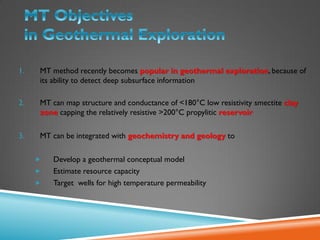
1. MT method recently becomes popular in geothermal exploration, because of
its ability to detect deep subsurface information
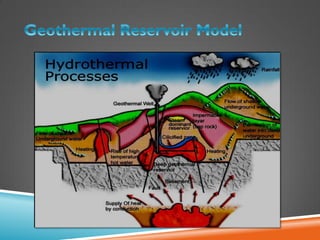
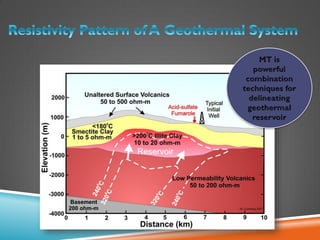
2. MT can map structure and conductance of <180°C low resistivity smectite clay
zone capping the relatively resistive >200°C propylitic reservoir
3. MT can be integrated with geochemistry and geology to
 Develop a geothermal conceptual model
 Estimate resource capacity
 Target wells for high temperature permeability
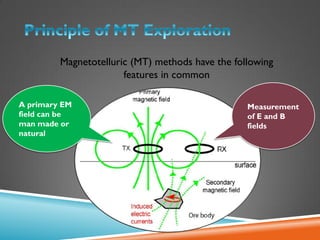
Magnetotelluric (MT) methods have the following
features in common
A primary EM
field can be
man made or
natural
Measurement
of E and B
fields
 The magnetotelluric (MT) method is the
measurement of the Earth’s naturally occurring,
time-varying EM fields.
 The electromagnetic fields are generated by two
sources.
1. First is the interaction of the Earth’s
magnetic field with the solar wind
(charged particles emitted from the
sun) that results in fluctuations in the
magnetosphere.The fields resulting from
this interaction typically contain
frequencies below 1 Hz.
2. Second is the electromagnetic energy
that comes from lightning activity
which typically results in frequencies
above 1 Hz.
 Naturally occurring variations in the Earth's magnetic
field induce eddy currents in the Earth that are
detectable as electric (or telluric) field variations on
the surface.
 The magnetotelluric (MT) method is an
electromagnetic (EM) technique for determining the
resistivity distribution of the subsurface from
measurements of natural time-varying magnetic
and electric fields at the surface of the Earth.
 The ratio of the horizontal electric field to the
orthogonal horizontal magnetic field (termed the EM
impedance, Z), measured at a number of frequencies,
gives Earth resistivity as a function of frequency
or period, resulting in a form of depth sounding.
H : input E : output
Z, earth
t
D
j
H






t
B
E






Ionospheric Current
Transverse Magnetic Mode (TM):
• Magnetic field polarized parallel
to the strike direction.
• Electric field components are
confined to the y-z plane
2
2
.
0
x
y
yx
H
E
T


Transverse Electric Mode (TE):
• Electric field polarized parallel
to the strike direction.
• Magnetic field components are
confined to the y-z plane.
2
2
.
0
y
x
xy
H
E
T


strike
strike
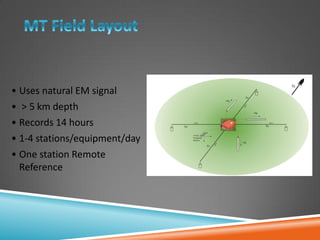
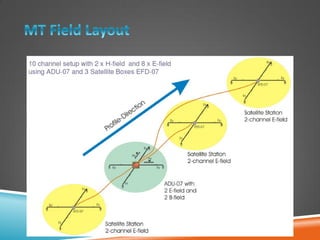
• Uses natural EM signal
• > 5 km depth
• Records 14 hours
• 1-4 stations/equipment/day
• One station Remote
Reference
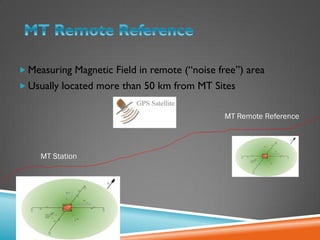
 Measuring Magnetic Field in remote (“noise free”) area
 Usually located more than 50 km from MT Sites
MT Station
MT Remote Reference
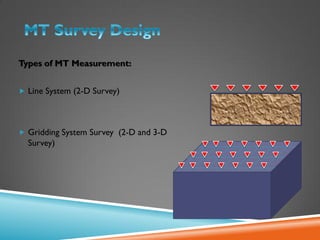
Types of MT Measurement:
 Line System (2-D Survey)
 Gridding System Survey (2-D and 3-D
Survey)
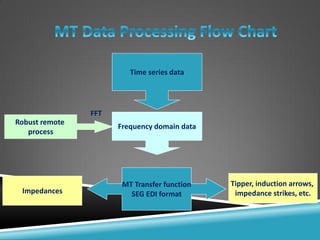
Impedances
Tipper, induction arrows,
impedance strikes, etc.
Time series data
FFT
MT Transfer function
SEG EDI format
Frequency domain data
Robust remote
process
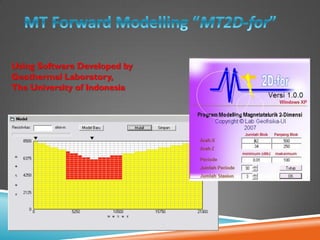
Using Software Developed by
Geothermal Laboratory,
The University of Indonesia
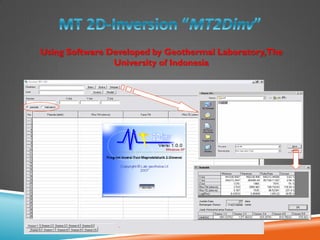
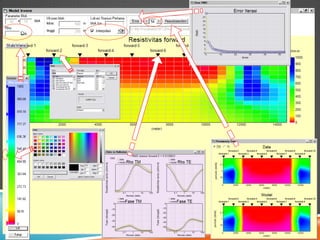
Using Software Developed by Geothermal Laboratory,The
University of Indonesia
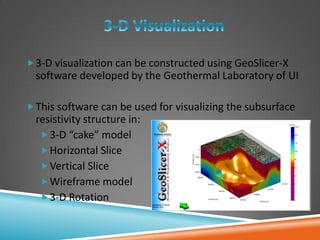
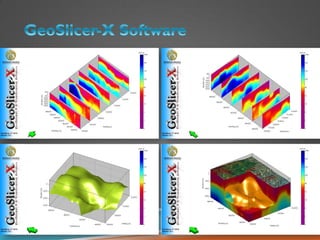
3-D visualization can be constructed using GeoSlicer-X
software developed by the Geothermal Laboratory of UI
This software can be used for visualizing the subsurface
resistivity structure in:
3-D “cake” model
Horizontal Slice
Vertical Slice
Wireframe model
3-D Rotation
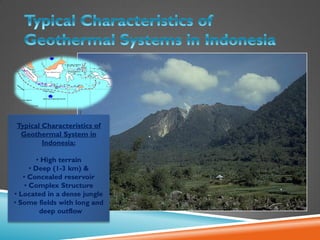
Typical Characteristics of
Geothermal System in
Indonesia:
• High terrain
• Deep (1-3 km) &
• Concealed reservoir
• Complex Structure
• Located in a dense jungle
• Some fields with long and
deep outflow
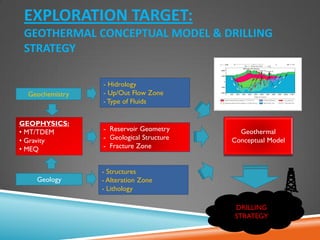
EXPLORATION TARGET:
GEOTHERMAL CONCEPTUAL MODEL & DRILLING
STRATEGY
Geochemistry
GEOPHYSICS:
• MT/TDEM
• Gravity
• MEQ
Geology
Geothermal
Conceptual Model
- Hidrology
- Up/Out Flow Zone
- Type of Fluids
- Structures
- Alteration Zone
- Lithology
- Reservoir Geometry
- Geological Structure
- Fracture Zone
DRILLING
STRATEGY
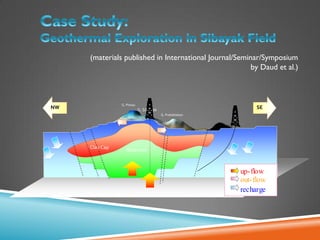
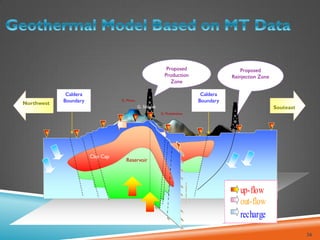
G. Pintau
G. Sibayak
G. Pratektekan
SE
NW
barat-laut
up-flow
out-flow
recharge
Reservoir
Clay Cap
(materials published in International Journal/Seminar/Symposium
by Daud et al.)
30
SIBAYAK
GEOTHERMAL FIELD
Medan
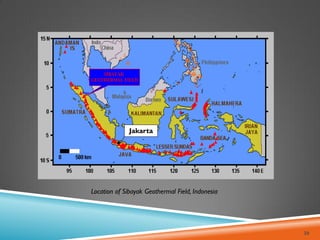
Location of Sibayak Geothermal Field, Indonesia
Jakarta
31
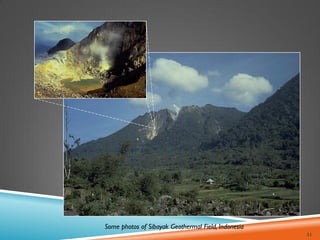
Some photos of Sibayak Geothermal Field, Indonesia
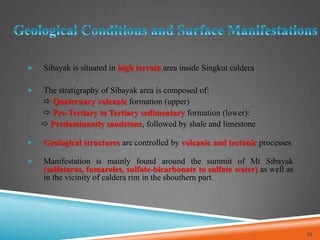
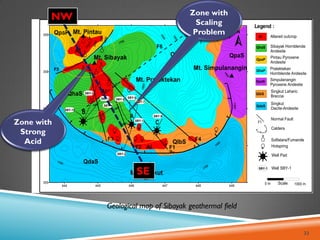
 Sibayak is situated in high terrain area inside Singkut caldera
 The stratigraphy of Sibayak area is composed of:
 Quaternary volcanic formation (upper)
 Pre-Tertiary to Tertiary sedimentary formation (lower):
 Predominantly sandstone, followed by shale and limestone
 Geological structures are controlled by volcanic and tectonic processes
 Manifestation is mainly found around the summit of Mt Sibayak
(solfataras, fumaroles, sulfate-bicarbonate to sulfate water) as well as
in the vicinity of caldera rim in the shouthern part.
32
33
Legend :
Sibayak Hornblende
Andesite
Pintau Pyroxene
Andesite
Singkut Laharic
Breccia
Pratektekan
Hornblende Andesite
Singkut
Dacite-Andesite
Altered outcrop
Simpulanangin
Pyroxene Andesite
F1
Normal Fault
Caldera
Solfatara/Fumarole
Hotspring
0 m 1000 m
Scale
Mt. Pintau
Mt. Sibayak
Mt. Pratektekan
Mt. Simpulanangin
B
A
C
Mt. Singkut
F2
F4
F5
444 445 446 447 448 449
355
356
357
358
359
F3
QdaS
QlbS
QpaS
QpaP
QhaP
QhaS
QdaS
QlbS
QpaS
QhaP
QpaP
QhaS
Al
Al
Al
Al F1
Well Pad
F6
SBY-10
SBY-5
SBY-3
SBY-4
SBY-8
SBY-6
SBY-7
SBY-2
SBY-9
SBY-1 Well SBY-1
SBY-1
Geological map of Sibayak geothermal field
Zone with
Strong
Acid
Zone with
Scaling
Problem
NW
SE
34
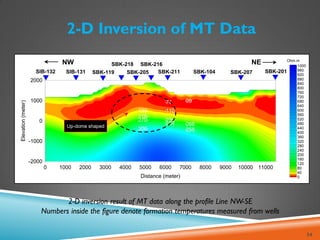
2-D inversion result of MT data along the profile Line NW-SE
Numbers inside the figure denote formation temperatures measured from wells
2-D Inversion of MT Data
0 1000 2000 3000 4000 5000 6000 7000 8000 9000 10000 11000
Distance (meter)
-2000
-1000
0
1000
2000
Elevation
(meter)
139
218
270
306
74
110
236
254
99
266
256
SIB-132 SIB-131 SBK-119
SBK-218
SBK-205
SBK-216
SBK-211 SBK-104 SBK-207 SBK-201
0
40
80
120
160
200
240
280
320
360
400
440
480
520
560
600
640
680
720
760
800
840
880
920
960
1000
Ohm.m
NW NE
Up-dome shaped
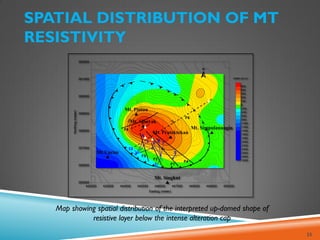
SPATIAL DISTRIBUTION OF MT
RESISTIVITY
35
Mt. Pratektekan
Mt. Sibayak
Mt. Pintau
Mt. Singkut
Mt. Simpulanangin
Mt Uncim
10
5
3
4
8 6 7
9
2
-3000
-2800
-2600
-2400
-2200
-2000
-1800
-1600
-1400
-1200
-1000
-800
-600
-400
-200
0
100
200
300
400
600
meter (a.s.l)
442000 443000 444000 445000 446000 447000 448000 449000 450000
Easting (meter)
355000
356000
357000
358000
359000
360000
361000
362000
Northing
(meter)
F1
F2
F3
F4
F5
F6
Map showing spatial distribution of the interpreted up-domed shape of
resistive layer below the intense alteration cap
36
G. Pintau
G. Sibayak
Caldera
Boundary
Caldera
Boundary
G. Pratektekan
Proposed
Production
Zone
Proposed
Reinjection Zone
Souteast
Northwest
barat-laut
up-flow
out-flow
recharge
Reservoir
Clay Cap
37
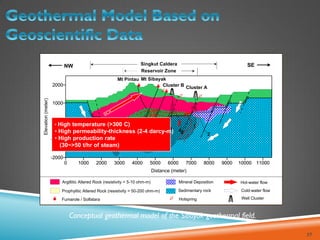
Conceptual geothermal model of the Sibayak geothermal field.
0 1000 2000 3000 4000 5000 6000 7000 8000 9000 10000 11000
-2000
-1000
0
1000
2000
0 1000 2000 3000 4000 5000 6000 7000 8000 9000 10000 11000
Distance (meter)
-2000
-1000
0
1000
2000
Elevation
(meter)
Reservoir Zone
Argillitic Altered Rock (resistivity = 5-10 ohm-m)
Prophylitic Altered Rock (resistivity = 50-200 ohm-m) Sedimentary rock
Mineral Deposition Hot-water flow
Cold-water flow
Singkut Caldera
Cluster A
Cluster B
200
250
300
Mt Pintau Mt Sibayak
5 3 48
1
2
Fumarole / Solfatara Hotspring
NW SE
Well Cluster
• High temperature (>300 C)
• High permeability-thickness (2-4 darcy-m)
• High production rate
(30~>50 t/hr of steam)
38
Mt. Pratektekan
Mt. Sibayak
Mt. Pintau
Mt. Singkut
Mt. Simpulanangin
Mt Uncim
10
5
3
4
8 6 7
9
2
-3000
-2800
-2600
-2400
-2200
-2000
-1800
-1600
-1400
-1200
-1000
-800
-600
-400
-200
0
100
200
300
400
600
meter (a.s.l)
442000 443000 444000 445000 446000 447000 448000 449000 450000
Easting (meter)
355000
356000
357000
358000
359000
360000
361000
362000
Northing
(meter)
F1
F2
F3
F4
F5
F6
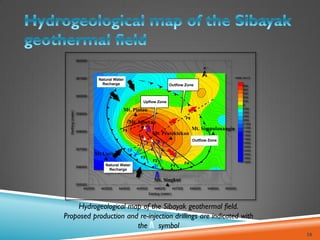
Upflow Zone
Outflow Zone
Outflow Zone
Natural Water
Recharge
Natural Water
Recharge
Hydrogeological map of the Sibayak geothermal field.
Proposed production and re-injection drillings are indicated with
the symbol
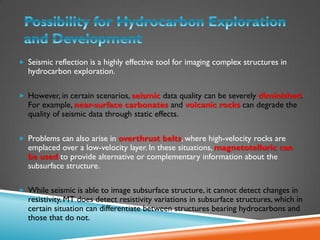
 Seismic reflection is a highly effective tool for imaging complex structures in
hydrocarbon exploration.
 However, in certain scenarios, seismic data quality can be severely diminished.
For example, near-surface carbonates and volcanic rocks can degrade the
quality of seismic data through static effects.
 Problems can also arise in overthrust belts, where high-velocity rocks are
emplaced over a low-velocity layer. In these situations, magnetotelluric can
be used to provide alternative or complementary information about the
subsurface structure.
 While seismic is able to image subsurface structure, it cannot detect changes in
resistivity. MT does detect resistivity variations in subsurface structures, which in
certain situation can differentiate between structures bearing hydrocarbons and
those that do not.
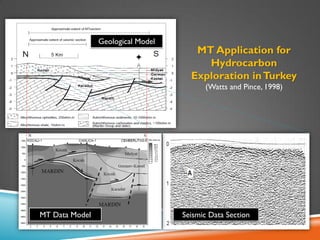
MT Application for
Hydrocarbon
Exploration inTurkey
(Watts and Pince, 1998)
Geological Model
MT Data Model Seismic Data Section
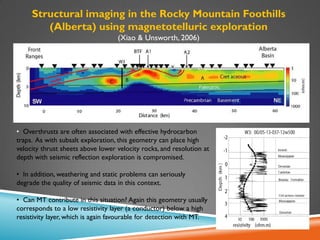
• Overthrusts are often associated with effective hydrocarbon
traps. As with subsalt exploration, this geometry can place high
velocity thrust sheets above lower velocity rocks, and resolution at
depth with seismic reflection exploration is compromised.
• In addition, weathering and static problems can seriously
degrade the quality of seismic data in this context.
• Can MT contribute in this situation? Again this geometry usually
corresponds to a low resistivity layer (a conductor) below a high
resistivity layer, which is again favourable for detection with MT.
Structural imaging in the Rocky Mountain Foothills
(Alberta) using magnetotelluric exploration
(Xiao & Unsworth, 2006)
MAGENTOTELLURIC (MT) METHOD:
SUCCESS STORY IN GEOTHERMAL EXPLORATION
THANKYOU

386465179-Magnetotelluric-Mt-Method.pdf

  • 2.
     Introduction  BasicConcept of MT Method  MT Method from Data Acquisition to Interpretation  MT Method in Indonesia: Success Story in Geothermal Exploration
  • 4.
     History  MT(Low Frequency 300-0.001 Hz) : Cagniard (1953), Kato and Kikuchi (1950), Rikitake (1950,1951), and Tikonov (1950)  AMT (10 Hz – 10 kHz) : 1960  CSAMT (2 kHz – 1 Hz) : Goldstein (1971), David Strangway (1975), Zonge (1980)  Worldwide applications  MT has been popular for geothermal exploration, mineral exploration, hydrocarbon exploration and regional geophysical mapping.  It is used in oil exploration for low-cost reconnaissance of sedimentary basins and for exploration in areas where seismic surveys are difficult because of severe topography or the presence high-impedance volcanic rocks near the surface.  Geothermal, hydrocarbon, mineral, tectonic
  • 5.
    1. MT methodrecently becomes popular in geothermal exploration, because of its ability to detect deep subsurface information 2. MT can map structure and conductance of <180°C low resistivity smectite clay zone capping the relatively resistive >200°C propylitic reservoir 3. MT can be integrated with geochemistry and geology to  Develop a geothermal conceptual model  Estimate resource capacity  Target wells for high temperature permeability
  • 7.
    Magnetotelluric (MT) methodshave the following features in common A primary EM field can be man made or natural Measurement of E and B fields
  • 8.
     The magnetotelluric(MT) method is the measurement of the Earth’s naturally occurring, time-varying EM fields.  The electromagnetic fields are generated by two sources. 1. First is the interaction of the Earth’s magnetic field with the solar wind (charged particles emitted from the sun) that results in fluctuations in the magnetosphere.The fields resulting from this interaction typically contain frequencies below 1 Hz. 2. Second is the electromagnetic energy that comes from lightning activity which typically results in frequencies above 1 Hz.
  • 9.
     Naturally occurringvariations in the Earth's magnetic field induce eddy currents in the Earth that are detectable as electric (or telluric) field variations on the surface.  The magnetotelluric (MT) method is an electromagnetic (EM) technique for determining the resistivity distribution of the subsurface from measurements of natural time-varying magnetic and electric fields at the surface of the Earth.  The ratio of the horizontal electric field to the orthogonal horizontal magnetic field (termed the EM impedance, Z), measured at a number of frequencies, gives Earth resistivity as a function of frequency or period, resulting in a form of depth sounding. H : input E : output Z, earth t D j H       t B E       Ionospheric Current
  • 10.
    Transverse Magnetic Mode(TM): • Magnetic field polarized parallel to the strike direction. • Electric field components are confined to the y-z plane 2 2 . 0 x y yx H E T   Transverse Electric Mode (TE): • Electric field polarized parallel to the strike direction. • Magnetic field components are confined to the y-z plane. 2 2 . 0 y x xy H E T   strike strike
  • 12.
    • Uses naturalEM signal • > 5 km depth • Records 14 hours • 1-4 stations/equipment/day • One station Remote Reference
  • 14.
     Measuring MagneticField in remote (“noise free”) area  Usually located more than 50 km from MT Sites MT Station MT Remote Reference
  • 15.
    Types of MTMeasurement:  Line System (2-D Survey)  Gridding System Survey (2-D and 3-D Survey)
  • 17.
    Impedances Tipper, induction arrows, impedancestrikes, etc. Time series data FFT MT Transfer function SEG EDI format Frequency domain data Robust remote process
  • 18.
    Using Software Developedby Geothermal Laboratory, The University of Indonesia
  • 19.
    Using Software Developedby Geothermal Laboratory,The University of Indonesia
  • 21.
    3-D visualization canbe constructed using GeoSlicer-X software developed by the Geothermal Laboratory of UI This software can be used for visualizing the subsurface resistivity structure in: 3-D “cake” model Horizontal Slice Vertical Slice Wireframe model 3-D Rotation
  • 27.
    Typical Characteristics of GeothermalSystem in Indonesia: • High terrain • Deep (1-3 km) & • Concealed reservoir • Complex Structure • Located in a dense jungle • Some fields with long and deep outflow
  • 28.
    EXPLORATION TARGET: GEOTHERMAL CONCEPTUALMODEL & DRILLING STRATEGY Geochemistry GEOPHYSICS: • MT/TDEM • Gravity • MEQ Geology Geothermal Conceptual Model - Hidrology - Up/Out Flow Zone - Type of Fluids - Structures - Alteration Zone - Lithology - Reservoir Geometry - Geological Structure - Fracture Zone DRILLING STRATEGY
  • 29.
    G. Pintau G. Sibayak G.Pratektekan SE NW barat-laut up-flow out-flow recharge Reservoir Clay Cap (materials published in International Journal/Seminar/Symposium by Daud et al.)
  • 30.
    30 SIBAYAK GEOTHERMAL FIELD Medan Location ofSibayak Geothermal Field, Indonesia Jakarta
  • 31.
    31 Some photos ofSibayak Geothermal Field, Indonesia
  • 32.
     Sibayak issituated in high terrain area inside Singkut caldera  The stratigraphy of Sibayak area is composed of:  Quaternary volcanic formation (upper)  Pre-Tertiary to Tertiary sedimentary formation (lower):  Predominantly sandstone, followed by shale and limestone  Geological structures are controlled by volcanic and tectonic processes  Manifestation is mainly found around the summit of Mt Sibayak (solfataras, fumaroles, sulfate-bicarbonate to sulfate water) as well as in the vicinity of caldera rim in the shouthern part. 32
  • 33.
    33 Legend : Sibayak Hornblende Andesite PintauPyroxene Andesite Singkut Laharic Breccia Pratektekan Hornblende Andesite Singkut Dacite-Andesite Altered outcrop Simpulanangin Pyroxene Andesite F1 Normal Fault Caldera Solfatara/Fumarole Hotspring 0 m 1000 m Scale Mt. Pintau Mt. Sibayak Mt. Pratektekan Mt. Simpulanangin B A C Mt. Singkut F2 F4 F5 444 445 446 447 448 449 355 356 357 358 359 F3 QdaS QlbS QpaS QpaP QhaP QhaS QdaS QlbS QpaS QhaP QpaP QhaS Al Al Al Al F1 Well Pad F6 SBY-10 SBY-5 SBY-3 SBY-4 SBY-8 SBY-6 SBY-7 SBY-2 SBY-9 SBY-1 Well SBY-1 SBY-1 Geological map of Sibayak geothermal field Zone with Strong Acid Zone with Scaling Problem NW SE
  • 34.
    34 2-D inversion resultof MT data along the profile Line NW-SE Numbers inside the figure denote formation temperatures measured from wells 2-D Inversion of MT Data 0 1000 2000 3000 4000 5000 6000 7000 8000 9000 10000 11000 Distance (meter) -2000 -1000 0 1000 2000 Elevation (meter) 139 218 270 306 74 110 236 254 99 266 256 SIB-132 SIB-131 SBK-119 SBK-218 SBK-205 SBK-216 SBK-211 SBK-104 SBK-207 SBK-201 0 40 80 120 160 200 240 280 320 360 400 440 480 520 560 600 640 680 720 760 800 840 880 920 960 1000 Ohm.m NW NE Up-dome shaped
  • 35.
    SPATIAL DISTRIBUTION OFMT RESISTIVITY 35 Mt. Pratektekan Mt. Sibayak Mt. Pintau Mt. Singkut Mt. Simpulanangin Mt Uncim 10 5 3 4 8 6 7 9 2 -3000 -2800 -2600 -2400 -2200 -2000 -1800 -1600 -1400 -1200 -1000 -800 -600 -400 -200 0 100 200 300 400 600 meter (a.s.l) 442000 443000 444000 445000 446000 447000 448000 449000 450000 Easting (meter) 355000 356000 357000 358000 359000 360000 361000 362000 Northing (meter) F1 F2 F3 F4 F5 F6 Map showing spatial distribution of the interpreted up-domed shape of resistive layer below the intense alteration cap
  • 36.
    36 G. Pintau G. Sibayak Caldera Boundary Caldera Boundary G.Pratektekan Proposed Production Zone Proposed Reinjection Zone Souteast Northwest barat-laut up-flow out-flow recharge Reservoir Clay Cap
  • 37.
    37 Conceptual geothermal modelof the Sibayak geothermal field. 0 1000 2000 3000 4000 5000 6000 7000 8000 9000 10000 11000 -2000 -1000 0 1000 2000 0 1000 2000 3000 4000 5000 6000 7000 8000 9000 10000 11000 Distance (meter) -2000 -1000 0 1000 2000 Elevation (meter) Reservoir Zone Argillitic Altered Rock (resistivity = 5-10 ohm-m) Prophylitic Altered Rock (resistivity = 50-200 ohm-m) Sedimentary rock Mineral Deposition Hot-water flow Cold-water flow Singkut Caldera Cluster A Cluster B 200 250 300 Mt Pintau Mt Sibayak 5 3 48 1 2 Fumarole / Solfatara Hotspring NW SE Well Cluster • High temperature (>300 C) • High permeability-thickness (2-4 darcy-m) • High production rate (30~>50 t/hr of steam)
  • 38.
    38 Mt. Pratektekan Mt. Sibayak Mt.Pintau Mt. Singkut Mt. Simpulanangin Mt Uncim 10 5 3 4 8 6 7 9 2 -3000 -2800 -2600 -2400 -2200 -2000 -1800 -1600 -1400 -1200 -1000 -800 -600 -400 -200 0 100 200 300 400 600 meter (a.s.l) 442000 443000 444000 445000 446000 447000 448000 449000 450000 Easting (meter) 355000 356000 357000 358000 359000 360000 361000 362000 Northing (meter) F1 F2 F3 F4 F5 F6 Upflow Zone Outflow Zone Outflow Zone Natural Water Recharge Natural Water Recharge Hydrogeological map of the Sibayak geothermal field. Proposed production and re-injection drillings are indicated with the symbol
  • 39.
     Seismic reflectionis a highly effective tool for imaging complex structures in hydrocarbon exploration.  However, in certain scenarios, seismic data quality can be severely diminished. For example, near-surface carbonates and volcanic rocks can degrade the quality of seismic data through static effects.  Problems can also arise in overthrust belts, where high-velocity rocks are emplaced over a low-velocity layer. In these situations, magnetotelluric can be used to provide alternative or complementary information about the subsurface structure.  While seismic is able to image subsurface structure, it cannot detect changes in resistivity. MT does detect resistivity variations in subsurface structures, which in certain situation can differentiate between structures bearing hydrocarbons and those that do not.
  • 40.
    MT Application for Hydrocarbon ExplorationinTurkey (Watts and Pince, 1998) Geological Model MT Data Model Seismic Data Section
  • 41.
    • Overthrusts areoften associated with effective hydrocarbon traps. As with subsalt exploration, this geometry can place high velocity thrust sheets above lower velocity rocks, and resolution at depth with seismic reflection exploration is compromised. • In addition, weathering and static problems can seriously degrade the quality of seismic data in this context. • Can MT contribute in this situation? Again this geometry usually corresponds to a low resistivity layer (a conductor) below a high resistivity layer, which is again favourable for detection with MT. Structural imaging in the Rocky Mountain Foothills (Alberta) using magnetotelluric exploration (Xiao & Unsworth, 2006)
  • 42.
    MAGENTOTELLURIC (MT) METHOD: SUCCESSSTORY IN GEOTHERMAL EXPLORATION THANKYOU