Electrical Resistivity Method
Submitted by Abhineet Godayal
M.Tech Geotechnical Engineering
 The resistivity of a material depends upon the
type of material, its water content,
concentration of dissolved ions and many
other factors
 Rocks and dry soils have a greater resistivity
than saturated clays
 Therefore resistivity of soil decreases as both
water content and concentration of salt
increases.
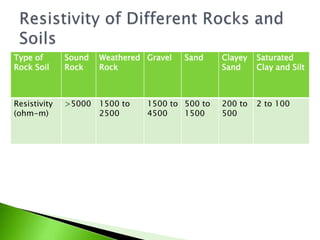
Type of
Rock Soil
Sound
Rock
Weathered
Rock
Gravel Sand Clayey
Sand
Saturated
Clay and Silt
Resistivity
(ohm-m)
>5000 1500 to
2500
1500 to
4500
500 to
1500
200 to
500
2 to 100
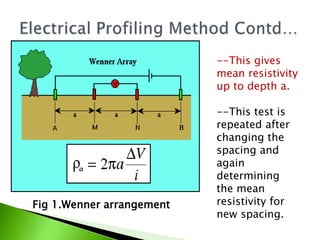
 In this method four electrodes are used at
constant spacing “a”
 To conduct this test ,four electrodes in the form
of metal spikes are driven in to the ground.
 Two outer electrodes are called current
electrodes and inner two electrodes are potential
electrodes.
 The mean resistivity of strata is determined by
applying D.C. to outer electrodes and measuring
the potential drop between inner electrodes.
--This gives
mean resistivity
up to depth a.
--This test is
repeated after
changing the
spacing and
again
determining
the mean
resistivity for
new spacing.
Fig 1.Wenner arrangement
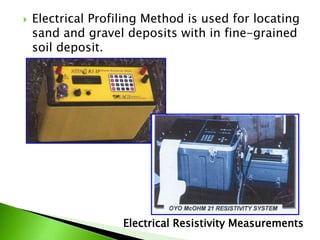
 Electrical Profiling Method is used for locating
sand and gravel deposits with in fine-grained
soil deposit.
Electrical Resistivity Measurements
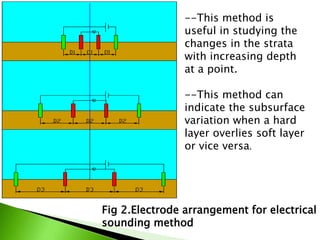
 In this method, the electrode system
consisting of four electrodes is expanded
about a fixed point.
 The spacing in first sitting is a1, which is
increased to a2 in the second sitting and to a3
in the third sitting.
 The spacing is thus increased to depth of
exploration
Fig 2.Electrode arrangement for electrical
sounding method
--This method is
useful in studying the
changes in the strata
with increasing depth
at a point.
--This method can
indicate the subsurface
variation when a hard
layer overlies soft layer
or vice versa.
 The method capable of detecting only the
strata having different electrical resistivity.
 The results considerably influenced by
surface irregularities, wetness of strata and
electrolytic concentration of ground water
 As the resistivity of different strata at
interface changes gradually and not abruptly
as assumed, the interpretation of results
becomes difficult.
Geophysical exploration

Geophysical exploration

  • 1.
    Electrical Resistivity Method Submittedby Abhineet Godayal M.Tech Geotechnical Engineering
  • 2.
     The resistivityof a material depends upon the type of material, its water content, concentration of dissolved ions and many other factors  Rocks and dry soils have a greater resistivity than saturated clays  Therefore resistivity of soil decreases as both water content and concentration of salt increases.
  • 3.
    Type of Rock Soil Sound Rock Weathered Rock GravelSand Clayey Sand Saturated Clay and Silt Resistivity (ohm-m) >5000 1500 to 2500 1500 to 4500 500 to 1500 200 to 500 2 to 100
  • 4.
     In thismethod four electrodes are used at constant spacing “a”  To conduct this test ,four electrodes in the form of metal spikes are driven in to the ground.  Two outer electrodes are called current electrodes and inner two electrodes are potential electrodes.  The mean resistivity of strata is determined by applying D.C. to outer electrodes and measuring the potential drop between inner electrodes.
  • 5.
    --This gives mean resistivity upto depth a. --This test is repeated after changing the spacing and again determining the mean resistivity for new spacing. Fig 1.Wenner arrangement
  • 6.
     Electrical ProfilingMethod is used for locating sand and gravel deposits with in fine-grained soil deposit. Electrical Resistivity Measurements
  • 7.
     In thismethod, the electrode system consisting of four electrodes is expanded about a fixed point.  The spacing in first sitting is a1, which is increased to a2 in the second sitting and to a3 in the third sitting.  The spacing is thus increased to depth of exploration
  • 8.
    Fig 2.Electrode arrangementfor electrical sounding method --This method is useful in studying the changes in the strata with increasing depth at a point. --This method can indicate the subsurface variation when a hard layer overlies soft layer or vice versa.
  • 9.
     The methodcapable of detecting only the strata having different electrical resistivity.  The results considerably influenced by surface irregularities, wetness of strata and electrolytic concentration of ground water  As the resistivity of different strata at interface changes gradually and not abruptly as assumed, the interpretation of results becomes difficult.