SEMINAR
ON
GEOMORPHI
C PROCESSES
CONTENT
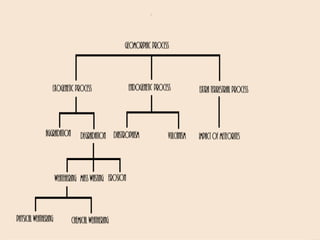
GEOMORPHIC PROCESS
INTRODUCTION
EXOGENETIC PROCESS
ENDOGENETIC PROCESS
EXTRA-TERRESTRIAL PROCESS
CONCLUSION
REFERENCE
INTRODUCTION
 The geomorphic process are all those physical and
chemical changes which effect a modification of the
earth surficial form.
 A geomorphic agent is any natural medium, which is
capable of securing and transporting earth material.
 The leading natural agencies that play a major role in
this cycle of making and breaking are :-
 Running water, ground water, waves and currents,
wind, glaciers, lakes and swamps, volcano's and
earthquake and living organism.
 Most of the geomorphological agents are originate
with in the earths atmosphere and are directed by the
force of gravity and energized by the sun.
DEGRADATION
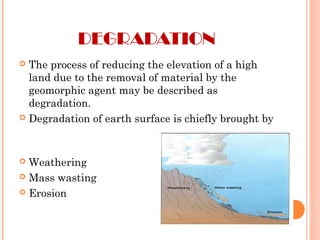
 The process of reducing the elevation of a high
land due to the removal of material by the
geomorphic agent may be described as
degradation.
 Degradation of earth surface is chiefly brought by
 Weathering
 Mass wasting
 Erosion
WEATHERING
PHYSICAL WEATHERING
FROST ACTION
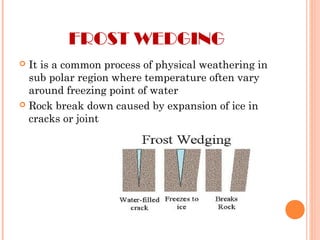
FROST WEDGING
 It is a common process of physical weathering in
sub polar region where temperature often vary
around freezing point of water
 Rock break down caused by expansion of ice in
cracks or joint
CRYSTAL GROWTH
 Growth of crystal in rock fracture with the
evaporation of saline ground water causes
disintegration
 The salt is in solution and precipitate as soil
water and ground water evaporate.
 It is most effective in dry land landscapes where
water tables are near the surface (e.g., saline
seeps)
THERMAL EXPANTION &
CONTRATION
 Repeated daily heating cooling of causes
expansion & contraction
 Different minerals expand & contract at different
rates causing stress along mineral boundaries
 Thermal expansion due to the extreme range of
temperatures shutter rocks in desert
environments
 Repeated swelling and shirking of minerals with
different expansion rates will also shatter rock
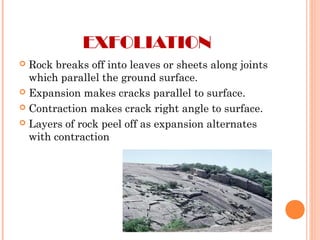
EXFOLIATION
 Rock breaks off into leaves or sheets along joints
which parallel the ground surface.
 Expansion makes cracks parallel to surface.
 Contraction makes crack right angle to surface.
 Layers of rock peel off as expansion alternates
with contraction
CHEMICAL WEATHERING
 Chemical weathering is the process by which
rocks are decomposed or dissolved or loosened by
chemical processes to form residual material.
 The agents of chemical weathering are;
 Water,Oxygen,CO2,Living organism, Acid rain.
HYDRATION
 The process where minerals in the rock absorb
water and expand, creating stress which cause
the disintegration of rock.
 Eg:CasO4+2H2O CasO42H2O
HYDROLYSIS
 Hydrolysis is a chemical weathering process
affecting silicate minerals.
 In such reactions, pure water ionizes slightly and
reacts with silicate minerals.
SOLUTION
 It is the process by which rock is dissolved in
water.
 It is strongly influenced by pH and temperature.
 When water becomes saturated, chemicals may
precipitate out forming evaporate deposits.
 Calcium carbonate(calcite, limestone),sodium
chloride(salt), and calcium sulphate(gypsum) are
particularly vulnerable to solution weathering.
OXIDATION
Iron combines with oxygen in the presence of water
to form iron hydroxide. This processes called
oxidation
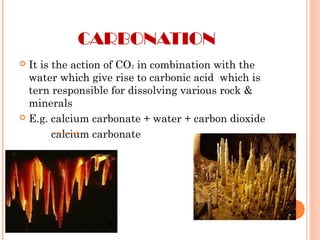
CARBONATION
 It is the action of CO2 in combination with the
water which give rise to carbonic acid which is
tern responsible for dissolving various rock &
minerals
 E.g. calcium carbonate + water + carbon dioxide
calcium carbonate
MASS - WASTING
 Mass wasting is the process that involves the
spontaneous downward movement of soil,
regolith and rock under influence of gravity
 Mass wasting is usually aided by the presence of
water but without any dynamic action of it or in
other words the amount of water present is not
sufficient to act as a transporting medium
 The process occur at speeds ranging from those
which are so slow that the movement is
imperceptible to rapid flow and catastrophic
slumping and rock falls
 Evidences of the down slope movement of rock
and soil is found almost universally
EROSION
 Erosion is the process associated with the
geomorphological agents like :-wind, river,
glaciers etc.
 By which rock materials are loosen or dissolved
and then transported from one place to other
 Erosion consist of process like :-
 Collecting together of the loose material produced
by weathering
 Wearing down the surface and curve out valley
features which is commonly known as abrasion &
corrosion
AGGRADATION
 The process of living up of low land due to the
addition or deposition of material by the agents
of gradation
 During the transportation an agent like wind,
water, glacier, ocean, waves
VOLCANISM
 Volcanism includes the movement of rock or
magma towards the earth surface
 It beyond the scope of geomorphology to explain
the complex changes with in the earth which
indicate volcanism
 Molten rock may be extruded through centralized
vents called volcanoes
DIASTROPHISM
 Diastrophic process are usually classified into
two types
 Organic (mountain-building with deformation)
 Epirogenic (regional uplift without important
deformation)
 Organic movements are more localized than are
epirogenic and usually involve tangential forces
with resulting compression or tension of rock
strata
IMPACT OF METEORITES
 Probably the most usually land forms are those
that originate from the impact of meteorites
 Such forms are rather rare but approximately
fifty well
 Substantiated meteorite craters are known to
exist
 Their uniqueness lies in the fact that they were
produced by extra-terrestrial agents, although
the earths gravitate alteration was responsible
for the in fall of the meteorites
CONCLUTION
 The geomorphological process, as already
indicated, play significant roles in shaping the
surface of the earth
 Depending up on their individual nature and
mode of operation, the processes classified into
two categories
 Exogenetic process
 Endogenetic process
 Impact of meteorites is considered as a special
category is named as extraterrestrial
REFERENCE
 WILLIAM D. THORNBURY, (1954),
PRINCIPLES OF GEOMORPHOLOGY, Page
No:-34
 Dr.A.V.GEORGE, M.N.RAJESH, T.S.SABITHA
(2005),AN INTRODECTION TO PHYSICAL
GEOLOGY AND GEOMORPHOLOGY
 BERNAND W.PIPKIN AND D.D.TRENT,(2001),
GEOLOGY AND THE ENVIORMENT
 PARBIN SINGH, ENGINEERING AND
GENARAL GEOLOGY
 RAUL A DEJU AND Et al,(1972),THE
ENVIORMENT AND ITS RESOURCES
CONT……..
 S.M.MATHUR,(2008),ELEMENT OF GEOLOGY
 G.B.MAHAPATRA,(1994),TEXT BOOK OF
PHYSICAL GEOLOGY
 P.K.MUKERJEE,(1962),A TEXT BOOK OF
GEOLOGY
Geomorphic processes

Geomorphic processes

  • 1.
  • 2.
    CONTENT GEOMORPHIC PROCESS INTRODUCTION EXOGENETIC PROCESS ENDOGENETICPROCESS EXTRA-TERRESTRIAL PROCESS CONCLUSION REFERENCE
  • 3.
    INTRODUCTION  The geomorphicprocess are all those physical and chemical changes which effect a modification of the earth surficial form.  A geomorphic agent is any natural medium, which is capable of securing and transporting earth material.  The leading natural agencies that play a major role in this cycle of making and breaking are :-  Running water, ground water, waves and currents, wind, glaciers, lakes and swamps, volcano's and earthquake and living organism.  Most of the geomorphological agents are originate with in the earths atmosphere and are directed by the force of gravity and energized by the sun.
  • 5.
    DEGRADATION  The processof reducing the elevation of a high land due to the removal of material by the geomorphic agent may be described as degradation.  Degradation of earth surface is chiefly brought by  Weathering  Mass wasting  Erosion
  • 6.
  • 7.
  • 8.
  • 9.
    FROST WEDGING  Itis a common process of physical weathering in sub polar region where temperature often vary around freezing point of water  Rock break down caused by expansion of ice in cracks or joint
  • 10.
    CRYSTAL GROWTH  Growthof crystal in rock fracture with the evaporation of saline ground water causes disintegration  The salt is in solution and precipitate as soil water and ground water evaporate.  It is most effective in dry land landscapes where water tables are near the surface (e.g., saline seeps)
  • 11.
    THERMAL EXPANTION & CONTRATION Repeated daily heating cooling of causes expansion & contraction  Different minerals expand & contract at different rates causing stress along mineral boundaries  Thermal expansion due to the extreme range of temperatures shutter rocks in desert environments  Repeated swelling and shirking of minerals with different expansion rates will also shatter rock
  • 12.
    EXFOLIATION  Rock breaksoff into leaves or sheets along joints which parallel the ground surface.  Expansion makes cracks parallel to surface.  Contraction makes crack right angle to surface.  Layers of rock peel off as expansion alternates with contraction
  • 13.
    CHEMICAL WEATHERING  Chemicalweathering is the process by which rocks are decomposed or dissolved or loosened by chemical processes to form residual material.  The agents of chemical weathering are;  Water,Oxygen,CO2,Living organism, Acid rain.
  • 14.
    HYDRATION  The processwhere minerals in the rock absorb water and expand, creating stress which cause the disintegration of rock.  Eg:CasO4+2H2O CasO42H2O
  • 15.
    HYDROLYSIS  Hydrolysis isa chemical weathering process affecting silicate minerals.  In such reactions, pure water ionizes slightly and reacts with silicate minerals.
  • 16.
    SOLUTION  It isthe process by which rock is dissolved in water.  It is strongly influenced by pH and temperature.  When water becomes saturated, chemicals may precipitate out forming evaporate deposits.  Calcium carbonate(calcite, limestone),sodium chloride(salt), and calcium sulphate(gypsum) are particularly vulnerable to solution weathering.
  • 17.
    OXIDATION Iron combines withoxygen in the presence of water to form iron hydroxide. This processes called oxidation
  • 18.
    CARBONATION  It isthe action of CO2 in combination with the water which give rise to carbonic acid which is tern responsible for dissolving various rock & minerals  E.g. calcium carbonate + water + carbon dioxide calcium carbonate
  • 19.
    MASS - WASTING Mass wasting is the process that involves the spontaneous downward movement of soil, regolith and rock under influence of gravity  Mass wasting is usually aided by the presence of water but without any dynamic action of it or in other words the amount of water present is not sufficient to act as a transporting medium  The process occur at speeds ranging from those which are so slow that the movement is imperceptible to rapid flow and catastrophic slumping and rock falls  Evidences of the down slope movement of rock and soil is found almost universally
  • 20.
    EROSION  Erosion isthe process associated with the geomorphological agents like :-wind, river, glaciers etc.  By which rock materials are loosen or dissolved and then transported from one place to other  Erosion consist of process like :-  Collecting together of the loose material produced by weathering  Wearing down the surface and curve out valley features which is commonly known as abrasion & corrosion
  • 21.
    AGGRADATION  The processof living up of low land due to the addition or deposition of material by the agents of gradation  During the transportation an agent like wind, water, glacier, ocean, waves
  • 22.
    VOLCANISM  Volcanism includesthe movement of rock or magma towards the earth surface  It beyond the scope of geomorphology to explain the complex changes with in the earth which indicate volcanism  Molten rock may be extruded through centralized vents called volcanoes
  • 23.
    DIASTROPHISM  Diastrophic processare usually classified into two types  Organic (mountain-building with deformation)  Epirogenic (regional uplift without important deformation)  Organic movements are more localized than are epirogenic and usually involve tangential forces with resulting compression or tension of rock strata
  • 24.
    IMPACT OF METEORITES Probably the most usually land forms are those that originate from the impact of meteorites  Such forms are rather rare but approximately fifty well  Substantiated meteorite craters are known to exist  Their uniqueness lies in the fact that they were produced by extra-terrestrial agents, although the earths gravitate alteration was responsible for the in fall of the meteorites
  • 25.
    CONCLUTION  The geomorphologicalprocess, as already indicated, play significant roles in shaping the surface of the earth  Depending up on their individual nature and mode of operation, the processes classified into two categories  Exogenetic process  Endogenetic process  Impact of meteorites is considered as a special category is named as extraterrestrial
  • 26.
    REFERENCE  WILLIAM D.THORNBURY, (1954), PRINCIPLES OF GEOMORPHOLOGY, Page No:-34  Dr.A.V.GEORGE, M.N.RAJESH, T.S.SABITHA (2005),AN INTRODECTION TO PHYSICAL GEOLOGY AND GEOMORPHOLOGY  BERNAND W.PIPKIN AND D.D.TRENT,(2001), GEOLOGY AND THE ENVIORMENT  PARBIN SINGH, ENGINEERING AND GENARAL GEOLOGY  RAUL A DEJU AND Et al,(1972),THE ENVIORMENT AND ITS RESOURCES
  • 27.
    CONT……..  S.M.MATHUR,(2008),ELEMENT OFGEOLOGY  G.B.MAHAPATRA,(1994),TEXT BOOK OF PHYSICAL GEOLOGY  P.K.MUKERJEE,(1962),A TEXT BOOK OF GEOLOGY