EXOGENIC
PROCESSES
TOPIC OUTLINE
 Geological Process
 Weathering
 Erosion
 Mass movement
SCIENTIFIC TERMINOLOGIES
 Creep
 Detachment
 Entertainment
 Erosion
 Falls (rock fall)
 Flocculation
 Flow
 Landslide (landslip)
 Mass movement (mass
wasting)
 Plucking
 Precipitation
 Slump
 Topples
 Weathering
GEOLOGIC PROCESSES
Geological processes are the internal
(endogenous) and external ( exogenous) forces
that shape the Earth’s feature. Exogenous
processes on the surface of the Earth are caused
by external agents such as weathering, erosion,
mass wasting.
WEATHERING
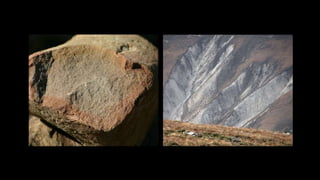
Rocks undergo natural process known as weathering which
involves changes in its physical and chemical properties.
Physical or mechanical weathering and chemical weathering
are processes that lead to soil formation. Physical or
mechanical occurs when physical forces break rocks into
smaller pieces without changing the rock’s composition.
Physical weathering is caused by the following:
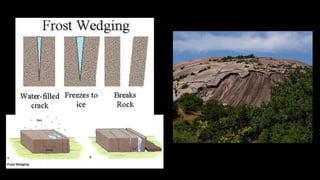
Frost wedging-The mechanical breakup of rock
is due to the expansion of freezing water in
cracks.
Pressure (stress) release-It is also known as
unloading which occurs when overlying materials
that cause stress to the underlying rocks are
removed by erosion.
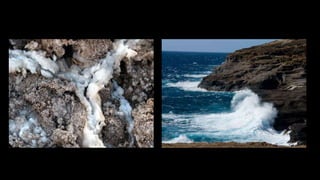
Salt crystal growth (salt crystallization)- The disintegration
of rocks is caused by salt solutions that seep into cracks and
joints in the rocks. The water component of the salt solution
evaporates leaving salt crystals behind. When the salt crystals
are heated up, the expand to exert pressure on the rock which
causes its breakdown.
Water(hydraulic) action- The disintegration of rocks is
caused by water from powerful waves that move rapidly into
cracks in the rock.
Thermal stress- Rock expands when heated and
contracts when it cools. The outer layers of rocks
peel off in thin sheets because of the temperature
changes which cause expansion and contraction of
rock. It is an important mechanism in deserts, where
there is a large temperature range, hot in the day and
cold at night.
Chemical weathering is caused by different chemical reactions
such as:
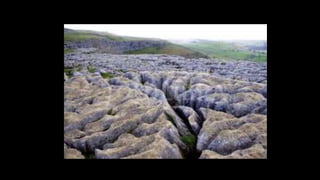
Carbonation- It occurs when water(rain) combines with carbon
dioxide or an organic acid to form a weak carbonic acid. This
acid reacts with calcium carbonate (the limestone) present in
the rock and forms calcium bicarbonate. Decrease in
temperature can speed up the chemical reaction because cold
water holds more dissolved carbon dioxide gas. Therefore
carbonation is a significant feature of glacial weathering.
Hydrolysis- It refers to the reaction between
water and the silicate and carbonate minerals
present in rock.
Oxidation- It involves reaction between oxygen
(in air or water) and metal (such as iron) present
in the rock.
BIOLOGICAL WEATHERING
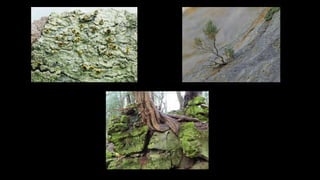
Living organism may contribute to mechanical
as well as chemical weathering. The activity of
organisms, including plants, burrowing
animals, and humans, can cause physical
breakdown of rock. The attachment of lichens
and mosses to the rock surface can cause
physical or chemical breakdown.
Seedlings sprouting can also cause physical
breakdown of rock. Plant roots can cause physical
weathering by exerting stress or pressure on rocks.
It also causes chemical weathering by providing
pathway for the infiltration of water and chemical.
The organic molecules produced by plants can react
with the minerals found in rock. This reaction is
known as chelation which can contribute to the
decomposition of rock.
End.
EROSION
This a surface process which involves the removal of
soil, sediment, and rock fragments from the landscape.
The natural agents of erosion include gravity, wind,
running water, glaciers, waves, and rain. It is
responsible for: (1) the creation of hills and valleys; (2)
removal of sediments from areas that were once
glaciated; (3) shaping the shorelines of lakes and
coastlines; and (4) movement of material downslope from
elevated sites. Erosion is different from weathering since
erosion has the moving element.
The three processes involved in erosion are
detachment, entrainment and transport.
Detachment is a separation of a particle from
surrounding material. The agents of erosion can
cause detachment on surface rocks and soil due
to different mechanisms such as plucking,
cavitation, raindrop impact, and abrasion.
Plucking occurs when ice freezes onto the surface and
cracks which cause fragmentation of the rock.
Cavitation is caused by moving water with high
velocity like high waterfalls.
Raindrop impact is characterized by the force of a
raindrop falling on the soil and weathered rock surface
which is enough to break the weaker particle bonds.
Abrasion is due to the excavation of surface particles
by material carried by the erosion agent.
Entrainment is the process of particle lifting by the
agent of erosion. The particle cohesive bonds are
weakened by weathering or forces created by the
erosion. This resistance should be overcome by the
entrainment forces. The main force responsible for
entrainment is fluid drag which cause the particle
to move. The forces of friction, slope angle, and
cohesion are overcome once the particle is lifted and
the only force resisting in transport is gravity.
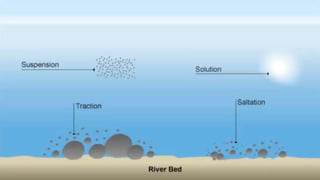
Once a particle is entrained, transport can
already occur through various mechanisms
such as suspension, saltation, traction
and solution.
Suspension is where the particles are carried by
the medium without touching the surface of
their origin. It can occur in air, water, and ice
Saltation is where the particle moves from the
surface to the medium in quick continuous
repeated cycles.
It is only active in air and water.
Traction which occurs in all erosional mediums is
characterized by the movement of particles by
rolling, sliding, and shuffling along the eroded
surface.
Solution is a transport mechanism that occurs only
in aqueous environments. Solution involves the
eroded material being dissolve and carried along in
water as individual ions.
The process which ends erosion is known as
deposition. It occurs when the transported
particles fall out of the transporting medium
and settle on a surface. Deposition is caused by
particle precipitation and flocculation which
are active only in the presence of water.
Precipitation is a process where dissolved ions
become solid because of changes in the
temperature or chemistry of the water.
Flocculation is a chemical process where salt
causes the aggregation of minute clay particles
into larger masses that are too heavy to remain
suspended.
End.
MASS
MOVEMENT OR
MASS WASTING
It is the geomorphic process by which soil and rock move
downslope due to the gravitational force. It occurs when the
gravitational force acting on a slope exceeds its resisting
force. The process of mass wasting may occur at a very slow
rate in areas that are very dry or those areas that receive
sufficient rainfall because the vegetation has already
stabilized the surface. Mass wasting may occur at very high
speed when there is landslide. The factors that affect the
occurrence of mass wasting by weathering; increased water
content; changes in vegetation cover; and overloading.
The various types of mass
movement include creep, landslides,
flows, topples, slump, falls and
debris avalanche.
Creep is the slow downhill movement of
soil wherein a steeper the slope means
faster creep.
Flow is characterized by mass movements
of material containing a large amount of
water.
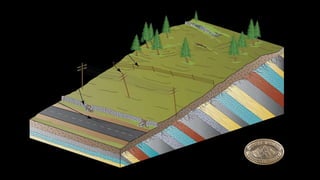
Landslide which is also called landslip, is a rapid movement of
a large mass of earth and rocks down a hill or a mountainside.
Heavy rain can facilitate the movement of the materials,
causing a landslide to occur.
Topples occur when blocks of rock pivot and fall away from a
slope.
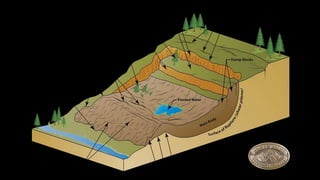
Slump is the downward movement of a block of material along
a curved surface It involves a mass of soil or other material
sliding along a curved surface (shaped like a spoon). It forms a
small, crescent-shaped cliff, or abrupt scarp at the top end of
the slope.
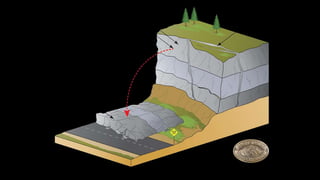
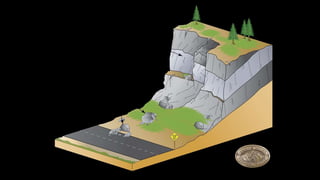
Falls or rockfalls occur when rocks or rock fragments fall
freely through the air. They usually occur at very steep
slopes such as cliff face. The rock material may be
loosened by earthquakes, rain, plant-root wedging,
expanding ice, among other things. The accumulation of
rock material that has fallen and resides at the base of the
structure is known as talus.
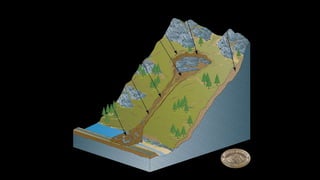
Debris avalanche is a variety of very rapid to extremely
rapid debris flow.
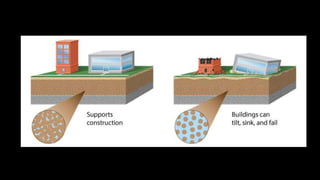
Soil liquefaction is a phenomenon in which the strength
and stiffness of a soil is reduced by vibrations of an
earthquake. It takes place when loosely packed, water-
logged sediments at or near the ground surface lose
their strength in response to strong ground shaking.
Liquefaction is most often observed in saturated, loose,
sandy soils. Liquefaction is a special case of
quicksand. Quicksand forms when water saturates an
area of loose sand and the ordinary sand is agitated.
BLAST FROM THE PAST:
On November 5, 1991, a massive landslide in Ormoc City,
Leyte killed more than 5,000 people. It was caused by
continuous heavy rain brought about by one of the strongest
typhoon that hit Philippines. The water and mud streams came
downwards from the hills and mountain areas in the central
part of the island to the lowlands around Ormoc City. The soil in
Leyte was unstable and highly susceptible to soil erosion and
transport because the island was formed by volcanic activity.
GREAT SCIENTIST:
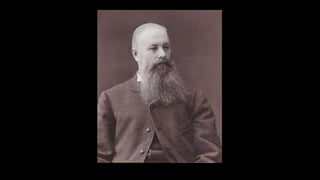
Vasily Vasil’evich Dokuchaev is considered as the
father of soil science. He was the first carry out a
comprehensive survey and study of soils. According to
Dokuchaev, the properties of soil are closely related to
their position on the earth’s surface and change
regularly as a result of environmental conditions. He
was the founder of the Journal Soil Science in 1899.
He was born in Russia on November 8, 1903.
Thank You!

Exogenic Processes

  • 1.
  • 2.
    TOPIC OUTLINE  GeologicalProcess  Weathering  Erosion  Mass movement
  • 3.
    SCIENTIFIC TERMINOLOGIES  Creep Detachment  Entertainment  Erosion  Falls (rock fall)  Flocculation  Flow  Landslide (landslip)  Mass movement (mass wasting)  Plucking  Precipitation  Slump  Topples  Weathering
  • 4.
    GEOLOGIC PROCESSES Geological processesare the internal (endogenous) and external ( exogenous) forces that shape the Earth’s feature. Exogenous processes on the surface of the Earth are caused by external agents such as weathering, erosion, mass wasting.
  • 5.
    WEATHERING Rocks undergo naturalprocess known as weathering which involves changes in its physical and chemical properties. Physical or mechanical weathering and chemical weathering are processes that lead to soil formation. Physical or mechanical occurs when physical forces break rocks into smaller pieces without changing the rock’s composition. Physical weathering is caused by the following:
  • 6.
    Frost wedging-The mechanicalbreakup of rock is due to the expansion of freezing water in cracks. Pressure (stress) release-It is also known as unloading which occurs when overlying materials that cause stress to the underlying rocks are removed by erosion.
  • 8.
    Salt crystal growth(salt crystallization)- The disintegration of rocks is caused by salt solutions that seep into cracks and joints in the rocks. The water component of the salt solution evaporates leaving salt crystals behind. When the salt crystals are heated up, the expand to exert pressure on the rock which causes its breakdown. Water(hydraulic) action- The disintegration of rocks is caused by water from powerful waves that move rapidly into cracks in the rock.
  • 10.
    Thermal stress- Rockexpands when heated and contracts when it cools. The outer layers of rocks peel off in thin sheets because of the temperature changes which cause expansion and contraction of rock. It is an important mechanism in deserts, where there is a large temperature range, hot in the day and cold at night.
  • 12.
    Chemical weathering iscaused by different chemical reactions such as: Carbonation- It occurs when water(rain) combines with carbon dioxide or an organic acid to form a weak carbonic acid. This acid reacts with calcium carbonate (the limestone) present in the rock and forms calcium bicarbonate. Decrease in temperature can speed up the chemical reaction because cold water holds more dissolved carbon dioxide gas. Therefore carbonation is a significant feature of glacial weathering.
  • 14.
    Hydrolysis- It refersto the reaction between water and the silicate and carbonate minerals present in rock. Oxidation- It involves reaction between oxygen (in air or water) and metal (such as iron) present in the rock.
  • 16.
    BIOLOGICAL WEATHERING Living organismmay contribute to mechanical as well as chemical weathering. The activity of organisms, including plants, burrowing animals, and humans, can cause physical breakdown of rock. The attachment of lichens and mosses to the rock surface can cause physical or chemical breakdown.
  • 17.
    Seedlings sprouting canalso cause physical breakdown of rock. Plant roots can cause physical weathering by exerting stress or pressure on rocks. It also causes chemical weathering by providing pathway for the infiltration of water and chemical. The organic molecules produced by plants can react with the minerals found in rock. This reaction is known as chelation which can contribute to the decomposition of rock.
  • 19.
  • 20.
  • 21.
    This a surfaceprocess which involves the removal of soil, sediment, and rock fragments from the landscape. The natural agents of erosion include gravity, wind, running water, glaciers, waves, and rain. It is responsible for: (1) the creation of hills and valleys; (2) removal of sediments from areas that were once glaciated; (3) shaping the shorelines of lakes and coastlines; and (4) movement of material downslope from elevated sites. Erosion is different from weathering since erosion has the moving element.
  • 22.
    The three processesinvolved in erosion are detachment, entrainment and transport. Detachment is a separation of a particle from surrounding material. The agents of erosion can cause detachment on surface rocks and soil due to different mechanisms such as plucking, cavitation, raindrop impact, and abrasion.
  • 23.
    Plucking occurs whenice freezes onto the surface and cracks which cause fragmentation of the rock. Cavitation is caused by moving water with high velocity like high waterfalls. Raindrop impact is characterized by the force of a raindrop falling on the soil and weathered rock surface which is enough to break the weaker particle bonds. Abrasion is due to the excavation of surface particles by material carried by the erosion agent.
  • 24.
    Entrainment is theprocess of particle lifting by the agent of erosion. The particle cohesive bonds are weakened by weathering or forces created by the erosion. This resistance should be overcome by the entrainment forces. The main force responsible for entrainment is fluid drag which cause the particle to move. The forces of friction, slope angle, and cohesion are overcome once the particle is lifted and the only force resisting in transport is gravity.
  • 25.
    Once a particleis entrained, transport can already occur through various mechanisms such as suspension, saltation, traction and solution.
  • 27.
    Suspension is wherethe particles are carried by the medium without touching the surface of their origin. It can occur in air, water, and ice Saltation is where the particle moves from the surface to the medium in quick continuous repeated cycles. It is only active in air and water.
  • 28.
    Traction which occursin all erosional mediums is characterized by the movement of particles by rolling, sliding, and shuffling along the eroded surface. Solution is a transport mechanism that occurs only in aqueous environments. Solution involves the eroded material being dissolve and carried along in water as individual ions.
  • 29.
    The process whichends erosion is known as deposition. It occurs when the transported particles fall out of the transporting medium and settle on a surface. Deposition is caused by particle precipitation and flocculation which are active only in the presence of water.
  • 30.
    Precipitation is aprocess where dissolved ions become solid because of changes in the temperature or chemistry of the water. Flocculation is a chemical process where salt causes the aggregation of minute clay particles into larger masses that are too heavy to remain suspended.
  • 31.
  • 32.
  • 33.
    It is thegeomorphic process by which soil and rock move downslope due to the gravitational force. It occurs when the gravitational force acting on a slope exceeds its resisting force. The process of mass wasting may occur at a very slow rate in areas that are very dry or those areas that receive sufficient rainfall because the vegetation has already stabilized the surface. Mass wasting may occur at very high speed when there is landslide. The factors that affect the occurrence of mass wasting by weathering; increased water content; changes in vegetation cover; and overloading.
  • 34.
    The various typesof mass movement include creep, landslides, flows, topples, slump, falls and debris avalanche.
  • 36.
    Creep is theslow downhill movement of soil wherein a steeper the slope means faster creep. Flow is characterized by mass movements of material containing a large amount of water.
  • 38.
    Landslide which isalso called landslip, is a rapid movement of a large mass of earth and rocks down a hill or a mountainside. Heavy rain can facilitate the movement of the materials, causing a landslide to occur. Topples occur when blocks of rock pivot and fall away from a slope. Slump is the downward movement of a block of material along a curved surface It involves a mass of soil or other material sliding along a curved surface (shaped like a spoon). It forms a small, crescent-shaped cliff, or abrupt scarp at the top end of the slope.
  • 41.
    Falls or rockfallsoccur when rocks or rock fragments fall freely through the air. They usually occur at very steep slopes such as cliff face. The rock material may be loosened by earthquakes, rain, plant-root wedging, expanding ice, among other things. The accumulation of rock material that has fallen and resides at the base of the structure is known as talus. Debris avalanche is a variety of very rapid to extremely rapid debris flow.
  • 44.
    Soil liquefaction isa phenomenon in which the strength and stiffness of a soil is reduced by vibrations of an earthquake. It takes place when loosely packed, water- logged sediments at or near the ground surface lose their strength in response to strong ground shaking. Liquefaction is most often observed in saturated, loose, sandy soils. Liquefaction is a special case of quicksand. Quicksand forms when water saturates an area of loose sand and the ordinary sand is agitated.
  • 46.
    BLAST FROM THEPAST: On November 5, 1991, a massive landslide in Ormoc City, Leyte killed more than 5,000 people. It was caused by continuous heavy rain brought about by one of the strongest typhoon that hit Philippines. The water and mud streams came downwards from the hills and mountain areas in the central part of the island to the lowlands around Ormoc City. The soil in Leyte was unstable and highly susceptible to soil erosion and transport because the island was formed by volcanic activity.
  • 47.
    GREAT SCIENTIST: Vasily Vasil’evichDokuchaev is considered as the father of soil science. He was the first carry out a comprehensive survey and study of soils. According to Dokuchaev, the properties of soil are closely related to their position on the earth’s surface and change regularly as a result of environmental conditions. He was the founder of the Journal Soil Science in 1899. He was born in Russia on November 8, 1903.
  • 49.

Editor's Notes