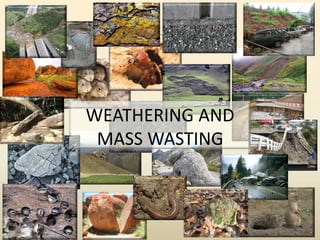
WEATHERING AND
MASS WASTING
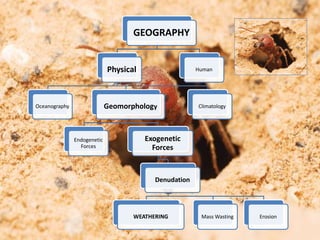
GEOGRAPHY
Physical
Oceanography Geomorphology
Endogenetic
Forces
Exogenetic
Forces
Denudation
WEATHERING Mass Wasting Erosion
Climatology
Human
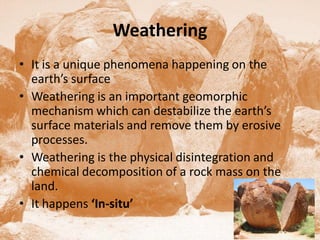
Weathering
• It is a unique phenomena happening on the
earth’s surface
• Weathering is an important geomorphic
mechanism which can destabilize the earth’s
surface materials and remove them by erosive
processes.
• Weathering is the physical disintegration and
chemical decomposition of a rock mass on the
land.
• It happens ‘In-situ’
Factors Influencing Weathering
• Topography : Ground Slope, Aspect,
Altitude
• Physical characteristics of rocks : Minerals,
Joints, Layering, Folding, Faulting.
• Climatic Variations : Humid Tropics
(CW>MW), Dry, semi-Arid (MW>CW),
Permafrost, Monsoon.
• Vegetation (Flora) : Presence-Absence,
Macro-Micro, Physical-Chemical.
Weathering is In-situ and involves no agent of Transport
Geomorphic Importance of Weathering
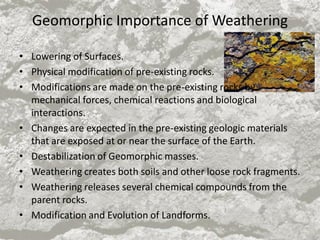
• Lowering of Surfaces.
• Physical modification of pre-existing rocks.
• Modifications are made on the pre-existing rocks by
mechanical forces, chemical reactions and biological
interactions.
• Changes are expected in the pre-existing geologic materials
that are exposed at or near the surface of the Earth.
• Destabilization of Geomorphic masses.
• Weathering creates both soils and other loose rock fragments.
• Weathering releases several chemical compounds from the
parent rocks.
• Modification and Evolution of Landforms.
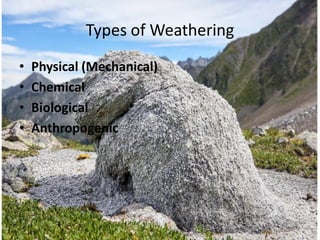
Types of Weathering
• Physical (Mechanical)
• Chemical
• Biological
• Anthropogenic
Physical Weathering
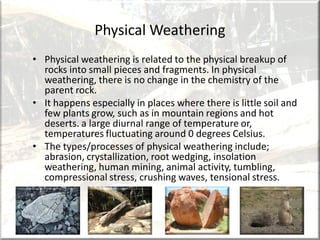
• Physical weathering is related to the physical breakup of
rocks into small pieces and fragments. In physical
weathering, there is no change in the chemistry of the
parent rock.
• It happens especially in places where there is little soil and
few plants grow, such as in mountain regions and hot
deserts. a large diurnal range of temperature or,
temperatures fluctuating around 0 degrees Celsius.
• The types/processes of physical weathering include;
abrasion, crystallization, root wedging, insolation
weathering, human mining, animal activity, tumbling,
compressional stress, crushing waves, tensional stress.
Mechanisms of Physical Weathering
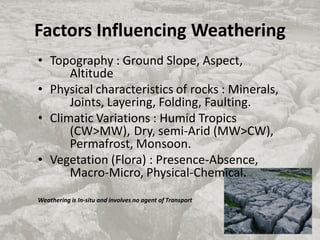
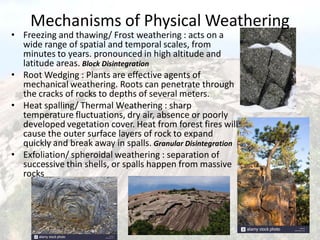
• Freezing and thawing/ Frost weathering : acts on a
wide range of spatial and temporal scales, from
minutes to years. pronounced in high altitude and
latitude areas. Block Disintegration
• Root Wedging : Plants are effective agents of
mechanical weathering. Roots can penetrate through
the cracks of rocks to depths of several meters.
• Heat spalling/ Thermal Weathering : sharp
temperature fluctuations, dry air, absence or poorly
developed vegetation cover. Heat from forest fires will
cause the outer surface layers of rock to expand
quickly and break away in spalls. Granular Disintegration
• Exfoliation/ spheroidal weathering : separation of
successive thin shells, or spalls happen from massive
rocks
Chemical Weathering
• Chemical Weathering is the process of
decomposition of Earth’s surface materials.
• Effectiveness of chemical weathering, is
directly related to, Mineral stability, surface
area exposed, which is related to the Density
of fractures in a rock.
• Rate of Chemical weathering depends on
Temperature, Availability of water or natural
acid.
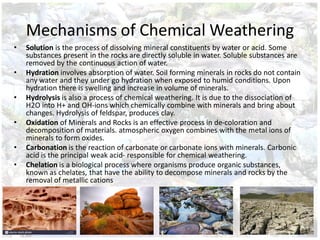
Mechanisms of Chemical Weathering
• Solution is the process of dissolving mineral constituents by water or acid. Some
substances present in the rocks are directly soluble in water. Soluble substances are
removed by the continuous action of water.
• Hydration involves absorption of water. Soil forming minerals in rocks do not contain
any water and they under go hydration when exposed to humid conditions. Upon
hydration there is swelling and increase in volume of minerals.
• Hydrolysis is also a process of chemical weathering. It is due to the dissociation of
H2O into H+ and OH-ions which chemically combine with minerals and bring about
changes. Hydrolysis of feldspar, produces clay.
• Oxidation of Minerals and Rocks is an effective process in de-coloration and
decomposition of materials. atmospheric oxygen combines with the metal ions of
minerals to form oxides.
• Carbonation is the reaction of carbonate or carbonate ions with minerals. Carbonic
acid is the principal weak acid- responsible for chemical weathering.
• Chelation is a biological process where organisms produce organic substances,
known as chelates, that have the ability to decompose minerals and rocks by the
removal of metallic cations
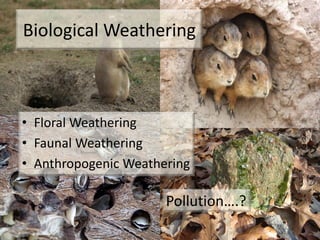
Biological Weathering
• Floral Weathering
• Faunal Weathering
• Anthropogenic Weathering
Pollution….?
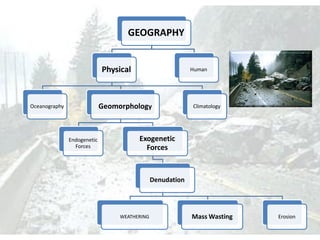
GEOGRAPHY
Physical
Oceanography Geomorphology
Endogenetic
Forces
Exogenetic
Forces
Denudation
WEATHERING Mass Wasting Erosion
Climatology
Human
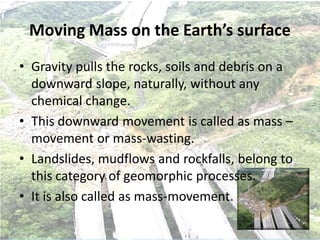
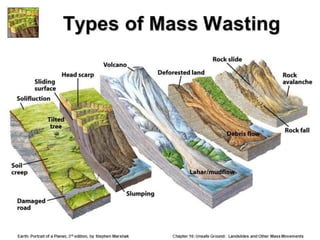
Moving Mass on the Earth’s surface
• Gravity pulls the rocks, soils and debris on a
downward slope, naturally, without any
chemical change.
• This downward movement is called as mass –
movement or mass-wasting.
• Landslides, mudflows and rockfalls, belong to
this category of geomorphic processes.
• It is also called as mass-movement.
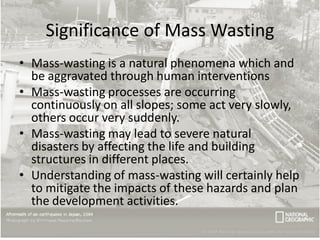
Significance of Mass Wasting
• Mass-wasting is a natural phenomena which and
be aggravated through human interventions
• Mass-wasting processes are occurring
continuously on all slopes; some act very slowly,
others occur very suddenly.
• Mass-wasting may lead to severe natural
disasters by affecting the life and building
structures in different places.
• Understanding of mass-wasting will certainly help
to mitigate the impacts of these hazards and plan
the development activities.
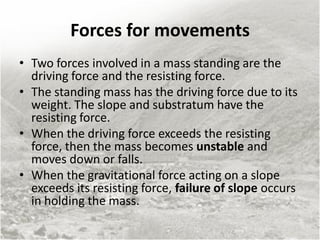
Forces for movements
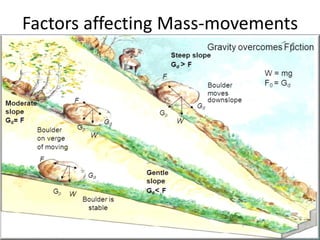
• Two forces involved in a mass standing are the
driving force and the resisting force.
• The standing mass has the driving force due to its
weight. The slope and substratum have the
resisting force.
• When the driving force exceeds the resisting
force, then the mass becomes unstable and
moves down or falls.
• When the gravitational force acting on a slope
exceeds its resisting force, failure of slope occurs
in holding the mass.
Factors affecting Mass-movements
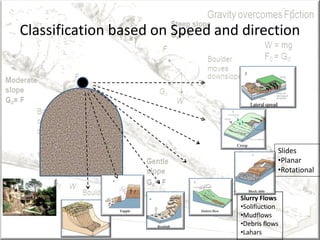
Classification based on Speed and direction
Slurry Flows
•Solifluction
•Mudflows
•Debris flows
•Lahars
Slides
•Planar
•Rotational
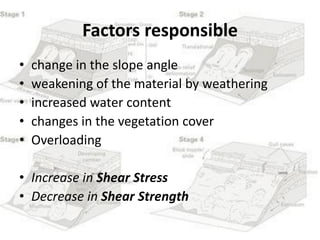
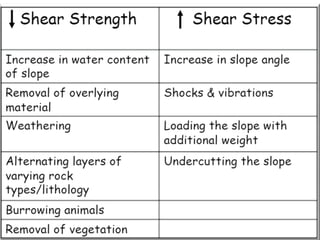
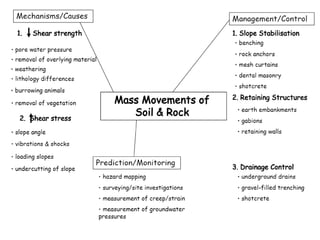
Factors responsible
• change in the slope angle
• weakening of the material by weathering
• increased water content
• changes in the vegetation cover
• Overloading
• Increase in Shear Stress
• Decrease in Shear Strength
Thank You
Dr. Manojkumar P. Devne
Mob : +91 9422 353525
Email :manojdevne10@hotmail.com
manojkumar.devne@spcollegepune.ac.in
FB : Manojkumar Devne
YouTube Channel : Dr. Manojkumar Devne

Weathering and mass wasting

  • 1.
  • 2.
  • 3.
    Weathering • It isa unique phenomena happening on the earth’s surface • Weathering is an important geomorphic mechanism which can destabilize the earth’s surface materials and remove them by erosive processes. • Weathering is the physical disintegration and chemical decomposition of a rock mass on the land. • It happens ‘In-situ’
  • 4.
    Factors Influencing Weathering •Topography : Ground Slope, Aspect, Altitude • Physical characteristics of rocks : Minerals, Joints, Layering, Folding, Faulting. • Climatic Variations : Humid Tropics (CW>MW), Dry, semi-Arid (MW>CW), Permafrost, Monsoon. • Vegetation (Flora) : Presence-Absence, Macro-Micro, Physical-Chemical. Weathering is In-situ and involves no agent of Transport
  • 5.
    Geomorphic Importance ofWeathering • Lowering of Surfaces. • Physical modification of pre-existing rocks. • Modifications are made on the pre-existing rocks by mechanical forces, chemical reactions and biological interactions. • Changes are expected in the pre-existing geologic materials that are exposed at or near the surface of the Earth. • Destabilization of Geomorphic masses. • Weathering creates both soils and other loose rock fragments. • Weathering releases several chemical compounds from the parent rocks. • Modification and Evolution of Landforms.
  • 6.
    Types of Weathering •Physical (Mechanical) • Chemical • Biological • Anthropogenic
  • 7.
    Physical Weathering • Physicalweathering is related to the physical breakup of rocks into small pieces and fragments. In physical weathering, there is no change in the chemistry of the parent rock. • It happens especially in places where there is little soil and few plants grow, such as in mountain regions and hot deserts. a large diurnal range of temperature or, temperatures fluctuating around 0 degrees Celsius. • The types/processes of physical weathering include; abrasion, crystallization, root wedging, insolation weathering, human mining, animal activity, tumbling, compressional stress, crushing waves, tensional stress.
  • 8.
    Mechanisms of PhysicalWeathering • Freezing and thawing/ Frost weathering : acts on a wide range of spatial and temporal scales, from minutes to years. pronounced in high altitude and latitude areas. Block Disintegration • Root Wedging : Plants are effective agents of mechanical weathering. Roots can penetrate through the cracks of rocks to depths of several meters. • Heat spalling/ Thermal Weathering : sharp temperature fluctuations, dry air, absence or poorly developed vegetation cover. Heat from forest fires will cause the outer surface layers of rock to expand quickly and break away in spalls. Granular Disintegration • Exfoliation/ spheroidal weathering : separation of successive thin shells, or spalls happen from massive rocks
  • 9.
    Chemical Weathering • ChemicalWeathering is the process of decomposition of Earth’s surface materials. • Effectiveness of chemical weathering, is directly related to, Mineral stability, surface area exposed, which is related to the Density of fractures in a rock. • Rate of Chemical weathering depends on Temperature, Availability of water or natural acid.
  • 10.
    Mechanisms of ChemicalWeathering • Solution is the process of dissolving mineral constituents by water or acid. Some substances present in the rocks are directly soluble in water. Soluble substances are removed by the continuous action of water. • Hydration involves absorption of water. Soil forming minerals in rocks do not contain any water and they under go hydration when exposed to humid conditions. Upon hydration there is swelling and increase in volume of minerals. • Hydrolysis is also a process of chemical weathering. It is due to the dissociation of H2O into H+ and OH-ions which chemically combine with minerals and bring about changes. Hydrolysis of feldspar, produces clay. • Oxidation of Minerals and Rocks is an effective process in de-coloration and decomposition of materials. atmospheric oxygen combines with the metal ions of minerals to form oxides. • Carbonation is the reaction of carbonate or carbonate ions with minerals. Carbonic acid is the principal weak acid- responsible for chemical weathering. • Chelation is a biological process where organisms produce organic substances, known as chelates, that have the ability to decompose minerals and rocks by the removal of metallic cations
  • 11.
    Biological Weathering • FloralWeathering • Faunal Weathering • Anthropogenic Weathering Pollution….?
  • 12.
  • 13.
    Moving Mass onthe Earth’s surface • Gravity pulls the rocks, soils and debris on a downward slope, naturally, without any chemical change. • This downward movement is called as mass – movement or mass-wasting. • Landslides, mudflows and rockfalls, belong to this category of geomorphic processes. • It is also called as mass-movement.
  • 14.
    Significance of MassWasting • Mass-wasting is a natural phenomena which and be aggravated through human interventions • Mass-wasting processes are occurring continuously on all slopes; some act very slowly, others occur very suddenly. • Mass-wasting may lead to severe natural disasters by affecting the life and building structures in different places. • Understanding of mass-wasting will certainly help to mitigate the impacts of these hazards and plan the development activities.
  • 15.
    Forces for movements •Two forces involved in a mass standing are the driving force and the resisting force. • The standing mass has the driving force due to its weight. The slope and substratum have the resisting force. • When the driving force exceeds the resisting force, then the mass becomes unstable and moves down or falls. • When the gravitational force acting on a slope exceeds its resisting force, failure of slope occurs in holding the mass.
  • 16.
  • 17.
    Classification based onSpeed and direction Slurry Flows •Solifluction •Mudflows •Debris flows •Lahars Slides •Planar •Rotational
  • 19.
    Factors responsible • changein the slope angle • weakening of the material by weathering • increased water content • changes in the vegetation cover • Overloading • Increase in Shear Stress • Decrease in Shear Strength
  • 22.
    Thank You Dr. ManojkumarP. Devne Mob : +91 9422 353525 Email :manojdevne10@hotmail.com manojkumar.devne@spcollegepune.ac.in FB : Manojkumar Devne YouTube Channel : Dr. Manojkumar Devne