6.
GEOMORPHIC PROCESSES
Why is the surface of the earth uneven ?
• The earth surface is being continuously
subjected to by External forces originating
within the earth atmosphere and by the
internal forces within the earth.
• The external forces are known as EXOGENIC
forces.
• The internal forces are known as
ENDOGENIC forces.
1. Degradation
2. Aggradation
3. Gradation
• The ENDOGENIC forces are mainly land
building forces.
1. Diastrophism
2. Volcanism
• The EXOGENIC processes are mainly land
wearing forces.
1. Weathering
2. Mass wasting/Movement
3. Erosion
4. Deposition
GEOMORPHIC PROCESSES
The endogenic and exogenic forces
causing physical stress and chemical
actions on earth materials and
changes the earth surface.
GEOMORPHIC AGENTS
• Any exogenic element of nature capable
of acquiring and transporting earth
materials.
1. Running water
2. Moving ice mass
3. Wind
4. Waves and currents
ENDOGENIC PROCESSES
• The force is mostly generated by
1. Radioactivity
2. Rotational and tidal friction
3. Primordial heat from the origin of the
earth.
DIASTROPHISM
• All processes that moves, elevate or build
up portions of the earth crust.
• They include
1. Orogenic Processes – mountain building
2. Epirogenic Processes – continental building
3. Earthquakes – minor movements
4. Plate tectonics – horizontal movements of
crustal plates
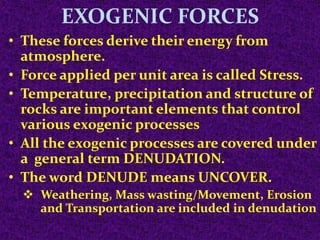
EXOGENIC FORCES
• These forces derive their energy from
atmosphere.
• Force applied per unit area is called Stress.
• Temperature, precipitation and structure of
rocks are important elements that control
various exogenic processes
• All the exogenic processes are covered under
a general term DENUDATION.
• The word DENUDE means UNCOVER.
 Weathering, Mass wasting/Movement, Erosion
and Transportation are included in denudation
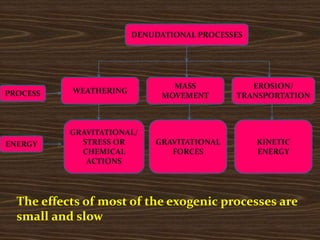
DENUDATIONAL PROCESSES
WEATHERING
MASS
MOVEMENT
EROSION/
TRANSPORTATION
GRAVITATIONAL/
STRESS OR
CHEMICAL
ACTIONS
GRAVITATIONAL
FORCES
KINETIC
ENERGY
ENERGY
PROCESS
The effects of most of the exogenic processes are
small and slow
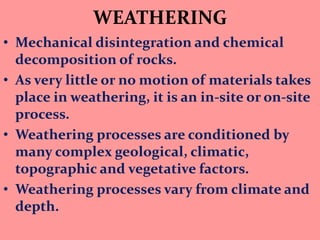
WEATHERING
• Mechanical disintegration and chemical
decomposition of rocks.
• As very little or no motion of materials takes
place in weathering, it is an in-site or on-site
process.
• Weathering processes are conditioned by
many complex geological, climatic,
topographic and vegetative factors.
• Weathering processes vary from climate and
depth.
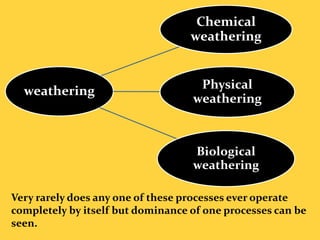
weathering
Chemical
weathering
Physical
weathering
Biological
weathering
Very rarely does any one of these processes ever operate
completely by itself but dominance of one processes can be
seen.
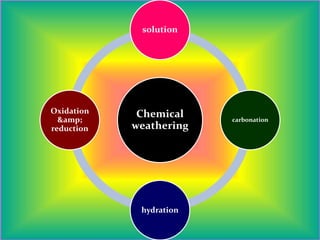
Chemical
weathering
solution
carbonation
hydration
Oxidation
&
reduction
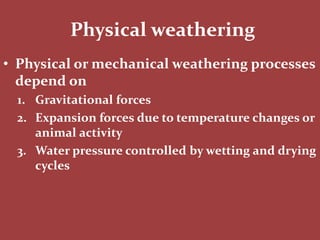
Physical weathering
• Physical or mechanical weathering processes
depend on
1. Gravitational forces
2. Expansion forces due to temperature changes or
animal activity
3. Water pressure controlled by wetting and drying
cycles
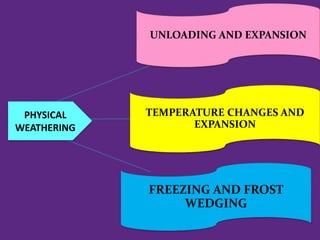
UNLOADING AND EXPANSION
TEMPERATURE CHANGES AND
EXPANSION
FREEZING AND FROST
WEDGING
PHYSICAL
WEATHERING
EXFOLIATION
Exfoliated Domes
Exfoliated Tors
BIOLOGICAL WEATHERING
1. Human Activity
2. Small organisms and dead animals
3. Leaves and roots of trees
MASS MOVEMENT
 Transfer the mass of rock debris down the
slopes under the direct influence of gravity.
 Mass movements are aided by
 Gravity
 Weathering
 Weak unconsolidated materials
 Steep slopes
 Abundant rains
 Scarcity of vegetation
CAUSES OF MASS
MOVEMENT
1. Indiscriminate removal of natural
vegetation.
2. Earthquakes.
3. Overloading through addition of materials.
4. Removal of materials from the slope.
5. Overloading due to heavy rainfall.
6. Increase in gradient and height of slope.
TYPES OF MASS MOVEMENTS
1. Slow Movement
2. Rapid Movement
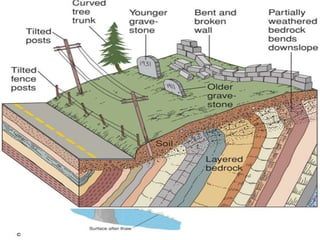
SLOW MOVEMENT
• Occur on moderately soil covered slope,
movement of materials is extremely
slow.
1. SOIL CREEP
2. TALUS CREEP
3. ROCK CREEP
4. ROCK- GLACIER CREEP
SOLIFLUCTION
Which involves slow down slope
flowing soil mass or fine grained rock
debris saturated or lubricated with
water.
• common in moist temperate areas
RAPID MOVEMENTS
• Mostly occur in humid climatic region over
gentle to steep slopes.
• Earth flow – movement of water
saturated clay
• Mud flow – along a definite channel
• Debris avalanche – narrow tracks and
steep slopes, faster than mudflow
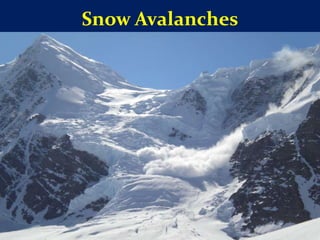
• Snow avalanche .
Snow Avalanches
LANDSLIDES
• These are relatively rapid and perceptible
movements.
• The materials involved are relatively dry.
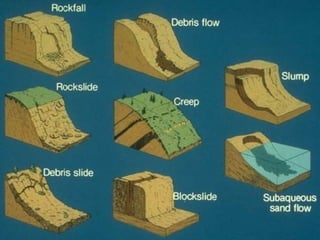
1. Slump - slipping of rock debris with
a backward rotation
2. Debris slide
3. Rock slide
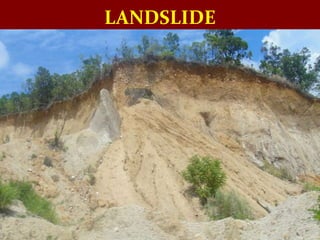
LANDSLIDE
EROSION
• Application of the kinetic energy
associated with the agent to the surface of
land along which it moves.
• involves acquisition and transportation of
materials.
SOIL
• Collection of natural bodies on the earth
surface, contains minerals, water, air,
living organisms and dead matters.
• Pedology is soil science.
• Pedologist is a soil-scientist.
• Soil is a dynamic medium in which many
chemical, physical and biological activities
go on constantly.
SOIL-FORMING FACTORS
1. Parent material
2. Topography
3. Climate
4. Biological activity
5. Time

6. GEOMORPHIC PROCESSES.pptx in the land forms

  • 1.
  • 2.
    Why is thesurface of the earth uneven ? • The earth surface is being continuously subjected to by External forces originating within the earth atmosphere and by the internal forces within the earth. • The external forces are known as EXOGENIC forces. • The internal forces are known as ENDOGENIC forces.
  • 3.
  • 4.
    • The ENDOGENICforces are mainly land building forces. 1. Diastrophism 2. Volcanism • The EXOGENIC processes are mainly land wearing forces. 1. Weathering 2. Mass wasting/Movement 3. Erosion 4. Deposition
  • 5.
    GEOMORPHIC PROCESSES The endogenicand exogenic forces causing physical stress and chemical actions on earth materials and changes the earth surface.
  • 6.
    GEOMORPHIC AGENTS • Anyexogenic element of nature capable of acquiring and transporting earth materials. 1. Running water 2. Moving ice mass 3. Wind 4. Waves and currents
  • 7.
    ENDOGENIC PROCESSES • Theforce is mostly generated by 1. Radioactivity 2. Rotational and tidal friction 3. Primordial heat from the origin of the earth.
  • 8.
    DIASTROPHISM • All processesthat moves, elevate or build up portions of the earth crust. • They include 1. Orogenic Processes – mountain building 2. Epirogenic Processes – continental building 3. Earthquakes – minor movements 4. Plate tectonics – horizontal movements of crustal plates
  • 9.
    EXOGENIC FORCES • Theseforces derive their energy from atmosphere. • Force applied per unit area is called Stress. • Temperature, precipitation and structure of rocks are important elements that control various exogenic processes • All the exogenic processes are covered under a general term DENUDATION. • The word DENUDE means UNCOVER.  Weathering, Mass wasting/Movement, Erosion and Transportation are included in denudation
  • 10.
  • 11.
    WEATHERING • Mechanical disintegrationand chemical decomposition of rocks. • As very little or no motion of materials takes place in weathering, it is an in-site or on-site process. • Weathering processes are conditioned by many complex geological, climatic, topographic and vegetative factors. • Weathering processes vary from climate and depth.
  • 12.
    weathering Chemical weathering Physical weathering Biological weathering Very rarely doesany one of these processes ever operate completely by itself but dominance of one processes can be seen.
  • 13.
  • 14.
    Physical weathering • Physicalor mechanical weathering processes depend on 1. Gravitational forces 2. Expansion forces due to temperature changes or animal activity 3. Water pressure controlled by wetting and drying cycles
  • 15.
    UNLOADING AND EXPANSION TEMPERATURECHANGES AND EXPANSION FREEZING AND FROST WEDGING PHYSICAL WEATHERING
  • 16.
  • 17.
    BIOLOGICAL WEATHERING 1. HumanActivity 2. Small organisms and dead animals 3. Leaves and roots of trees
  • 18.
    MASS MOVEMENT  Transferthe mass of rock debris down the slopes under the direct influence of gravity.  Mass movements are aided by  Gravity  Weathering  Weak unconsolidated materials  Steep slopes  Abundant rains  Scarcity of vegetation
  • 19.
    CAUSES OF MASS MOVEMENT 1.Indiscriminate removal of natural vegetation. 2. Earthquakes. 3. Overloading through addition of materials. 4. Removal of materials from the slope. 5. Overloading due to heavy rainfall. 6. Increase in gradient and height of slope.
  • 20.
    TYPES OF MASSMOVEMENTS 1. Slow Movement 2. Rapid Movement
  • 21.
    SLOW MOVEMENT • Occuron moderately soil covered slope, movement of materials is extremely slow. 1. SOIL CREEP 2. TALUS CREEP 3. ROCK CREEP 4. ROCK- GLACIER CREEP
  • 23.
    SOLIFLUCTION Which involves slowdown slope flowing soil mass or fine grained rock debris saturated or lubricated with water. • common in moist temperate areas
  • 24.
    RAPID MOVEMENTS • Mostlyoccur in humid climatic region over gentle to steep slopes. • Earth flow – movement of water saturated clay • Mud flow – along a definite channel • Debris avalanche – narrow tracks and steep slopes, faster than mudflow • Snow avalanche .
  • 25.
  • 26.
    LANDSLIDES • These arerelatively rapid and perceptible movements. • The materials involved are relatively dry. 1. Slump - slipping of rock debris with a backward rotation 2. Debris slide 3. Rock slide
  • 27.
  • 29.
    EROSION • Application ofthe kinetic energy associated with the agent to the surface of land along which it moves. • involves acquisition and transportation of materials.
  • 30.
    SOIL • Collection ofnatural bodies on the earth surface, contains minerals, water, air, living organisms and dead matters. • Pedology is soil science. • Pedologist is a soil-scientist. • Soil is a dynamic medium in which many chemical, physical and biological activities go on constantly.
  • 31.
    SOIL-FORMING FACTORS 1. Parentmaterial 2. Topography 3. Climate 4. Biological activity 5. Time