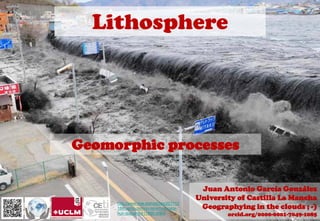
Lithosphere
Geomorphic processes
Juan Antonio García González
University of Castilla La Mancha
Geographying in the clouds ; -)
orcid.org/0000-0001-7049-1085
http://www.rtve.es/noticias/201103
18/cuanto-tiempo-tenemos-para-
huir-tsunami/417869.shtml
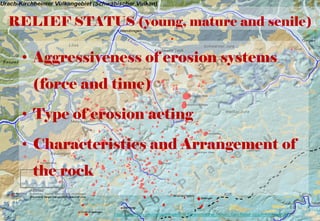
RELIEF STATUS (young, mature and senile)
• Aggressiveness of erosion systems
(force and time)
• Type of erosion acting
• Characteristics and Arrangement of
the rock
https://commons.wikimedia.org/wiki/File:Schwaebischer-Vulkan_Geo-Relief_Urach-Kirchheim.jpg
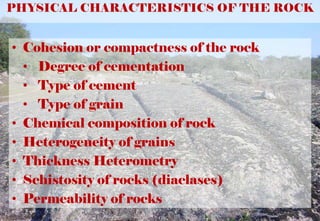
PHYSICAL CHARACTERISTICS OF THE ROCK
• Cohesion or compactness of the rock
• Degree of cementation
• Type of cement
• Type of grain
• Chemical composition of rock
• Heterogeneity of grains
• Thickness Heterometry
• Schistosity of rocks (diaclases)
• Permeability of rocks
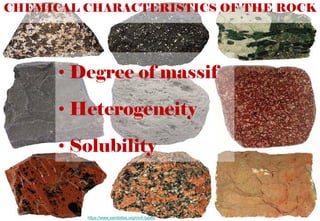
• Degree of massif
• Heterogeneity
• Solubility
CHEMICAL CHARACTERISTICS OF THE ROCK
https://www.sandatlas.org/rock-types/
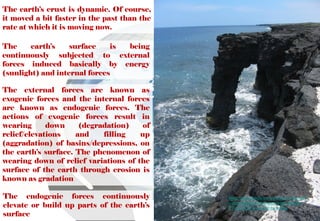
The earth’s crust is dynamic. Of course,
it moved a bit faster in the past than the
rate at which it is moving now.
The earth’s surface is being
continuously subjected to external
forces induced basically by energy
(sunlight) and internal forces
The external forces are known as
exogenic forces and the internal forces
are known as endogenic forces. The
actions of exogenic forces result in
wearing down (degradation) of
relief/elevations and filling up
(aggradation) of basins/depressions, on
the earth’s surface. The phenomenon of
wearing down of relief variations of the
surface of the earth through erosion is
known as gradation
The endogenic forces continuously
elevate or build up parts of the earth’s
surface
https://sites.google.com/a/gbaps.org/erosio
n-and-deposition-5th-hour/water-erosion-
2/7-land-forms-caused-by-waves
ENDOGENIC PROCESSES
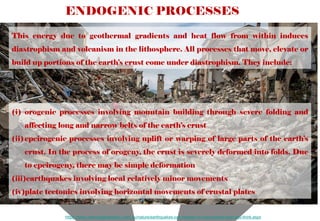
This energy due to geothermal gradients and heat flow from within induces
diastrophism and volcanism in the lithosphere. All processes that move, elevate or
build up portions of the earth’s crust come under diastrophism. They include:
(i) orogenic processes involving mountain building through severe folding and
affecting long and narrow belts of the earth’s crust
(ii)epeirogenic processes involving uplift or warping of large parts of the earth’s
crust. In the process of orogeny, the crust is severely deformed into folds. Due
to epeirogeny, there may be simple deformation
(iii)earthquakes involving local relatively minor movements
(iv)plate tectonics involving horizontal movements of crustal plates
https://www.nationalgeographic.com.au/nature/earthquakes-can-happen-in-more-places-than-you-think.aspx
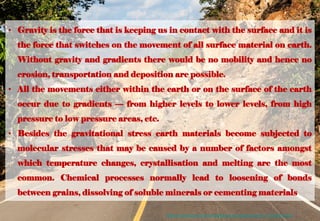
• Gravity is the force that is keeping us in contact with the surface and it is
the force that switches on the movement of all surface material on earth.
Without gravity and gradients there would be no mobility and hence no
erosion, transportation and deposition are possible.
• All the movements either within the earth or on the surface of the earth
occur due to gradients — from higher levels to lower levels, from high
pressure to low pressure areas, etc.
• Besides the gravitational stress earth materials become subjected to
molecular stresses that may be caused by a number of factors amongst
which temperature changes, crystallisation and melting are the most
common. Chemical processes normally lead to loosening of bonds
between grains, dissolving of soluble minerals or cementing materials
https://sciencing.com/how-does-gravity-cause-erosion-13710457.html
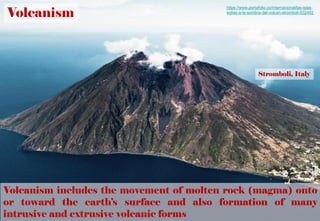
Volcanism
Volcanism includes the movement of molten rock (magma) onto
or toward the earth’s surface and also formation of many
intrusive and extrusive volcanic forms
https://www.portafolio.co/internacional/las-islas-
eolias-a-la-sombra-del-volcan-stromboli-532492
Stromboli, Italy
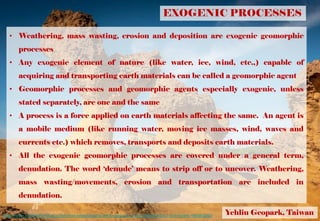
EXOGENIC PROCESSES
• Weathering, mass wasting, erosion and deposition are exogenic geomorphic
processes
• Any exogenic element of nature (like water, ice, wind, etc.,) capable of
acquiring and transporting earth materials can be called a geomorphic agent
• Geomorphic processes and geomorphic agents especially exogenic, unless
stated separately, are one and the same
• A process is a force applied on earth materials affecting the same. An agent is
a mobile medium (like running water, moving ice masses, wind, waves and
currents etc.) which removes, transports and deposits earth materials.
• All the exogenic geomorphic processes are covered under a general term,
denudation. The word ‘denude’ means to strip off or to uncover. Weathering,
mass wasting/movements, erosion and transportation are included in
denudation.
Yehliu Geopark, Taiwanhttps://www.smithsonianmag.com/smart-news/taiwans-yehliu-geopark-is-like-disneyland-for-rock-lovers-180960060/
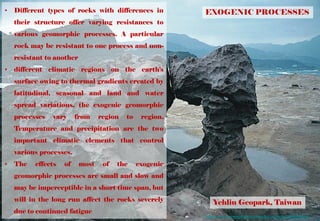
EXOGENIC PROCESSES• Different types of rocks with differences in
their structure offer varying resistances to
various geomorphic processes. A particular
rock may be resistant to one process and non-
resistant to another
• different climatic regions on the earth’s
surface owing to thermal gradients created by
latitudinal, seasonal and land and water
spread variations, the exogenic geomorphic
processes vary from region to region.
Temperature and precipitation are the two
important climatic elements that control
various processes.
• The effects of most of the exogenic
geomorphic processes are small and slow and
may be imperceptible in a short time span, but
will in the long run affect the rocks severely
due to continued fatigue
https://www.newworldencyclopedia.org/entry/Weathering
Yehliu Geopark, Taiwan
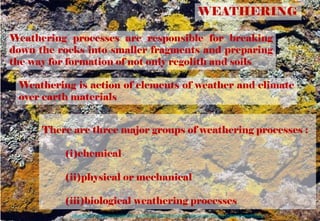
WEATHERING
Weathering is action of elements of weather and climate
over earth materials
There are three major groups of weathering processes :
(i)chemical
(ii)physical or mechanical
(iii)biological weathering processes
Weathering processes are responsible for breaking
down the rocks into smaller fragments and preparing
the way for formation of not only regolith and soils
https://www.americangeosciences.org/education/k5geosource/content/rocks/what-is-biological-weathering
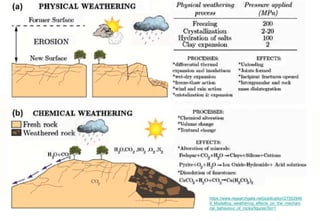
https://www.researchgate.net/publication/27552946
9_Modelling_weathering_effects_on_the_mechani
cal_behaviour_of_rocks/figures?lo=1
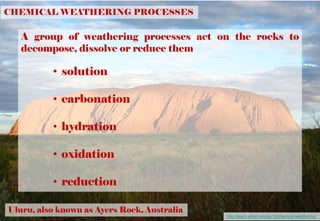
CHEMICAL WEATHERING PROCESSES
A group of weathering processes act on the rocks to
decompose, dissolve or reduce them
• solution
• carbonation
• hydration
• oxidation
• reduction
http://teach.albion.edu/jjn10/chemical-weathering/
Uluru, also known as Ayers Rock, Australia
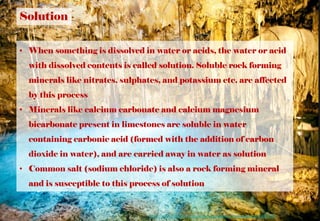
Solution
• When something is dissolved in water or acids, the water or acid
with dissolved contents is called solution. Soluble rock forming
minerals like nitrates, sulphates, and potassium etc. are affected
by this process
• Minerals like calcium carbonate and calcium magnesium
bicarbonate present in limestones are soluble in water
containing carbonic acid (formed with the addition of carbon
dioxide in water), and are carried away in water as solution
• Common salt (sodium chloride) is also a rock forming mineral
and is susceptible to this process of solution
https://www.thoughtco.com/examples-of-chemical-weathering-607608
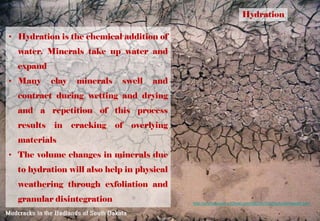
Hydration
• Hydration is the chemical addition of
water. Minerals take up water and
expand
• Many clay minerals swell and
contract during wetting and drying
and a repetition of this process
results in cracking of overlying
materials
• The volume changes in minerals due
to hydration will also help in physical
weathering through exfoliation and
granular disintegration http://profharwood.x10host.com/GEOG102/Study/chmweath.htm
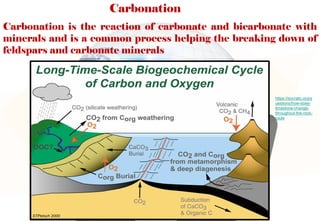
Carbonation
Carbonation is the reaction of carbonate and bicarbonate with
minerals and is a common process helping the breaking down of
feldspars and carbonate minerals
https://socratic.org/q
uestions/how-does-
limestone-change-
throughout-the-rock-
cycle
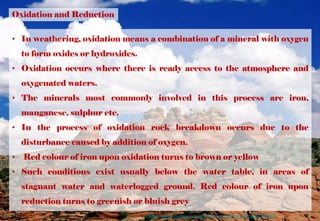
Oxidation and Reduction
• In weathering, oxidation means a combination of a mineral with oxygen
to form oxides or hydroxides.
• Oxidation occurs where there is ready access to the atmosphere and
oxygenated waters.
• The minerals most commonly involved in this process are iron,
manganese, sulphur etc.
• In the process of oxidation rock breakdown occurs due to the
disturbance caused by addition of oxygen.
• Red colour of iron upon oxidation turns to brown or yellow
• Such conditions exist usually below the water table, in areas of
stagnant water and waterlogged ground. Red colour of iron upon
reduction turns to greenish or bluish grey
https://www.thoughtco.com/examples-of-chemical-weathering-607608
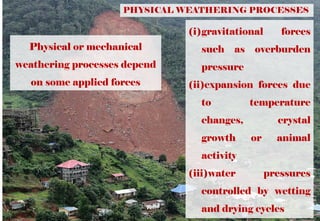
PHYSICAL WEATHERING PROCESSES
Physical or mechanical
weathering processes depend
on some applied forces
(i)gravitational forces
such as overburden
pressure
(ii)expansion forces due
to temperature
changes, crystal
growth or animal
activity
(iii)water pressures
controlled by wetting
and drying cycles
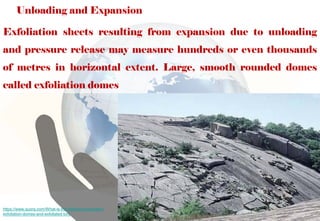
Unloading and Expansion
Exfoliation sheets resulting from expansion due to unloading
and pressure release may measure hundreds or even thousands
of metres in horizontal extent. Large, smooth rounded domes
called exfoliation domes
https://www.quora.com/What-is-the-difference-between-
exfoliation-domes-and-exfoliated-tors
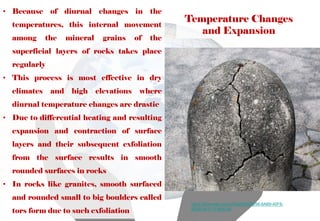
Temperature Changes
and Expansion
• Because of diurnal changes in the
temperatures, this internal movement
among the mineral grains of the
superficial layers of rocks takes place
regularly
• This process is most effective in dry
climates and high elevations where
diurnal temperature changes are drastic
• Due to differential heating and resulting
expansion and contraction of surface
layers and their subsequent exfoliation
from the surface results in smooth
rounded surfaces in rocks
• In rocks like granites, smooth surfaced
and rounded small to big boulders called
tors form due to such exfoliation
https://flowvella.com/s/45yj/0902FE98-6AB9-40F8-
8E9D-941F1F983C44
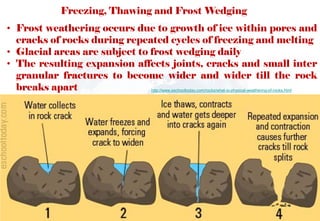
Freezing, Thawing and Frost Wedging
• Frost weathering occurs due to growth of ice within pores and
cracks of rocks during repeated cycles of freezing and melting
• Glacial areas are subject to frost wedging daily
• The resulting expansion affects joints, cracks and small inter
granular fractures to become wider and wider till the rock
breaks apart http://www.eschooltoday.com/rocks/what-is-physical-weathering-of-rocks.html
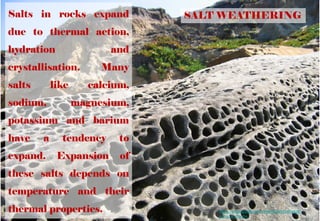
SALT WEATHERINGSalts in rocks expand
due to thermal action,
hydration and
crystallisation. Many
salts like calcium,
sodium, magnesium,
potassium and barium
have a tendency to
expand. Expansion of
these salts depends on
temperature and their
thermal properties. https://sites.google.com/site/drylandsaltweath
ering/landforms
https://epod.usra.edu/blog/2012/10/juniper-pine-and-rock-weathering.html
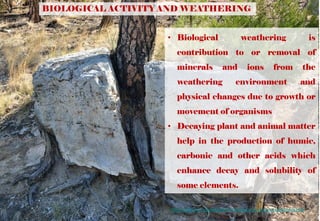
BIOLOGICAL ACTIVITY AND WEATHERING
• Biological weathering is
contribution to or removal of
minerals and ions from the
weathering environment and
physical changes due to growth or
movement of organisms
• Decaying plant and animal matter
help in the production of humic,
carbonic and other acids which
enhance decay and solubility of
some elements.
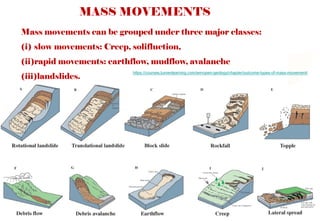
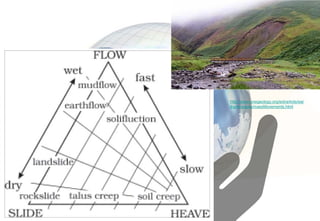
MASS MOVEMENTS
Mass movements can be grouped under three major classes:
(i) slow movements: Creep, solifluction,
(ii)rapid movements: earthflow, mudflow, avalanche
(iii)landslides.
https://courses.lumenlearning.com/wmopen-geology/chapter/outcome-types-of-mass-movement/
http://www.onegeology.org/extra/kids/ear
thprocesses/massMovements.html
EROSION AND DEPOSITION
• The erosion can be defined as “application of the kinetic energy
associated with the agent to the surface of the land along which it
moves
• Erosion involves acquisition and transportation of rock debris. When
massive rocks break into smaller fragments through weathering and
any other process, erosional geomorphic agents like running water,
groundwater, glaciers, wind and waves remove and transport it to
other places depending upon the dynamics of each of these agents
• They represent three states of matter —gaseous (wind), liquid
(running water) and solid (glacier) respectively.
• Abrasion by rock debris carried by these geomorphic agents also aids
greatly in erosion
• Deposition is a consequence of erosion https://www.worldatlas.com/articles/what-are-the-differences-
between-weathering-and-erosion.html
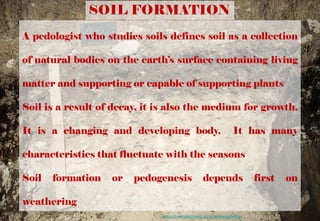
SOIL FORMATION
A pedologist who studies soils defines soil as a collection
of natural bodies on the earth’s surface containing living
matter and supporting or capable of supporting plants
Soil is a result of decay, it is also the medium for growth.
It is a changing and developing body. It has many
characteristics that fluctuate with the seasons
Soil formation or pedogenesis depends first on
weathering
https://memolaproject.eu/activities/pedology
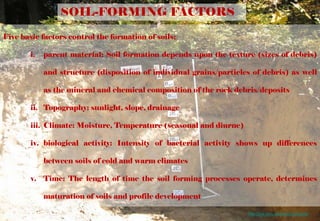
SOIL-FORMING FACTORS
Five basic factors control the formation of soils:
i. parent material: Soil formation depends upon the texture (sizes of debris)
and structure (disposition of individual grains/particles of debris) as well
as the mineral and chemical composition of the rock debris/deposits
ii. Topography: sunlight, slope, drainage
iii. Climate: Moisture, Temperature (seasonal and diurne)
iv. biological activity: Intensity of bacterial activity shows up differences
between soils of cold and warm climates
v. Time: The length of time the soil forming processes operate, determines
maturation of soils and profile development
http://css.wsu.edu/research/soils/
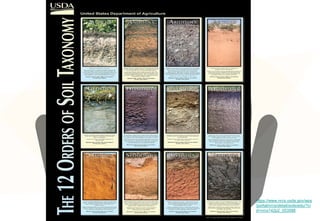
https://www.nrcs.usda.gov/wps
/portal/nrcs/detail/soils/edu/?ci
d=nrcs142p2_053588
https://www.yourquot
e.in/hit-tu-
n2to/quotes/keep-
calm-enjoy-silence-
nature-fam0w
https://nios.ac.in/online-course-material/sr-secondary-courses/Geography-(316).aspx
https://www.pmfias.com/
https://pixabay.com/
http://www.physicalgeography.net/
https://www.geografiainfinita.com/2015/03/espana-y-su-huso-horario/
THANKS TO….
Thanks for your attention, you can follow us in
“Geografiando en las nubes ;-)”
@JGARCIAGONZALEZ
garciagonzalez.juanantonio@gmail.com
http://www.youtube.com/user/garciotum1?feature=mhee
“Geographying in the clouds ;-)”
http://www.linkedin.com/profile/view?id=139061635&trk=tab_pro
http://es.slideshare.net/JuanAntonioGarciaGonzlez
http://pinterest.com/geografiando/boards/
http://geografiandoenlasnubes.blogspot.com.es/
http://www.scoop.it/u/dr-juan-antonio-garcia-gonzalez
https://plus.google.com/u/0/105941284089211583758/posts
http://www.facebook.com/juanantonio.garciagonzalez.37

2019 tg lithosphere3 geomorphic processes

  • 1.
    Lithosphere Geomorphic processes Juan AntonioGarcía González University of Castilla La Mancha Geographying in the clouds ; -) orcid.org/0000-0001-7049-1085 http://www.rtve.es/noticias/201103 18/cuanto-tiempo-tenemos-para- huir-tsunami/417869.shtml
  • 2.
    RELIEF STATUS (young,mature and senile) • Aggressiveness of erosion systems (force and time) • Type of erosion acting • Characteristics and Arrangement of the rock https://commons.wikimedia.org/wiki/File:Schwaebischer-Vulkan_Geo-Relief_Urach-Kirchheim.jpg
  • 3.
    PHYSICAL CHARACTERISTICS OFTHE ROCK • Cohesion or compactness of the rock • Degree of cementation • Type of cement • Type of grain • Chemical composition of rock • Heterogeneity of grains • Thickness Heterometry • Schistosity of rocks (diaclases) • Permeability of rocks
  • 4.
    • Degree ofmassif • Heterogeneity • Solubility CHEMICAL CHARACTERISTICS OF THE ROCK https://www.sandatlas.org/rock-types/
  • 5.
    The earth’s crustis dynamic. Of course, it moved a bit faster in the past than the rate at which it is moving now. The earth’s surface is being continuously subjected to external forces induced basically by energy (sunlight) and internal forces The external forces are known as exogenic forces and the internal forces are known as endogenic forces. The actions of exogenic forces result in wearing down (degradation) of relief/elevations and filling up (aggradation) of basins/depressions, on the earth’s surface. The phenomenon of wearing down of relief variations of the surface of the earth through erosion is known as gradation The endogenic forces continuously elevate or build up parts of the earth’s surface https://sites.google.com/a/gbaps.org/erosio n-and-deposition-5th-hour/water-erosion- 2/7-land-forms-caused-by-waves
  • 6.
    ENDOGENIC PROCESSES This energydue to geothermal gradients and heat flow from within induces diastrophism and volcanism in the lithosphere. All processes that move, elevate or build up portions of the earth’s crust come under diastrophism. They include: (i) orogenic processes involving mountain building through severe folding and affecting long and narrow belts of the earth’s crust (ii)epeirogenic processes involving uplift or warping of large parts of the earth’s crust. In the process of orogeny, the crust is severely deformed into folds. Due to epeirogeny, there may be simple deformation (iii)earthquakes involving local relatively minor movements (iv)plate tectonics involving horizontal movements of crustal plates https://www.nationalgeographic.com.au/nature/earthquakes-can-happen-in-more-places-than-you-think.aspx
  • 7.
    • Gravity isthe force that is keeping us in contact with the surface and it is the force that switches on the movement of all surface material on earth. Without gravity and gradients there would be no mobility and hence no erosion, transportation and deposition are possible. • All the movements either within the earth or on the surface of the earth occur due to gradients — from higher levels to lower levels, from high pressure to low pressure areas, etc. • Besides the gravitational stress earth materials become subjected to molecular stresses that may be caused by a number of factors amongst which temperature changes, crystallisation and melting are the most common. Chemical processes normally lead to loosening of bonds between grains, dissolving of soluble minerals or cementing materials https://sciencing.com/how-does-gravity-cause-erosion-13710457.html
  • 8.
    Volcanism Volcanism includes themovement of molten rock (magma) onto or toward the earth’s surface and also formation of many intrusive and extrusive volcanic forms https://www.portafolio.co/internacional/las-islas- eolias-a-la-sombra-del-volcan-stromboli-532492 Stromboli, Italy
  • 9.
    EXOGENIC PROCESSES • Weathering,mass wasting, erosion and deposition are exogenic geomorphic processes • Any exogenic element of nature (like water, ice, wind, etc.,) capable of acquiring and transporting earth materials can be called a geomorphic agent • Geomorphic processes and geomorphic agents especially exogenic, unless stated separately, are one and the same • A process is a force applied on earth materials affecting the same. An agent is a mobile medium (like running water, moving ice masses, wind, waves and currents etc.) which removes, transports and deposits earth materials. • All the exogenic geomorphic processes are covered under a general term, denudation. The word ‘denude’ means to strip off or to uncover. Weathering, mass wasting/movements, erosion and transportation are included in denudation. Yehliu Geopark, Taiwanhttps://www.smithsonianmag.com/smart-news/taiwans-yehliu-geopark-is-like-disneyland-for-rock-lovers-180960060/
  • 10.
    EXOGENIC PROCESSES• Differenttypes of rocks with differences in their structure offer varying resistances to various geomorphic processes. A particular rock may be resistant to one process and non- resistant to another • different climatic regions on the earth’s surface owing to thermal gradients created by latitudinal, seasonal and land and water spread variations, the exogenic geomorphic processes vary from region to region. Temperature and precipitation are the two important climatic elements that control various processes. • The effects of most of the exogenic geomorphic processes are small and slow and may be imperceptible in a short time span, but will in the long run affect the rocks severely due to continued fatigue https://www.newworldencyclopedia.org/entry/Weathering Yehliu Geopark, Taiwan
  • 11.
    WEATHERING Weathering is actionof elements of weather and climate over earth materials There are three major groups of weathering processes : (i)chemical (ii)physical or mechanical (iii)biological weathering processes Weathering processes are responsible for breaking down the rocks into smaller fragments and preparing the way for formation of not only regolith and soils https://www.americangeosciences.org/education/k5geosource/content/rocks/what-is-biological-weathering
  • 12.
  • 13.
    CHEMICAL WEATHERING PROCESSES Agroup of weathering processes act on the rocks to decompose, dissolve or reduce them • solution • carbonation • hydration • oxidation • reduction http://teach.albion.edu/jjn10/chemical-weathering/ Uluru, also known as Ayers Rock, Australia
  • 14.
    Solution • When somethingis dissolved in water or acids, the water or acid with dissolved contents is called solution. Soluble rock forming minerals like nitrates, sulphates, and potassium etc. are affected by this process • Minerals like calcium carbonate and calcium magnesium bicarbonate present in limestones are soluble in water containing carbonic acid (formed with the addition of carbon dioxide in water), and are carried away in water as solution • Common salt (sodium chloride) is also a rock forming mineral and is susceptible to this process of solution https://www.thoughtco.com/examples-of-chemical-weathering-607608
  • 15.
    Hydration • Hydration isthe chemical addition of water. Minerals take up water and expand • Many clay minerals swell and contract during wetting and drying and a repetition of this process results in cracking of overlying materials • The volume changes in minerals due to hydration will also help in physical weathering through exfoliation and granular disintegration http://profharwood.x10host.com/GEOG102/Study/chmweath.htm
  • 16.
    Carbonation Carbonation is thereaction of carbonate and bicarbonate with minerals and is a common process helping the breaking down of feldspars and carbonate minerals https://socratic.org/q uestions/how-does- limestone-change- throughout-the-rock- cycle
  • 17.
    Oxidation and Reduction •In weathering, oxidation means a combination of a mineral with oxygen to form oxides or hydroxides. • Oxidation occurs where there is ready access to the atmosphere and oxygenated waters. • The minerals most commonly involved in this process are iron, manganese, sulphur etc. • In the process of oxidation rock breakdown occurs due to the disturbance caused by addition of oxygen. • Red colour of iron upon oxidation turns to brown or yellow • Such conditions exist usually below the water table, in areas of stagnant water and waterlogged ground. Red colour of iron upon reduction turns to greenish or bluish grey https://www.thoughtco.com/examples-of-chemical-weathering-607608
  • 18.
    PHYSICAL WEATHERING PROCESSES Physicalor mechanical weathering processes depend on some applied forces (i)gravitational forces such as overburden pressure (ii)expansion forces due to temperature changes, crystal growth or animal activity (iii)water pressures controlled by wetting and drying cycles
  • 19.
    Unloading and Expansion Exfoliationsheets resulting from expansion due to unloading and pressure release may measure hundreds or even thousands of metres in horizontal extent. Large, smooth rounded domes called exfoliation domes https://www.quora.com/What-is-the-difference-between- exfoliation-domes-and-exfoliated-tors
  • 20.
    Temperature Changes and Expansion •Because of diurnal changes in the temperatures, this internal movement among the mineral grains of the superficial layers of rocks takes place regularly • This process is most effective in dry climates and high elevations where diurnal temperature changes are drastic • Due to differential heating and resulting expansion and contraction of surface layers and their subsequent exfoliation from the surface results in smooth rounded surfaces in rocks • In rocks like granites, smooth surfaced and rounded small to big boulders called tors form due to such exfoliation https://flowvella.com/s/45yj/0902FE98-6AB9-40F8- 8E9D-941F1F983C44
  • 21.
    Freezing, Thawing andFrost Wedging • Frost weathering occurs due to growth of ice within pores and cracks of rocks during repeated cycles of freezing and melting • Glacial areas are subject to frost wedging daily • The resulting expansion affects joints, cracks and small inter granular fractures to become wider and wider till the rock breaks apart http://www.eschooltoday.com/rocks/what-is-physical-weathering-of-rocks.html
  • 22.
    SALT WEATHERINGSalts inrocks expand due to thermal action, hydration and crystallisation. Many salts like calcium, sodium, magnesium, potassium and barium have a tendency to expand. Expansion of these salts depends on temperature and their thermal properties. https://sites.google.com/site/drylandsaltweath ering/landforms
  • 23.
    https://epod.usra.edu/blog/2012/10/juniper-pine-and-rock-weathering.html BIOLOGICAL ACTIVITY ANDWEATHERING • Biological weathering is contribution to or removal of minerals and ions from the weathering environment and physical changes due to growth or movement of organisms • Decaying plant and animal matter help in the production of humic, carbonic and other acids which enhance decay and solubility of some elements.
  • 24.
    MASS MOVEMENTS Mass movementscan be grouped under three major classes: (i) slow movements: Creep, solifluction, (ii)rapid movements: earthflow, mudflow, avalanche (iii)landslides. https://courses.lumenlearning.com/wmopen-geology/chapter/outcome-types-of-mass-movement/
  • 25.
  • 26.
    EROSION AND DEPOSITION •The erosion can be defined as “application of the kinetic energy associated with the agent to the surface of the land along which it moves • Erosion involves acquisition and transportation of rock debris. When massive rocks break into smaller fragments through weathering and any other process, erosional geomorphic agents like running water, groundwater, glaciers, wind and waves remove and transport it to other places depending upon the dynamics of each of these agents • They represent three states of matter —gaseous (wind), liquid (running water) and solid (glacier) respectively. • Abrasion by rock debris carried by these geomorphic agents also aids greatly in erosion • Deposition is a consequence of erosion https://www.worldatlas.com/articles/what-are-the-differences- between-weathering-and-erosion.html
  • 27.
    SOIL FORMATION A pedologistwho studies soils defines soil as a collection of natural bodies on the earth’s surface containing living matter and supporting or capable of supporting plants Soil is a result of decay, it is also the medium for growth. It is a changing and developing body. It has many characteristics that fluctuate with the seasons Soil formation or pedogenesis depends first on weathering https://memolaproject.eu/activities/pedology
  • 28.
    SOIL-FORMING FACTORS Five basicfactors control the formation of soils: i. parent material: Soil formation depends upon the texture (sizes of debris) and structure (disposition of individual grains/particles of debris) as well as the mineral and chemical composition of the rock debris/deposits ii. Topography: sunlight, slope, drainage iii. Climate: Moisture, Temperature (seasonal and diurne) iv. biological activity: Intensity of bacterial activity shows up differences between soils of cold and warm climates v. Time: The length of time the soil forming processes operate, determines maturation of soils and profile development http://css.wsu.edu/research/soils/
  • 29.
  • 30.
  • 31.
  • 32.
    Thanks for yourattention, you can follow us in “Geografiando en las nubes ;-)” @JGARCIAGONZALEZ garciagonzalez.juanantonio@gmail.com http://www.youtube.com/user/garciotum1?feature=mhee “Geographying in the clouds ;-)” http://www.linkedin.com/profile/view?id=139061635&trk=tab_pro http://es.slideshare.net/JuanAntonioGarciaGonzlez http://pinterest.com/geografiando/boards/ http://geografiandoenlasnubes.blogspot.com.es/ http://www.scoop.it/u/dr-juan-antonio-garcia-gonzalez https://plus.google.com/u/0/105941284089211583758/posts http://www.facebook.com/juanantonio.garciagonzalez.37