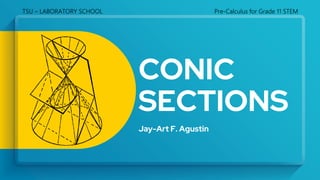
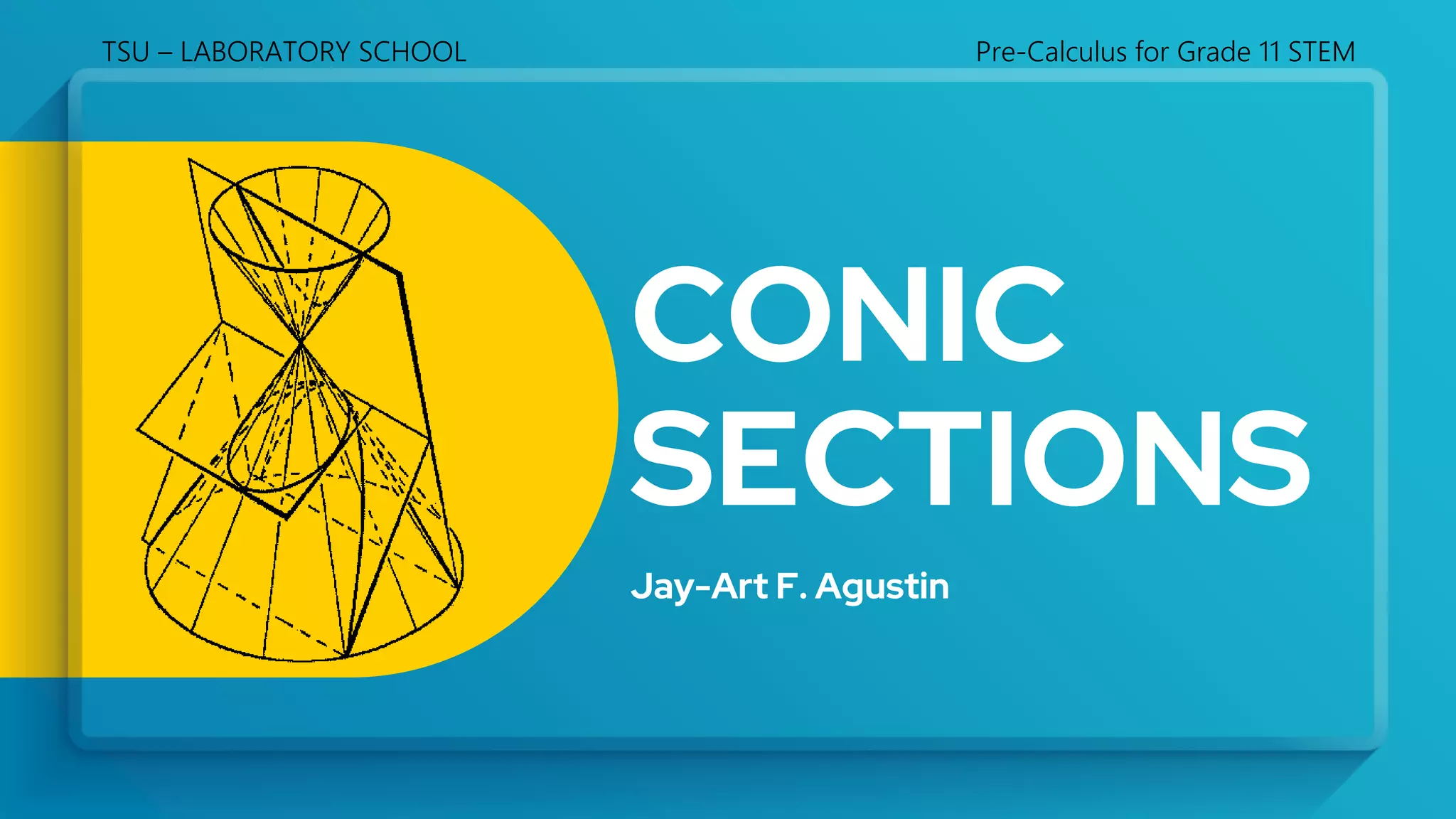
CONIC
SECTIONS
Jay-Art F. Agustin
TSU – LABORATORY SCHOOL Pre-Calculus for Grade 11 STEM
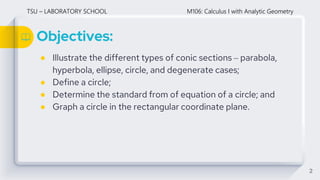
Objectives:
2
● Illustrate the different types of conic sections – parabola,
hyperbola, ellipse, circle, and degenerate cases;
● Define a circle;
● Determine the standard from of equation of a circle; and
● Graph a circle in the rectangular coordinate plane.
TSU – LABORATORY SCHOOL M106: Calculus I with Analytic Geometry
Conic Sections
1
TSU – LABORATORY SCHOOL M106: Calculus I with Analytic Geometry
The Origin
4
TSU – LABORATORY SCHOOL M106: Calculus I with Analytic Geometry
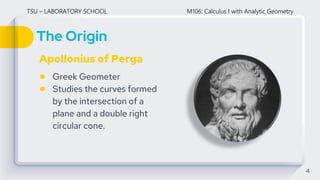
Apollonius of Perga
● Greek Geometer
● Studies the curves formed
by the intersection of a
plane and a double right
circular cone.
The ‘Cone-ic’ Sections
5
TSU – LABORATORY SCHOOL M106: Calculus I with Analytic Geometry
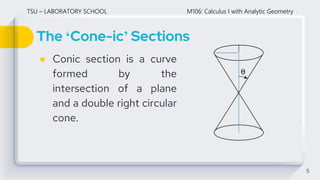
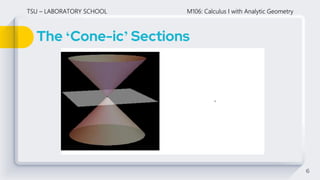
● Conic section is a curve
formed by the
intersection of a plane
and a double right circular
cone.
The ‘Cone-ic’ Sections
6
TSU – LABORATORY SCHOOL M106: Calculus I with Analytic Geometry
The Three Conic Sections
7
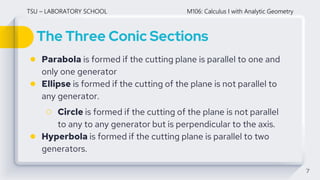
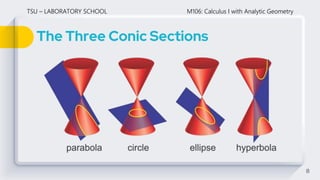
● Parabola is formed if the cutting plane is parallel to one and
only one generator
● Ellipse is formed if the cutting of the plane is not parallel to
any generator.
○ Circle is formed if the cutting of the plane is not parallel
to any to any generator but is perpendicular to the axis.
● Hyperbola is formed if the cutting plane is parallel to two
generators.
TSU – LABORATORY SCHOOL M106: Calculus I with Analytic Geometry
The Three Conic Sections
8
TSU – LABORATORY SCHOOL M106: Calculus I with Analytic Geometry
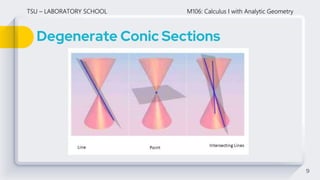
Degenerate Conic Sections
9
TSU – LABORATORY SCHOOL M106: Calculus I with Analytic Geometry
Conic Sections as Defined
10
● A conic is a set of points
whose distances from a
fixed point are in constant
ratio to their distances
from a fixed line that is not
passing through the fixed
point.
TSU – LABORATORY SCHOOL M106: Calculus I with Analytic Geometry
Elements
11
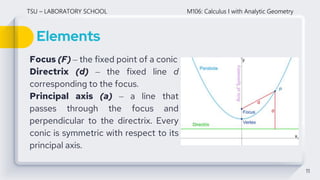
Focus (F) – the fixed point of a conic
Directrix (d) – the fixed line d
corresponding to the focus.
Principal axis (a) – a line that
passes through the focus and
perpendicular to the directrix. Every
conic is symmetric with respect to its
principal axis.
TSU – LABORATORY SCHOOL M106: Calculus I with Analytic Geometry
Elements
12
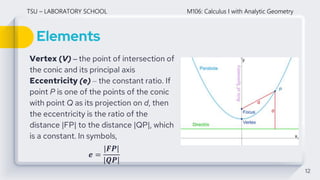
Vertex (V) – the point of intersection of
the conic and its principal axis
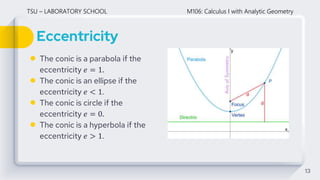
Eccentricity (e) – the constant ratio. If
point P is one of the points of the conic
with point Q as its projection on d, then
the eccentricity is the ratio of the
distance |FP| to the distance |QP|, which
is a constant. In symbols,
𝒆 =
|𝑭𝑷|
|𝑸𝑷|
TSU – LABORATORY SCHOOL M106: Calculus I with Analytic Geometry
Eccentricity
13
● The conic is a parabola if the
eccentricity 𝑒 = 1.
● The conic is an ellipse if the
eccentricity 𝑒 < 1.
● The conic is circle if the
eccentricity 𝑒 = 0.
● The conic is a hyperbola if the
eccentricity 𝑒 > 1.
TSU – LABORATORY SCHOOL M106: Calculus I with Analytic Geometry
Circles
2
TSU – LABORATORY SCHOOL M106: Calculus I with Analytic Geometry
Circle Defined
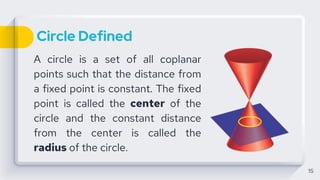
A circle is a set of all coplanar
points such that the distance from
a fixed point is constant. The fixed
point is called the center of the
circle and the constant distance
from the center is called the
radius of the circle.
15
Circle Defined
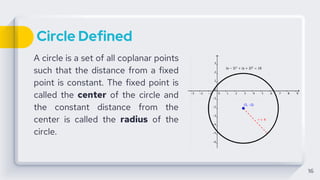
A circle is a set of all coplanar points
such that the distance from a fixed
point is constant. The fixed point is
called the center of the circle and
the constant distance from the
center is called the radius of the
circle.
16
Equation of a Circle with C (0, 0)
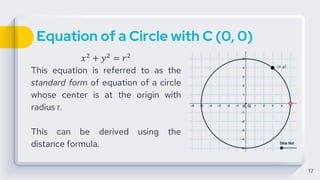
𝑥2
+ 𝑦2
= 𝑟2
This equation is referred to as the
standard form of equation of a circle
whose center is at the origin with
radius r.
This can be derived using the
distance formula.
17
Derivation
𝑥2
+ 𝑦2
= 𝑟2
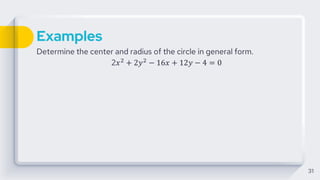
The distance of C (0,0) to P (x, y) is equal to the radius.
18
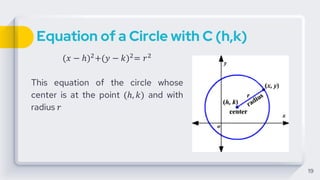
Equation of a Circle with C (h,k)
(𝑥 − ℎ)2
+(𝑦 − 𝑘)2
= 𝑟2
This equation of the circle whose
center is at the point (ℎ, 𝑘) and with
radius 𝑟
19
Exercise
Determine the standard form of equation of the following circles
and the radius. Draw the graph.
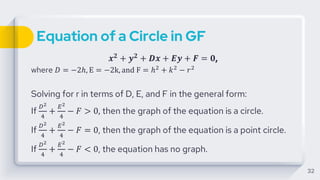
1. Center 𝐶(0, 0), radius: 9;
2. Center 𝐶(−5,7), radius: 6;
3. Center 𝐶( 7, 3 3), radius: 8.
20
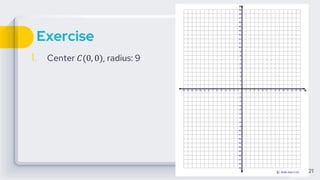
Exercise
1. Center 𝐶(0, 0), radius: 9
21
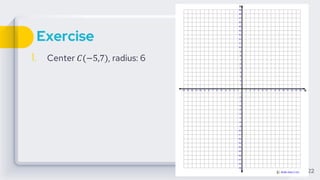
Exercise
1. Center 𝐶(−5,7), radius: 6
22
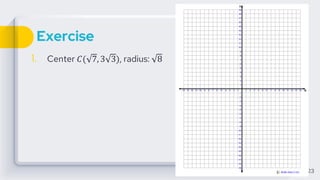
Exercise
1. Center 𝐶( 7, 3 3), radius: 8
23
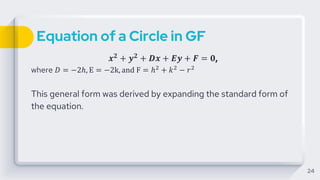
Equation of a Circle in GF
𝒙𝟐 + 𝒚𝟐 + 𝑫𝒙 + 𝑬𝒚 + 𝑭 = 𝟎,
where 𝐷 = −2ℎ, E = −2k, and F = ℎ2
+ 𝑘2
− 𝑟2
This general form was derived by expanding the standard form of
the equation.
24
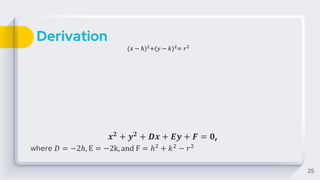
Derivation
𝒙𝟐 + 𝒚𝟐 + 𝑫𝒙 + 𝑬𝒚 + 𝑭 = 𝟎,
where 𝐷 = −2ℎ, E = −2k, and F = ℎ2
+ 𝑘2
− 𝑟2
25
(𝑥 − ℎ)2
+(𝑦 − 𝑘)2
= 𝑟2
Examples
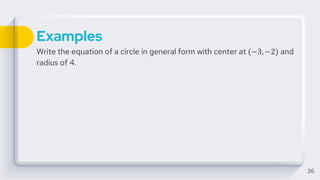
Write the equation of a circle in general form with center at (−3, −2) and
radius of 4.
26
Examples
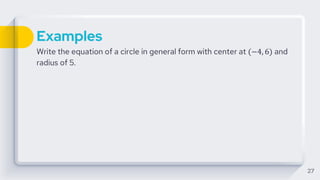
Write the equation of a circle in general form with center at (−4, 6) and
radius of 5.
27
Examples
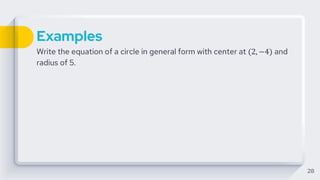
Write the equation of a circle in general form with center at (2, −4) and
radius of 5.
28
Examples
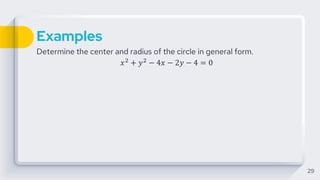
Determine the center and radius of the circle in general form.
𝑥2 + 𝑦2 − 4𝑥 − 2𝑦 − 4 = 0
29
Examples
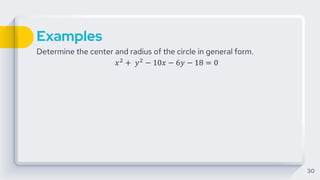
Determine the center and radius of the circle in general form.
𝑥2 + 𝑦2 − 10𝑥 − 6𝑦 − 18 = 0
30
Examples
Determine the center and radius of the circle in general form.
2𝑥2 + 2𝑦2 − 16𝑥 + 12𝑦 − 4 = 0
31
Equation of a Circle in GF
𝒙𝟐 + 𝒚𝟐 + 𝑫𝒙 + 𝑬𝒚 + 𝑭 = 𝟎,
where 𝐷 = −2ℎ, E = −2k, and F = ℎ2
+ 𝑘2
− 𝑟2
Solving for r in terms of D, E, and F in the general form:
If
𝐷2
4
+
𝐸2
4
− 𝐹 > 0, then the graph of the equation is a circle.
If
𝐷2
4
+
𝐸2
4
− 𝐹 = 0, then the graph of the equation is a point circle.
If
𝐷2
4
+
𝐸2
4
− 𝐹 < 0, the equation has no graph.
32
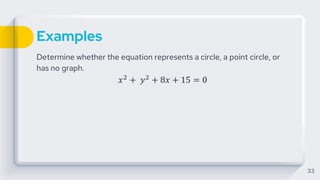
Examples
Determine whether the equation represents a circle, a point circle, or
has no graph.
𝑥2 + 𝑦2 + 8𝑥 + 15 = 0
33
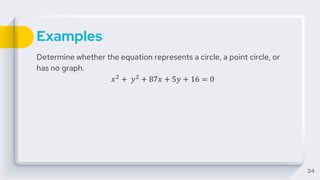
Examples
Determine whether the equation represents a circle, a point circle, or
has no graph.
𝑥2 + 𝑦2 + 87𝑥 + 5𝑦 + 16 = 0
34
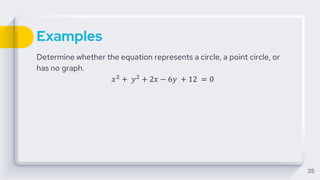
Examples
Determine whether the equation represents a circle, a point circle, or
has no graph.
𝑥2 + 𝑦2 + 2𝑥 − 6𝑦 + 12 = 0
35
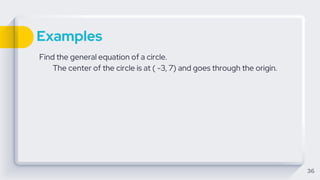
Examples
Find the general equation of a circle.
The center of the circle is at ( -3, 7) and goes through the origin.
36
Examples
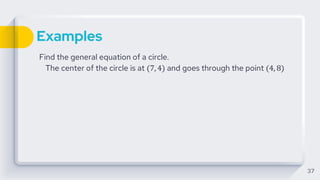
Find the general equation of a circle.
The center of the circle is at (7, 4) and goes through the point (4, 8)
37
Examples
Find the equation of a circle
The circle passes through the origin, and contain the points (0, 5), and (3, 3).
𝑥2
+ 𝑦2
+ 𝐷𝑥 + 𝐸𝑦 + 𝐹 = 0
38
Examples
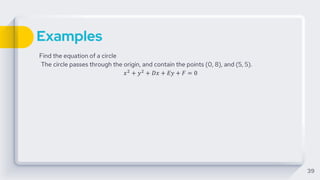
Find the equation of a circle
The circle passes through the origin, and contain the points (0, 8), and (5, 5).
𝑥2
+ 𝑦2
+ 𝐷𝑥 + 𝐸𝑦 + 𝐹 = 0
39
Examples
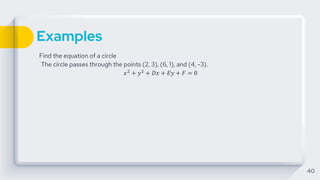
Find the equation of a circle
The circle passes through the points (2, 3), (6, 1), and (4, -3).
𝑥2
+ 𝑦2
+ 𝐷𝑥 + 𝐸𝑦 + 𝐹 = 0
40
Examples
A particular cellphone tower is designed to service a 15-km radius. The tower is located at
(5, -3) on a coordinate plane whose units represents km.
● What is the standard form equation of the outer boundary of the region serviced by
the tower?
● What is the general form equation of the region serviced by the tower?
● Draw the graph of the region serviced by the tower.
41
Meronnnn paaaa!
42

Conic Sections

  • 1.
    CONIC SECTIONS Jay-Art F. Agustin TSU– LABORATORY SCHOOL Pre-Calculus for Grade 11 STEM
  • 2.
    Objectives: 2 ● Illustrate thedifferent types of conic sections – parabola, hyperbola, ellipse, circle, and degenerate cases; ● Define a circle; ● Determine the standard from of equation of a circle; and ● Graph a circle in the rectangular coordinate plane. TSU – LABORATORY SCHOOL M106: Calculus I with Analytic Geometry
  • 3.
    Conic Sections 1 TSU –LABORATORY SCHOOL M106: Calculus I with Analytic Geometry
  • 4.
    The Origin 4 TSU –LABORATORY SCHOOL M106: Calculus I with Analytic Geometry Apollonius of Perga ● Greek Geometer ● Studies the curves formed by the intersection of a plane and a double right circular cone.
  • 5.
    The ‘Cone-ic’ Sections 5 TSU– LABORATORY SCHOOL M106: Calculus I with Analytic Geometry ● Conic section is a curve formed by the intersection of a plane and a double right circular cone.
  • 6.
    The ‘Cone-ic’ Sections 6 TSU– LABORATORY SCHOOL M106: Calculus I with Analytic Geometry
  • 7.
    The Three ConicSections 7 ● Parabola is formed if the cutting plane is parallel to one and only one generator ● Ellipse is formed if the cutting of the plane is not parallel to any generator. ○ Circle is formed if the cutting of the plane is not parallel to any to any generator but is perpendicular to the axis. ● Hyperbola is formed if the cutting plane is parallel to two generators. TSU – LABORATORY SCHOOL M106: Calculus I with Analytic Geometry
  • 8.
    The Three ConicSections 8 TSU – LABORATORY SCHOOL M106: Calculus I with Analytic Geometry
  • 9.
    Degenerate Conic Sections 9 TSU– LABORATORY SCHOOL M106: Calculus I with Analytic Geometry
  • 10.
    Conic Sections asDefined 10 ● A conic is a set of points whose distances from a fixed point are in constant ratio to their distances from a fixed line that is not passing through the fixed point. TSU – LABORATORY SCHOOL M106: Calculus I with Analytic Geometry
  • 11.
    Elements 11 Focus (F) –the fixed point of a conic Directrix (d) – the fixed line d corresponding to the focus. Principal axis (a) – a line that passes through the focus and perpendicular to the directrix. Every conic is symmetric with respect to its principal axis. TSU – LABORATORY SCHOOL M106: Calculus I with Analytic Geometry
  • 12.
    Elements 12 Vertex (V) –the point of intersection of the conic and its principal axis Eccentricity (e) – the constant ratio. If point P is one of the points of the conic with point Q as its projection on d, then the eccentricity is the ratio of the distance |FP| to the distance |QP|, which is a constant. In symbols, 𝒆 = |𝑭𝑷| |𝑸𝑷| TSU – LABORATORY SCHOOL M106: Calculus I with Analytic Geometry
  • 13.
    Eccentricity 13 ● The conicis a parabola if the eccentricity 𝑒 = 1. ● The conic is an ellipse if the eccentricity 𝑒 < 1. ● The conic is circle if the eccentricity 𝑒 = 0. ● The conic is a hyperbola if the eccentricity 𝑒 > 1. TSU – LABORATORY SCHOOL M106: Calculus I with Analytic Geometry
  • 14.
    Circles 2 TSU – LABORATORYSCHOOL M106: Calculus I with Analytic Geometry
  • 15.
    Circle Defined A circleis a set of all coplanar points such that the distance from a fixed point is constant. The fixed point is called the center of the circle and the constant distance from the center is called the radius of the circle. 15
  • 16.
    Circle Defined A circleis a set of all coplanar points such that the distance from a fixed point is constant. The fixed point is called the center of the circle and the constant distance from the center is called the radius of the circle. 16
  • 17.
    Equation of aCircle with C (0, 0) 𝑥2 + 𝑦2 = 𝑟2 This equation is referred to as the standard form of equation of a circle whose center is at the origin with radius r. This can be derived using the distance formula. 17
  • 18.
    Derivation 𝑥2 + 𝑦2 = 𝑟2 Thedistance of C (0,0) to P (x, y) is equal to the radius. 18
  • 19.
    Equation of aCircle with C (h,k) (𝑥 − ℎ)2 +(𝑦 − 𝑘)2 = 𝑟2 This equation of the circle whose center is at the point (ℎ, 𝑘) and with radius 𝑟 19
  • 20.
    Exercise Determine the standardform of equation of the following circles and the radius. Draw the graph. 1. Center 𝐶(0, 0), radius: 9; 2. Center 𝐶(−5,7), radius: 6; 3. Center 𝐶( 7, 3 3), radius: 8. 20
  • 21.
  • 22.
  • 23.
    Exercise 1. Center 𝐶(7, 3 3), radius: 8 23
  • 24.
    Equation of aCircle in GF 𝒙𝟐 + 𝒚𝟐 + 𝑫𝒙 + 𝑬𝒚 + 𝑭 = 𝟎, where 𝐷 = −2ℎ, E = −2k, and F = ℎ2 + 𝑘2 − 𝑟2 This general form was derived by expanding the standard form of the equation. 24
  • 25.
    Derivation 𝒙𝟐 + 𝒚𝟐+ 𝑫𝒙 + 𝑬𝒚 + 𝑭 = 𝟎, where 𝐷 = −2ℎ, E = −2k, and F = ℎ2 + 𝑘2 − 𝑟2 25 (𝑥 − ℎ)2 +(𝑦 − 𝑘)2 = 𝑟2
  • 26.
    Examples Write the equationof a circle in general form with center at (−3, −2) and radius of 4. 26
  • 27.
    Examples Write the equationof a circle in general form with center at (−4, 6) and radius of 5. 27
  • 28.
    Examples Write the equationof a circle in general form with center at (2, −4) and radius of 5. 28
  • 29.
    Examples Determine the centerand radius of the circle in general form. 𝑥2 + 𝑦2 − 4𝑥 − 2𝑦 − 4 = 0 29
  • 30.
    Examples Determine the centerand radius of the circle in general form. 𝑥2 + 𝑦2 − 10𝑥 − 6𝑦 − 18 = 0 30
  • 31.
    Examples Determine the centerand radius of the circle in general form. 2𝑥2 + 2𝑦2 − 16𝑥 + 12𝑦 − 4 = 0 31
  • 32.
    Equation of aCircle in GF 𝒙𝟐 + 𝒚𝟐 + 𝑫𝒙 + 𝑬𝒚 + 𝑭 = 𝟎, where 𝐷 = −2ℎ, E = −2k, and F = ℎ2 + 𝑘2 − 𝑟2 Solving for r in terms of D, E, and F in the general form: If 𝐷2 4 + 𝐸2 4 − 𝐹 > 0, then the graph of the equation is a circle. If 𝐷2 4 + 𝐸2 4 − 𝐹 = 0, then the graph of the equation is a point circle. If 𝐷2 4 + 𝐸2 4 − 𝐹 < 0, the equation has no graph. 32
  • 33.
    Examples Determine whether theequation represents a circle, a point circle, or has no graph. 𝑥2 + 𝑦2 + 8𝑥 + 15 = 0 33
  • 34.
    Examples Determine whether theequation represents a circle, a point circle, or has no graph. 𝑥2 + 𝑦2 + 87𝑥 + 5𝑦 + 16 = 0 34
  • 35.
    Examples Determine whether theequation represents a circle, a point circle, or has no graph. 𝑥2 + 𝑦2 + 2𝑥 − 6𝑦 + 12 = 0 35
  • 36.
    Examples Find the generalequation of a circle. The center of the circle is at ( -3, 7) and goes through the origin. 36
  • 37.
    Examples Find the generalequation of a circle. The center of the circle is at (7, 4) and goes through the point (4, 8) 37
  • 38.
    Examples Find the equationof a circle The circle passes through the origin, and contain the points (0, 5), and (3, 3). 𝑥2 + 𝑦2 + 𝐷𝑥 + 𝐸𝑦 + 𝐹 = 0 38
  • 39.
    Examples Find the equationof a circle The circle passes through the origin, and contain the points (0, 8), and (5, 5). 𝑥2 + 𝑦2 + 𝐷𝑥 + 𝐸𝑦 + 𝐹 = 0 39
  • 40.
    Examples Find the equationof a circle The circle passes through the points (2, 3), (6, 1), and (4, -3). 𝑥2 + 𝑦2 + 𝐷𝑥 + 𝐸𝑦 + 𝐹 = 0 40
  • 41.
    Examples A particular cellphonetower is designed to service a 15-km radius. The tower is located at (5, -3) on a coordinate plane whose units represents km. ● What is the standard form equation of the outer boundary of the region serviced by the tower? ● What is the general form equation of the region serviced by the tower? ● Draw the graph of the region serviced by the tower. 41
  • 42.