O B JE C T I V E
At the end of the lesson students shall be able to;
• Distinguish between eons, eras, periods, and epochs
• Describe the characteristics of the major groups of organisms present during the
periods of the geologic time scale;
• Illustrate through a diagram the sequence of events of the geologic time scale.
9.
W H AT I S
G E O L O G Y ?
Science that deals
with studying Earth
– its materials and
processes
10.
P R IN C I P L E S
Uniformitarianism
The principle states that forces and processes that
can be observed shaping the Earth at present, have been
at work for a long time since the Earth’s beginnings.
•Principles of relative dating
•Principle of fossil succession
11.
P R IN C I P L E O F R E L AT I V E D AT I N G
- is the process of determining if one rock or geologic event is older or younger
than another without knowing their specific ages
12.
P R IN C I P L E O F F O S S I L S U C C E S S I O N
- states that different fossil species always appear and disappear in the same order,
and that once a fossil species goes extinct, it disappears and cannot reappear in
younger rocks.
13.
• Radiometric dating-calculates an age in years for geologic
materials by measuring the presence of short-life radioactive
element (carbon-14) or long-life radioactive element
(potassium-14/agron-40)
14.
G E OL O G I C T I M E S C A L E
- divides the history of the earth into time
intervals which are; EONS, ERAS, PERIODS, AND
EPOCHS
15.
E O NS
-the longest
time interval, which
can be subdivided
into smaller intervals
called eras
16.
T H EP R E C A M B R I A N S U P E R E O N
Hadean eon- is characterized by earth’s initial formation. The
stabilization of its core and crust and the development of its atmosphere
and oceans
Archean eon- is said to be the time when first signs of life began. The first
organisms were known as photosynthetic bacteria and archaea
(prokaryotes that able to survive in extreme environment)
Proterozoic eon - the time when the eukaryotes (unicellular organisms
with true nucleus and multicellular organism) begin to evolved.
17.
T H EP H A N E R O Z O I C E O N
- is the more recent eon and is subdivided into eras
which include Paleozoic era, Mesozoic era, and Cenozoic era.
These eras are further subdivided into periods and the most
recent periods are subdivided into shorter time intervals
called epochs.
18.
T H EPA L E O Z O I C E R A
• Paleozoic Era (“Age of Invertebrates”)
-represents the time of the “ancient life”
which was dominated by ancient marine
invertebrates. Paleozoic era is subdivided into six
periods namely: Cambrian, Ordovician, Silurian,
Devonian, Carboniferous, and Permian
19.
PA L EO Z O I C E R A
Cambrian Period
-period is also known as “Cambrian explosion”. During this time red and green algae, sponges,
jellyfishes, and worms which were found in the Cambrian seas
Ordovician Period
-first vertebrates, the jawless fishes called the ostracoderms.
period ended with a large-scale mass extinction of marine
invertebrates.
Silurian Period
-the first plants with water-conducting and mineral conduction tissues known as vascular plants
evolve at this time. The first land animals also left fossil evidence which looked like scorpions
which were predators of smaller animals.
20.
Devonian Period
-Thisperiod is known as the “age of fishes” as more fishes diversified as bony and cartilaginous
fishes. By the end of the period, the first amphibian appeared which resembled fishes but with
paddle like legs and toes.
Carboniferous Period ( COAL BEARING)
-This period is known as the “age of amphibians” as more amphibians dominated both land and
water. This period is subdivided into two epochs, namely (oldest to more recent): Mississippian
(oldest ) and Pennsylvanian (recent). Many land plants like ferns and early seed plants and
many different kinds of insects dominated
Permian Period
-During this period, gymnosperms (non-flower bearing plants) became dominant while reptiles
were the dominant animals including the ancestors of dinosaurs. The Permian period ended with
the most catastrophic mass extinctions, also known as “the mother of mass extinctions,” as it
affected 90% of species, which were mostly marine invertebrates found in shallow areas of the
seas.
PA L E O Z O I C E R A
21.
T H EM E S O Z O I C
E R A
• Mesozoic Era
known to be the age of Reptiles,
it is dominated by small and huge
reptiles called the dinosaurs. This era is
subdivided into three periods, namely:
Triassic, Jurassic, and Cretaceous
periods.
22.
M E SO Z O I C E R A
Triassic Period
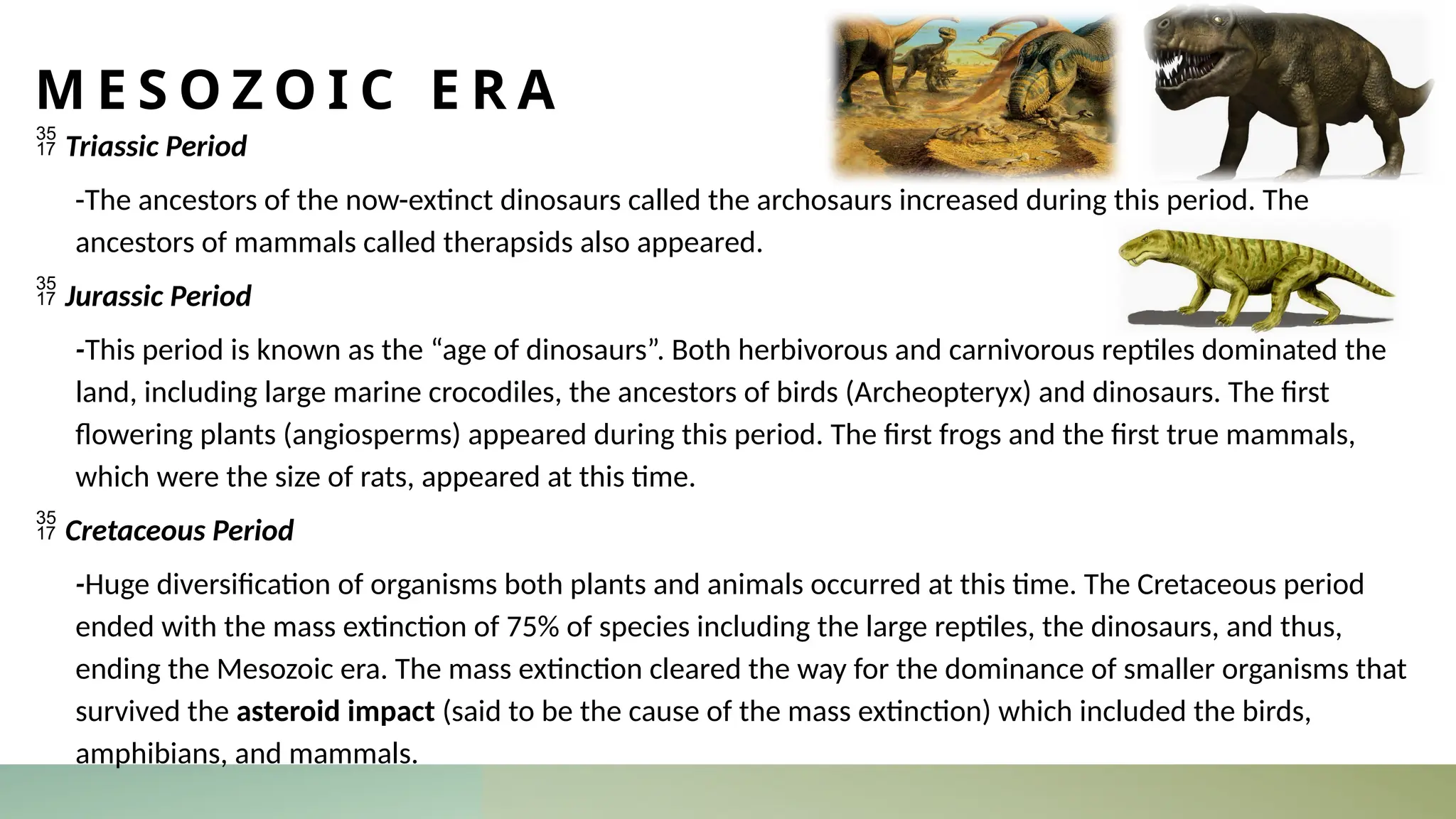
-The ancestors of the now-extinct dinosaurs called the archosaurs increased during this period. The
ancestors of mammals called therapsids also appeared.
Jurassic Period
-This period is known as the “age of dinosaurs”. Both herbivorous and carnivorous reptiles dominated the
land, including large marine crocodiles, the ancestors of birds (Archeopteryx) and dinosaurs. The first
flowering plants (angiosperms) appeared during this period. The first frogs and the first true mammals,
which were the size of rats, appeared at this time.
Cretaceous Period
-Huge diversification of organisms both plants and animals occurred at this time. The Cretaceous period
ended with the mass extinction of 75% of species including the large reptiles, the dinosaurs, and thus,
ending the Mesozoic era. The mass extinction cleared the way for the dominance of smaller organisms that
survived the asteroid impact (said to be the cause of the mass extinction) which included the birds,
amphibians, and mammals.
23.
T H EC E N O Z O I C E R A
• Cenozoic Era
-known as the Age of Mammals, it has
been dominated by the greatly diversified
mammals. This era is subdivided into three
periods, namely: Paleogene, Neogene, and
Quaternary periods
24.
C E NO Z O I C E R A
Paleogene Period
• -it is subdivided into three epochs
Paleocene Epoch- early placental mammals appeared including the
first primates, speciation of birds and insects.
Eocene Epoch- angiosperms dominated, origin of the mammalian
orders including the appearance of the primitive whales.
Oligocene Epoch- origins of the different primate groups including the
apes; tropical rainforests appeared in many continents; pigs, cats and
rhinos appeared; marine life was dominated by mollusks.
25.
C E NO Z O I C E R A
Neogene Period
•-it subdivided into two epochs
Miocene Epoch—coevolution of angiosperms and insects; continued speciation of mammals.
Pliocene Epoch—origin of the hominids (Homo)
Quaternary Period
•- (most recent) Subdivided into two epochs:
Pleistocene epoch—origin of modern humans; major glaciation events occurred (ice ages)
Holocene epoch—rise of human civilization, impact of human activities are widespread and
continues to the present time
•Anthropocene- scientist think that we are now in a new epoch, which marked by extensive
human impact to the environment.
#6 ARCHEAN EON ( first sign of life) photosynthetic bacteria
#9 Modern geology began in late 1700’s when JAMES HUTTON introduce the principle of uniformitarianism.
Who has an idea of what principle of uniformitarianism is?
#10 JAMES HUTTON, CHARLES LYELL–the fundamental principle of geology of today, Earth’s landscape like mountains and oceans formed over a long period of time through gradual process. Forces: movement of earth beneath faults and outside processess ( land, animal , air, water erosion, mass wasting). Many of the important contributions in the advancement of geology began with the study of rocks and its layering (strata). Today, scientists like geologists, paleontologists (scientist who study fossils), chemists, and biologists have worked together to analyze the physical, chemical, and biological materials in ancient rocks. Geologists use the principles of relative dating and the principle of fossil (remains of dead organisms) succession in determining the age of rocks, which became the start of the development of the geologic timescale
#11 Base on this geologic event try to arrange the events from oldest to youngest? C, B, A, D, E
#12 Base on this geologic event try to arrange the events from oldest to youngest? which became the start of the development of the geologic timescale, a scale that can place rock evidence into specific time interval and recreate the events of the past to the present time.j
#13 The discovery of radioactive isotopes in rocks and the hidden materials within it, allowed chemists to introduce an absolute dating method that uses these radioactive isotopes to determine the exact age (in years) of rocks, fossils, and other materials. Radioactive isotopes, also called radioisotopes, radionuclides, or radioactive nuclides, are species of the same chemical element with different masses whose nuclei are unstable and dissipate excess energy by spontaneously emitting radiation in the form of alpha, beta, and gamma rays
Carbon-6/12, Potassium 19/39, Argon 18/ 39
#16 Pamspermia , spontaneous theory, creation theory, miller uray Experiment.
Endosymbiotic theory – proposed by Lynn Margulis – a theory that explains the evolution of eukaryotes in proterozic eon. It proposes that some organelles, such as mitochondria and chloroplasts, originated from once free-living prokaryotic organisms that were engulfed by ancestral eukaryotic cells245. This resulted in a cooperative relationship between the two cells that allowed both to survive and diversify134.
#17 Endosymbiotic theory – proposed by Lynn Margulis – a theory that explains the evolution of eukaryotes in proterozic eon.
#19 CAMBRIAN PERIOD -as fossils of major groups of animals diversified within a few million years of each other. Most important fossils were from organisms with hard parts including the insect-like trilobites, nautiloids, scorpion-like eurypterids, and brachiopods, which looked like clams.
#20 Amphibians- frogs, toads, salamanders and newts ( live in water and land and with smooth skin
Reptiles – crocodiles, turtles, snakes, lizards
CARBONIFEROUS -By the end of the period, many of these plants died which were buried beneath swamps which formed the rich coal layers of the Earth, which is the source of the fossil fuel (coal) that we have today
PERMIAN PERIOD- widely believe that is cause by VOLCANIC ERUPTION.
#24 Paleocene- speciation ( new and distinct species of birds and insects cause by evolution) , primates – group of mammals that are more advance ( vision , hands and feet and inlarge brain)
Mollusk – octopus, snail,
#25 Pliocene- hominids means ancestors of humans ( orangutans, gorillas, chimpanzees to humans