Earth and Life Science
EVOLVING CONCEPT OF LIFE BASED
ON EMERGING PIECES OF EVIDENCE
Let me Ask You:
Where do you think life on Earth came from?
Do you know any superstitious belief regarding
the beginning of life on earth?
In your own opinion, where do life on Earth came
from?
Theories about the
Origin of Life
Let’s Talk:
Theories of the Origin of LIFE
PANSPERMIA
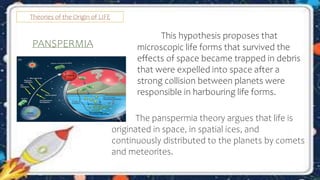
This hypothesis proposes that
microscopic life forms that survived the
effects of space became trapped in debris
that were expelled into space after a
strong collision between planets were
responsible in harbouring life forms.
The panspermia theory argues that life is
originated in space, in spatial ices, and
continuously distributed to the planets by comets
and meteorites.
Theories of the Origin of LIFE
Primordial Soup Theory
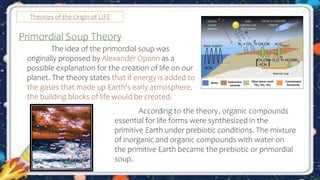
The idea of the primordial soup was
originally proposed by Alexander Oparin as a
possible explanation for the creation of life on our
planet. The theory states that if energy is added to
the gases that made up Earth's early atmosphere,
the building blocks of life would be created.
According to the theory, organic compounds
essential for life forms were synthesized in the
primitive Earth under prebiotic conditions. The mixture
of inorganic and organic compounds with water on
the primitive Earth became the prebiotic or primordial
soup.
Theories of the Origin of LIFE
Deep Sea Vent Theory/
Deep hot Biosphere theory
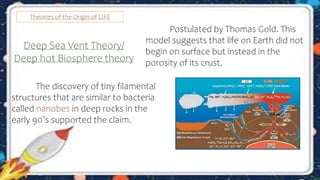
Postulated by Thomas Gold. This
model suggests that life on Earth did not
begin on surface but instead in the
porosity of its crust.
The discovery of tiny filamental
structures that are similar to bacteria
called nanobes in deep rocks in the
early 90’s supported the claim.
Theories of the Origin of LIFE
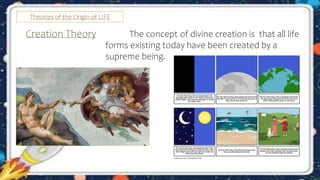
Creation Theory The concept of divine creation is that all life
forms existing today have been created by a
supreme being.
Which of the theories discussed is more likely
convinced you?
Activity:
Why you choose that theory, support your
answer?
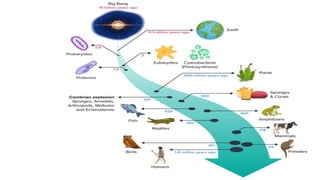
Historical Timeline
of Life on Earth
Let’s Talk:
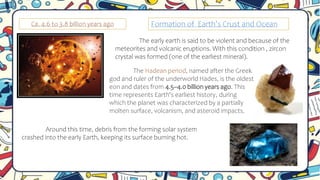
Ca. 4.6 to 3.8 billion years ago
The early earth is said to be violent and because of the
meteorites and volcanic eruptions. With this condition , zircon
crystal was formed (one of the earliest mineral).
Around this time, debris from the forming solar system
crashed into the early Earth, keeping its surface burning hot.
The Hadean period, named after the Greek
god and ruler of the underworld Hades, is the oldest
eon and dates from 4.5–4.0 billion years ago. This
time represents Earth's earliest history, during
which the planet was characterized by a partially
molten surface, volcanism, and asteroid impacts.
Formation of Earth’s Crust and Ocean
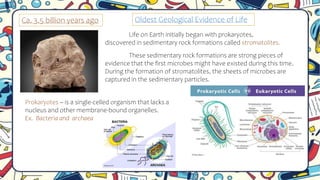
Life on Earth initially began with prokaryotes,
discovered in sedimentary rock formations called stromatolites.
These sedimentary rock formations are strong pieces of
evidence that the first microbes might have existed during this time.
During the formation of stromatolites, the sheets of microbes are
captured in the sedimentary particles.
Ca. 3.5 billion years ago
Prokaryotes – is a single-celled organism that lacks a
nucleus and other membrane-bound organelles.
Ex. Bacteria and archaea
Oldest Geological Evidence of Life
Ca. 3.0 billion years ago
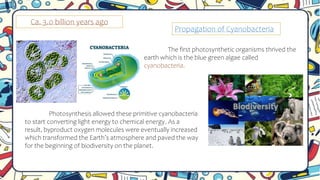
The first photosynthetic organisms thrived the
earth which is the blue green algae called
cyanobacteria.
Photosynthesis allowed these primitive cyanobacteria
to start converting light energy to chemical energy. As a
result, byproduct oxygen molecules were eventually increased
which transformed the Earth’s atmosphere and paved the way
for the beginning of biodiversity on the planet.
Propagation of Cyanobacteria
Ca. 2.0 billion years ago
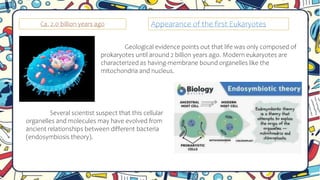
Geological evidence points out that life was only composed of
prokaryotes until around 2 billion years ago. Modern eukaryotes are
characterized as having-membrane bound organelles like the
mitochondria and nucleus.
Appearance of the first Eukaryotes
Several scientist suspect that this cellular
organelles and molecules may have evolved from
ancient relationships between different bacteria
(endosymbiosis theory).
Ca. 1.2 billion years ago
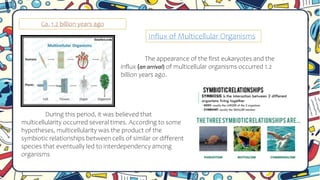
The appearance of the first eukaryotes and the
influx (an arrival) of multicellular organisms occurred 1.2
billion years ago.
During this period, it was believed that
multicellularity occurred several times. According to some
hypotheses, multicellularity was the product of the
symbiotic relationships between cells of similar or different
species that eventually led to interdependency among
organisms
Influx of Multicellular Organisms
Ca. 500 milli0n years ago
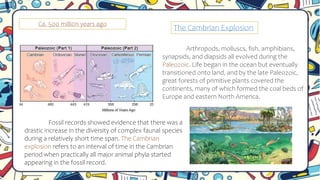
The Cambrian Explosion
Arthropods, molluscs, fish, amphibians,
synapsids, and diapsids all evolved during the
Paleozoic. Life began in the ocean but eventually
transitioned onto land, and by the late Paleozoic,
great forests of primitive plants covered the
continents, many of which formed the coal beds of
Europe and eastern North America.
Fossil records showed evidence that there was a
drastic increase in the diversity of complex faunal species
during a relatively short time span. The Cambrian
explosion refers to an interval of time in the Cambrian
period when practically all major animal phyla started
appearing in the fossil record.
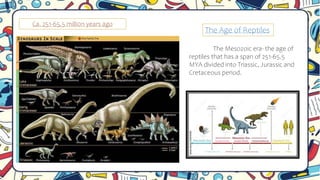
Ca. 251-65.5 milli0n years ago
The Age of Reptiles
The Mesozoic era- the age of
reptiles that has a span of 251-65.5
MYA divided into Triassic, Jurassic and
Cretaceous period.
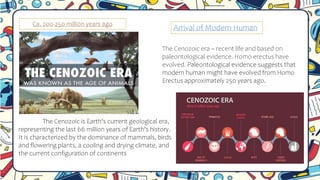
Ca. 200-250 milli0n years ago
Arrival of Modern Human
The Cenozoic era – recent life and based on
paleontological evidence. Homo erectus have
evolved. Paleontological evidence suggests that
modern human might have evolved from Homo
Erectus approximately 250 years ago.
The Cenozoic is Earth's current geological era,
representing the last 66 million years of Earth's history.
It is characterized by the dominance of mammals, birds
and flowering plants, a cooling and drying climate, and
the current configuration of continents
Make/create your own
Historical Timeline of Life on
Earth based on the discussion.
Apply your creativity in
designing your timeline.
Activity:

Evolving Concept .pptx

  • 1.
    Earth and LifeScience EVOLVING CONCEPT OF LIFE BASED ON EMERGING PIECES OF EVIDENCE
  • 2.
    Let me AskYou: Where do you think life on Earth came from? Do you know any superstitious belief regarding the beginning of life on earth? In your own opinion, where do life on Earth came from?
  • 3.
    Theories about the Originof Life Let’s Talk:
  • 4.
    Theories of theOrigin of LIFE PANSPERMIA This hypothesis proposes that microscopic life forms that survived the effects of space became trapped in debris that were expelled into space after a strong collision between planets were responsible in harbouring life forms. The panspermia theory argues that life is originated in space, in spatial ices, and continuously distributed to the planets by comets and meteorites.
  • 5.
    Theories of theOrigin of LIFE Primordial Soup Theory The idea of the primordial soup was originally proposed by Alexander Oparin as a possible explanation for the creation of life on our planet. The theory states that if energy is added to the gases that made up Earth's early atmosphere, the building blocks of life would be created. According to the theory, organic compounds essential for life forms were synthesized in the primitive Earth under prebiotic conditions. The mixture of inorganic and organic compounds with water on the primitive Earth became the prebiotic or primordial soup.
  • 6.
    Theories of theOrigin of LIFE Deep Sea Vent Theory/ Deep hot Biosphere theory Postulated by Thomas Gold. This model suggests that life on Earth did not begin on surface but instead in the porosity of its crust. The discovery of tiny filamental structures that are similar to bacteria called nanobes in deep rocks in the early 90’s supported the claim.
  • 7.
    Theories of theOrigin of LIFE Creation Theory The concept of divine creation is that all life forms existing today have been created by a supreme being.
  • 8.
    Which of thetheories discussed is more likely convinced you? Activity: Why you choose that theory, support your answer?
  • 9.
    Historical Timeline of Lifeon Earth Let’s Talk:
  • 10.
    Ca. 4.6 to3.8 billion years ago The early earth is said to be violent and because of the meteorites and volcanic eruptions. With this condition , zircon crystal was formed (one of the earliest mineral). Around this time, debris from the forming solar system crashed into the early Earth, keeping its surface burning hot. The Hadean period, named after the Greek god and ruler of the underworld Hades, is the oldest eon and dates from 4.5–4.0 billion years ago. This time represents Earth's earliest history, during which the planet was characterized by a partially molten surface, volcanism, and asteroid impacts. Formation of Earth’s Crust and Ocean
  • 11.
    Life on Earthinitially began with prokaryotes, discovered in sedimentary rock formations called stromatolites. These sedimentary rock formations are strong pieces of evidence that the first microbes might have existed during this time. During the formation of stromatolites, the sheets of microbes are captured in the sedimentary particles. Ca. 3.5 billion years ago Prokaryotes – is a single-celled organism that lacks a nucleus and other membrane-bound organelles. Ex. Bacteria and archaea Oldest Geological Evidence of Life
  • 12.
    Ca. 3.0 billionyears ago The first photosynthetic organisms thrived the earth which is the blue green algae called cyanobacteria. Photosynthesis allowed these primitive cyanobacteria to start converting light energy to chemical energy. As a result, byproduct oxygen molecules were eventually increased which transformed the Earth’s atmosphere and paved the way for the beginning of biodiversity on the planet. Propagation of Cyanobacteria
  • 13.
    Ca. 2.0 billionyears ago Geological evidence points out that life was only composed of prokaryotes until around 2 billion years ago. Modern eukaryotes are characterized as having-membrane bound organelles like the mitochondria and nucleus. Appearance of the first Eukaryotes Several scientist suspect that this cellular organelles and molecules may have evolved from ancient relationships between different bacteria (endosymbiosis theory).
  • 14.
    Ca. 1.2 billionyears ago The appearance of the first eukaryotes and the influx (an arrival) of multicellular organisms occurred 1.2 billion years ago. During this period, it was believed that multicellularity occurred several times. According to some hypotheses, multicellularity was the product of the symbiotic relationships between cells of similar or different species that eventually led to interdependency among organisms Influx of Multicellular Organisms
  • 15.
    Ca. 500 milli0nyears ago The Cambrian Explosion Arthropods, molluscs, fish, amphibians, synapsids, and diapsids all evolved during the Paleozoic. Life began in the ocean but eventually transitioned onto land, and by the late Paleozoic, great forests of primitive plants covered the continents, many of which formed the coal beds of Europe and eastern North America. Fossil records showed evidence that there was a drastic increase in the diversity of complex faunal species during a relatively short time span. The Cambrian explosion refers to an interval of time in the Cambrian period when practically all major animal phyla started appearing in the fossil record.
  • 16.
    Ca. 251-65.5 milli0nyears ago The Age of Reptiles The Mesozoic era- the age of reptiles that has a span of 251-65.5 MYA divided into Triassic, Jurassic and Cretaceous period.
  • 17.
    Ca. 200-250 milli0nyears ago Arrival of Modern Human The Cenozoic era – recent life and based on paleontological evidence. Homo erectus have evolved. Paleontological evidence suggests that modern human might have evolved from Homo Erectus approximately 250 years ago. The Cenozoic is Earth's current geological era, representing the last 66 million years of Earth's history. It is characterized by the dominance of mammals, birds and flowering plants, a cooling and drying climate, and the current configuration of continents
  • 19.
    Make/create your own HistoricalTimeline of Life on Earth based on the discussion. Apply your creativity in designing your timeline. Activity: