Genomics & Proteomics Based Drug DISCOVERY Dr. Basavaraj K. Nanjwade  M.Pharm., Ph. D Associate Professor Department of Pharmaceutics KLE University BELGAUM – 590010
Genomics Genetic scientist isolate individual genes and determine their chemical composition, and ultimately to sequence entire genomes. The sequencing of the human genome with the human genome project
Genome Sequencing Gene number, exact locations, and functions  Gene regulation  DNA sequence organization  Chromosomal structure and organization  Noncoding DNA types, amount, distribution, information content, and functions  Coordination of gene expression, protein synthesis, and post-translational events  Interaction of proteins in complex molecular machines  Predicted vs experimentally determined gene function
Genome Sequencing Evolutionary conservation among organisms  Protein conservation (structure and function)  Proteomes (total protein content and function) in organisms  Correlation of SNPs (Single nucleotide polymorphisms ) with health and disease  Disease-susceptibility prediction based on gene sequence variation  Genes involved in complex traits and multigene diseases  Complex systems biology including microbial consortia useful for environmental restoration  Developmental genetics, genomics
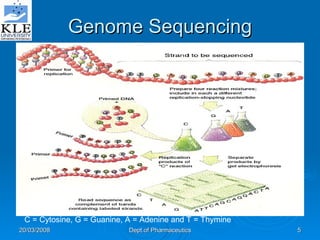
Genome Sequencing C = Cytosine, G = Guanine, A = Adenine and T = Thymine
SBI* can be used to examine: drug  targets  (usually proteins) binding of  ligands ↓ “rational” drug design (benefits = saved time and  RsRsRs ) Drug Discovery * SBI-Structural Bioinformatics
What’s different? Drug discovery process begins  with a  disease  (rather than a treatment) Use disease model to pinpoint relevant genetic/biological components (i.e. possible drug targets) Modern  Drug Discovery NEW and IMPROVED!
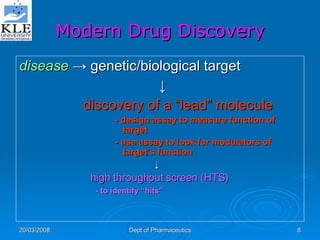
Modern Drug Discovery disease   ->  genetic/biological target   ↓ discovery of a “lead” molecule - design assay to measure function of    target - use assay to look for modulators of    target’s function   ↓ high throughput screen (HTS) - to identify “hits”
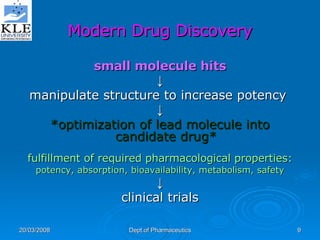
Modern Drug Discovery small molecule hits ↓ manipulate structure to increase potency  ↓ *optimization of lead molecule into candidate drug* fulfillment of required pharmacological properties: potency, absorption, bioavailability, metabolism, safety ↓ clinical trials
Interesting facts... Over 90% of drugs entering clinical trials fail to make it to market The average cost to bring a new drug to market is estimated at  $770 million
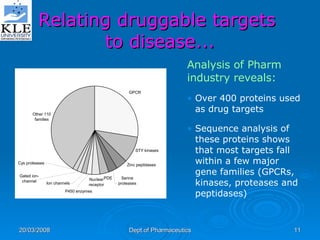
Relating druggable targets  to disease... Analysis of Pharm  industry reveals: Over 400 proteins used as drug targets Sequence analysis of these proteins shows that most targets fall within a few major gene families (GPCRs, kinases, proteases and peptidases)
Assessing Target Druggability Once a target is defined for your disease of interest, SBI can help answer the question:  Is this a “druggable” target? Does it have sequence/domains similar to known targets? Does the target have a site where a drug can bind, and with appropriate affinity?
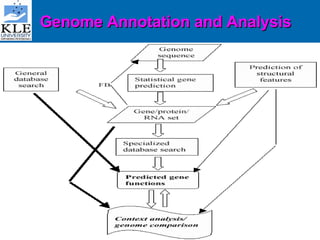
Genome Annotation and Analysis
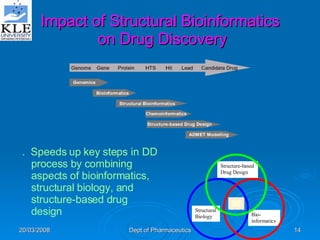
Impact of Structural Bioinformatics  on Drug Discovery .  Speeds up key steps in DD process by combining aspects of bioinformatics, structural biology, and structure-based drug design
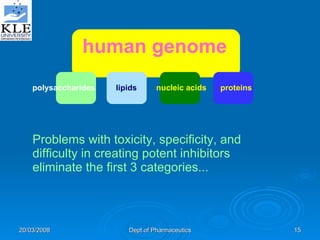
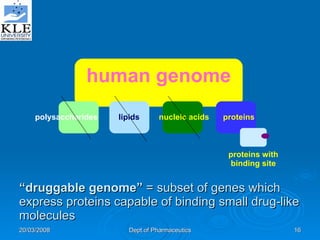
human genome polysaccharides lipids nucleic acids proteins Problems with toxicity, specificity, and difficulty in creating potent inhibitors eliminate the first 3 categories...
“ druggable genome”  = subset of genes which express proteins capable of binding small drug-like molecules human genome polysaccharides lipids nucleic acids proteins proteins with binding site
Proteomics Proteomics studies networks of proteins by measuring, among other things, protein expression.  Protein activity is regulated by post-translational modification and degradation; these cannot yet be predicted from DNA sequence.   Proteomics measures protein expression directly, not via gene expression, thus achieving better accuracy. Current work uses 2-dimensional polyacrylamide gel electrophoresis (2D-PAGE) and mass spectrometry.  New separation and characterization technologies, such as protein microarrays and high-throughput chromatography, are being developed
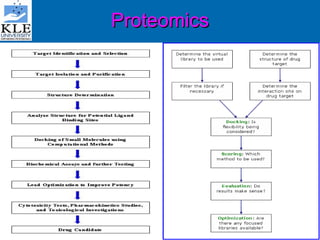
Proteomics
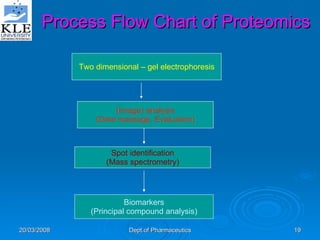
Process Flow Chart of Proteomics (Image) analysis (Data massage, Evaluation) Spot identification (Mass spectrometry) Biomarkers (Principal compound analysis) Two dimensional – gel electrophoresis
Proteomics in Drug Discovery As we have seen genomics has dramatically altered the way drug discovery is now being viewed.  However, there may not be a good correlation between gene expression and protein expression as most disease processes and treatments are manifest at the protein level.  It is believed that gene-based expression analysis alone will be totally inadequate for drug discovery.
Proteomics is Drug Discovery Proteomics has unique and significant advantages as an important complement to a genomics approach. Target/marker identification Target validation/toxicology
Target/marker identification This application of proteomics provides a protein profile of a cell, tissue and/or bodily fluids that can be used to compare a healthy with a diseased state for protein differences in the search for drugs or drug targets.
Target validation/toxicology Proteomics can be applied as an assay procedure for the potential utility of drug candidates.  This can be achieved by a comparative analysis of reference protein profiles from normal or diseased states with profiles after drug treatment (Wang 1999).  Proteomics technology can also be integrated with combinatorial chemistry to evaluate comparative structure-activity relationships of drug analogs.
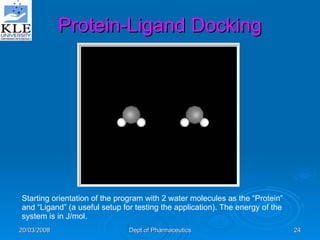
Protein-Ligand Docking Starting orientation of the program with 2 water molecules as the “Protein” and “Ligand” (a useful setup for testing the application). The energy of the system is in J/mol.
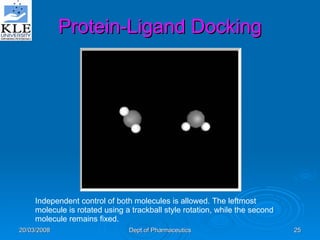
Protein-Ligand Docking Independent control of both molecules is allowed. The leftmost molecule is rotated using a trackball style rotation, while the second molecule remains fixed.
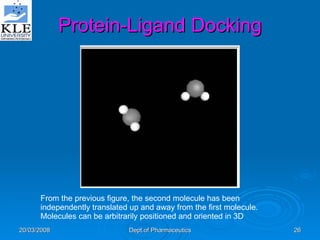
Protein-Ligand Docking From the previous figure, the second molecule has been independently translated up and away from the first molecule. Molecules can be arbitrarily positioned and oriented in 3D
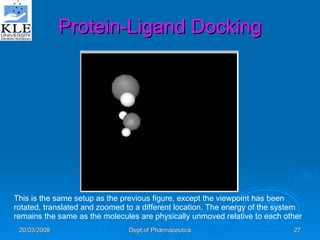
Protein-Ligand Docking This is the same setup as the previous figure, except the viewpoint has been rotated, translated and zoomed to a different location. The energy of the system remains the same as the molecules are physically unmoved relative to each other
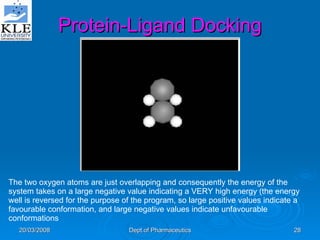
Protein-Ligand Docking The two oxygen atoms are just overlapping and consequently the energy of the system takes on a large negative value indicating a VERY high energy (the energy well is reversed for the purpose of the program, so large positive values indicate a favourable conformation, and large negative values indicate unfavourable conformations
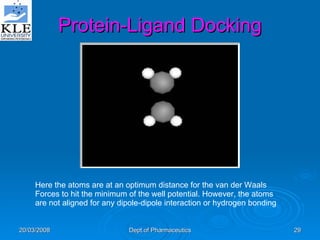
Protein-Ligand Docking Here the atoms are at an optimum distance for the van der Waals Forces to hit the minimum of the well potential. However, the atoms are not aligned for any dipole-dipole interaction or hydrogen bonding
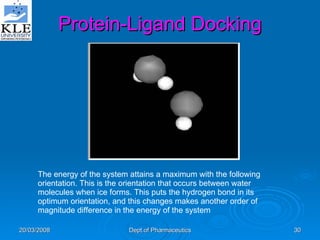
Protein-Ligand Docking The energy of the system attains a maximum with the following orientation. This is the orientation that occurs between water molecules when ice forms. This puts the hydrogen bond in its optimum orientation, and this changes makes another order of magnitude difference in the energy of the system
Structure being the key to function, determining a protein’s structure is a key step toward elucidating its role. The subfield of protein-ligand docking is useful in rational drug design. Laboratory prediction is time consuming and expensive, so researchers have been working on computerized prediction for several decades. Exact computational prediction is difficult but sophisticated algorithms to find approximate solutions continue to be developed. Protein-Ligand Docking
Critical Assessment of Methods of Protein Structure Prediction Computational groups predict structures of proteins whose structures have been found in the laboratory before the latter results are released. Tools are Classified Comparative modeling looks for amino acid similarity to proteins of known structure. Fold recognition predicts folds in regions that do not share amino acid similarity with known structures
Advantages More Powerful Medicines   Better, Safer Drugs the First Time   More Accurate Methods of Determining Appropriate Drug Dosages   Advanced Screening for Disease   Better Vaccines   Improvements in the Drug Discovery and Approval Process   Decrease in the Overall Cost of Health Care
Disadvantages  Complexity of finding gene variations that affect drug response   Limited drug alternatives   Disincentives for drug companies to make multiple pharmacogenomic products   Educating healthcare providers
THANK YOU E-mail: bknanjwade@yahoo.co.in

Genomics & Proteomics Based Drug Discovery

  • 1.
    Genomics & ProteomicsBased Drug DISCOVERY Dr. Basavaraj K. Nanjwade M.Pharm., Ph. D Associate Professor Department of Pharmaceutics KLE University BELGAUM – 590010
  • 2.
    Genomics Genetic scientistisolate individual genes and determine their chemical composition, and ultimately to sequence entire genomes. The sequencing of the human genome with the human genome project
  • 3.
    Genome Sequencing Genenumber, exact locations, and functions Gene regulation DNA sequence organization Chromosomal structure and organization Noncoding DNA types, amount, distribution, information content, and functions Coordination of gene expression, protein synthesis, and post-translational events Interaction of proteins in complex molecular machines Predicted vs experimentally determined gene function
  • 4.
    Genome Sequencing Evolutionaryconservation among organisms Protein conservation (structure and function) Proteomes (total protein content and function) in organisms Correlation of SNPs (Single nucleotide polymorphisms ) with health and disease Disease-susceptibility prediction based on gene sequence variation Genes involved in complex traits and multigene diseases Complex systems biology including microbial consortia useful for environmental restoration Developmental genetics, genomics
  • 5.
    Genome Sequencing C= Cytosine, G = Guanine, A = Adenine and T = Thymine
  • 6.
    SBI* can beused to examine: drug targets (usually proteins) binding of ligands ↓ “rational” drug design (benefits = saved time and RsRsRs ) Drug Discovery * SBI-Structural Bioinformatics
  • 7.
    What’s different? Drugdiscovery process begins with a disease (rather than a treatment) Use disease model to pinpoint relevant genetic/biological components (i.e. possible drug targets) Modern Drug Discovery NEW and IMPROVED!
  • 8.
    Modern Drug Discoverydisease -> genetic/biological target ↓ discovery of a “lead” molecule - design assay to measure function of target - use assay to look for modulators of target’s function ↓ high throughput screen (HTS) - to identify “hits”
  • 9.
    Modern Drug Discoverysmall molecule hits ↓ manipulate structure to increase potency ↓ *optimization of lead molecule into candidate drug* fulfillment of required pharmacological properties: potency, absorption, bioavailability, metabolism, safety ↓ clinical trials
  • 10.
    Interesting facts... Over90% of drugs entering clinical trials fail to make it to market The average cost to bring a new drug to market is estimated at $770 million
  • 11.
    Relating druggable targets to disease... Analysis of Pharm industry reveals: Over 400 proteins used as drug targets Sequence analysis of these proteins shows that most targets fall within a few major gene families (GPCRs, kinases, proteases and peptidases)
  • 12.
    Assessing Target DruggabilityOnce a target is defined for your disease of interest, SBI can help answer the question: Is this a “druggable” target? Does it have sequence/domains similar to known targets? Does the target have a site where a drug can bind, and with appropriate affinity?
  • 13.
  • 14.
    Impact of StructuralBioinformatics on Drug Discovery . Speeds up key steps in DD process by combining aspects of bioinformatics, structural biology, and structure-based drug design
  • 15.
    human genome polysaccharideslipids nucleic acids proteins Problems with toxicity, specificity, and difficulty in creating potent inhibitors eliminate the first 3 categories...
  • 16.
    “ druggable genome” = subset of genes which express proteins capable of binding small drug-like molecules human genome polysaccharides lipids nucleic acids proteins proteins with binding site
  • 17.
    Proteomics Proteomics studiesnetworks of proteins by measuring, among other things, protein expression. Protein activity is regulated by post-translational modification and degradation; these cannot yet be predicted from DNA sequence. Proteomics measures protein expression directly, not via gene expression, thus achieving better accuracy. Current work uses 2-dimensional polyacrylamide gel electrophoresis (2D-PAGE) and mass spectrometry. New separation and characterization technologies, such as protein microarrays and high-throughput chromatography, are being developed
  • 18.
  • 19.
    Process Flow Chartof Proteomics (Image) analysis (Data massage, Evaluation) Spot identification (Mass spectrometry) Biomarkers (Principal compound analysis) Two dimensional – gel electrophoresis
  • 20.
    Proteomics in DrugDiscovery As we have seen genomics has dramatically altered the way drug discovery is now being viewed. However, there may not be a good correlation between gene expression and protein expression as most disease processes and treatments are manifest at the protein level. It is believed that gene-based expression analysis alone will be totally inadequate for drug discovery.
  • 21.
    Proteomics is DrugDiscovery Proteomics has unique and significant advantages as an important complement to a genomics approach. Target/marker identification Target validation/toxicology
  • 22.
    Target/marker identification Thisapplication of proteomics provides a protein profile of a cell, tissue and/or bodily fluids that can be used to compare a healthy with a diseased state for protein differences in the search for drugs or drug targets.
  • 23.
    Target validation/toxicology Proteomicscan be applied as an assay procedure for the potential utility of drug candidates. This can be achieved by a comparative analysis of reference protein profiles from normal or diseased states with profiles after drug treatment (Wang 1999). Proteomics technology can also be integrated with combinatorial chemistry to evaluate comparative structure-activity relationships of drug analogs.
  • 24.
    Protein-Ligand Docking Startingorientation of the program with 2 water molecules as the “Protein” and “Ligand” (a useful setup for testing the application). The energy of the system is in J/mol.
  • 25.
    Protein-Ligand Docking Independentcontrol of both molecules is allowed. The leftmost molecule is rotated using a trackball style rotation, while the second molecule remains fixed.
  • 26.
    Protein-Ligand Docking Fromthe previous figure, the second molecule has been independently translated up and away from the first molecule. Molecules can be arbitrarily positioned and oriented in 3D
  • 27.
    Protein-Ligand Docking Thisis the same setup as the previous figure, except the viewpoint has been rotated, translated and zoomed to a different location. The energy of the system remains the same as the molecules are physically unmoved relative to each other
  • 28.
    Protein-Ligand Docking Thetwo oxygen atoms are just overlapping and consequently the energy of the system takes on a large negative value indicating a VERY high energy (the energy well is reversed for the purpose of the program, so large positive values indicate a favourable conformation, and large negative values indicate unfavourable conformations
  • 29.
    Protein-Ligand Docking Herethe atoms are at an optimum distance for the van der Waals Forces to hit the minimum of the well potential. However, the atoms are not aligned for any dipole-dipole interaction or hydrogen bonding
  • 30.
    Protein-Ligand Docking Theenergy of the system attains a maximum with the following orientation. This is the orientation that occurs between water molecules when ice forms. This puts the hydrogen bond in its optimum orientation, and this changes makes another order of magnitude difference in the energy of the system
  • 31.
    Structure being thekey to function, determining a protein’s structure is a key step toward elucidating its role. The subfield of protein-ligand docking is useful in rational drug design. Laboratory prediction is time consuming and expensive, so researchers have been working on computerized prediction for several decades. Exact computational prediction is difficult but sophisticated algorithms to find approximate solutions continue to be developed. Protein-Ligand Docking
  • 32.
    Critical Assessment ofMethods of Protein Structure Prediction Computational groups predict structures of proteins whose structures have been found in the laboratory before the latter results are released. Tools are Classified Comparative modeling looks for amino acid similarity to proteins of known structure. Fold recognition predicts folds in regions that do not share amino acid similarity with known structures
  • 33.
    Advantages More PowerfulMedicines Better, Safer Drugs the First Time More Accurate Methods of Determining Appropriate Drug Dosages Advanced Screening for Disease Better Vaccines Improvements in the Drug Discovery and Approval Process Decrease in the Overall Cost of Health Care
  • 34.
    Disadvantages Complexityof finding gene variations that affect drug response Limited drug alternatives Disincentives for drug companies to make multiple pharmacogenomic products Educating healthcare providers
  • 35.
    THANK YOU E-mail:bknanjwade@yahoo.co.in