HIGH THROUGHPUT
SCREENING (HTS)
By
Dr. Debasish Pradhan
Sr. Faculty Pharmacology
University Department of Pharmaceutical
Sciences
Utkal University, Bhubaneswar
HIGH THROUGHPUT SCREENING (HTS) is identification of one or
more positive candidates extracted from a pool of possible candidates
based on specific criteria.
LEAD compound is a representative of a compound series with sufficient
potential (as measured by potency, selectivity, pharmacokinetics,
physicochemical properties, toxicity and novelty) to progress to a full
drug development programme.
It is a drug-discovery process widely used in the pharmaceutical
industry.
It allows automation to quickly assay the biological or biochemical
activity of a large no of compounds.
HTS is process by which large nos. of compounds are rapidly tested for
their ability to modify the properties of a selected biological target.
Goal is to identify: ‘hits’ or ‘leads’
-affect target in desired manner
-active at fairly low concentrations ( to show specificity)
-new structure
 It is a useful for discovering ligands for receptors, enzymes, ion-
channels or other pharmacological targets, or pharmacologically
profiling a cellular or biochemical pathway of interest.
Screening Collection
Screening libraries:
(a)Diversity Libraries
(b)Focused Libraries :
Ligand-Based Approaches
Structure-Based Approaches
 Compound acquisition Purchasing commercially available
compounds is an important aspect of screening collection
enhancement
LIBRARIES
siRNA libraries: providing the best available RNA
interference technology with maximum flexibility The mouse
whole genome contain about 16872 gene targets and the
Human whole-genome contains 18120 gene targets.
microRNA libraries: Human libraries of synthetic microRNA
mimics and microRNA inhibitors.
Small Compound libraries: A library of 640 FDA approved
drugs (Screen-Well FDA Approved Drug Library, Enzo Life
Sciences) is also available for screening. The library contains
clinically-relevant pharmacophores.
Steps in HTS
1 st stage screening
• Test optical clarity, abrasion resistance, and adhesion
• Eliminates ~ 90% of samples
2 nd stage screening
• Test weather ability, integrity, gloss, and surface
smoothness
• ~10% of the samples
Rapidly identify coating samples with desired properties
Candidates for scale up
• Test according to the customer’s specification
DETECTION METHODS IN HTS
• Spectroscopy
• Mass Spectrometry
• Chromatography
• Calorimetry
• X-ray diffraction
• Microscopy
• Radioactive methods
SPECTROSCOPY IN HTS:
• Fluorescence Spectroscopy
• Total internal reflection fluorescence (TIRF)
• Nuclear magnetic resonance (NMR)
• Absorption and luminescence
• Fourier transformed infrared(FTIR)
• Light scattering
CHROMATOGRAPHY IN HTS:
•Gas chromatography (GC)
•Thin layer chromatography
•Liquid chromatography (HPLC)
•Ion Exchange chromatography
•Reverse phase chromatography
•Hydrophobic interaction chromatography
•Affinity chromatography
CALORIMETRY IN HTS:
• Isothermal Titration Calorimetry (ITC)
• Differential Scanning Calorimetry (DSC)
MICROSCOPY IN HTS:
• Scanning Tunnelling Microscopy
• Atomic Force Microscopy
• Confocal Microscopy
USES:
To screen Micro arrays such as:
• DNAchips
• RNAchips
• Protein chips
• To screen for all kind of novel biological active
compounds
• Natural products
METHODOLOGY
The heart of the HTS system is a plate, or tray, which
consists of tiny wells where assay reagents and samples are
deposited, and their reactions monitored
The configuration of the plate has changed from 96 wells
(in a matrix of 8 rows by 12 columns) to 384, and now to a
high - density 1536 - well format, which enables large - scale
screening.
Assay reagents may be coated onto the plates or deposited
in liquid form together with test samples into the wells.
Both samples and assay reagents may be incubated, and
those that interact show signals, which can be detected.
The aim of HTS is cost effectiveness and speed of
compound scanning.
Cell - based assays have become an important test compared
with other in vitro assays, as they can provide information about
bioavailability, cytotoxicity and effects on biochemical pathway
The enzyme - based and cell - based assay systems consist of
receptors or mimetics of receptors (components that mimic
active parts of receptors)
Receptors- Normally the assays are linked to an indicator that
shows the ligands – receptor interaction as some form of signal
The advantage of cell - based assays over biochemical assays is
that cell - based assays enable the analysis of sample compound
activity in an environment that is similar to the one in which a
drug would act.
It also provides a platform for toxicity studies.
CELL BASED ASSAYS
 Cell-based assays refer to any of a number of different
experiments based on the use of live cells
 This is a general definition and can include a variety of assays
that measure cell proliferation, toxicity, motility, production of
a measurable product and morphology
 Cell-based assays offer a more accurate representation of the
real-life model since live cells are used.
 A CELL-BASED ASSAY IS: one where the fundamental unit
of expression is the cell, either cell populations or single cell.
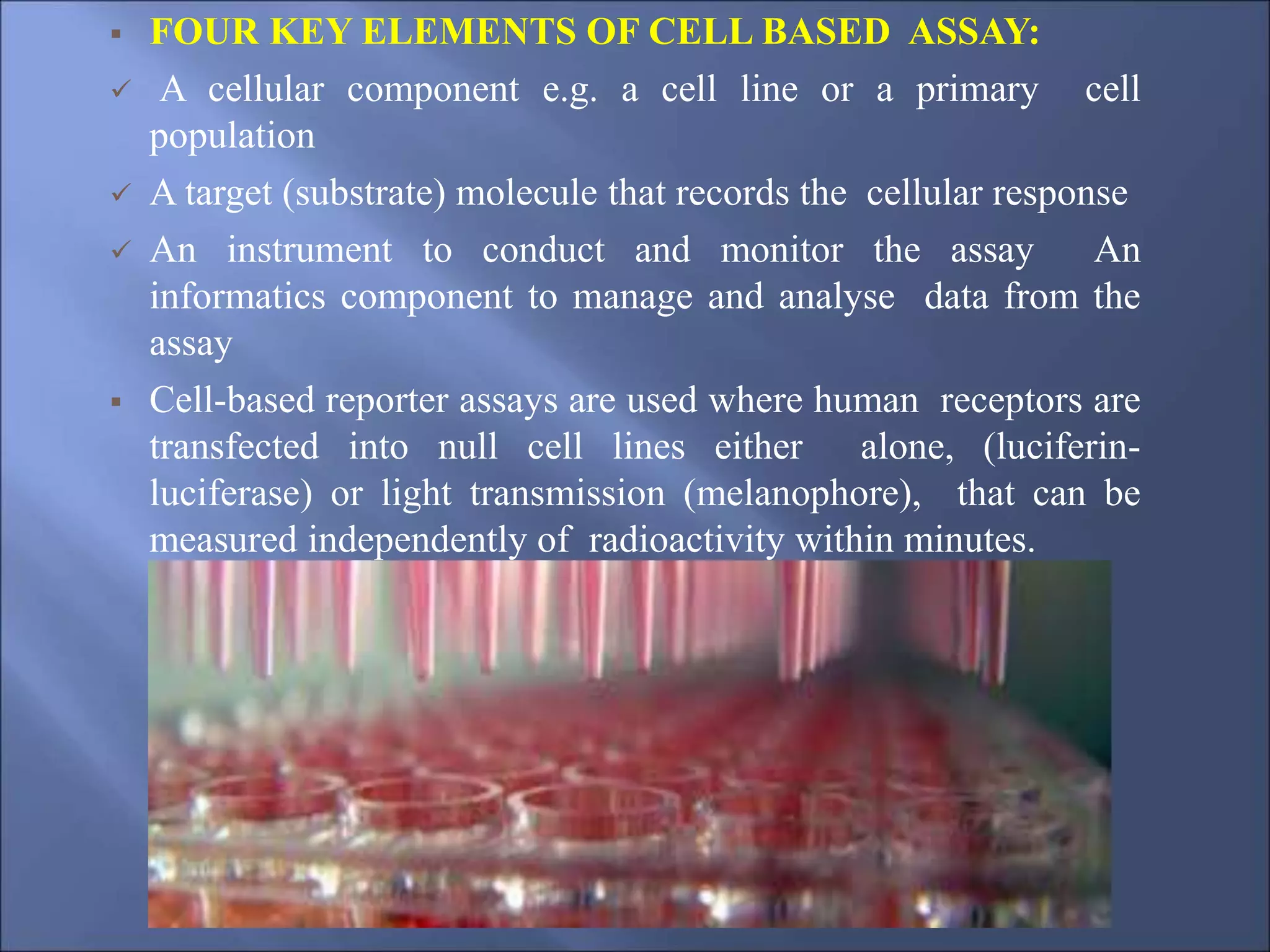
 FOUR KEY ELEMENTS OF CELL BASED ASSAY:
 A cellular component e.g. a cell line or a primary cell
population
 A target (substrate) molecule that records the cellular response
 An instrument to conduct and monitor the assay An
informatics component to manage and analyse data from the
assay
 Cell-based reporter assays are used where human receptors are
transfected into null cell lines either alone, (luciferin-
luciferase) or light transmission (melanophore), that can be
measured independently of radioactivity within minutes.
ADVANTAGES
 Assays do not require purification of the target protein
 Can immediately select against compounds / potential
drugs that are generally cytotoxic, or that cannot
permeate cellular membranes to reach intracellular
sites
 Hit/lead compounds identified by cell based assays have
passed important validation steps, saving time and costs
in drug development
 Cell-based assays visualize all possible drug-target
interactions e.g. activators, target interactions
 High sensitivity of assays & Automation
DISADVANTAGES
 High Cost
 Low data data quality
 Local contamination
 Need of relatively pure product
Newer method in HTS
High-Throughput, Fluorescence-Based Screening
(a)For screening, expressed proteins are labelled either as
fusions with green fluorescent protein (GFP) or through
translational incorporation of a fluorescent amino acid
derivative, BODIPY-FL-Lysine.
(a)Using fluorescence detection, the entire procedure can be
carried out in approximately 8 h.
Applications
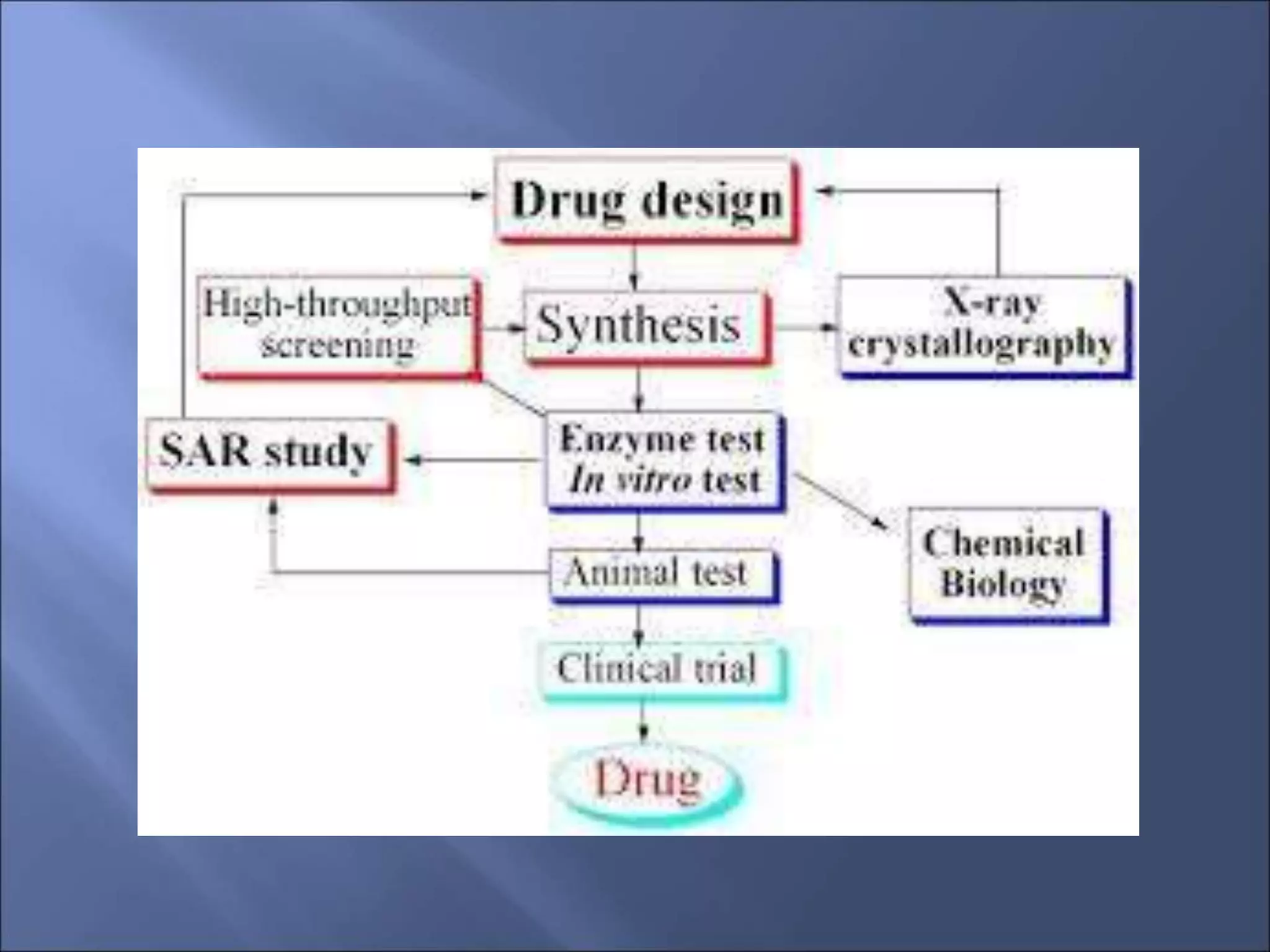
In drug discovery
Systematic Study of Mitochondrial Toxicity of
Environmental
Chemicals High-Throughput Screening of Dendrimer-
Binding Drugs
To Fractionate Plant Natural Products for Drug Discover
CELLULAR COMPONENTS
Different cell lines are being used in cell based assays
Some examples are:
•HUMAN CELL LINES
•DU145, PC3, Lncap (Prostate cancer)
•MCF-7, MDA-MB-438, T47D (Breast cancer)
•THP-1 (Acute Myeloid Leukemia)
REFERENCES
Leach AR, Hann MM. The in silico world of virtual libraries. Drug
Discov Today 2000; 5:326–336.
J. AM. CHEM. SOC. 2010, 132, 13182–13184
High Throughput Screening

High Throughput Screening

  • 1.
    HIGH THROUGHPUT SCREENING (HTS) By Dr.Debasish Pradhan Sr. Faculty Pharmacology University Department of Pharmaceutical Sciences Utkal University, Bhubaneswar
  • 2.
    HIGH THROUGHPUT SCREENING(HTS) is identification of one or more positive candidates extracted from a pool of possible candidates based on specific criteria. LEAD compound is a representative of a compound series with sufficient potential (as measured by potency, selectivity, pharmacokinetics, physicochemical properties, toxicity and novelty) to progress to a full drug development programme. It is a drug-discovery process widely used in the pharmaceutical industry. It allows automation to quickly assay the biological or biochemical activity of a large no of compounds. HTS is process by which large nos. of compounds are rapidly tested for their ability to modify the properties of a selected biological target. Goal is to identify: ‘hits’ or ‘leads’ -affect target in desired manner -active at fairly low concentrations ( to show specificity) -new structure
  • 3.
     It isa useful for discovering ligands for receptors, enzymes, ion- channels or other pharmacological targets, or pharmacologically profiling a cellular or biochemical pathway of interest. Screening Collection Screening libraries: (a)Diversity Libraries (b)Focused Libraries : Ligand-Based Approaches Structure-Based Approaches  Compound acquisition Purchasing commercially available compounds is an important aspect of screening collection enhancement
  • 4.
    LIBRARIES siRNA libraries: providingthe best available RNA interference technology with maximum flexibility The mouse whole genome contain about 16872 gene targets and the Human whole-genome contains 18120 gene targets. microRNA libraries: Human libraries of synthetic microRNA mimics and microRNA inhibitors. Small Compound libraries: A library of 640 FDA approved drugs (Screen-Well FDA Approved Drug Library, Enzo Life Sciences) is also available for screening. The library contains clinically-relevant pharmacophores.
  • 5.
    Steps in HTS 1st stage screening • Test optical clarity, abrasion resistance, and adhesion • Eliminates ~ 90% of samples 2 nd stage screening • Test weather ability, integrity, gloss, and surface smoothness • ~10% of the samples Rapidly identify coating samples with desired properties Candidates for scale up • Test according to the customer’s specification
  • 6.
    DETECTION METHODS INHTS • Spectroscopy • Mass Spectrometry • Chromatography • Calorimetry • X-ray diffraction • Microscopy • Radioactive methods
  • 7.
    SPECTROSCOPY IN HTS: •Fluorescence Spectroscopy • Total internal reflection fluorescence (TIRF) • Nuclear magnetic resonance (NMR) • Absorption and luminescence • Fourier transformed infrared(FTIR) • Light scattering CHROMATOGRAPHY IN HTS: •Gas chromatography (GC) •Thin layer chromatography •Liquid chromatography (HPLC) •Ion Exchange chromatography •Reverse phase chromatography •Hydrophobic interaction chromatography •Affinity chromatography
  • 8.
    CALORIMETRY IN HTS: •Isothermal Titration Calorimetry (ITC) • Differential Scanning Calorimetry (DSC) MICROSCOPY IN HTS: • Scanning Tunnelling Microscopy • Atomic Force Microscopy • Confocal Microscopy USES: To screen Micro arrays such as: • DNAchips • RNAchips • Protein chips • To screen for all kind of novel biological active compounds • Natural products
  • 9.
    METHODOLOGY The heart ofthe HTS system is a plate, or tray, which consists of tiny wells where assay reagents and samples are deposited, and their reactions monitored The configuration of the plate has changed from 96 wells (in a matrix of 8 rows by 12 columns) to 384, and now to a high - density 1536 - well format, which enables large - scale screening. Assay reagents may be coated onto the plates or deposited in liquid form together with test samples into the wells. Both samples and assay reagents may be incubated, and those that interact show signals, which can be detected. The aim of HTS is cost effectiveness and speed of compound scanning.
  • 10.
    Cell - basedassays have become an important test compared with other in vitro assays, as they can provide information about bioavailability, cytotoxicity and effects on biochemical pathway The enzyme - based and cell - based assay systems consist of receptors or mimetics of receptors (components that mimic active parts of receptors) Receptors- Normally the assays are linked to an indicator that shows the ligands – receptor interaction as some form of signal The advantage of cell - based assays over biochemical assays is that cell - based assays enable the analysis of sample compound activity in an environment that is similar to the one in which a drug would act. It also provides a platform for toxicity studies.
  • 12.
    CELL BASED ASSAYS Cell-based assays refer to any of a number of different experiments based on the use of live cells  This is a general definition and can include a variety of assays that measure cell proliferation, toxicity, motility, production of a measurable product and morphology  Cell-based assays offer a more accurate representation of the real-life model since live cells are used.  A CELL-BASED ASSAY IS: one where the fundamental unit of expression is the cell, either cell populations or single cell.
  • 13.
     FOUR KEYELEMENTS OF CELL BASED ASSAY:  A cellular component e.g. a cell line or a primary cell population  A target (substrate) molecule that records the cellular response  An instrument to conduct and monitor the assay An informatics component to manage and analyse data from the assay  Cell-based reporter assays are used where human receptors are transfected into null cell lines either alone, (luciferin- luciferase) or light transmission (melanophore), that can be measured independently of radioactivity within minutes.
  • 14.
    ADVANTAGES  Assays donot require purification of the target protein  Can immediately select against compounds / potential drugs that are generally cytotoxic, or that cannot permeate cellular membranes to reach intracellular sites  Hit/lead compounds identified by cell based assays have passed important validation steps, saving time and costs in drug development  Cell-based assays visualize all possible drug-target interactions e.g. activators, target interactions  High sensitivity of assays & Automation DISADVANTAGES  High Cost  Low data data quality  Local contamination  Need of relatively pure product
  • 15.
    Newer method inHTS High-Throughput, Fluorescence-Based Screening (a)For screening, expressed proteins are labelled either as fusions with green fluorescent protein (GFP) or through translational incorporation of a fluorescent amino acid derivative, BODIPY-FL-Lysine. (a)Using fluorescence detection, the entire procedure can be carried out in approximately 8 h. Applications In drug discovery Systematic Study of Mitochondrial Toxicity of Environmental Chemicals High-Throughput Screening of Dendrimer- Binding Drugs To Fractionate Plant Natural Products for Drug Discover
  • 16.
    CELLULAR COMPONENTS Different celllines are being used in cell based assays Some examples are: •HUMAN CELL LINES •DU145, PC3, Lncap (Prostate cancer) •MCF-7, MDA-MB-438, T47D (Breast cancer) •THP-1 (Acute Myeloid Leukemia)
  • 17.
    REFERENCES Leach AR, HannMM. The in silico world of virtual libraries. Drug Discov Today 2000; 5:326–336. J. AM. CHEM. SOC. 2010, 132, 13182–13184