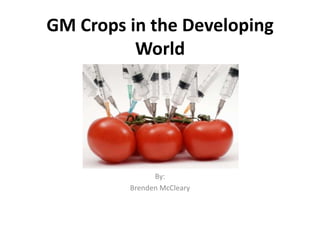
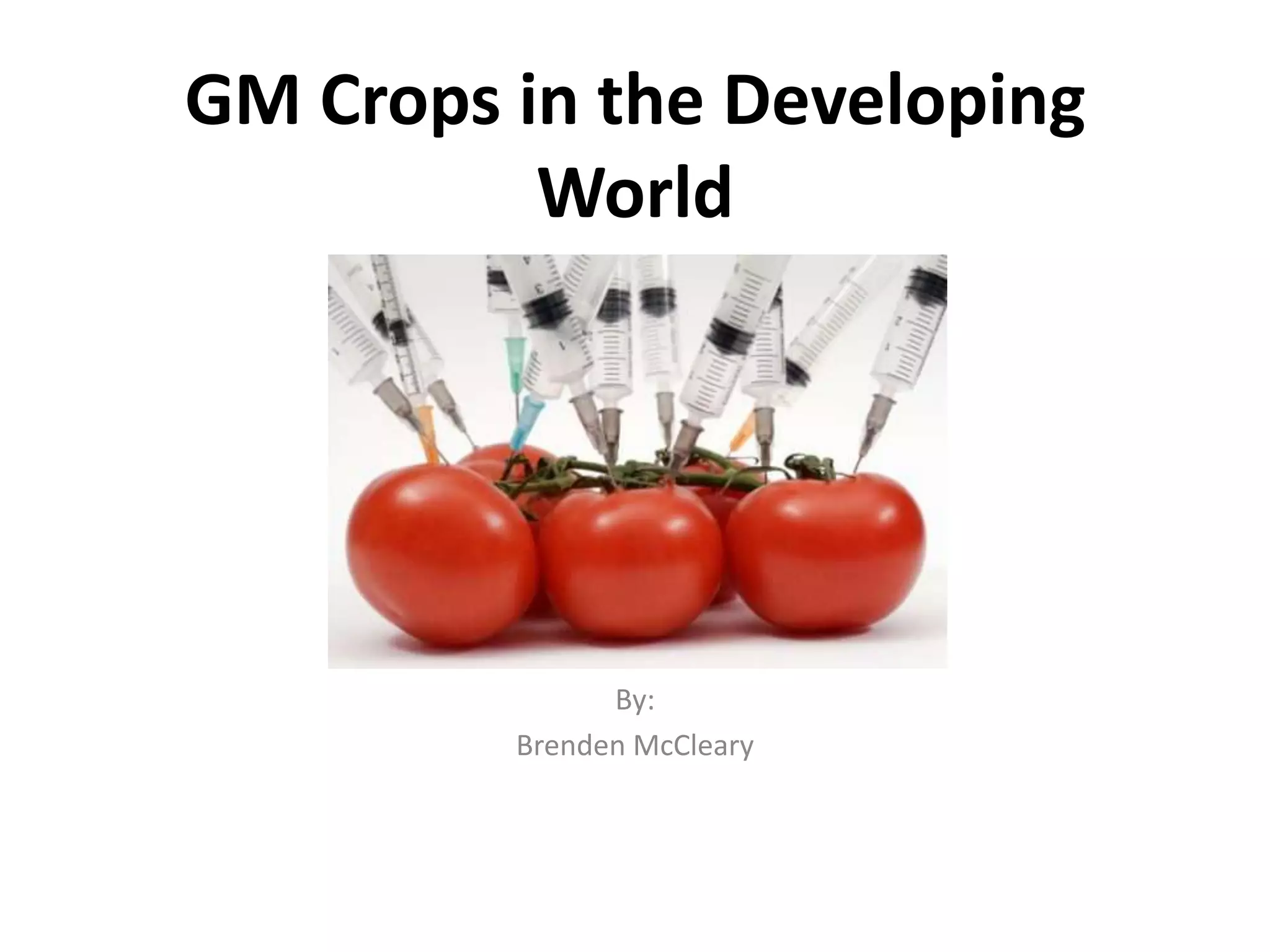
GM Crops in the Developing
World

By:
Brenden McCleary
What are GM crops?
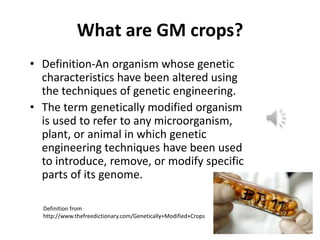
• Definition-An organism whose genetic
characteristics have been altered using
the techniques of genetic engineering.
• The term genetically modified organism
is used to refer to any microorganism,
plant, or animal in which genetic
engineering techniques have been used
to introduce, remove, or modify specific
parts of its genome.
Definition from
http://www.thefreedictionary.com/Genetically+Modified+Crops
GM Social Issues
• Much of the current social debates on genetically
modified have focused on the potential risks of GM
crops for human health.
• “Reports on hundreds of villagers and cotton
handlers who developed skin allergy in
India.”(Maghari and Ardekani, 2011)
• “Recent studies have revealed that Bacillus
thuringiensis corn expresses an allergenic protein
which alters overall immunological reactions in the
body.”(Maghari and Ardekani, 2011)
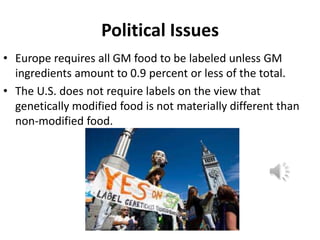
Political Issues
• Europe requires all GM food to be labeled unless GM
ingredients amount to 0.9 percent or less of the total.
• The U.S. does not require labels on the view that
genetically modified food is not materially different than
non-modified food.
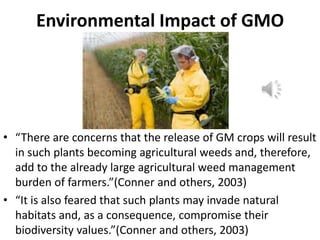
Environmental Impact of GMO

• “There are concerns that the release of GM crops will result
in such plants becoming agricultural weeds and, therefore,
add to the already large agricultural weed management
burden of farmers.”(Conner and others, 2003)
• “It is also feared that such plants may invade natural
habitats and, as a consequence, compromise their
biodiversity values.”(Conner and others, 2003)
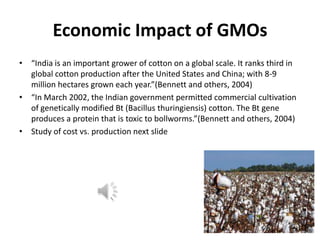
Economic Impact of GMOs
• “India is an important grower of cotton on a global scale. It ranks third in
global cotton production after the United States and China; with 8-9
million hectares grown each year.”(Bennett and others, 2004)
• “In March 2002, the Indian government permitted commercial cultivation
of genetically modified Bt (Bacillus thuringiensis) cotton. The Bt gene
produces a protein that is toxic to bollworms.”(Bennett and others, 2004)
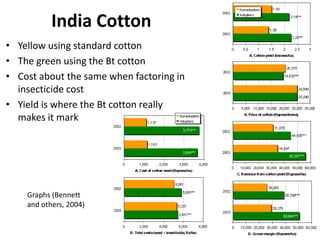
• Study of cost vs. production next slide
India Cotton
• Yellow using standard cotton
• The green using the Bt cotton
• Cost about the same when factoring in
insecticide cost
• Yield is where the Bt cotton really
makes it mark

Graphs (Bennett
and others, 2004)
Ethical Issues
• Peoples right to know what they are putting in
there bodies safe or unsafe
• Beneficence the worlds job to feed its people
to do good GMOs can help along the way
• The balance of likely benefits over harms to
consumers and the environment from GM
technology
Bibliography
•

•

•

Bennett. R.M. Ismael. Y. Kambhampati. U. Morse. S. Economic Impact of Genetically
Modified Cotton in India. The Journal of Agro biotechnology management & economics.
Volume 7 number 3 article 1. accessed 11/8/13. http://www.agbioforum.org/v7n3/v7n3a01morse.htm
Conner. A.J. Glare. T.R. Nap. J.P. The release of genetically modified crops into the
Environment. The Plant Journal. 33, 19–46. Accessed 11/8/13
http://onlinelibrary.wiley.com/doi/10.1046/j.0960-7412.2002.001607.x/pdf
Maghari. B.M. Ardekani. A.M. Genetically Modified Foods and Social Concerns. Avicenna
Journal of Medical Biotechnology. 3(3): 109–117. Accessed 11/8/13.
http://www.ncbi.nlm.nih.gov/pmc/articles/PMC3558185/

Agron 342 mc cleary pwrpnt

  • 1.
    GM Crops inthe Developing World By: Brenden McCleary
  • 2.
    What are GMcrops? • Definition-An organism whose genetic characteristics have been altered using the techniques of genetic engineering. • The term genetically modified organism is used to refer to any microorganism, plant, or animal in which genetic engineering techniques have been used to introduce, remove, or modify specific parts of its genome. Definition from http://www.thefreedictionary.com/Genetically+Modified+Crops
  • 3.
    GM Social Issues •Much of the current social debates on genetically modified have focused on the potential risks of GM crops for human health. • “Reports on hundreds of villagers and cotton handlers who developed skin allergy in India.”(Maghari and Ardekani, 2011) • “Recent studies have revealed that Bacillus thuringiensis corn expresses an allergenic protein which alters overall immunological reactions in the body.”(Maghari and Ardekani, 2011)
  • 4.
    Political Issues • Europerequires all GM food to be labeled unless GM ingredients amount to 0.9 percent or less of the total. • The U.S. does not require labels on the view that genetically modified food is not materially different than non-modified food.
  • 5.
    Environmental Impact ofGMO • “There are concerns that the release of GM crops will result in such plants becoming agricultural weeds and, therefore, add to the already large agricultural weed management burden of farmers.”(Conner and others, 2003) • “It is also feared that such plants may invade natural habitats and, as a consequence, compromise their biodiversity values.”(Conner and others, 2003)
  • 6.
    Economic Impact ofGMOs • “India is an important grower of cotton on a global scale. It ranks third in global cotton production after the United States and China; with 8-9 million hectares grown each year.”(Bennett and others, 2004) • “In March 2002, the Indian government permitted commercial cultivation of genetically modified Bt (Bacillus thuringiensis) cotton. The Bt gene produces a protein that is toxic to bollworms.”(Bennett and others, 2004) • Study of cost vs. production next slide
  • 7.
    India Cotton • Yellowusing standard cotton • The green using the Bt cotton • Cost about the same when factoring in insecticide cost • Yield is where the Bt cotton really makes it mark Graphs (Bennett and others, 2004)
  • 8.
    Ethical Issues • Peoplesright to know what they are putting in there bodies safe or unsafe • Beneficence the worlds job to feed its people to do good GMOs can help along the way • The balance of likely benefits over harms to consumers and the environment from GM technology
  • 9.
    Bibliography • • • Bennett. R.M. Ismael.Y. Kambhampati. U. Morse. S. Economic Impact of Genetically Modified Cotton in India. The Journal of Agro biotechnology management & economics. Volume 7 number 3 article 1. accessed 11/8/13. http://www.agbioforum.org/v7n3/v7n3a01morse.htm Conner. A.J. Glare. T.R. Nap. J.P. The release of genetically modified crops into the Environment. The Plant Journal. 33, 19–46. Accessed 11/8/13 http://onlinelibrary.wiley.com/doi/10.1046/j.0960-7412.2002.001607.x/pdf Maghari. B.M. Ardekani. A.M. Genetically Modified Foods and Social Concerns. Avicenna Journal of Medical Biotechnology. 3(3): 109–117. Accessed 11/8/13. http://www.ncbi.nlm.nih.gov/pmc/articles/PMC3558185/