.
Genetically Modified
Crop Production
By Md. Mainur Reja
Islamic University, Bangladesh.
Email: mainurreja1@gmail.com
A presentation
on
Genetically Modified Crop Production
Presented To,
Shaikh Shahinur Rahman
Assistant Professor,
Dept. of Applied Nutrition & Food Technology,
Islamic University, Kushtia.
Presented By,
Md. Mainur Reja.
Session: 2014 -15 Roll no: 1416010,
Date:30.07.2018 Dept. of Applied Nutrition & Food Technology.
Islamic University, Bangladesh.
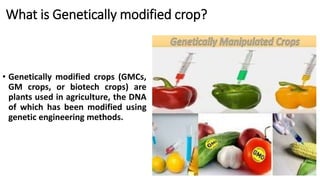
What is Genetically modified crop?
• Genetically modified crops (GMCs,
GM crops, or biotech crops) are
plants used in agriculture, the DNA
of which has been modified using
genetic engineering methods.
History of GMCs….
• The first genetically modified crop plant was produced in 1982, an
antibiotic-resistant tobacco plant.
• The first genetically modified crop approved for sale in the U.S., in
1994, was the FlavrSavr tomato.
• In 1995, Bt Potato was approved by the US Environmental
Protection Agency, making it the country's first pesticide producing
crop.
• In 2000, Vitamin A-enriched golden rice was developed.
• Now it is rapidly increasing GM Crops.
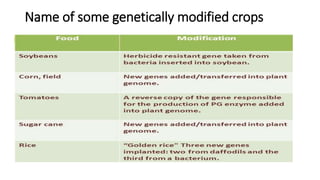
Name of some genetically modified crops
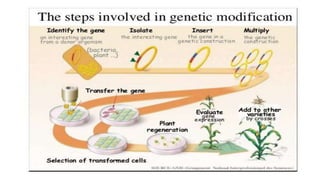
Selection of Plants, Breeding, Isolation and
Insertion of desired gene :
• To produce a new generation of
plants.
• To produce crops with improved
characteristics by changing their
genetic makeup.
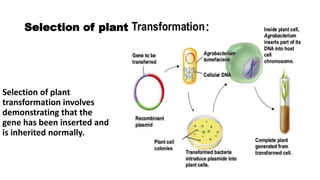
• The gene(s) of interest is inserted
into the plasmid using
recombinant DNA (rDNA)
techniques.
Selection of plant :
Selection of plant
transformation involves
demonstrating that the
gene has been inserted and
is inherited normally.
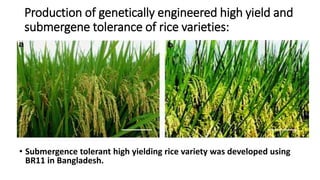
Production of genetically engineered high yield and
submergene tolerance of rice varieties:
• Submergence tolerant high yielding rice variety was developed using
BR11 in Bangladesh.
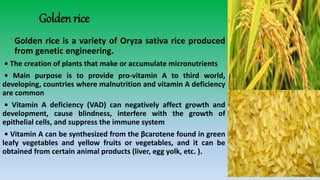
Golden rice
Golden rice is a variety of Oryza sativa rice produced
from genetic engineering.
• The creation of plants that make or accumulate micronutrients
• Main purpose is to provide pro-vitamin A to third world,
developing, countries where malnutrition and vitamin A deficiency
are common
• Vitamin A deficiency (VAD) can negatively affect growth and
development, cause blindness, interfere with the growth of
epithelial cells, and suppress the immune system
• Vitamin A can be synthesized from the βcarotene found in green
leafy vegetables and yellow fruits or vegetables, and it can be
obtained from certain animal products (liver, egg yolk, etc. ).
Disadvantage of Golden Rice
Some Initiatives in Bangladesh:
 Dhaka University, Bangladesh Agricultural University (BAU),
Rajshahi University (RU), Bangladesh Sugarcane Research Institute
(BSRI), BARI, BRRI, and BINA have started genetic fingerprinting and
genetic engineering research.
• BRRI developed vitamin A-enriched Golden Rice.
• BARI developed fruit and shoot borer resistant Bt brinjal.
• The Department of Botany in Dhaka University started a program
on plant biotechnology.
.
Algal technology in Rice Cultivation
The application of algae by scientific knowledge for practical purposes, especially in
industry and agricultural production.
Types of Algae
1. Green Algae
These forms use the green pigment
chlorophyll to photosynthesize.
2. Red Algae
Their red color comes from the
pigments phycoerythrin and
phycocyanin, which they use for
photosynthesis.
Types of Algae
3.Brown Algae
They use a different kind of chlorophyll from
that used by plants to photosynthesize and
often have additional pigments, such as
fucoxanthin, which gives many of these
organisms a brown color.
4.Cyanobacteria
They are still sometimes referred to by their old
name, “blue-green algae.” They differ mainly in
that they are prokaryotes, like all bacteria, but
they can make their own food by photosynthesis.
Blue-Green Algae in rice cultivation
 Cyanobacteria ‘formerly known as’ Blue Green Algae
Cyano = blue
Bacteria – acknowledges that they are more closely related
to prokaryotic bacteria than eukaryotic algae
Found in marine sediments and pelagic zone, freshwater
lakes, soils,
Blue green algae(Cyanobacteria) belonging to genera
Nostoc, Anabaena, tolypothrix and Aulosira.
Why is the blue green algae Important than
others ?
Fix or convert atmospheric nitrogen into usable forms through
Nitrogen Fixation.Because, atmospheric N2 is unavailable to most
living organisms because breaking the triple bond is difficult.
They are easily prepared on the farm but can be use only for rice
cultivation when the field is flooded and do not survive in acidic
field
Live in extreme environments – chemically and temperature.
These organisms fix atmospheric nitrogen and supply it to plants
and most effective under low land rice cultivation and contribute
20-30 kg N per ha per season in submerged rice fields
Genetic Transformation in Wheat
• Genetic transformation is fundamental to
wheat molecular genetics and improvement
through genetic engineering.
• Agrobacterium-mediated transformation and
microparticle bombardment are the two widely
used methods for wheat genetic
transformation.
Making nitrogen available to plants
• Nitrogen fixation is essential for some
forms of life because inorganic nitrogen
compounds are required for the
biosynthesis of the basic building blocks
of plants, animals and other life forms.
How Do Plants Fix Nitrogen?
• Nitrogen fixing plants don’t pull nitrogen from the air
on their own. They actually need help from a common
bacteria called Rhizobium.
• The bacteria converts this nitrogen gas and then stores
it in the roots of the plant. When the plant stores the
nitrogen in the roots, it produces a lump on the root
called a nitrogen nodule.
Is it safe to eat GM crops?
Yes.
• There is no evidence that a crop is dangerous to eat just because it is
GM. There has been no evidence of ill effects linked to the
consumption of any approved GM crop.
• Before any food produced using GM technology is permitted onto
the market, a variety of tests have to be completed. The results
from these tests, including results from animal feeding trials, are
considered by the authorities responsible for determining the safety
of each new GM product.
Food safety assessment principles of GM foods
The codex safety assessment principle for GM foods require investigation of :
-Direct health effects (toxicity).
- Tendency to provoke allergic reaction (allergenicity).
-specific components for to have nutritional or toxic properties.
- The stability of the inserted gene.
-Nutritional effects associated with the specific genetic modification.
- Any unintended effects which could result from the gene insertion.
.
Reference:
• Ref: Meenakshi Paul, Biotechnology & Food Processing Mechanics,
2007. Gene Tech Books. Page: (224 – 228).
• https://www.gardeningknowhow.com/garden-how-to/soil-
fertilizers/nitrogen-nodules-and-nitrogen-fixing-plants.htm
• https://en.wikipedia.org/wiki/Nitrogen_fixation
• http://www.nature.com/articles/hdy200890
• www.slideshare.com/genetically modified crops

Genetically Modified Crop Production.

  • 1.
    . Genetically Modified Crop Production ByMd. Mainur Reja Islamic University, Bangladesh. Email: mainurreja1@gmail.com
  • 2.
    A presentation on Genetically ModifiedCrop Production Presented To, Shaikh Shahinur Rahman Assistant Professor, Dept. of Applied Nutrition & Food Technology, Islamic University, Kushtia. Presented By, Md. Mainur Reja. Session: 2014 -15 Roll no: 1416010, Date:30.07.2018 Dept. of Applied Nutrition & Food Technology. Islamic University, Bangladesh.
  • 3.
    What is Geneticallymodified crop? • Genetically modified crops (GMCs, GM crops, or biotech crops) are plants used in agriculture, the DNA of which has been modified using genetic engineering methods.
  • 4.
    History of GMCs…. •The first genetically modified crop plant was produced in 1982, an antibiotic-resistant tobacco plant. • The first genetically modified crop approved for sale in the U.S., in 1994, was the FlavrSavr tomato. • In 1995, Bt Potato was approved by the US Environmental Protection Agency, making it the country's first pesticide producing crop. • In 2000, Vitamin A-enriched golden rice was developed. • Now it is rapidly increasing GM Crops.
  • 5.
    Name of somegenetically modified crops
  • 8.
    Selection of Plants,Breeding, Isolation and Insertion of desired gene : • To produce a new generation of plants. • To produce crops with improved characteristics by changing their genetic makeup. • The gene(s) of interest is inserted into the plasmid using recombinant DNA (rDNA) techniques.
  • 9.
    Selection of plant: Selection of plant transformation involves demonstrating that the gene has been inserted and is inherited normally.
  • 13.
    Production of geneticallyengineered high yield and submergene tolerance of rice varieties: • Submergence tolerant high yielding rice variety was developed using BR11 in Bangladesh.
  • 14.
    Golden rice Golden riceis a variety of Oryza sativa rice produced from genetic engineering. • The creation of plants that make or accumulate micronutrients • Main purpose is to provide pro-vitamin A to third world, developing, countries where malnutrition and vitamin A deficiency are common • Vitamin A deficiency (VAD) can negatively affect growth and development, cause blindness, interfere with the growth of epithelial cells, and suppress the immune system • Vitamin A can be synthesized from the βcarotene found in green leafy vegetables and yellow fruits or vegetables, and it can be obtained from certain animal products (liver, egg yolk, etc. ).
  • 16.
  • 17.
    Some Initiatives inBangladesh:  Dhaka University, Bangladesh Agricultural University (BAU), Rajshahi University (RU), Bangladesh Sugarcane Research Institute (BSRI), BARI, BRRI, and BINA have started genetic fingerprinting and genetic engineering research. • BRRI developed vitamin A-enriched Golden Rice. • BARI developed fruit and shoot borer resistant Bt brinjal. • The Department of Botany in Dhaka University started a program on plant biotechnology.
  • 18.
    . Algal technology inRice Cultivation The application of algae by scientific knowledge for practical purposes, especially in industry and agricultural production.
  • 19.
    Types of Algae 1.Green Algae These forms use the green pigment chlorophyll to photosynthesize. 2. Red Algae Their red color comes from the pigments phycoerythrin and phycocyanin, which they use for photosynthesis.
  • 20.
    Types of Algae 3.BrownAlgae They use a different kind of chlorophyll from that used by plants to photosynthesize and often have additional pigments, such as fucoxanthin, which gives many of these organisms a brown color. 4.Cyanobacteria They are still sometimes referred to by their old name, “blue-green algae.” They differ mainly in that they are prokaryotes, like all bacteria, but they can make their own food by photosynthesis.
  • 21.
    Blue-Green Algae inrice cultivation  Cyanobacteria ‘formerly known as’ Blue Green Algae Cyano = blue Bacteria – acknowledges that they are more closely related to prokaryotic bacteria than eukaryotic algae Found in marine sediments and pelagic zone, freshwater lakes, soils, Blue green algae(Cyanobacteria) belonging to genera Nostoc, Anabaena, tolypothrix and Aulosira.
  • 22.
    Why is theblue green algae Important than others ? Fix or convert atmospheric nitrogen into usable forms through Nitrogen Fixation.Because, atmospheric N2 is unavailable to most living organisms because breaking the triple bond is difficult. They are easily prepared on the farm but can be use only for rice cultivation when the field is flooded and do not survive in acidic field Live in extreme environments – chemically and temperature. These organisms fix atmospheric nitrogen and supply it to plants and most effective under low land rice cultivation and contribute 20-30 kg N per ha per season in submerged rice fields
  • 23.
    Genetic Transformation inWheat • Genetic transformation is fundamental to wheat molecular genetics and improvement through genetic engineering. • Agrobacterium-mediated transformation and microparticle bombardment are the two widely used methods for wheat genetic transformation.
  • 26.
    Making nitrogen availableto plants • Nitrogen fixation is essential for some forms of life because inorganic nitrogen compounds are required for the biosynthesis of the basic building blocks of plants, animals and other life forms.
  • 28.
    How Do PlantsFix Nitrogen? • Nitrogen fixing plants don’t pull nitrogen from the air on their own. They actually need help from a common bacteria called Rhizobium. • The bacteria converts this nitrogen gas and then stores it in the roots of the plant. When the plant stores the nitrogen in the roots, it produces a lump on the root called a nitrogen nodule.
  • 29.
    Is it safeto eat GM crops? Yes. • There is no evidence that a crop is dangerous to eat just because it is GM. There has been no evidence of ill effects linked to the consumption of any approved GM crop. • Before any food produced using GM technology is permitted onto the market, a variety of tests have to be completed. The results from these tests, including results from animal feeding trials, are considered by the authorities responsible for determining the safety of each new GM product.
  • 31.
    Food safety assessmentprinciples of GM foods The codex safety assessment principle for GM foods require investigation of : -Direct health effects (toxicity). - Tendency to provoke allergic reaction (allergenicity). -specific components for to have nutritional or toxic properties. - The stability of the inserted gene. -Nutritional effects associated with the specific genetic modification. - Any unintended effects which could result from the gene insertion.
  • 33.
  • 35.
    Reference: • Ref: MeenakshiPaul, Biotechnology & Food Processing Mechanics, 2007. Gene Tech Books. Page: (224 – 228). • https://www.gardeningknowhow.com/garden-how-to/soil- fertilizers/nitrogen-nodules-and-nitrogen-fixing-plants.htm • https://en.wikipedia.org/wiki/Nitrogen_fixation • http://www.nature.com/articles/hdy200890 • www.slideshare.com/genetically modified crops