20EE023 PROTECTION AND SWITCHGEAR
UNIT-III
Apparatus Protection
Stator Protection
Stator Protection
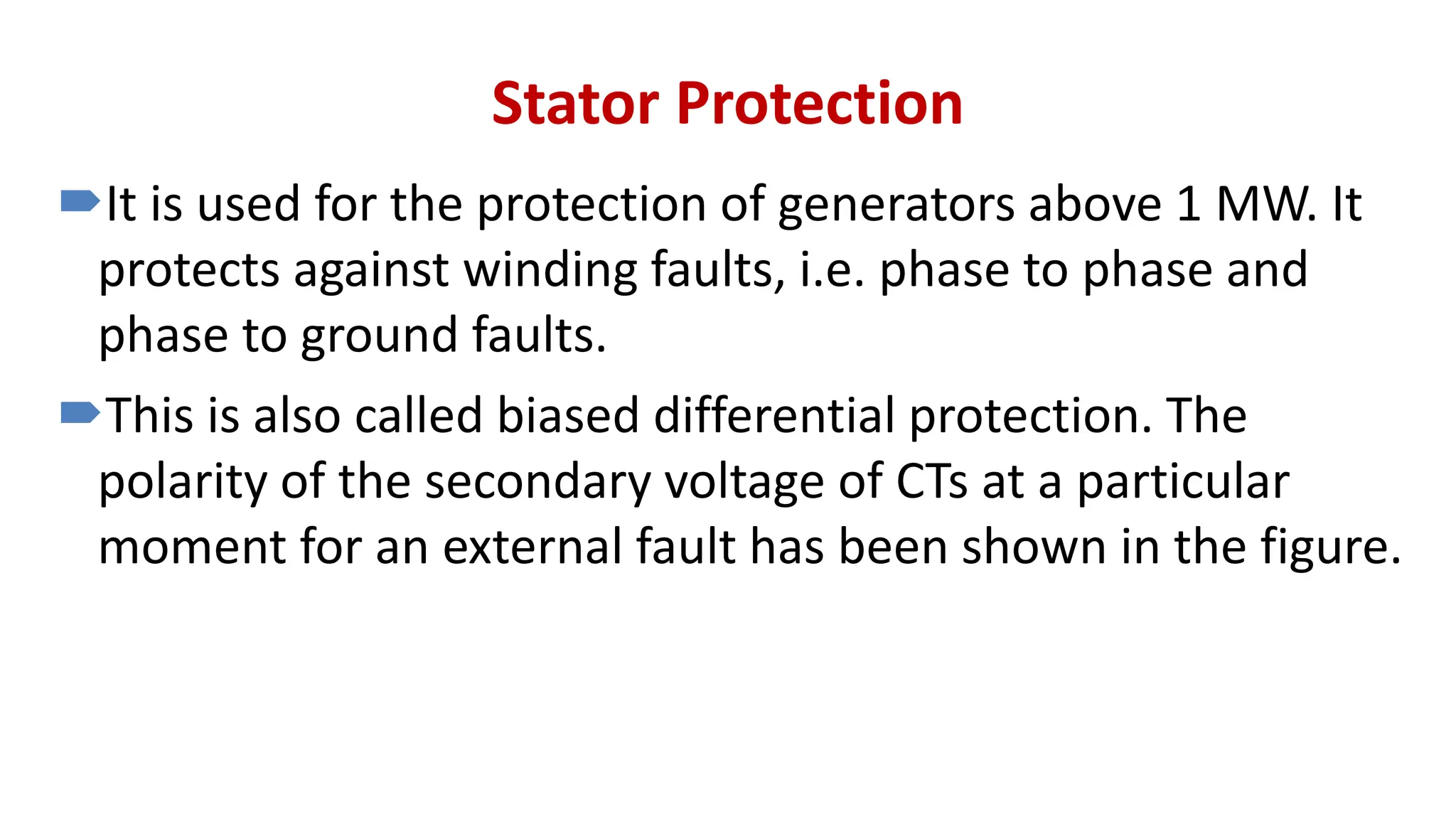
It is used for the protection of generators above 1 MW. It
protects against winding faults, i.e. phase to phase and
phase to ground faults.
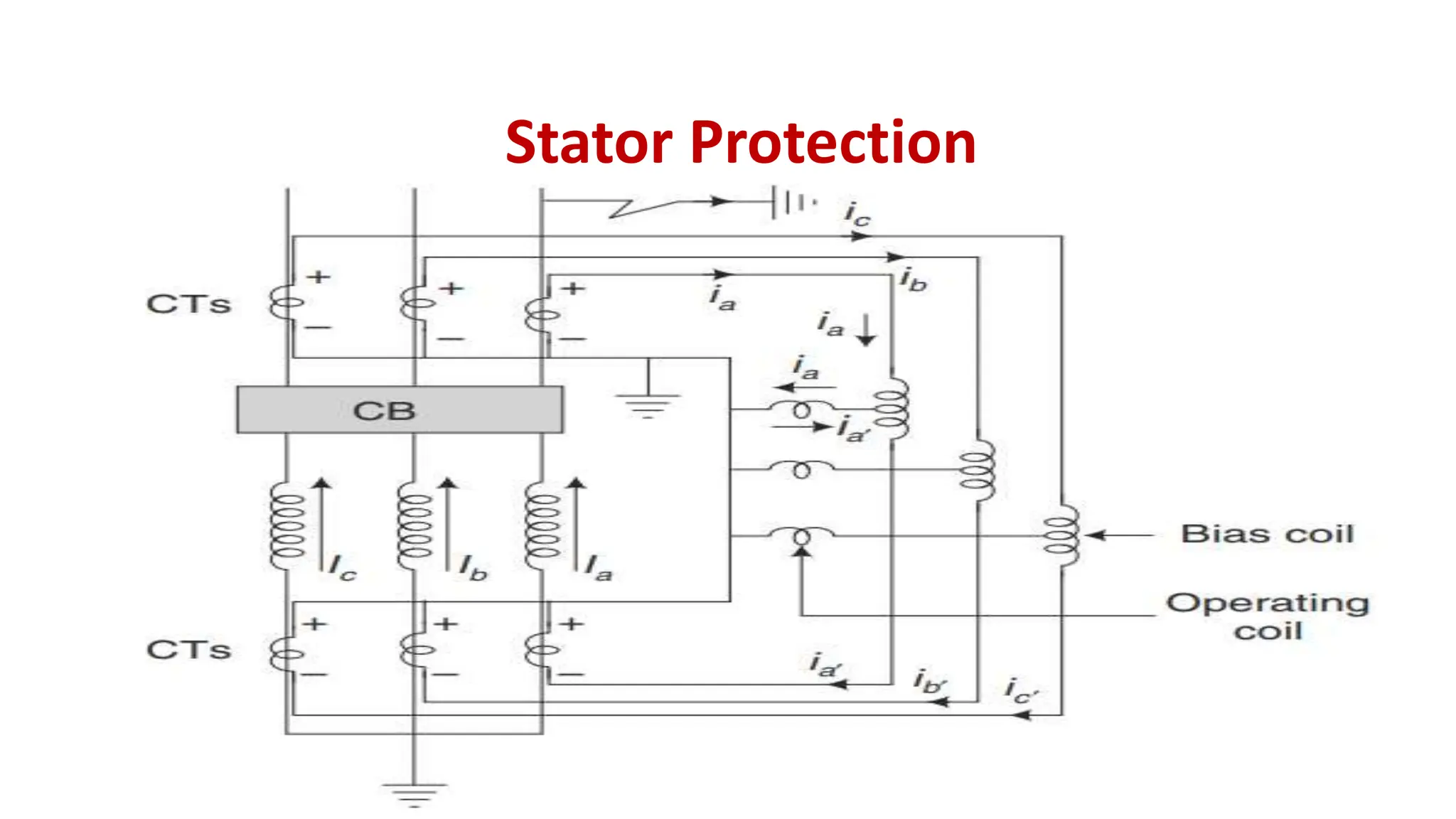
This is also called biased differential protection. The
polarity of the secondary voltage of CTs at a particular
moment for an external fault has been shown in the figure.
Stator Protection
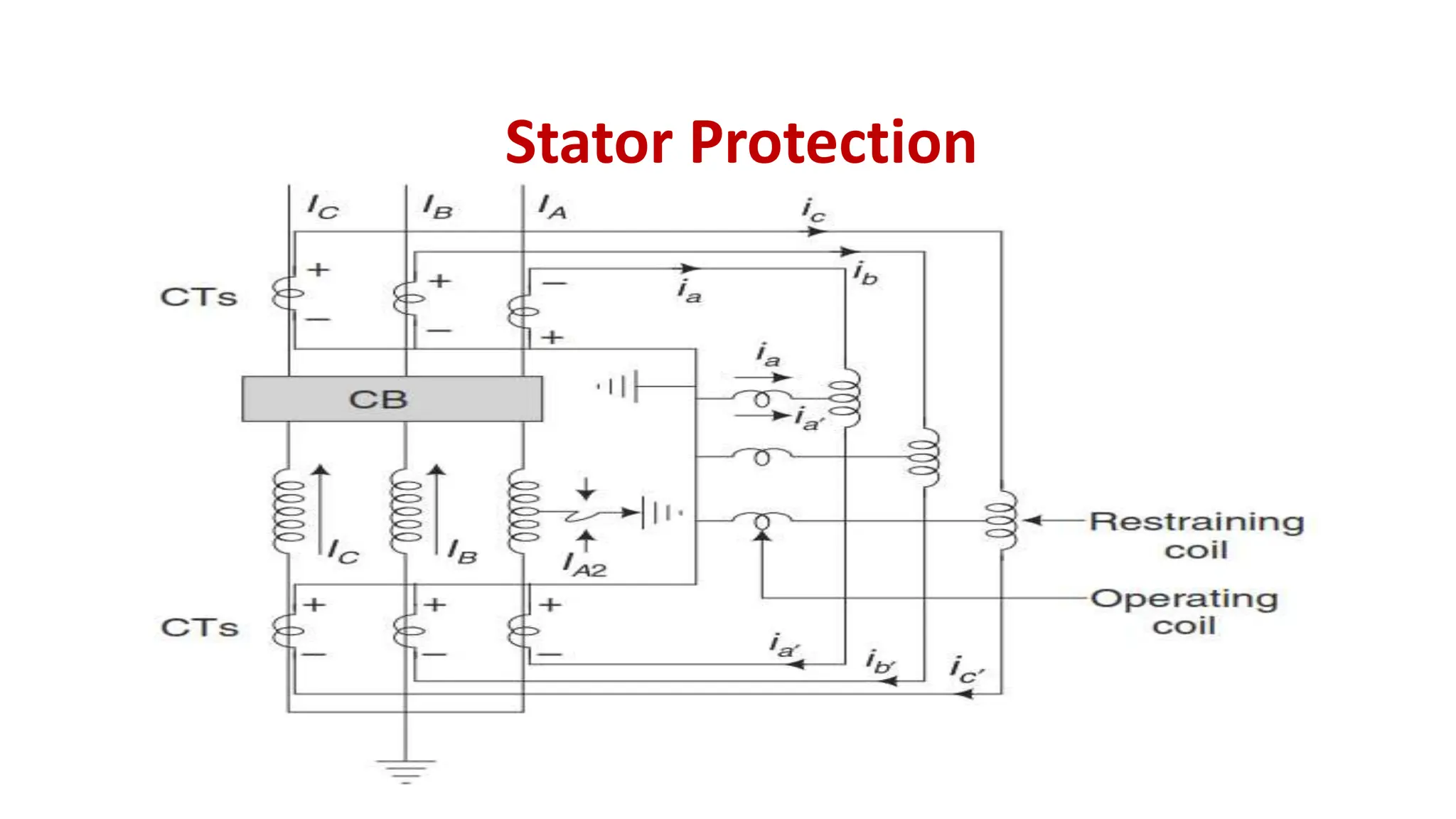
In the operating coil, the current sent by the upper CT is
cancelled by the current sent by the lower CT and the relay
does not operate,
For an internal fault, the polarity of the secondary voltage
of the upper CT is reversed, as shown in Fig. 9.1(b).
Now the operating coil carries the sum of the currents sent
by the upper CT and the lower CT and it operates and trips
the circuit breaker.
Stator Protection
Stator Protection
Stator Protection
The percentage differential protection does not respond to
external faults and overloads.
It provides complete protection against phase to phase faults.
It provides protection against ground faults to about 80 to 85
per cent of the generator windings.
Stator Protection
It does not provide protection to 100 per cent of the winding
because it is influenced by the magnitude of the earth fault
current which depends upon the method of neutral
grounding.
 When the neutral is grounded through an impedance, the
differential protection is supplemented by sensitive earth fault
relays
Restricted earth-fault protection by differential system
When the neutral is solidly grounded, it is possible to provide
protection to complete winding of the generator against
ground faults.
However, the neutral is grounded through resistance to limit
ground fault currents. With resistance grounding it is not
possible to protect the complete winding against ground
faults.
The percentage of winding protected depends on the value of
the neutral grounding resistor and the relay setting. .
Restricted earth-fault protection by
differential system
The usual practice is to protect 80 to 85% of the
generator winding against ground fault. The remaining 15-
20% from neutral end is left unprotected.
In Fig. 9.2 for phase to ground fault, it can be seen that
the relay setting for the differential protection is
determined by the value of the neutral grounding resistor
and the percentage of winding to be protected.
Restricted earth-fault protection by differential system
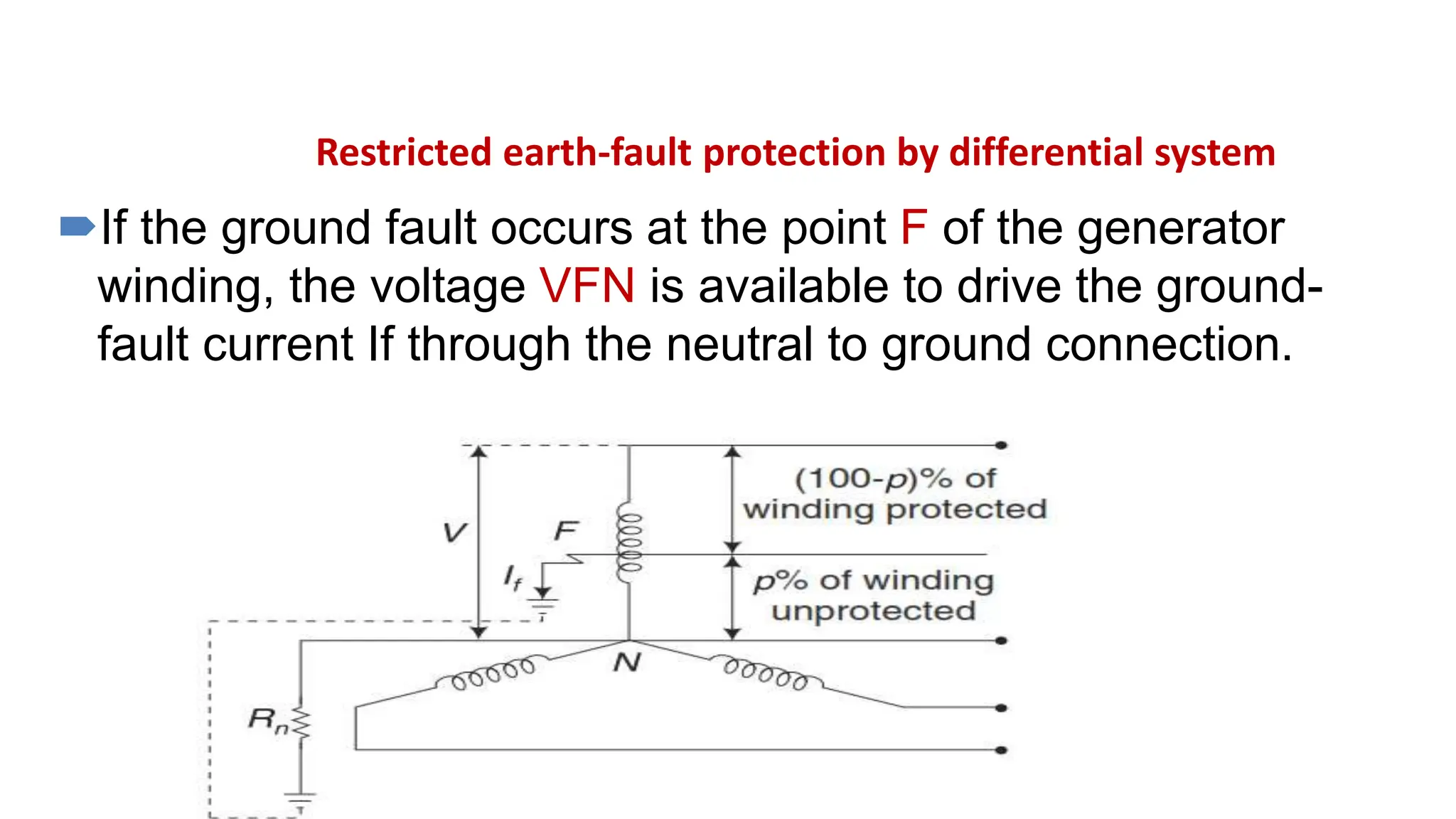
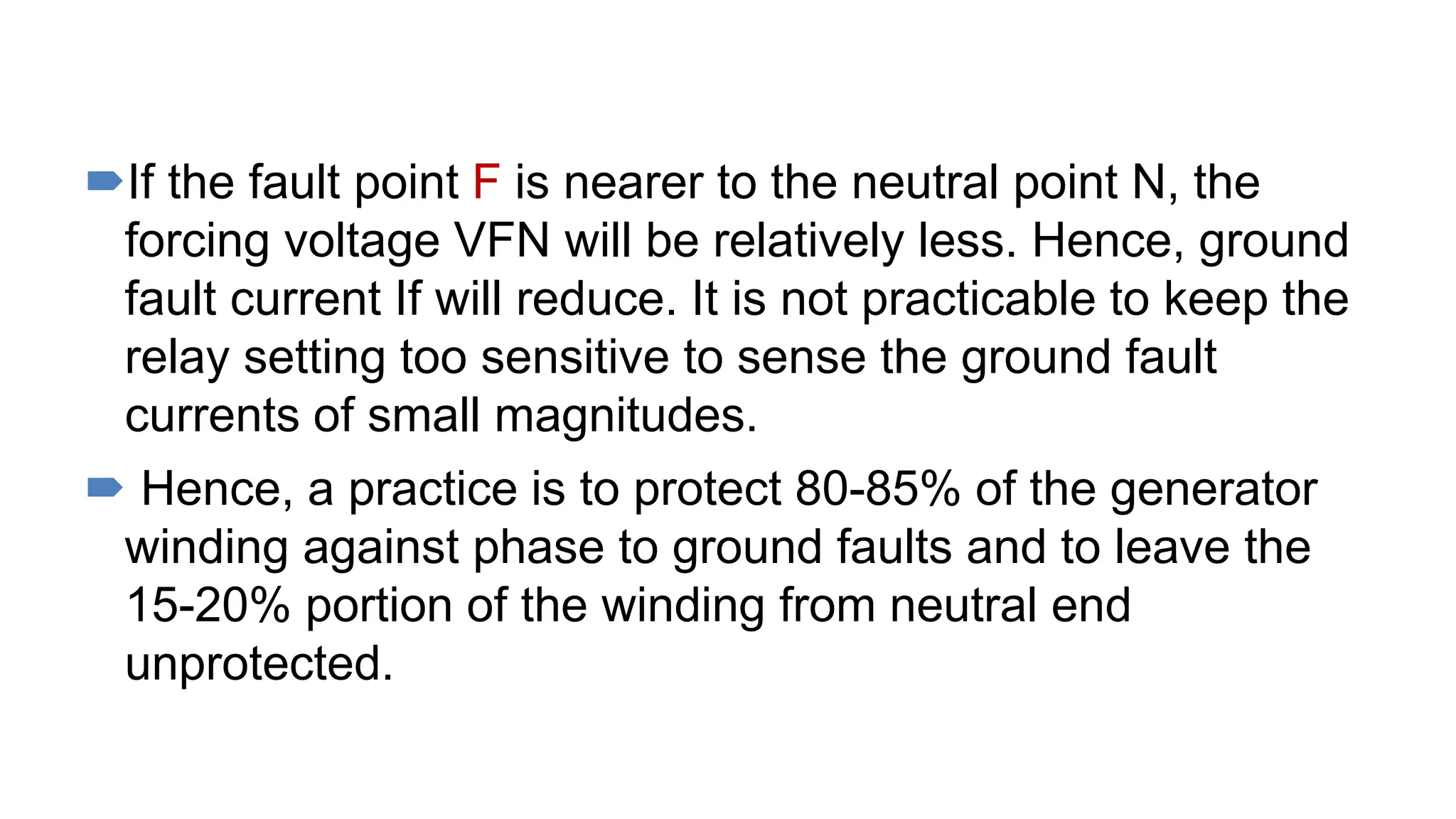
If the ground fault occurs at the point F of the generator
winding, the voltage VFN is available to drive the ground-
fault current If through the neutral to ground connection.
If the fault point F is nearer to the neutral point N, the
forcing voltage VFN will be relatively less. Hence, ground
fault current If will reduce. It is not practicable to keep the
relay setting too sensitive to sense the ground fault
currents of small magnitudes.
 Hence, a practice is to protect 80-85% of the generator
winding against phase to ground faults and to leave the
15-20% portion of the winding from neutral end
unprotected.
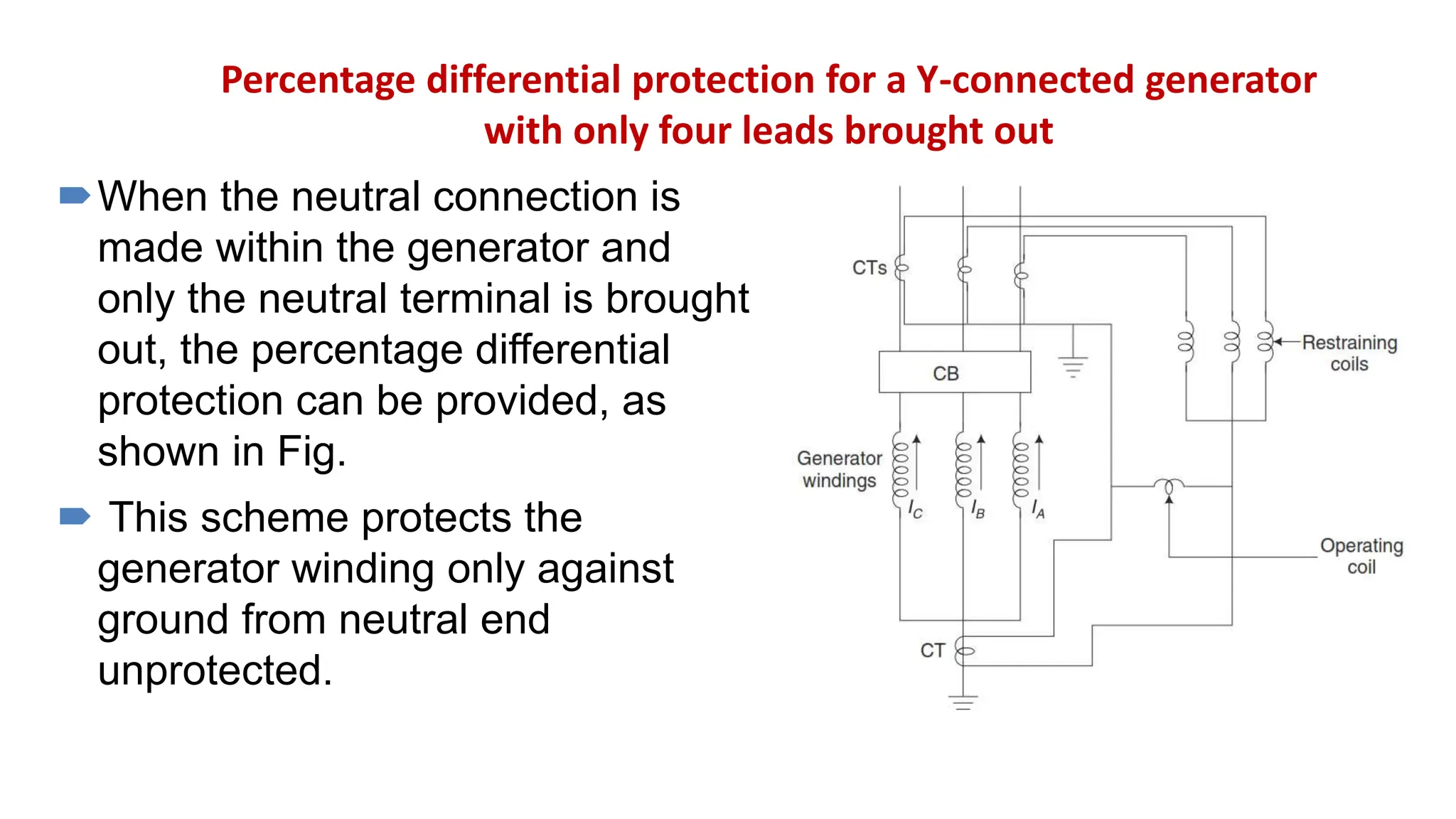
Percentage differential protection for a Y-connected generator
with only four leads brought out
When the neutral connection is
made within the generator and
only the neutral terminal is brought
out, the percentage differential
protection can be provided, as
shown in Fig.
 This scheme protects the
generator winding only against
ground from neutral end
unprotected.
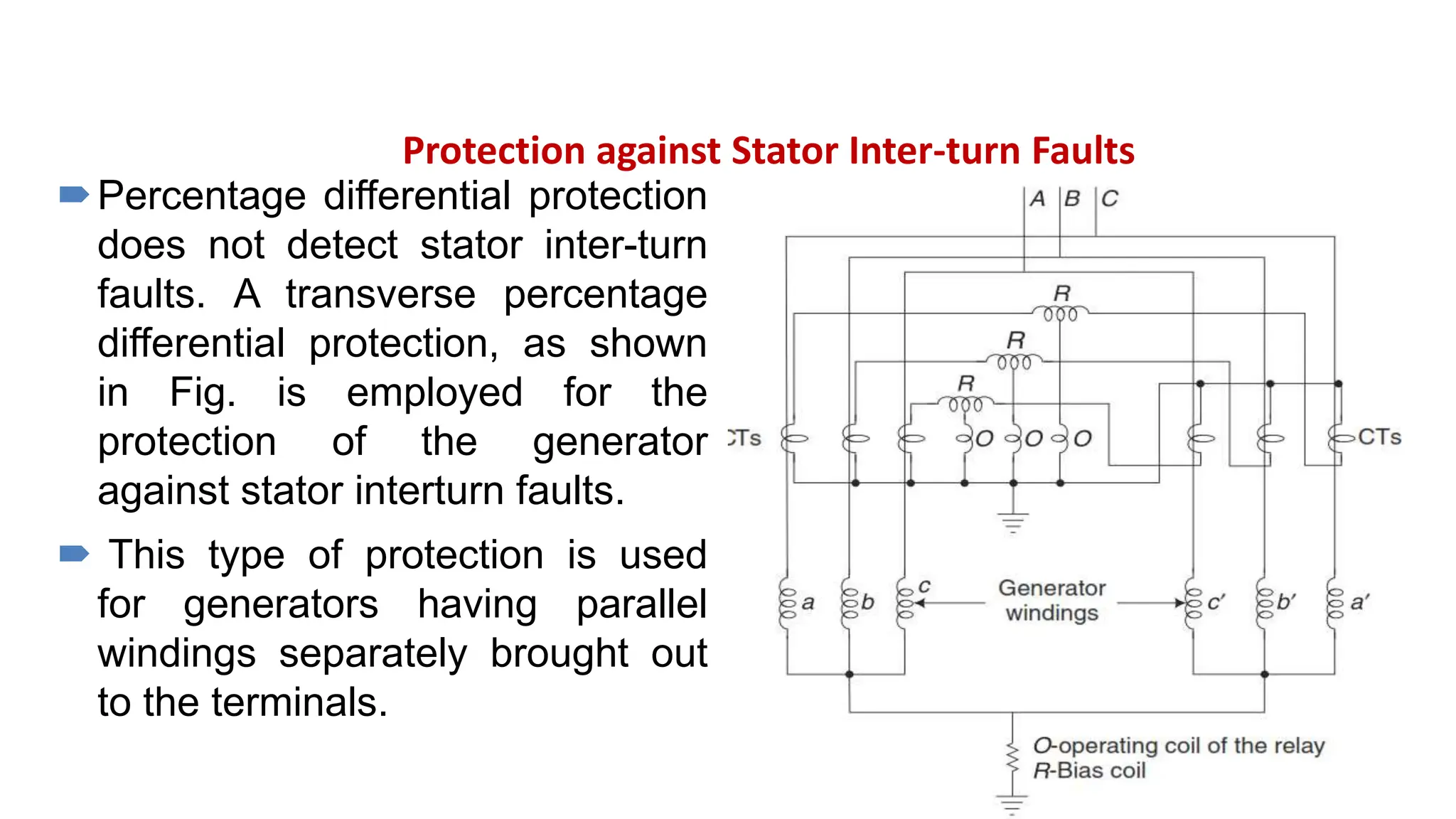
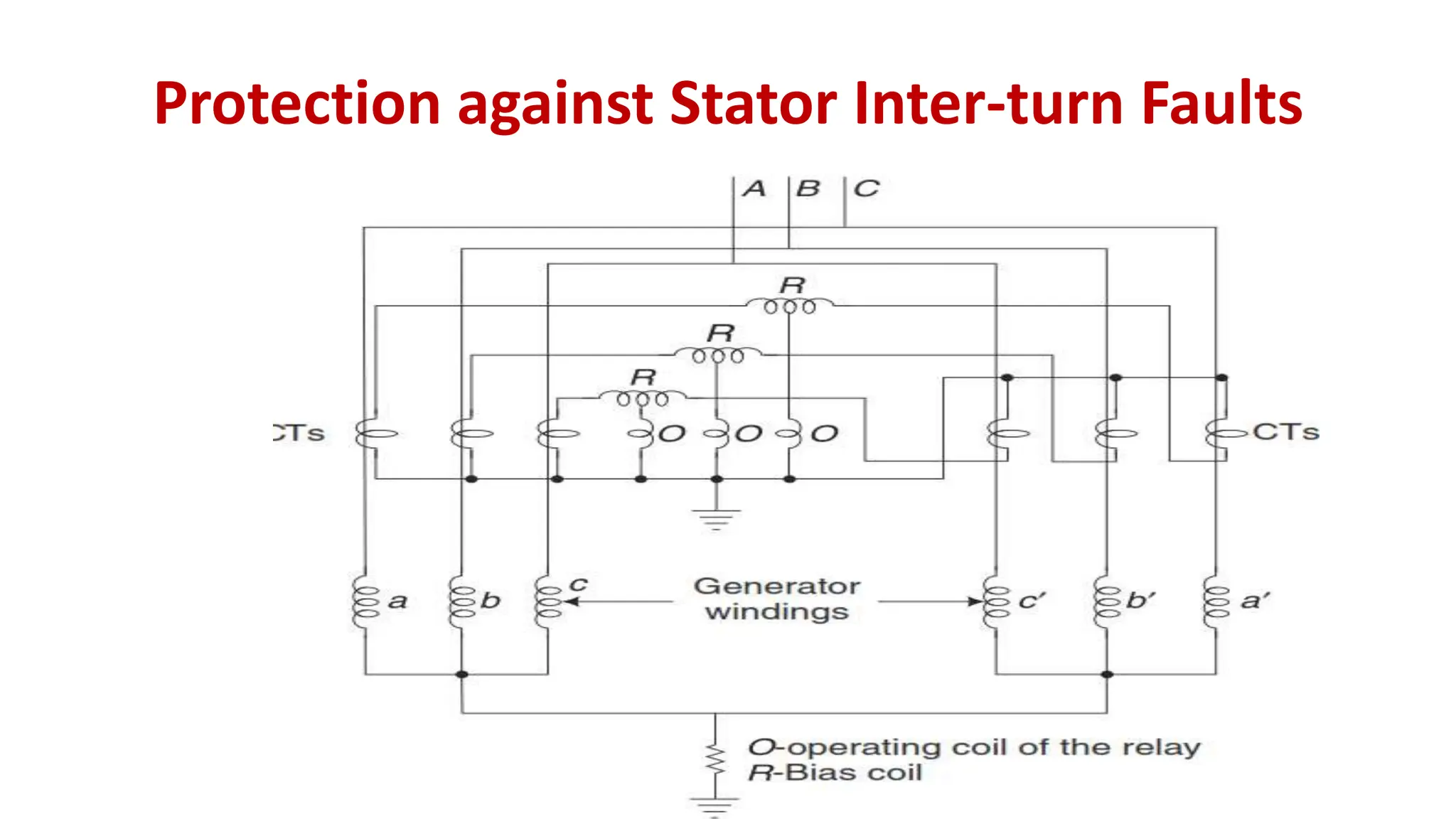
Protection against Stator Inter-turn Faults
Percentage differential protection
does not detect stator inter-turn
faults. A transverse percentage
differential protection, as shown
in Fig. is employed for the
protection of the generator
against stator interturn faults.
 This type of protection is used
for generators having parallel
windings separately brought out
to the terminals.
Protection against Stator Inter-turn Faults
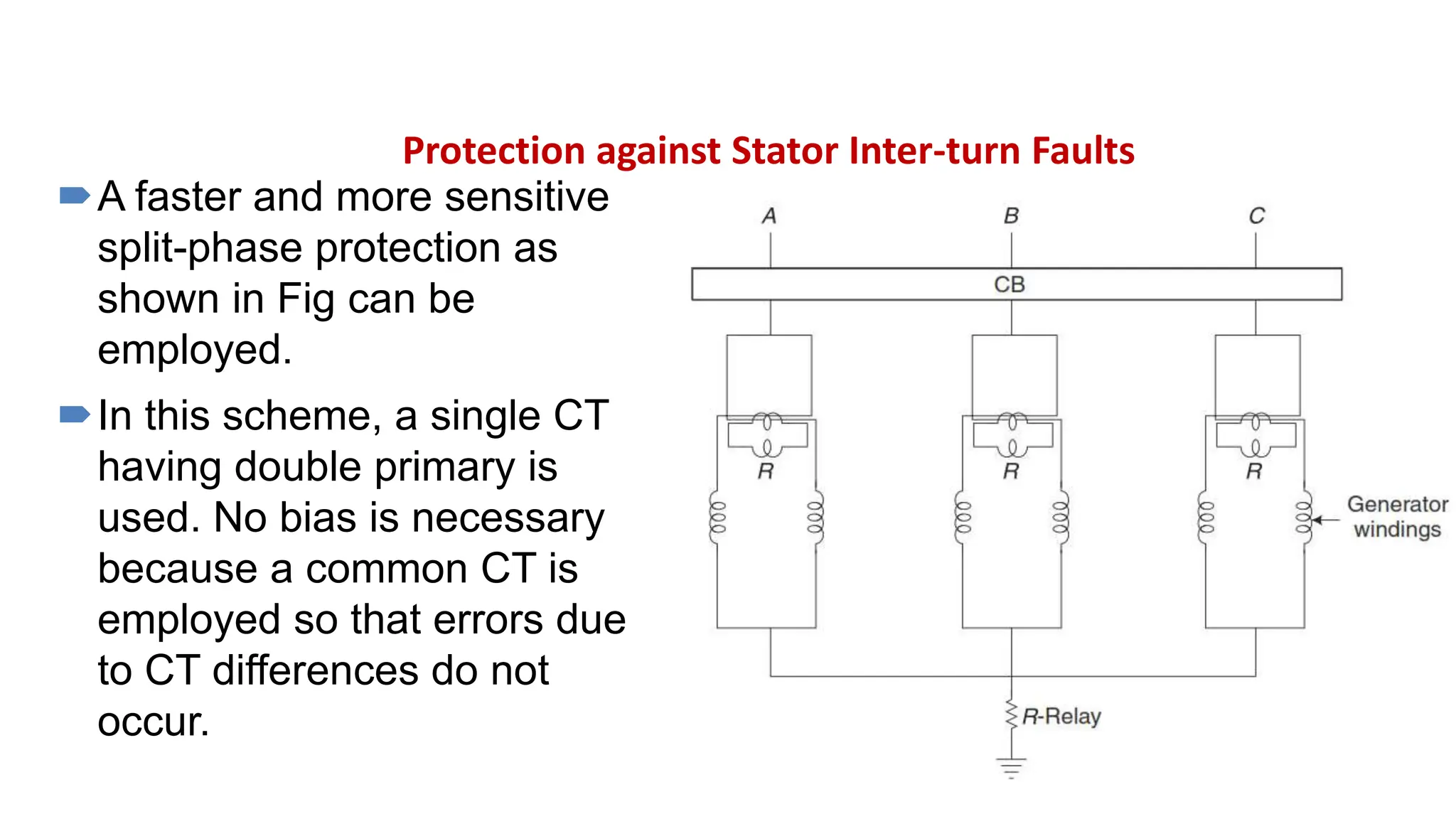
A faster and more sensitive
split-phase protection as
shown in Fig can be
employed.
In this scheme, a single CT
having double primary is
used. No bias is necessary
because a common CT is
employed so that errors due
to CT differences do not
occur.
Inter-turn protection based on zero-sequence component
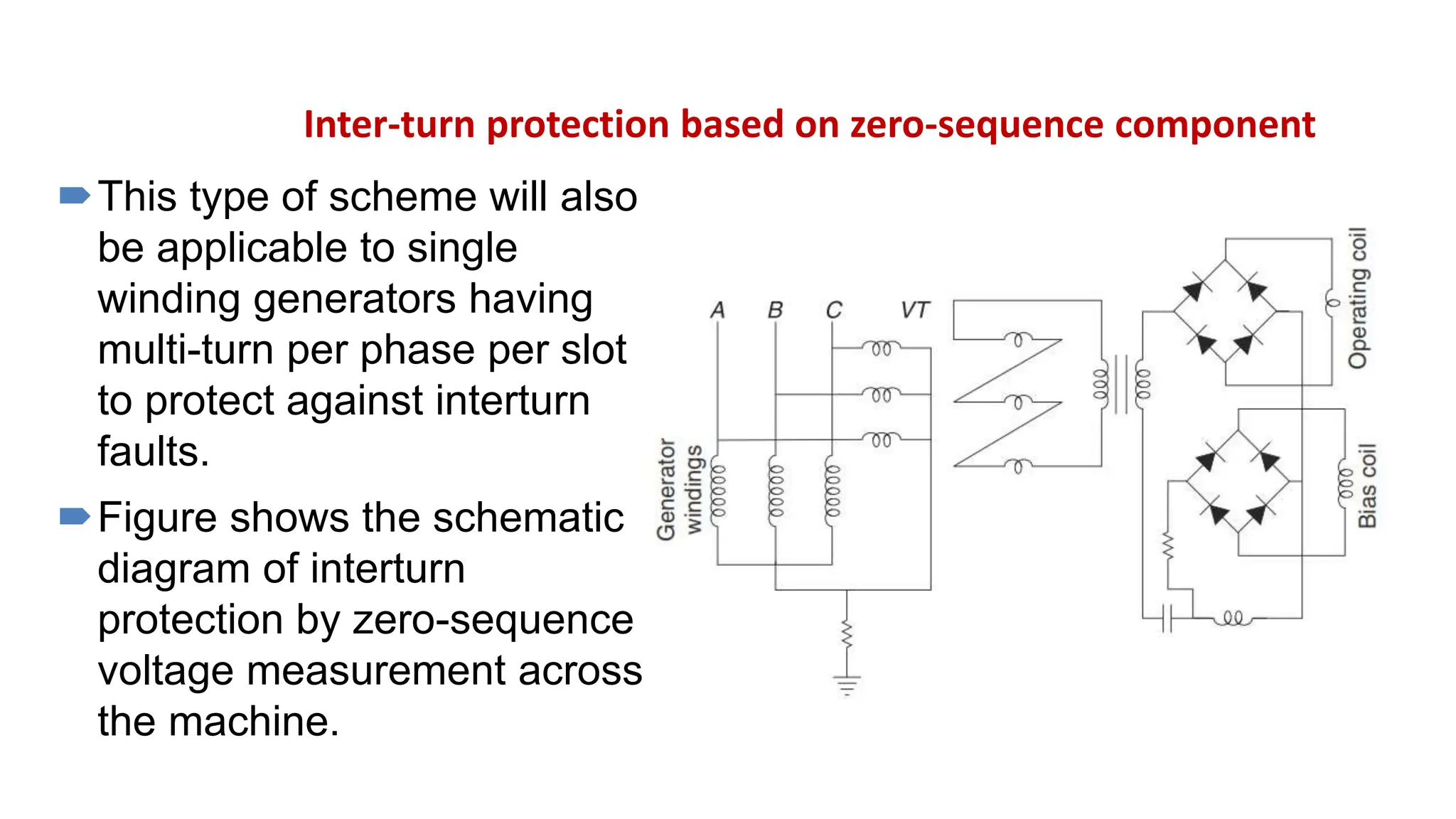
This type of scheme will also
be applicable to single
winding generators having
multi-turn per phase per slot
to protect against interturn
faults.
Figure shows the schematic
diagram of interturn
protection by zero-sequence
voltage measurement across
the machine.
Inter-turn protection based on zero-sequence
component
The zero-sequence voltage does not exist during normal
conditions. If one or more turns of a phase are short
circuited, the generated emf contains zero-sequence
component.
A voltage transformer as shown in the figure is employed to
extract zero-sequence component.
Inter-turn protection based on zero-sequence
component
The secondary winding of the voltage transformer is in
open-delta connection to provide the zero-sequence
component of the voltage to the protective relay.
 A filter is provided to extract a third harmonic component
from the VT output and apply it as the relay bias.
Stator-overheating Protection
Overheating of the stator may be caused by the failure of the
cooling system, overloading or core faults like short-circuited
laminations and failure of core bolt insulation.
 Modern generators employ two methods to detect overheating
both being used in large generators (above 2 MW). In one
method, the inlet and outlet temperatures of the cooling
medium which may be hydrogen/ water are compared for
detecting overheating.
Stator-overheating Protection
In the other method, the temperature sensing elements are
embedded in the stator slots to sense the temperature.
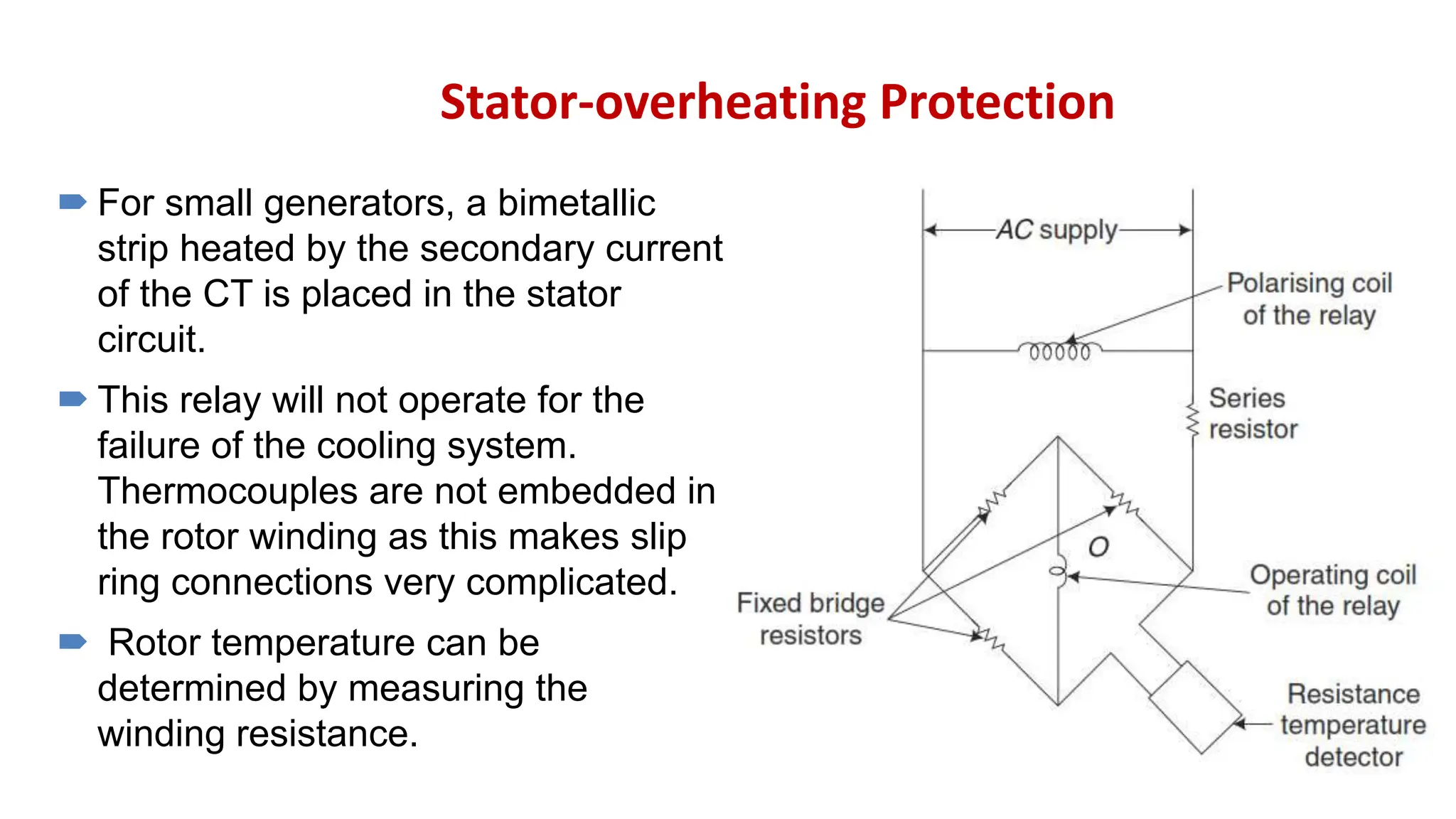
Figure 9.7 shows a stator overheating relaying scheme.
When the temperature exceeds a certain preset maximum
temperature limit, the relay sounds an alarm. The scheme
employs a temperature detector unit, relay and
Wheatstone-bridge for the purpose.
Stator-overheating Protection
 For small generators, a bimetallic
strip heated by the secondary current
of the CT is placed in the stator
circuit.
 This relay will not operate for the
failure of the cooling system.
Thermocouples are not embedded in
the rotor winding as this makes slip
ring connections very complicated.
 Rotor temperature can be
determined by measuring the
winding resistance.
Rotor Protection
Field Ground-fault Protection
As the field circuit is operated ungrounded, a single ground
fault does not affect the operation of the generator or cause
any damage.
 However, a single rotor fault to earth increases the stress
to the ground in the field when stator transients induce an
extra voltage in the field winding.
Thus, the probability of the occurrence of the second
ground fault is increased.
Rotor Protection
Field Ground-fault Protection
In case a second ground fault occurs, a part of the field
winding is bypassed, thereby increasing the current
through the remaining portion of the field winding.
This causes an unbalance in the air-gap fluxes, thereby
creating an unbalance in the magnetic forces on opposite
sides of the rotor.
Field Ground-fault Protection
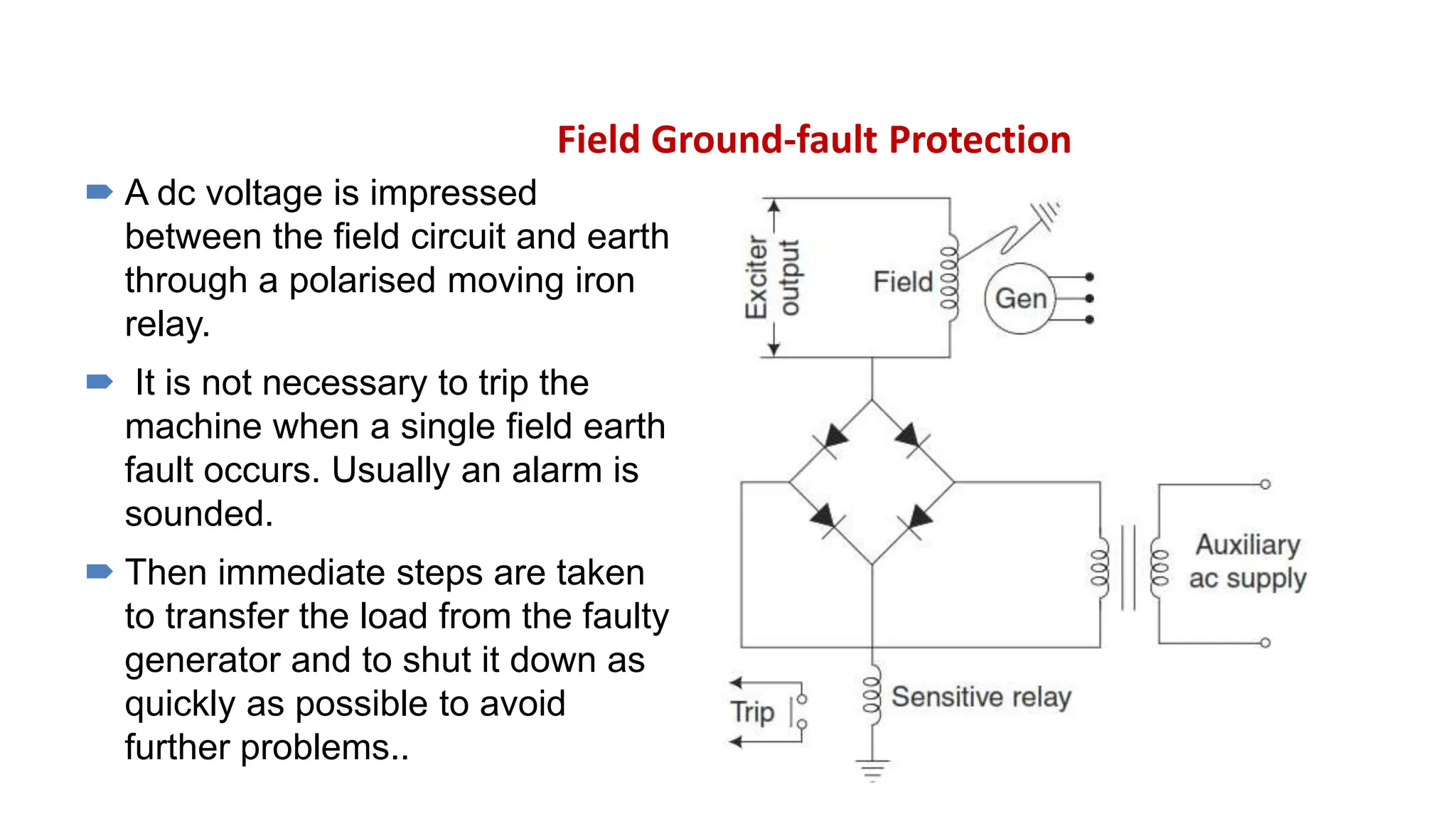
 A dc voltage is impressed
between the field circuit and earth
through a polarised moving iron
relay.
 It is not necessary to trip the
machine when a single field earth
fault occurs. Usually an alarm is
sounded.
 Then immediate steps are taken
to transfer the load from the faulty
generator and to shut it down as
quickly as possible to avoid
further problems..
Loss of Excitation
When the excitation of a generator is lost, it speeds up
slightly and operates as an induction generator.
Round-rotor generators do not have damper windings and
hence they are not suitable for such an operation.
Loss of Excitation
The rotor is overheated quickly due to heavy induced
currents in the rotor iron.
The rotors of salient pole generators are not overheated
because they have damper windings which carry induced
currents.
Loss of Excitation
The stators of both salient and non-salient pole generators
are overheated due to wattless current drawn by the
machines as magnetising current from the system.
A large machine may upset the system stability because it
draws reactive power from the system when it runs as an
induction generator whereas it supplies reactive power
when it runs as a generator
Loss of Excitation
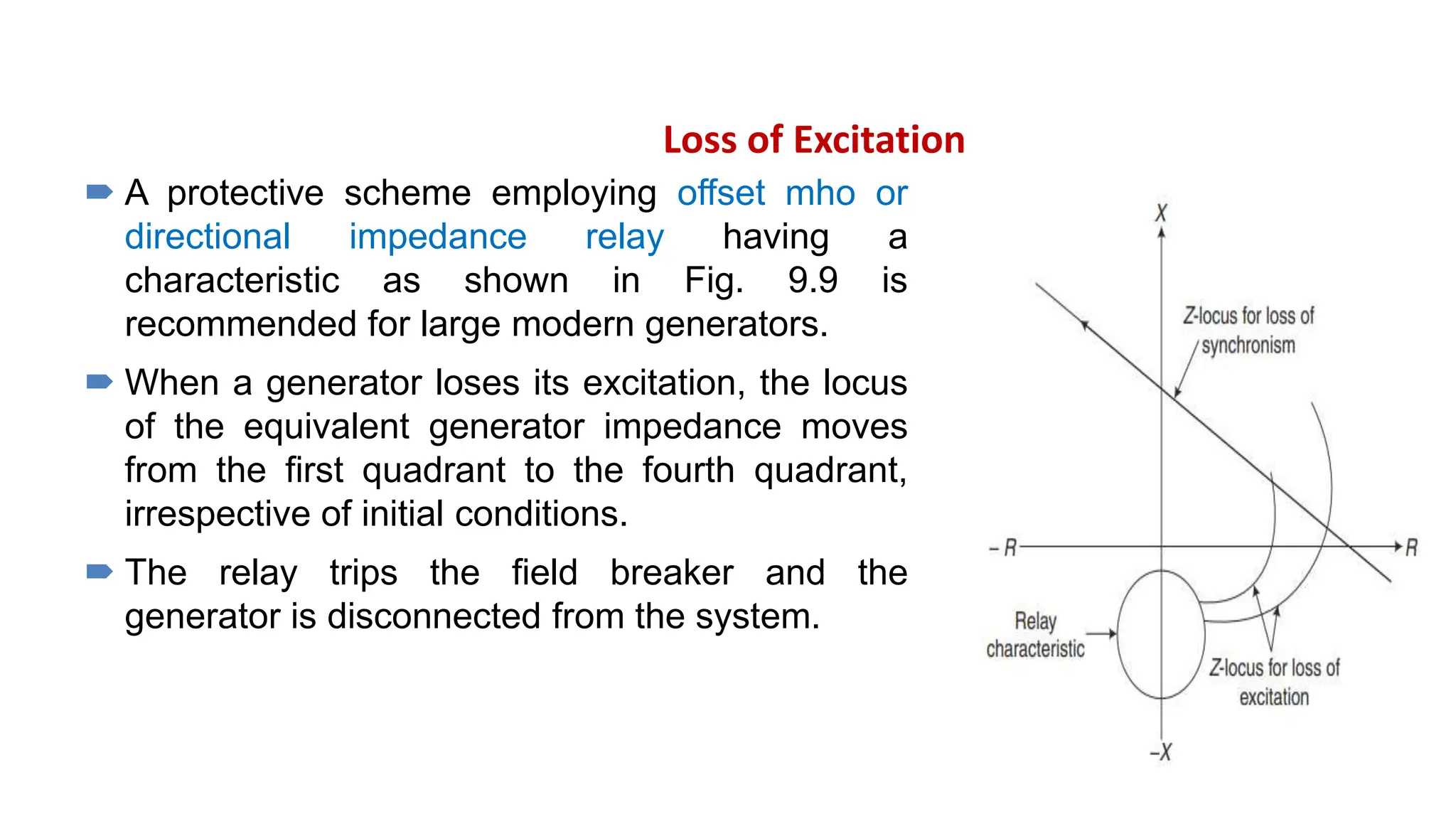
 A protective scheme employing offset mho or
directional impedance relay having a
characteristic as shown in Fig. 9.9 is
recommended for large modern generators.
 When a generator loses its excitation, the locus
of the equivalent generator impedance moves
from the first quadrant to the fourth quadrant,
irrespective of initial conditions.
 The relay trips the field breaker and the
generator is disconnected from the system.
Protection against Rotor Overheating because of Unbalanced Three-
phase Stator Currents
 The negative sequence component of unbalanced stator currents cause double
frequency current to be induced in the rotor iron.
 If this component becomes high severe overheating of the rotor may be
caused. The unbalanced condition may arise due to the following reasons:
 (i) When a fault occurs in the stator winding
 (ii) An unbalanced external fault which is not cleared quickly
 (iii) Open-circuiting of a phase
 (iv) Failure of one contact of the circuit breaker
 The time for which the rotor can be allowed by the expression I 2
2 t = K where
I2 is the negative sequence component of the current, t = time, and, K = 7 for
turbo-generator with direct cooling = 60 for a salient-pole hydro generator
Protection against Rotor Overheating because of Unbalanced Three-
phase Stator Currents
Protection against Rotor Overheating because of Unbalanced Three-
phase Stator Currents
 Figure shows a protective scheme using a negative sequence filter and relay.
 The overcurrent relay used in the negative phase sequence protection has a
long operating time with a facility of range setting to permit its characteristic to
be matched to I 2
2 t characteristic of the machine.
 A typical time range of the relay is 0.2 to 2000 s.
 It has a typical construction with a special electromagnet. It has shaded pole
construction with a Mu-metal shunt.
 The negative sequence filter gives an output proportional to I2. It actuates an
alarm as well as the timecurrent relay which has a very inverse characteristic.
• Other Protection - Generator
Overvoltage Protection
 Overvoltage may be caused by a defective voltage regulator or it may occur
due to sudden loss of electrical load on generators.
 When a load is lost, there is an increase in speed and hence the voltage also
increases. In case of a steam power station, it is possible to bypass the steam
before the speed reaches a limit above which a dangerous overvoltage can be
produced.
 Also, In steam power stations, the automatic voltage regulator controls the
overvoltages which is associated with overspeed.
 In hydro-stations it is not possible to stop or divert water flow so quickly and
overspeed may occur.
 Therefore, overvoltage relays are provided with hydro and gas-turbine sets. But
overvoltage relays are not commonly used with turbo-alternators
Overspeed Protection
 A turbo-generator is provided with a mechanical overspeed device. The spseed
governor normally controls its speed.
 It is designed to prevent any speed rise even with a 100 per cent load rejection.
 An emergency centrifugal overspeed device is also incorporated to trip
emergency steam valves when the speed exceeds 110 percent.
 Large turbosets are sometimes provided with overspeed relays.
Protection against Motoring
 When the steam supply is cut off, the generator runs as a motor.
 The steam turbine gets overheated because insufficient steam passes through
the turbine to carry away the heat generated by windage loss.
 Therefore, a protective relay is required for the protection of the steam turbine.
Generally, the relay operates when power output falls below 3%.
 A sensitive reverse power relay is available which has an operating setting of
about 0.5% of the generator’s output.
 Hydrosets sometimes require protection against motoring. Cavitation problems
arise in water turbines at low water flow.
 Protection is provided by reverse power relay having an operating setting of 0.2
to 2% of the rated power.
Protection against Vibration and Distortion of Rotor
 Vibration is caused by overheating of the rotor or some mechanical failure or
abnormality.
 The overheating of the rotor is caused due to unbalanced stator currents or
rotor ground faults.
 Overheating of the rotor distorts it, thereby causing unconventional behavior
and produces vibration.
 Protection provided for unbalanced stator currents and rotor ground faults
minimise vibration.
 A vibration measuring device is also used for steam turbine sets.
 Such a device detects the vibration which is caused either by electrical or
mechanical causes. An alarm is actuated if vibration takes place
Bearing Overheating Protection
 Temperature of the bearing is detected by inserting a temperature sensing
device in a hole in the bearing.
 For large machines where lubricating oil is circulated through the bearing, an oil
flow device is used to detect the failure of oil cooling equipment.
 An alarm is actuated when the bearing is overheated or when the circulation of
the lubricating oil fails.
Protection against Auxiliary Failure
 The power plant auxiliaries are very important for the running of the generating
sets.
 High grade protective equipment is employed for their reliable operation.
 For large generating sets, protection against loss of vacuum and loss of boiler
pressure are provided. Such failures are due to the failure of the associated
auxiliaries.
 In the case of such failures generating sets are shut down. Protection against
the failure of induced draught fans is also provided..
Protection against voltage regulator Failure
 Modern quick response automatic voltage regulators are very complex. They
are subject to component failures.
 Suitable protective devices are provided against their failure.
 A definite time dc overcurrent relay is provided which operates when there is
overcurrent in the rotor circuit for a period longer than a prescribed limit.
 In such a situation, the excitation is switched to a predetermined value for
manual control.
Protection against voltage regulator Failure
 The supply for the regulator reference voltage is given from a separate voltage
transformer.
 Protection is also required against the failure of the regulator reference voltage.
An under voltage relay is used for this purpose.
 A better approach is to use a voltage balance relay which compares the
voltage derived from the instrument transformer with the voltage derived from
the voltage regulator transformer.
 If there is mal-operation of the voltage regulator due to the failure of the
reference voltage, the relay operates and switches the excitation to a
predetermined value for manual control.

UNIT III PROTECTION OF GENERATOR OCTOBER 2 (2).ppt

  • 1.
    20EE023 PROTECTION ANDSWITCHGEAR UNIT-III Apparatus Protection
  • 3.
  • 4.
    Stator Protection It isused for the protection of generators above 1 MW. It protects against winding faults, i.e. phase to phase and phase to ground faults. This is also called biased differential protection. The polarity of the secondary voltage of CTs at a particular moment for an external fault has been shown in the figure.
  • 5.
    Stator Protection In theoperating coil, the current sent by the upper CT is cancelled by the current sent by the lower CT and the relay does not operate, For an internal fault, the polarity of the secondary voltage of the upper CT is reversed, as shown in Fig. 9.1(b). Now the operating coil carries the sum of the currents sent by the upper CT and the lower CT and it operates and trips the circuit breaker.
  • 6.
  • 7.
  • 8.
    Stator Protection The percentagedifferential protection does not respond to external faults and overloads. It provides complete protection against phase to phase faults. It provides protection against ground faults to about 80 to 85 per cent of the generator windings.
  • 9.
    Stator Protection It doesnot provide protection to 100 per cent of the winding because it is influenced by the magnitude of the earth fault current which depends upon the method of neutral grounding.  When the neutral is grounded through an impedance, the differential protection is supplemented by sensitive earth fault relays
  • 10.
    Restricted earth-fault protectionby differential system When the neutral is solidly grounded, it is possible to provide protection to complete winding of the generator against ground faults. However, the neutral is grounded through resistance to limit ground fault currents. With resistance grounding it is not possible to protect the complete winding against ground faults. The percentage of winding protected depends on the value of the neutral grounding resistor and the relay setting. .
  • 11.
    Restricted earth-fault protectionby differential system The usual practice is to protect 80 to 85% of the generator winding against ground fault. The remaining 15- 20% from neutral end is left unprotected. In Fig. 9.2 for phase to ground fault, it can be seen that the relay setting for the differential protection is determined by the value of the neutral grounding resistor and the percentage of winding to be protected.
  • 12.
    Restricted earth-fault protectionby differential system If the ground fault occurs at the point F of the generator winding, the voltage VFN is available to drive the ground- fault current If through the neutral to ground connection.
  • 13.
    If the faultpoint F is nearer to the neutral point N, the forcing voltage VFN will be relatively less. Hence, ground fault current If will reduce. It is not practicable to keep the relay setting too sensitive to sense the ground fault currents of small magnitudes.  Hence, a practice is to protect 80-85% of the generator winding against phase to ground faults and to leave the 15-20% portion of the winding from neutral end unprotected.
  • 14.
    Percentage differential protectionfor a Y-connected generator with only four leads brought out When the neutral connection is made within the generator and only the neutral terminal is brought out, the percentage differential protection can be provided, as shown in Fig.  This scheme protects the generator winding only against ground from neutral end unprotected.
  • 15.
    Protection against StatorInter-turn Faults Percentage differential protection does not detect stator inter-turn faults. A transverse percentage differential protection, as shown in Fig. is employed for the protection of the generator against stator interturn faults.  This type of protection is used for generators having parallel windings separately brought out to the terminals.
  • 16.
    Protection against StatorInter-turn Faults
  • 17.
    Protection against StatorInter-turn Faults A faster and more sensitive split-phase protection as shown in Fig can be employed. In this scheme, a single CT having double primary is used. No bias is necessary because a common CT is employed so that errors due to CT differences do not occur.
  • 18.
    Inter-turn protection basedon zero-sequence component This type of scheme will also be applicable to single winding generators having multi-turn per phase per slot to protect against interturn faults. Figure shows the schematic diagram of interturn protection by zero-sequence voltage measurement across the machine.
  • 19.
    Inter-turn protection basedon zero-sequence component The zero-sequence voltage does not exist during normal conditions. If one or more turns of a phase are short circuited, the generated emf contains zero-sequence component. A voltage transformer as shown in the figure is employed to extract zero-sequence component.
  • 20.
    Inter-turn protection basedon zero-sequence component The secondary winding of the voltage transformer is in open-delta connection to provide the zero-sequence component of the voltage to the protective relay.  A filter is provided to extract a third harmonic component from the VT output and apply it as the relay bias.
  • 21.
    Stator-overheating Protection Overheating ofthe stator may be caused by the failure of the cooling system, overloading or core faults like short-circuited laminations and failure of core bolt insulation.  Modern generators employ two methods to detect overheating both being used in large generators (above 2 MW). In one method, the inlet and outlet temperatures of the cooling medium which may be hydrogen/ water are compared for detecting overheating.
  • 22.
    Stator-overheating Protection In theother method, the temperature sensing elements are embedded in the stator slots to sense the temperature. Figure 9.7 shows a stator overheating relaying scheme. When the temperature exceeds a certain preset maximum temperature limit, the relay sounds an alarm. The scheme employs a temperature detector unit, relay and Wheatstone-bridge for the purpose.
  • 23.
    Stator-overheating Protection  Forsmall generators, a bimetallic strip heated by the secondary current of the CT is placed in the stator circuit.  This relay will not operate for the failure of the cooling system. Thermocouples are not embedded in the rotor winding as this makes slip ring connections very complicated.  Rotor temperature can be determined by measuring the winding resistance.
  • 24.
    Rotor Protection Field Ground-faultProtection As the field circuit is operated ungrounded, a single ground fault does not affect the operation of the generator or cause any damage.  However, a single rotor fault to earth increases the stress to the ground in the field when stator transients induce an extra voltage in the field winding. Thus, the probability of the occurrence of the second ground fault is increased.
  • 25.
    Rotor Protection Field Ground-faultProtection In case a second ground fault occurs, a part of the field winding is bypassed, thereby increasing the current through the remaining portion of the field winding. This causes an unbalance in the air-gap fluxes, thereby creating an unbalance in the magnetic forces on opposite sides of the rotor.
  • 26.
    Field Ground-fault Protection A dc voltage is impressed between the field circuit and earth through a polarised moving iron relay.  It is not necessary to trip the machine when a single field earth fault occurs. Usually an alarm is sounded.  Then immediate steps are taken to transfer the load from the faulty generator and to shut it down as quickly as possible to avoid further problems..
  • 27.
    Loss of Excitation Whenthe excitation of a generator is lost, it speeds up slightly and operates as an induction generator. Round-rotor generators do not have damper windings and hence they are not suitable for such an operation.
  • 28.
    Loss of Excitation Therotor is overheated quickly due to heavy induced currents in the rotor iron. The rotors of salient pole generators are not overheated because they have damper windings which carry induced currents.
  • 29.
    Loss of Excitation Thestators of both salient and non-salient pole generators are overheated due to wattless current drawn by the machines as magnetising current from the system. A large machine may upset the system stability because it draws reactive power from the system when it runs as an induction generator whereas it supplies reactive power when it runs as a generator
  • 30.
    Loss of Excitation A protective scheme employing offset mho or directional impedance relay having a characteristic as shown in Fig. 9.9 is recommended for large modern generators.  When a generator loses its excitation, the locus of the equivalent generator impedance moves from the first quadrant to the fourth quadrant, irrespective of initial conditions.  The relay trips the field breaker and the generator is disconnected from the system.
  • 31.
    Protection against RotorOverheating because of Unbalanced Three- phase Stator Currents  The negative sequence component of unbalanced stator currents cause double frequency current to be induced in the rotor iron.  If this component becomes high severe overheating of the rotor may be caused. The unbalanced condition may arise due to the following reasons:  (i) When a fault occurs in the stator winding  (ii) An unbalanced external fault which is not cleared quickly  (iii) Open-circuiting of a phase  (iv) Failure of one contact of the circuit breaker  The time for which the rotor can be allowed by the expression I 2 2 t = K where I2 is the negative sequence component of the current, t = time, and, K = 7 for turbo-generator with direct cooling = 60 for a salient-pole hydro generator
  • 32.
    Protection against RotorOverheating because of Unbalanced Three- phase Stator Currents
  • 33.
    Protection against RotorOverheating because of Unbalanced Three- phase Stator Currents  Figure shows a protective scheme using a negative sequence filter and relay.  The overcurrent relay used in the negative phase sequence protection has a long operating time with a facility of range setting to permit its characteristic to be matched to I 2 2 t characteristic of the machine.  A typical time range of the relay is 0.2 to 2000 s.  It has a typical construction with a special electromagnet. It has shaded pole construction with a Mu-metal shunt.  The negative sequence filter gives an output proportional to I2. It actuates an alarm as well as the timecurrent relay which has a very inverse characteristic.
  • 34.
  • 35.
    Overvoltage Protection  Overvoltagemay be caused by a defective voltage regulator or it may occur due to sudden loss of electrical load on generators.  When a load is lost, there is an increase in speed and hence the voltage also increases. In case of a steam power station, it is possible to bypass the steam before the speed reaches a limit above which a dangerous overvoltage can be produced.  Also, In steam power stations, the automatic voltage regulator controls the overvoltages which is associated with overspeed.  In hydro-stations it is not possible to stop or divert water flow so quickly and overspeed may occur.  Therefore, overvoltage relays are provided with hydro and gas-turbine sets. But overvoltage relays are not commonly used with turbo-alternators
  • 36.
    Overspeed Protection  Aturbo-generator is provided with a mechanical overspeed device. The spseed governor normally controls its speed.  It is designed to prevent any speed rise even with a 100 per cent load rejection.  An emergency centrifugal overspeed device is also incorporated to trip emergency steam valves when the speed exceeds 110 percent.  Large turbosets are sometimes provided with overspeed relays.
  • 37.
    Protection against Motoring When the steam supply is cut off, the generator runs as a motor.  The steam turbine gets overheated because insufficient steam passes through the turbine to carry away the heat generated by windage loss.  Therefore, a protective relay is required for the protection of the steam turbine. Generally, the relay operates when power output falls below 3%.  A sensitive reverse power relay is available which has an operating setting of about 0.5% of the generator’s output.  Hydrosets sometimes require protection against motoring. Cavitation problems arise in water turbines at low water flow.  Protection is provided by reverse power relay having an operating setting of 0.2 to 2% of the rated power.
  • 38.
    Protection against Vibrationand Distortion of Rotor  Vibration is caused by overheating of the rotor or some mechanical failure or abnormality.  The overheating of the rotor is caused due to unbalanced stator currents or rotor ground faults.  Overheating of the rotor distorts it, thereby causing unconventional behavior and produces vibration.  Protection provided for unbalanced stator currents and rotor ground faults minimise vibration.  A vibration measuring device is also used for steam turbine sets.  Such a device detects the vibration which is caused either by electrical or mechanical causes. An alarm is actuated if vibration takes place
  • 39.
    Bearing Overheating Protection Temperature of the bearing is detected by inserting a temperature sensing device in a hole in the bearing.  For large machines where lubricating oil is circulated through the bearing, an oil flow device is used to detect the failure of oil cooling equipment.  An alarm is actuated when the bearing is overheated or when the circulation of the lubricating oil fails.
  • 40.
    Protection against AuxiliaryFailure  The power plant auxiliaries are very important for the running of the generating sets.  High grade protective equipment is employed for their reliable operation.  For large generating sets, protection against loss of vacuum and loss of boiler pressure are provided. Such failures are due to the failure of the associated auxiliaries.  In the case of such failures generating sets are shut down. Protection against the failure of induced draught fans is also provided..
  • 41.
    Protection against voltageregulator Failure  Modern quick response automatic voltage regulators are very complex. They are subject to component failures.  Suitable protective devices are provided against their failure.  A definite time dc overcurrent relay is provided which operates when there is overcurrent in the rotor circuit for a period longer than a prescribed limit.  In such a situation, the excitation is switched to a predetermined value for manual control.
  • 42.
    Protection against voltageregulator Failure  The supply for the regulator reference voltage is given from a separate voltage transformer.  Protection is also required against the failure of the regulator reference voltage. An under voltage relay is used for this purpose.  A better approach is to use a voltage balance relay which compares the voltage derived from the instrument transformer with the voltage derived from the voltage regulator transformer.  If there is mal-operation of the voltage regulator due to the failure of the reference voltage, the relay operates and switches the excitation to a predetermined value for manual control.