Payment for Ecosystem Services
Pilot Implementation in Mae Sa-Kog Ma Biosphere Reserve
USAID Lowering Emissions in Asia’s Forests (LEAF)
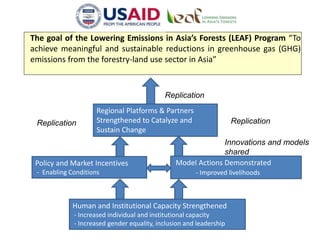
Model Actions Demonstrated
- Improved livelihoods
Policy and Market Incentives
- Enabling Conditions
Human and Institutional Capacity Strengthened
- Increased individual and institutional capacity
- Increased gender equality, inclusion and leadership
Regional Platforms & Partners
Strengthened to Catalyze and
Sustain Change
Replication
Innovations and models
shared
ReplicationReplication
The goal of the Lowering Emissions in Asia’s Forests (LEAF) Program “To
achieve meaningful and sustainable reductions in greenhouse gas (GHG)
emissions from the forestry-land use sector in Asia”
UNESCO – Man and Biosphere Program
(MAB)
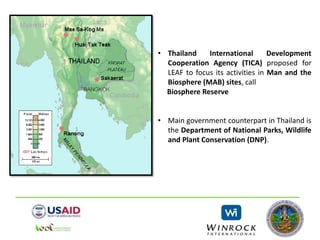
• Thailand International Development
Cooperation Agency (TICA) proposed for
LEAF to focus its activities in Man and the
Biosphere (MAB) sites, call
Biosphere Reserve
• Main government counterpart in Thailand is
the Department of National Parks, Wildlife
and Plant Conservation (DNP).
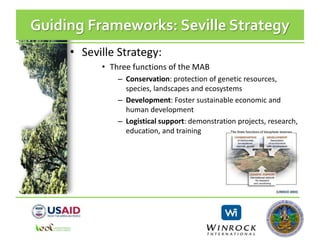
• Seville Strategy:
• Three functions of the MAB
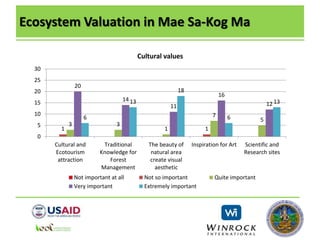
– Conservation: protection of genetic resources,
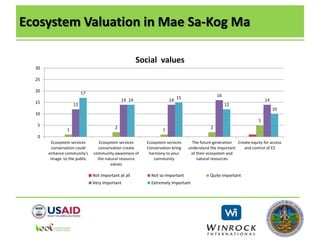
species, landscapes and ecosystems
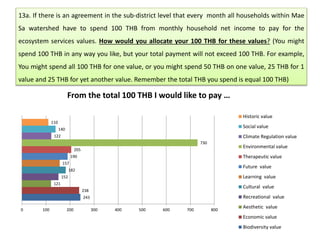
– Development: Foster sustainable economic and
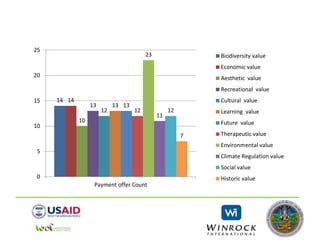
human development
– Logistical support: demonstration projects, research,
education, and training
Guiding Frameworks: Seville Strategy
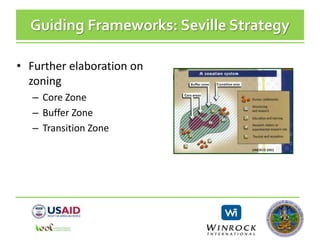
• Further elaboration on
zoning
– Core Zone
– Buffer Zone
– Transition Zone
Guiding Frameworks: Madrid Action Plan
Emerging role of biosphere reserves in addressing these challenges
According to the Madrid Action Plan (2008)
1) Climate change,
2) Provision of ecosystem services, and
3) Rapid urbanization as a driver of environmental change
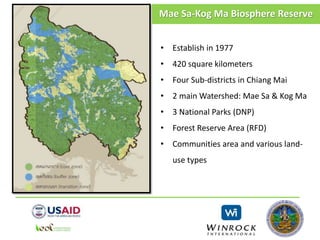
• Establish in 1977
• 420 square kilometers
• Four Sub-districts in Chiang Mai
• 2 main Watershed: Mae Sa & Kog Ma
• 3 National Parks (DNP)
• Forest Reserve Area (RFD)
• Communities area and various land-
use types
Mae Sa-Kog Ma Biosphere Reserve
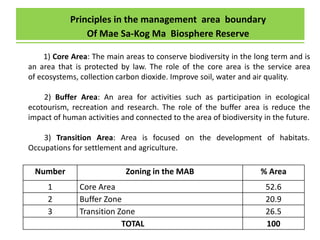
Number Zoning in the MAB % Area
1 Core Area 52.6
2 Buffer Zone 20.9
3 Transition Zone 26.5
TOTAL 100
Principles in the management area boundary
Of Mae Sa-Kog Ma Biosphere Reserve
1) Core Area: The main areas to conserve biodiversity in the long term and is
an area that is protected by law. The role of the core area is the service area
of ​​ecosystems, collection carbon dioxide. Improve soil, water and air quality.
2) Buffer Area: An area for activities such as participation in ecological
ecotourism, recreation and research. The role of the buffer area is reduce the
impact of human activities and connected to the area of biodiversity in the future.
3) Transition Area: Area is focused on the development of habitats.
Occupations for settlement and agriculture.
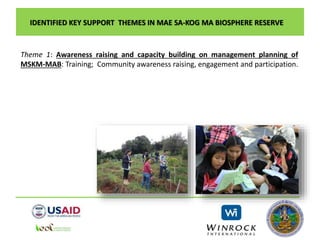
Theme 1: Awareness raising and capacity building on management planning of
MSKM-MAB: Training; Community awareness raising, engagement and participation.
IDENTIFIED KEY SUPPORT THEMES IN MAE SA-KOG MA BIOSPHERE RESERVE
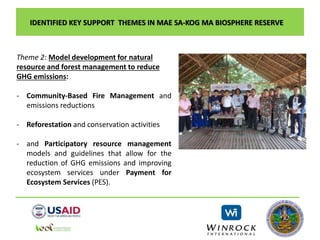
Theme 2: Model development for natural
resource and forest management to reduce
GHG emissions:
- Community-Based Fire Management and
emissions reductions
- Reforestation and conservation activities
- and Participatory resource management
models and guidelines that allow for the
reduction of GHG emissions and improving
ecosystem services under Payment for
Ecosystem Services (PES).
IDENTIFIED KEY SUPPORT THEMES IN MAE SA-KOG MA BIOSPHERE RESERVE
Theme 3: Advocacy and local policy development Evaluating of lessons learned from
implementation to build confidence in the development of appropriate and
sustainable local agreements, guidelines and rules.
Mae Sa-Kog Ma Management Plan
• Integrate effective participatory management planning
for MSKM-MAB to reducing emissions by addressing
deforestation and degradation of forest ecosystem.
• Development of pilot-PES and test in MSKM-MAB is
one key activity in the management plan
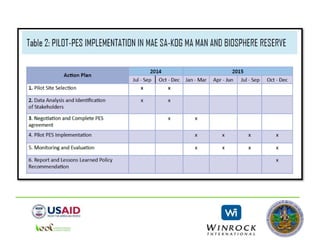
MSKM PES pilot Timeline
I. Pre - Implementation (2011 – 2013)
II. Pilot - Implementation (2014 – 2016)
MSKM PES pilot Timeline
I. Pre - Implementation (2011 – 2013)
• Establish PES – TWG and identified LEAF demonstration site
• PES – TWG attended Lam Dong Study Tour (2012)
• Recruit ‘PES - project Officer’
• Land Tenure and Policy Assignment for PES in MSKM-MAB
• USAID LEAF and DNP Mae Sa-Kog Ma Kick Off
MSKM PES pilot Timeline
I. Pre - Implementation (2011 – 2013)
• USAID, LEAF HAPPEN and CBFCM promoting PES in Mae Sa Catchment
• Support Capacity Building to stakeholder on PES topics through regional
training workshop
• MSKM-MAB management Plan identified PES as pilot activity
• Ecosystem Services Valuation in MSKM
• Initial collaboration with Private Sectors
MSKM PES pilot Timeline
II. Pilot - Implementation (2014 – 2016)
• Gathering relevant data to support pilot site selection process
• Finalized PES pilot site in MSKM
• Stakeholders, Buyers, Sellers, identified and Consultation Meeting
• Negotiation with stakeholders , design PES agreement, and payment
mechanism
• Establish PES agreement and launch implementation
MSKM PES Pilot Timeline
II. Pilot - Implementation (2014 – 2016)
• Monitoring and evaluation and reporting of the pilot PES implementation
• Sharing lesson learned and proposed enabling policy /legal framework
that scaling up PES implementation in the long term.
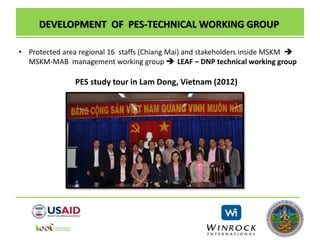
DEVELOPMENT OF PES-TECHNICAL WORKING GROUP
• Protected area regional 16 staffs (Chiang Mai) and stakeholders inside MSKM 
MSKM-MAB management working group  LEAF – DNP technical working group
PES study tour in Lam Dong, Vietnam (2012)
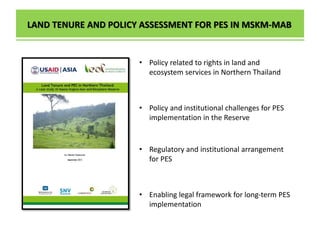
LAND TENURE AND POLICY ASSESSMENT FOR PES IN MSKM-MAB
• Policy and institutional challenges for PES
implementation in the Reserve
• Policy related to rights in land and
ecosystem services in Northern Thailand
• Regulatory and institutional arrangement
for PES
• Enabling legal framework for long-term PES
implementation
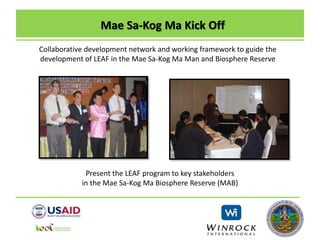
Mae Sa-Kog Ma Kick Off
Collaborative development network and working framework to guide the
development of LEAF in the Mae Sa-Kog Ma Man and Biosphere Reserve
Present the LEAF program to key stakeholders
in the Mae Sa-Kog Ma Biosphere Reserve (MAB)
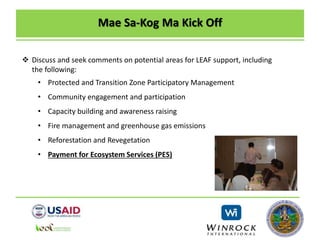
Mae Sa-Kog Ma Kick Off
 Discuss and seek comments on potential areas for LEAF support, including
the following:
• Protected and Transition Zone Participatory Management
• Community engagement and participation
• Capacity building and awareness raising
• Fire management and greenhouse gas emissions
• Reforestation and Revegetation
• Payment for Ecosystem Services (PES)
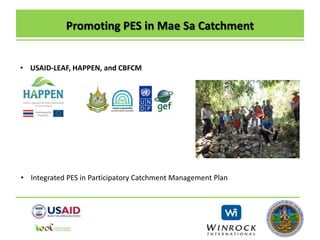
Promoting PES in Mae Sa Catchment
• USAID-LEAF, HAPPEN, and CBFCM
• Integrated PES in Participatory Catchment Management Plan
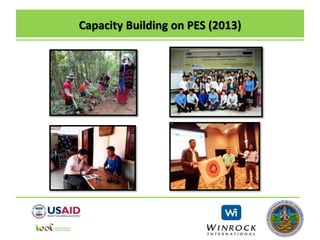
Capacity Building on PES (2013)
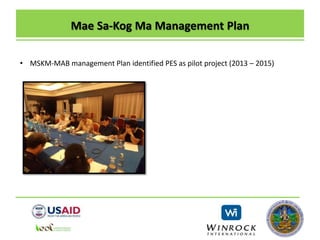
Mae Sa-Kog Ma Management Plan
• MSKM-MAB management Plan identified PES as pilot project (2013 – 2015)
Mae Sa-Kog Ma MA Strategies
1. Preserve and protect MAB MSKM by participatory approach
2. Develop collaborative mechanism in management of natural resources and access to
using of resources in MSKM
3. Promote learning process and awareness to community and wider public on value of MSKM
4. Strengthening mechanism in management for MAB MSKM
Sub strategy: 4.3 Develop funding mechanism for ecosystem services such as PES funding
5. Develop data based and research for MAB MSKM management
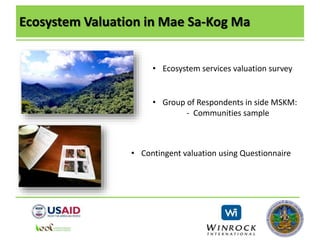
Ecosystem Valuation in Mae Sa-Kog Ma
• Ecosystem services valuation survey
• Group of Respondents in side MSKM:
- Communities sample
• Contingent valuation using Questionnaire
Ecosystem Valuation in Mae Sa-Kog Ma
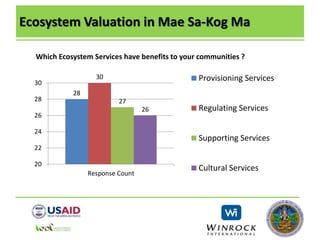
28
30
27
26
20
22
24
26
28
30
Response Count
Which Ecosystem Services have benefits to your communities ?
Provisioning Services
Regulating Services
Supporting Services
Cultural Services
Ecosystem Valuation in Mae Sa-Kog Ma
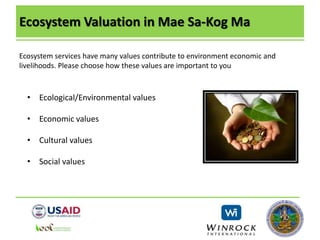
Ecosystem services have many values contribute to environment economic and
livelihoods. Please choose how these values are important to you
• Ecological/Environmental values
• Economic values
• Cultural values
• Social values
Ecosystem Valuation in Mae Sa-Kog Ma
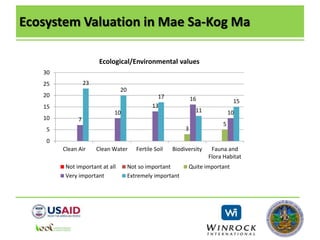
3
5
7
10
13
16
10
23
20
17
11
15
0
5
10
15
20
25
30
Clean Air Clean Water Fertile Soil Biodiversity Fauna and
Flora Habitat
Ecological/Environmental values
Not important at all Not so important Quite important
Very important Extremely important
Ecosystem Valuation in Mae Sa-Kog Ma
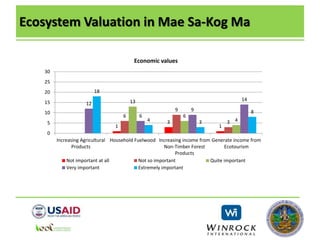
1
3
1
6
9
3
13
6
4
12
6
9
14
18
4 3
8
0
5
10
15
20
25
30
Increasing Agricultural
Products
Household Fuelwood Increasing income from
Non-Timber Forest
Products
Generate income from
Ecotourism
Economic values
Not important at all Not so important Quite important
Very important Extremely important
Ecosystem Valuation in Mae Sa-Kog Ma
1 1
3 3
1
7
5
20
14
11
16
12
6
13
18
6
13
0
5
10
15
20
25
30
Cultural and
Ecotourism
attraction
Traditional
Knowledge for
Forest
Management
The beauty of
natural area
create visual
aesthetic
Inspiration for Art Scientific and
Research sites
Cultural values
Not important at all Not so important Quite important
Very important Extremely important
Ecosystem Valuation in Mae Sa-Kog Ma
1 2 1 2
5
12
14 14
16
14
17
14 15
12
10
0
5
10
15
20
25
30
Ecosystem services
conservation could
enhance community's
image to the public
Ecosystem services
conservation create
community awareness of
the natural resource
values
Ecosystem services
Conservation bring
harmony to your
community
The future generation
understand the important
of their ecosystem and
natural resources
Create equity for access
and control of ES
Social values
Not important at all Not so important Quite important
Very important Extremely important
13a. If there is an agreement in the sub-district level that every month all households within Mae
Sa watershed have to spend 100 THB from monthly household net income to pay for the
ecosystem services values. How would you allocate your 100 THB for these values? (You might
spend 100 THB in any way you like, but your total payment will not exceed 100 THB. For example,
You might spend all 100 THB for one value, or you might spend 50 THB on one value, 25 THB for 1
value and 25 THB for yet another value. Remember the total THB you spend is equal 100 THB)
243
238
121
152
182
157
190
205
730
122
140
110
0 100 200 300 400 500 600 700 800
Historic value
Social value
Climate Regulation value
Environmental value
Therapeutic value
Future value
Learning value
Cultural value
Recreational value
Aesthetic value
Economic value
Biodiversity value
From the total 100 THB I would like to pay …
14 14
10
13
12
13 13
12
23
11
12
7
0
5
10
15
20
25
Payment offer Count
Biodiversity value
Economic value
Aesthetic value
Recreational value
Cultural value
Learning value
Future value
Therapeutic value
Environmental value
Climate Regulation value
Social value
Historic value
13b. If there is an additional option in the agreement state that the monthly
household payment for ecosystem services is voluntary. Would you willing to pay
or not to pay for the ecosystem services?
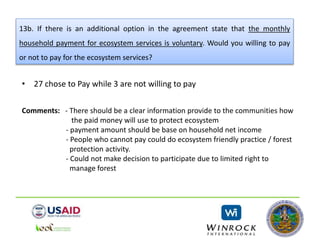
• 27 chose to Pay while 3 are not willing to pay
Comments: - There should be a clear information provide to the communities how
the paid money will use to protect ecosystem
- payment amount should be base on household net income
- People who cannot pay could do ecosystem friendly practice / forest
protection activity.
- Could not make decision to participate due to limited right to
manage forest
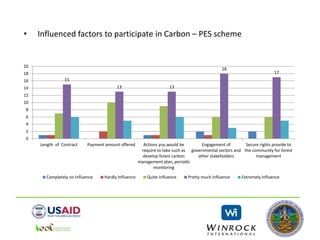
15
13 13
18
17
0
2
4
6
8
10
12
14
16
18
20
Length of Contract Payment amount offered Actions you would be
require to take such as
develop forest carbon
management plan, periodic
monitoring
Engagement of
governmental sectors and
other stakeholders
Secure rights provide to
the community for forest
management
Completely no Influence Hardly Influence Quite Influence Pretty much Influence Extremely Influence
• Influenced factors to participate in Carbon – PES scheme
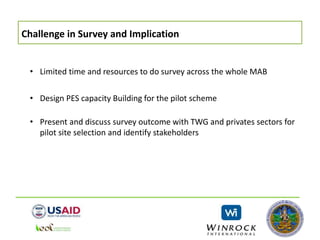
Challenge in Survey and Implication
• Limited time and resources to do survey across the whole MAB
• Design PES capacity Building for the pilot scheme
• Present and discuss survey outcome with TWG and privates sectors for
pilot site selection and identify stakeholders
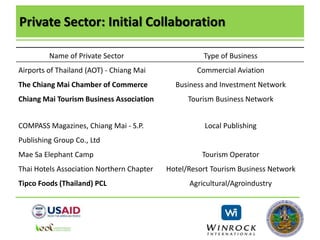
Private Sector: Initial Collaboration
Name of Private Sector Type of Business
Airports of Thailand (AOT) - Chiang Mai Commercial Aviation
The Chiang Mai Chamber of Commerce Business and Investment Network
Chiang Mai Tourism Business Association Tourism Business Network
COMPASS Magazines, Chiang Mai - S.P.
Publishing Group Co., Ltd
Local Publishing
Mae Sa Elephant Camp Tourism Operator
Thai Hotels Association Northern Chapter Hotel/Resort Tourism Business Network
Tipco Foods (Thailand) PCL Agricultural/Agroindustry
Private Sector: Initial Collaboration
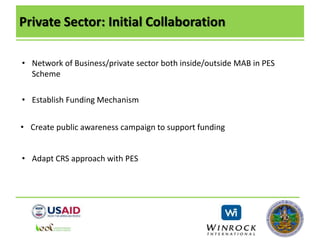
• Network of Business/private sector both inside/outside MAB in PES
Scheme
• Adapt CRS approach with PES
• Establish Funding Mechanism
• Create public awareness campaign to support funding
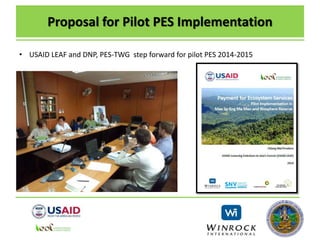
Proposal for Pilot PES Implementation
• USAID LEAF and DNP, PES-TWG step forward for pilot PES 2014-2015
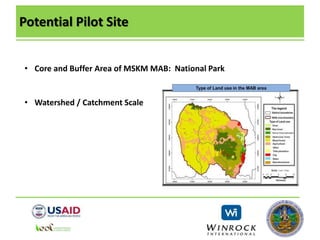
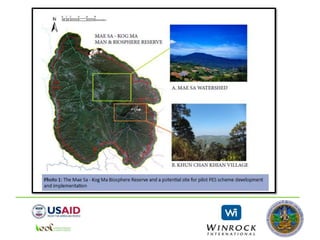
Potential Pilot Site
• Core and Buffer Area of MSKM MAB: National Park
• Watershed / Catchment Scale
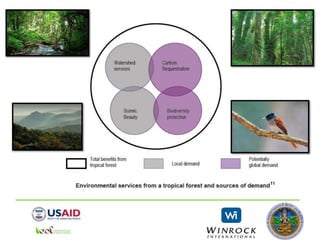
PES Core
“PES-like” Schemes
PES Core
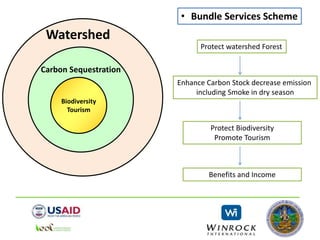
Watershed
Carbon Sequestration
Biodiversity
Tourism
• Bundle Services Scheme
Protect watershed Forest
Enhance Carbon Stock decrease emission
including Smoke in dry season
Protect Biodiversity
Promote Tourism
Benefits and Income
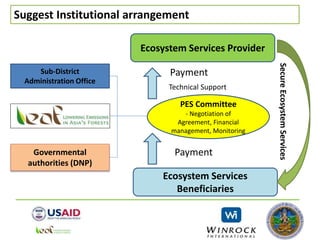
Suggest Institutional arrangement
Sub-District
Administration Office
Governmental
authorities (DNP)
Ecosystem Services Provider
Ecosystem Services
Beneficiaries
PES Committee
- Negotiation of
Agreement, Financial
management, Monitoring
Payment
SecureEcosystemServices
Payment
Technical Support
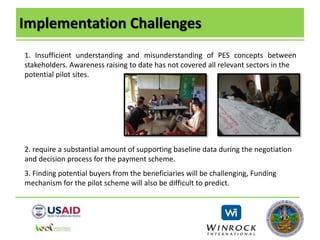
Implementation Challenges
1. Insufficient understanding and misunderstanding of PES concepts between
stakeholders. Awareness raising to date has not covered all relevant sectors in the
potential pilot sites.
2. require a substantial amount of supporting baseline data during the negotiation
and decision process for the payment scheme.
3. Finding potential buyers from the beneficiaries will be challenging, Funding
mechanism for the pilot scheme will also be difficult to predict.
Expected Outcomes of Pilot-PES for MSKM
• Establish a system of PES innovation by incorporating engagement with local
communities, the private sector and government to develop a transparent pilot
payment scheme
• Ensures equality in benefit sharing from an identified ecosystem services such as
watershed, and carbon sequestration to mitigate climate change, to both providers
and beneficiaries.
• Local communities are expected to gain benefits from payment allocation or
support activities identified in the pilot scheme.
• Lessons learned and policy recommendations will enable a legal framework to
support long term implementation.
• Scaling up of PES innovation will also benefit other countries in Southeast Asia,
such as Laos, through study tour exchanges and sharing lessons learned via the
regional platform.
Thank You !!
For more Information visit
http://www.leafasia.org/
Resources : Payment for Ecosystem Services
http://www.leafasia.org/resource_by_topic/185

Payment for Ecosystem Services Pilot Implementation in Mae Sa-Kog Ma Biosphere Reserve

  • 1.
    Payment for EcosystemServices Pilot Implementation in Mae Sa-Kog Ma Biosphere Reserve USAID Lowering Emissions in Asia’s Forests (LEAF)
  • 2.
    Model Actions Demonstrated -Improved livelihoods Policy and Market Incentives - Enabling Conditions Human and Institutional Capacity Strengthened - Increased individual and institutional capacity - Increased gender equality, inclusion and leadership Regional Platforms & Partners Strengthened to Catalyze and Sustain Change Replication Innovations and models shared ReplicationReplication The goal of the Lowering Emissions in Asia’s Forests (LEAF) Program “To achieve meaningful and sustainable reductions in greenhouse gas (GHG) emissions from the forestry-land use sector in Asia”
  • 3.
    UNESCO – Manand Biosphere Program (MAB)
  • 4.
    • Thailand InternationalDevelopment Cooperation Agency (TICA) proposed for LEAF to focus its activities in Man and the Biosphere (MAB) sites, call Biosphere Reserve • Main government counterpart in Thailand is the Department of National Parks, Wildlife and Plant Conservation (DNP).
  • 5.
    • Seville Strategy: •Three functions of the MAB – Conservation: protection of genetic resources, species, landscapes and ecosystems – Development: Foster sustainable economic and human development – Logistical support: demonstration projects, research, education, and training Guiding Frameworks: Seville Strategy
  • 6.
    Guiding Frameworks: SevilleStrategy • Further elaboration on zoning – Core Zone – Buffer Zone – Transition Zone
  • 7.
    Guiding Frameworks: MadridAction Plan Emerging role of biosphere reserves in addressing these challenges According to the Madrid Action Plan (2008) 1) Climate change, 2) Provision of ecosystem services, and 3) Rapid urbanization as a driver of environmental change
  • 8.
    • Establish in1977 • 420 square kilometers • Four Sub-districts in Chiang Mai • 2 main Watershed: Mae Sa & Kog Ma • 3 National Parks (DNP) • Forest Reserve Area (RFD) • Communities area and various land- use types Mae Sa-Kog Ma Biosphere Reserve
  • 9.
    Number Zoning inthe MAB % Area 1 Core Area 52.6 2 Buffer Zone 20.9 3 Transition Zone 26.5 TOTAL 100 Principles in the management area boundary Of Mae Sa-Kog Ma Biosphere Reserve 1) Core Area: The main areas to conserve biodiversity in the long term and is an area that is protected by law. The role of the core area is the service area of ​​ecosystems, collection carbon dioxide. Improve soil, water and air quality. 2) Buffer Area: An area for activities such as participation in ecological ecotourism, recreation and research. The role of the buffer area is reduce the impact of human activities and connected to the area of biodiversity in the future. 3) Transition Area: Area is focused on the development of habitats. Occupations for settlement and agriculture.
  • 10.
    Theme 1: Awarenessraising and capacity building on management planning of MSKM-MAB: Training; Community awareness raising, engagement and participation. IDENTIFIED KEY SUPPORT THEMES IN MAE SA-KOG MA BIOSPHERE RESERVE
  • 11.
    IDENTIFIED KEY SUPPORTTHEMES IN MAE SA-KOG MA BIOSPHERE RESERVE Theme 2: Model development for natural resource and forest management to reduce GHG emissions: - Community-Based Fire Management and emissions reductions - Reforestation and conservation activities - and Participatory resource management models and guidelines that allow for the reduction of GHG emissions and improving ecosystem services under Payment for Ecosystem Services (PES).
  • 12.
    IDENTIFIED KEY SUPPORTTHEMES IN MAE SA-KOG MA BIOSPHERE RESERVE Theme 3: Advocacy and local policy development Evaluating of lessons learned from implementation to build confidence in the development of appropriate and sustainable local agreements, guidelines and rules.
  • 13.
    Mae Sa-Kog MaManagement Plan • Integrate effective participatory management planning for MSKM-MAB to reducing emissions by addressing deforestation and degradation of forest ecosystem. • Development of pilot-PES and test in MSKM-MAB is one key activity in the management plan
  • 14.
    MSKM PES pilotTimeline I. Pre - Implementation (2011 – 2013) II. Pilot - Implementation (2014 – 2016)
  • 15.
    MSKM PES pilotTimeline I. Pre - Implementation (2011 – 2013) • Establish PES – TWG and identified LEAF demonstration site • PES – TWG attended Lam Dong Study Tour (2012) • Recruit ‘PES - project Officer’ • Land Tenure and Policy Assignment for PES in MSKM-MAB • USAID LEAF and DNP Mae Sa-Kog Ma Kick Off
  • 16.
    MSKM PES pilotTimeline I. Pre - Implementation (2011 – 2013) • USAID, LEAF HAPPEN and CBFCM promoting PES in Mae Sa Catchment • Support Capacity Building to stakeholder on PES topics through regional training workshop • MSKM-MAB management Plan identified PES as pilot activity • Ecosystem Services Valuation in MSKM • Initial collaboration with Private Sectors
  • 17.
    MSKM PES pilotTimeline II. Pilot - Implementation (2014 – 2016) • Gathering relevant data to support pilot site selection process • Finalized PES pilot site in MSKM • Stakeholders, Buyers, Sellers, identified and Consultation Meeting • Negotiation with stakeholders , design PES agreement, and payment mechanism • Establish PES agreement and launch implementation
  • 18.
    MSKM PES PilotTimeline II. Pilot - Implementation (2014 – 2016) • Monitoring and evaluation and reporting of the pilot PES implementation • Sharing lesson learned and proposed enabling policy /legal framework that scaling up PES implementation in the long term.
  • 19.
    DEVELOPMENT OF PES-TECHNICALWORKING GROUP • Protected area regional 16 staffs (Chiang Mai) and stakeholders inside MSKM  MSKM-MAB management working group  LEAF – DNP technical working group PES study tour in Lam Dong, Vietnam (2012)
  • 20.
    LAND TENURE ANDPOLICY ASSESSMENT FOR PES IN MSKM-MAB • Policy and institutional challenges for PES implementation in the Reserve • Policy related to rights in land and ecosystem services in Northern Thailand • Regulatory and institutional arrangement for PES • Enabling legal framework for long-term PES implementation
  • 21.
    Mae Sa-Kog MaKick Off Collaborative development network and working framework to guide the development of LEAF in the Mae Sa-Kog Ma Man and Biosphere Reserve Present the LEAF program to key stakeholders in the Mae Sa-Kog Ma Biosphere Reserve (MAB)
  • 22.
    Mae Sa-Kog MaKick Off  Discuss and seek comments on potential areas for LEAF support, including the following: • Protected and Transition Zone Participatory Management • Community engagement and participation • Capacity building and awareness raising • Fire management and greenhouse gas emissions • Reforestation and Revegetation • Payment for Ecosystem Services (PES)
  • 23.
    Promoting PES inMae Sa Catchment • USAID-LEAF, HAPPEN, and CBFCM • Integrated PES in Participatory Catchment Management Plan
  • 24.
  • 25.
    Mae Sa-Kog MaManagement Plan • MSKM-MAB management Plan identified PES as pilot project (2013 – 2015)
  • 26.
    Mae Sa-Kog MaMA Strategies 1. Preserve and protect MAB MSKM by participatory approach 2. Develop collaborative mechanism in management of natural resources and access to using of resources in MSKM 3. Promote learning process and awareness to community and wider public on value of MSKM 4. Strengthening mechanism in management for MAB MSKM Sub strategy: 4.3 Develop funding mechanism for ecosystem services such as PES funding 5. Develop data based and research for MAB MSKM management
  • 27.
    Ecosystem Valuation inMae Sa-Kog Ma • Ecosystem services valuation survey • Group of Respondents in side MSKM: - Communities sample • Contingent valuation using Questionnaire
  • 28.
    Ecosystem Valuation inMae Sa-Kog Ma 28 30 27 26 20 22 24 26 28 30 Response Count Which Ecosystem Services have benefits to your communities ? Provisioning Services Regulating Services Supporting Services Cultural Services
  • 29.
    Ecosystem Valuation inMae Sa-Kog Ma Ecosystem services have many values contribute to environment economic and livelihoods. Please choose how these values are important to you • Ecological/Environmental values • Economic values • Cultural values • Social values
  • 30.
    Ecosystem Valuation inMae Sa-Kog Ma 3 5 7 10 13 16 10 23 20 17 11 15 0 5 10 15 20 25 30 Clean Air Clean Water Fertile Soil Biodiversity Fauna and Flora Habitat Ecological/Environmental values Not important at all Not so important Quite important Very important Extremely important
  • 31.
    Ecosystem Valuation inMae Sa-Kog Ma 1 3 1 6 9 3 13 6 4 12 6 9 14 18 4 3 8 0 5 10 15 20 25 30 Increasing Agricultural Products Household Fuelwood Increasing income from Non-Timber Forest Products Generate income from Ecotourism Economic values Not important at all Not so important Quite important Very important Extremely important
  • 32.
    Ecosystem Valuation inMae Sa-Kog Ma 1 1 3 3 1 7 5 20 14 11 16 12 6 13 18 6 13 0 5 10 15 20 25 30 Cultural and Ecotourism attraction Traditional Knowledge for Forest Management The beauty of natural area create visual aesthetic Inspiration for Art Scientific and Research sites Cultural values Not important at all Not so important Quite important Very important Extremely important
  • 33.
    Ecosystem Valuation inMae Sa-Kog Ma 1 2 1 2 5 12 14 14 16 14 17 14 15 12 10 0 5 10 15 20 25 30 Ecosystem services conservation could enhance community's image to the public Ecosystem services conservation create community awareness of the natural resource values Ecosystem services Conservation bring harmony to your community The future generation understand the important of their ecosystem and natural resources Create equity for access and control of ES Social values Not important at all Not so important Quite important Very important Extremely important
  • 34.
    13a. If thereis an agreement in the sub-district level that every month all households within Mae Sa watershed have to spend 100 THB from monthly household net income to pay for the ecosystem services values. How would you allocate your 100 THB for these values? (You might spend 100 THB in any way you like, but your total payment will not exceed 100 THB. For example, You might spend all 100 THB for one value, or you might spend 50 THB on one value, 25 THB for 1 value and 25 THB for yet another value. Remember the total THB you spend is equal 100 THB) 243 238 121 152 182 157 190 205 730 122 140 110 0 100 200 300 400 500 600 700 800 Historic value Social value Climate Regulation value Environmental value Therapeutic value Future value Learning value Cultural value Recreational value Aesthetic value Economic value Biodiversity value From the total 100 THB I would like to pay …
  • 35.
    14 14 10 13 12 13 13 12 23 11 12 7 0 5 10 15 20 25 Paymentoffer Count Biodiversity value Economic value Aesthetic value Recreational value Cultural value Learning value Future value Therapeutic value Environmental value Climate Regulation value Social value Historic value
  • 36.
    13b. If thereis an additional option in the agreement state that the monthly household payment for ecosystem services is voluntary. Would you willing to pay or not to pay for the ecosystem services? • 27 chose to Pay while 3 are not willing to pay Comments: - There should be a clear information provide to the communities how the paid money will use to protect ecosystem - payment amount should be base on household net income - People who cannot pay could do ecosystem friendly practice / forest protection activity. - Could not make decision to participate due to limited right to manage forest
  • 37.
    15 13 13 18 17 0 2 4 6 8 10 12 14 16 18 20 Length ofContract Payment amount offered Actions you would be require to take such as develop forest carbon management plan, periodic monitoring Engagement of governmental sectors and other stakeholders Secure rights provide to the community for forest management Completely no Influence Hardly Influence Quite Influence Pretty much Influence Extremely Influence • Influenced factors to participate in Carbon – PES scheme
  • 38.
    Challenge in Surveyand Implication • Limited time and resources to do survey across the whole MAB • Design PES capacity Building for the pilot scheme • Present and discuss survey outcome with TWG and privates sectors for pilot site selection and identify stakeholders
  • 39.
    Private Sector: InitialCollaboration Name of Private Sector Type of Business Airports of Thailand (AOT) - Chiang Mai Commercial Aviation The Chiang Mai Chamber of Commerce Business and Investment Network Chiang Mai Tourism Business Association Tourism Business Network COMPASS Magazines, Chiang Mai - S.P. Publishing Group Co., Ltd Local Publishing Mae Sa Elephant Camp Tourism Operator Thai Hotels Association Northern Chapter Hotel/Resort Tourism Business Network Tipco Foods (Thailand) PCL Agricultural/Agroindustry
  • 40.
    Private Sector: InitialCollaboration • Network of Business/private sector both inside/outside MAB in PES Scheme • Adapt CRS approach with PES • Establish Funding Mechanism • Create public awareness campaign to support funding
  • 41.
    Proposal for PilotPES Implementation • USAID LEAF and DNP, PES-TWG step forward for pilot PES 2014-2015
  • 44.
    Potential Pilot Site •Core and Buffer Area of MSKM MAB: National Park • Watershed / Catchment Scale
  • 46.
    PES Core “PES-like” Schemes PESCore Watershed Carbon Sequestration Biodiversity Tourism • Bundle Services Scheme Protect watershed Forest Enhance Carbon Stock decrease emission including Smoke in dry season Protect Biodiversity Promote Tourism Benefits and Income
  • 47.
    Suggest Institutional arrangement Sub-District AdministrationOffice Governmental authorities (DNP) Ecosystem Services Provider Ecosystem Services Beneficiaries PES Committee - Negotiation of Agreement, Financial management, Monitoring Payment SecureEcosystemServices Payment Technical Support
  • 48.
    Implementation Challenges 1. Insufficientunderstanding and misunderstanding of PES concepts between stakeholders. Awareness raising to date has not covered all relevant sectors in the potential pilot sites. 2. require a substantial amount of supporting baseline data during the negotiation and decision process for the payment scheme. 3. Finding potential buyers from the beneficiaries will be challenging, Funding mechanism for the pilot scheme will also be difficult to predict.
  • 49.
    Expected Outcomes ofPilot-PES for MSKM • Establish a system of PES innovation by incorporating engagement with local communities, the private sector and government to develop a transparent pilot payment scheme • Ensures equality in benefit sharing from an identified ecosystem services such as watershed, and carbon sequestration to mitigate climate change, to both providers and beneficiaries. • Local communities are expected to gain benefits from payment allocation or support activities identified in the pilot scheme. • Lessons learned and policy recommendations will enable a legal framework to support long term implementation. • Scaling up of PES innovation will also benefit other countries in Southeast Asia, such as Laos, through study tour exchanges and sharing lessons learned via the regional platform.
  • 50.
    Thank You !! Formore Information visit http://www.leafasia.org/ Resources : Payment for Ecosystem Services http://www.leafasia.org/resource_by_topic/185

Editor's Notes

  • #3 วัตถุประสงค์ของโครงการ LEAF ในประเทศไทย เพื่อให้บรรลุเป้าหมาย โครงการ LEAF ประเทศไทย ได้กำหนดวัตถุประสงค์ไว้ 4 ข้อดังนี้: 1) นำนวตกรรม (เช่นรูปแบบการปฏิบัติที่ดี ต้นแบบการดำเนินงาน และวิธีการ) ไปทดสอบดำเนินการในพื้นที่จริง ขยายผลในพื้นที่อื่นๆ รวมทั้งทำการแลกเปลี่ยนเรียนรู้โดยผ่านกระบวนการมีส่วนร่วมกับ-และการเรียนรู้จาก-เวทีของ PES และเรดด์พลัสในระดับภูมิภาค (regional PES and REDD+ platforms) และภาคี 2) จัดทำแนวทางเพื่อการดำเนินงานและแรงจูงใจด้านการตลาดสำหรับการลดการปล่อยก๊าซเรือนกระจก 3) เสริมสร้างศักยภาพของบุคคลากรและหน่วยงานในด้านการประเมินมูลค่าทางเศรษฐกิจของบริการ จากระบบนิเวศป่า และการติดตามการเปลี่ยนแปลงของบริการทางระบบนิเวศอื่นๆ รวมทั้งการกักเก็บคาร์บอน 4)สาธิตการนำ นวัตกรรมไปประยุกต์ใช้ในการจัดการพื้นที่อย่างยั่งยืน
  • #27 Sub strategy: 4.3 Develop funding mechanism for ecosystem services such as PES funding Indicator: Development of PES funding in pilot sites