









Presented by: ERIC F. PAZZIUAGAN, RN, MAN
   Involves the collection, organization, and
    analysis of information about the client’s
    health.
   In psychiatric- mental health nursing, it is
    referred to as psychosocial assessment, which
    includes a mental status examination.
   Purpose: to construct a picture of the client’s
    emotional state, mental capacity and
    behavioural function.
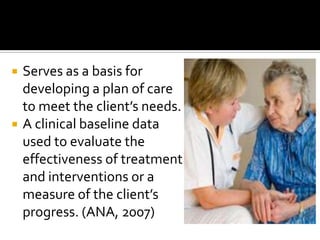
   Serves as a basis for
    developing a plan of care
    to meet the client’s needs.
   A clinical baseline data
    used to evaluate the
    effectiveness of treatment
    and interventions or a
    measure of the client’s
    progress. (ANA, 2007)
 If client is unavailable or unwilling to
  participate, some areas of the
  assessment will be incomplete or vague.
 The nurse may have several contacts
  with some clients to complete the
  assessment or gather information as the
  client’s condition permits.
   If client is anxious, tired, or in pain, the nurse
    may have difficulty eliciting the client’s full
    participation.
   Information gathered may reflect the pain or
    anxiety rather than an accurate assessment
    of the client’s situation.
   The client may need to rest, receive
    medications to alleviate pain, or be calmed
    before the assessment continues.
   Client’s perception of his own circumstances
    can elicit emotions that interfere with
    obtaining an accurate psychosocial
    assessment.
   If reluctant to seek treatment or has previous
    unsatisfactory experiences with the health
    care system, he may have difficulty
    answering questions directly.
   Client may minimize or maximize symptoms
    or problems or may refuse to provide
    information in some areas.
   The nurse must address the client’s feelings
    and perceptions to establish a trusting
    working relationship before proceeding with
    the assessment.
 The nurse must determine the client’s
  ability to hear, read, and understand the
  language being used in the assessment.
 It is important that the information in
  the assessment reflects the client’s
  health status; it should not be a result of
  poor communication.
   If the client perceives the nurse’s questions to
    be short and curt or feels rushed or pressured
    to complete the assessment, he may provide
    only superficial information or omit
    discussing problems in some areas
    altogether.
   The client may also refrain from providing
    sensitive information if her perceives the
    nurse as nonaccepting, defensive or
    judgmental.
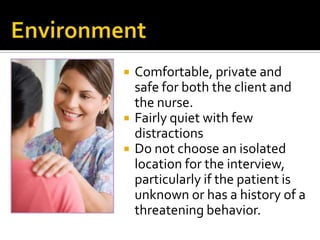
   Comfortable, private and
    safe for both the client and
    the nurse.
   Fairly quiet with few
    distractions
   Do not choose an isolated
    location for the interview,
    particularly if the patient is
    unknown or has a history of a
    threatening behavior.
 Obtain client’s behavior and emotional
  state.
 Family or friends may not feel comfortable
  talking about the client in his presence and
  may provide limited information.
 It is desirable to conduct at least part of
  the assessment without others, especially
  in cases of suspected abuse or
  intimidation.
   Use open-ended questions to start the
    assessment.
     Allows the client to begin as he feels comfortable
     and also gives the nurse an idea about the client’s
     perception of his situation.
   Examples of open-ended questions:
     What brings you here today?
     Tell me what has been happening to you.
     How can I help you?
 If client cannot organize thoughts, or
  has difficulty answering open-ended
  questions, the nurse may need to use
  more direct questions to obtain
  information.
 Questions should be clear, simple and
  focused on one specific behavior or
  symptom.
   “How are your eating and sleeping habits and
     have you been taking any over-the-counter
      medications that affect your eating and
                     sleeping?”

   The above question can be confusing to the
    client. Questions should not cause the client to
    remember several things at once.
   Examples of focused or closed-ended
    questions:
     How many hours did you sleep last night?
     Have you been thinking about suicide?
     How much alcohol have you been have you been
      drinking?
     How well have you been sleeping?
     How many meals a day do you eat?
     What over-the-counter medications are you taking?
   Use a nonjudgmental tone and language,
    particularly when asking about sensitive
    information such as drug or alcohol use, sexual
    behavior, abuse or violence, and child-rearing
    practices.
   Using nonjudgmental language and matter-of-
    fact tone avoids giving the client verbal cues to
    become defensive or not to tell the truth.
   “How often do you physically punish your
                         child?”

            “What types of discipline do you use?”

   First question: gives the impression that
    physical discipline is wrong and it may cause
    the client to respond dishonestly.
   Second question: more likely to elicit honest
    and accurate information.
   History
   General appearance and behavior
   Mood and affect
   Thought process and content
   Sensorium and intellectual process
   Judgment and insight
   Self-concept
   Roles and relationships
   Physiologic and self-care concerns
   Previous history
     History of client and his family
   Age and Developmental stage
     Evaluate chronological age and developmental stage for
      congruence with expected norms
   Cultural and spiritual beliefs
     To avoid making inaccurate assumptions about
      psychosocial functioning
     Ask clients about the beliefs or health practices that are
      important to them.
     Consider beliefs on health and illness
   Hygiene and grooming
     Unkempt or dishevelled?
     Appears to be his stated age?
   Appropriate dress
     For age and weather?
 PostureEye contact
 Unusual movements or mannerisms
     Unusual tics or tremors?
   Speech
     Quantity, quality and any abnormalities
     Nonstop?
     Perseverate? (seems to stuck on one topic
      and unable to move to another idea)
     Minimal “yes” or “no” without elaboration?
 Rate of speech fast or slow?
 Content relevant to the question?
 Audible or loud?
 Neologisms? (invented words that have
  meaning only for client)
 Any speech difficulties or lisping?
   Specific terms in general appearance and motor
    behavior:
     Automatisms: repeated purposeless behaviors often
      indicative of anxiety, such as drumming of fingers,
      twisting locks of hair, or tapping of foot.
     Psychomotor retardation: overall slowed
      movements
     Waxy flexibility: maintenance of posture or position
      over time even when it is awkward or uncomfortable
 Mood: refers to the client’s pervasive and
  enduring emotional state.
 Affect: outward expression of the client’s
  emotional state.
 Assess for:
     Expressed emotions
     Facial expressions
     Inconsistencies
   Mood:
       Happy
       Sad
       Depressed
       Euphoric
       Anxious
       Angry
       Labile (rapidly changing)
       May let client estimate intensity of mood using a
        scale of 1 to 10.
   Common terms for assessing effect:
     Blunted affect: showing little or slow-to-respond
        facial expression.
       Broad affect: displaying a full range of emotional
        expressions.
       Flat affect: showing no facial expression.
       Inappropriate effect: displaying a facial expression
        that is incongruent with mood or situation; often
        silly or giddy regardless of circumstances.
       Restricted affect: displaying one type of expression,
        usually serious or somber.
 Thought process: refers to how the
  client thinks.
 Thought content: what the client
  usually says.
 Verbalizations makes sense?
 Preoccupied?
 Marked difficulties ?
   Circumstantial thinking: a client eventually
    answers a question but only after giving
    excessive unnecessary detail.
   Delusion: a fixed false belief not based in
    reality.
   Flight of ideas: excessive amount and rate of
    speech composed of fragmented or unrelated
    ideas.
   Ideas of reference: client’s inaccurate
    interpretation that general events are personally
    directed to him or her, such as hearing a speech
    on the news and believing the message had
    personal meaning.
   Loose associations: disorganized thinking that
    jumps from one idea to another with little or no
    evident relation between the thoughts.
   Tangential thinking: wandering off the topic and
    never providing the information requested.
   Thought blocking: stopping abruptly in the
    middle of a sentence or a train of thought;
    sometimes unable to continue the idea.
   Thought broadcasting: a delusional belief that
    others can hear or know what the client is
    thinking.
   Thought insertion: a delusional belief that
    others are putting ideas or thoughts into the
    clients head- that is, the ideas are not those of
    a client.
   Thought withdrawal: a delusional belief that
    others are taking the client’s thoughts away
    and the client is powerless to stop it.
   Word salad: flow of unconnected thoughts
    that conveys no meaning to the listener.
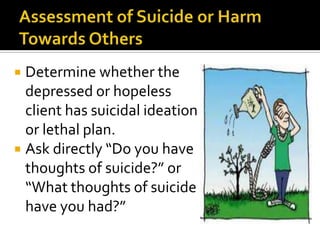
 Determine whether the
  depressed or hopeless
  client has suicidal ideation
  or lethal plan.
 Ask directly “Do you have
  thoughts of suicide?” or
  “What thoughts of suicide
  have you had?”
   Suicide assessment questions:
     Ideation: Are you thinking of killing yourself?
     Plan: Do you have a plan to kill yourself?
     Method: How do you plan to kill yourself?
     Access: How would you carry out this plan? Do you
      have access to the means to carry out the plan?
     Where: Where would you kill yourself?
     When: When do you plan to kill yourself?
     Timing: What day or time of day to you plan to kill
      yourself?
   If client is angry, hostile, or making threatening
    remarks about a family member, spouse, or
    anyone else, the nurse must ask if the client
    has thoughts or plans about hurting that
    person.
   Questions:
     What thoughts have you had about hurting
      (person’s name)?
     What is your plan?
     What do you want to do to (person’s name)?
   When a client makes specific threats or has a
    plan to harm another person, health care
    providers are legally obligated to warn the
    person who is the target of the threats or plan
    (duty to warn).
   This one situation in which the nurse must
    breach the client’s confidentiality to protect
    the threatened person.
   Orientation
     Recognition of person, place and time
     Knowing who he and where he is and the correct day,
      date, and year.
     Order of person, place, and time is significant.
     When a person is disoriented, he first loses track of
      time, then place, and finally person.
     Absence of correct information about person, place,
      and time is referred to as disorientation, or “oriented x
      1” (person only) or “oriented x 2” (person and place).
Orientation is not synonymous with
                confusion.

A confused person cannot make sense of
   his surroundings or figure things out
  even though he may be fully oriented.
 Memory
  Recent and remote
  Ask questions with verifiable answers
  Are these questions correct?
   ▪ Do you have any memory problems?
   ▪ What did you do yesterday?
 NO, because the nurse cannot
verify the accuracy of the answers.
   Questions to assess memory generally
    include the following:
     What is the name of the current president?
     Who was the president before that?
     In what country do you live?
     What is the capital of this state?
     What is your social security number?
   Ability to concentrate
     Spell the word world backwards.
     Begin with the number 100, subtract 7,
      subtract 7 again and so on. This is called
      “serial sevens.”
     Repeat the days of the week backwards.
     Perform a three-part task, such as “Take a
      piece of paper in your right hand, fold it in
      half, and put it on the floor.”
   Abstract Thinking and Intellectual Abilities
     Consider the client’s formal education.
     Abstract thinking: to make use associations or
      interpretations about a situation or comment.
     Let client interpret a common proverb
     If the client can explain the proverb correctly, his
      thinking abilities are intact.
     When client continually gives literal interpretations,
      this is evidence of concrete thinking.
 A stitch in time saves nine.


 People who live in glass stones
 shouldn’t throw stones.
 A stitch in time saves nine.
  Abstract: If you take the time to fix
   something now, you’ll avoid bigger
   problems in the future.
  Literal: Don’t forget to sew up holes
   in your clothes.
 People who live in glass houses
 should not throw stones.
  Abstract: Don’t criticize others for
   things you also may be guilty of doing.
  Literal: If you throw a stone at a glass
   house, the glass will break.
   May also assess intellectual functioning
    by asking him similarities between pairs
    of objects:
     What is similar between an orange and an
      apple?
     What do the newspaper and the TV have in
      common?
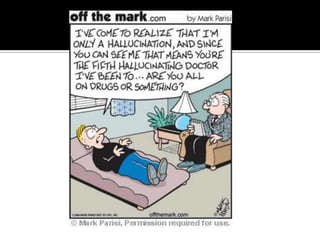
 Hallucinations: false sensory perceptions
  or perceptual experiences that do not
  really exist.
 Can involve the five senses
 Auditory hallucinations: most common
 Visual hallucinations: second most
  common
   Judgment: refers to the ability to interpret one’s
    environment and situations accordingly.
   May be evidenced as the client describes recent
    behavior and activities that reflect a lack of care
    for self or others.
   Risky behaviors (picking up strangers in bars,
    unprotected sexual encounters) may indicate
    poor judgment.
   May ask: “If you found a stamped address
    envelope on the ground, what would you do?”
   Insight: ability to understand the true nature of
    one’s situation and accept some personal
    responsibility for the situation.
   The nurse can frequently can infer insight from
    the client’s ability to describe realistically the
    strengths and weaknesses of his behavior.
   Examples of poor insight:
     Not accepting responsibility on for drinking and
      fighting
     Expecting all problems to be solved with little or no
      personal effort.
   Self-concept: the way one views oneself in
    terms of personal worth and dignity.
   Ask the client to describe himself and what
    characteristics he likes and what he would
    change.
   Let client describe self in terms of physical
    characteristics
   Include:
     Emotions frequently experiences
     Whether comfortable with those emotions
   Assess coping strategies:
     What do you do when you have a problem?
     How do you solve it?
     What usually works to deal with anger or
     disappointment?
   Assess the roles the client occupies, client
    satisfaction with those roles, and whether the
    client believes he or she is fulfilling the roles
    adequately.
   Number and types of roles vary but may
    include:
     Family, occupation, and hobbies or activities.
   Relationships with other people are
    important to one’s social and emotional
    health.
   Relationships vary in terms of significance,
    level of intimacy or closeness, and intensity.
   Inability to sustain satisfying relationships
    can result from mental health problems or
    can contribute to the worsening of some
    problems.
   Common questions:
     Do you feel close to your family?
     Do you have or want a relationship with a
      significant other?
     Are your relationships meeting your needs for
      companionship or intimacy?
     Can you meet your sexual needs satisfactorily?
     Have you been involved in any abusive relationship?
   Although a full physical health assessment
    may not be indicated, emotional problems
    often affect some areas of physiologic
    function.
   Ask if there is any major or chronic health
    problems and how he takes prescribed
    medications as ordered and follows dietary
    recommendations.
   Explore use of alcohol and OTC or illicit drugs.
   Noncompliance with prescribed medications:
    important area.
   Help the client feel comfortable enough to
    reveal the information.
   Explore barriers to compliance.
     Undesirable effects?
     Failure to produce desired results?
     Difficult to obtain?
     Too expensive?
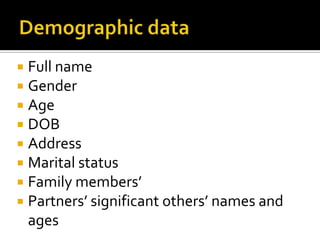
 Full name
 Gender
 Age
 DOB
 Address
 Marital status
 Family members’
 Partners’ significant others’ names and
  ages
   Date and time of admission and type of
    admission (voluntary or committed)
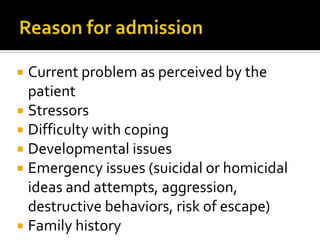
 Current problem as perceived by the
  patient
 Stressors
 Difficulty with coping
 Developmental issues
 Emergency issues (suicidal or homicidal
  ideas and attempts, aggression,
  destructive behaviors, risk of escape)
 Family history
 Dates
 Inpatient or outpatient
 Reasons for and types of treatment and
  their effectiveness
 Current medications
 Compliance
 Allergies
 Result of laboratory tests
 X-rays
 Examinations
 Amount
 Frequency
 Duration of past and present use legal
  and illegal substances
 Date and time of last use
 Potential for withdrawal symptoms
 Sleep
 Intake
 Elimination
 Sexual activity
 Work
 Leisure
 Self-care
 hygiene
   Ethnicity
   Beliefs
   Practices
   Religious preference
   Amount of contact
   Nature and quality of relationships
   Availability of support
General assessment considerations

General assessment considerations

  • 1.
    Presented by: ERICF. PAZZIUAGAN, RN, MAN
  • 5.
    Involves the collection, organization, and analysis of information about the client’s health.  In psychiatric- mental health nursing, it is referred to as psychosocial assessment, which includes a mental status examination.  Purpose: to construct a picture of the client’s emotional state, mental capacity and behavioural function.
  • 6.
    Serves as a basis for developing a plan of care to meet the client’s needs.  A clinical baseline data used to evaluate the effectiveness of treatment and interventions or a measure of the client’s progress. (ANA, 2007)
  • 8.
     If clientis unavailable or unwilling to participate, some areas of the assessment will be incomplete or vague.  The nurse may have several contacts with some clients to complete the assessment or gather information as the client’s condition permits.
  • 9.
    If client is anxious, tired, or in pain, the nurse may have difficulty eliciting the client’s full participation.  Information gathered may reflect the pain or anxiety rather than an accurate assessment of the client’s situation.  The client may need to rest, receive medications to alleviate pain, or be calmed before the assessment continues.
  • 10.
    Client’s perception of his own circumstances can elicit emotions that interfere with obtaining an accurate psychosocial assessment.  If reluctant to seek treatment or has previous unsatisfactory experiences with the health care system, he may have difficulty answering questions directly.
  • 11.
    Client may minimize or maximize symptoms or problems or may refuse to provide information in some areas.  The nurse must address the client’s feelings and perceptions to establish a trusting working relationship before proceeding with the assessment.
  • 12.
     The nursemust determine the client’s ability to hear, read, and understand the language being used in the assessment.  It is important that the information in the assessment reflects the client’s health status; it should not be a result of poor communication.
  • 13.
    If the client perceives the nurse’s questions to be short and curt or feels rushed or pressured to complete the assessment, he may provide only superficial information or omit discussing problems in some areas altogether.  The client may also refrain from providing sensitive information if her perceives the nurse as nonaccepting, defensive or judgmental.
  • 15.
    Comfortable, private and safe for both the client and the nurse.  Fairly quiet with few distractions  Do not choose an isolated location for the interview, particularly if the patient is unknown or has a history of a threatening behavior.
  • 16.
     Obtain client’sbehavior and emotional state.  Family or friends may not feel comfortable talking about the client in his presence and may provide limited information.  It is desirable to conduct at least part of the assessment without others, especially in cases of suspected abuse or intimidation.
  • 17.
    Use open-ended questions to start the assessment.  Allows the client to begin as he feels comfortable and also gives the nurse an idea about the client’s perception of his situation.  Examples of open-ended questions:  What brings you here today?  Tell me what has been happening to you.  How can I help you?
  • 18.
     If clientcannot organize thoughts, or has difficulty answering open-ended questions, the nurse may need to use more direct questions to obtain information.  Questions should be clear, simple and focused on one specific behavior or symptom.
  • 19.
    “How are your eating and sleeping habits and have you been taking any over-the-counter medications that affect your eating and sleeping?”  The above question can be confusing to the client. Questions should not cause the client to remember several things at once.
  • 20.
    Examples of focused or closed-ended questions:  How many hours did you sleep last night?  Have you been thinking about suicide?  How much alcohol have you been have you been drinking?  How well have you been sleeping?  How many meals a day do you eat?  What over-the-counter medications are you taking?
  • 21.
    Use a nonjudgmental tone and language, particularly when asking about sensitive information such as drug or alcohol use, sexual behavior, abuse or violence, and child-rearing practices.  Using nonjudgmental language and matter-of- fact tone avoids giving the client verbal cues to become defensive or not to tell the truth.
  • 22.
    “How often do you physically punish your child?”  “What types of discipline do you use?”  First question: gives the impression that physical discipline is wrong and it may cause the client to respond dishonestly.  Second question: more likely to elicit honest and accurate information.
  • 24.
    History  General appearance and behavior  Mood and affect  Thought process and content  Sensorium and intellectual process  Judgment and insight  Self-concept  Roles and relationships  Physiologic and self-care concerns
  • 26.
    Previous history  History of client and his family  Age and Developmental stage  Evaluate chronological age and developmental stage for congruence with expected norms  Cultural and spiritual beliefs  To avoid making inaccurate assumptions about psychosocial functioning  Ask clients about the beliefs or health practices that are important to them.  Consider beliefs on health and illness
  • 27.
    Hygiene and grooming  Unkempt or dishevelled?  Appears to be his stated age?  Appropriate dress  For age and weather?  PostureEye contact  Unusual movements or mannerisms  Unusual tics or tremors?
  • 28.
    Speech  Quantity, quality and any abnormalities  Nonstop?  Perseverate? (seems to stuck on one topic and unable to move to another idea)  Minimal “yes” or “no” without elaboration?
  • 29.
     Rate ofspeech fast or slow?  Content relevant to the question?  Audible or loud?  Neologisms? (invented words that have meaning only for client)  Any speech difficulties or lisping?
  • 31.
    Specific terms in general appearance and motor behavior:  Automatisms: repeated purposeless behaviors often indicative of anxiety, such as drumming of fingers, twisting locks of hair, or tapping of foot.  Psychomotor retardation: overall slowed movements  Waxy flexibility: maintenance of posture or position over time even when it is awkward or uncomfortable
  • 32.
     Mood: refersto the client’s pervasive and enduring emotional state.  Affect: outward expression of the client’s emotional state.  Assess for:  Expressed emotions  Facial expressions  Inconsistencies
  • 33.
    Mood:  Happy  Sad  Depressed  Euphoric  Anxious  Angry  Labile (rapidly changing)  May let client estimate intensity of mood using a scale of 1 to 10.
  • 34.
    Common terms for assessing effect:  Blunted affect: showing little or slow-to-respond facial expression.  Broad affect: displaying a full range of emotional expressions.  Flat affect: showing no facial expression.  Inappropriate effect: displaying a facial expression that is incongruent with mood or situation; often silly or giddy regardless of circumstances.  Restricted affect: displaying one type of expression, usually serious or somber.
  • 35.
     Thought process:refers to how the client thinks.  Thought content: what the client usually says.  Verbalizations makes sense?  Preoccupied?  Marked difficulties ?
  • 36.
    Circumstantial thinking: a client eventually answers a question but only after giving excessive unnecessary detail.  Delusion: a fixed false belief not based in reality.  Flight of ideas: excessive amount and rate of speech composed of fragmented or unrelated ideas.
  • 38.
    Ideas of reference: client’s inaccurate interpretation that general events are personally directed to him or her, such as hearing a speech on the news and believing the message had personal meaning.  Loose associations: disorganized thinking that jumps from one idea to another with little or no evident relation between the thoughts.  Tangential thinking: wandering off the topic and never providing the information requested.
  • 39.
    Thought blocking: stopping abruptly in the middle of a sentence or a train of thought; sometimes unable to continue the idea.  Thought broadcasting: a delusional belief that others can hear or know what the client is thinking.  Thought insertion: a delusional belief that others are putting ideas or thoughts into the clients head- that is, the ideas are not those of a client.
  • 40.
    Thought withdrawal: a delusional belief that others are taking the client’s thoughts away and the client is powerless to stop it.  Word salad: flow of unconnected thoughts that conveys no meaning to the listener.
  • 41.
     Determine whetherthe depressed or hopeless client has suicidal ideation or lethal plan.  Ask directly “Do you have thoughts of suicide?” or “What thoughts of suicide have you had?”
  • 42.
    Suicide assessment questions:  Ideation: Are you thinking of killing yourself?  Plan: Do you have a plan to kill yourself?  Method: How do you plan to kill yourself?  Access: How would you carry out this plan? Do you have access to the means to carry out the plan?  Where: Where would you kill yourself?  When: When do you plan to kill yourself?  Timing: What day or time of day to you plan to kill yourself?
  • 44.
    If client is angry, hostile, or making threatening remarks about a family member, spouse, or anyone else, the nurse must ask if the client has thoughts or plans about hurting that person.  Questions:  What thoughts have you had about hurting (person’s name)?  What is your plan?  What do you want to do to (person’s name)?
  • 45.
    When a client makes specific threats or has a plan to harm another person, health care providers are legally obligated to warn the person who is the target of the threats or plan (duty to warn).  This one situation in which the nurse must breach the client’s confidentiality to protect the threatened person.
  • 46.
    Orientation  Recognition of person, place and time  Knowing who he and where he is and the correct day, date, and year.  Order of person, place, and time is significant.  When a person is disoriented, he first loses track of time, then place, and finally person.  Absence of correct information about person, place, and time is referred to as disorientation, or “oriented x 1” (person only) or “oriented x 2” (person and place).
  • 47.
    Orientation is notsynonymous with confusion. A confused person cannot make sense of his surroundings or figure things out even though he may be fully oriented.
  • 48.
     Memory Recent and remote  Ask questions with verifiable answers  Are these questions correct? ▪ Do you have any memory problems? ▪ What did you do yesterday?
  • 49.
     NO, becausethe nurse cannot verify the accuracy of the answers.
  • 50.
    Questions to assess memory generally include the following:  What is the name of the current president?  Who was the president before that?  In what country do you live?  What is the capital of this state?  What is your social security number?
  • 51.
    Ability to concentrate  Spell the word world backwards.  Begin with the number 100, subtract 7, subtract 7 again and so on. This is called “serial sevens.”  Repeat the days of the week backwards.  Perform a three-part task, such as “Take a piece of paper in your right hand, fold it in half, and put it on the floor.”
  • 52.
    Abstract Thinking and Intellectual Abilities  Consider the client’s formal education.  Abstract thinking: to make use associations or interpretations about a situation or comment.  Let client interpret a common proverb  If the client can explain the proverb correctly, his thinking abilities are intact.  When client continually gives literal interpretations, this is evidence of concrete thinking.
  • 53.
     A stitchin time saves nine.  People who live in glass stones shouldn’t throw stones.
  • 54.
     A stitchin time saves nine.  Abstract: If you take the time to fix something now, you’ll avoid bigger problems in the future.  Literal: Don’t forget to sew up holes in your clothes.
  • 55.
     People wholive in glass houses should not throw stones.  Abstract: Don’t criticize others for things you also may be guilty of doing.  Literal: If you throw a stone at a glass house, the glass will break.
  • 56.
    May also assess intellectual functioning by asking him similarities between pairs of objects:  What is similar between an orange and an apple?  What do the newspaper and the TV have in common?
  • 57.
     Hallucinations: falsesensory perceptions or perceptual experiences that do not really exist.  Can involve the five senses  Auditory hallucinations: most common  Visual hallucinations: second most common
  • 59.
    Judgment: refers to the ability to interpret one’s environment and situations accordingly.  May be evidenced as the client describes recent behavior and activities that reflect a lack of care for self or others.  Risky behaviors (picking up strangers in bars, unprotected sexual encounters) may indicate poor judgment.  May ask: “If you found a stamped address envelope on the ground, what would you do?”
  • 60.
    Insight: ability to understand the true nature of one’s situation and accept some personal responsibility for the situation.  The nurse can frequently can infer insight from the client’s ability to describe realistically the strengths and weaknesses of his behavior.  Examples of poor insight:  Not accepting responsibility on for drinking and fighting  Expecting all problems to be solved with little or no personal effort.
  • 62.
    Self-concept: the way one views oneself in terms of personal worth and dignity.  Ask the client to describe himself and what characteristics he likes and what he would change.  Let client describe self in terms of physical characteristics  Include:  Emotions frequently experiences  Whether comfortable with those emotions
  • 63.
    Assess coping strategies:  What do you do when you have a problem?  How do you solve it?  What usually works to deal with anger or disappointment?
  • 64.
    Assess the roles the client occupies, client satisfaction with those roles, and whether the client believes he or she is fulfilling the roles adequately.  Number and types of roles vary but may include:  Family, occupation, and hobbies or activities.
  • 65.
    Relationships with other people are important to one’s social and emotional health.  Relationships vary in terms of significance, level of intimacy or closeness, and intensity.  Inability to sustain satisfying relationships can result from mental health problems or can contribute to the worsening of some problems.
  • 66.
    Common questions:  Do you feel close to your family?  Do you have or want a relationship with a significant other?  Are your relationships meeting your needs for companionship or intimacy?  Can you meet your sexual needs satisfactorily?  Have you been involved in any abusive relationship?
  • 68.
    Although a full physical health assessment may not be indicated, emotional problems often affect some areas of physiologic function.  Ask if there is any major or chronic health problems and how he takes prescribed medications as ordered and follows dietary recommendations.  Explore use of alcohol and OTC or illicit drugs.
  • 69.
    Noncompliance with prescribed medications: important area.  Help the client feel comfortable enough to reveal the information.  Explore barriers to compliance.  Undesirable effects?  Failure to produce desired results?  Difficult to obtain?  Too expensive?
  • 71.
     Full name Gender  Age  DOB  Address  Marital status  Family members’  Partners’ significant others’ names and ages
  • 72.
    Date and time of admission and type of admission (voluntary or committed)
  • 73.
     Current problemas perceived by the patient  Stressors  Difficulty with coping  Developmental issues  Emergency issues (suicidal or homicidal ideas and attempts, aggression, destructive behaviors, risk of escape)  Family history
  • 74.
     Dates  Inpatientor outpatient  Reasons for and types of treatment and their effectiveness  Current medications  Compliance
  • 75.
     Allergies  Resultof laboratory tests  X-rays  Examinations
  • 76.
     Amount  Frequency Duration of past and present use legal and illegal substances  Date and time of last use  Potential for withdrawal symptoms
  • 77.
     Sleep  Intake Elimination  Sexual activity  Work  Leisure  Self-care  hygiene
  • 78.
    Ethnicity  Beliefs  Practices  Religious preference
  • 79.
    Amount of contact  Nature and quality of relationships  Availability of support