

By Eric F. Pazziuagan, RN, MAN
Mental Status Examination
 Focuses on the patient’s current state in
  terms of thoughts, feelings and behaviors.
 An overall description of the client’s mental
  status, including general appearance, mood
 and affect, quality of speech, thought
 content and processes, level of
 consciousness and
 cognition, impulsivity, ability to
 abstract, judgment and insight, and
 reliability.
Major goals:
 Gather baseline data about the
  client’s level of functioning
 Identify actual and potential
  problems
 Facilitate making accurate
  psychiatric and medical diagnoses
Major Components:
General Appearance
 LOC
 Dress
 Facial expressions
 Posture
 Level of understanding
 Gait
 Grooming
 Psychomotor behavior or activity level
 Eye contact
 Attitude toward the nurse
 With whom and how the client arrived
Mood and affect
 Mood
   Pervasive and sustained emotional state that
    depicts the client’s perception of the world
   Depressed
   Sad
   Labile
   Elated
   Expansive anxious
 Affect
   Present state of emotional responsiveness and is
    observable with body language.
   Blunted
   Flat
   Restricted
   Depressed
   Expansive
   Angry


 Major point: whether thought is
 congruent, appropriate, or both, with the mood and
 affect.
Quality of Speech
 Speech
   Process of expressing
    ideas, thoughts, and feelings through
    language
   The use of words or language


 Involves physical descriptions of the
 client’s speech
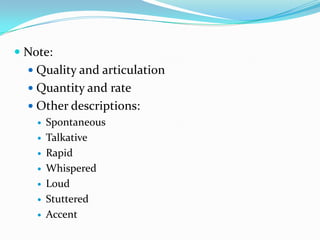
 Note:
   Quality and articulation
   Quantity and rate
   Other descriptions:
     Spontaneous

     Talkative

     Rapid

     Whispered

     Loud

     Stuttered

     Accent
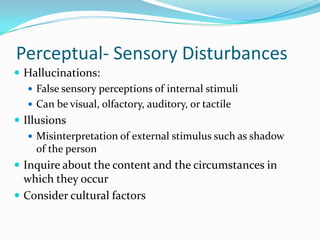
Perceptual- Sensory Disturbances
 Hallucinations:
    False sensory perceptions of internal stimuli
    Can be visual, olfactory, auditory, or tactile
 Illusions
    Misinterpretation of external stimulus such as shadow
     of the person
 Inquire about the content and the circumstances in
  which they occur
 Consider cultural factors
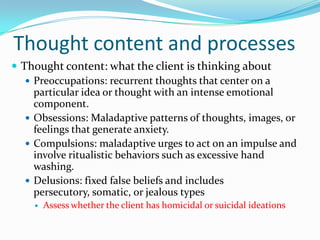
Thought content and processes
 Thought content: what the client is thinking about
    Preoccupations: recurrent thoughts that center on a
     particular idea or thought with an intense emotional
     component.
    Obsessions: Maladaptive patterns of thoughts, images, or
     feelings that generate anxiety.
    Compulsions: maladaptive urges to act on an impulse and
     involve ritualistic behaviors such as excessive hand
     washing.
    Delusions: fixed false beliefs and includes
     persecutory, somatic, or jealous types
       Assess whether the client has homicidal or suicidal ideations
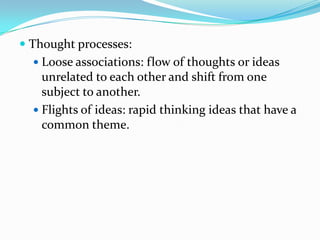
 Thought processes:
   Loose associations: flow of thoughts or ideas
    unrelated to each other and shift from one
    subject to another.
   Flights of ideas: rapid thinking ideas that have a
    common theme.
Higher brain function
 Level of consciousness
 Orientation: refer to one’s sense of time, person, and
  place.
 Memory: complex form of brain function that involves
  storing and retrieving information that is later recalled
  to consciousness.
   Remote (long term)
   Recent
   Recent past (current events)
   Immediate memory (short term)
   Immediate recall
 Concentration and attention: various conditions
  produce disturbances, including delirium or other
  medical anxiety or depressions.
 Cognition: ability to think and know
 Visuouspatial: refers to time and space
 Ability to read and write; consider:
    Cultural factors
    Educational preparations
    Previous level of functioning
 Ability to abstract: testing for concrete thinking
 Impulsivity: ability to control or manage various
  urges appropriately.
 Judgment: ask “what if” questions
 Insight: involves the client’s understanding about
  being ill and the need for treatment when
  warranted.
 Reliability: whether the client’s perception of the
  present problem and its history are credible.

Mental status examination

  • 1.
    By Eric F.Pazziuagan, RN, MAN
  • 2.
    Mental Status Examination Focuses on the patient’s current state in terms of thoughts, feelings and behaviors.  An overall description of the client’s mental status, including general appearance, mood and affect, quality of speech, thought content and processes, level of consciousness and cognition, impulsivity, ability to abstract, judgment and insight, and reliability.
  • 3.
    Major goals:  Gatherbaseline data about the client’s level of functioning  Identify actual and potential problems  Facilitate making accurate psychiatric and medical diagnoses
  • 5.
  • 6.
    General Appearance  LOC Dress  Facial expressions  Posture  Level of understanding  Gait  Grooming  Psychomotor behavior or activity level  Eye contact
  • 7.
     Attitude towardthe nurse  With whom and how the client arrived
  • 8.
    Mood and affect Mood  Pervasive and sustained emotional state that depicts the client’s perception of the world  Depressed  Sad  Labile  Elated  Expansive anxious
  • 9.
     Affect  Present state of emotional responsiveness and is observable with body language.  Blunted  Flat  Restricted  Depressed  Expansive  Angry  Major point: whether thought is congruent, appropriate, or both, with the mood and affect.
  • 10.
    Quality of Speech Speech  Process of expressing ideas, thoughts, and feelings through language  The use of words or language  Involves physical descriptions of the client’s speech
  • 11.
     Note:  Quality and articulation  Quantity and rate  Other descriptions:  Spontaneous  Talkative  Rapid  Whispered  Loud  Stuttered  Accent
  • 12.
    Perceptual- Sensory Disturbances Hallucinations:  False sensory perceptions of internal stimuli  Can be visual, olfactory, auditory, or tactile  Illusions  Misinterpretation of external stimulus such as shadow of the person  Inquire about the content and the circumstances in which they occur  Consider cultural factors
  • 13.
    Thought content andprocesses  Thought content: what the client is thinking about  Preoccupations: recurrent thoughts that center on a particular idea or thought with an intense emotional component.  Obsessions: Maladaptive patterns of thoughts, images, or feelings that generate anxiety.  Compulsions: maladaptive urges to act on an impulse and involve ritualistic behaviors such as excessive hand washing.  Delusions: fixed false beliefs and includes persecutory, somatic, or jealous types  Assess whether the client has homicidal or suicidal ideations
  • 14.
     Thought processes:  Loose associations: flow of thoughts or ideas unrelated to each other and shift from one subject to another.  Flights of ideas: rapid thinking ideas that have a common theme.
  • 15.
    Higher brain function Level of consciousness  Orientation: refer to one’s sense of time, person, and place.  Memory: complex form of brain function that involves storing and retrieving information that is later recalled to consciousness.  Remote (long term)  Recent  Recent past (current events)  Immediate memory (short term)  Immediate recall
  • 16.
     Concentration andattention: various conditions produce disturbances, including delirium or other medical anxiety or depressions.  Cognition: ability to think and know  Visuouspatial: refers to time and space  Ability to read and write; consider:  Cultural factors  Educational preparations  Previous level of functioning
  • 17.
     Ability toabstract: testing for concrete thinking  Impulsivity: ability to control or manage various urges appropriately.  Judgment: ask “what if” questions  Insight: involves the client’s understanding about being ill and the need for treatment when warranted.  Reliability: whether the client’s perception of the present problem and its history are credible.