GENERAL PHYSICAL
EXAMINATION
ASSESSMENT OF NUTRITION
Macronutrient assessment
1) Body Mass Index (Quetelet Index)
It is calculated by the formula weight/ height2 (Kg/m2)
However the disadvantage is it doesn’t describe the
distribution of body fat.
BMI non Asian BMI Asian
Underweight <18.5 <18.5
Normal 18.5-24.9 18.5-22.9
Overweight 25-29.9 23-24.9
Obese 30-39.9 25-29.9
Morbidly obese >40 >30
2) Waist Circumference:
Normal <94 cm in men and <80 cm in women
3) Waist:Hip ratio:
<0.8 in females <0.9 in males
inceased waist hip ratio has increased risk of coronary
artery disease
Micronutrient assessment
Clinical findings in Vitamin deficiencies
 Thiamine: Beri beri, neuropathy,muscle weakness
and wasting, cardiomyopathy
 Riboflavin: Angular stomatitis, Magenta tongue
 Niacin: Pellagra- dermatitis diarrhea dementia
 Vitamin B6: Glossitis, confusion, microcytic anemia
 Folate: Megaloblastic anemia
 Vitamin B12: Megaloblastic anemia, neuropathy
 Vitamin C: Scurvy, imflamed and bleeding gums
 Vitamin A: Xerophthalmia, night blindness, Bitot
spots, follicular hyperkeratosis
 Vitamin D: Rickets, osteomalacia
 Vitamin E:Peripheral neuropathy, spino cerebellar
ataxia
 Vitamin K: Bleeding Disorder
 Iron: Koilonychia, pica, anemia
 Calcium: Reduced bone mass
 Fluoride: Increased dental caries
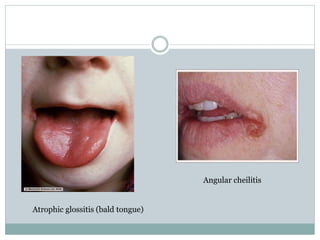
Atrophic glossitis (bald tongue)
Angular cheilitis
Fissured tongue in Vitamin B
deficiency
Bitot spots seen in Vitamin A deficiency
Koilonychia seen in iron deficiency anemia
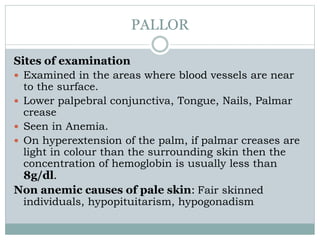
PALLOR
Sites of examination
 Examined in the areas where blood vessels are near
to the surface.
 Lower palpebral conjunctiva, Tongue, Nails, Palmar
crease
 Seen in Anemia.
 On hyperextension of the palm, if palmar creases are
light in colour than the surrounding skin then the
concentration of hemoglobin is usually less than
8g/dl.
Non anemic causes of pale skin: Fair skinned
individuals, hypopituitarism, hypogonadism
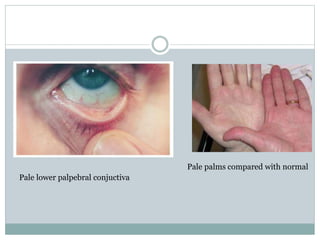
Pale lower palpebral conjuctiva
Pale palms compared with normal
ICTERUS
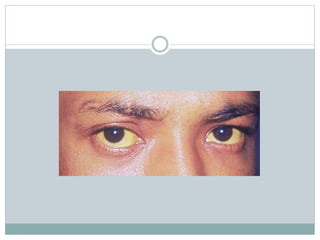
 Yellowish discolouration of skin,mucous membrane
and sclera.
 Due to increased bilirubin.
 Yellowish discolouration of sclera is due to the high
elastin content in the sclera
Sites to examine icterus
 Upper bulbar conjunctiva, lower surface of tongue
 It denotes the concentration of serum bilirubin of
atleast 3mg/dL
Differential diagnosis of yellowish discolouration of
skin
 Carotenoderma ( increased intake of carrots, oranges
and leafy vegetables): here there is no yellowish
discolouration of sclera
 Quinacrine
 Chronic exposure to phenols
 Long standing anemia
CYANOSIS
Cyanosis is the bluish discolouration of skin and mucous
membrane.
It results from the increased amount of reduced hemoglobin
the the blood.
Manifests when the reduced hemoglobin is >4g/dL
Cyanosis may be masked in severe anemia
Types:
1) Central cyanosis: Due to the decreased SaO2
Respiratory cause: High altitude, Alveolar
hypoventillation, pulmonary A-V shunts & fistula,
Cardiac causes: Congenital heart diseases
Sites: Skin, lips, tongue
 Other causes: Methemoglobinemia,
sulfhemoglobinemia
2) Peripheral cyanosis
Exposure to cold, arterial obstruction, reduced
cardiac output, venous obstruction.
Sites to be examined: tip of the nose, ear lobule, nails
CLUBBING
 Bulbous enlargement of the distal part of the fingers
and toes due to proliferation of connective tissue
Theories:
1) Platelet derived growth factor theory: This is the
most accepted theory. There is release of PDGF
from the platelets in response to imflammation or
hypoxia leading to vasodilation and proliferation of
soft tissues
2) Neurogenic theory: Vagal mediated stimulation
causing vasodilation
3) Humoural theory: GH, PTH, estrogen,PG, bradykinin
causes vasodilation and clubbing
4) Ferritin theory
5) Hypoxic theory
Normal angle between the nail bed and and nail is known as
Lovibond angle and is about 160.
Causes:
Hereditary
Idiopathic
Respiratory: Bronchogenic carcinoma,
bronchiectasis, cystic fibrosis
Cardiac: Cyanotic heart disease, infective endocarditis
GIT causes: Liver cirrhosis,Imflammatory bowel
disease
Hypertrophic osteoarthropathy: Clubbing along with
subperiosteal distal diaphyseal new bone formation
with symmetric arthritis like changes in shoulders,
elbow, knee, ankle seen in lung cancers,
mesothelioma, bronchiectasis, hepatic cirrhosis.
Cyanosis in the nails with Clubbing
LYMPHADENOPATHY
 Check for the number, size, site consistency and
tenderness.
 Some important lymph node involvement in certain
diseases.
 Jugulodigastric nodes: URTI, tonsillitis
 Virchow’s node (Troisier sign): enlargement of left
supraclavicular node due to GIT or testicular
malignancies.
 Right supraclavicular nodes: malignancy of right lung
and left lower lobe
 Axillary lymph nodes: Carcinoma breast, Lymphoma
 Epitrochlear nodes: Secondary syphilis. Non hodgkin’s
lymphoma
 Periumbilical nodes ( Sister Mary Joseph’s nodule)
abdominal malignancy
EDEMA
Accumulation of fluid in interstitial space.
Types:
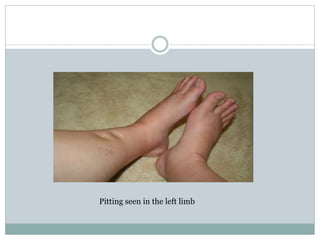
 Pitting type: Apply firm pressure on the shin of
tibia or 2cm above the medial malleolus for 20-30 s
and see for pitting.
Causes: Congestive cardiac failure, nephrotic
syndrome, liver cirrhosis, hypoproteinemia
 Non pitting type: Graves disease (non pitting due to
deposition of hyaluronic acid), filariasis (lymphatic
obstruction)
Pitting seen in the left limb

GENERAL PHYSICAL EXAMINATION

  • 1.
  • 2.
    ASSESSMENT OF NUTRITION Macronutrientassessment 1) Body Mass Index (Quetelet Index) It is calculated by the formula weight/ height2 (Kg/m2) However the disadvantage is it doesn’t describe the distribution of body fat. BMI non Asian BMI Asian Underweight <18.5 <18.5 Normal 18.5-24.9 18.5-22.9 Overweight 25-29.9 23-24.9 Obese 30-39.9 25-29.9 Morbidly obese >40 >30
  • 3.
    2) Waist Circumference: Normal<94 cm in men and <80 cm in women 3) Waist:Hip ratio: <0.8 in females <0.9 in males inceased waist hip ratio has increased risk of coronary artery disease
  • 4.
    Micronutrient assessment Clinical findingsin Vitamin deficiencies  Thiamine: Beri beri, neuropathy,muscle weakness and wasting, cardiomyopathy  Riboflavin: Angular stomatitis, Magenta tongue  Niacin: Pellagra- dermatitis diarrhea dementia  Vitamin B6: Glossitis, confusion, microcytic anemia  Folate: Megaloblastic anemia  Vitamin B12: Megaloblastic anemia, neuropathy  Vitamin C: Scurvy, imflamed and bleeding gums
  • 5.
     Vitamin A:Xerophthalmia, night blindness, Bitot spots, follicular hyperkeratosis  Vitamin D: Rickets, osteomalacia  Vitamin E:Peripheral neuropathy, spino cerebellar ataxia  Vitamin K: Bleeding Disorder  Iron: Koilonychia, pica, anemia  Calcium: Reduced bone mass  Fluoride: Increased dental caries
  • 6.
    Atrophic glossitis (baldtongue) Angular cheilitis
  • 7.
    Fissured tongue inVitamin B deficiency Bitot spots seen in Vitamin A deficiency
  • 8.
    Koilonychia seen iniron deficiency anemia
  • 9.
    PALLOR Sites of examination Examined in the areas where blood vessels are near to the surface.  Lower palpebral conjunctiva, Tongue, Nails, Palmar crease  Seen in Anemia.  On hyperextension of the palm, if palmar creases are light in colour than the surrounding skin then the concentration of hemoglobin is usually less than 8g/dl. Non anemic causes of pale skin: Fair skinned individuals, hypopituitarism, hypogonadism
  • 10.
    Pale lower palpebralconjuctiva Pale palms compared with normal
  • 11.
    ICTERUS  Yellowish discolourationof skin,mucous membrane and sclera.  Due to increased bilirubin.  Yellowish discolouration of sclera is due to the high elastin content in the sclera Sites to examine icterus  Upper bulbar conjunctiva, lower surface of tongue  It denotes the concentration of serum bilirubin of atleast 3mg/dL
  • 13.
    Differential diagnosis ofyellowish discolouration of skin  Carotenoderma ( increased intake of carrots, oranges and leafy vegetables): here there is no yellowish discolouration of sclera  Quinacrine  Chronic exposure to phenols  Long standing anemia
  • 14.
    CYANOSIS Cyanosis is thebluish discolouration of skin and mucous membrane. It results from the increased amount of reduced hemoglobin the the blood. Manifests when the reduced hemoglobin is >4g/dL Cyanosis may be masked in severe anemia Types: 1) Central cyanosis: Due to the decreased SaO2 Respiratory cause: High altitude, Alveolar hypoventillation, pulmonary A-V shunts & fistula, Cardiac causes: Congenital heart diseases Sites: Skin, lips, tongue
  • 15.
     Other causes:Methemoglobinemia, sulfhemoglobinemia 2) Peripheral cyanosis Exposure to cold, arterial obstruction, reduced cardiac output, venous obstruction. Sites to be examined: tip of the nose, ear lobule, nails
  • 16.
    CLUBBING  Bulbous enlargementof the distal part of the fingers and toes due to proliferation of connective tissue Theories: 1) Platelet derived growth factor theory: This is the most accepted theory. There is release of PDGF from the platelets in response to imflammation or hypoxia leading to vasodilation and proliferation of soft tissues 2) Neurogenic theory: Vagal mediated stimulation causing vasodilation
  • 17.
    3) Humoural theory:GH, PTH, estrogen,PG, bradykinin causes vasodilation and clubbing 4) Ferritin theory 5) Hypoxic theory Normal angle between the nail bed and and nail is known as Lovibond angle and is about 160. Causes: Hereditary Idiopathic Respiratory: Bronchogenic carcinoma, bronchiectasis, cystic fibrosis Cardiac: Cyanotic heart disease, infective endocarditis
  • 18.
    GIT causes: Livercirrhosis,Imflammatory bowel disease Hypertrophic osteoarthropathy: Clubbing along with subperiosteal distal diaphyseal new bone formation with symmetric arthritis like changes in shoulders, elbow, knee, ankle seen in lung cancers, mesothelioma, bronchiectasis, hepatic cirrhosis.
  • 19.
    Cyanosis in thenails with Clubbing
  • 21.
    LYMPHADENOPATHY  Check forthe number, size, site consistency and tenderness.  Some important lymph node involvement in certain diseases.  Jugulodigastric nodes: URTI, tonsillitis  Virchow’s node (Troisier sign): enlargement of left supraclavicular node due to GIT or testicular malignancies.  Right supraclavicular nodes: malignancy of right lung and left lower lobe  Axillary lymph nodes: Carcinoma breast, Lymphoma  Epitrochlear nodes: Secondary syphilis. Non hodgkin’s lymphoma  Periumbilical nodes ( Sister Mary Joseph’s nodule) abdominal malignancy
  • 22.
    EDEMA Accumulation of fluidin interstitial space. Types:  Pitting type: Apply firm pressure on the shin of tibia or 2cm above the medial malleolus for 20-30 s and see for pitting. Causes: Congestive cardiac failure, nephrotic syndrome, liver cirrhosis, hypoproteinemia  Non pitting type: Graves disease (non pitting due to deposition of hyaluronic acid), filariasis (lymphatic obstruction)
  • 23.
    Pitting seen inthe left limb