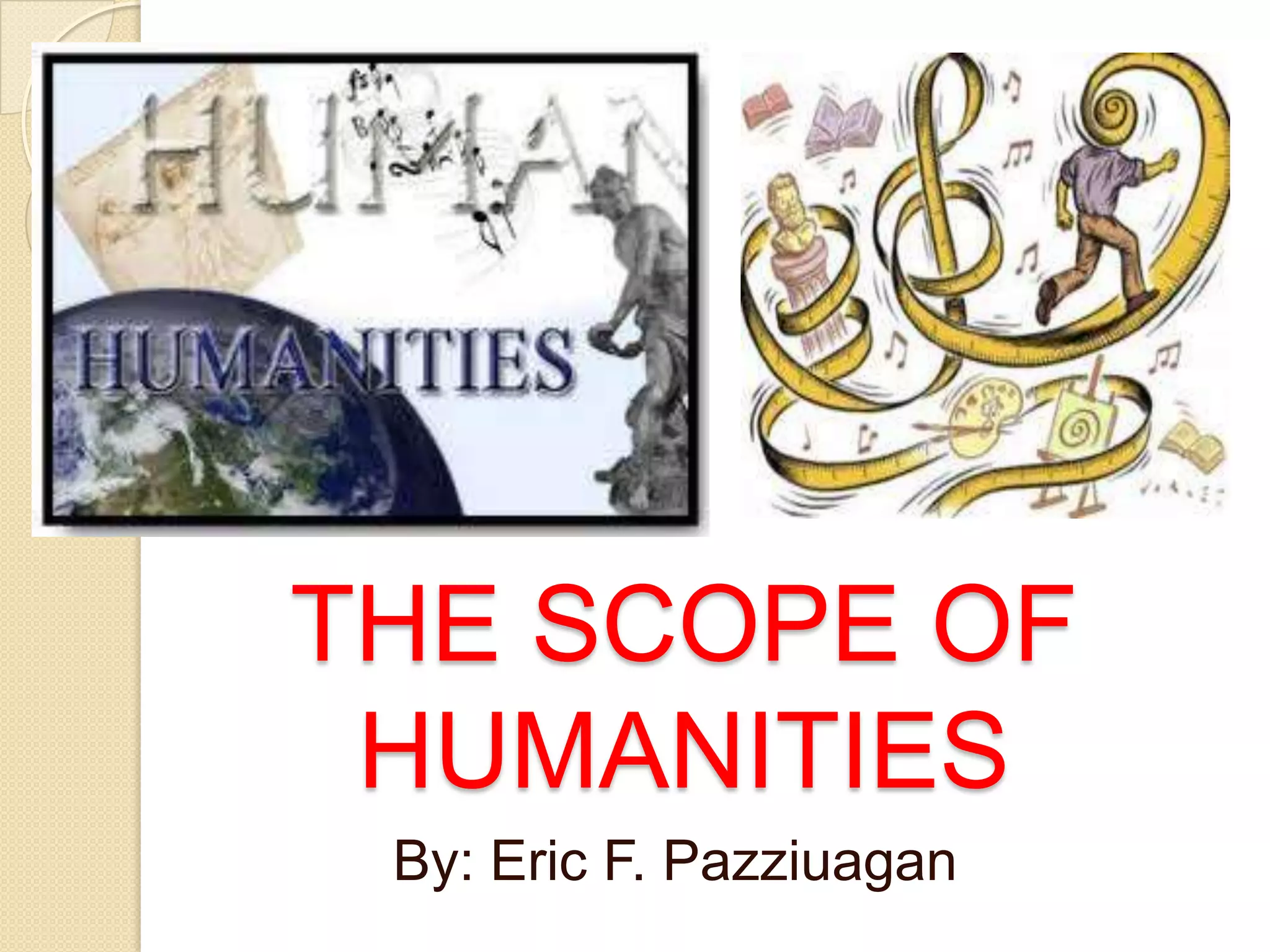

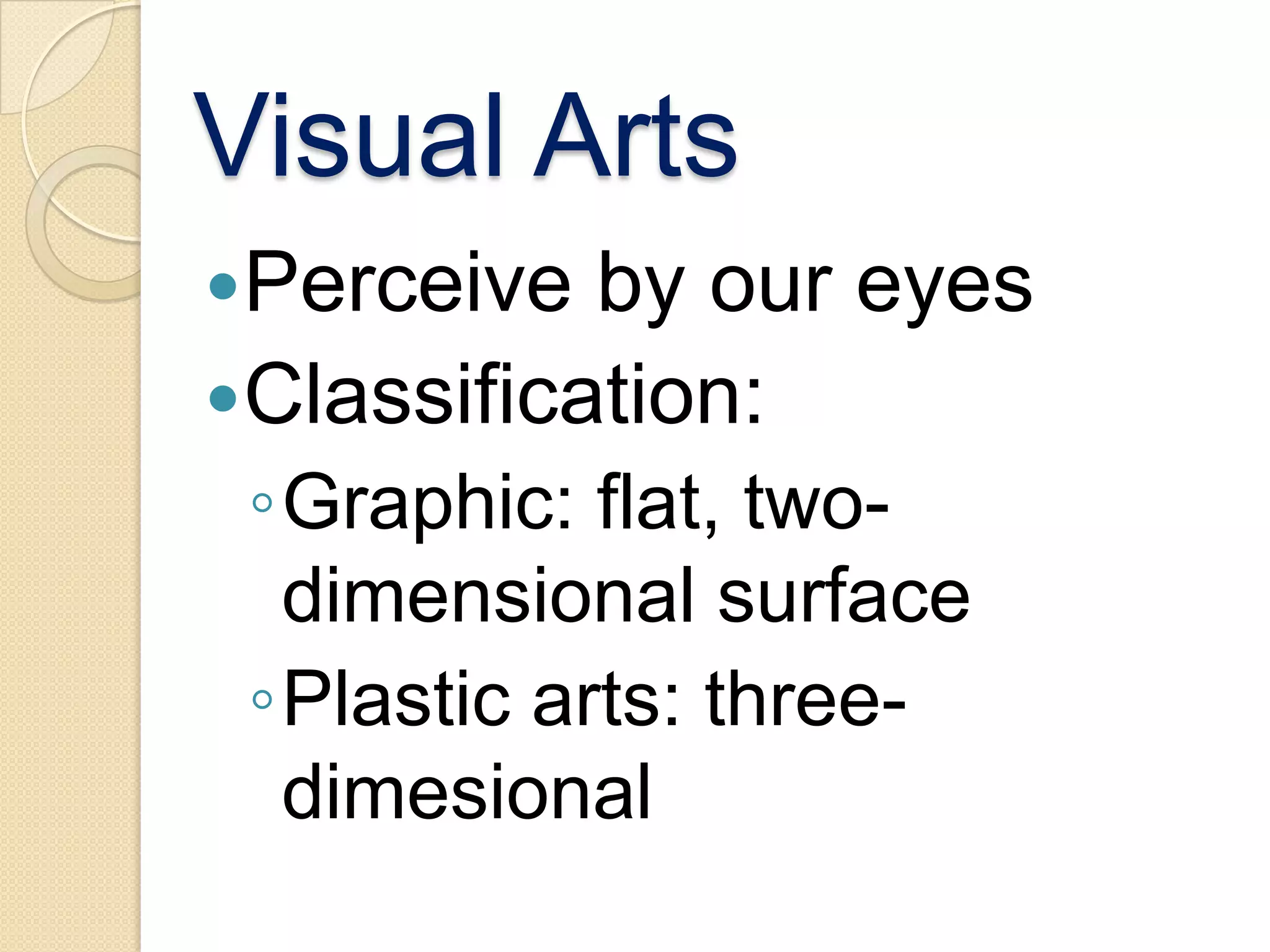
THE SCOPE OF
 HUMANITIES
 By: Eric F. Pazziuagan
VISUAL ARTS
Visual Arts
Perceive  by our eyes
Classification:
 ◦Graphic: flat, two-
  dimensional surface
 ◦Plastic arts: three-
  dimesional
The Graphic Arts
 Any  form of visual
  representation in which
  portrayals of forms and
  symbols are recorded on a
  two-dimensional surface.
 All processes and products
  of the of the printing
  industry.
1.Painting
2.Drawing
3.GraphicProcesses
4.Commercial Art
5.Mechanical
  Processes
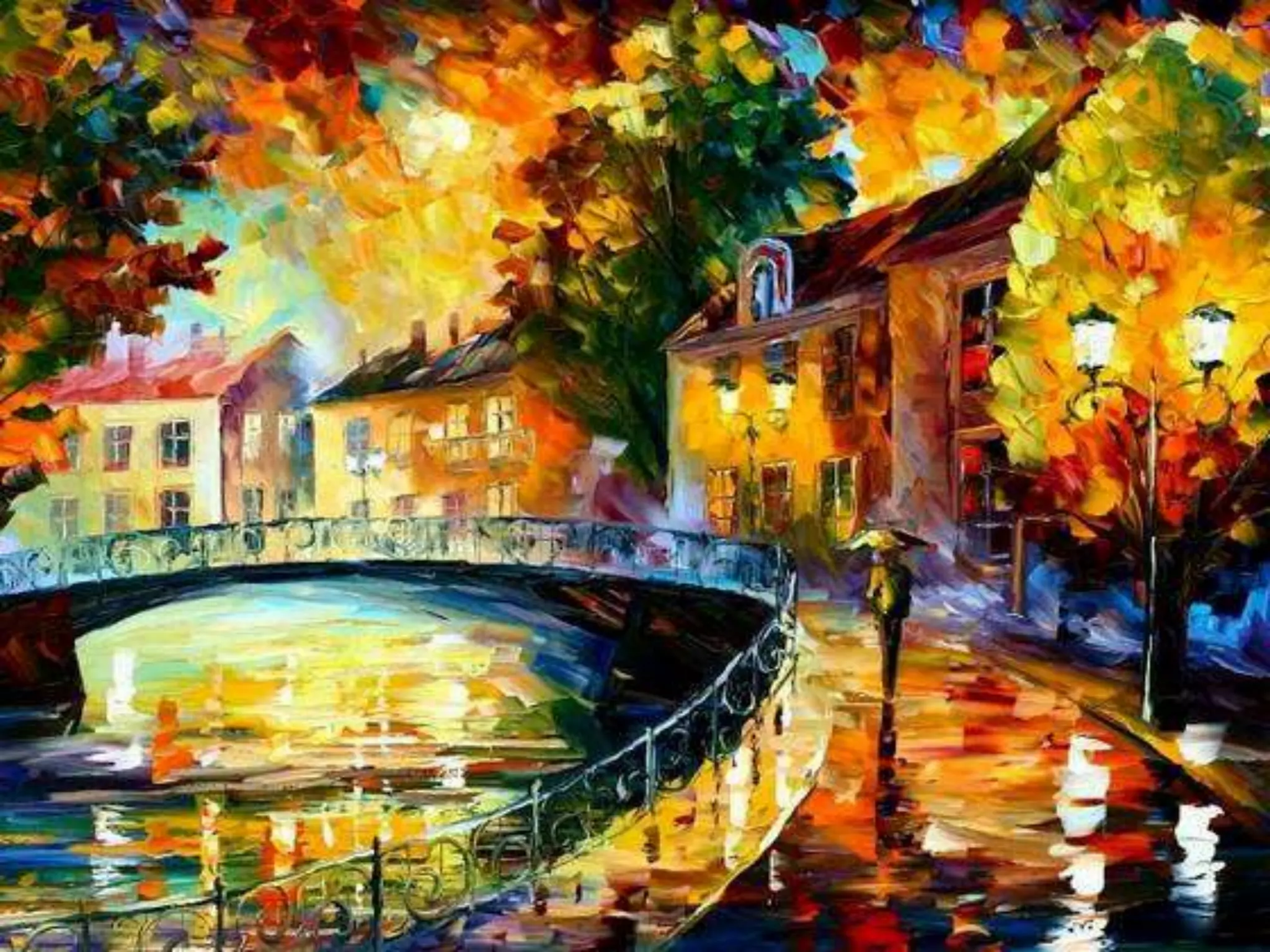
Painting
 Process  of applying pigment to
  a surface to secure effects
  involving forms and colors.
 Painting mediums: oils,
  watercolors, tempera, others.
 Surfaces: canvas, wood,
  paper and plaster.
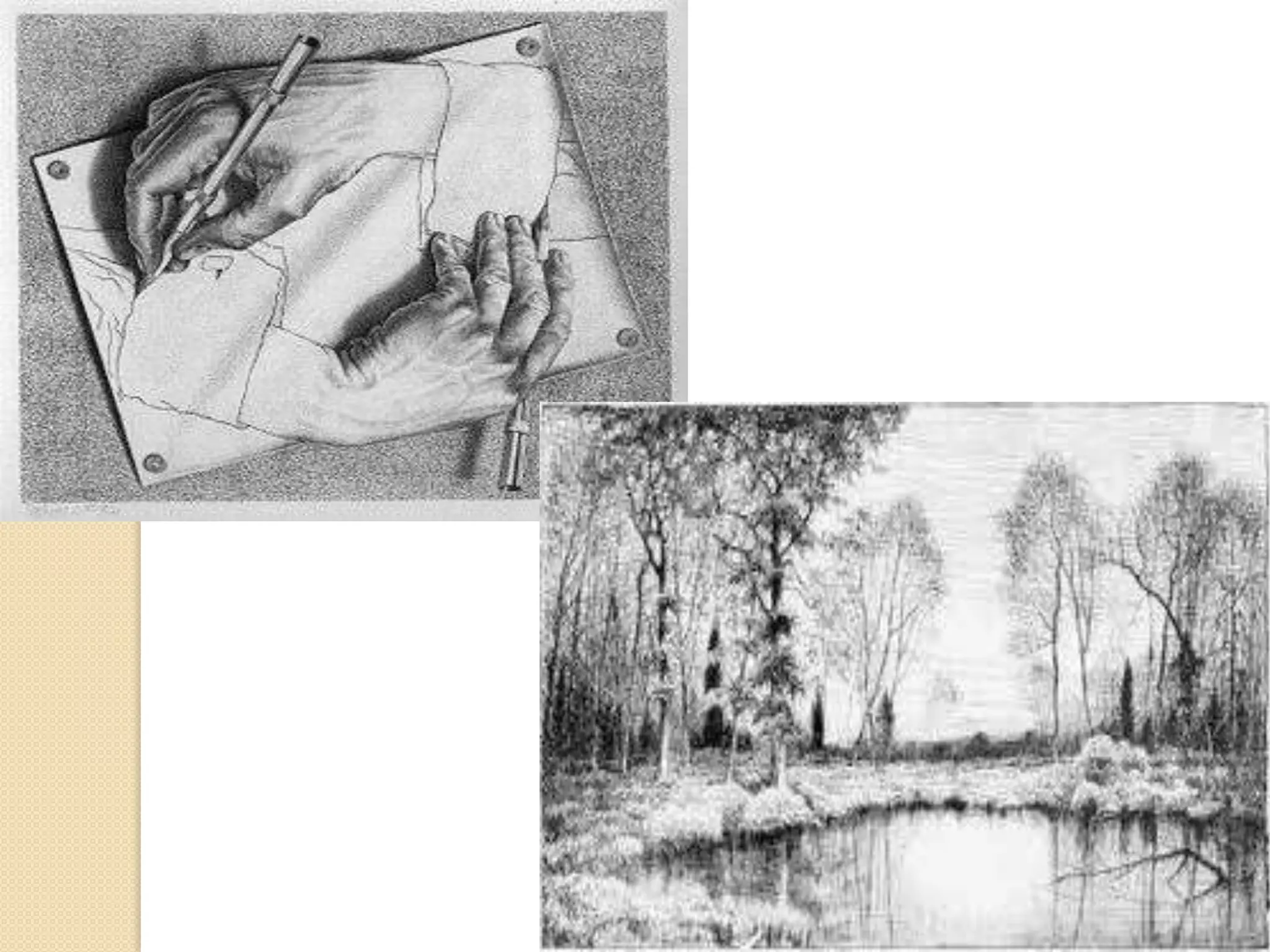
Drawing
 The  art of representing something
  by lines made on a surface or the
  process of portraying an object,
  scene, or forms of decorative or
  symbolic meaning through lines,
  shading, and textures in one or
  more colors.
 Medium: pencil, pen and ink,
  crayon, brush, and charcoal.
Graphic Processes
 Processes for making multi-
  reproduction of graphic works.
 Involve the preparation of master
  image of the drawing or design on
  some durable material such as wood,
  metal, or stone, from which printing is
  done.
 Processes:
    ◦ Raised (relief)
    ◦ Depressed (Intaglio)
    ◦ Flat (surface, or plane)
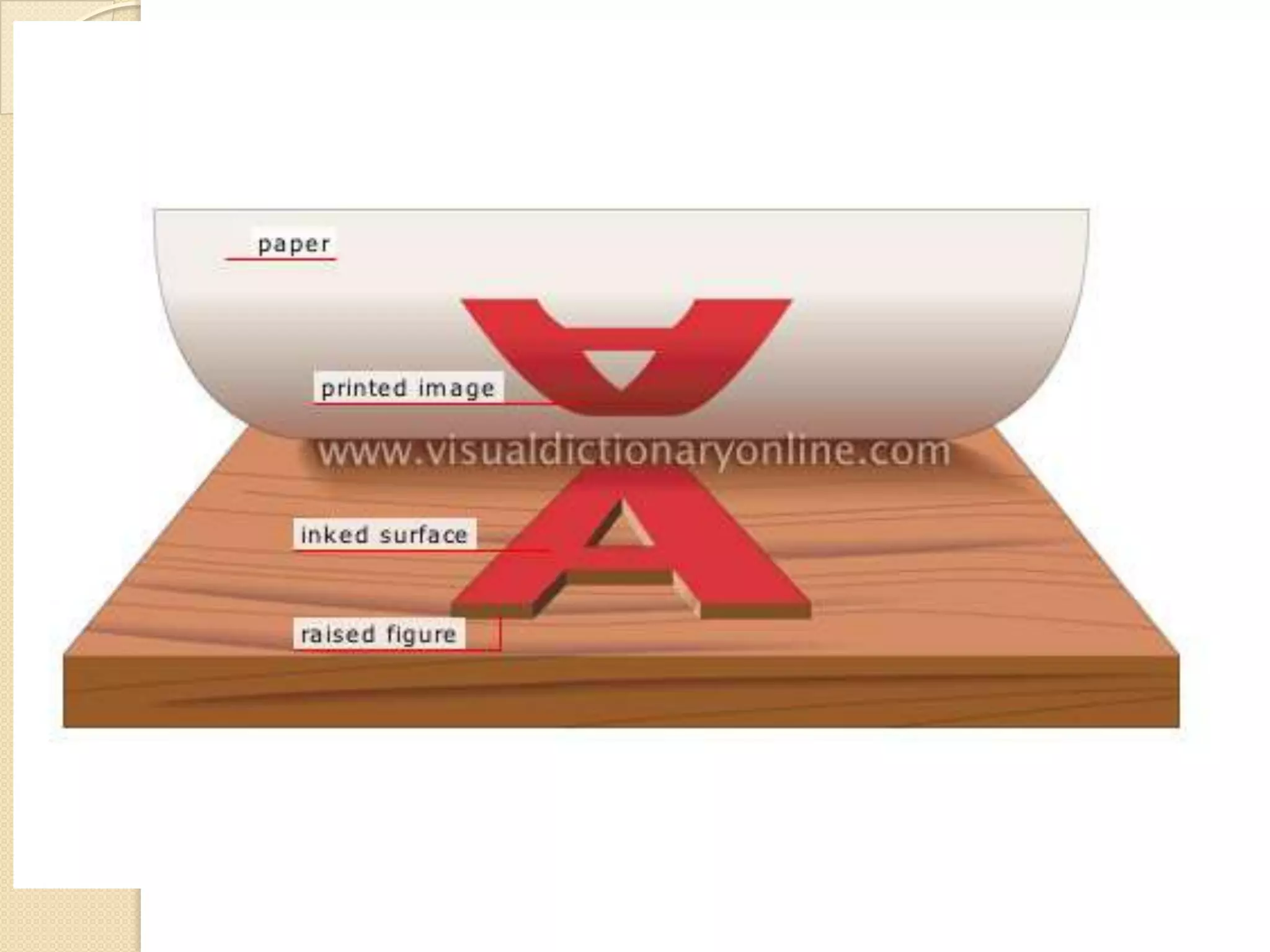
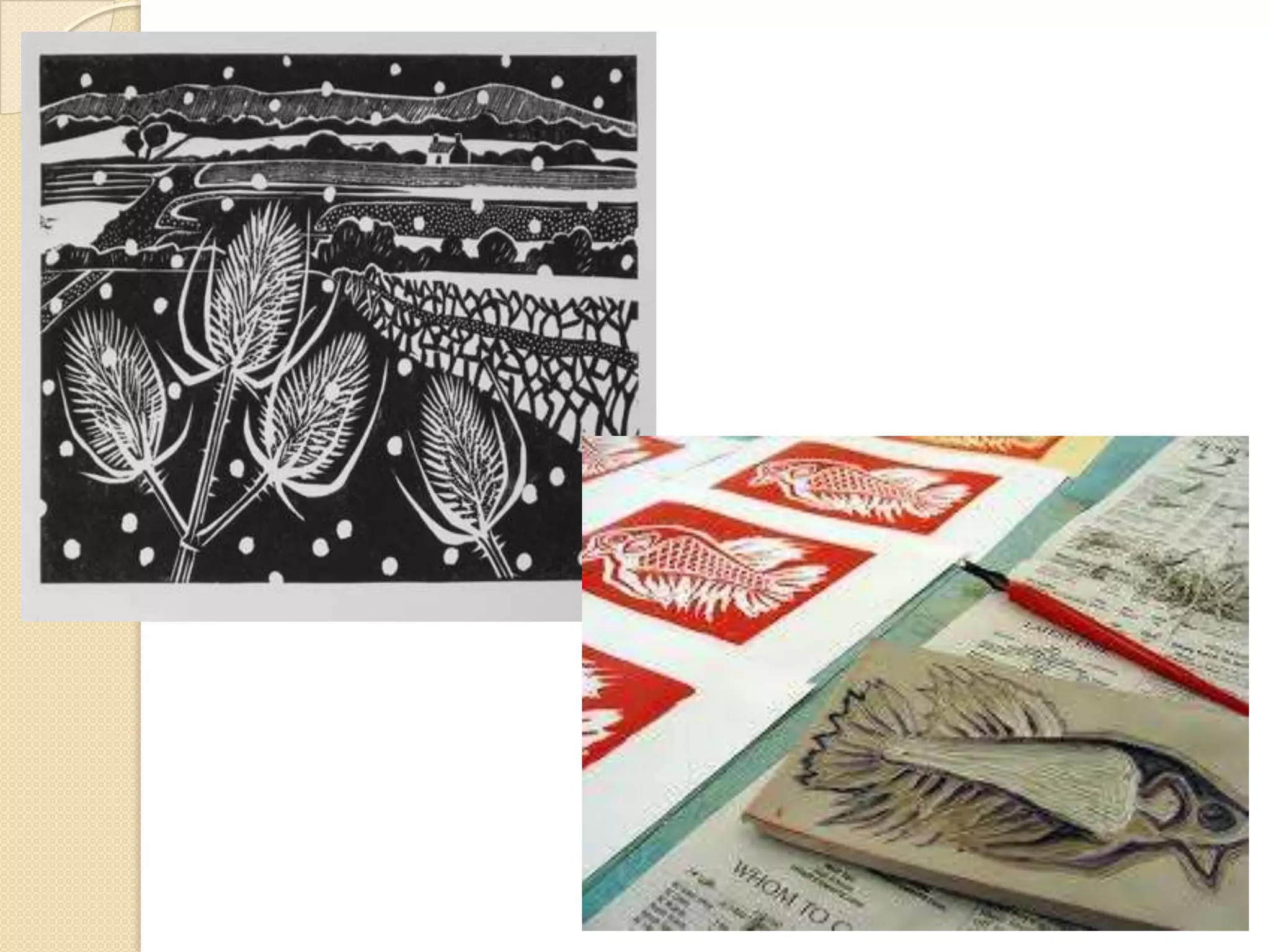
Relief Printing
 Unwanted  portions of
  design are cut away on the
  master image.
 Printed image is formed by
  the remaining surfaces.
 Examples: linoleum cuts,
  woodcuts, wood
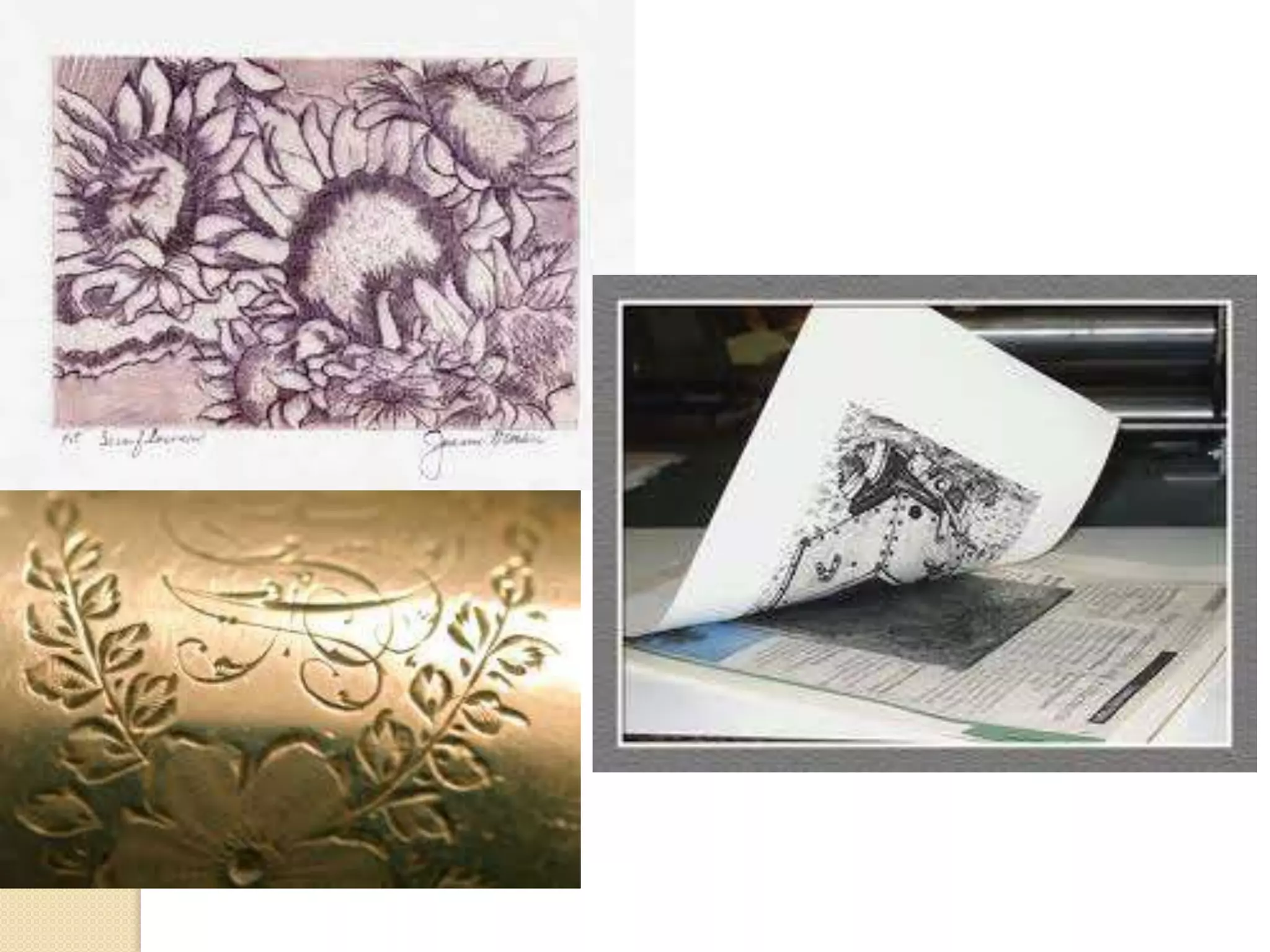
Intaglio Printing
 Printing from a plate on which incised
  lines, which carry the ink, leave a
  raised impression.
 Dry point:
    ◦ Artist draws directly on a metal plate with
      a sharp needle and scratches lines, or
      grooves, into the metal.
    ◦ For each print, ink is rubbed into the
      grooves and the unscratched surface is
      wiped clean.
    ◦ In printing, the ink in the grooves is
      transferred to paper.
   Etching:
    ◦ Drawing or designs on metal plates covered
      with wax.
    ◦ Needle penetrates wax to the surface of the
      plate.
    ◦ Plate is then dipped in acid, which eats the
      lines into the metal.
    ◦ For printing, etched (bitten) lines are filled
      with ink which is transferred to the paper.
   Engraving:
    ◦ Done on a metal plate with a cutting tool
      called a barin, which leaves a V-shaped
      trough.
    ◦ Drawings or designs on the plate are entirely
      composed of lines or dots.
Surface Printing
 Includes all processes in which
  printing is done from a flat (plane)
  surface.
 Lithography:
    ◦ Printing from a flat stone or metal plate by
      am method based on the repulsion
      between grease and water.
    ◦ Design is put on the surface.
    ◦ Surface is treated so that ink adheres
      only to areas where drawing has been
      done.
    ◦ Ink is then transferred to the paper in
      printing.
 Silkscreen:
 ◦ Silk is stretched over a rectangular
   frame and unwanted portions in the
   design are blocked out.
 ◦ Pigment is forced through the clear
   areas.
 ◦ For multi-color prints, a separate
   screen is used for each color.
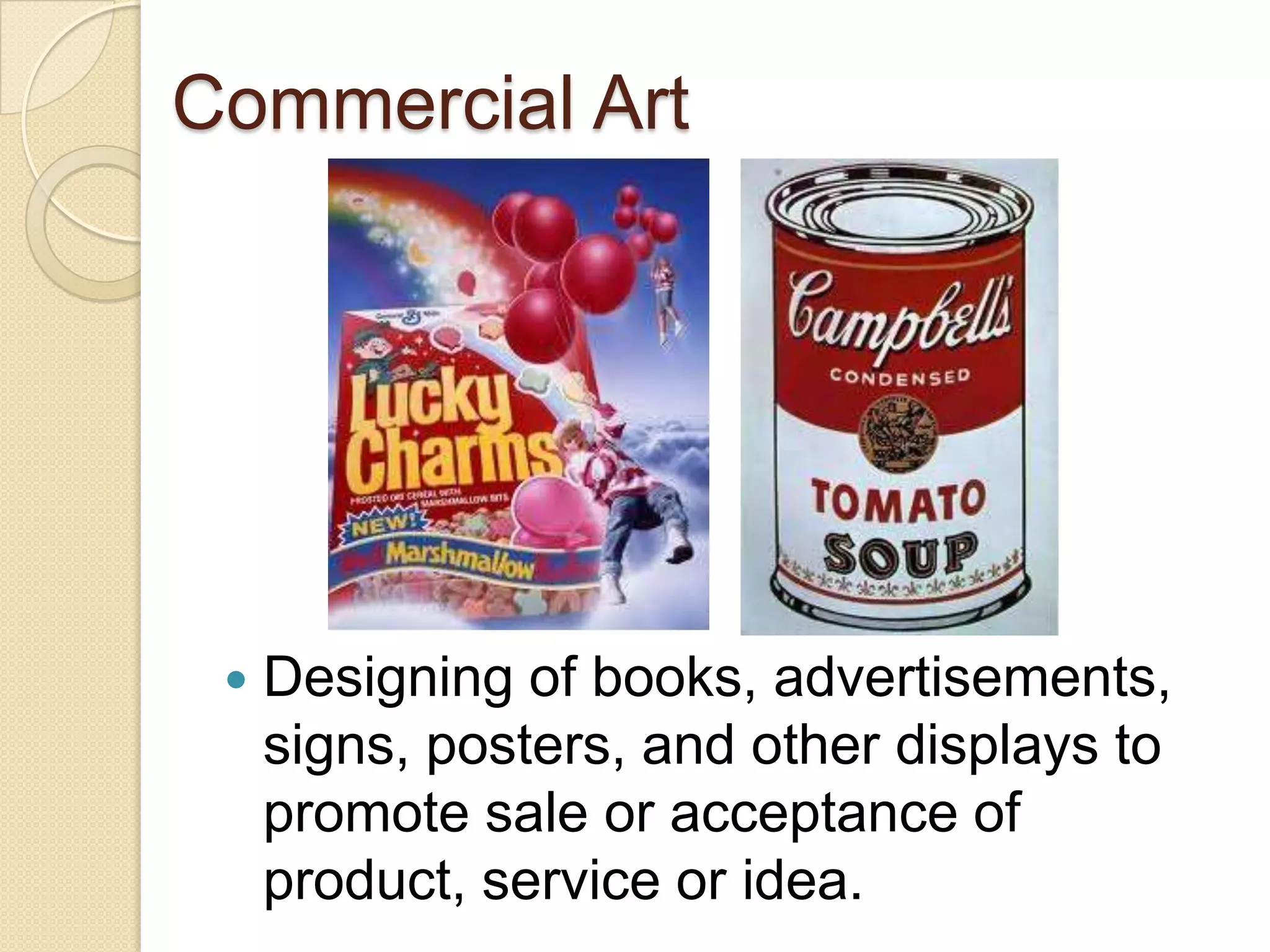
Commercial Art


    Designing of books, advertisements,
     signs, posters, and other displays to
     promote sale or acceptance of
     product, service or idea.
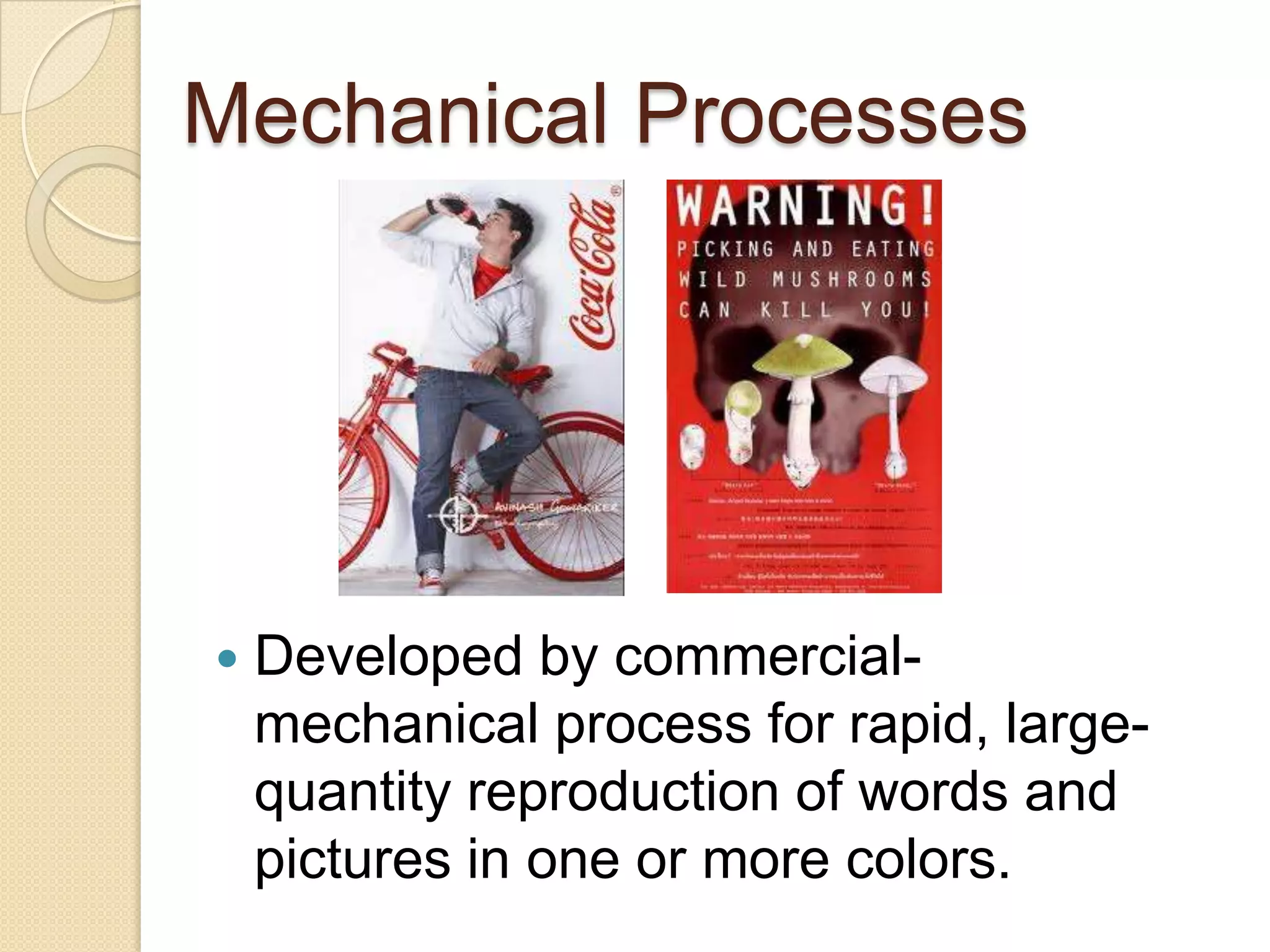
Mechanical Processes


   Developed by commercial-
    mechanical process for rapid, large-
    quantity reproduction of words and
    pictures in one or more colors.
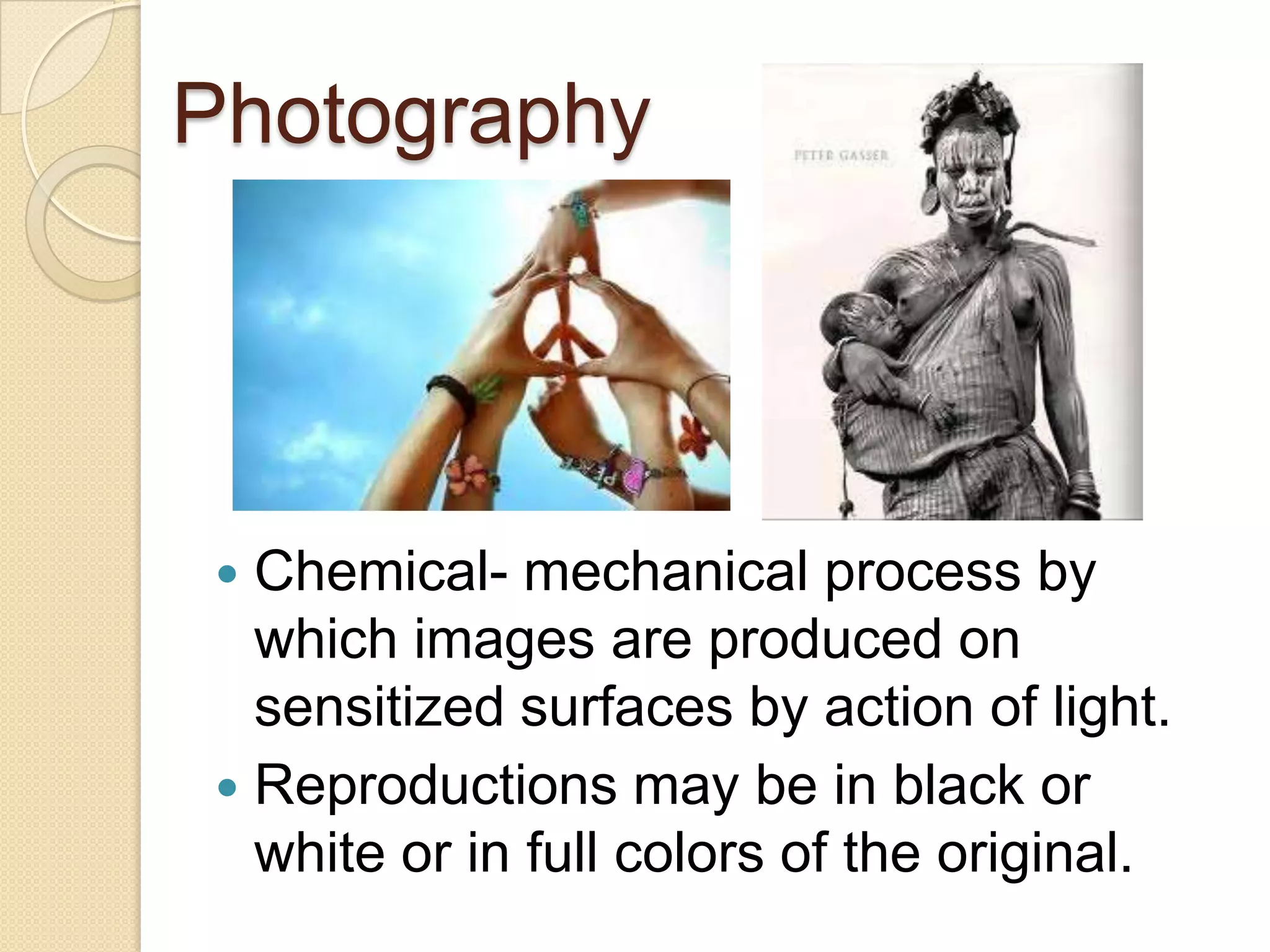
Photography


 Chemical- mechanical process by
  which images are produced on
  sensitized surfaces by action of light.
 Reproductions may be in black or
  white or in full colors of the original.
THE PLASTIC
   ARTS
The Plastic Arts
Allfields of the visual arts
 in which materials are
 organized into three-
 dimensional forms.
Architecture
 The art of designing and constructing
  buildings and other types of
  structures.
 Materials: stone, concrete, brick,
  wood, steel, glass, plaster
 “mother of the arts”- it houses, serves
  as background for, or occurs in
  relation to other fields of art such as
  painting, sculpture, interior design,
  landscape architecture, and city
Landscape
Architecture
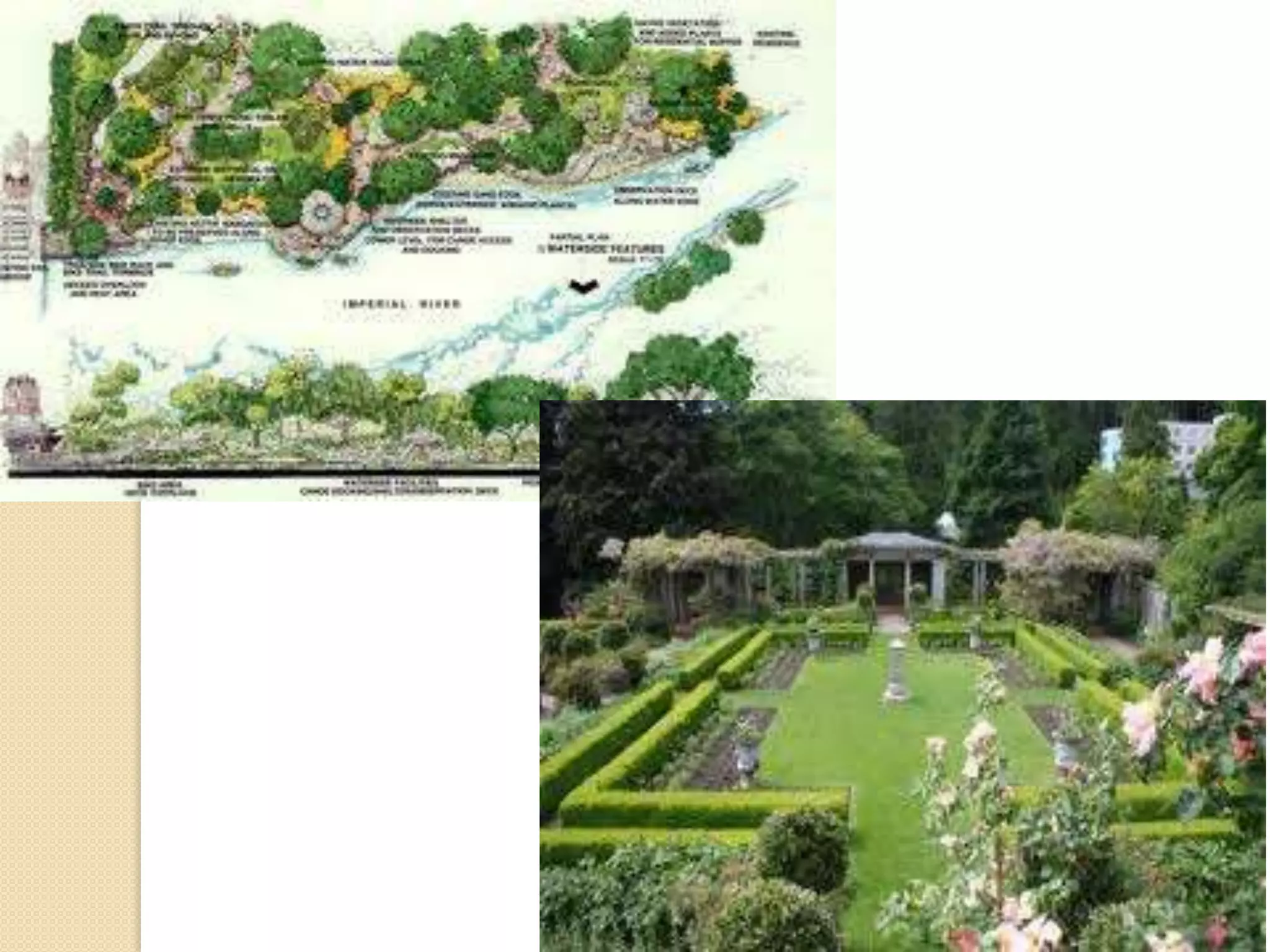
 Planning  outdoor areas for
  human use and enjoyment,
  especially gardens, parks,
  playgrounds, golf courses.
 Chief materials: plants,
  shrubs, trees, folwers,
  vines, and ground cover.
City Planning
 Planning  and arranging the
  physical aspects of a large or
  small community.
 Structures and areas
  concerned with all phases of
  living and working are
  attractively and efficiently
  organized and related.
Interior Design
 Design   and arrangement of
  architectural interiors for
  convenience and beauty.
 Includes backgrounds (wall,
  floors, ceilings), furnishings, and
  accessories.
 Fields: Design of wallpaper,
  furniture, textiles for curtains, and
  upholstery
Sculpture
 Design  and construction of three
  dimensional forms representing
  natural objects or imaginary
  (sometimes abstract) shapes.
 Common materials: stone, wood,
  clay, metal; ivory, jade, wire, string
  and other materials.
 Sculpture of figures: statues
Crafts
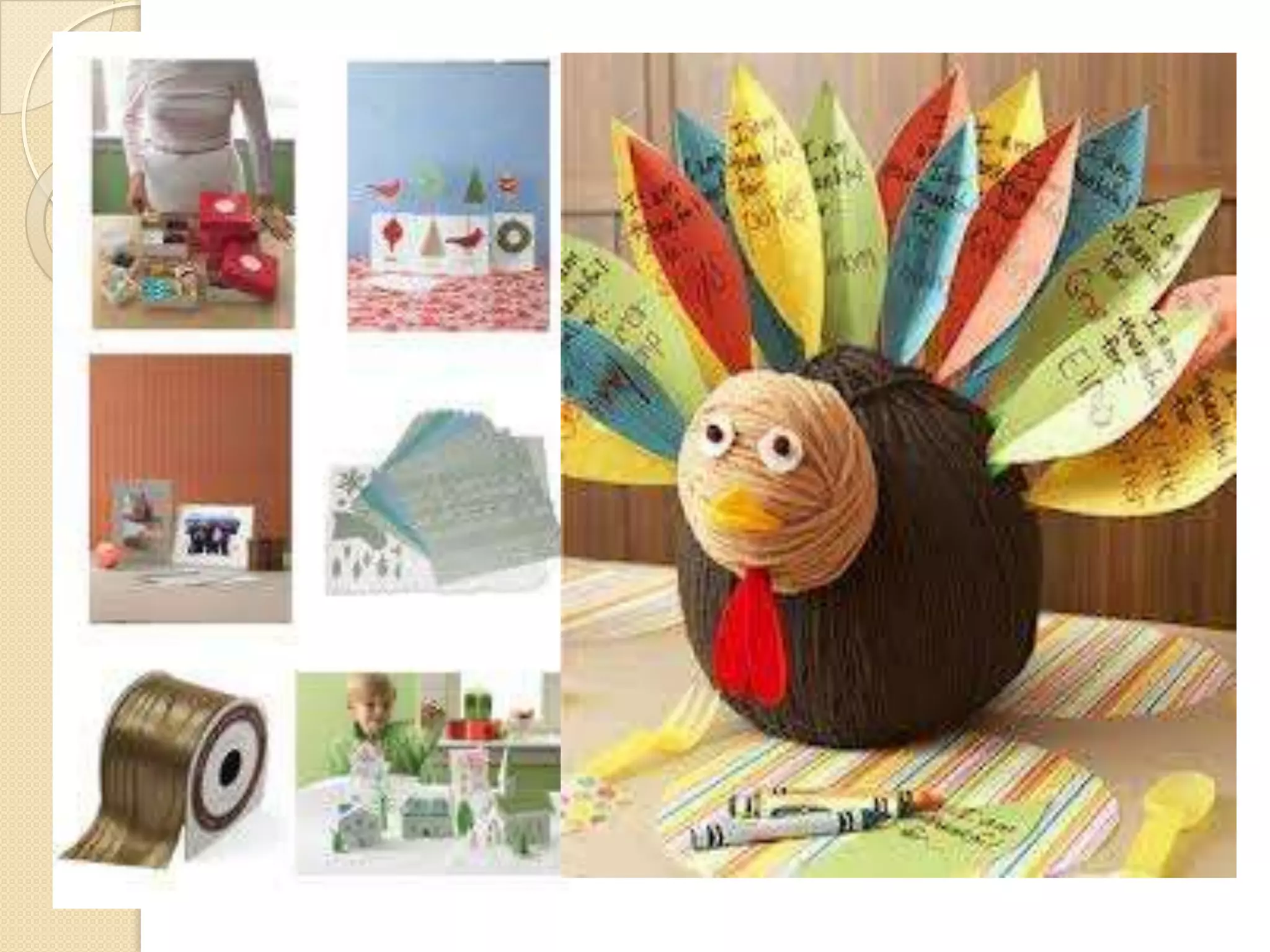
 Designing and making of objects
  by hand for use or for pleasure.
 Ceramics, jewelry, leatherwork,
  and weaving.
 Mass- produced: industrial
  design.
Industrial Design


 Design of objects for machine
  production.
 Examples: automobiles, household
  appliances
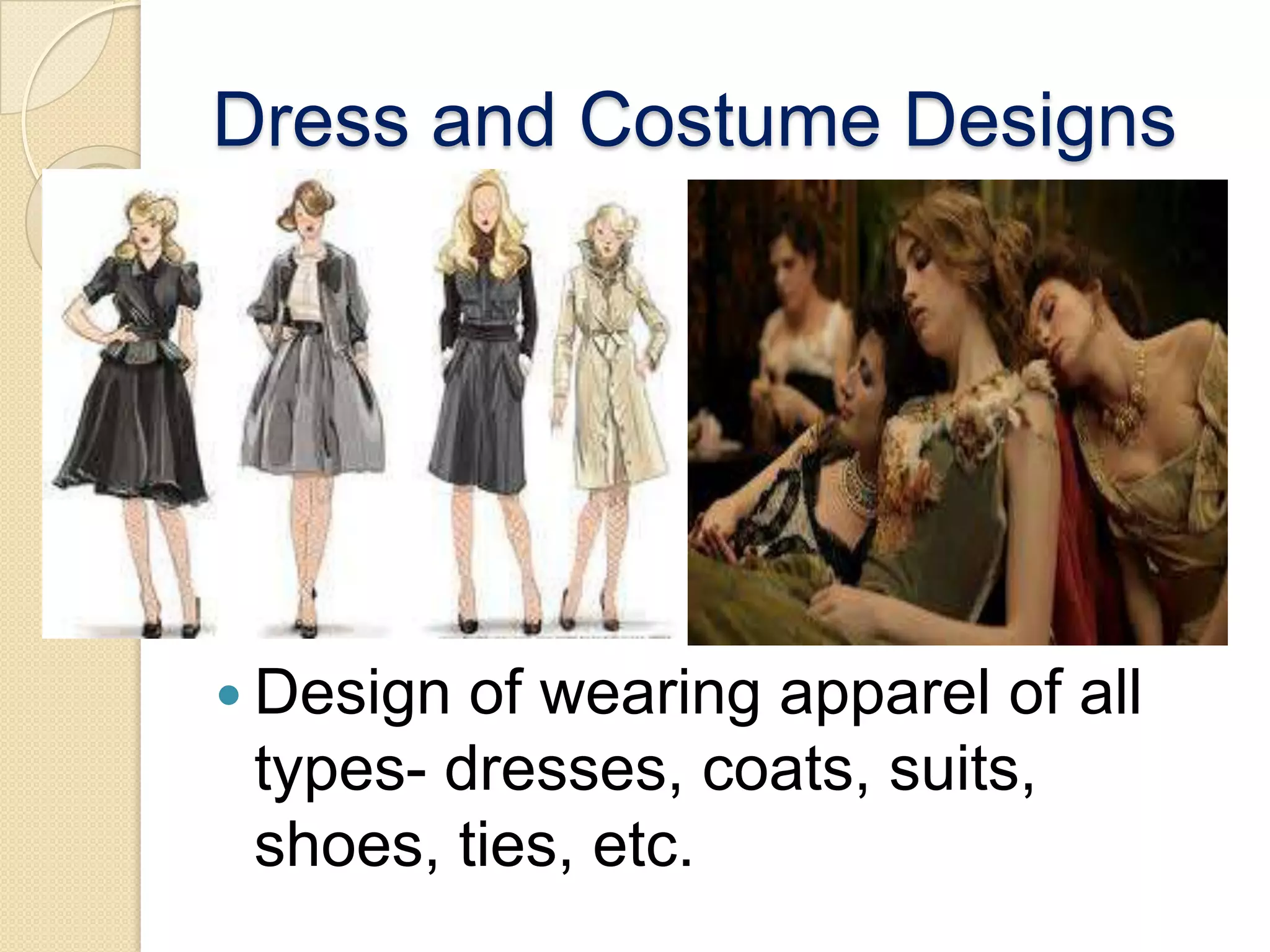
Dress and Costume Designs


 Design of wearing apparel of all
 types- dresses, coats, suits,
 shoes, ties, etc.
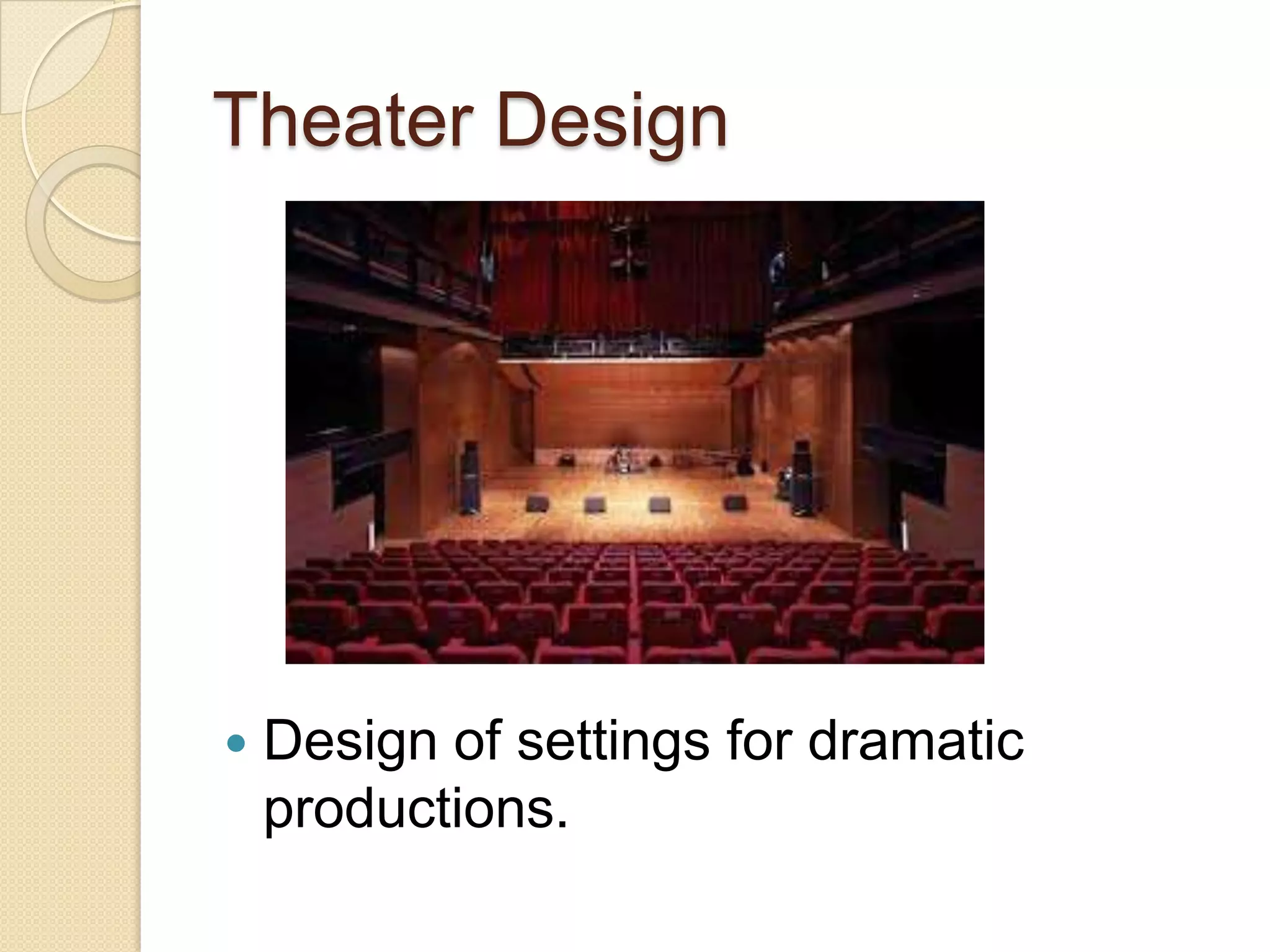
Theater Design


   Design of settings for dramatic
    productions.
LITERATUR
    E
Literature
 Theart of combining
 spoken or written words
 and their meanings into
 forms which have artistic
 and emotional appeal.
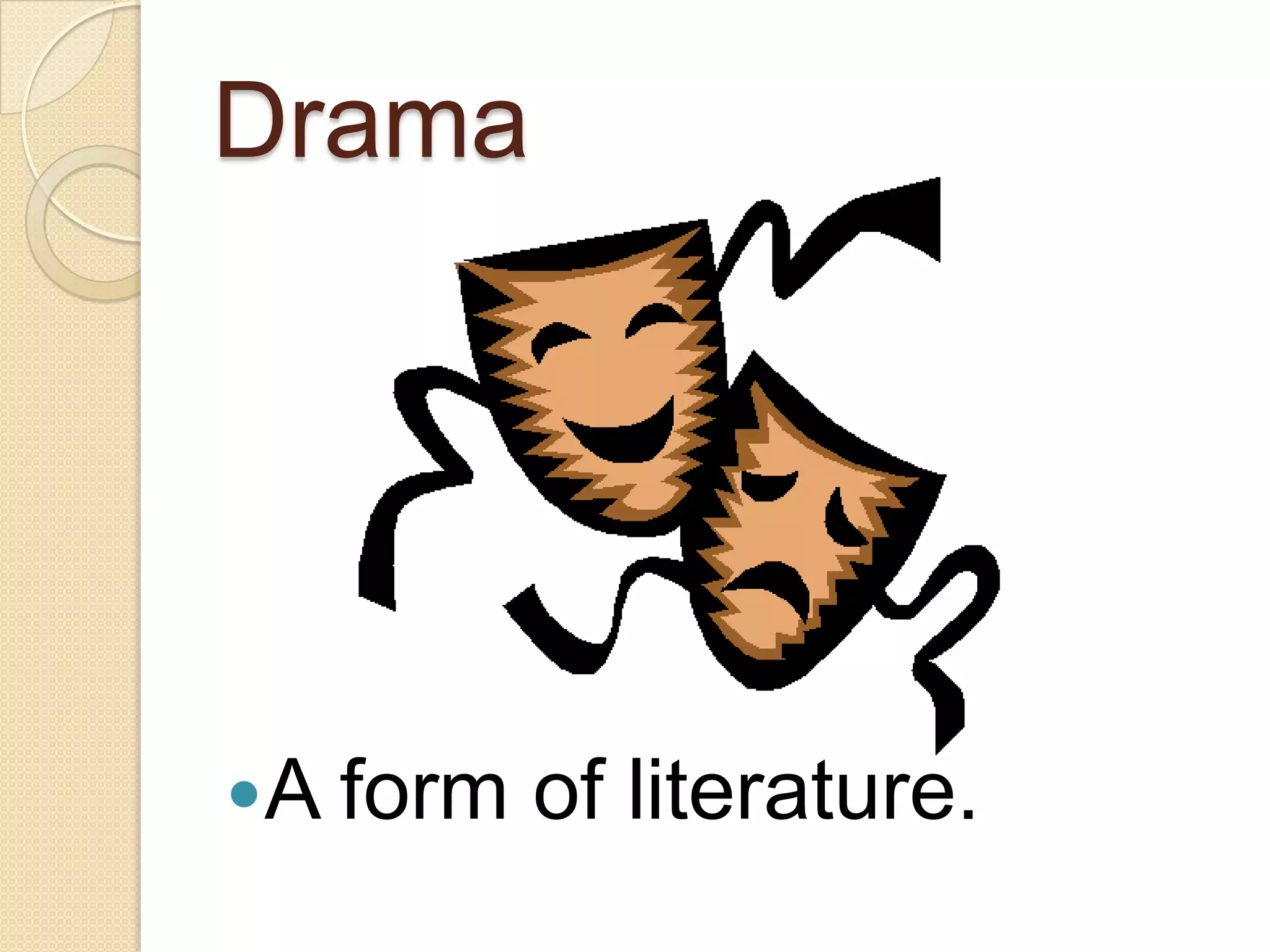
Drama


A form   of literature.
Essay
 Non-fiction,expository
 (descriptive or explanatory)
 writing ranging from informal,
 personal topics to closely
 reasoned critical treatments of
 important subjects.
Prose Fiction
 Includes narratives (stories) created by
  the author, as distinguished from true
  accounts.
 Fiction: comes from the Latin word
  which means “to form”, “to invent”, or
  “to feign.”
 Divided into: novel, novelette, and short
  story forms.
 Novel or short story: describes
Poetry
 Literature of a highly expressive
  nature using special forms and
  choice of words and emotional
  images.
 Narrative (story telling) poetry
  includes epics, romances, and
  ballads.
 Lyric forms: sonnet, ode, elegy
  and songs.
Miscellaneous
 History,biography, letters,
 journals, diaries, and other works
 not formally classified as literature
 often have literary appeal and
 status due to high quality of the
 writing.
MUSIC
Music
 The art of arranging sound in rhythmic
  succession and generally in
  combination.
 Melody results from this sequence,
  and harmony from combinations.
 Both creative and a performing art
 Common forms: songs, march, fugue,
  sonata, suite, fantasy, concerto, and
  symphony.
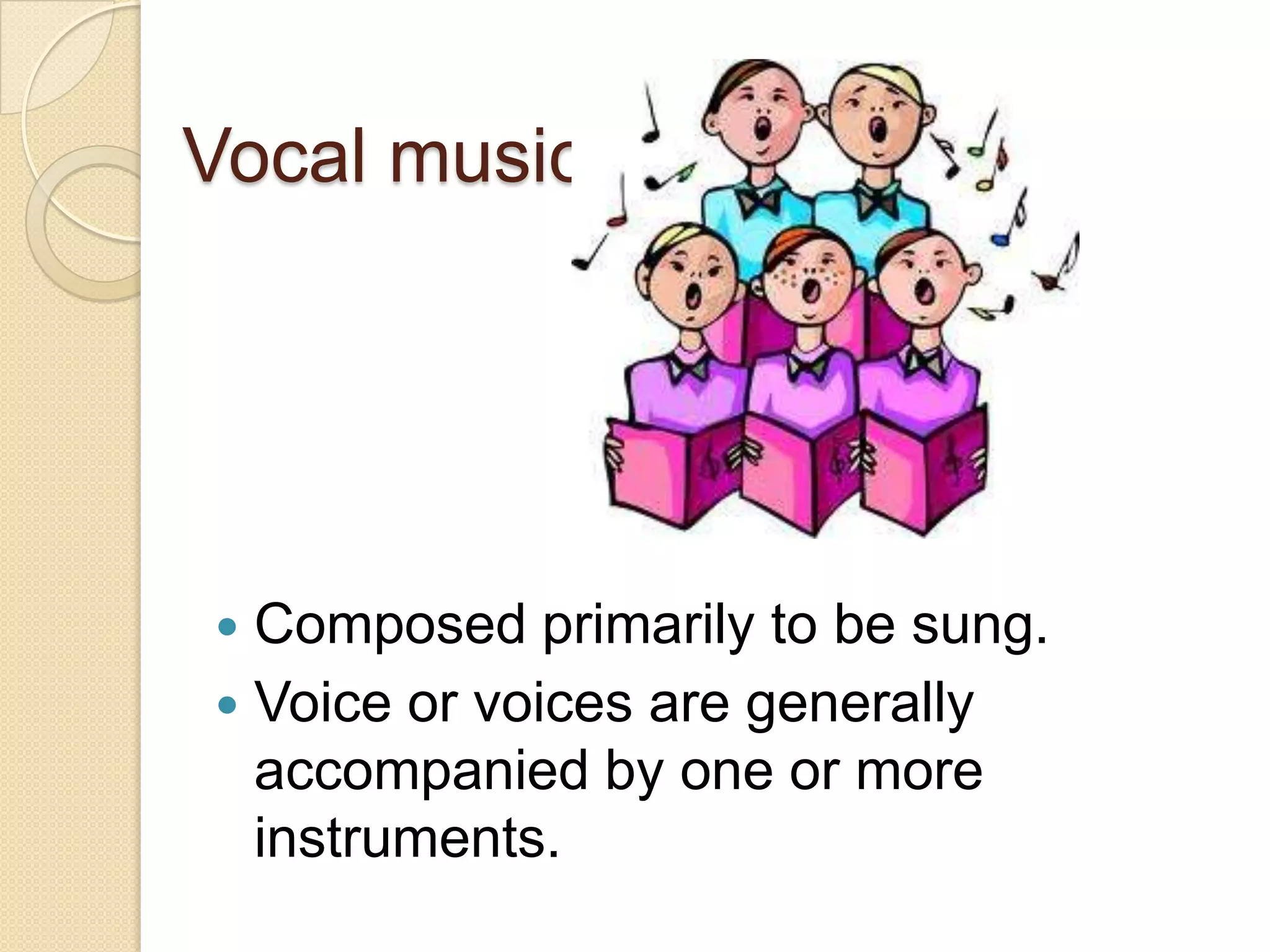
Vocal music


 Composed primarily to be sung.
 Voice or voices are generally
  accompanied by one or more
  instruments.
Instrumental music
 Written
        for instruments of four
 general types:
 ◦ Keyboard (piano, organ, etc.)
 ◦ Stringed ( violin, cello, guitar, etc.)
 ◦ Wind (flute, clarinet, etc.)
 ◦ Brass winds (trumpet, saxo-phone,
   etc.)
 ◦ Percussion (drum, xylophone, etc.)
Music combined with other
arts
 Opera:
 ◦ drama set to music
 ◦ Mostly or entirely sung with
   orchestral accompaniment
 ◦ Spectacularly staged with
   accomplished singers, elaborate
   scenery, and costumes.
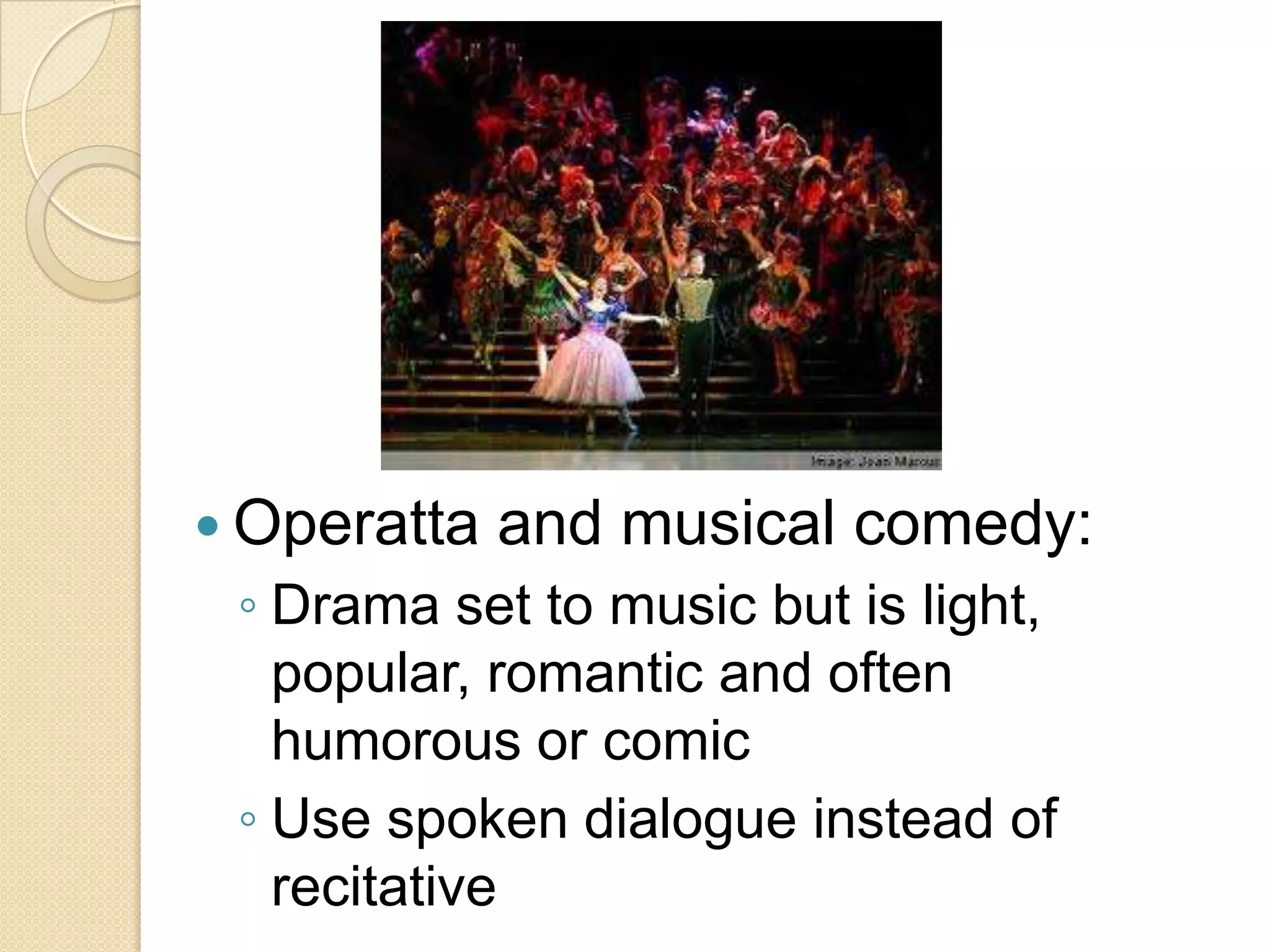
 Operatta   and musical comedy:
 ◦ Drama set to music but is light,
   popular, romantic and often
   humorous or comic
 ◦ Use spoken dialogue instead of
   recitative
   Oratorio and Cantata:
    ◦ Sacred musical drama in concert form.
    ◦ Made up of recited parts (recitative), arias,
      and choruses, with orchestral
      accompaniment.
    ◦ No action, sets, and costumes are used.
    ◦ Oratories are usually based on Biblical
      themes
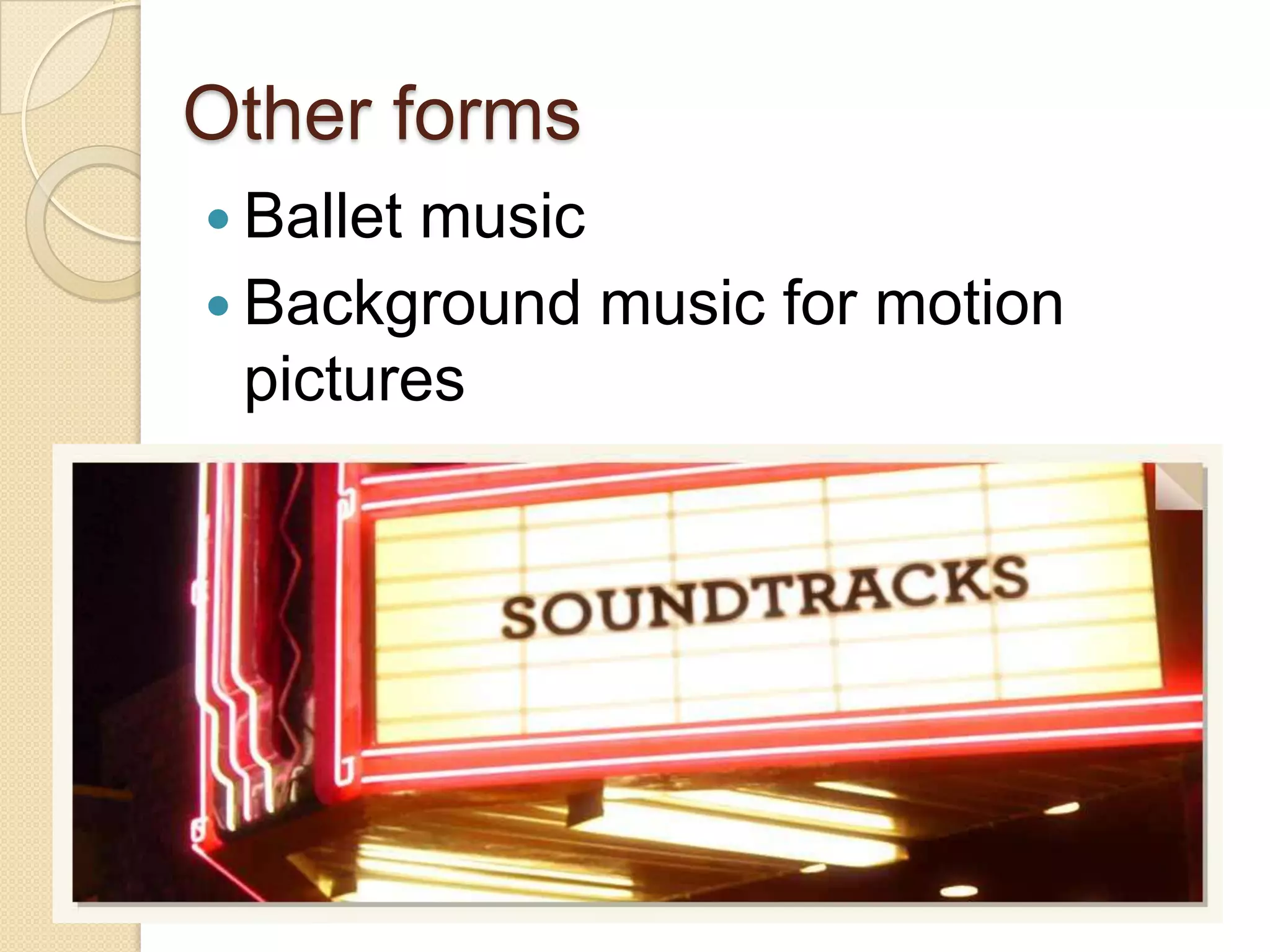
Other forms
 Ballet music
 Background music for motion
  pictures
DRAMA AND
 THEATER
Drama or play
A story  re-created by
 actors on stage in
 front of an audience.
Tragedy
 One   of literature's greatest
  dramatic art forms.
 A drama of serious nature
  in which the central
  character comes to sad or
  disastrous end.
 All tragedies portray
Melodrama
 Emphasis   is on action
  rather than on character.
 The action is sensational or
  romantic and usually has a
  happy ending.
Comedy
 All plays with happy endings.
 Romantic comedy: light, amusing tale of
  lovers in some dilemma which is solved
  happily,
 Farce: light, humurous play. Emphasis is
  on jokes, humorous physical action,
  ludicrous situations, and improbable
  characters.
 Comedy of manners or “drawing room
  comedy”: sophisticated or satirical.
  Characters are usually high-society types,
  and situations have little to do with real
Miscellaneous
 Tragicomedy: drama blending tragic
  and comic elements but which ends
  happily.
 Miracle and mystery plays: dramatized
  stories from the Bible and lives of
  saints.
 Morality plays: characters represent
  specific vices and virtues.
 Closet drama: plays written for reading
  than for staging.
   Piano drama: based on piano works
    which revolve around the musical
    pieces composed under the inspiration
    of a literary work. It combines the
    interpretation of music with the
    recitation of poetry and the literary
    source of music.
DANCE
Dance


 Involves
         the movement of
 the body and feet in
 rhythm.
Ethnologic


 Includes folk dancing
 associated with national and
 cultural groups.
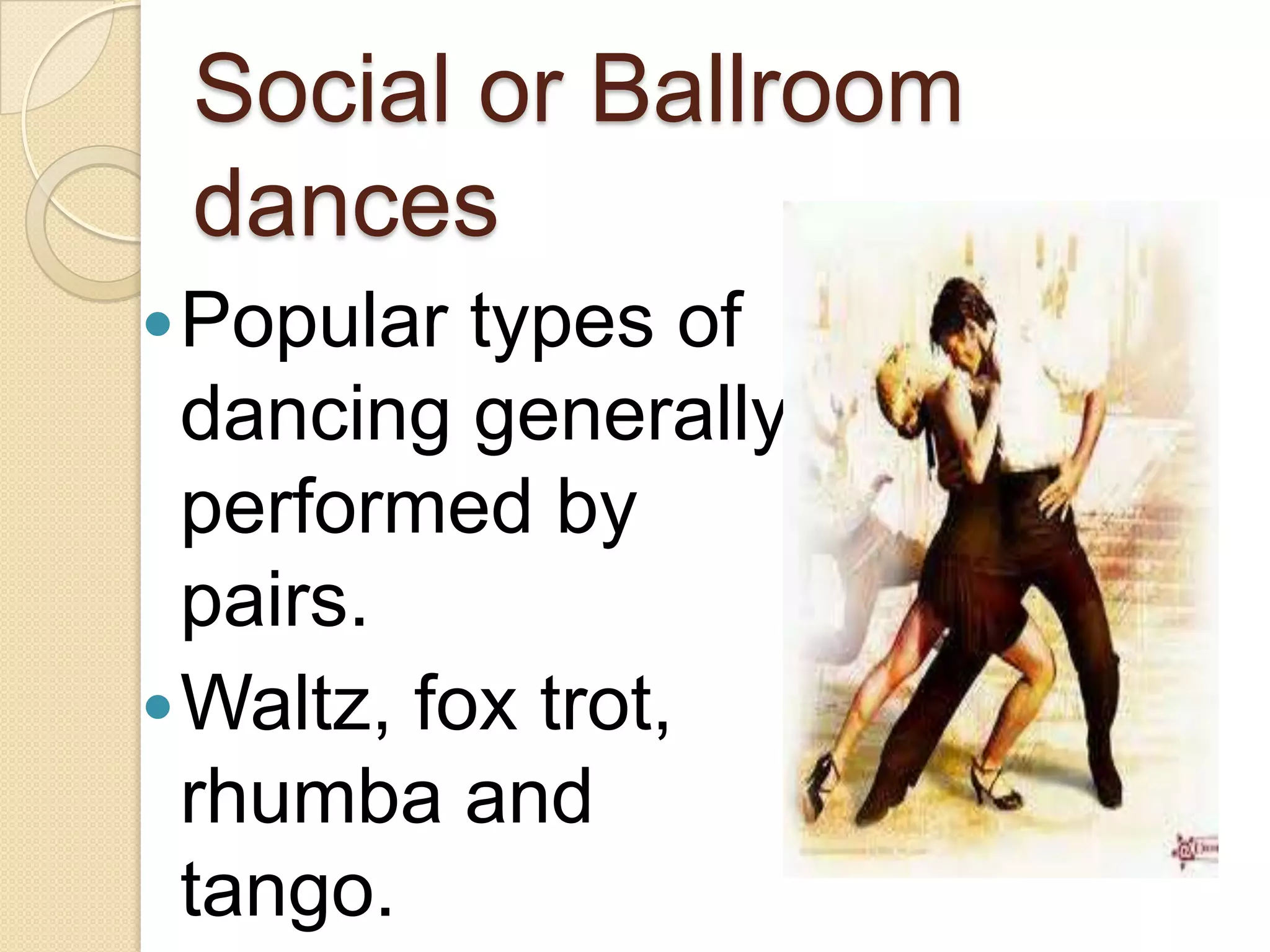
Social or Ballroom
 dances
 Popular  types of
  dancing generally
  performed by
  pairs.
 Waltz, fox trot,
  rhumba and
  tango.
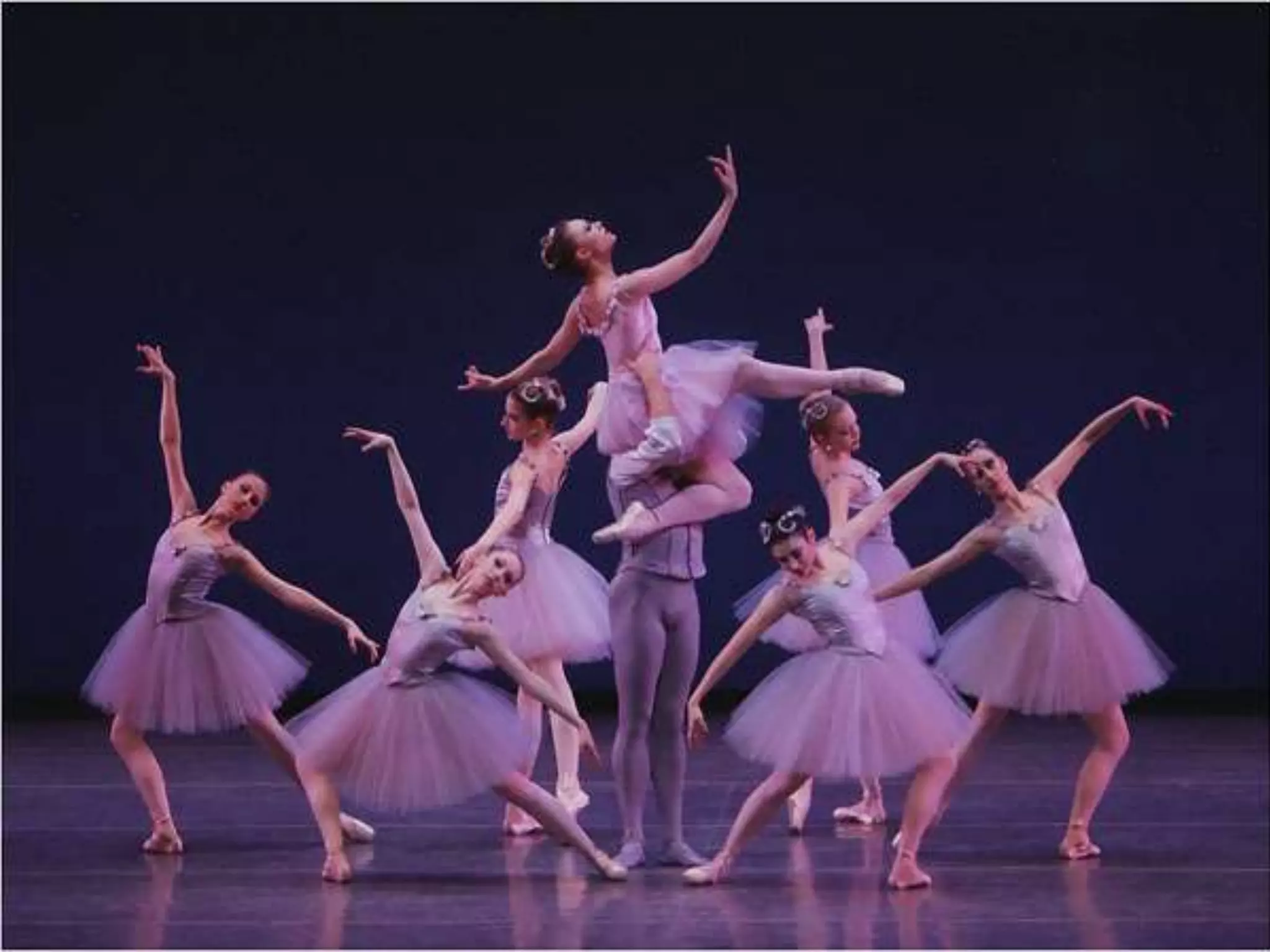
The Ballet
 Formalized   type of dance which
  originated in the courts of the
  Middle Ages.
 Amy either be solo or concerted
  dances with mimetic actions
  accompanied by music.
 Generally built around a theme or
  story.
Modern
 Sometimes called contemporary or
  interpretative dances.
 Represents rebellion against the
  classical formalism of ballet: they
  emphasize personal communication of
  moods and themes.
 Past: movements were natural and
  untrained.
 Today: varied forms of movements
  usually based on the current trend.
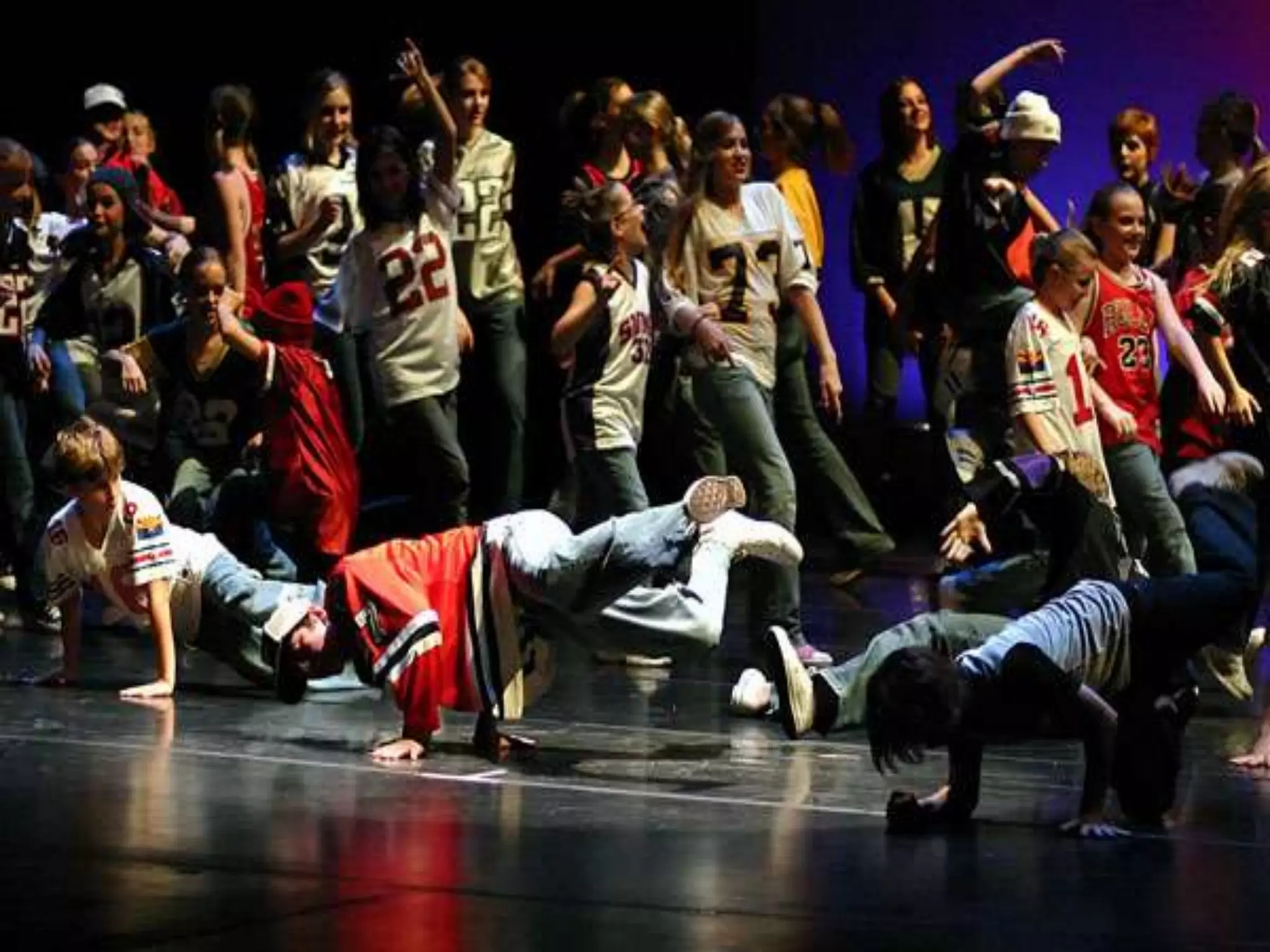
Musical Comedy
 Refers to those dances performed by
  soloists, groups, and choruses in
  theaters, night clubs, motion pictures,
  and television.
 Combines various forms of ballet,
  modern, tap and acrobatics.

The scope of humanities

  • 1.
    THE SCOPE OF HUMANITIES By: Eric F. Pazziuagan
  • 2.
  • 3.
    Visual Arts Perceive by our eyes Classification: ◦Graphic: flat, two- dimensional surface ◦Plastic arts: three- dimesional
  • 4.
    The Graphic Arts Any form of visual representation in which portrayals of forms and symbols are recorded on a two-dimensional surface.  All processes and products of the of the printing industry.
  • 5.
  • 6.
    Painting  Process of applying pigment to a surface to secure effects involving forms and colors.  Painting mediums: oils, watercolors, tempera, others.  Surfaces: canvas, wood, paper and plaster.
  • 8.
    Drawing  The art of representing something by lines made on a surface or the process of portraying an object, scene, or forms of decorative or symbolic meaning through lines, shading, and textures in one or more colors.  Medium: pencil, pen and ink, crayon, brush, and charcoal.
  • 10.
    Graphic Processes  Processesfor making multi- reproduction of graphic works.  Involve the preparation of master image of the drawing or design on some durable material such as wood, metal, or stone, from which printing is done.  Processes: ◦ Raised (relief) ◦ Depressed (Intaglio) ◦ Flat (surface, or plane)
  • 11.
    Relief Printing  Unwanted portions of design are cut away on the master image.  Printed image is formed by the remaining surfaces.  Examples: linoleum cuts, woodcuts, wood
  • 14.
    Intaglio Printing  Printingfrom a plate on which incised lines, which carry the ink, leave a raised impression.  Dry point: ◦ Artist draws directly on a metal plate with a sharp needle and scratches lines, or grooves, into the metal. ◦ For each print, ink is rubbed into the grooves and the unscratched surface is wiped clean. ◦ In printing, the ink in the grooves is transferred to paper.
  • 15.
    Etching: ◦ Drawing or designs on metal plates covered with wax. ◦ Needle penetrates wax to the surface of the plate. ◦ Plate is then dipped in acid, which eats the lines into the metal. ◦ For printing, etched (bitten) lines are filled with ink which is transferred to the paper.  Engraving: ◦ Done on a metal plate with a cutting tool called a barin, which leaves a V-shaped trough. ◦ Drawings or designs on the plate are entirely composed of lines or dots.
  • 17.
    Surface Printing  Includesall processes in which printing is done from a flat (plane) surface.  Lithography: ◦ Printing from a flat stone or metal plate by am method based on the repulsion between grease and water. ◦ Design is put on the surface. ◦ Surface is treated so that ink adheres only to areas where drawing has been done. ◦ Ink is then transferred to the paper in printing.
  • 18.
     Silkscreen: ◦Silk is stretched over a rectangular frame and unwanted portions in the design are blocked out. ◦ Pigment is forced through the clear areas. ◦ For multi-color prints, a separate screen is used for each color.
  • 19.
    Commercial Art  Designing of books, advertisements, signs, posters, and other displays to promote sale or acceptance of product, service or idea.
  • 20.
    Mechanical Processes  Developed by commercial- mechanical process for rapid, large- quantity reproduction of words and pictures in one or more colors.
  • 21.
    Photography  Chemical- mechanicalprocess by which images are produced on sensitized surfaces by action of light.  Reproductions may be in black or white or in full colors of the original.
  • 22.
  • 23.
    The Plastic Arts Allfieldsof the visual arts in which materials are organized into three- dimensional forms.
  • 24.
    Architecture  The artof designing and constructing buildings and other types of structures.  Materials: stone, concrete, brick, wood, steel, glass, plaster  “mother of the arts”- it houses, serves as background for, or occurs in relation to other fields of art such as painting, sculpture, interior design, landscape architecture, and city
  • 26.
    Landscape Architecture  Planning outdoor areas for human use and enjoyment, especially gardens, parks, playgrounds, golf courses.  Chief materials: plants, shrubs, trees, folwers, vines, and ground cover.
  • 28.
    City Planning  Planning and arranging the physical aspects of a large or small community.  Structures and areas concerned with all phases of living and working are attractively and efficiently organized and related.
  • 30.
    Interior Design  Design and arrangement of architectural interiors for convenience and beauty.  Includes backgrounds (wall, floors, ceilings), furnishings, and accessories.  Fields: Design of wallpaper, furniture, textiles for curtains, and upholstery
  • 32.
    Sculpture  Design and construction of three dimensional forms representing natural objects or imaginary (sometimes abstract) shapes.  Common materials: stone, wood, clay, metal; ivory, jade, wire, string and other materials.  Sculpture of figures: statues
  • 34.
    Crafts  Designing andmaking of objects by hand for use or for pleasure.  Ceramics, jewelry, leatherwork, and weaving.  Mass- produced: industrial design.
  • 36.
    Industrial Design  Designof objects for machine production.  Examples: automobiles, household appliances
  • 37.
    Dress and CostumeDesigns  Design of wearing apparel of all types- dresses, coats, suits, shoes, ties, etc.
  • 38.
    Theater Design  Design of settings for dramatic productions.
  • 39.
  • 40.
    Literature  Theart ofcombining spoken or written words and their meanings into forms which have artistic and emotional appeal.
  • 41.
    Drama A form of literature.
  • 42.
    Essay  Non-fiction,expository (descriptiveor explanatory) writing ranging from informal, personal topics to closely reasoned critical treatments of important subjects.
  • 43.
    Prose Fiction  Includesnarratives (stories) created by the author, as distinguished from true accounts.  Fiction: comes from the Latin word which means “to form”, “to invent”, or “to feign.”  Divided into: novel, novelette, and short story forms.  Novel or short story: describes
  • 44.
    Poetry  Literature ofa highly expressive nature using special forms and choice of words and emotional images.  Narrative (story telling) poetry includes epics, romances, and ballads.  Lyric forms: sonnet, ode, elegy and songs.
  • 45.
    Miscellaneous  History,biography, letters, journals, diaries, and other works not formally classified as literature often have literary appeal and status due to high quality of the writing.
  • 46.
  • 47.
    Music  The artof arranging sound in rhythmic succession and generally in combination.  Melody results from this sequence, and harmony from combinations.  Both creative and a performing art  Common forms: songs, march, fugue, sonata, suite, fantasy, concerto, and symphony.
  • 48.
    Vocal music  Composedprimarily to be sung.  Voice or voices are generally accompanied by one or more instruments.
  • 49.
    Instrumental music  Written for instruments of four general types: ◦ Keyboard (piano, organ, etc.) ◦ Stringed ( violin, cello, guitar, etc.) ◦ Wind (flute, clarinet, etc.) ◦ Brass winds (trumpet, saxo-phone, etc.) ◦ Percussion (drum, xylophone, etc.)
  • 50.
    Music combined withother arts  Opera: ◦ drama set to music ◦ Mostly or entirely sung with orchestral accompaniment ◦ Spectacularly staged with accomplished singers, elaborate scenery, and costumes.
  • 51.
     Operatta and musical comedy: ◦ Drama set to music but is light, popular, romantic and often humorous or comic ◦ Use spoken dialogue instead of recitative
  • 52.
    Oratorio and Cantata: ◦ Sacred musical drama in concert form. ◦ Made up of recited parts (recitative), arias, and choruses, with orchestral accompaniment. ◦ No action, sets, and costumes are used. ◦ Oratories are usually based on Biblical themes
  • 53.
    Other forms  Balletmusic  Background music for motion pictures
  • 54.
  • 55.
    Drama or play Astory re-created by actors on stage in front of an audience.
  • 56.
    Tragedy  One of literature's greatest dramatic art forms.  A drama of serious nature in which the central character comes to sad or disastrous end.  All tragedies portray
  • 58.
    Melodrama  Emphasis is on action rather than on character.  The action is sensational or romantic and usually has a happy ending.
  • 60.
    Comedy  All playswith happy endings.  Romantic comedy: light, amusing tale of lovers in some dilemma which is solved happily,  Farce: light, humurous play. Emphasis is on jokes, humorous physical action, ludicrous situations, and improbable characters.  Comedy of manners or “drawing room comedy”: sophisticated or satirical. Characters are usually high-society types, and situations have little to do with real
  • 61.
    Miscellaneous  Tragicomedy: dramablending tragic and comic elements but which ends happily.  Miracle and mystery plays: dramatized stories from the Bible and lives of saints.  Morality plays: characters represent specific vices and virtues.  Closet drama: plays written for reading than for staging.
  • 62.
    Piano drama: based on piano works which revolve around the musical pieces composed under the inspiration of a literary work. It combines the interpretation of music with the recitation of poetry and the literary source of music.
  • 63.
  • 64.
    Dance  Involves the movement of the body and feet in rhythm.
  • 65.
    Ethnologic  Includes folkdancing associated with national and cultural groups.
  • 66.
    Social or Ballroom dances  Popular types of dancing generally performed by pairs.  Waltz, fox trot, rhumba and tango.
  • 67.
    The Ballet  Formalized type of dance which originated in the courts of the Middle Ages.  Amy either be solo or concerted dances with mimetic actions accompanied by music.  Generally built around a theme or story.
  • 69.
    Modern  Sometimes calledcontemporary or interpretative dances.  Represents rebellion against the classical formalism of ballet: they emphasize personal communication of moods and themes.  Past: movements were natural and untrained.  Today: varied forms of movements usually based on the current trend.
  • 71.
    Musical Comedy  Refersto those dances performed by soloists, groups, and choruses in theaters, night clubs, motion pictures, and television.  Combines various forms of ballet, modern, tap and acrobatics.