DR. D RAJ KIRAN
SENIOR RESIDENT
DEPT. OF PSYCHIATRY, KIMSRF
AMALAPURAM
Interviewing
techniques
TYPES OF INTERVIEW TECHNIQUES
 Facilitating interventions
 Enable patient to continue sharing, promotes a positive
patient doctor relationship.
 Expanding interventions
 Helps to expand the focus of the interview.
 Obstructive interventions
 If introduced in an unclear manner, unconnected to
content, or poorly timed they may be experienced as
unresponsive to the patient’s concerns or feelings
FACILITATING INTERVENTIONS
 Reinforcement
 Reflection
 Summarizing
 Education
 Reassurance
 Encouragement
 Acknowledging emotion
 Humour
 Non verbal communication
 Silence
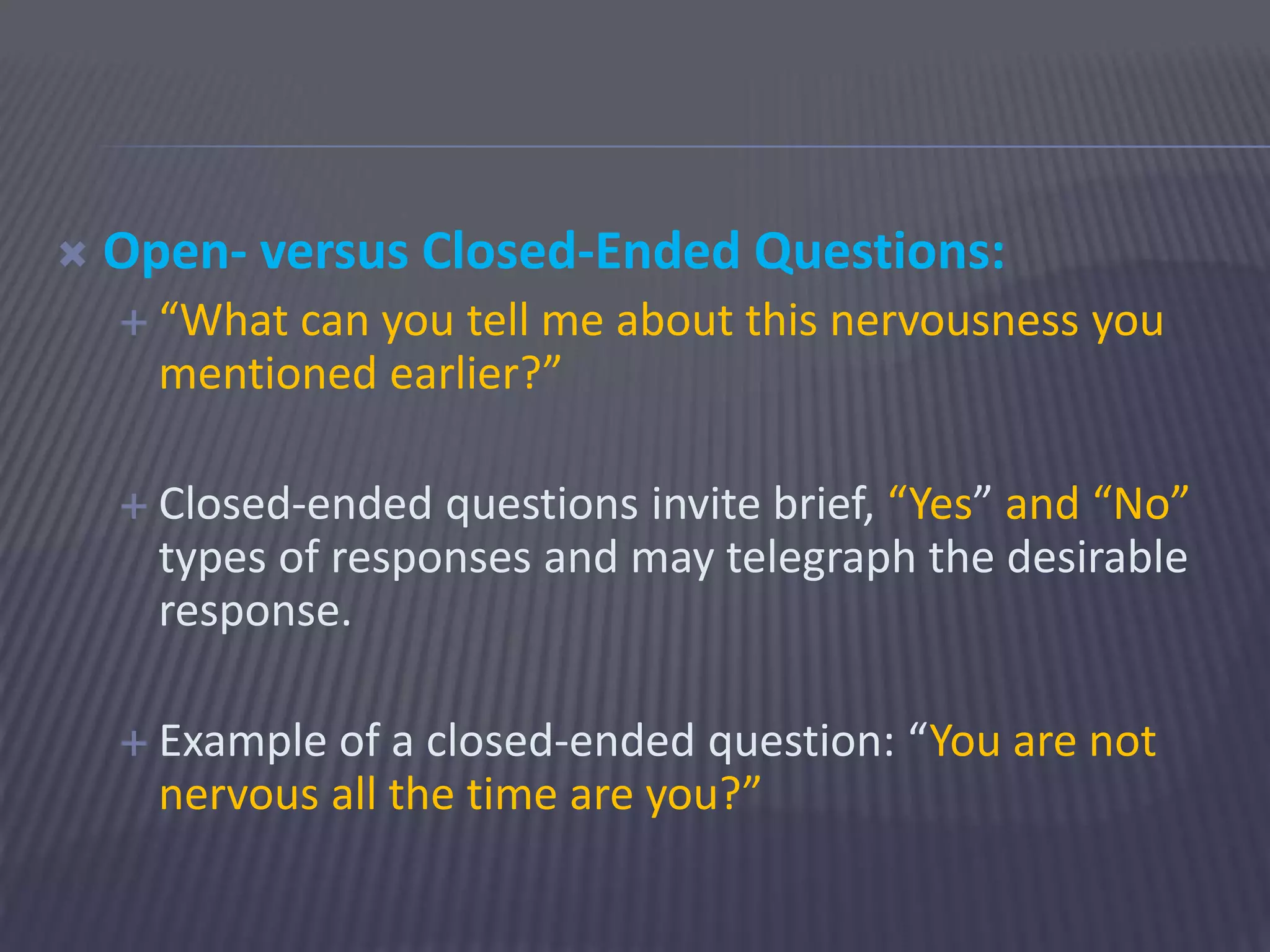
 Open- versus Closed-Ended Questions:
 “What can you tell me about this nervousness you
mentioned earlier?”
 Closed-ended questions invite brief, “Yes” and “No”
types of responses and may telegraph the desirable
response.
 Example of a closed-ended question: “You are not
nervous all the time are you?”
 Reinforcement :
 Brief phrases such as, “I see,” “Go on,” “Yes,” “Tell
me more,” “Hmm,” or “Uh-huh,” all convey the
interviewer’s interest in the patient continuing.
 Important that these phrases fit naturally into the
dialogue.
 Reflection:
 By using the patient’s words, the interviewer
indicates that he/she has heard what the patient is
saying and conveys the implicit message that he/she
is interested in hearing more
 Summarizing :
 Periodically during the interview, it is helpful to
summarize what the patient offered about a certain
topic.
 Provides the opportunity for the patient to clarify or
modify the interviewer’s understanding and possibly
add new material
 Education :
 At times in the interview, it is helpful for the
interviewer to educate the patient about the
interview process.
 Reassurance :
 It is often appropriate and helpful to provide
reassurance to the patient.
 False reassurance should never be given.
 Encouragement :
 It is difficult for many patients to come for evaluation.
 They are uncertain about what will happen, and
receiving encouragement can facilitate their
engagement
 Acknowledgment of Emotion:
 It is important for the interviewer to acknowledge the
expression of emotion by the patient.
 Humor :
 At times, patients make humorous comments or tell a
joke.
 Very helpful if the interviewer smiles, laughs, or even,
when appropriate, adds another punch line.
 Sharing of humor can decrease tension and anxiety
and reinforce the interviewer’s genuineness
 Silence :
 Careful use of silence can facilitate the progression
of the interview.
 Patient may need time to think about what has been
said or to experience a feeling that has arisen in the
interview.
 Nonverbal Communication :
 Most common facilitating interventions are nonverbal.
 Nodding of the head, body posture including leaning
toward the patient, body positioning becoming more
open, moving the chair closer to the patient, putting
down pen and folder, and facial expressions including
arching of eyebrows all indicate that the interviewer is
concerned, listening attentively, and engaged in the
interview.
 Expanding Intervention
 Helpful when the line of discussion has been
sufficiently mined, at least for the time being, and the
interviewer wants to encourage the patient to talk
about other issues
 Most successful when a degree of trust has been
established in the interview and the patient feels that
the interviewer is nonjudgmental about what is being
shared.
EXPANDING INTERVENTIONS
 Clarifying
 Association
 Leading
 Probing
 Transitions
 Redirecting
 Clarifying :
 At times carefully clarifying what the patient has
said can lead to unrecognized issues.
 Associations :
 As the patient describes symptoms, other areas that
may accompany or relate to a symptom should be
explored.
 Leading :
 Often, encouraging the patient to continue their story
can be facilitated by asking a “what,” “when,”
“where,” or “who” questions.
 “Why” questions are generally not helpful early in an
interview.
 Probing:
 Interview may point toward an area of conflict, but
the patient may minimize or deny any difficulties.
 Gently encouraging the patient to talk more about
this issue may be quite productive.
 Transitions:
 Sometimes transitions occur very smoothly.
 Transition means moving to a different area of the
interview and a bridge statement is useful.
 Redirecting :
 It is difficult to proceed with the interview in one
direction if one is concentrating on other direction.
 Redirection can be used when patient changes topics
too quickly or persists in offering information about
non productive or already crossed area.
OBSTRUCTIVE INTERVENTIONS
 Excessive use of closed ended questions
 Compound questions
 Excessive use “why?” questions
 Judgmental questions
 Minimizing patient concerns
 Premature advice
 Premature interpretations
 Abrupt transitions
 Ambiguous non verbal communication
 Compound Questions :
 Some questions are difficult for patients to respond
to because more than one answer is being sought.
 Why Questions :
 Especially early in the psychiatric interview, “why”
questions are often nonproductive.
 Very often seeking an answer to a “why” question is
one of the reasons that the patient has sought help.
 Judgmental Questions or Statements:
 Non productive and prevent progress of the
interview.
 They inhibit the patient from sharing more
information
 Minimizing Patient’s Concerns:
 In an attempt to reassure a patient the interviewer
makes the error of minimizing a concern.
 Premature Advice :
 Even though it may be accurate, it may be counter-
productive, as the patient may respond defensively
and feel misunderstood
 Premature Interpretation :
 Interrupting before the patient finishes off what he/
she is saying.
 This might disinterest or might feel that the
interviewer is not genuinely interested in the concern
of the patient
 Transitions :
 Some transitions are too abrupt and may interrupt
important issues that the patient is discussing.
 Nonverbal Communication :
 Repeatedly looking at watch, turning away from the
patient, yawning, or refreshing the computer screen
all convey boredom, disinterest, distraction, or
annoyance.
 These can quickly shatter an interview and
undermine the patient–doctor relationship.
STRESS INTERVIEW
 It is used by an employer to put a candidate
under intense pressure, to assess how a
candidate handles work overload, how they deal
with multiple projects, and how good they are at
handling workplace conflict.
APPROACHES
 Intimidating: Why were you fired from your last job, was your
previous job too much to handle?
 Aggressive behaviour: interviewer may be sitting with feet up
on the desk, while answering the questions answering the
phone.
 Unexpected answers: may ask the same question multiple
times, pretending that he or she forgot the question
 Brainteasers: How many steps have you while coming to
office?
METHODS TO COPE
 Remain calm and unemotional during the process. Some
tactics can be used like-
 Clarifying the question asked. This helps to buy some time to
think about the question before answering.
 Requesting for more details.
 Focussing on describing the problem solving approach rather
than devise the correct answer.
 Not to get the fearful or intimidated
DISADVANTAGES
 Interview is a reflection of the kind of people and
culture the company has, this would give wrong
information about the interviewer or the company.
 Creates an unnecessary pressure, may cause insult,
humiliation, frustration and even de-motivate the
interviewee.
 Hostile environment may turn down a potential
candidate.
COUNSELING
 Definition: Counselling is an interactive learning
process contracted between the counsellor and the
client, be they individual, families, groups or
institutions, which approach in a holistic way, social ,
cultural economic and/ or emotional issues.
 Aims: Provide the individual with opportunity to
work in self defined ways, towards living in more
satisfying and resourceful ways.
USES
 Behavior change
 Enhancing coping skills
 Promote decision making
 Improving relationships
 Enlightenment
 Acquisition of social skills
PRINCIPLES
 Acceptance
 Communication
 Empathy
 Confidentiality
 Individuality
 Non emotional involvement
TECHNIQUES
 Clarification
 Individual expectations
 Confrontation
 Congruence
 Encouraging
 Focusing
 Listening skills
 Open ended questions
 Paraphrasing
 Reflection of feeling
 Trustworthiness
 Self disclosure
QUALITIES OF COUNSELORS
 Communications skills
 Acceptance
 Empathy
 Problem solving skills
 Rapport building skills
 Self awareness
 Multicultural competency
THANK YOU

Interviewing techniques

  • 1.
    DR. D RAJKIRAN SENIOR RESIDENT DEPT. OF PSYCHIATRY, KIMSRF AMALAPURAM Interviewing techniques
  • 2.
    TYPES OF INTERVIEWTECHNIQUES  Facilitating interventions  Enable patient to continue sharing, promotes a positive patient doctor relationship.  Expanding interventions  Helps to expand the focus of the interview.  Obstructive interventions  If introduced in an unclear manner, unconnected to content, or poorly timed they may be experienced as unresponsive to the patient’s concerns or feelings
  • 3.
    FACILITATING INTERVENTIONS  Reinforcement Reflection  Summarizing  Education  Reassurance  Encouragement  Acknowledging emotion  Humour  Non verbal communication  Silence
  • 4.
     Open- versusClosed-Ended Questions:  “What can you tell me about this nervousness you mentioned earlier?”  Closed-ended questions invite brief, “Yes” and “No” types of responses and may telegraph the desirable response.  Example of a closed-ended question: “You are not nervous all the time are you?”
  • 5.
     Reinforcement : Brief phrases such as, “I see,” “Go on,” “Yes,” “Tell me more,” “Hmm,” or “Uh-huh,” all convey the interviewer’s interest in the patient continuing.  Important that these phrases fit naturally into the dialogue.
  • 6.
     Reflection:  Byusing the patient’s words, the interviewer indicates that he/she has heard what the patient is saying and conveys the implicit message that he/she is interested in hearing more
  • 7.
     Summarizing : Periodically during the interview, it is helpful to summarize what the patient offered about a certain topic.  Provides the opportunity for the patient to clarify or modify the interviewer’s understanding and possibly add new material
  • 8.
     Education : At times in the interview, it is helpful for the interviewer to educate the patient about the interview process.
  • 9.
     Reassurance : It is often appropriate and helpful to provide reassurance to the patient.  False reassurance should never be given.
  • 10.
     Encouragement : It is difficult for many patients to come for evaluation.  They are uncertain about what will happen, and receiving encouragement can facilitate their engagement
  • 11.
     Acknowledgment ofEmotion:  It is important for the interviewer to acknowledge the expression of emotion by the patient.
  • 12.
     Humor : At times, patients make humorous comments or tell a joke.  Very helpful if the interviewer smiles, laughs, or even, when appropriate, adds another punch line.  Sharing of humor can decrease tension and anxiety and reinforce the interviewer’s genuineness
  • 13.
     Silence : Careful use of silence can facilitate the progression of the interview.  Patient may need time to think about what has been said or to experience a feeling that has arisen in the interview.
  • 14.
     Nonverbal Communication:  Most common facilitating interventions are nonverbal.  Nodding of the head, body posture including leaning toward the patient, body positioning becoming more open, moving the chair closer to the patient, putting down pen and folder, and facial expressions including arching of eyebrows all indicate that the interviewer is concerned, listening attentively, and engaged in the interview.
  • 15.
     Expanding Intervention Helpful when the line of discussion has been sufficiently mined, at least for the time being, and the interviewer wants to encourage the patient to talk about other issues  Most successful when a degree of trust has been established in the interview and the patient feels that the interviewer is nonjudgmental about what is being shared.
  • 16.
    EXPANDING INTERVENTIONS  Clarifying Association  Leading  Probing  Transitions  Redirecting
  • 17.
     Clarifying : At times carefully clarifying what the patient has said can lead to unrecognized issues.
  • 18.
     Associations : As the patient describes symptoms, other areas that may accompany or relate to a symptom should be explored.
  • 19.
     Leading : Often, encouraging the patient to continue their story can be facilitated by asking a “what,” “when,” “where,” or “who” questions.  “Why” questions are generally not helpful early in an interview.
  • 20.
     Probing:  Interviewmay point toward an area of conflict, but the patient may minimize or deny any difficulties.  Gently encouraging the patient to talk more about this issue may be quite productive.
  • 21.
     Transitions:  Sometimestransitions occur very smoothly.  Transition means moving to a different area of the interview and a bridge statement is useful.
  • 22.
     Redirecting : It is difficult to proceed with the interview in one direction if one is concentrating on other direction.  Redirection can be used when patient changes topics too quickly or persists in offering information about non productive or already crossed area.
  • 23.
    OBSTRUCTIVE INTERVENTIONS  Excessiveuse of closed ended questions  Compound questions  Excessive use “why?” questions  Judgmental questions  Minimizing patient concerns  Premature advice  Premature interpretations  Abrupt transitions  Ambiguous non verbal communication
  • 24.
     Compound Questions:  Some questions are difficult for patients to respond to because more than one answer is being sought.
  • 25.
     Why Questions:  Especially early in the psychiatric interview, “why” questions are often nonproductive.  Very often seeking an answer to a “why” question is one of the reasons that the patient has sought help.
  • 26.
     Judgmental Questionsor Statements:  Non productive and prevent progress of the interview.  They inhibit the patient from sharing more information
  • 27.
     Minimizing Patient’sConcerns:  In an attempt to reassure a patient the interviewer makes the error of minimizing a concern.
  • 28.
     Premature Advice:  Even though it may be accurate, it may be counter- productive, as the patient may respond defensively and feel misunderstood
  • 29.
     Premature Interpretation:  Interrupting before the patient finishes off what he/ she is saying.  This might disinterest or might feel that the interviewer is not genuinely interested in the concern of the patient
  • 30.
     Transitions : Some transitions are too abrupt and may interrupt important issues that the patient is discussing.
  • 31.
     Nonverbal Communication:  Repeatedly looking at watch, turning away from the patient, yawning, or refreshing the computer screen all convey boredom, disinterest, distraction, or annoyance.  These can quickly shatter an interview and undermine the patient–doctor relationship.
  • 32.
    STRESS INTERVIEW  Itis used by an employer to put a candidate under intense pressure, to assess how a candidate handles work overload, how they deal with multiple projects, and how good they are at handling workplace conflict.
  • 33.
    APPROACHES  Intimidating: Whywere you fired from your last job, was your previous job too much to handle?  Aggressive behaviour: interviewer may be sitting with feet up on the desk, while answering the questions answering the phone.  Unexpected answers: may ask the same question multiple times, pretending that he or she forgot the question  Brainteasers: How many steps have you while coming to office?
  • 34.
    METHODS TO COPE Remain calm and unemotional during the process. Some tactics can be used like-  Clarifying the question asked. This helps to buy some time to think about the question before answering.  Requesting for more details.  Focussing on describing the problem solving approach rather than devise the correct answer.  Not to get the fearful or intimidated
  • 35.
    DISADVANTAGES  Interview isa reflection of the kind of people and culture the company has, this would give wrong information about the interviewer or the company.  Creates an unnecessary pressure, may cause insult, humiliation, frustration and even de-motivate the interviewee.  Hostile environment may turn down a potential candidate.
  • 36.
    COUNSELING  Definition: Counsellingis an interactive learning process contracted between the counsellor and the client, be they individual, families, groups or institutions, which approach in a holistic way, social , cultural economic and/ or emotional issues.  Aims: Provide the individual with opportunity to work in self defined ways, towards living in more satisfying and resourceful ways.
  • 37.
    USES  Behavior change Enhancing coping skills  Promote decision making  Improving relationships  Enlightenment  Acquisition of social skills
  • 38.
    PRINCIPLES  Acceptance  Communication Empathy  Confidentiality  Individuality  Non emotional involvement
  • 39.
    TECHNIQUES  Clarification  Individualexpectations  Confrontation  Congruence  Encouraging  Focusing  Listening skills  Open ended questions  Paraphrasing  Reflection of feeling  Trustworthiness  Self disclosure
  • 40.
    QUALITIES OF COUNSELORS Communications skills  Acceptance  Empathy  Problem solving skills  Rapport building skills  Self awareness  Multicultural competency
  • 41.