




ERIC F. PAZZIUAGAN, RN, MAN
 Substance: a drug of abuse. A medication
or a toxin.
 Substance abuse: maladaptive pattern of
drug use leading to impairment or
distress, as manifested by one or more of
the following occurring within a 12-month
period.
 Failure to fulfil major roles
 Use in hazardous situations
 Recurring related legal problems.
 Continued use despite social or interpersonal
problems
 Substance intoxication: a reversible drug
intoxication syndrome caused by recent
ingestion of, or exposure to, a substance
resulting in maladaptive behavior or
psychologic changes from effect of CNS.
 Substance withdrawal: development of a
substance- specific syndrome resulting
from cessation or reduction in substance
use that has been heavy or prolonged.
 Impairment in role functioning
 Symptoms are not from another mental
disorder
 Substance tolerance: the need for greatly
increased amounts of the substance to
achieve the desired effects, or a markedly
diminished effect with the continued use
of the same amount of substance.
 Polysubstance abuse: abuse of two or
more drugs or of alcohol and drugs.
 Potentiation: two or more substances
interact in the body to produce an effect
greater than the sum of the effects of
each substance taken alone.
 Substance dependence: the
continued use of a substance despite
significant related problems in
cognitive, physiologic, and
behavioural components; spending
more time in getting, taking, and
recovering from the substance;
continuous abuse despite knowledge
of physical or psychological problems
or awareness of complications
resulting from continued use.
 Depressant of major brain functions
(mood
cognition, attention, concentration, insi
ght. Judgment, memory, affect)
resulting in diminished emotional
rapport with others.
 Alcohol is a CNS depressant that is
dose dependent and ranges from
lethargy, unconsciousness, coma, resp
 Causation theories range from genetic,
stress, environmental to interpersonal
factors; none fully explains causation.
 Neurobiologic perspective:
 The biologic or genetic theory continues to be
researched.
 Some research has identified subtypes of
alcoholism; one type is associated with early
onset, inability to abstain, and an antisocial
personality; another is a later onset, after age
25, inability to stop drinking once started and a
passive-dependent personality; this latter type
seems to be influenced by the environment.
Some researches subscribe to
the single genetic transmission;
others believe that complex
genetic factors are involved in
alcoholism.
Biologic differences in the
response to alcohol may influence
susceptibility.
Further research is necessary
 Intoxication: state in which coordination or
speech is impaired and behavior is altered.
 Episodic excessive drinking: becoming
intoxicated as infrequently as four times a year;
episodes may vary in length from hours to days
or weeks.
 Habitual excessive drinking: becoming
intoxicated more than 12 times a year or being
recognizably under the influence of alcohol more
than once a week even though not considered
intoxicated.
 Alcohol addiction: direct or strong
presumptive evidence of dependence on
alcohol; demonstrated by withdrawal
(nausea, hypertension, anorexia) or by the
inability to go for a day without drinking;
when there is a history of heavy drinking
for 3 or more months; the individual is
considered addicted to alcohol.
 Early symptoms of alcoholism: frequent
drinking sprees, increased intake, drinking
alone or in the early morning, occurrence
of blackout.
 Should be multifaceted social and
medical involves psychotherapy
(group, family and individual
functioning).
 Self- help group such as Alcoholics
Anonymous
 Negative conditioning with disulfiram
(Antabuse) appears to help; never
given without the
Naltrexone hcl (Trexan, ReVia) to
help overcome the craving for
alcohol.
Clients can be assisted only when
they admit they need help.
Relaxation therapy.
Physical needs must be met
because dietary needs have been
often ignored for long periods.
 History of alcohol use/ abuse from client or
family; screen using the CAGE questionnaire
 Blood alcohol level (BAL)
 Data collection pertaining to substance and
psychiatric impairment
 Client’s perception of the problem.
 Physical and emotional status in relation to needs
associated with nutrition, fluid and electrolyte
status, and safety.
 Why client is seeking treatment at this time
 Anxiety
 Impaired verbal communication
 Acute confusion
 Chronic confusion
 Defensive coping
 Dysfunctional family processes
 Ineffective health maintenance
 Defensive coping
 Risk for injury
 Risk for loneliness
 Impaired memory
 Noncompliance with abstinence and
supportive therapy
 Imbalanced nutrition: less than body
requirements
 Chronic low self-esteem
 Risk for self- mutilation
 Disturbed sensory perceptions
(visual, kinesthetic, tactile)
 Risk for violence: self- directed or directed at
others
 Provide a well- controlled, alcohol- free
environment; explain all unit routines.
 Plan a full program of activities but provide
for adequate rest; environment should be
well lit and quiet.
 Support the client without criticism of
judgement.
 Expect and accept lapses as client is
changing a long-term habit; assist with
ADL as necessary.
 Avoid attempting to talk client out of problem
or making client feel guilty.
 Accept the smooth facade that the client may
present while approaching the lonely and
fearful individual behind it.
 Monitor visitors because they may supply the
client with alcohol.
 Accept failures without judgment or
punishment.
 Recognize that the development of PTs and
hallucinations are frightening; stay with and
support client.
Accept hostility without criticism or
retaliation.
Recognize ambivalence and limit
the need for decision making.
Maintain the client’s interest in a
therapy program.
Refer to an appropriate 12- step
group such as AA.
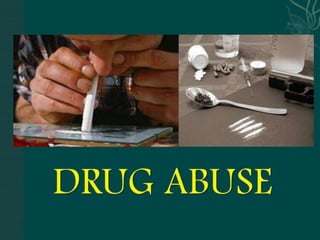
 Misuse of drugs, usually by self-
administration, in such a way as to
bring about physical, emotional, or
behavioural changes and blurring of
reality.
 Stressors: premorbid
personality, utilizing compensatory
mechanisms of the addictive patterns
of behavior.
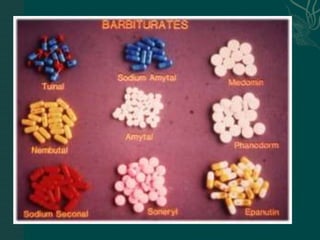
Antianxiety drugs, hypnotics.
Reduction in anxiety, escape from
stress.
Irritability, weight loss, changes in
mood or motor coordination.
Keep person awake and moving
to prevent coma; maintain airway.
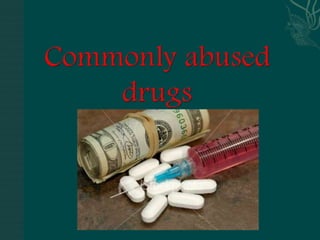
 Heroin, morphine, meperedine, methadon
e.
 Euphoria, dysphoria, and or/apathy
 Pinpoint pupils, mental
clouding, lethargy, impaired memory and
judgment, evidence of needle
tracks, inflamed nasal mucosa if drug is
snorted.
 Provide emergency support of vital
functions.
 In withdrawal, administer methadone or
 Cocaine/ crack
 Increased self-esteem, energy, sexual
desire, euphoria; decreased anxiety.
 Increased VS, headache, chest
pain, depression and/or paranoia, inflamed
nasal passages if snorted.
 Emergency support of vital
functions, reduce CNS stimulation.
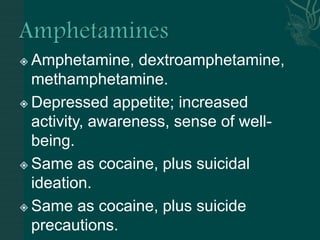
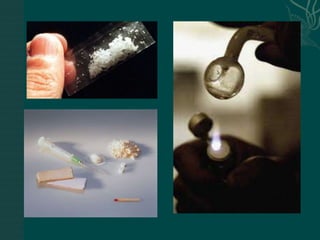
 Amphetamine, dextroamphetamine,
methamphetamine.
 Depressed appetite; increased
activity, awareness, sense of well-
being.
 Same as cocaine, plus suicidal
ideation.
 Same as cocaine, plus suicide
precautions.
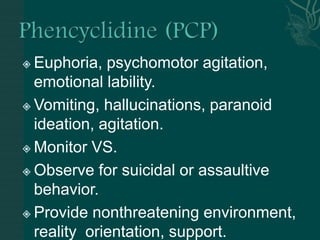
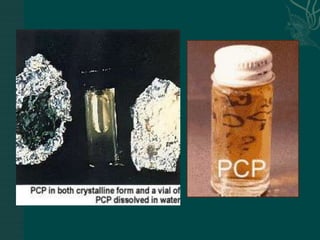
 Euphoria, psychomotor agitation,
emotional lability.
 Vomiting, hallucinations, paranoid
ideation, agitation.
 Monitor VS.
 Observe for suicidal or assaultive
behavior.
 Provide nonthreatening environment,
reality orientation, support.
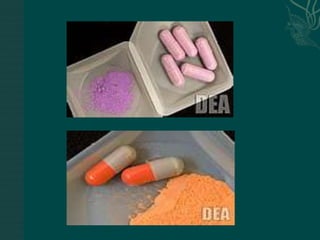
 LSD, mescaline
 Disordered perceptions,
depersonalization.
 “bad trip,” high anxiety to panic;
hallucinations may occur long after the
drug has been metabolized; flashbacks
may produce long-lasting psychotic
disorders.
 Same as PCP, plus talk client down.
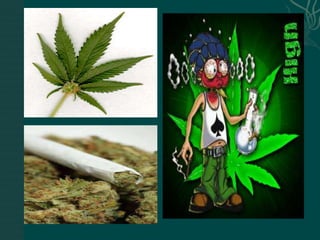
 Marijuana, hashish, THC
 Euphoria, intense
perceptions, relaxation, lethargy.
 Increased pulse rate and appetite;
impaired judgement and coordination.
 In panic, talk down.
 In severe depression, institute suicide
precautions.
 Nicotine is one of the most highly
addictive and heavily used drugs in the
United States and around the world. It
causes lung cancer, emphysema, and
cardiovascular disease and
secondhand smoke is associated with
lung cancer in adults and respiratory
illness in children.
 Death is the primary adverse effect of
 Behaviorally, the stimulatory effects of
nicotine produce improved attention,
learning, reaction time, and problem-
solving ability.
 In low doses the signs and symptoms of
nicotine toxicity include nausea, vomiting,
salivation, pallor (caused by peripheral
vasoconstriction), weakness, abdominal
pain (caused by increased peristalsis),
diarrhea, dizziness, headache, increased
blood pressure, tachycardia, tremor, and
cold sweats.
 Toxicity is also associated with an inability
to concentrate, confusion, and sensory
 Psychiatrists should advise all patients to
quit smoking.
 Behavior therapy is the most widely
accepted and well-proved psychological
therapy for smoking.
 Skills training and relapse prevention
identify high-risk situations and plan and
practice behavioral or cognitive coping skills
for those situations in which smoking
occurs.
 Aversive therapy has smokers smoke
repeatedly and rapidly to the point of
nausea that associates smoking with
unpleasant, rather than
 Needle marks on limbs , or between
toes, can lead to infections
(e.g., endocarditis, hepatitis, or HIV)
 Addicted individuals may tend to wear
long-sleeved shirts, even in warmer
weathers.
 Yawning, lacrimation, rhinorrhea, and
perspiration appear 10 to 15 hours
after the last opiate injection; unrealistic
high; pronounced depression.
 Severe abdominal cramps if too much time
has elapsed between opiate injections or
inhalation.
 Physical examination may reveal an
underweight, malnourished individual with
multiple dental carries and depressed CNS
functioning.
 Job or academic failure; marital conflicts;
poor reality testing; personality change.
 History of violent acting out with total
disregard for human life or suffering.
 History of stealing to support habit.
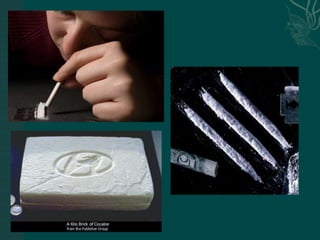
 Cocaine snorting leads to nasal septum
destruction, hoarseness, and throat
infections.
 Inability to maintain activities of daily living
or fulfil role obligations.
 Marked tolerance with a progressive need
for higher doses to achieve desired effects.
 Marked letdown with progression to severe
depression after cocaine use.
 Hallucinations, hypervigilance, increased
sexual activity, and paranoid ideation with
 Techno drugs: ecstacy (MDMA, methylene
dioxymetamphetamine) and ketamine
resemble amphetamine effects; also known
as recreational drugs.
 Adverse effects of psychostimulants can cause
hyperthermia, acute renal
failure, depression, panic, psychosis, and
cardiovascular collapse.
 Sleep disorders, depression, high anxiety
levels, hostility, and impulsiveness are all
associated with recreational drug use.
 Sexual assault-rape drug, flunitrazepam
(Rohypnol) produces disinhibition and muscle
relaxation along with antero-grade amnesia;
alcohol potentiate the effects.
Treatment for drug overdose:
Narcotic antagonists
Nalorphine (nallin)/ naloxone
(Narcan): improves RR although may
not affect LOC
Gastric lavage may be done if
substance has been taken orally
within the past several hours.
Treatment for withdrawal
symptoms:
Antidepressants: block the “high”
from stimulant abuse and diminish
craving for the substance.
Clonidine (Catapres): suppresses
narcotic withdrawal symptoms and
decreases adrenergic excess while
opiate receptors return to normal
Methadone maintenance for
opiate addiction: programs do not
treat addiction, but change the
addiction from an illegal drug to a
legal drug, which is administered
under supervision; has proved
successful only in individuals with
long-standing addictions.
High- calorie, high-protein, high-
vitamin diet because of poor
eating habits.
Treatment in groups run by ex-
addicts.
Therapeutic community setting.
Psychotherapy and family therapy
on out-patient basis.
Vocational counselling.
 History of drugs being used.
 Urine toxicology screen and HIV
 Drug abuse screening test (DAST)
 History and length of pattern of drug
dependence.
 Time since last dose was taken.
 Physical status of the client for signs and
symptoms of drug dependence; nutritional
status.
 Symptoms of drug overdose or withdrawal.
 Degree of difficulty sustained by client in
relation to family members, job, school,
etc.
 Why client is seeking treatment at this
time.
 Pending criminal charges.
 Presence of hallucinations, paranoid
ideation, and depression (often associated
with cocaine use)
 Potential for violence towards others or
self
 Relationship between substance abuse
 Anxiety
 Impaired verbal communication
 Acute confusion
 Chronic confusion
 Defensive coping
 Dysfunctional family processes
 Ineffective denial
 Risk for injury
 Risk for loneliness
 Impaired memory
 Noncompliance with abstinence and
supportive therapy
 Imbalanced nutrition: less than body
requirements
 Self-esteem disturbance
 Risk for self-mutilation
 Disturbed sensory perception (visual,
kinesthetic, tactile)
 Risk for violence: self-directed or directed to
 Set firm controls and keep area drug
free when client is hospitalized.
 Keep atmosphere pleasant and
cheerful but not over-stimulating.
 Contribute to client’s self-confidence,
self-respect, and security in a realistic
manner.
 Walk the fine line between a relatively
permissible and a firm attitude.
 Expect and accept evasion, manipulative
behavior, and negativism, but require the
client to shoulder certain standards of
responsibility.
 Accept the client without approving the
behavior.
 Do not permit the client to become
isolated.
 Introduce the client group activities as
soon as possible; evaluate client’s
response to group interaction.
 Protect clients from themselves and
others.

Substance- Related Disorders

  • 1.
  • 2.
     Substance: adrug of abuse. A medication or a toxin.  Substance abuse: maladaptive pattern of drug use leading to impairment or distress, as manifested by one or more of the following occurring within a 12-month period.  Failure to fulfil major roles  Use in hazardous situations  Recurring related legal problems.  Continued use despite social or interpersonal problems
  • 3.
     Substance intoxication:a reversible drug intoxication syndrome caused by recent ingestion of, or exposure to, a substance resulting in maladaptive behavior or psychologic changes from effect of CNS.  Substance withdrawal: development of a substance- specific syndrome resulting from cessation or reduction in substance use that has been heavy or prolonged.  Impairment in role functioning  Symptoms are not from another mental disorder
  • 4.
     Substance tolerance:the need for greatly increased amounts of the substance to achieve the desired effects, or a markedly diminished effect with the continued use of the same amount of substance.  Polysubstance abuse: abuse of two or more drugs or of alcohol and drugs.  Potentiation: two or more substances interact in the body to produce an effect greater than the sum of the effects of each substance taken alone.
  • 5.
     Substance dependence:the continued use of a substance despite significant related problems in cognitive, physiologic, and behavioural components; spending more time in getting, taking, and recovering from the substance; continuous abuse despite knowledge of physical or psychological problems or awareness of complications resulting from continued use.
  • 7.
     Depressant ofmajor brain functions (mood cognition, attention, concentration, insi ght. Judgment, memory, affect) resulting in diminished emotional rapport with others.  Alcohol is a CNS depressant that is dose dependent and ranges from lethargy, unconsciousness, coma, resp
  • 8.
     Causation theoriesrange from genetic, stress, environmental to interpersonal factors; none fully explains causation.  Neurobiologic perspective:  The biologic or genetic theory continues to be researched.  Some research has identified subtypes of alcoholism; one type is associated with early onset, inability to abstain, and an antisocial personality; another is a later onset, after age 25, inability to stop drinking once started and a passive-dependent personality; this latter type seems to be influenced by the environment.
  • 9.
    Some researches subscribeto the single genetic transmission; others believe that complex genetic factors are involved in alcoholism. Biologic differences in the response to alcohol may influence susceptibility. Further research is necessary
  • 11.
     Intoxication: statein which coordination or speech is impaired and behavior is altered.  Episodic excessive drinking: becoming intoxicated as infrequently as four times a year; episodes may vary in length from hours to days or weeks.  Habitual excessive drinking: becoming intoxicated more than 12 times a year or being recognizably under the influence of alcohol more than once a week even though not considered intoxicated.
  • 12.
     Alcohol addiction:direct or strong presumptive evidence of dependence on alcohol; demonstrated by withdrawal (nausea, hypertension, anorexia) or by the inability to go for a day without drinking; when there is a history of heavy drinking for 3 or more months; the individual is considered addicted to alcohol.  Early symptoms of alcoholism: frequent drinking sprees, increased intake, drinking alone or in the early morning, occurrence of blackout.
  • 14.
     Should bemultifaceted social and medical involves psychotherapy (group, family and individual functioning).  Self- help group such as Alcoholics Anonymous  Negative conditioning with disulfiram (Antabuse) appears to help; never given without the
  • 15.
    Naltrexone hcl (Trexan,ReVia) to help overcome the craving for alcohol. Clients can be assisted only when they admit they need help. Relaxation therapy. Physical needs must be met because dietary needs have been often ignored for long periods.
  • 17.
     History ofalcohol use/ abuse from client or family; screen using the CAGE questionnaire  Blood alcohol level (BAL)  Data collection pertaining to substance and psychiatric impairment  Client’s perception of the problem.  Physical and emotional status in relation to needs associated with nutrition, fluid and electrolyte status, and safety.  Why client is seeking treatment at this time
  • 18.
     Anxiety  Impairedverbal communication  Acute confusion  Chronic confusion  Defensive coping  Dysfunctional family processes  Ineffective health maintenance  Defensive coping
  • 19.
     Risk forinjury  Risk for loneliness  Impaired memory  Noncompliance with abstinence and supportive therapy  Imbalanced nutrition: less than body requirements  Chronic low self-esteem  Risk for self- mutilation  Disturbed sensory perceptions (visual, kinesthetic, tactile)  Risk for violence: self- directed or directed at others
  • 20.
     Provide awell- controlled, alcohol- free environment; explain all unit routines.  Plan a full program of activities but provide for adequate rest; environment should be well lit and quiet.  Support the client without criticism of judgement.  Expect and accept lapses as client is changing a long-term habit; assist with ADL as necessary.
  • 21.
     Avoid attemptingto talk client out of problem or making client feel guilty.  Accept the smooth facade that the client may present while approaching the lonely and fearful individual behind it.  Monitor visitors because they may supply the client with alcohol.  Accept failures without judgment or punishment.  Recognize that the development of PTs and hallucinations are frightening; stay with and support client.
  • 22.
    Accept hostility withoutcriticism or retaliation. Recognize ambivalence and limit the need for decision making. Maintain the client’s interest in a therapy program. Refer to an appropriate 12- step group such as AA.
  • 24.
     Misuse ofdrugs, usually by self- administration, in such a way as to bring about physical, emotional, or behavioural changes and blurring of reality.  Stressors: premorbid personality, utilizing compensatory mechanisms of the addictive patterns of behavior.
  • 26.
    Antianxiety drugs, hypnotics. Reductionin anxiety, escape from stress. Irritability, weight loss, changes in mood or motor coordination. Keep person awake and moving to prevent coma; maintain airway.
  • 28.
     Heroin, morphine,meperedine, methadon e.  Euphoria, dysphoria, and or/apathy  Pinpoint pupils, mental clouding, lethargy, impaired memory and judgment, evidence of needle tracks, inflamed nasal mucosa if drug is snorted.  Provide emergency support of vital functions.  In withdrawal, administer methadone or
  • 30.
     Cocaine/ crack Increased self-esteem, energy, sexual desire, euphoria; decreased anxiety.  Increased VS, headache, chest pain, depression and/or paranoia, inflamed nasal passages if snorted.  Emergency support of vital functions, reduce CNS stimulation.
  • 32.
     Amphetamine, dextroamphetamine, methamphetamine. Depressed appetite; increased activity, awareness, sense of well- being.  Same as cocaine, plus suicidal ideation.  Same as cocaine, plus suicide precautions.
  • 34.
     Euphoria, psychomotoragitation, emotional lability.  Vomiting, hallucinations, paranoid ideation, agitation.  Monitor VS.  Observe for suicidal or assaultive behavior.  Provide nonthreatening environment, reality orientation, support.
  • 36.
     LSD, mescaline Disordered perceptions, depersonalization.  “bad trip,” high anxiety to panic; hallucinations may occur long after the drug has been metabolized; flashbacks may produce long-lasting psychotic disorders.  Same as PCP, plus talk client down.
  • 38.
     Marijuana, hashish,THC  Euphoria, intense perceptions, relaxation, lethargy.  Increased pulse rate and appetite; impaired judgement and coordination.  In panic, talk down.  In severe depression, institute suicide precautions.
  • 40.
     Nicotine isone of the most highly addictive and heavily used drugs in the United States and around the world. It causes lung cancer, emphysema, and cardiovascular disease and secondhand smoke is associated with lung cancer in adults and respiratory illness in children.  Death is the primary adverse effect of
  • 41.
     Behaviorally, thestimulatory effects of nicotine produce improved attention, learning, reaction time, and problem- solving ability.  In low doses the signs and symptoms of nicotine toxicity include nausea, vomiting, salivation, pallor (caused by peripheral vasoconstriction), weakness, abdominal pain (caused by increased peristalsis), diarrhea, dizziness, headache, increased blood pressure, tachycardia, tremor, and cold sweats.  Toxicity is also associated with an inability to concentrate, confusion, and sensory
  • 42.
     Psychiatrists shouldadvise all patients to quit smoking.  Behavior therapy is the most widely accepted and well-proved psychological therapy for smoking.  Skills training and relapse prevention identify high-risk situations and plan and practice behavioral or cognitive coping skills for those situations in which smoking occurs.  Aversive therapy has smokers smoke repeatedly and rapidly to the point of nausea that associates smoking with unpleasant, rather than
  • 44.
     Needle markson limbs , or between toes, can lead to infections (e.g., endocarditis, hepatitis, or HIV)  Addicted individuals may tend to wear long-sleeved shirts, even in warmer weathers.  Yawning, lacrimation, rhinorrhea, and perspiration appear 10 to 15 hours after the last opiate injection; unrealistic high; pronounced depression.
  • 45.
     Severe abdominalcramps if too much time has elapsed between opiate injections or inhalation.  Physical examination may reveal an underweight, malnourished individual with multiple dental carries and depressed CNS functioning.  Job or academic failure; marital conflicts; poor reality testing; personality change.  History of violent acting out with total disregard for human life or suffering.
  • 46.
     History ofstealing to support habit.  Cocaine snorting leads to nasal septum destruction, hoarseness, and throat infections.  Inability to maintain activities of daily living or fulfil role obligations.  Marked tolerance with a progressive need for higher doses to achieve desired effects.  Marked letdown with progression to severe depression after cocaine use.  Hallucinations, hypervigilance, increased sexual activity, and paranoid ideation with
  • 47.
     Techno drugs:ecstacy (MDMA, methylene dioxymetamphetamine) and ketamine resemble amphetamine effects; also known as recreational drugs.  Adverse effects of psychostimulants can cause hyperthermia, acute renal failure, depression, panic, psychosis, and cardiovascular collapse.  Sleep disorders, depression, high anxiety levels, hostility, and impulsiveness are all associated with recreational drug use.  Sexual assault-rape drug, flunitrazepam (Rohypnol) produces disinhibition and muscle relaxation along with antero-grade amnesia; alcohol potentiate the effects.
  • 49.
    Treatment for drugoverdose: Narcotic antagonists Nalorphine (nallin)/ naloxone (Narcan): improves RR although may not affect LOC Gastric lavage may be done if substance has been taken orally within the past several hours.
  • 50.
    Treatment for withdrawal symptoms: Antidepressants:block the “high” from stimulant abuse and diminish craving for the substance. Clonidine (Catapres): suppresses narcotic withdrawal symptoms and decreases adrenergic excess while opiate receptors return to normal
  • 51.
    Methadone maintenance for opiateaddiction: programs do not treat addiction, but change the addiction from an illegal drug to a legal drug, which is administered under supervision; has proved successful only in individuals with long-standing addictions.
  • 52.
    High- calorie, high-protein,high- vitamin diet because of poor eating habits. Treatment in groups run by ex- addicts. Therapeutic community setting. Psychotherapy and family therapy on out-patient basis. Vocational counselling.
  • 54.
     History ofdrugs being used.  Urine toxicology screen and HIV  Drug abuse screening test (DAST)  History and length of pattern of drug dependence.  Time since last dose was taken.  Physical status of the client for signs and symptoms of drug dependence; nutritional status.
  • 55.
     Symptoms ofdrug overdose or withdrawal.  Degree of difficulty sustained by client in relation to family members, job, school, etc.  Why client is seeking treatment at this time.  Pending criminal charges.  Presence of hallucinations, paranoid ideation, and depression (often associated with cocaine use)  Potential for violence towards others or self  Relationship between substance abuse
  • 56.
     Anxiety  Impairedverbal communication  Acute confusion  Chronic confusion  Defensive coping  Dysfunctional family processes  Ineffective denial
  • 57.
     Risk forinjury  Risk for loneliness  Impaired memory  Noncompliance with abstinence and supportive therapy  Imbalanced nutrition: less than body requirements  Self-esteem disturbance  Risk for self-mutilation  Disturbed sensory perception (visual, kinesthetic, tactile)  Risk for violence: self-directed or directed to
  • 58.
     Set firmcontrols and keep area drug free when client is hospitalized.  Keep atmosphere pleasant and cheerful but not over-stimulating.  Contribute to client’s self-confidence, self-respect, and security in a realistic manner.  Walk the fine line between a relatively permissible and a firm attitude.
  • 59.
     Expect andaccept evasion, manipulative behavior, and negativism, but require the client to shoulder certain standards of responsibility.  Accept the client without approving the behavior.  Do not permit the client to become isolated.  Introduce the client group activities as soon as possible; evaluate client’s response to group interaction.  Protect clients from themselves and others.