MEDIUM OF THE VISUAL
       ARTS
           Prepared by:
  ERIC F. PAZZIUAGAN, RN, MAN
MEDIUM
   Refers to the materials which are used
    by an artist.
   A means by which he communicates his
    ideas.
   Very essential to art.
Painting
   The art of creating meaningful effects on a
    flat surface by the use of pigments.
   Each medium exerts a pronounced effect on
    the finished product, is capable of varied
    treatment, and determines its own stroke.
   The materials of the painter are pigments
    applied to wet plaster, canvas, wood or
    paper.
Oil

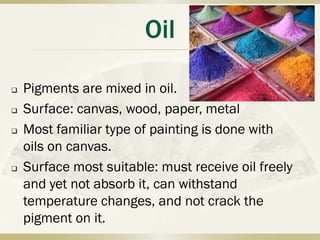
   Pigments are mixed in oil.
   Surface: canvas, wood, paper, metal
   Most familiar type of painting is done with
    oils on canvas.
   Surface most suitable: must receive oil freely
    and yet not absorb it, can withstand
    temperature changes, and not crack the
    pigment on it.
   Pigments mixed with oil provide a medium
    that gives richness in the opacity of light and
    depth of shadow.
   Pigments can come from different sources:
    minerals, vegetable matter, coal tars, and
    other chemical combinations.
       Ground by hand or machine then mixed with oil.
   Painters usually depend upon those
    pigments which do not change through the
    years.
   Oil painting: popular because there are many
    ways of handling oil pigments.
   It is possible to get a wide range of separate
    effects.
   Pigment may be applied in a thick and heavy
    manner or in washes of almost water color
    transparency.
   Oil color is the best method for a convincing
    representation where reproduction of color
    is necessary.
   Its ease of handling, the easy blending of
    tones, and the possibility of painting over
    and covering any mistake are some of the
    reasons why oil painting is a very popular
    technique.
   Two methods of painting in oil:
       Direct method- paints are opaque and are
        applied to the surface just as they are to look in
        the finished product; more flexible
       Indirect method: paint is applied in many thin
        layers of transparent color
   Disadvantages:
       Dries slowly and has a tendency to rise to the
        surface and form a film over the picture, making
        it appear dull.
       Has a tendency to become yellow and crack so
        that preservation usually becomes a problem.
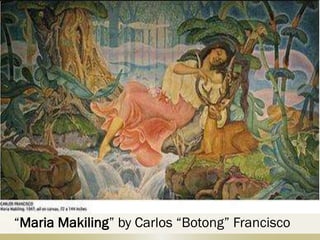
“Maria Makiling” by Carlos “Botong” Francisco
Tempera
   Mixture of ground pigments and an
    albuminous or colloidal vehicle, either
    egg, gum, or glue, used by
    Egyptian, Medieval, and Renaissance
    painters.
   Special characteristic: being an
    emulsion
       Watery, milk-like texture of oily and watery
        consistency.
   Usually done on a wooden panel that has
    been smooth with a coating of plaster.
   The colors are mixed with egg yolk.
   There is little blending or fusing of colors
    since paint dries rapidly.
   Colors are laid on side by side or
    superimposed.
   Needs careful details.
   It is hard to obtain rich, deep tones, and
    shadows.
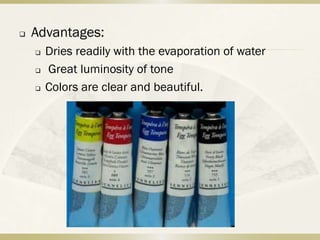
   Advantages:
       Dries readily with the evaporation of water
       Great luminosity of tone
       Colors are clear and beautiful.
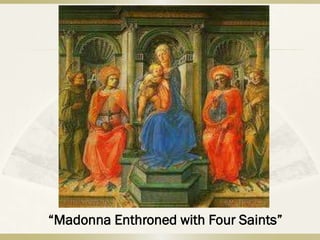
“Madonna Enthroned with Four Saints”
Watercolor
   Pigments are mixed with water and applied to
    fine white paper.
   Good watercolor paintings are not easy to
    make.
       Require a high degree of technical dexterity.
   In pure watercolor painting, all the light comes
    from the ground.
   Paper is the most commonly used ground.
   Other ground: parchment, ivory, silk, and
    cambric.
   A medium familiar to every school child.
   Gouache: opaque water color
       Made by grinding opaque colors with water and
        mixing the product with a preparation of gum
        and adding Chinese white to transparent
        watercolors.
       It differs from the brilliant quality of translucent
        water color painting whose major effects are
        caused by the white paper.
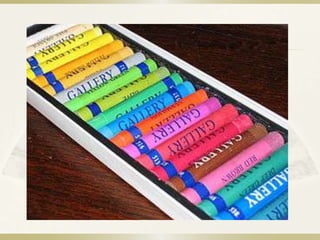
Pastel
   The most recent medium.
   Possesses only surfaces of light, gives no
    glazed effect, and most closely resembles
    dry pigment.
   Pigment is bound so as to form a crayon
    which is applied directly to the
    surface, usually, paper.
   As support for pastel painting
    paper, pasteboard or canvas is used.
   As far as the technique is concerned, the
    painter is free to handle the material to suit
    himself.
   It is a very flexible medium.
   Varied effects may be produced.
   Not a very popular medium because no one
    has yet to discovered the way to preserve its
    original freshness.
   The chalk tends to rub off and the picture
    loses its brilliance.
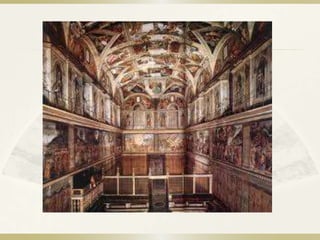
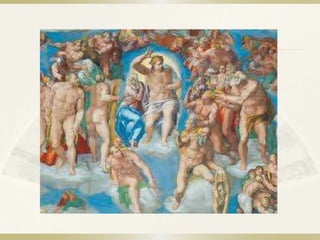
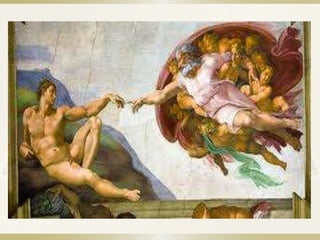
Fresco
   The most popular type of painting.
   Colors are mixed with water and applied to
    fresh plaster which absorbs the color.
   Since the pigment has been incorporated
    with the plaster, it lasts until the wall is
    destroyed.
   Flourished during the 15th and 16th century.
   Fresco means “fresh.”
   The process begins with preliminary
    sketches, later enlarged to full-size cartoons
    which are transferred to rough plaster.
   The coloring must be ready as soon as the
    plaster is put on the wall.
   It is prepared by mixing a pigment with water
    or with water and lime.
   When this is applied to the wet plaster, the
    lime binds the pigment to the plaster and
    makes the painting part of the wall.
   Since fresco must be done quickly, it is a
    very exacting method.
   There is no changing once the design is
    begun.
   Only earth pigments are used because of the
    chemical action of the plaster on the paint.
   These colors have uniformity of tone and no
    glaring contrasts.
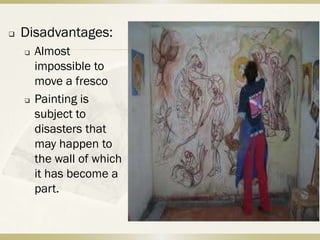
   Disadvantages:
       Almost
        impossible to
        move a fresco
       Painting is
        subject to
        disasters that
        may happen to
        the wall of which
        it has become a
        part.
Acrylic
   The newest medium and one that is used widely
    by painters today.
   Synthetic paints using acrylic emulsions as
    binder.
   Combine transparency and quick- drying
    qualities of watercolor and are as flexible as oil.
   They are completely insoluble when dry and can
    be used almost on any surface.
   They do not tend to crack, and tun yellow with
    age.
SCULPTURE
   In choosing a subject for the sculpture,
    the most important thing to consider is
    the material.
   Substances available for sculpture are
    limitless.
   Different materials require different
    methods of handling.
   Soft medium: will lend itself to a
    modelling technique that uses
    squeezing and shaping and
    continuously adding itself to it as the
    work goes on.
       Allows for the expansion of gesture.
   Hard medium: requires the process of
    cutting and taking away from the block.
       Confined to the limits of the piece of wood
        or stone.
Two Major Sculpture Processes
   Subtractive process:
       Unwanted material is cut away
       Carving of stone and wood
   Additive process:
       Example: Construction of figure by putting
        together bits of clay, or by welding together parts
        of metal.
       Final result if putting together smaller segments
        of the material.
Two types of Sculpture


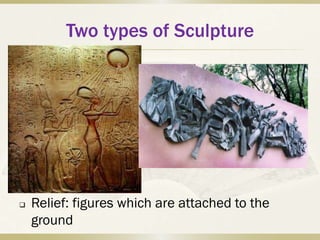
   Relief: figures which are attached to the
    ground
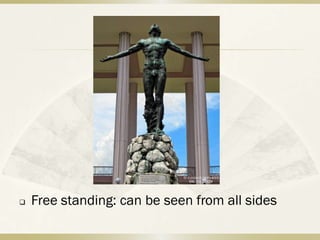
   Free standing: can be seen from all sides
Stone and Bronze

   Stone:
     durable, resistant to the elements, fire,
      and other hazards
     Heavy and breaks easily

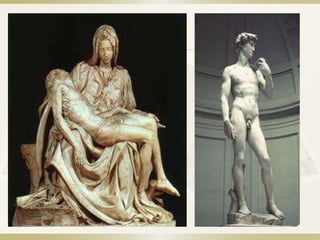
     Marble- Favorite material in Greece and

      Italy; high gloss when polished
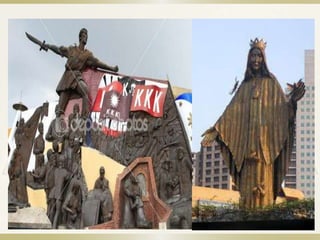
   Metals:
       Most commonly used is bronze
       May be solid in small statues
       Hallowed in most large statues (heavy and
        expensive)
       Tendency to crack when cooled
       Disadvantages: difficulty and intricacy in casting
        bronze
       Rich color and texture: most beautiful media
       Light and can support itself in many positions
       Other metals: forged iron, welded steel, and
        duraluminum
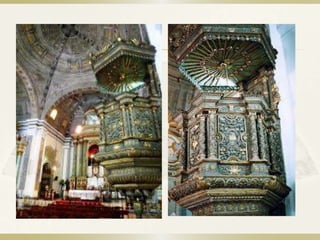
Wood
   Advantage: cheap, readily available, and easy
    to cut
   Polishes well and has a smooth shiny surface
    and beautiful color.
   Relatively light and can be easily made into a
    variety of shapes.
   Popular in Paete, Pkil in Laguna and
    Betis, Pampanga,
   Drawback: limited in size, burn easily, discolor
    and decay easily
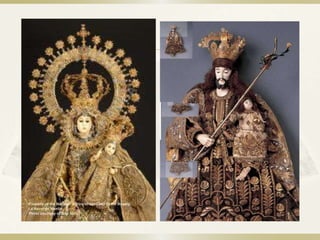
Ivory
   Intrinsic value of the material.
   Lends itself to technical mastery.
   Lacks the vigor of wooden statues
   Like wood, it also cracks
   Seldom used today.
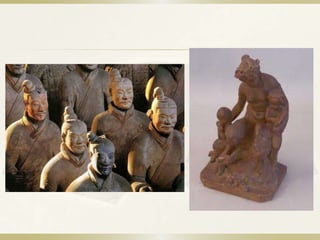
Terra Cotta
   Plastic clay
   Yields to even the slightest pressure and can
    be worked and re-worked until the artist has
    achieved what he wants to do.
   Unfired clay is a fragile material and
    sculpture in this medium would have a short
    life.
   For a more durable work in clay, the sculptor
    can fire the original in a kiln.
   Result is terra cotta which means “cooked
    earth”
   Moderately coarse clay product fired at
    comparatively low temperature.
   Usually painted and coated with heavy glaze.
   Breaks and chips easily.
   Not a strong material and it cannot stand
    strain or weight.
   Beautiful and versatile medium.
Other Materials
   Aluminum
   Chromium
   Steel
   Plastic
       Less expensive
       Less fragile
       light
   Chemically treated clay
   Stone for casting in liquid form
Architecture
   Art of designing and constructing building.
   Functional definition: to fulfil a need that
    leads to its creation.
   Materials used and the methods of
    assembling them are among the factors
    contributing to architectural style.
   Materials:
    stone, wood, brick, concrete, glass.
   Wood:
     Common building material
     Advantages: abundance, relative

      durability, and high tensile and
      compressions strength
     Disadvantages: Easily destroyed by

      moisture, insects, and fire
     Plywood: improved the structural

      possibilities of wood; stronger than any
      known material.
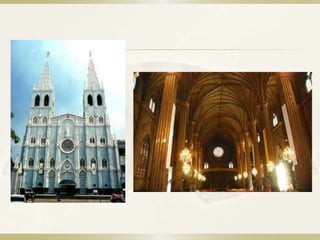
   Stone:
     Material used when permanence is desired
     Concrete:

         made of sand and gravel mixed with cement
         high compressive strength

         doesn’t crumble or break down when subjected

          to heavy weight
         Does not corrode and is fire resistant

         Stronger: ferro-concrete or reinforced concrete

          (reinforced with steel)
   Steel:
       Tough alloy of iron in variable amounts
       Malleable under proper conditions and greatly
        hardened by sudden cooling
       Tensile strength
       Made possible the building of the high-rise
        structures which are very popular this days.
Types of Construction

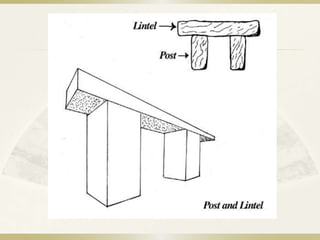
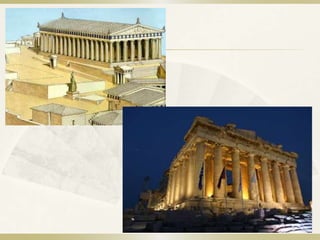
   Post-and-lintel:
     Consists of two vertical posts for support
      (post) and horizontal one (lintel).
     Generally used for wooden buildings.
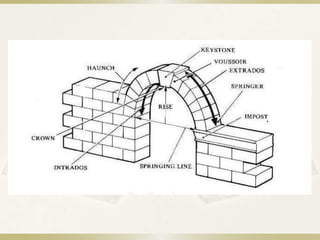
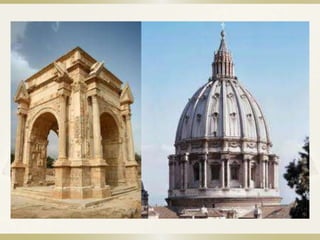
   Arch
       Dominant in Roman architecture
       Architectural forms built from pieces of wood
        called voussoirs with joints between them and
        are arranged in semi-circle.
       All materials are in compression
       Typical for stone construction: can stand great
        pressure
       Dome is an extension of the arch
            Roof resembling an inverted cup or hemisphere,
             formed by round arches or vaults rising from a round or
             many-sided base.
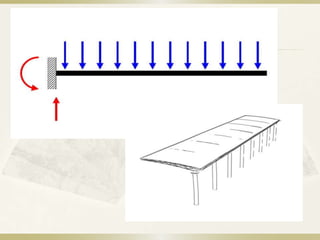
   Cantilever
       Any structural part projecting horizontally and
        anchored at one end only.
       Needs a beam with tensile strength, and does
        not crack or break easily
       Largely utilized in buildings with steel as
        medium
       Wood is also used but is limited since it has a
        tendency to warp, sag or rot.
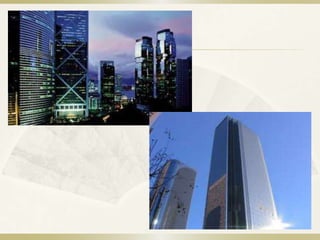
       Used in construction of skyscrapers which
        depends for support upon a steel skeleton.
Medium of the visual arts

Medium of the visual arts

  • 1.
    MEDIUM OF THEVISUAL ARTS Prepared by: ERIC F. PAZZIUAGAN, RN, MAN
  • 2.
    MEDIUM  Refers to the materials which are used by an artist.  A means by which he communicates his ideas.  Very essential to art.
  • 3.
    Painting  The art of creating meaningful effects on a flat surface by the use of pigments.  Each medium exerts a pronounced effect on the finished product, is capable of varied treatment, and determines its own stroke.  The materials of the painter are pigments applied to wet plaster, canvas, wood or paper.
  • 4.
    Oil  Pigments are mixed in oil.  Surface: canvas, wood, paper, metal  Most familiar type of painting is done with oils on canvas.  Surface most suitable: must receive oil freely and yet not absorb it, can withstand temperature changes, and not crack the pigment on it.
  • 5.
    Pigments mixed with oil provide a medium that gives richness in the opacity of light and depth of shadow.  Pigments can come from different sources: minerals, vegetable matter, coal tars, and other chemical combinations.  Ground by hand or machine then mixed with oil.  Painters usually depend upon those pigments which do not change through the years.
  • 6.
    Oil painting: popular because there are many ways of handling oil pigments.  It is possible to get a wide range of separate effects.  Pigment may be applied in a thick and heavy manner or in washes of almost water color transparency.  Oil color is the best method for a convincing representation where reproduction of color is necessary.
  • 7.
    Its ease of handling, the easy blending of tones, and the possibility of painting over and covering any mistake are some of the reasons why oil painting is a very popular technique.  Two methods of painting in oil:  Direct method- paints are opaque and are applied to the surface just as they are to look in the finished product; more flexible  Indirect method: paint is applied in many thin layers of transparent color
  • 8.
    Disadvantages:  Dries slowly and has a tendency to rise to the surface and form a film over the picture, making it appear dull.  Has a tendency to become yellow and crack so that preservation usually becomes a problem.
  • 9.
    “Maria Makiling” byCarlos “Botong” Francisco
  • 10.
    Tempera  Mixture of ground pigments and an albuminous or colloidal vehicle, either egg, gum, or glue, used by Egyptian, Medieval, and Renaissance painters.  Special characteristic: being an emulsion  Watery, milk-like texture of oily and watery consistency.
  • 11.
    Usually done on a wooden panel that has been smooth with a coating of plaster.  The colors are mixed with egg yolk.  There is little blending or fusing of colors since paint dries rapidly.  Colors are laid on side by side or superimposed.  Needs careful details.  It is hard to obtain rich, deep tones, and shadows.
  • 12.
    Advantages:  Dries readily with the evaporation of water  Great luminosity of tone  Colors are clear and beautiful.
  • 13.
  • 14.
    Watercolor  Pigments are mixed with water and applied to fine white paper.  Good watercolor paintings are not easy to make.  Require a high degree of technical dexterity.  In pure watercolor painting, all the light comes from the ground.  Paper is the most commonly used ground.  Other ground: parchment, ivory, silk, and cambric.
  • 15.
    A medium familiar to every school child.  Gouache: opaque water color  Made by grinding opaque colors with water and mixing the product with a preparation of gum and adding Chinese white to transparent watercolors.  It differs from the brilliant quality of translucent water color painting whose major effects are caused by the white paper.
  • 17.
    Pastel  The most recent medium.  Possesses only surfaces of light, gives no glazed effect, and most closely resembles dry pigment.  Pigment is bound so as to form a crayon which is applied directly to the surface, usually, paper.  As support for pastel painting paper, pasteboard or canvas is used.
  • 18.
    As far as the technique is concerned, the painter is free to handle the material to suit himself.  It is a very flexible medium.  Varied effects may be produced.  Not a very popular medium because no one has yet to discovered the way to preserve its original freshness.  The chalk tends to rub off and the picture loses its brilliance.
  • 21.
    Fresco  The most popular type of painting.  Colors are mixed with water and applied to fresh plaster which absorbs the color.  Since the pigment has been incorporated with the plaster, it lasts until the wall is destroyed.  Flourished during the 15th and 16th century.  Fresco means “fresh.”
  • 22.
    The process begins with preliminary sketches, later enlarged to full-size cartoons which are transferred to rough plaster.  The coloring must be ready as soon as the plaster is put on the wall.  It is prepared by mixing a pigment with water or with water and lime.  When this is applied to the wet plaster, the lime binds the pigment to the plaster and makes the painting part of the wall.
  • 23.
    Since fresco must be done quickly, it is a very exacting method.  There is no changing once the design is begun.  Only earth pigments are used because of the chemical action of the plaster on the paint.  These colors have uniformity of tone and no glaring contrasts.
  • 24.
    Disadvantages:  Almost impossible to move a fresco  Painting is subject to disasters that may happen to the wall of which it has become a part.
  • 28.
    Acrylic  The newest medium and one that is used widely by painters today.  Synthetic paints using acrylic emulsions as binder.  Combine transparency and quick- drying qualities of watercolor and are as flexible as oil.  They are completely insoluble when dry and can be used almost on any surface.  They do not tend to crack, and tun yellow with age.
  • 29.
    SCULPTURE  In choosing a subject for the sculpture, the most important thing to consider is the material.  Substances available for sculpture are limitless.  Different materials require different methods of handling.
  • 30.
    Soft medium: will lend itself to a modelling technique that uses squeezing and shaping and continuously adding itself to it as the work goes on.  Allows for the expansion of gesture.  Hard medium: requires the process of cutting and taking away from the block.  Confined to the limits of the piece of wood or stone.
  • 31.
    Two Major SculptureProcesses  Subtractive process:  Unwanted material is cut away  Carving of stone and wood  Additive process:  Example: Construction of figure by putting together bits of clay, or by welding together parts of metal.  Final result if putting together smaller segments of the material.
  • 32.
    Two types ofSculpture  Relief: figures which are attached to the ground
  • 33.
    Free standing: can be seen from all sides
  • 34.
    Stone and Bronze  Stone:  durable, resistant to the elements, fire, and other hazards  Heavy and breaks easily  Marble- Favorite material in Greece and Italy; high gloss when polished
  • 36.
    Metals:  Most commonly used is bronze  May be solid in small statues  Hallowed in most large statues (heavy and expensive)  Tendency to crack when cooled  Disadvantages: difficulty and intricacy in casting bronze  Rich color and texture: most beautiful media  Light and can support itself in many positions  Other metals: forged iron, welded steel, and duraluminum
  • 38.
    Wood  Advantage: cheap, readily available, and easy to cut  Polishes well and has a smooth shiny surface and beautiful color.  Relatively light and can be easily made into a variety of shapes.  Popular in Paete, Pkil in Laguna and Betis, Pampanga,  Drawback: limited in size, burn easily, discolor and decay easily
  • 40.
    Ivory  Intrinsic value of the material.  Lends itself to technical mastery.  Lacks the vigor of wooden statues  Like wood, it also cracks  Seldom used today.
  • 42.
    Terra Cotta  Plastic clay  Yields to even the slightest pressure and can be worked and re-worked until the artist has achieved what he wants to do.  Unfired clay is a fragile material and sculpture in this medium would have a short life.  For a more durable work in clay, the sculptor can fire the original in a kiln.
  • 43.
    Result is terra cotta which means “cooked earth”  Moderately coarse clay product fired at comparatively low temperature.  Usually painted and coated with heavy glaze.  Breaks and chips easily.  Not a strong material and it cannot stand strain or weight.  Beautiful and versatile medium.
  • 45.
    Other Materials  Aluminum  Chromium  Steel  Plastic  Less expensive  Less fragile  light  Chemically treated clay  Stone for casting in liquid form
  • 46.
    Architecture  Art of designing and constructing building.  Functional definition: to fulfil a need that leads to its creation.  Materials used and the methods of assembling them are among the factors contributing to architectural style.  Materials: stone, wood, brick, concrete, glass.
  • 47.
    Wood:  Common building material  Advantages: abundance, relative durability, and high tensile and compressions strength  Disadvantages: Easily destroyed by moisture, insects, and fire  Plywood: improved the structural possibilities of wood; stronger than any known material.
  • 48.
    Stone:  Material used when permanence is desired  Concrete:  made of sand and gravel mixed with cement  high compressive strength  doesn’t crumble or break down when subjected to heavy weight  Does not corrode and is fire resistant  Stronger: ferro-concrete or reinforced concrete (reinforced with steel)
  • 49.
    Steel:  Tough alloy of iron in variable amounts  Malleable under proper conditions and greatly hardened by sudden cooling  Tensile strength  Made possible the building of the high-rise structures which are very popular this days.
  • 51.
    Types of Construction  Post-and-lintel:  Consists of two vertical posts for support (post) and horizontal one (lintel).  Generally used for wooden buildings.
  • 54.
    Arch  Dominant in Roman architecture  Architectural forms built from pieces of wood called voussoirs with joints between them and are arranged in semi-circle.  All materials are in compression  Typical for stone construction: can stand great pressure  Dome is an extension of the arch  Roof resembling an inverted cup or hemisphere, formed by round arches or vaults rising from a round or many-sided base.
  • 57.
    Cantilever  Any structural part projecting horizontally and anchored at one end only.  Needs a beam with tensile strength, and does not crack or break easily  Largely utilized in buildings with steel as medium  Wood is also used but is limited since it has a tendency to warp, sag or rot.  Used in construction of skyscrapers which depends for support upon a steel skeleton.