Dr. Subhash R. Yende
Asst. Professor,
Gurunanak College of Pharmacy, Nagpur
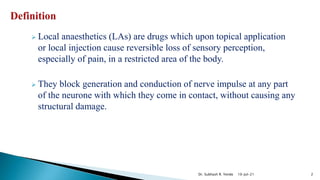
 Local anaesthetics (LAs) are drugs which upon topical application
or local injection cause reversible loss of sensory perception,
especially of pain, in a restricted area of the body.
 They block generation and conduction of nerve impulse at any part
of the neurone with which they come in contact, without causing any
structural damage.
10-Jul-21 2
Dr. Subhash R. Yende
10-Jul-21
Dr. Subhash R. Yende 3
10-Jul-21 4
Dr. Subhash R. Yende
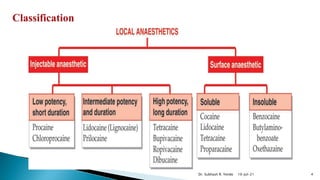
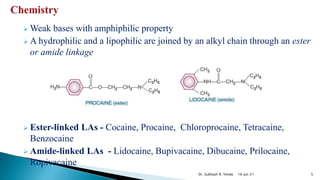
 Weak bases with amphiphilic property
 A hydrophilic and a lipophilic are joined by an alkyl chain through an ester
or amide linkage
 Ester-linked LAs - Cocaine, Procaine, Chloroprocaine, Tetracaine,
Benzocaine
 Amide-linked LAs - Lidocaine, Bupivacaine, Dibucaine, Prilocaine,
Ropivacaine
10-Jul-21 5
Dr. Subhash R. Yende
Features of amide LAs (compared to ester LAs)
• Produce more intense and longer lasting anaesthesia
• Bind to α1 acid glycoprotein in plasma
• Not hydrolysed by plasma esterases
• Rarely cause hypersensitivity reactions
10-Jul-21 6
Dr. Subhash R. Yende
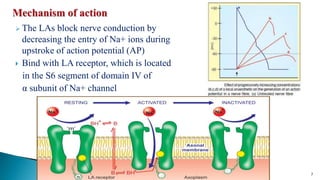
 The LAs block nerve conduction by
decreasing the entry of Na+ ions during
upstroke of action potential (AP)
 Bind with LA receptor, which is located
in the S6 segment of domain IV of
α subunit of Na+ channel
10-Jul-21 7
Dr. Subhash R. Yende
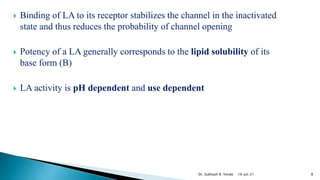
 Binding of LA to its receptor stabilizes the channel in the inactivated
state and thus reduces the probability of channel opening
 Potency of a LA generally corresponds to the lipid solubility of its
base form (B)
 LA activity is pH dependent and use dependent
10-Jul-21 8
Dr. Subhash R. Yende
Local action
 No/minimal local irritant action and block sensory nerve endings, nerve
trunks, neuromuscular junction, ganglionic synapse and receptors
 The sensitivity to LA is determined by diameter of the fibres as well as by
fibre type Small myelinated > non myelinated > large myelinated
 The LA often fails to afford adequate pain control in inflamed tissues
 Addition of a vasoconstrictor, e.g. adrenaline prolongs duration of action
of LAs
10-Jul-21 9
Dr. Subhash R. Yende
Systemic action
CNS
 Stimulation followed by depression in a dose dependent manner
C.V.S.
 Heart -Cardiac depressants, but no significant effects are observed at
conventional doses. At high doses they decrease automaticity,
excitability, contractility, conductivity and prolong effective refractory
period (ERP).
 Blood vessels - LAs tend to produce fall in BP. This is primarily due to
sympathetic blockade, but high concentrations
10-Jul-21 10
Dr. Subhash R. Yende
 Procaine is negligibly bound to plasma proteins, but amide LAs are bound
to plasma α1 acid glycoprotein.
 Ester-linked LAs (procaine) are rapidly hydrolysed by plasma
pseudocholinesterase and the remaining by esterases in the liver
 Amide-linked LAs (lidocaine) are degraded only in the liver microsomes
by dealkylation and hydrolysis.
 After oral ingestion both procaine and lidocaine have high first pass
metabolism in the liver
10-Jul-21 11
Dr. Subhash R. Yende
 CNS effects – light headedness, dizziness, auditory and visual
disturbances, mental confusion, disorientation, shivering, twitchings,
involuntary movements, finally convulsions and respiratory arrest.
 Cardiovascular toxicity - bradycardia, hypotension, cardiac arrhythmias
and vascular collapse
 Hypersensitivity reactions like rashes, angioedema, dermatitis, contact
sensitization, asthma and rarely anaphylaxis occur
 Injection of LAs may be painful
10-Jul-21 12
Dr. Subhash R. Yende
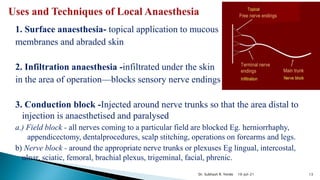
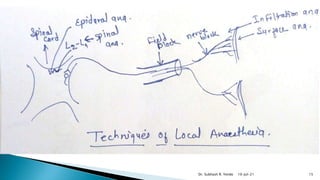
1. Surface anaesthesia- topical application to mucous
membranes and abraded skin
2. Infiltration anaesthesia -infiltrated under the skin
in the area of operation—blocks sensory nerve endings
3. Conduction block -Injected around nerve trunks so that the area distal to
injection is anaesthetised and paralysed
a.) Field block - all nerves coming to a particular field are blocked Eg. herniorrhaphy,
appendicectomy, dentalprocedures, scalp stitching, operations on forearms and legs.
b) Nerve block - around the appropriate nerve trunks or plexuses Eg lingual, intercostal,
ulnar, sciatic, femoral, brachial plexus, trigeminal, facial, phrenic.
10-Jul-21 13
Dr. Subhash R. Yende
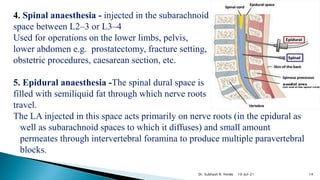
4. Spinal anaesthesia - injected in the subarachnoid
space between L2–3 or L3–4
Used for operations on the lower limbs, pelvis,
lower abdomen e.g. prostatectomy, fracture setting,
obstetric procedures, caesarean section, etc.
5. Epidural anaesthesia -The spinal dural space is
filled with semiliquid fat through which nerve roots
travel.
The LA injected in this space acts primarily on nerve roots (in the epidural as
well as subarachnoid spaces to which it diffuses) and small amount
permeates through intervertebral foramina to produce multiple paravertebral
blocks.
10-Jul-21 14
Dr. Subhash R. Yende
10-Jul-21
Dr. Subhash R. Yende 15
KD Tripathi. Essentials of Medical Pharmacology, 8th edition, 2019,
Jaypee Brothers Medical Publishers (P) Ltd. New Delhi.
10-Jul-21 16
Dr. Subhash R. Yende

Local anesthetics

  • 1.
    Dr. Subhash R.Yende Asst. Professor, Gurunanak College of Pharmacy, Nagpur
  • 2.
     Local anaesthetics(LAs) are drugs which upon topical application or local injection cause reversible loss of sensory perception, especially of pain, in a restricted area of the body.  They block generation and conduction of nerve impulse at any part of the neurone with which they come in contact, without causing any structural damage. 10-Jul-21 2 Dr. Subhash R. Yende
  • 3.
  • 4.
  • 5.
     Weak baseswith amphiphilic property  A hydrophilic and a lipophilic are joined by an alkyl chain through an ester or amide linkage  Ester-linked LAs - Cocaine, Procaine, Chloroprocaine, Tetracaine, Benzocaine  Amide-linked LAs - Lidocaine, Bupivacaine, Dibucaine, Prilocaine, Ropivacaine 10-Jul-21 5 Dr. Subhash R. Yende
  • 6.
    Features of amideLAs (compared to ester LAs) • Produce more intense and longer lasting anaesthesia • Bind to α1 acid glycoprotein in plasma • Not hydrolysed by plasma esterases • Rarely cause hypersensitivity reactions 10-Jul-21 6 Dr. Subhash R. Yende
  • 7.
     The LAsblock nerve conduction by decreasing the entry of Na+ ions during upstroke of action potential (AP)  Bind with LA receptor, which is located in the S6 segment of domain IV of α subunit of Na+ channel 10-Jul-21 7 Dr. Subhash R. Yende
  • 8.
     Binding ofLA to its receptor stabilizes the channel in the inactivated state and thus reduces the probability of channel opening  Potency of a LA generally corresponds to the lipid solubility of its base form (B)  LA activity is pH dependent and use dependent 10-Jul-21 8 Dr. Subhash R. Yende
  • 9.
    Local action  No/minimallocal irritant action and block sensory nerve endings, nerve trunks, neuromuscular junction, ganglionic synapse and receptors  The sensitivity to LA is determined by diameter of the fibres as well as by fibre type Small myelinated > non myelinated > large myelinated  The LA often fails to afford adequate pain control in inflamed tissues  Addition of a vasoconstrictor, e.g. adrenaline prolongs duration of action of LAs 10-Jul-21 9 Dr. Subhash R. Yende
  • 10.
    Systemic action CNS  Stimulationfollowed by depression in a dose dependent manner C.V.S.  Heart -Cardiac depressants, but no significant effects are observed at conventional doses. At high doses they decrease automaticity, excitability, contractility, conductivity and prolong effective refractory period (ERP).  Blood vessels - LAs tend to produce fall in BP. This is primarily due to sympathetic blockade, but high concentrations 10-Jul-21 10 Dr. Subhash R. Yende
  • 11.
     Procaine isnegligibly bound to plasma proteins, but amide LAs are bound to plasma α1 acid glycoprotein.  Ester-linked LAs (procaine) are rapidly hydrolysed by plasma pseudocholinesterase and the remaining by esterases in the liver  Amide-linked LAs (lidocaine) are degraded only in the liver microsomes by dealkylation and hydrolysis.  After oral ingestion both procaine and lidocaine have high first pass metabolism in the liver 10-Jul-21 11 Dr. Subhash R. Yende
  • 12.
     CNS effects– light headedness, dizziness, auditory and visual disturbances, mental confusion, disorientation, shivering, twitchings, involuntary movements, finally convulsions and respiratory arrest.  Cardiovascular toxicity - bradycardia, hypotension, cardiac arrhythmias and vascular collapse  Hypersensitivity reactions like rashes, angioedema, dermatitis, contact sensitization, asthma and rarely anaphylaxis occur  Injection of LAs may be painful 10-Jul-21 12 Dr. Subhash R. Yende
  • 13.
    1. Surface anaesthesia-topical application to mucous membranes and abraded skin 2. Infiltration anaesthesia -infiltrated under the skin in the area of operation—blocks sensory nerve endings 3. Conduction block -Injected around nerve trunks so that the area distal to injection is anaesthetised and paralysed a.) Field block - all nerves coming to a particular field are blocked Eg. herniorrhaphy, appendicectomy, dentalprocedures, scalp stitching, operations on forearms and legs. b) Nerve block - around the appropriate nerve trunks or plexuses Eg lingual, intercostal, ulnar, sciatic, femoral, brachial plexus, trigeminal, facial, phrenic. 10-Jul-21 13 Dr. Subhash R. Yende
  • 14.
    4. Spinal anaesthesia- injected in the subarachnoid space between L2–3 or L3–4 Used for operations on the lower limbs, pelvis, lower abdomen e.g. prostatectomy, fracture setting, obstetric procedures, caesarean section, etc. 5. Epidural anaesthesia -The spinal dural space is filled with semiliquid fat through which nerve roots travel. The LA injected in this space acts primarily on nerve roots (in the epidural as well as subarachnoid spaces to which it diffuses) and small amount permeates through intervertebral foramina to produce multiple paravertebral blocks. 10-Jul-21 14 Dr. Subhash R. Yende
  • 15.
  • 16.
    KD Tripathi. Essentialsof Medical Pharmacology, 8th edition, 2019, Jaypee Brothers Medical Publishers (P) Ltd. New Delhi. 10-Jul-21 16 Dr. Subhash R. Yende