BENZODIAZEPINE
(INTRO, MOA, SAR)
(Diazepam synthesis)
Department of pharmacy
University of Peshawar
INTRODUCTION
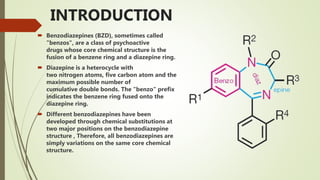
ď‚´ Benzodiazepines (BZD), sometimes called
"benzos", are a class of psychoactive
drugs whose core chemical structure is the
fusion of a benzene ring and a diazepine ring.
ď‚´ Diazepine is a heterocycle with
two nitrogen atoms, five carbon atom and the
maximum possible number of
cumulative double bonds. The "benzo" prefix
indicates the benzene ring fused onto the
diazepine ring.
ď‚´ Different benzodiazepines have been
developed through chemical substitutions at
two major positions on the benzodiazepine
structure , Therefore, all benzodiazepines are
simply variations on the same core chemical
structure.
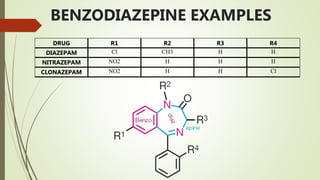
BENZODIAZEPINE EXAMPLES
DRUG R1 R2 R3 R4
DIAZEPAM Cl CH3 H H
NITRAZEPAM NO2 H H H
CLONAZEPAM NO2 H H Cl
HISTORY
ď‚´ The first benzodiazepine, chlordiazepoxide (Librium), was synthesized
in 1955 by Leo Sternbach.
ď‚´ Following chlordiazepoxide, Diazepam was synthesized in 1959 and
marketed by Hoffmann–La Roche under the brand name Valium in
1963.
ď‚´ The introduction of benzodiazepines led to a decrease in the
prescription of barbiturates, and by the 1970s they had largely replaced
the older drugs for sedative and hypnotic uses.
CLASSIFICATION
ď‚´ SHORT ACTING (5-20 HRS):
ď‚´ Lorazepam (Ativan)
ď‚´ Alprazolam (Xanax)
ď‚´ INTERMEDIATE ACTING (10-30 HRS):
ď‚´ Diazepam (Valium)
ď‚´ Bromazepam (Lexotanil)
ď‚´ LONG ACTING (30-100 HRS):
ď‚´ Clonazepam (Rivotril)
ď‚´ Clorazepate (Tranxene)
ď‚´ ULTRA LONG ACTING (40-200 HRS):
ď‚´ Flurazepam (Dalmane)
ď‚´ Flunitrazepam (Rohypnol)
ADVANTAGES OF BDZ
 BDZ’s have high therapeutic index. Ingestion of even 20 hypnotic doses does
not usually endanger life.
ď‚´ Hypnotic does not affect respiration or cardiovascular functions. Higher doses
produce mild respiration & hypotension which is problematic only in patients
with respiratory insufficiency & cardiac abnormality.
ď‚´ BZDs have practically no action on other body system
ď‚´ BZDs cause little distortion of sleep pattern
ď‚´ BZDs do not alter disposition of other drug by microsomal enzyme induction.
ď‚´ They have lower abuse liability: tolerance is mild, psychological & physical
dependence & withdrawal syndrome are less marked.
ď‚´ A specific BZDs antagonist flumazenil is available which can be used in case of
poisoning.
MECHANISM OF ACTION
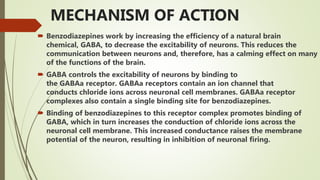
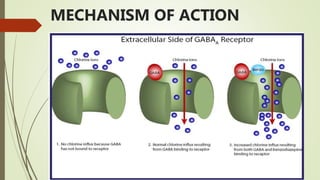
ď‚´ Benzodiazepines work by increasing the efficiency of a natural brain
chemical, GABA, to decrease the excitability of neurons. This reduces the
communication between neurons and, therefore, has a calming effect on many
of the functions of the brain.
ď‚´ GABA controls the excitability of neurons by binding to
the GABAa receptor. GABAa receptors contain an ion channel that
conducts chloride ions across neuronal cell membranes. GABAa receptor
complexes also contain a single binding site for benzodiazepines.
ď‚´ Binding of benzodiazepines to this receptor complex promotes binding of
GABA, which in turn increases the conduction of chloride ions across the
neuronal cell membrane. This increased conductance raises the membrane
potential of the neuron, resulting in inhibition of neuronal firing.
MECHANISM OF ACTION
SAR
ď‚´DIAZEPINE RING (B):
1. Diazepine ring (B) is essential for
activity.
2. Carbonyl group at P-2 is essential for
activity.
3. Double bond between P-4, P-5 is
essential for optimum activity.
4. Shifting double bond to P-3, P-4
deceases activity.
5. Phenyl group at P-5 increases
activity.
SAR
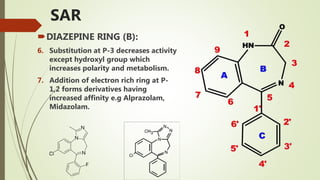
ď‚´DIAZEPINE RING (B):
6. Substitution at P-3 decreases activity
except hydroxyl group which
increases polarity and metabolism.
7. Addition of electron rich ring at P-
1,2 forms derivatives having
increased affinity e.g Alprazolam,
Midazolam.
SAR
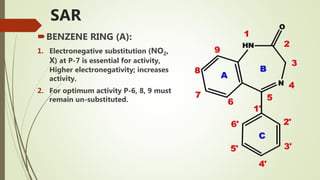
ď‚´BENZENE RING (A):
1. Electronegative substitution (NO2,
X) at P-7 is essential for activity,
Higher electronegativity; increases
activity.
2. For optimum activity P-6, 8, 9 must
remain un-substituted.
SAR
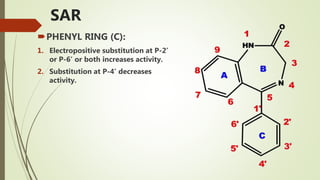
ď‚´PHENYL RING (C):
1. Electropositive substitution at P-2’
or P-6’ or both increases activity.
2. Substitution at P-4’ decreases
activity.
DIAZEPAM SYNTHESIS
ď‚´ STEP 1:
ď‚´5-Chloroaniline upon reaction with Nitrous acid forms Diazonium salt.
DIAZEPAM SYNTHESIS
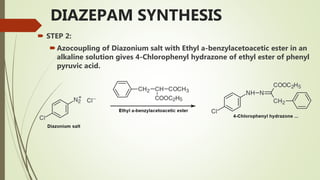
ď‚´ STEP 2:
ď‚´Azocoupling of Diazonium salt with Ethyl a-benzylacetoacetic ester in an
alkaline solution gives 4-Chlorophenyl hydrazone of ethyl ester of phenyl
pyruvic acid.
DIAZEPAM SYNTHESIS
ď‚´ STEP 3:
ď‚´4-Chlorophenyl hydrazone of ethyl ester of phenyl pyruvic acid in presence
of Hydrochloric acid undergoes Fischer indole synthesis reaction and form
Ethyl ester of 5-chloro-3-phenylindolyl-2-carboxylic acid
DIAZEPAM SYNTHESIS
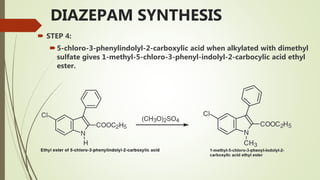
ď‚´ STEP 4:
ď‚´5-chloro-3-phenylindolyl-2-carboxylic acid when alkylated with dimethyl
sulfate gives 1-methyl-5-chloro-3-phenyl-indolyl-2-carbocylic acid ethyl
ester.
DIAZEPAM SYNTHESIS
ď‚´ STEP 5:
ď‚´1-methyl-5-chloro-3-phenyl-indolyl-2-carbocylic acid ethyl ester when
reacted with ammonia gives 1-methyl-5-chloro-3-phenyl-indolyl-2-amide.
DIAZEPAM SYNTHESIS
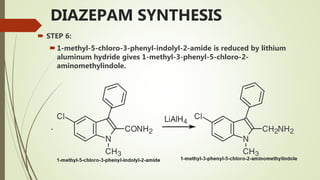
ď‚´ STEP 6:
ď‚´1-methyl-5-chloro-3-phenyl-indolyl-2-amide is reduced by lithium
aluminum hydride gives 1-methyl-3-phenyl-5-chloro-2-
aminomethylindole.
DIAZEPAM SYNTHESIS
ď‚´ STEP 7:
ď‚´1-methyl-3-phenyl-5-chloro-2-aminomethylindole is treated with
chromium oxide to open the indole ring to form 1-methyl-3-phenyl-5-
chloro-2-aminobenzophenone.
DIAZEPAM SYNTHESIS
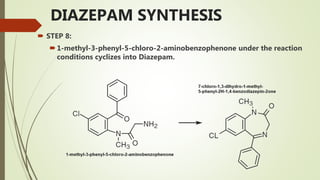
ď‚´ STEP 8:
ď‚´1-methyl-3-phenyl-5-chloro-2-aminobenzophenone under the reaction
conditions cyclizes into Diazepam.
INDICATIONS
ď‚´ Alcohol withdrawal (Diazepam)
ď‚´ Anxiety (Lorazepam, Diazepam)
ď‚´ Bipolar disorder (Clonazepam)
ď‚´ Insomnia (Lorazepam)
ď‚´ Muscle spasm (Diazepam)
ď‚´ Nausea and vomiting (Lorazepam)
ď‚´ Status epilepticus (Diazepam, Lorazepam)
ď‚´ Tetanus (Diazepam)
THANK YOU!

Benzodiazepines; Diazepam

  • 1.
    BENZODIAZEPINE (INTRO, MOA, SAR) (Diazepamsynthesis) Department of pharmacy University of Peshawar
  • 2.
    INTRODUCTION ď‚´ Benzodiazepines (BZD),sometimes called "benzos", are a class of psychoactive drugs whose core chemical structure is the fusion of a benzene ring and a diazepine ring. ď‚´ Diazepine is a heterocycle with two nitrogen atoms, five carbon atom and the maximum possible number of cumulative double bonds. The "benzo" prefix indicates the benzene ring fused onto the diazepine ring. ď‚´ Different benzodiazepines have been developed through chemical substitutions at two major positions on the benzodiazepine structure , Therefore, all benzodiazepines are simply variations on the same core chemical structure.
  • 3.
    BENZODIAZEPINE EXAMPLES DRUG R1R2 R3 R4 DIAZEPAM Cl CH3 H H NITRAZEPAM NO2 H H H CLONAZEPAM NO2 H H Cl
  • 4.
    HISTORY  The firstbenzodiazepine, chlordiazepoxide (Librium), was synthesized in 1955 by Leo Sternbach.  Following chlordiazepoxide, Diazepam was synthesized in 1959 and marketed by Hoffmann–La Roche under the brand name Valium in 1963.  The introduction of benzodiazepines led to a decrease in the prescription of barbiturates, and by the 1970s they had largely replaced the older drugs for sedative and hypnotic uses.
  • 5.
    CLASSIFICATION ď‚´ SHORT ACTING(5-20 HRS): ď‚´ Lorazepam (Ativan) ď‚´ Alprazolam (Xanax) ď‚´ INTERMEDIATE ACTING (10-30 HRS): ď‚´ Diazepam (Valium) ď‚´ Bromazepam (Lexotanil) ď‚´ LONG ACTING (30-100 HRS): ď‚´ Clonazepam (Rivotril) ď‚´ Clorazepate (Tranxene) ď‚´ ULTRA LONG ACTING (40-200 HRS): ď‚´ Flurazepam (Dalmane) ď‚´ Flunitrazepam (Rohypnol)
  • 6.
    ADVANTAGES OF BDZ BDZ’s have high therapeutic index. Ingestion of even 20 hypnotic doses does not usually endanger life.  Hypnotic does not affect respiration or cardiovascular functions. Higher doses produce mild respiration & hypotension which is problematic only in patients with respiratory insufficiency & cardiac abnormality.  BZDs have practically no action on other body system  BZDs cause little distortion of sleep pattern  BZDs do not alter disposition of other drug by microsomal enzyme induction.  They have lower abuse liability: tolerance is mild, psychological & physical dependence & withdrawal syndrome are less marked.  A specific BZDs antagonist flumazenil is available which can be used in case of poisoning.
  • 7.
    MECHANISM OF ACTION ď‚´Benzodiazepines work by increasing the efficiency of a natural brain chemical, GABA, to decrease the excitability of neurons. This reduces the communication between neurons and, therefore, has a calming effect on many of the functions of the brain. ď‚´ GABA controls the excitability of neurons by binding to the GABAa receptor. GABAa receptors contain an ion channel that conducts chloride ions across neuronal cell membranes. GABAa receptor complexes also contain a single binding site for benzodiazepines. ď‚´ Binding of benzodiazepines to this receptor complex promotes binding of GABA, which in turn increases the conduction of chloride ions across the neuronal cell membrane. This increased conductance raises the membrane potential of the neuron, resulting in inhibition of neuronal firing.
  • 8.
  • 9.
    SAR ď‚´DIAZEPINE RING (B): 1.Diazepine ring (B) is essential for activity. 2. Carbonyl group at P-2 is essential for activity. 3. Double bond between P-4, P-5 is essential for optimum activity. 4. Shifting double bond to P-3, P-4 deceases activity. 5. Phenyl group at P-5 increases activity.
  • 10.
    SAR ď‚´DIAZEPINE RING (B): 6.Substitution at P-3 decreases activity except hydroxyl group which increases polarity and metabolism. 7. Addition of electron rich ring at P- 1,2 forms derivatives having increased affinity e.g Alprazolam, Midazolam.
  • 11.
    SAR ď‚´BENZENE RING (A): 1.Electronegative substitution (NO2, X) at P-7 is essential for activity, Higher electronegativity; increases activity. 2. For optimum activity P-6, 8, 9 must remain un-substituted.
  • 12.
    SAR PHENYL RING (C): 1.Electropositive substitution at P-2’ or P-6’ or both increases activity. 2. Substitution at P-4’ decreases activity.
  • 13.
    DIAZEPAM SYNTHESIS ď‚´ STEP1: ď‚´5-Chloroaniline upon reaction with Nitrous acid forms Diazonium salt.
  • 14.
    DIAZEPAM SYNTHESIS ď‚´ STEP2: ď‚´Azocoupling of Diazonium salt with Ethyl a-benzylacetoacetic ester in an alkaline solution gives 4-Chlorophenyl hydrazone of ethyl ester of phenyl pyruvic acid.
  • 15.
    DIAZEPAM SYNTHESIS ď‚´ STEP3: ď‚´4-Chlorophenyl hydrazone of ethyl ester of phenyl pyruvic acid in presence of Hydrochloric acid undergoes Fischer indole synthesis reaction and form Ethyl ester of 5-chloro-3-phenylindolyl-2-carboxylic acid
  • 16.
    DIAZEPAM SYNTHESIS ď‚´ STEP4: ď‚´5-chloro-3-phenylindolyl-2-carboxylic acid when alkylated with dimethyl sulfate gives 1-methyl-5-chloro-3-phenyl-indolyl-2-carbocylic acid ethyl ester.
  • 17.
    DIAZEPAM SYNTHESIS ď‚´ STEP5: ď‚´1-methyl-5-chloro-3-phenyl-indolyl-2-carbocylic acid ethyl ester when reacted with ammonia gives 1-methyl-5-chloro-3-phenyl-indolyl-2-amide.
  • 18.
    DIAZEPAM SYNTHESIS ď‚´ STEP6: ď‚´1-methyl-5-chloro-3-phenyl-indolyl-2-amide is reduced by lithium aluminum hydride gives 1-methyl-3-phenyl-5-chloro-2- aminomethylindole.
  • 19.
    DIAZEPAM SYNTHESIS ď‚´ STEP7: ď‚´1-methyl-3-phenyl-5-chloro-2-aminomethylindole is treated with chromium oxide to open the indole ring to form 1-methyl-3-phenyl-5- chloro-2-aminobenzophenone.
  • 20.
    DIAZEPAM SYNTHESIS ď‚´ STEP8: ď‚´1-methyl-3-phenyl-5-chloro-2-aminobenzophenone under the reaction conditions cyclizes into Diazepam.
  • 21.
    INDICATIONS ď‚´ Alcohol withdrawal(Diazepam) ď‚´ Anxiety (Lorazepam, Diazepam) ď‚´ Bipolar disorder (Clonazepam) ď‚´ Insomnia (Lorazepam) ď‚´ Muscle spasm (Diazepam) ď‚´ Nausea and vomiting (Lorazepam) ď‚´ Status epilepticus (Diazepam, Lorazepam) ď‚´ Tetanus (Diazepam)
  • 22.