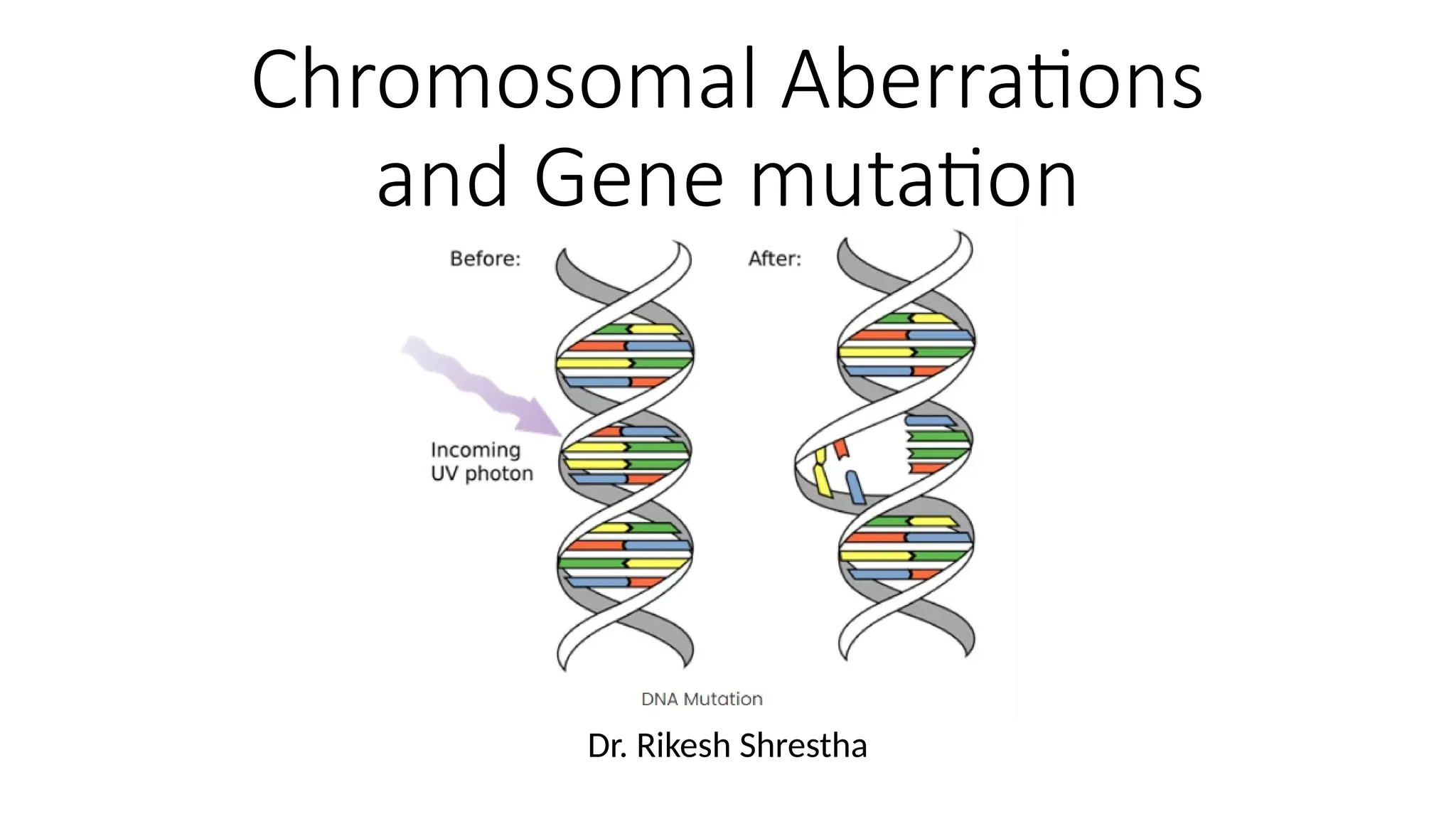
Chromosomal Aberrations
and Gene mutation
Dr. Rikesh Shrestha
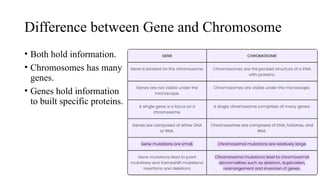
Difference between Gene and Chromosome
• Both hold information.
• Chromosomes has many
genes.
• Genes hold information
to built specific proteins.
Chromosomal Mutation
• The changes in the structure and number of chromosomes.
• Also called as chromosomal aberrations.
• These are produced by misrepair of broken chromosomes, by improper
recombination or malsegregation of chromosomes during mitosis and
meiosis.
• Types –
• Changes in the structure of chromosomes.
• Changes in the number of chromosomes.
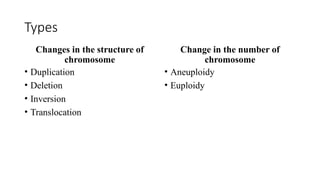
Types
Changes in the structure of
chromosome
• Duplication
• Deletion
• Inversion
• Translocation
Change in the number of
chromosome
• Aneuploidy
• Euploidy
Change in the structure of the chromosomes
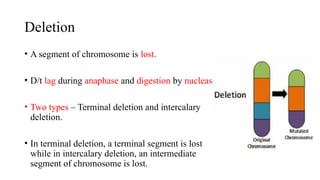
Deletion
• A segment of chromosome is lost.
• D/t lag during anaphase and digestion by nucleases.
• Two types – Terminal deletion and intercalary
deletion.
• In terminal deletion, a terminal segment is lost
while in intercalary deletion, an intermediate
segment of chromosome is lost.
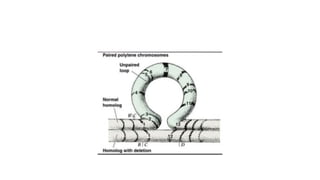
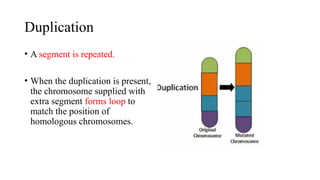
Duplication
• A segment is repeated.
• When the duplication is present,
the chromosome supplied with
extra segment forms loop to
match the position of
homologous chromosomes.
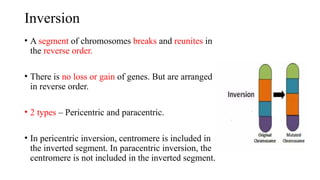
Inversion
• A segment of chromosomes breaks and reunites in
the reverse order.
• There is no loss or gain of genes. But are arranged
in reverse order.
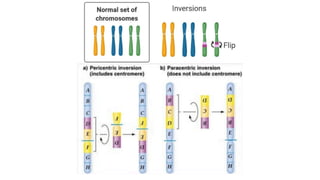
• 2 types – Pericentric and paracentric.
• In pericentric inversion, centromere is included in
the inverted segment. In paracentric inversion, the
centromere is not included in the inverted segment.
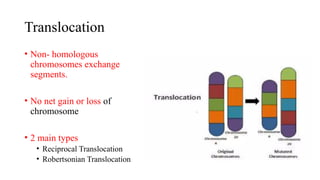
Translocation
• Non- homologous
chromosomes exchange
segments.
• No net gain or loss of
chromosome
• 2 main types
• Reciprocal Translocation
• Robertsonian Translocation
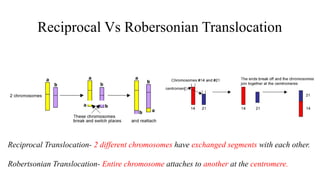
Reciprocal Vs Robersonian Translocation
Reciprocal Translocation- 2 different chromosomes have exchanged segments with each other.
Robertsonian Translocation- Entire chromosome attaches to another at the centromere.
Changes in the number of chromosomes
• Change in the number of chromosomes is called ploidy.
• D/t loss or gain of chromosome of a set or changes in the number of
chromosomes.
• Two types-
• Aneuploidy
• Euploidy
Aneuploidy
• Where there is addition or loss of one or more chromosomes in a set.
• Caused by non- disjunction (Failure of homologous chromosomes or
sister chromatids to separate properly during cell divisions) of
chromosomes.
• 3 Types
• Monosomy
• Nullisomy
• Trisomy
Monosomy
• One chromosome is lost from a pair,
• Represented by 2n-1
• The monosomic individual has one chromosome less from the normal
number of chromosomes.
• Turner Syndrome (Egg without X chromosome fuse with sperm
containg X chromosome).
Nullisomy
• Where both chromosomes of a pair are lost.
• Represented by 2n-2.
• Nullisomy is produced by the fusion of gametes having one
chromosome less. Nullisomy individual cant survive.
Trisomy
• One chromosome is added to a pair.
• Represented by 2n+1
• Caused by non- disjunction.
• Klinefelter Syndrome – During gamete formation extra X chromosome
(Either XX from mother, Y from father or X from mother XY from father).
• Down‘s syndrome.
Euploidy
• Change in the number of chromosome sets.
• 2 types
• Haploidy
• Polyploidy
Haploidy
• The basic set of chromosome in any species is haploid.
• Represented by N number.
• Gametes carry haploid number of chromosomes. During fertilization,
the parental combination unite together to form diploid chromosome
(2N). Some times in life of an animal, a set of chromosome will be
lost leading to haploidy.
Polyploidy
• Condition in which an organism contains more than the usual 2 sets of
chromosomes.
• Triploids (3N)
• Tetraploids (4N)
• Pen- ploids (5N)
• Hexaploids (6N)
• During gamate formation, the homologous chromosomes may not separate
completely, resulting in diploid number of chromosomes.
Gene Mutation
• Change in the base sequence of the genes.
• Change in the structure of DNA.
• Point Mutation (Occurs when the base sequence of a codon is
exchanged) (GCA - GAA)
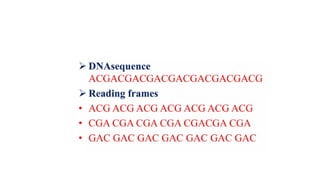
• Frame Shift Mutation- A change of the reading frame is called
frameshift mutation.
Gene Mutation
• Change in amount or structure of DNA of an organism.
• Cause of Mutation - Also k/a mutagens
• There are certain physical and chemical agents which causes
inheritable changes in a gene called mutagens.
• Types of Mutagens
• Ionizing Radiation – High energy radiations like alpha, beta,
gamma and cosmic rays. Called because they penetrate tissues
deeply and ionization of encountered molecules. Electron forced to
flow out of molecules and atoms are transferred into free radicals
and reactive ions. Altering in purines and pyrimidines in the DNA.
• Non- Ionizing Radiation – UV Rays. Effects mainly pyrimidines to
cause change in DNA.
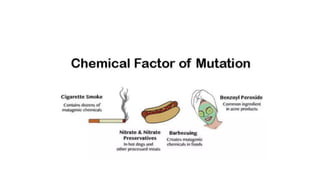
• Chemical mutagens – Certain chemicals like nitrous acid
hydroxylamine, formaldehyde, certain component of tobacco, food
preservatives, pesticides, etc.
• Types
• Induced Mutations- Artificially produced mutation. Eg. X- rays,
nitrous acid, etc
• Spontaneous Mutation – Naturally occurring. D/t normal cellular
operations or due to random interaction with environment.
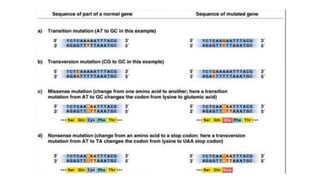
Point Mutation
• When single base pair is altered
• Types –
• Base substitution – One base is replaced by another base.
• Base insertion – A new base is inserted.
• Base deletion – A base is missing.
• Base inversion – The base sequence is reversed.
Missense mutation
• Sometimes in a polypeptide chain, an amino acid is substituted by
another amino acid.
• This is d/t substitution of three bases (a codon) in the DNA.
Non- sense mutation
• Sometime mutation produces a base sequence that doesn’t code for
any amino acid (non- sense codon)
• Termination of the synthesis of protein occurs.
• A non sense mutation is a point mutation that introduces a premature
stop codon into the part of the gene that encodes a protein.
• Instructs ribosome to stop making the protein.
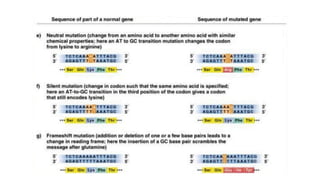
Silent Mutation
• Substitution of 3 bases in the DNA may result in the substitution of a
new amino acid in the polypeptide chain.
• When substituted amino acid is closely related to the original amino
acid, mutation has no detectable effect on the phenotype of the cell.
Transition
• Point mutation where one purine base is substituted by another purine
or one pyrimidine base is substituted by other pyrimidine.
• G-C pair is exchanged with an A-T pair vice versa.
Transversion
• Point mutation in which a purine is replaced by pyrimidine or vice
versa.
• An A-T pair is replaced by a T-A pair
Frameshift mutation
• A mutation that inserts or deletes a single base will change the reading
frame for the entire subsequent sequence.
• A change of the reading frame is called frameshift mutation.
• Induced by acridine compound that binds to DNA and distort the
structure of double helix causing additional bases to be incorporated or
omitted during replication.
THANK YOU

Gene mutation and chromosomal mutation.pptx

  • 1.
    Chromosomal Aberrations and Genemutation Dr. Rikesh Shrestha
  • 2.
    Difference between Geneand Chromosome • Both hold information. • Chromosomes has many genes. • Genes hold information to built specific proteins.
  • 3.
    Chromosomal Mutation • Thechanges in the structure and number of chromosomes. • Also called as chromosomal aberrations. • These are produced by misrepair of broken chromosomes, by improper recombination or malsegregation of chromosomes during mitosis and meiosis. • Types – • Changes in the structure of chromosomes. • Changes in the number of chromosomes.
  • 4.
    Types Changes in thestructure of chromosome • Duplication • Deletion • Inversion • Translocation Change in the number of chromosome • Aneuploidy • Euploidy
  • 5.
    Change in thestructure of the chromosomes
  • 6.
    Deletion • A segmentof chromosome is lost. • D/t lag during anaphase and digestion by nucleases. • Two types – Terminal deletion and intercalary deletion. • In terminal deletion, a terminal segment is lost while in intercalary deletion, an intermediate segment of chromosome is lost.
  • 8.
    Duplication • A segmentis repeated. • When the duplication is present, the chromosome supplied with extra segment forms loop to match the position of homologous chromosomes.
  • 9.
    Inversion • A segmentof chromosomes breaks and reunites in the reverse order. • There is no loss or gain of genes. But are arranged in reverse order. • 2 types – Pericentric and paracentric. • In pericentric inversion, centromere is included in the inverted segment. In paracentric inversion, the centromere is not included in the inverted segment.
  • 11.
    Translocation • Non- homologous chromosomesexchange segments. • No net gain or loss of chromosome • 2 main types • Reciprocal Translocation • Robertsonian Translocation
  • 12.
    Reciprocal Vs RobersonianTranslocation Reciprocal Translocation- 2 different chromosomes have exchanged segments with each other. Robertsonian Translocation- Entire chromosome attaches to another at the centromere.
  • 13.
    Changes in thenumber of chromosomes • Change in the number of chromosomes is called ploidy. • D/t loss or gain of chromosome of a set or changes in the number of chromosomes. • Two types- • Aneuploidy • Euploidy
  • 14.
    Aneuploidy • Where thereis addition or loss of one or more chromosomes in a set. • Caused by non- disjunction (Failure of homologous chromosomes or sister chromatids to separate properly during cell divisions) of chromosomes. • 3 Types • Monosomy • Nullisomy • Trisomy
  • 15.
    Monosomy • One chromosomeis lost from a pair, • Represented by 2n-1 • The monosomic individual has one chromosome less from the normal number of chromosomes. • Turner Syndrome (Egg without X chromosome fuse with sperm containg X chromosome).
  • 16.
    Nullisomy • Where bothchromosomes of a pair are lost. • Represented by 2n-2. • Nullisomy is produced by the fusion of gametes having one chromosome less. Nullisomy individual cant survive.
  • 17.
    Trisomy • One chromosomeis added to a pair. • Represented by 2n+1 • Caused by non- disjunction. • Klinefelter Syndrome – During gamete formation extra X chromosome (Either XX from mother, Y from father or X from mother XY from father). • Down‘s syndrome.
  • 18.
    Euploidy • Change inthe number of chromosome sets. • 2 types • Haploidy • Polyploidy
  • 19.
    Haploidy • The basicset of chromosome in any species is haploid. • Represented by N number. • Gametes carry haploid number of chromosomes. During fertilization, the parental combination unite together to form diploid chromosome (2N). Some times in life of an animal, a set of chromosome will be lost leading to haploidy.
  • 20.
    Polyploidy • Condition inwhich an organism contains more than the usual 2 sets of chromosomes. • Triploids (3N) • Tetraploids (4N) • Pen- ploids (5N) • Hexaploids (6N) • During gamate formation, the homologous chromosomes may not separate completely, resulting in diploid number of chromosomes.
  • 21.
    Gene Mutation • Changein the base sequence of the genes. • Change in the structure of DNA. • Point Mutation (Occurs when the base sequence of a codon is exchanged) (GCA - GAA) • Frame Shift Mutation- A change of the reading frame is called frameshift mutation.
  • 22.
    Gene Mutation • Changein amount or structure of DNA of an organism. • Cause of Mutation - Also k/a mutagens • There are certain physical and chemical agents which causes inheritable changes in a gene called mutagens.
  • 23.
    • Types ofMutagens • Ionizing Radiation – High energy radiations like alpha, beta, gamma and cosmic rays. Called because they penetrate tissues deeply and ionization of encountered molecules. Electron forced to flow out of molecules and atoms are transferred into free radicals and reactive ions. Altering in purines and pyrimidines in the DNA. • Non- Ionizing Radiation – UV Rays. Effects mainly pyrimidines to cause change in DNA. • Chemical mutagens – Certain chemicals like nitrous acid hydroxylamine, formaldehyde, certain component of tobacco, food preservatives, pesticides, etc.
  • 25.
    • Types • InducedMutations- Artificially produced mutation. Eg. X- rays, nitrous acid, etc • Spontaneous Mutation – Naturally occurring. D/t normal cellular operations or due to random interaction with environment.
  • 26.
    Point Mutation • Whensingle base pair is altered • Types – • Base substitution – One base is replaced by another base. • Base insertion – A new base is inserted. • Base deletion – A base is missing. • Base inversion – The base sequence is reversed.
  • 27.
    Missense mutation • Sometimesin a polypeptide chain, an amino acid is substituted by another amino acid. • This is d/t substitution of three bases (a codon) in the DNA.
  • 28.
    Non- sense mutation •Sometime mutation produces a base sequence that doesn’t code for any amino acid (non- sense codon) • Termination of the synthesis of protein occurs. • A non sense mutation is a point mutation that introduces a premature stop codon into the part of the gene that encodes a protein. • Instructs ribosome to stop making the protein.
  • 29.
    Silent Mutation • Substitutionof 3 bases in the DNA may result in the substitution of a new amino acid in the polypeptide chain. • When substituted amino acid is closely related to the original amino acid, mutation has no detectable effect on the phenotype of the cell.
  • 30.
    Transition • Point mutationwhere one purine base is substituted by another purine or one pyrimidine base is substituted by other pyrimidine. • G-C pair is exchanged with an A-T pair vice versa.
  • 31.
    Transversion • Point mutationin which a purine is replaced by pyrimidine or vice versa. • An A-T pair is replaced by a T-A pair
  • 32.
    Frameshift mutation • Amutation that inserts or deletes a single base will change the reading frame for the entire subsequent sequence. • A change of the reading frame is called frameshift mutation. • Induced by acridine compound that binds to DNA and distort the structure of double helix causing additional bases to be incorporated or omitted during replication.
  • 36.