(A way to communicate and learn from
“Internationalization” Experiences)
Case Studies
12/19/20161 PREM KUMAR SONI
12/19/20162 PREM KUMAR SONI
definition
12/19/2016PREM KUMAR SONI3
1. a process or record of research into the development of a
particular person, group, or situation over a period of time.
 "the case study was undertaken over a period of two months
through a series of visits to the school"
2. a particular instance of something used or analysed in order
to illustrate a thesis or principle.
 "airline deregulation provides a case study of the effects of
the internal market"
12/19/2016PREM KUMAR SONI4
 A case study is about a person, group, or situation that has
been studied over time. If the case study, for instance, is
about a group, it describes the behavior of the group as a
whole, not the behavior of each individual in the group.
 Case studies can be produced by following a
formal research method. These case studies are likely to
appear in formal research venues, as journals and professional
conferences, rather than popular works. The resulting body
of 'case study research' has long had a prominent place in
many disciplines and professions, ranging from psychology,
anthropology, sociology, and political science to education,
clinical science, social work, and administrative science
Types of case study include the
following:
12/19/2016PREM KUMAR SONI5
 Illustrative case studies. These are primarily descriptive
studies. They typically utilize one or two instances of an event
to show the existing situation. Illustrative case studies serve
primarily to make the unfamiliar familiar and to give readers
a common language about the topic in question.
 Exploratory (or pilot) case studies. These are
condensed case studies performed before implementing a
large scale investigation. Their basic function is to help
identify questions and select types of measurement prior to
the main investigation. The primary pitfall of this type of
study is that initial findings may seem convincing enough to
be released prematurely as conclusions.
12/19/2016PREM KUMAR SONI6
 Cumulative case studies. These serve to aggregate
information from several sites collected at different times.
The idea behind these studies is the collection of past studies
will allow for greater generalization without additional cost
or time being expended on new, possibly repetitive studies.
 Critical instance case studies. These examine one or
more sites for either the purpose of examining a situation of
unique interest with little to no interest in generalization, or
to call into question or challenge a highly generalized or
universal assertion. This method is useful for answering cause
and effect questions.
Case Study Format:
Internationalizing Extension
1. Context: Background
information, climate,
concerns, issues
2. Strategies Described:
approaches taken,
agencies and actors
involved
3. Challenges: concerns
that emerged, various
perspectives
4. Outcomes:
accomplishments, changes,
lessons learned
12/19/20167 PREM KUMAR SONI
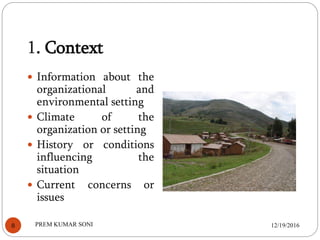
1. Context
 Information about the
organizational and
environmental setting
 Climate of the
organization or setting
 History or conditions
influencing the
situation
 Current concerns or
issues
12/19/20168 PREM KUMAR SONI
2. Strategies Described
 Facts about the case—
narrative that
describes what
innovations were
introduced
 Actors involved
 Strategies tried
 Goals or outcomes
expected
12/19/20169 PREM KUMAR SONI
3. Challenges Encountered
 Challenges that emerged
 Perspectives of various
actors
 Decisions taken
 Actions or changes made
12/19/201610 PREM KUMAR SONI
4. Outcomes
 Results of changes
taken or practices
continued
 Analysis of post-
intervention situation
 Accomplishments or
outcomes
 Lessons learned
12/19/201611 PREM KUMAR SONI
Use of a case study
 Read the written case
study
 Analyze the strategies and
resulting outcomes—
what happened and why?
 Discuss what could have
been done to further
enhance
outcomes, how could
this experience be
adapted/replicated
•Highlight principles
or lessons learned
12/19/201612 PREM KUMAR SONI
Tips For Creating a Great Case Study
12/19/2016PREM KUMAR SONI13
 Case studies are a great way to tell the world how
valuable your products or services are.
 They go beyond simple testimonials by showing real-
life examples of how you were able to satisfy your
customer’s needs and help them accomplish their
goals.
 With great case studies, you will be able to highlight
your successes in a way that will make your ideal
potential customer become your customer.
 The following are some tips on how to make your case
studies a powerful asset in soliciting business.
1. Write About Someone Your Ideal
Customer Can Relate To
12/19/2016PREM KUMAR SONI14
Do you know who your ideal customer is? If it’s
someone in the education industry, then make your
case studies about your university customers. If it’s
someone in the automobile industry, then make your
case studies about auto parts and accessories
manufacturers.
The goal is to ensure that once your ideal customer has
read your case studies, they will feel:
 You are comfortable in their industry.
 You know their industry’s specific needs.
 You know how to give their industry targeted results.
2. Tell the Story from Start to Finish
12/19/2016PREM KUMAR SONI15
People enjoy reading a story. A great case study will
allow someone to really get to know the customer in
the case study including:
 Who is the sample customer and what do they do?
 What were the customer’s goals?
 What were the customer’s needs?
 How did you satisfy those needs and help the customer
meet their goals?
3. Provide Easy to Read Formatting
12/19/2016PREM KUMAR SONI16
No one really likes to read one huge chunk of text, no matter
how interesting and informative it might be. Be sure to use
good content formatting elements like you would with
articles, blog posts, and copywriting on your website
including:
 Headers
 Images
 Bulleted lists
 Bolded & italicized text
4. Include Real Numbers
12/19/2016PREM KUMAR SONI17
 Have you ever read case studies where a business
states that they “doubled traffic” for the customer in
their case study and wondered if that meant they went
from 100 to 200 visits or 10,000 to 20,000 visits?
 Certain ways of displaying numbers can have an
ambiguous meaning. You will want your case study to
be as clear as day.
 So instead of just saying you doubled their traffic,
show them real numbers and (if possible) real proof.
5. Talk Specific Strategy
12/19/2016PREM KUMAR SONI18
 So you doubled a website’s traffic or sales, right? How
did you do it? This is where you sell your products or
services simply by saying which ones you used and
how they led to the desired result.
 You shouldn’t just say “our online marketing services
led to these results.” Instead, you should say “it was a
combination of a three-month dedicated social media
campaign focusing on Facebook & YouTube and five
months of link building that led to an increase in
rankings plus brand exposure that led to these results.”
6. Try Different Formats
12/19/2016PREM KUMAR SONI19
 While people like stories, case studies do not have to
be fit into story form every time. You could try
different types of case studies, such as an interview
format where you have your clients answer the same
questions mentioned earlier about what they do, their
needs, their goals, and how you met them.
 Quoting your customer in their own words will
make the case study even more relatable to your
ideal customer than you telling the story.
7. Appeal to Different Types of Learners
12/19/2016PREM KUMAR SONI20
While some people enjoy reading, others may prefer
audio, video, or visual representation of your case
study. So consider taking your text-based case studies
and re-purposing the content as:
 A podcast
 A YouTube video
 Or even an infographic (such as the one below)
8. Make Them Easy to Find
12/19/2016PREM KUMAR SONI21
 What’s the point of having great case studies if no one
will ever read them? Be sure that your case studies are
organized and easy to find
Thank you
12/19/201622 PREM KUMAR SONI

Casestudy

  • 1.
    (A way tocommunicate and learn from “Internationalization” Experiences) Case Studies 12/19/20161 PREM KUMAR SONI
  • 2.
  • 3.
    definition 12/19/2016PREM KUMAR SONI3 1.a process or record of research into the development of a particular person, group, or situation over a period of time.  "the case study was undertaken over a period of two months through a series of visits to the school" 2. a particular instance of something used or analysed in order to illustrate a thesis or principle.  "airline deregulation provides a case study of the effects of the internal market"
  • 4.
    12/19/2016PREM KUMAR SONI4 A case study is about a person, group, or situation that has been studied over time. If the case study, for instance, is about a group, it describes the behavior of the group as a whole, not the behavior of each individual in the group.  Case studies can be produced by following a formal research method. These case studies are likely to appear in formal research venues, as journals and professional conferences, rather than popular works. The resulting body of 'case study research' has long had a prominent place in many disciplines and professions, ranging from psychology, anthropology, sociology, and political science to education, clinical science, social work, and administrative science
  • 5.
    Types of casestudy include the following: 12/19/2016PREM KUMAR SONI5  Illustrative case studies. These are primarily descriptive studies. They typically utilize one or two instances of an event to show the existing situation. Illustrative case studies serve primarily to make the unfamiliar familiar and to give readers a common language about the topic in question.  Exploratory (or pilot) case studies. These are condensed case studies performed before implementing a large scale investigation. Their basic function is to help identify questions and select types of measurement prior to the main investigation. The primary pitfall of this type of study is that initial findings may seem convincing enough to be released prematurely as conclusions.
  • 6.
    12/19/2016PREM KUMAR SONI6 Cumulative case studies. These serve to aggregate information from several sites collected at different times. The idea behind these studies is the collection of past studies will allow for greater generalization without additional cost or time being expended on new, possibly repetitive studies.  Critical instance case studies. These examine one or more sites for either the purpose of examining a situation of unique interest with little to no interest in generalization, or to call into question or challenge a highly generalized or universal assertion. This method is useful for answering cause and effect questions.
  • 7.
    Case Study Format: InternationalizingExtension 1. Context: Background information, climate, concerns, issues 2. Strategies Described: approaches taken, agencies and actors involved 3. Challenges: concerns that emerged, various perspectives 4. Outcomes: accomplishments, changes, lessons learned 12/19/20167 PREM KUMAR SONI
  • 8.
    1. Context  Informationabout the organizational and environmental setting  Climate of the organization or setting  History or conditions influencing the situation  Current concerns or issues 12/19/20168 PREM KUMAR SONI
  • 9.
    2. Strategies Described Facts about the case— narrative that describes what innovations were introduced  Actors involved  Strategies tried  Goals or outcomes expected 12/19/20169 PREM KUMAR SONI
  • 10.
    3. Challenges Encountered Challenges that emerged  Perspectives of various actors  Decisions taken  Actions or changes made 12/19/201610 PREM KUMAR SONI
  • 11.
    4. Outcomes  Resultsof changes taken or practices continued  Analysis of post- intervention situation  Accomplishments or outcomes  Lessons learned 12/19/201611 PREM KUMAR SONI
  • 12.
    Use of acase study  Read the written case study  Analyze the strategies and resulting outcomes— what happened and why?  Discuss what could have been done to further enhance outcomes, how could this experience be adapted/replicated •Highlight principles or lessons learned 12/19/201612 PREM KUMAR SONI
  • 13.
    Tips For Creatinga Great Case Study 12/19/2016PREM KUMAR SONI13  Case studies are a great way to tell the world how valuable your products or services are.  They go beyond simple testimonials by showing real- life examples of how you were able to satisfy your customer’s needs and help them accomplish their goals.  With great case studies, you will be able to highlight your successes in a way that will make your ideal potential customer become your customer.  The following are some tips on how to make your case studies a powerful asset in soliciting business.
  • 14.
    1. Write AboutSomeone Your Ideal Customer Can Relate To 12/19/2016PREM KUMAR SONI14 Do you know who your ideal customer is? If it’s someone in the education industry, then make your case studies about your university customers. If it’s someone in the automobile industry, then make your case studies about auto parts and accessories manufacturers. The goal is to ensure that once your ideal customer has read your case studies, they will feel:  You are comfortable in their industry.  You know their industry’s specific needs.  You know how to give their industry targeted results.
  • 15.
    2. Tell theStory from Start to Finish 12/19/2016PREM KUMAR SONI15 People enjoy reading a story. A great case study will allow someone to really get to know the customer in the case study including:  Who is the sample customer and what do they do?  What were the customer’s goals?  What were the customer’s needs?  How did you satisfy those needs and help the customer meet their goals?
  • 16.
    3. Provide Easyto Read Formatting 12/19/2016PREM KUMAR SONI16 No one really likes to read one huge chunk of text, no matter how interesting and informative it might be. Be sure to use good content formatting elements like you would with articles, blog posts, and copywriting on your website including:  Headers  Images  Bulleted lists  Bolded & italicized text
  • 17.
    4. Include RealNumbers 12/19/2016PREM KUMAR SONI17  Have you ever read case studies where a business states that they “doubled traffic” for the customer in their case study and wondered if that meant they went from 100 to 200 visits or 10,000 to 20,000 visits?  Certain ways of displaying numbers can have an ambiguous meaning. You will want your case study to be as clear as day.  So instead of just saying you doubled their traffic, show them real numbers and (if possible) real proof.
  • 18.
    5. Talk SpecificStrategy 12/19/2016PREM KUMAR SONI18  So you doubled a website’s traffic or sales, right? How did you do it? This is where you sell your products or services simply by saying which ones you used and how they led to the desired result.  You shouldn’t just say “our online marketing services led to these results.” Instead, you should say “it was a combination of a three-month dedicated social media campaign focusing on Facebook & YouTube and five months of link building that led to an increase in rankings plus brand exposure that led to these results.”
  • 19.
    6. Try DifferentFormats 12/19/2016PREM KUMAR SONI19  While people like stories, case studies do not have to be fit into story form every time. You could try different types of case studies, such as an interview format where you have your clients answer the same questions mentioned earlier about what they do, their needs, their goals, and how you met them.  Quoting your customer in their own words will make the case study even more relatable to your ideal customer than you telling the story.
  • 20.
    7. Appeal toDifferent Types of Learners 12/19/2016PREM KUMAR SONI20 While some people enjoy reading, others may prefer audio, video, or visual representation of your case study. So consider taking your text-based case studies and re-purposing the content as:  A podcast  A YouTube video  Or even an infographic (such as the one below)
  • 21.
    8. Make ThemEasy to Find 12/19/2016PREM KUMAR SONI21  What’s the point of having great case studies if no one will ever read them? Be sure that your case studies are organized and easy to find
  • 22.