SPUR GEAR
13ME304 MANFACTURING PROCESSES
REVIEW 1
Team members
P.Aravind
B.Dhayanandhan
C.Jeeva bharathi
A.Joseph praveen
Guide
M.Bala kumaran
AP/MECH/NEC
SPUR GEAR
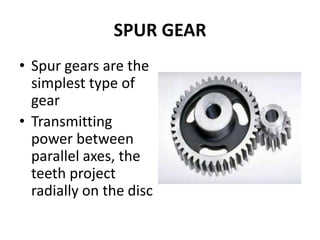
• Spur gears are the
simplest type of
gear
• Transmitting
power between
parallel axes, the
teeth project
radially on the disc
Types of Spur Gears
• External Spur Gear
• Internal Spur Gear
• Rack and Pinion Gears
External Spur Gears
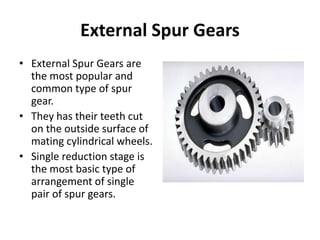
• External Spur Gears are
the most popular and
common type of spur
gear.
• They has their teeth cut
on the outside surface of
mating cylindrical wheels.
• Single reduction stage is
the most basic type of
arrangement of single
pair of spur gears.
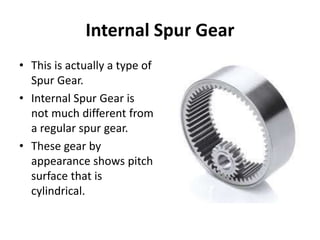
Internal Spur Gear
• This is actually a type of
Spur Gear.
• Internal Spur Gear is
not much different from
a regular spur gear.
• These gear by
appearance shows pitch
surface that is
cylindrical.
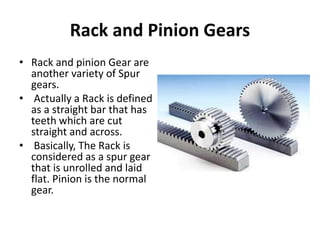
Rack and Pinion Gears
• Rack and pinion Gear are
another variety of Spur
gears.
• Actually a Rack is defined
as a straight bar that has
teeth which are cut
straight and across.
• Basically, The Rack is
considered as a spur gear
that is unrolled and laid
flat. Pinion is the normal
gear.
How Spur Gears Work
• Spur gears are regularly used for speed reduction
or increase, torque multiplication, resolution and
accuracy enhancement for positioning systems
• The teeth run parallel to the gear axis and can
only transfer motion between parallel-axis gear
sets
• Spur gears mate only one tooth at a time,
resulting in high stress on the mating teeth and
noisy operation.
Spur Gear Materials
• Cast iron provides durability and ease of
manufacture.
• Alloy steel provides superior durability and
corrosion resistance. Minerals may be added to
the alloy to further harden the gear.
• Cast steel provides easier fabrication, strong
working loads and vibration resistance.
• Carbon steels are inexpensive and strong, but are
susceptible to corrosion.
• Aluminum is used when low gear inertia with
some resiliency is required.
Applications of Spur Gear
Spur gears have a wide range of applications
• Metal cutting machines
• Power plants
• Marine engines
• Mechanical clocks and watches
• Fuel pumps
• Washing Machines
• Gear motors and gear pumps
• Rolling mills
Advantages of Spur Gear
• Spur gears have high power transmission
efficiency.
• They are compact and easy to install.
• They offer constant velocity ratio.
• Unlike belt drives, spur gear drives have no slip.
• Spur gears are highly reliable.
• They can be used to transmit large amount of
power (of the order of 50,000 kW).
Disadvantages of Spur Gear
• Spur gear drives are costly when compared to belt
drives.
• They have a limited center distance.
• This is because in a spur gear drive, the gears should
be meshed and they should be in direct contact with
each other.
• Spur gears produce a lot of noise when operating at
high speeds.
• They cannot be used for long distance power
transmission.
• Gear teeth experience a large amount of stress.

Spur gear

  • 1.
    SPUR GEAR 13ME304 MANFACTURINGPROCESSES REVIEW 1 Team members P.Aravind B.Dhayanandhan C.Jeeva bharathi A.Joseph praveen Guide M.Bala kumaran AP/MECH/NEC
  • 2.
    SPUR GEAR • Spurgears are the simplest type of gear • Transmitting power between parallel axes, the teeth project radially on the disc
  • 3.
    Types of SpurGears • External Spur Gear • Internal Spur Gear • Rack and Pinion Gears
  • 4.
    External Spur Gears •External Spur Gears are the most popular and common type of spur gear. • They has their teeth cut on the outside surface of mating cylindrical wheels. • Single reduction stage is the most basic type of arrangement of single pair of spur gears.
  • 5.
    Internal Spur Gear •This is actually a type of Spur Gear. • Internal Spur Gear is not much different from a regular spur gear. • These gear by appearance shows pitch surface that is cylindrical.
  • 6.
    Rack and PinionGears • Rack and pinion Gear are another variety of Spur gears. • Actually a Rack is defined as a straight bar that has teeth which are cut straight and across. • Basically, The Rack is considered as a spur gear that is unrolled and laid flat. Pinion is the normal gear.
  • 7.
    How Spur GearsWork • Spur gears are regularly used for speed reduction or increase, torque multiplication, resolution and accuracy enhancement for positioning systems • The teeth run parallel to the gear axis and can only transfer motion between parallel-axis gear sets • Spur gears mate only one tooth at a time, resulting in high stress on the mating teeth and noisy operation.
  • 8.
    Spur Gear Materials •Cast iron provides durability and ease of manufacture. • Alloy steel provides superior durability and corrosion resistance. Minerals may be added to the alloy to further harden the gear. • Cast steel provides easier fabrication, strong working loads and vibration resistance. • Carbon steels are inexpensive and strong, but are susceptible to corrosion. • Aluminum is used when low gear inertia with some resiliency is required.
  • 9.
    Applications of SpurGear Spur gears have a wide range of applications • Metal cutting machines • Power plants • Marine engines • Mechanical clocks and watches • Fuel pumps • Washing Machines • Gear motors and gear pumps • Rolling mills
  • 10.
    Advantages of SpurGear • Spur gears have high power transmission efficiency. • They are compact and easy to install. • They offer constant velocity ratio. • Unlike belt drives, spur gear drives have no slip. • Spur gears are highly reliable. • They can be used to transmit large amount of power (of the order of 50,000 kW).
  • 11.
    Disadvantages of SpurGear • Spur gear drives are costly when compared to belt drives. • They have a limited center distance. • This is because in a spur gear drive, the gears should be meshed and they should be in direct contact with each other. • Spur gears produce a lot of noise when operating at high speeds. • They cannot be used for long distance power transmission. • Gear teeth experience a large amount of stress.