Fabrication Of Spur
Gear
Supervised by
Md.Golam Kader
Professor,
Md Rasedul Islam
Lecturer,
Department of Mechanical
Engineering, KUET
Course ME 3118
Khulna University Of Engineering & Technology
Department of Mechanical Engineering
Submitted By
Md Rezowan Kabir [1205016]
Md Hasanuzzaman [1205017]
Md Abul Kashem Hemel [1205018]
Md Ashik Mahmud [1205019]
Saikat Biswas [1205020]
Chapter 1
Khulna university of Engineering &Technology
Objectives
To Study about gear.
To Study about the classification of gear.
To Study about spur gear.
Fabrication of spur gear.
To Study of advantages and disadvantages of
spur gear.
Khulna university of Engineering & Technology
Introduction
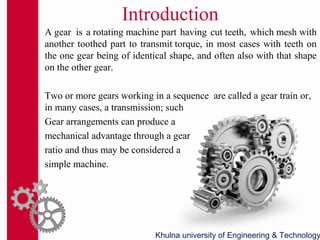
A gear is a rotating machine part having cut teeth, which mesh with
another toothed part to transmit torque, in most cases with teeth on
the one gear being of identical shape, and often also with that shape
on the other gear.
Two or more gears working in a sequence are called a gear train or,
in many cases, a transmission; such
Gear arrangements can produce a
mechanical advantage through a gear
ratio and thus may be considered a
simple machine.
Khulna university of Engineering & Technology
Introduction (Continued)
Gears are Used to Control Power Transmission in These Ways
1. Changing the direction through which power is transmitted (i.e.
parallel, right angles, rotating, linear etc.)
2. Changing the amount of force or torque
3. Changing RPM
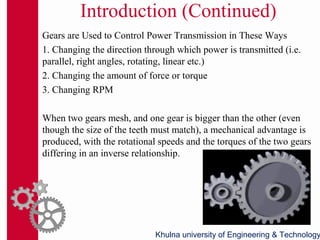
When two gears mesh, and one gear is bigger than the other (even
though the size of the teeth must match), a mechanical advantage is
produced, with the rotational speeds and the torques of the two gears
differing in an inverse relationship.
Khulna university of Engineering & Technology
Types Of Gears
According to the position of axes of the shafts.
Parallel
1.Spur Gear
2.Helical Gear
3.Rack and Pinion
Intersecting
1.Bevel Gear
Non-intersecting and Non-parallel
1.worm and worm gears
Khulna university of Engineering & Technology
Spur Gear
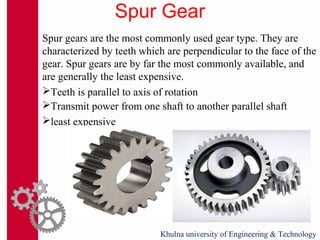
Spur gears are the most commonly used gear type. They are
characterized by teeth which are perpendicular to the face of the
gear. Spur gears are by far the most commonly available, and
are generally the least expensive.
Teeth is parallel to axis of rotation
Transmit power from one shaft to another parallel shaft
least expensive
Khulna university of Engineering & Technology
Applications of Spur Gear
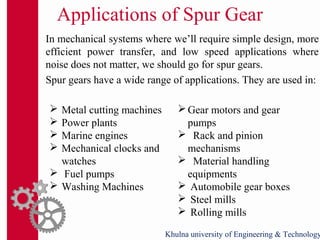
In mechanical systems where we’ll require simple design, more
efficient power transfer, and low speed applications where
noise does not matter, we should go for spur gears.
Spur gears have a wide range of applications. They are used in:
 Metal cutting machines
 Power plants
 Marine engines
 Mechanical clocks and
watches
 Fuel pumps
 Washing Machines
Gear motors and gear
pumps
 Rack and pinion
mechanisms
 Material handling
equipments
 Automobile gear boxes
 Steel mills
 Rolling mills
Khulna university of Engineering & Technology
Chapter 2
CONTENTS
Khulna university of Engineering & Technology
GEAR TERMINOLOGY
Pitch surface : The surface of the imaginary rolling cylinder
(cone, etc.) that the toothed gear may be considered to replace.
Pitch circle: A right section of the pitch surface.
Root (or dedendum) circle: The circle bounding the spaces
between the teeth, in a right section of the gear.
Addendum: The radial distance between the pitch circle and the
addendum circle.
Dedendum: The radial distance between the pitch circle and the
root circle.
Clearance: The difference between the dedendum of one gear and
the addendum of the mating gear.
Khulna university of Engineering & Technology
GEAR TERMINOLOGY(CON’D)
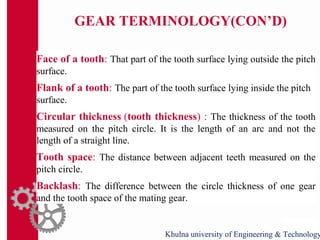
Face of a tooth: That part of the tooth surface lying outside the pitch
surface.
Flank of a tooth: The part of the tooth surface lying inside the pitch
surface.
Circular thickness (tooth thickness) : The thickness of the tooth
measured on the pitch circle. It is the length of an arc and not the
length of a straight line.
Tooth space: The distance between adjacent teeth measured on the
pitch circle.
Backlash: The difference between the circle thickness of one gear
and the tooth space of the mating gear.
Khulna university of Engineering & Technology
GEAR TERMINOLOGY(CON’D)
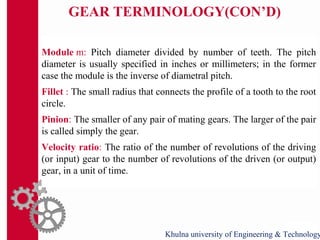
Module m: Pitch diameter divided by number of teeth. The pitch
diameter is usually specified in inches or millimeters; in the former
case the module is the inverse of diametral pitch.
Fillet : The small radius that connects the profile of a tooth to the root
circle.
Pinion: The smaller of any pair of mating gears. The larger of the pair
is called simply the gear.
Velocity ratio: The ratio of the number of revolutions of the driving
(or input) gear to the number of revolutions of the driven (or output)
gear, in a unit of time.
Khulna university of Engineering & Technology
GEAR TERMINOLOGY(CON’D)
Pressure angle: Pressure angle in relation to gear teeth, also known
as the angle of obliquity, is the angle between the tooth face and the
gear wheel tangent. It is more precisely the angle at a pitch point
between the line of pressure (which is normal to the tooth surface)
and the plane tangent to the pitch surface.
Fig: Pressure angle of spur gear[1]
Khulna university of Engineering & Technology
GEAR TERMINOLOGY
Fig2: Spur gear terminology[2] Fig3: Spur gear terminology[3]
PROBLEM
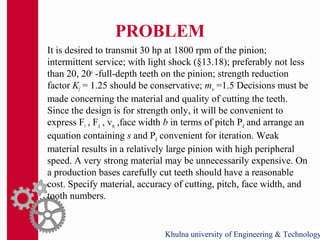
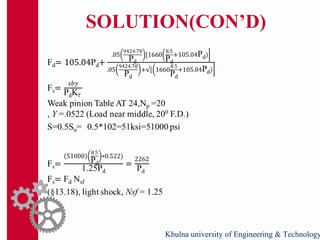
It is desired to transmit 30 hp at 1800 rpm of the pinion;
intermittent service; with light shock (§13.18); preferably not less
than 20, 20o
-full-depth teeth on the pinion; strength reduction
factor Kf = 1.25 should be conservative; mw =1.5 Decisions must be
made concerning the material and quality of cutting the teeth.
Since the design is for strength only, it will be convenient to
express Ft , Fd , vm ,face width b in terms of pitch Pd and arrange an
equation containing s and Pd convenient for iteration. Weak
material results in a relatively large pinion with high peripheral
speed. A very strong material may be unnecessarily expensive. On
a production bases carefully cut teeth should have a reasonable
cost. Specify material, accuracy of cutting, pitch, face width, and
tooth numbers.
Khulna university of Engineering & Technology
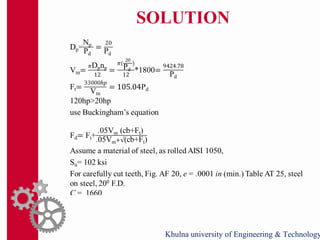
SOLUTION
Khulna university of Engineering & Technology
SOLUTION(CON’D)
Khulna university of Engineering & Technology
SOLUTION(CON’D)
Khulna university of Engineering & Technology
SOLUTION(CON’D)
Khulna university of Engineering & Technology
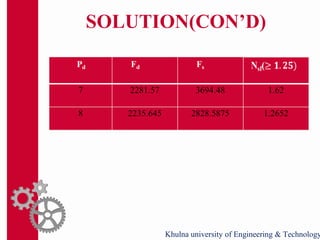
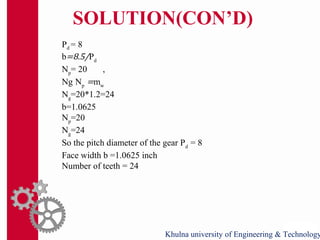
Pd = 8
b=8.5/Pd
Np
= 20 ,  
 
Ng Np
 =mw
Ng
=20*1.2=24
b=1.0625
Np
=20
Ng
=24
So the pitch diameter of the gear Pd
= 8
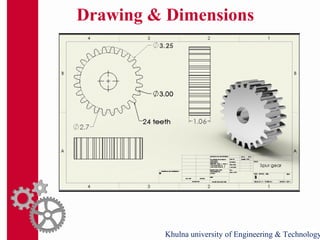
Face width b =1.0625 inch
Number of teeth = 24
Drawing & Dimensions
Khulna university of Engineering & Technology
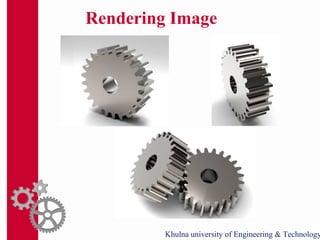
Rendering Image
Khulna university of Engineering & Technology
Chapter 3
CONTENTS
Khulna university of Engineering & Technology
MATERIAL
1.Steel
2.Cast Iron
3.Stainless Steel
4.Aluminum
5.Bronze
6.Nylon
7.Non-metallic phenolic
Khulna university of Engineering & Technology
Why we choose Cast Iron?
• High tensile strength to prevent failure against static loads.
• High endurance strength to withstand dynamic loads.
• Low coefficient of friction.
• Good manufacturability.
• Low cost.
• High availability.
Khulna university of Engineering & Technology
MANUFACTURING PROCESS OF SPUR
GEAR
1.Casting
2.Milling
3. Broaching
4. Gear hobbing
5. Gear forming
Khulna university of Engineering & Technology
Why we choose Milling Process?
1. It is Compatible with All Materials
2. Flexible Use
3. Short Lead Times
4. Better accuracy
Khulna university of Engineering & Technology
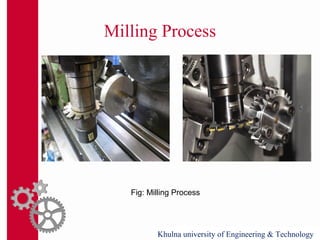
Milling Process
This is one of the initial and best known and metal removal process
for making gears. This method requires the usage of a milling
machine. It is also to be noted that this method can produce nearly
all types of gears. The method involves the use of a form cutter,
which is passed through the gear blank to create the tooth gap. This
method is right now used only for the manufacture of gears
requiring very less dimensional accuracy. To put it correctly this
method is currently outdated.
Khulna university of Engineering & Technology
Milling Process
Fig: Milling Process
Khulna university of Engineering & Technology
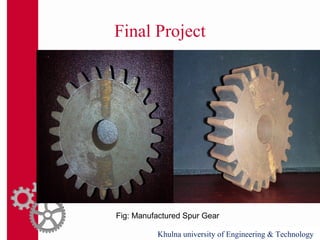
Final Project
Khulna university of Engineering & Technology
Fig: Manufactured Spur Gear
References
[1] FAIRES VIRGIL MORING, “DESIGN OF MACHINE
ELEMENTS”, 4th
edition, The Macmillan Company, New
York/Collier-Macmillan Limited, London
[2] Jain R.K., “ Production Technology”, 16th
edition, 2-B, Nath
Market, Nai Sarak, Delhi-110006
[3]http://www.brighthubengineering.com/manufacturing-
technology/7118-gear-manufacturing-methods
Khulna university of Engineering & TechnologyKhulna university of Engineering & Technology
THANK YOUYOU
Khulna university of Engineering & Technology

Presentation on Spur Gear

  • 1.
    Fabrication Of Spur Gear Supervisedby Md.Golam Kader Professor, Md Rasedul Islam Lecturer, Department of Mechanical Engineering, KUET Course ME 3118 Khulna University Of Engineering & Technology Department of Mechanical Engineering Submitted By Md Rezowan Kabir [1205016] Md Hasanuzzaman [1205017] Md Abul Kashem Hemel [1205018] Md Ashik Mahmud [1205019] Saikat Biswas [1205020]
  • 2.
    Chapter 1 Khulna universityof Engineering &Technology
  • 3.
    Objectives To Study aboutgear. To Study about the classification of gear. To Study about spur gear. Fabrication of spur gear. To Study of advantages and disadvantages of spur gear. Khulna university of Engineering & Technology
  • 4.
    Introduction A gear isa rotating machine part having cut teeth, which mesh with another toothed part to transmit torque, in most cases with teeth on the one gear being of identical shape, and often also with that shape on the other gear. Two or more gears working in a sequence are called a gear train or, in many cases, a transmission; such Gear arrangements can produce a mechanical advantage through a gear ratio and thus may be considered a simple machine. Khulna university of Engineering & Technology
  • 5.
    Introduction (Continued) Gears areUsed to Control Power Transmission in These Ways 1. Changing the direction through which power is transmitted (i.e. parallel, right angles, rotating, linear etc.) 2. Changing the amount of force or torque 3. Changing RPM When two gears mesh, and one gear is bigger than the other (even though the size of the teeth must match), a mechanical advantage is produced, with the rotational speeds and the torques of the two gears differing in an inverse relationship. Khulna university of Engineering & Technology
  • 6.
    Types Of Gears Accordingto the position of axes of the shafts. Parallel 1.Spur Gear 2.Helical Gear 3.Rack and Pinion Intersecting 1.Bevel Gear Non-intersecting and Non-parallel 1.worm and worm gears Khulna university of Engineering & Technology
  • 7.
    Spur Gear Spur gearsare the most commonly used gear type. They are characterized by teeth which are perpendicular to the face of the gear. Spur gears are by far the most commonly available, and are generally the least expensive. Teeth is parallel to axis of rotation Transmit power from one shaft to another parallel shaft least expensive Khulna university of Engineering & Technology
  • 8.
    Applications of SpurGear In mechanical systems where we’ll require simple design, more efficient power transfer, and low speed applications where noise does not matter, we should go for spur gears. Spur gears have a wide range of applications. They are used in:  Metal cutting machines  Power plants  Marine engines  Mechanical clocks and watches  Fuel pumps  Washing Machines Gear motors and gear pumps  Rack and pinion mechanisms  Material handling equipments  Automobile gear boxes  Steel mills  Rolling mills Khulna university of Engineering & Technology
  • 9.
    Chapter 2 CONTENTS Khulna universityof Engineering & Technology
  • 10.
    GEAR TERMINOLOGY Pitch surface: The surface of the imaginary rolling cylinder (cone, etc.) that the toothed gear may be considered to replace. Pitch circle: A right section of the pitch surface. Root (or dedendum) circle: The circle bounding the spaces between the teeth, in a right section of the gear. Addendum: The radial distance between the pitch circle and the addendum circle. Dedendum: The radial distance between the pitch circle and the root circle. Clearance: The difference between the dedendum of one gear and the addendum of the mating gear. Khulna university of Engineering & Technology
  • 11.
    GEAR TERMINOLOGY(CON’D) Face ofa tooth: That part of the tooth surface lying outside the pitch surface. Flank of a tooth: The part of the tooth surface lying inside the pitch surface. Circular thickness (tooth thickness) : The thickness of the tooth measured on the pitch circle. It is the length of an arc and not the length of a straight line. Tooth space: The distance between adjacent teeth measured on the pitch circle. Backlash: The difference between the circle thickness of one gear and the tooth space of the mating gear. Khulna university of Engineering & Technology
  • 12.
    GEAR TERMINOLOGY(CON’D) Module m:Pitch diameter divided by number of teeth. The pitch diameter is usually specified in inches or millimeters; in the former case the module is the inverse of diametral pitch. Fillet : The small radius that connects the profile of a tooth to the root circle. Pinion: The smaller of any pair of mating gears. The larger of the pair is called simply the gear. Velocity ratio: The ratio of the number of revolutions of the driving (or input) gear to the number of revolutions of the driven (or output) gear, in a unit of time. Khulna university of Engineering & Technology
  • 13.
    GEAR TERMINOLOGY(CON’D) Pressure angle:Pressure angle in relation to gear teeth, also known as the angle of obliquity, is the angle between the tooth face and the gear wheel tangent. It is more precisely the angle at a pitch point between the line of pressure (which is normal to the tooth surface) and the plane tangent to the pitch surface. Fig: Pressure angle of spur gear[1] Khulna university of Engineering & Technology
  • 14.
    GEAR TERMINOLOGY Fig2: Spurgear terminology[2] Fig3: Spur gear terminology[3]
  • 15.
    PROBLEM It is desiredto transmit 30 hp at 1800 rpm of the pinion; intermittent service; with light shock (§13.18); preferably not less than 20, 20o -full-depth teeth on the pinion; strength reduction factor Kf = 1.25 should be conservative; mw =1.5 Decisions must be made concerning the material and quality of cutting the teeth. Since the design is for strength only, it will be convenient to express Ft , Fd , vm ,face width b in terms of pitch Pd and arrange an equation containing s and Pd convenient for iteration. Weak material results in a relatively large pinion with high peripheral speed. A very strong material may be unnecessarily expensive. On a production bases carefully cut teeth should have a reasonable cost. Specify material, accuracy of cutting, pitch, face width, and tooth numbers. Khulna university of Engineering & Technology
  • 16.
    SOLUTION Khulna university ofEngineering & Technology
  • 17.
  • 18.
  • 19.
    SOLUTION(CON’D) Khulna university ofEngineering & Technology Pd = 8 b=8.5/Pd Np = 20 ,     Ng Np  =mw Ng =20*1.2=24 b=1.0625 Np =20 Ng =24 So the pitch diameter of the gear Pd = 8 Face width b =1.0625 inch Number of teeth = 24
  • 20.
    Drawing & Dimensions Khulnauniversity of Engineering & Technology
  • 21.
    Rendering Image Khulna universityof Engineering & Technology
  • 22.
    Chapter 3 CONTENTS Khulna universityof Engineering & Technology
  • 23.
  • 24.
    Why we chooseCast Iron? • High tensile strength to prevent failure against static loads. • High endurance strength to withstand dynamic loads. • Low coefficient of friction. • Good manufacturability. • Low cost. • High availability. Khulna university of Engineering & Technology
  • 25.
    MANUFACTURING PROCESS OFSPUR GEAR 1.Casting 2.Milling 3. Broaching 4. Gear hobbing 5. Gear forming Khulna university of Engineering & Technology
  • 26.
    Why we chooseMilling Process? 1. It is Compatible with All Materials 2. Flexible Use 3. Short Lead Times 4. Better accuracy Khulna university of Engineering & Technology
  • 27.
    Milling Process This isone of the initial and best known and metal removal process for making gears. This method requires the usage of a milling machine. It is also to be noted that this method can produce nearly all types of gears. The method involves the use of a form cutter, which is passed through the gear blank to create the tooth gap. This method is right now used only for the manufacture of gears requiring very less dimensional accuracy. To put it correctly this method is currently outdated. Khulna university of Engineering & Technology
  • 28.
    Milling Process Fig: MillingProcess Khulna university of Engineering & Technology
  • 29.
    Final Project Khulna universityof Engineering & Technology Fig: Manufactured Spur Gear
  • 30.
    References [1] FAIRES VIRGILMORING, “DESIGN OF MACHINE ELEMENTS”, 4th edition, The Macmillan Company, New York/Collier-Macmillan Limited, London [2] Jain R.K., “ Production Technology”, 16th edition, 2-B, Nath Market, Nai Sarak, Delhi-110006 [3]http://www.brighthubengineering.com/manufacturing- technology/7118-gear-manufacturing-methods Khulna university of Engineering & TechnologyKhulna university of Engineering & Technology
  • 31.
    THANK YOUYOU Khulna universityof Engineering & Technology