Lockless Programming in 
Games 
Bruce Dawson 
Principal Software Design Engineer 
Microsoft 
Windows Client Performance
Agenda 
» Locks and their problems 
» Lockless programming – a 
different set of problems! 
» Portable lockless programming 
» Lockless algorithms that work 
» Conclusions 
» Focus is on improving intuition on 
the reordering aspects of lockless 
programming
Cell phones 
» Please turn off all cell phones, 
pagers, alarm clocks, crying 
babies, internal combustion 
engines, leaf blowers, etc.
Mandatory Multi-core Mention 
» Xbox 360: six hardware threads 
» PS3: nine hardware threads 
» Windows: quad-core PCs for $500 
» Multi-threading is mandatory if you want 
to harness the available power 
» Luckily it's easy 
 As long as there is no sharing of non-constant 
data 
» Sharing data is tricky 
 Easiest and safest way is to use OS features 
such as locks and semaphores
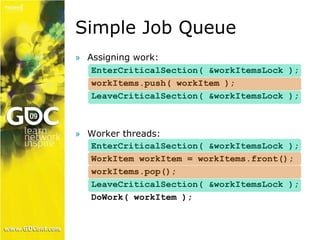
Simple Job Queue 
» Assigning work: 
EnterCriticalSection( &workItemsLock ); 
workItems.push( workItem ); 
LeaveCriticalSection( &workItemsLock ); 
» Worker threads: 
EnterCriticalSection( &workItemsLock ); 
WorkItem workItem = workItems.front(); 
workItems.pop(); 
LeaveCriticalSection( &workItemsLock ); 
DoWork( workItem );
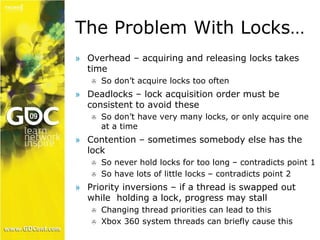
The Problem With Locks… 
» Overhead – acquiring and releasing locks takes 
time 
 So don’t acquire locks too often 
» Deadlocks – lock acquisition order must be 
consistent to avoid these 
 So don’t have very many locks, or only acquire one 
at a time 
» Contention – sometimes somebody else has the 
lock 
 So never hold locks for too long – contradicts point 1 
 So have lots of little locks – contradicts point 2 
» Priority inversions – if a thread is swapped out 
while holding a lock, progress may stall 
 Changing thread priorities can lead to this 
 Xbox 360 system threads can briefly cause this
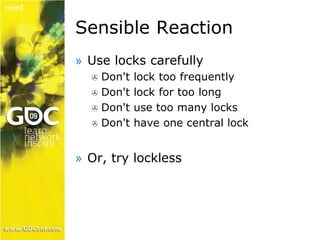
Sensible Reaction 
» Use locks carefully 
 Don't lock too frequently 
 Don't lock for too long 
 Don't use too many locks 
 Don't have one central lock 
» Or, try lockless
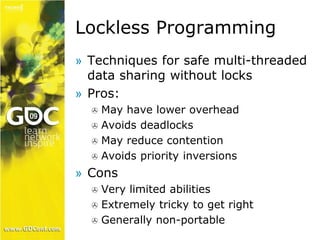
Lockless Programming 
» Techniques for safe multi-threaded 
data sharing without locks 
» Pros: 
 May have lower overhead 
 Avoids deadlocks 
 May reduce contention 
 Avoids priority inversions 
» Cons 
 Very limited abilities 
 Extremely tricky to get right 
 Generally non-portable
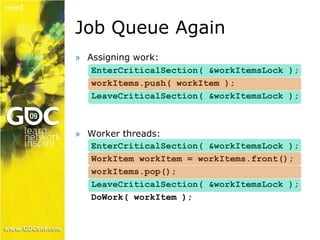
Job Queue Again 
» Assigning work: 
EnterCriticalSection( &workItemsLock ); 
workItems.push( workItem ); 
LeaveCriticalSection( &workItemsLock ); 
» Worker threads: 
EnterCriticalSection( &workItemsLock ); 
WorkItem workItem = workItems.front(); 
workItems.pop(); 
LeaveCriticalSection( &workItemsLock ); 
DoWork( workItem );
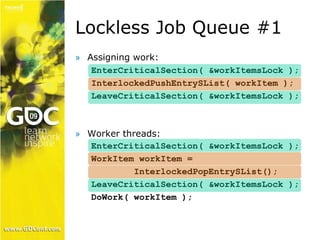
Lockless Job Queue #1 
» Assigning work: 
EnterCriticalSection( &workItemsLock ); 
InterlockedPushEntrySList( workItem ); 
LeaveCriticalSection( &workItemsLock ); 
» Worker threads: 
EnterCriticalSection( &workItemsLock ); 
WorkItem workItem = 
InterlockedPopEntrySList(); 
LeaveCriticalSection( &workItemsLock ); 
DoWork( workItem );
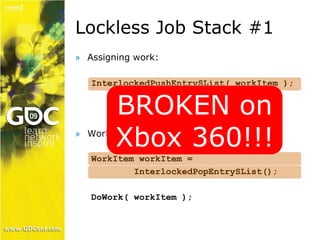
Lockless Job Stack #1 
» Assigning work: 
InterlockedPushEntrySList( workItem ); 
BROKEN on 
Xbox 360!!! 
» Worker threads: 
WorkItem workItem = 
InterlockedPopEntrySList(); 
DoWork( workItem );
Lockless Job Queue #2 
» Assigning work – one writer only: 
if( RoomAvail( readPt, writePt ) ) { 
CircWorkList[ writePt ] = workItem; 
writePt = WRAP( writePt + 1 ); 
Correct On 
Broken As 
Executed 
» Worker thread – one reader only: 
Paper 
if( DataAvail( writePt, readPt ) ) { 
WorkItem workItem = 
CircWorkList[ readPt ]; 
readPt = WRAP( readPt + 1 ); 
DoWork( workItem );
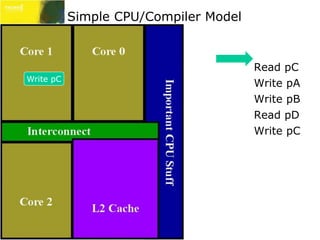
Simple CPU/Compiler Model 
Read pC 
Write pA 
Write pB 
Read pD 
Write pC 
Read pWReraitde ppDCAB
Write pA pCB 
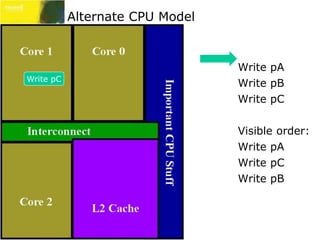
Alternate CPU Model 
Write pA 
Write pB 
Write pC 
Visible order: 
Write pA 
Write pC 
Write pB
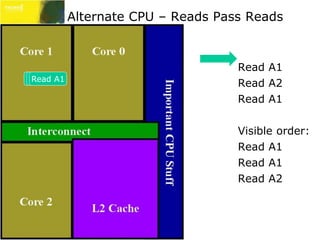
Alternate CPU – Reads Pass Reads 
Read A1 
Read A2 
Read A1 
Visible order: 
Read A1 
Read A1 
Read A2 
RRReeaeadad d A AA121
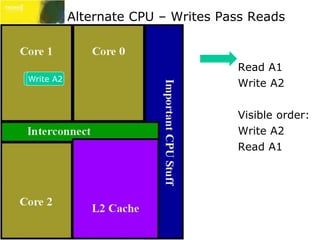
Alternate CPU – Writes Pass Reads 
Read A1 
Write A2 
Visible order: 
Write A2 
Read A1 
RWeraidte A A12
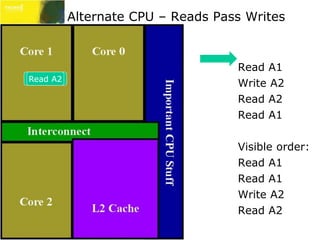
Alternate CPU – Reads Pass Writes 
Read A1 
Write A2 
Read A2 
Read A1 
Visible order: 
Read A1 
Read A1 
Write A2 
Read A2 
RWRReeraeaidtade d A AA1221
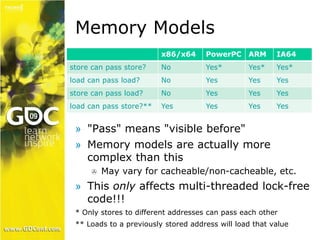
Memory Models 
x86/x64 PowerPC ARM IA64 
store can pass store? No Yes* Yes* Yes* 
load can pass load? No Yes Yes Yes 
store can pass load? No Yes Yes Yes 
load can pass store?** Yes Yes Yes Yes 
» "Pass" means "visible before" 
» Memory models are actually more 
complex than this 
 May vary for cacheable/non-cacheable, etc. 
» This only affects multi-threaded lock-free 
code!!! 
* Only stores to different addresses can pass each other 
** Loads to a previously stored address will load that value
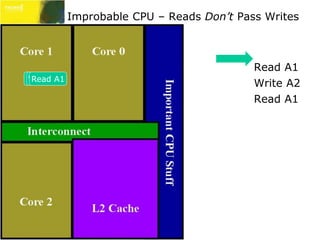
Improbable CPU – Reads Don’t Pass Writes 
Read A1 
Write A2 
Read A1 
RWReraeidtae dA AA121
Reads Must Pass Writes! 
» Reads not passing writes would 
mean L1 cache is frequently 
disabled 
 Every read that follows a write would 
stall for shared storage latency 
» Huge performance impact 
» Therefore, on x86 and x64 (on all 
modern CPUs) reads can pass 
writes
Reordering Implications 
» Publisher/Subscriber model 
» Thread A: 
g_data = data; 
g_dataReady = true; 
» Thread B: 
if( g_dataReady ) 
process( g_data ); 
» Is it safe?
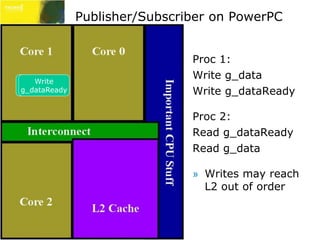
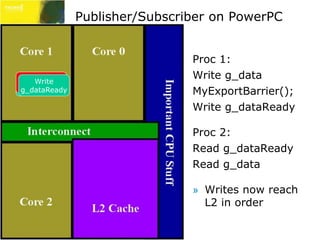
Publisher/Subscriber on PowerPC 
Proc 1: 
Write g_data 
Write g_dataReady 
Proc 2: 
Read g_dataReady 
Read g_data 
» Writes may reach 
L2 out of order 
Write 
Write 
g_data 
g_dataReady
Publisher/Subscriber on PowerPC 
Proc 1: 
Write g_data 
MyExportBarrier(); 
Write g_dataReady 
Proc 2: 
Read g_dataReady 
Read g_data 
» Writes now reach 
L2 in order 
Export 
Barrier 
Write 
Write 
g_data 
g_dataReady
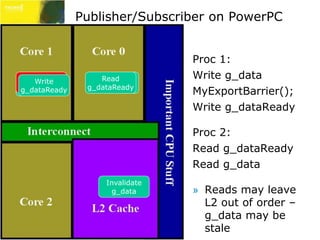
Publisher/Subscriber on PowerPC 
Proc 1: 
Write g_data 
MyExportBarrier(); 
Write g_dataReady 
Proc 2: 
Read g_dataReady 
Read g_data 
» Reads may leave 
L2 out of order – 
g_data may be 
stale 
Export 
Barrier 
Write 
Write 
g_data 
g_dataReady 
Read 
Read 
g_data 
g_dataReady 
Invalidate 
g_data
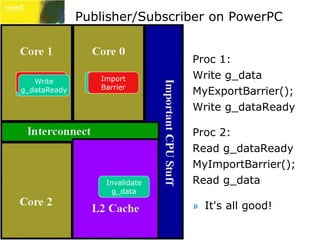
Publisher/Subscriber on PowerPC 
Proc 1: 
Write g_data 
MyExportBarrier(); 
Write g_dataReady 
Proc 2: 
Read g_dataReady 
MyImportBarrier(); 
Read g_data 
» It's all good! 
Export 
Barrier 
Write 
Write 
g_data 
g_dataReady 
Import 
Read 
Read 
g_Barrier 
data 
g_dataReady 
Invalidate 
g_data
x86/x64 FTW!!! 
» Not so fast… 
» Compilers are just as evil as 
processors 
» Compilers will rearrange your code 
as much as legally possible 
 And compilers assume your code is 
single threaded 
» Compiler and CPU reordering 
barriers needed
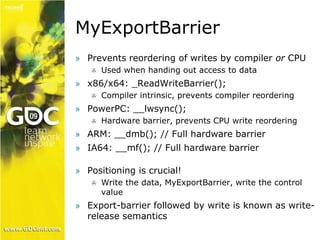
MyExportBarrier 
» Prevents reordering of writes by compiler or CPU 
 Used when handing out access to data 
» x86/x64: _ReadWriteBarrier(); 
 Compiler intrinsic, prevents compiler reordering 
» PowerPC: __lwsync(); 
 Hardware barrier, prevents CPU write reordering 
» ARM: __dmb(); // Full hardware barrier 
» IA64: __mf(); // Full hardware barrier 
» Positioning is crucial! 
 Write the data, MyExportBarrier, write the control 
value 
» Export-barrier followed by write is known as write-release 
semantics
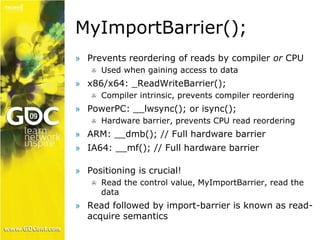
MyImportBarrier(); 
» Prevents reordering of reads by compiler or CPU 
 Used when gaining access to data 
» x86/x64: _ReadWriteBarrier(); 
 Compiler intrinsic, prevents compiler reordering 
» PowerPC: __lwsync(); or isync(); 
 Hardware barrier, prevents CPU read reordering 
» ARM: __dmb(); // Full hardware barrier 
» IA64: __mf(); // Full hardware barrier 
» Positioning is crucial! 
 Read the control value, MyImportBarrier, read the 
data 
» Read followed by import-barrier is known as read-acquire 
semantics
Fixed Job Queue #2 
» Assigning work – one writer only: 
if( RoomAvail( readPt, writePt ) ) { 
MyImportBarrier(); 
CircWorkList[ writePt ] = workItem; 
MyExportBarrier(); 
writePt = WRAP( writePtr + 1 ); 
» Worker thread – one reader only: 
Correct!!! 
if( DataAvail( writePt, readPt ) ) { 
MyImportBarrier(); 
WorkItem workItem = 
CircWorkList[ readPt ]; 
MyExportBarrier(); 
readPt = WRAP( readPt + 1 ); 
DoWork( workItem );
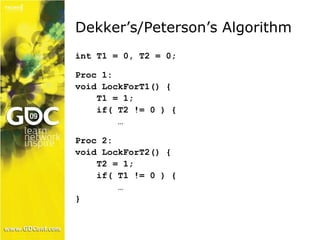
Dekker’s/Peterson’s Algorithm 
int T1 = 0, T2 = 0; 
Proc 1: 
void LockForT1() { 
T1 = 1; 
if( T2 != 0 ) { 
… 
Proc 2: 
void LockForT2() { 
T2 = 1; 
if( T1 != 0 ) { 
… 
}
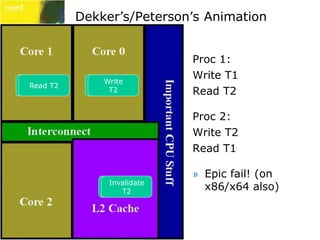
Dekker’s/Peterson’s Animation 
Proc 1: 
Write T1 
Read T2 
Proc 2: 
Write T2 
Read T1 
» Epic fail! (on 
x86/x64 also) 
Write 
T1 
Write 
T2 
Read T1 
Invalidate 
T1 
Read T2 
Invalidate 
T2
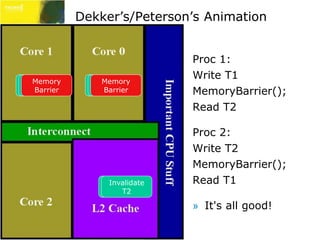
Dekker’s/Peterson’s Animation 
Proc 1: 
Write T1 
MemoryBarrier(); 
Read T2 
Proc 2: 
Write T2 
MemoryBarrier(); 
Read T1 
» It's all good! 
Write 
T1 
Memory 
Write 
Barrier 
T2 
Read T1 
Invalidate 
T1 
Read T2 
Invalidate 
T2 
Memory 
Barrier
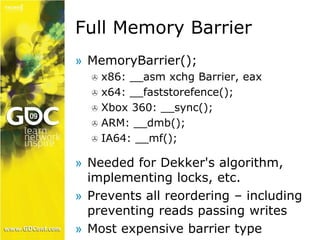
Full Memory Barrier 
» MemoryBarrier(); 
 x86: __asm xchg Barrier, eax 
 x64: __faststorefence(); 
 Xbox 360: __sync(); 
 ARM: __dmb(); 
 IA64: __mf(); 
» Needed for Dekker's algorithm, 
implementing locks, etc. 
» Prevents all reordering – including 
preventing reads passing writes 
» Most expensive barrier type
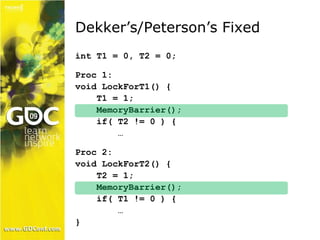
Dekker’s/Peterson’s Fixed 
int T1 = 0, T2 = 0; 
Proc 1: 
void LockForT1() { 
T1 = 1; 
MemoryBarrier(); 
if( T2 != 0 ) { 
… 
Proc 2: 
void LockForT2() { 
T2 = 1; 
MemoryBarrier(); 
if( T1 != 0 ) { 
… 
}
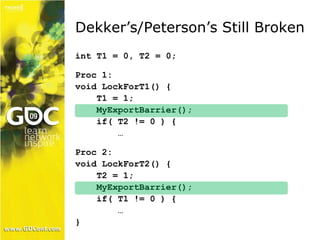
Dekker’s/Peterson’s Still Broken 
int T1 = 0, T2 = 0; 
Proc 1: 
void LockForT1() { 
T1 = 1; 
MyExportBarrier(); 
if( T2 != 0 ) { 
… 
Proc 2: 
void LockForT2() { 
T2 = 1; 
MyExportBarrier(); 
if( T1 != 0 ) { 
… 
}
Dekker’s/Peterson’s Still Broken 
int T1 = 0, T2 = 0; 
Proc 1: 
void LockForT1() { 
T1 = 1; 
MyImportBarrier(); 
if( T2 != 0 ) { 
… 
Proc 2: 
void LockForT2() { 
T2 = 1; 
MyImportBarrier(); 
if( T1 != 0 ) { 
… 
}
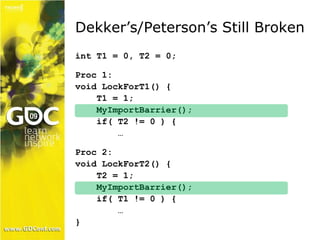
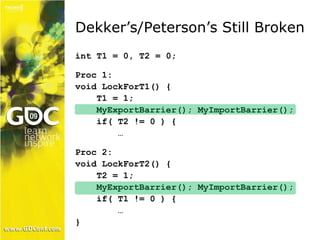
Dekker’s/Peterson’s Still Broken 
int T1 = 0, T2 = 0; 
Proc 1: 
void LockForT1() { 
T1 = 1; 
MyExportBarrier(); MyImportBarrier(); 
if( T2 != 0 ) { 
… 
Proc 2: 
void LockForT2() { 
T2 = 1; 
MyExportBarrier(); MyImportBarrier(); 
if( T1 != 0 ) { 
… 
}
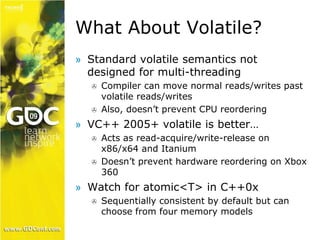
What About Volatile? 
» Standard volatile semantics not 
designed for multi-threading 
 Compiler can move normal reads/writes past 
volatile reads/writes 
 Also, doesn’t prevent CPU reordering 
» VC++ 2005+ volatile is better… 
 Acts as read-acquire/write-release on 
x86/x64 and Itanium 
 Doesn’t prevent hardware reordering on Xbox 
360 
» Watch for atomic<T> in C++0x 
 Sequentially consistent by default but can 
choose from four memory models
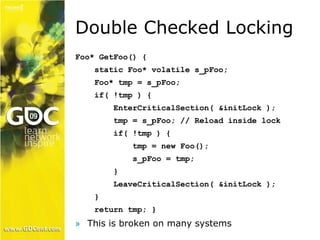
Double Checked Locking 
Foo* GetFoo() { 
static Foo* volatile s_pFoo; 
Foo* tmp = s_pFoo; 
if( !tmp ) { 
EnterCriticalSection( &initLock ); 
tmp = s_pFoo; // Reload inside lock 
if( !tmp ) { 
tmp = new Foo(); 
s_pFoo = tmp; 
} 
LeaveCriticalSection( &initLock ); 
} 
return tmp; } 
» This is broken on many systems
Possible Compiler Rewrite 
Foo* GetFoo() { 
static Foo* volatile s_pFoo; 
Foo* tmp = s_pFoo; 
if( !tmp ) { 
EnterCriticalSection( &initLock ); 
tmp = s_pFoo; // Reload inside lock 
if( !tmp ) { 
s_pFoo = (Foo*)new char[sizeof(Foo)]; 
new(s_pFoo) Foo; tmp = s_pFoo; 
} 
LeaveCriticalSection( &initLock ); 
} 
return tmp; }
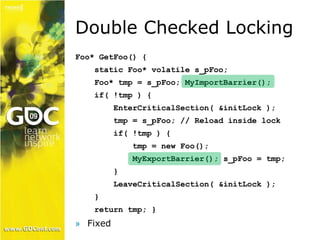
Double Checked Locking 
Foo* GetFoo() { 
static Foo* volatile s_pFoo; 
Foo* tmp = s_pFoo; MyImportBarrier(); 
if( !tmp ) { 
EnterCriticalSection( &initLock ); 
tmp = s_pFoo; // Reload inside lock 
if( !tmp ) { 
tmp = new Foo(); 
MyExportBarrier(); s_pFoo = tmp; 
} 
LeaveCriticalSection( &initLock ); 
} 
return tmp; } 
» Fixed
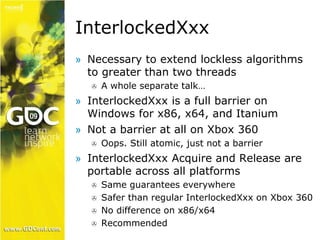
InterlockedXxx 
» Necessary to extend lockless algorithms 
to greater than two threads 
 A whole separate talk… 
» InterlockedXxx is a full barrier on 
Windows for x86, x64, and Itanium 
» Not a barrier at all on Xbox 360 
 Oops. Still atomic, just not a barrier 
» InterlockedXxx Acquire and Release are 
portable across all platforms 
 Same guarantees everywhere 
 Safer than regular InterlockedXxx on Xbox 360 
 No difference on x86/x64 
 Recommended
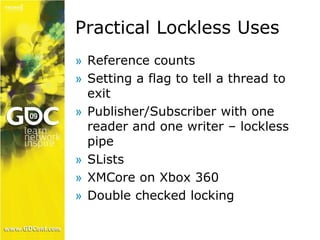
Practical Lockless Uses 
» Reference counts 
» Setting a flag to tell a thread to 
exit 
» Publisher/Subscriber with one 
reader and one writer – lockless 
pipe 
» SLists 
» XMCore on Xbox 360 
» Double checked locking
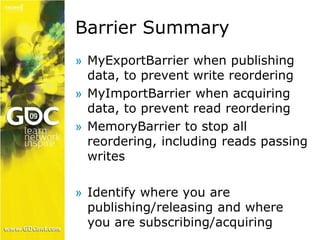
Barrier Summary 
» MyExportBarrier when publishing 
data, to prevent write reordering 
» MyImportBarrier when acquiring 
data, to prevent read reordering 
» MemoryBarrier to stop all 
reordering, including reads passing 
writes 
» Identify where you are 
publishing/releasing and where 
you are subscribing/acquiring
Summary 
» Prefer using locks – they are full barriers 
» Acquiring and releasing a lock is a memory 
barrier 
» Use lockless only when costs of locks are 
shown to be too high 
» Use pre-built lockless algorithms if 
possible 
» Encapsulate lockless algorithms to make 
them safe to use 
» Volatile is not a portable solution 
» Remember that InterlockedXxx is a full 
barrier on Windows, but not on Xbox 
360
References 
» Intel memory model documentation in Intel® 64 and IA-32 
Architectures Software Developer's Manual Volume 3A: 
System Programming Guide 
 http://download.intel.com/design/processor/manuals/253668.pdf 
» AMD "Multiprocessor Memory Access Ordering" 
 http://www.amd.com/us-en/ 
assets/content_type/white_papers_and_tech_docs/24593.pdf 
» PPC memory model explanation 
 http://www.ibm.com/developerworks/eserver/articles/powerpc.ht 
ml 
» Lockless Programming Considerations for Xbox 360 and 
Microsoft Windows 
 http://msdn.microsoft.com/en-us/library/bb310595.aspx 
» Perils of Double Checked Locking 
 http://www.aristeia.com/Papers/DDJ_Jul_Aug_2004_revised.pdf 
» Java Memory Model Cookbook 
 http://g.oswego.edu/dl/jmm/cookbook.html
Questions? 
» bdawson@microsoft.com
Feedback forms 
» Please fill out feedback forms

Lockless Programming GDC 09

  • 2.
    Lockless Programming in Games Bruce Dawson Principal Software Design Engineer Microsoft Windows Client Performance
  • 3.
    Agenda » Locksand their problems » Lockless programming – a different set of problems! » Portable lockless programming » Lockless algorithms that work » Conclusions » Focus is on improving intuition on the reordering aspects of lockless programming
  • 4.
    Cell phones »Please turn off all cell phones, pagers, alarm clocks, crying babies, internal combustion engines, leaf blowers, etc.
  • 5.
    Mandatory Multi-core Mention » Xbox 360: six hardware threads » PS3: nine hardware threads » Windows: quad-core PCs for $500 » Multi-threading is mandatory if you want to harness the available power » Luckily it's easy  As long as there is no sharing of non-constant data » Sharing data is tricky  Easiest and safest way is to use OS features such as locks and semaphores
  • 6.
    Simple Job Queue » Assigning work: EnterCriticalSection( &workItemsLock ); workItems.push( workItem ); LeaveCriticalSection( &workItemsLock ); » Worker threads: EnterCriticalSection( &workItemsLock ); WorkItem workItem = workItems.front(); workItems.pop(); LeaveCriticalSection( &workItemsLock ); DoWork( workItem );
  • 7.
    The Problem WithLocks… » Overhead – acquiring and releasing locks takes time  So don’t acquire locks too often » Deadlocks – lock acquisition order must be consistent to avoid these  So don’t have very many locks, or only acquire one at a time » Contention – sometimes somebody else has the lock  So never hold locks for too long – contradicts point 1  So have lots of little locks – contradicts point 2 » Priority inversions – if a thread is swapped out while holding a lock, progress may stall  Changing thread priorities can lead to this  Xbox 360 system threads can briefly cause this
  • 8.
    Sensible Reaction »Use locks carefully  Don't lock too frequently  Don't lock for too long  Don't use too many locks  Don't have one central lock » Or, try lockless
  • 9.
    Lockless Programming »Techniques for safe multi-threaded data sharing without locks » Pros:  May have lower overhead  Avoids deadlocks  May reduce contention  Avoids priority inversions » Cons  Very limited abilities  Extremely tricky to get right  Generally non-portable
  • 10.
    Job Queue Again » Assigning work: EnterCriticalSection( &workItemsLock ); workItems.push( workItem ); LeaveCriticalSection( &workItemsLock ); » Worker threads: EnterCriticalSection( &workItemsLock ); WorkItem workItem = workItems.front(); workItems.pop(); LeaveCriticalSection( &workItemsLock ); DoWork( workItem );
  • 11.
    Lockless Job Queue#1 » Assigning work: EnterCriticalSection( &workItemsLock ); InterlockedPushEntrySList( workItem ); LeaveCriticalSection( &workItemsLock ); » Worker threads: EnterCriticalSection( &workItemsLock ); WorkItem workItem = InterlockedPopEntrySList(); LeaveCriticalSection( &workItemsLock ); DoWork( workItem );
  • 12.
    Lockless Job Stack#1 » Assigning work: InterlockedPushEntrySList( workItem ); BROKEN on Xbox 360!!! » Worker threads: WorkItem workItem = InterlockedPopEntrySList(); DoWork( workItem );
  • 13.
    Lockless Job Queue#2 » Assigning work – one writer only: if( RoomAvail( readPt, writePt ) ) { CircWorkList[ writePt ] = workItem; writePt = WRAP( writePt + 1 ); Correct On Broken As Executed » Worker thread – one reader only: Paper if( DataAvail( writePt, readPt ) ) { WorkItem workItem = CircWorkList[ readPt ]; readPt = WRAP( readPt + 1 ); DoWork( workItem );
  • 14.
    Simple CPU/Compiler Model Read pC Write pA Write pB Read pD Write pC Read pWReraitde ppDCAB
  • 15.
    Write pA pCB Alternate CPU Model Write pA Write pB Write pC Visible order: Write pA Write pC Write pB
  • 16.
    Alternate CPU –Reads Pass Reads Read A1 Read A2 Read A1 Visible order: Read A1 Read A1 Read A2 RRReeaeadad d A AA121
  • 17.
    Alternate CPU –Writes Pass Reads Read A1 Write A2 Visible order: Write A2 Read A1 RWeraidte A A12
  • 18.
    Alternate CPU –Reads Pass Writes Read A1 Write A2 Read A2 Read A1 Visible order: Read A1 Read A1 Write A2 Read A2 RWRReeraeaidtade d A AA1221
  • 19.
    Memory Models x86/x64PowerPC ARM IA64 store can pass store? No Yes* Yes* Yes* load can pass load? No Yes Yes Yes store can pass load? No Yes Yes Yes load can pass store?** Yes Yes Yes Yes » "Pass" means "visible before" » Memory models are actually more complex than this  May vary for cacheable/non-cacheable, etc. » This only affects multi-threaded lock-free code!!! * Only stores to different addresses can pass each other ** Loads to a previously stored address will load that value
  • 20.
    Improbable CPU –Reads Don’t Pass Writes Read A1 Write A2 Read A1 RWReraeidtae dA AA121
  • 21.
    Reads Must PassWrites! » Reads not passing writes would mean L1 cache is frequently disabled  Every read that follows a write would stall for shared storage latency » Huge performance impact » Therefore, on x86 and x64 (on all modern CPUs) reads can pass writes
  • 22.
    Reordering Implications »Publisher/Subscriber model » Thread A: g_data = data; g_dataReady = true; » Thread B: if( g_dataReady ) process( g_data ); » Is it safe?
  • 23.
    Publisher/Subscriber on PowerPC Proc 1: Write g_data Write g_dataReady Proc 2: Read g_dataReady Read g_data » Writes may reach L2 out of order Write Write g_data g_dataReady
  • 24.
    Publisher/Subscriber on PowerPC Proc 1: Write g_data MyExportBarrier(); Write g_dataReady Proc 2: Read g_dataReady Read g_data » Writes now reach L2 in order Export Barrier Write Write g_data g_dataReady
  • 25.
    Publisher/Subscriber on PowerPC Proc 1: Write g_data MyExportBarrier(); Write g_dataReady Proc 2: Read g_dataReady Read g_data » Reads may leave L2 out of order – g_data may be stale Export Barrier Write Write g_data g_dataReady Read Read g_data g_dataReady Invalidate g_data
  • 26.
    Publisher/Subscriber on PowerPC Proc 1: Write g_data MyExportBarrier(); Write g_dataReady Proc 2: Read g_dataReady MyImportBarrier(); Read g_data » It's all good! Export Barrier Write Write g_data g_dataReady Import Read Read g_Barrier data g_dataReady Invalidate g_data
  • 27.
    x86/x64 FTW!!! »Not so fast… » Compilers are just as evil as processors » Compilers will rearrange your code as much as legally possible  And compilers assume your code is single threaded » Compiler and CPU reordering barriers needed
  • 28.
    MyExportBarrier » Preventsreordering of writes by compiler or CPU  Used when handing out access to data » x86/x64: _ReadWriteBarrier();  Compiler intrinsic, prevents compiler reordering » PowerPC: __lwsync();  Hardware barrier, prevents CPU write reordering » ARM: __dmb(); // Full hardware barrier » IA64: __mf(); // Full hardware barrier » Positioning is crucial!  Write the data, MyExportBarrier, write the control value » Export-barrier followed by write is known as write-release semantics
  • 29.
    MyImportBarrier(); » Preventsreordering of reads by compiler or CPU  Used when gaining access to data » x86/x64: _ReadWriteBarrier();  Compiler intrinsic, prevents compiler reordering » PowerPC: __lwsync(); or isync();  Hardware barrier, prevents CPU read reordering » ARM: __dmb(); // Full hardware barrier » IA64: __mf(); // Full hardware barrier » Positioning is crucial!  Read the control value, MyImportBarrier, read the data » Read followed by import-barrier is known as read-acquire semantics
  • 30.
    Fixed Job Queue#2 » Assigning work – one writer only: if( RoomAvail( readPt, writePt ) ) { MyImportBarrier(); CircWorkList[ writePt ] = workItem; MyExportBarrier(); writePt = WRAP( writePtr + 1 ); » Worker thread – one reader only: Correct!!! if( DataAvail( writePt, readPt ) ) { MyImportBarrier(); WorkItem workItem = CircWorkList[ readPt ]; MyExportBarrier(); readPt = WRAP( readPt + 1 ); DoWork( workItem );
  • 31.
    Dekker’s/Peterson’s Algorithm intT1 = 0, T2 = 0; Proc 1: void LockForT1() { T1 = 1; if( T2 != 0 ) { … Proc 2: void LockForT2() { T2 = 1; if( T1 != 0 ) { … }
  • 32.
    Dekker’s/Peterson’s Animation Proc1: Write T1 Read T2 Proc 2: Write T2 Read T1 » Epic fail! (on x86/x64 also) Write T1 Write T2 Read T1 Invalidate T1 Read T2 Invalidate T2
  • 33.
    Dekker’s/Peterson’s Animation Proc1: Write T1 MemoryBarrier(); Read T2 Proc 2: Write T2 MemoryBarrier(); Read T1 » It's all good! Write T1 Memory Write Barrier T2 Read T1 Invalidate T1 Read T2 Invalidate T2 Memory Barrier
  • 34.
    Full Memory Barrier » MemoryBarrier();  x86: __asm xchg Barrier, eax  x64: __faststorefence();  Xbox 360: __sync();  ARM: __dmb();  IA64: __mf(); » Needed for Dekker's algorithm, implementing locks, etc. » Prevents all reordering – including preventing reads passing writes » Most expensive barrier type
  • 35.
    Dekker’s/Peterson’s Fixed intT1 = 0, T2 = 0; Proc 1: void LockForT1() { T1 = 1; MemoryBarrier(); if( T2 != 0 ) { … Proc 2: void LockForT2() { T2 = 1; MemoryBarrier(); if( T1 != 0 ) { … }
  • 36.
    Dekker’s/Peterson’s Still Broken int T1 = 0, T2 = 0; Proc 1: void LockForT1() { T1 = 1; MyExportBarrier(); if( T2 != 0 ) { … Proc 2: void LockForT2() { T2 = 1; MyExportBarrier(); if( T1 != 0 ) { … }
  • 37.
    Dekker’s/Peterson’s Still Broken int T1 = 0, T2 = 0; Proc 1: void LockForT1() { T1 = 1; MyImportBarrier(); if( T2 != 0 ) { … Proc 2: void LockForT2() { T2 = 1; MyImportBarrier(); if( T1 != 0 ) { … }
  • 38.
    Dekker’s/Peterson’s Still Broken int T1 = 0, T2 = 0; Proc 1: void LockForT1() { T1 = 1; MyExportBarrier(); MyImportBarrier(); if( T2 != 0 ) { … Proc 2: void LockForT2() { T2 = 1; MyExportBarrier(); MyImportBarrier(); if( T1 != 0 ) { … }
  • 39.
    What About Volatile? » Standard volatile semantics not designed for multi-threading  Compiler can move normal reads/writes past volatile reads/writes  Also, doesn’t prevent CPU reordering » VC++ 2005+ volatile is better…  Acts as read-acquire/write-release on x86/x64 and Itanium  Doesn’t prevent hardware reordering on Xbox 360 » Watch for atomic<T> in C++0x  Sequentially consistent by default but can choose from four memory models
  • 40.
    Double Checked Locking Foo* GetFoo() { static Foo* volatile s_pFoo; Foo* tmp = s_pFoo; if( !tmp ) { EnterCriticalSection( &initLock ); tmp = s_pFoo; // Reload inside lock if( !tmp ) { tmp = new Foo(); s_pFoo = tmp; } LeaveCriticalSection( &initLock ); } return tmp; } » This is broken on many systems
  • 41.
    Possible Compiler Rewrite Foo* GetFoo() { static Foo* volatile s_pFoo; Foo* tmp = s_pFoo; if( !tmp ) { EnterCriticalSection( &initLock ); tmp = s_pFoo; // Reload inside lock if( !tmp ) { s_pFoo = (Foo*)new char[sizeof(Foo)]; new(s_pFoo) Foo; tmp = s_pFoo; } LeaveCriticalSection( &initLock ); } return tmp; }
  • 42.
    Double Checked Locking Foo* GetFoo() { static Foo* volatile s_pFoo; Foo* tmp = s_pFoo; MyImportBarrier(); if( !tmp ) { EnterCriticalSection( &initLock ); tmp = s_pFoo; // Reload inside lock if( !tmp ) { tmp = new Foo(); MyExportBarrier(); s_pFoo = tmp; } LeaveCriticalSection( &initLock ); } return tmp; } » Fixed
  • 43.
    InterlockedXxx » Necessaryto extend lockless algorithms to greater than two threads  A whole separate talk… » InterlockedXxx is a full barrier on Windows for x86, x64, and Itanium » Not a barrier at all on Xbox 360  Oops. Still atomic, just not a barrier » InterlockedXxx Acquire and Release are portable across all platforms  Same guarantees everywhere  Safer than regular InterlockedXxx on Xbox 360  No difference on x86/x64  Recommended
  • 44.
    Practical Lockless Uses » Reference counts » Setting a flag to tell a thread to exit » Publisher/Subscriber with one reader and one writer – lockless pipe » SLists » XMCore on Xbox 360 » Double checked locking
  • 45.
    Barrier Summary »MyExportBarrier when publishing data, to prevent write reordering » MyImportBarrier when acquiring data, to prevent read reordering » MemoryBarrier to stop all reordering, including reads passing writes » Identify where you are publishing/releasing and where you are subscribing/acquiring
  • 46.
    Summary » Preferusing locks – they are full barriers » Acquiring and releasing a lock is a memory barrier » Use lockless only when costs of locks are shown to be too high » Use pre-built lockless algorithms if possible » Encapsulate lockless algorithms to make them safe to use » Volatile is not a portable solution » Remember that InterlockedXxx is a full barrier on Windows, but not on Xbox 360
  • 47.
    References » Intelmemory model documentation in Intel® 64 and IA-32 Architectures Software Developer's Manual Volume 3A: System Programming Guide  http://download.intel.com/design/processor/manuals/253668.pdf » AMD "Multiprocessor Memory Access Ordering"  http://www.amd.com/us-en/ assets/content_type/white_papers_and_tech_docs/24593.pdf » PPC memory model explanation  http://www.ibm.com/developerworks/eserver/articles/powerpc.ht ml » Lockless Programming Considerations for Xbox 360 and Microsoft Windows  http://msdn.microsoft.com/en-us/library/bb310595.aspx » Perils of Double Checked Locking  http://www.aristeia.com/Papers/DDJ_Jul_Aug_2004_revised.pdf » Java Memory Model Cookbook  http://g.oswego.edu/dl/jmm/cookbook.html
  • 48.
  • 49.
    Feedback forms »Please fill out feedback forms