Ken Anderson  Executive Strategist  Chris Haddad Vice President, Service Director  Application Platform Strategies IT: The Business of Technology  Tuesday – April 22, 2008 Wednesday – April 23, 2008
The Executive Viewpoint As the internet connects the world, the world flattens, creating a new global economy.  With a new “connected world” and countries shedding their 3rd world status, business is changing.  Executives, burdened by past technology investments and wary of economic changes, are viewing IT investments with additional skepticism.  Executives realize that finding new ways to deliver their core business, automate process and reduce cost - is not enough.
IT Viewpoint IT departments are struggling to maintain legacy systems, provide required services, and fund new initiatives.  Technologies, (once thought revolutionary), that free employees from their desktops, enable a virtual workforce, and provide information—any where, any time, and any place—are now considered basic services and candidates for outsourcing.  IT professionals, once primarily viewed as technologists, find themselves in the unfamiliar territory of having to justify their role in today’s less technical, more traditional business landscape.  IT budgets, once bolstered by the excitement of change, are under scrutiny by executives who demand value from the millions spent.
The Birth of IT - Information Technology Mainframe to PC World Wide Web Y2K Automate Business Process Network People to Data Deploy Best-of-Breed Applications Move Business to the Web Remote Workforce Identity Management Collaboration Optimize IT Virtualization Business Intelligence Content Management Business Continuation IM Social Networking Unified Communications Digital Asset Management  Portfolio Management Security and Risk Management  Software as a Service SOA E-Mail Macintosh Laptops Cell Phones 1970  1980  1990  2000  2010 Intel 4004 IBM PC Lotus 1-2-3 Window 3.0 WordPerfect NetScape Remote Access Napster DBase LINUX Local Area Networks Wide Area Networks PDA’s
Impact of Technology on the World Before Christopher Columbus After Christopher Columbus Before the Internet After the Internet
Impact of Technology on People A Google search on “information overload” yields 1,640,000 results.
Today With a new “flatter, connected world,” business is changing.  Businesses are struggling to provide consumable – actionable  information from their multiple data sources. Businesses are changing, looking for new ideas and markets. Businesses look to divest and outsource non-core capabilities.  Expand into emerging markets and exploit acquisition opportunities. IT innovating alone, finding new ways to deliver, automate and reducing cost is not enough. IT needs to enable business opportunities IT needs to think like a business
Thinking Like a Business A traditional IT department operates as a monopoly with captive customers who are required to use corporate standards and internal IT services.  Successful businesses, provide their customers the right products and services.  Thinking like a business forces an IT department to transform itself into a service organization that offers core services and is managed as a business and marketed as though the customer has a choice.  IT professionals need to integrate the world of business into their world of technology.
Thinking Like a Business Smart businesses realize their success is directly tied to customer success.  This is not a process of alignment but an integration - requires an investment of limited IT resources to improve efficiency, increase productivity, and enable revenue generation.  IT professionals need to understand their customers’ needs (the business is the customer), incorporate feedback, and agree on a set of business-oriented metrics managed by IT departments and customers.
Measuring Success - Efficiency vs. Effectiveness IT departments rely on efficiency metrics to communicate status and success.  Efficiency metrics are easier to measure as they are derived from known data sources and generally presented as factual.  Common IT efficiency metrics include uptime, capacity, project progress, bugs logged, and expense against budget. Effective metrics define impacts and outcomes such as market growth, marketing efficiency, customer trends, and product profitability.
Effective Business Metrics Effective based metrics are more difficult to implement as they define impacts and outcomes; data points require analysis and outputs are subject to interpretation.  Revenue Business capability/process/service delivery efficiency Business inventories or other expenses  Ability to identify and pursue new business opportunities Customer relations  Single corporate image and unified channels Comprehensive view of customer needs, desires, and interactions Business process cycle times
Building Business Partnerships Businesses that effectively build and maintain relationships with their customers have a competitive advantage in today’s marketplace.  Effective partnerships are fostered when both parties work toward common goals and strengthened when those partners work together to overcome obstacles.  Through partnership, IT departments gain an intimate understanding of their customers and a unique viewpoint into the business world.  Partnerships also provide a clear understanding to all parties: If the project succeeds, the partners succeed; if the project fails, everyone fails.
Recommendations IT professionals who are comfortable communicating in technical language need to communicate in business terms that transcend return on investment predictions .  This requires an understanding of the customer’s business, goals, and what makes their specialties unique. This understanding goes beyond traditional requirements documents; it must be an ongoing, interactive, and iterative process that improves over time.  IT proposals that have traditionally focused on cost and impact on infrastructure need to focus on changes and improvements to the customer’s business - establish project success criteria - focus on higher level outcomes.
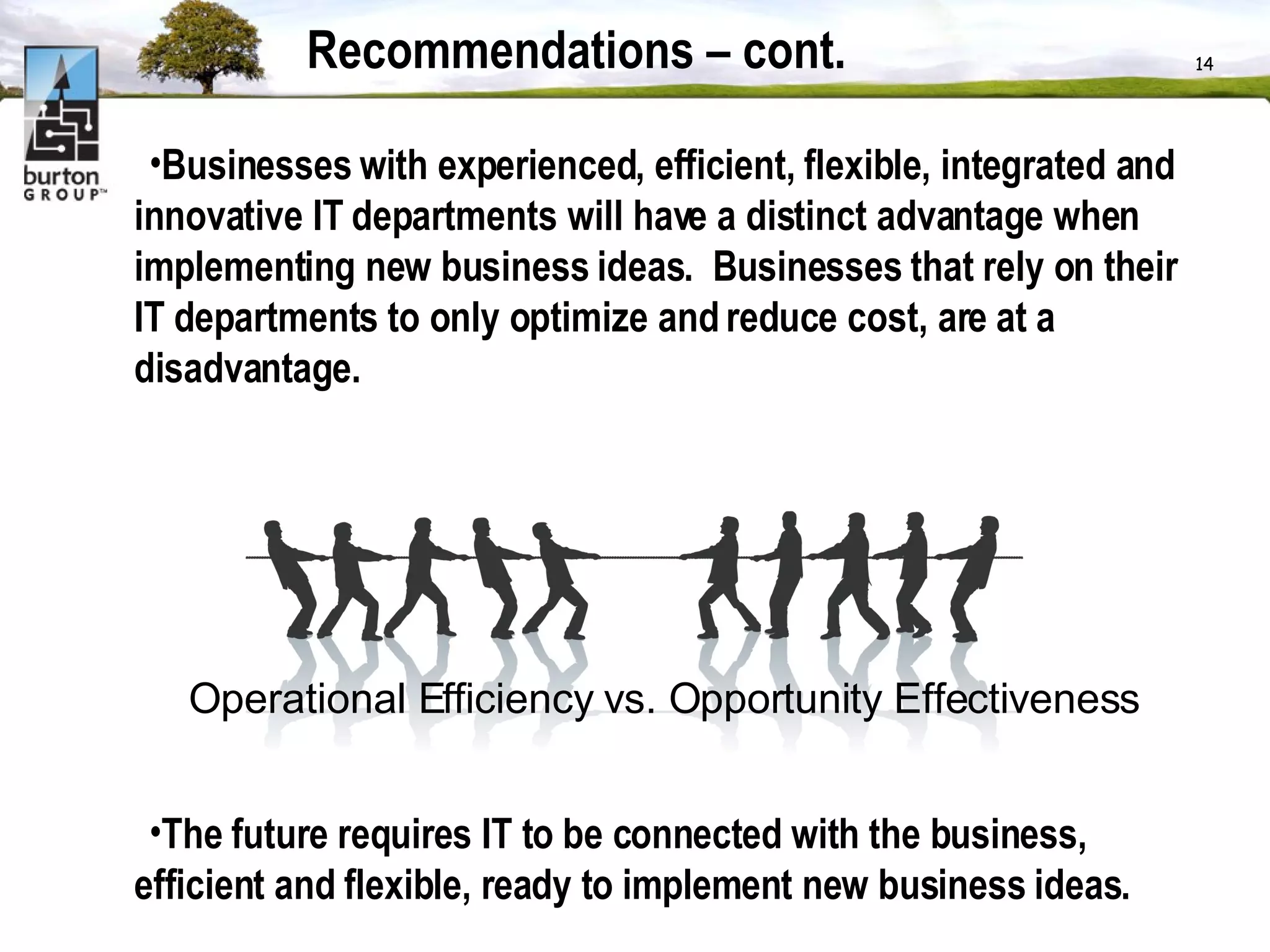
Businesses with experienced, efficient, flexible, integrated and innovative IT departments will have a distinct advantage when implementing new business ideas.  Businesses that rely on their IT departments to only optimize and reduce cost, are at a disadvantage. The future requires IT to be connected with the business, efficient and flexible, ready to implement new business ideas.  Recommendations – cont. Operational Efficiency vs. Opportunity Effectiveness

IT: The Business of Technology

  • 1.
    Ken Anderson Executive Strategist Chris Haddad Vice President, Service Director Application Platform Strategies IT: The Business of Technology Tuesday – April 22, 2008 Wednesday – April 23, 2008
  • 2.
    The Executive ViewpointAs the internet connects the world, the world flattens, creating a new global economy. With a new “connected world” and countries shedding their 3rd world status, business is changing. Executives, burdened by past technology investments and wary of economic changes, are viewing IT investments with additional skepticism. Executives realize that finding new ways to deliver their core business, automate process and reduce cost - is not enough.
  • 3.
    IT Viewpoint ITdepartments are struggling to maintain legacy systems, provide required services, and fund new initiatives. Technologies, (once thought revolutionary), that free employees from their desktops, enable a virtual workforce, and provide information—any where, any time, and any place—are now considered basic services and candidates for outsourcing. IT professionals, once primarily viewed as technologists, find themselves in the unfamiliar territory of having to justify their role in today’s less technical, more traditional business landscape. IT budgets, once bolstered by the excitement of change, are under scrutiny by executives who demand value from the millions spent.
  • 4.
    The Birth ofIT - Information Technology Mainframe to PC World Wide Web Y2K Automate Business Process Network People to Data Deploy Best-of-Breed Applications Move Business to the Web Remote Workforce Identity Management Collaboration Optimize IT Virtualization Business Intelligence Content Management Business Continuation IM Social Networking Unified Communications Digital Asset Management Portfolio Management Security and Risk Management Software as a Service SOA E-Mail Macintosh Laptops Cell Phones 1970 1980 1990 2000 2010 Intel 4004 IBM PC Lotus 1-2-3 Window 3.0 WordPerfect NetScape Remote Access Napster DBase LINUX Local Area Networks Wide Area Networks PDA’s
  • 5.
    Impact of Technologyon the World Before Christopher Columbus After Christopher Columbus Before the Internet After the Internet
  • 6.
    Impact of Technologyon People A Google search on “information overload” yields 1,640,000 results.
  • 7.
    Today With anew “flatter, connected world,” business is changing. Businesses are struggling to provide consumable – actionable information from their multiple data sources. Businesses are changing, looking for new ideas and markets. Businesses look to divest and outsource non-core capabilities. Expand into emerging markets and exploit acquisition opportunities. IT innovating alone, finding new ways to deliver, automate and reducing cost is not enough. IT needs to enable business opportunities IT needs to think like a business
  • 8.
    Thinking Like aBusiness A traditional IT department operates as a monopoly with captive customers who are required to use corporate standards and internal IT services. Successful businesses, provide their customers the right products and services. Thinking like a business forces an IT department to transform itself into a service organization that offers core services and is managed as a business and marketed as though the customer has a choice. IT professionals need to integrate the world of business into their world of technology.
  • 9.
    Thinking Like aBusiness Smart businesses realize their success is directly tied to customer success. This is not a process of alignment but an integration - requires an investment of limited IT resources to improve efficiency, increase productivity, and enable revenue generation. IT professionals need to understand their customers’ needs (the business is the customer), incorporate feedback, and agree on a set of business-oriented metrics managed by IT departments and customers.
  • 10.
    Measuring Success -Efficiency vs. Effectiveness IT departments rely on efficiency metrics to communicate status and success. Efficiency metrics are easier to measure as they are derived from known data sources and generally presented as factual. Common IT efficiency metrics include uptime, capacity, project progress, bugs logged, and expense against budget. Effective metrics define impacts and outcomes such as market growth, marketing efficiency, customer trends, and product profitability.
  • 11.
    Effective Business MetricsEffective based metrics are more difficult to implement as they define impacts and outcomes; data points require analysis and outputs are subject to interpretation. Revenue Business capability/process/service delivery efficiency Business inventories or other expenses Ability to identify and pursue new business opportunities Customer relations Single corporate image and unified channels Comprehensive view of customer needs, desires, and interactions Business process cycle times
  • 12.
    Building Business PartnershipsBusinesses that effectively build and maintain relationships with their customers have a competitive advantage in today’s marketplace. Effective partnerships are fostered when both parties work toward common goals and strengthened when those partners work together to overcome obstacles. Through partnership, IT departments gain an intimate understanding of their customers and a unique viewpoint into the business world. Partnerships also provide a clear understanding to all parties: If the project succeeds, the partners succeed; if the project fails, everyone fails.
  • 13.
    Recommendations IT professionalswho are comfortable communicating in technical language need to communicate in business terms that transcend return on investment predictions . This requires an understanding of the customer’s business, goals, and what makes their specialties unique. This understanding goes beyond traditional requirements documents; it must be an ongoing, interactive, and iterative process that improves over time. IT proposals that have traditionally focused on cost and impact on infrastructure need to focus on changes and improvements to the customer’s business - establish project success criteria - focus on higher level outcomes.
  • 14.
    Businesses with experienced,efficient, flexible, integrated and innovative IT departments will have a distinct advantage when implementing new business ideas. Businesses that rely on their IT departments to only optimize and reduce cost, are at a disadvantage. The future requires IT to be connected with the business, efficient and flexible, ready to implement new business ideas. Recommendations – cont. Operational Efficiency vs. Opportunity Effectiveness