Attack on the 
Core! 
@zer0mem
#whoami - Peter Hlavaty (@zer0mem) 
[ KEEN TEAM ] 
 Background 
 @K33nTeam 
 Previously ~4 years in ESET 
 Contact 
 twitter : @zer0mem 
 weibo : weibo.com/u/5238732594 
 blog : http://zer0mem.sk 
 src : https://github.com/zer0mem
outline 
ATTACKER 
▪ KernelIo tech 
▪ Vulnerability cases 
▪ Design features (flaws) 
▪ State of targets / security 
DEVELOPER 
▪ Point of view 
▪ Goal 
▪ Environment 
▪ C++! no more shellcoding!
Part 1 -> KernelIo tech
Privileged cpl3 != cpl0 
[NtQuerySystemInformation] 
• NtQueryInformation from win8.1 
requires elevated privileges 
• Still callable from user mode 
• Driver Signing Enforcement does 
not like installing drivers even 
from privileged ones … 
• Privileged are enpowered with 
good eye sight, kernel leakage
Read & Write boosting 
[windows] 
• write-where vuln 
• what => should be above 
read / write target 
• Pool address can be 
sufficient
Read & Write boosting 
[windows]
 KPP is not here to punish 
attackers 
 leak & write-where- 
(semi)what 
 patch & use & patch back 
 turned into full KernelIo 
 ReadFile alternative just 
with 
nt!MmUserProbeAddress 
Read & Write boosting 
http://haxpo.nl/wp-content/uploads/2014/01/ 
D1T2-Bypassing-Endpoint-Security-for-Fun-and-Profit.pdf 
[windows] 
https://www.dropbox.com/sh/bkfajegn2mn35ng/AABm_RyD4x9VLzYjI9n9Dl2Wa?dl=0
Read & Write boosting 
[linux / droids] 
• leak & write-where vuln 
• what => should be above read / write target 
• nullptr / pool address can be sufficient 
http://vulnfactory.org/blog/2011/06/05/smep-what-is-it-and-how-to-beat-it-on-linux/
[linux / droids] 
 PXN UDEREF handle it 
 PXN not in default build 
of linux 
 On droids ? XD 
 turned into full KernelIo 
Read & Write boosting 
http://vulnfactory.org/research/stackjacking-infiltrate11.pdf
Why KernelIo ? 
▪ abstraction behind 
virtual address 
▪ what is SMAP / SMEP 
about ?
MMU straigforward idea 
[PoC by MWR Labs] 
1. choose address X with isolated page tables 
1. To be sure write-where does not hit other used memory 
2. mmap (X) 
3. Patch S/U bits (write-where) 
4. S/U bits need to patch per PXE ! 
1. self ref, can help  
5. cpl0 memcpy (X, shellcode) 
6. Pwn (SMEP, SMAP out of the game) 
https://labs.mwrinfosecurity.com/blog/2014/08/15/windows-8-kernel-memory-protections-bypass/ 
http://fluxius.handgrep.se/2011/10/20/the-art-of-elf-analysises-and-exploitations/
Symbolic cpl0 – cpl3 separators 
“ 
The ProbeForRead routine checks 
that a user-mode buffer actually 
resides in the user portion of the 
address space, and is correctly 
aligned. 
“ 
 Ok, what about 
aliasing ?! 
 and about ret2dir 
approach ?  
https://www.usenix.org/conference/usenixsecurity14/technical-sessions/presentation/kemerlis
KERNEL- FAIL – SAFE – CHECKS 
 copy_to/from_user 
 ProbeForRead/Write 
 Checking just 
symbolic values 
 not cover aliasing…
Part 2 -> cases
Out of Boundary 
1. Trivial to exploit 
2. Generic implementation 
3. write/read – where 
4. NO -SMAP 
5. but sometimes PXN
Out of Boundary 
 what if SMAP enabled ? 
 Is over ? 
 Read – no problem, just do 
not try to read from 
usermode  
 Write – you have to know 
where to write – relative 
positioned structs
kmalloc under/overflow 
1. under/overflowed kmalloc 
2. copy_to/from_user 
3. search_exception_table 
for frv, but idea same 
4. force copy_to/from_user 
fail 
5. Copied just controlled 
bytes even in 
under/overflow situation!
KASLR 
• From win8.1 
NtQuerySystemInfo is just 
for privileged user 
• /proc/kallsyms same, just for 
privileged ones 
• Need to info-leak 
• Read-where vuln 
• Abusing weak or old 
mechanism
KASLR 
 PageTable concept is old 
 That time no hardering needed 
 Crucial for performance 
 Timing attacks, PageFault 
measuring, seems doable, see 
recent research 
 A lot of static PHYSICAL 
addresses, KASLR weakened 
 MMU mechanism attacks 
target of recent research, and 
it works … 
http://felinemenace.org/~nemo/docs/TR-HGI-2013-001-real.pdf 
http://labs.bromium.com/2014/10/27/tsx-improves-timing-attacks-against-kaslr/
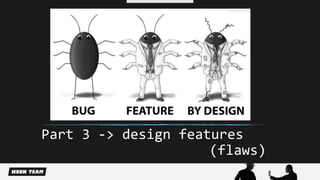
Part 3 -> design features 
(flaws)
Linked lists 
• nt!_list_entry / list_head 
• Lazy list entry assertions 
• Proper design ? 
• Manipulating next / prev 
outside of API ? 
• Hardening ? 
• Common member 
• Intrusive containers 
• Redirect list 
• pool leak && write-where 
• Own content && abussing 
algo ? 
http://www.k33nteam.org/blog.htm (nt!list_entry)
Kernel hidden pointers 
plenty of c++ 
alike vtables 
callbacks 
ops 
context func 
Interesting 
design features 
typecast instead 
of inheritance 
Plenty data 
pointers 
No integrity 
checks 
Plenty data 
structs 
Sensitive trusted 
context 
No 
hardening 
Plain pointers 
http://www.nosuchcon.org/talks/2013/ 
D3_02_Nikita_Exploiting_Hardcore_Pool_Corruptions_in_Microsoft_Windows_Kernel.pdf
Kernel ops by design 
• Callback mechanism 
• open / write / read … 
• If not implemented 
NULLPTR 
• If not implemented no call 
performed 
1. nullptr write vuln 
2. null some operation 
3. Abuse scoped resource 
handling logic 
4. pwn
Part 4 -> state of exploitation
before win8.1 
POOL 
HARDENING 
SMEP 
SMAP 
PLAIN 
PTRS 
“KASLR” 
NtQuerySysInfo even kids … … do pwn
Era of Windows 8.1, earlier and current linux 
POOL 
HARDENING 
SMEP 
SMAP 
PLAIN 
PTRS 
KASLR 
 Cool, seems more hardening 
 More software security features 
 Access control improved 
 UEFI 
 Finally! More hardware features 
goes implemented SMEP/SMAP, … 
 SMAP still waiting in some cases 
…. 
 Exploiting coming finally 
challenging! BUT still kernel not 
hardened enough
Future of OS ? 
POOL 
HARDENING 
SMEP 
SMAP 
HARDENED 
PTRS 
KASLR 
Hardware features implemented 
 Strong complex access control 
policy 
Well randomized kernel space 
 Kicked off obsolete designs 
Well designed core 
No plain pointers 
Data integrity checks
Rebirth to 
K E R N E L 
Developing begins
CHANGING DIRECTION 
[everything is just point of view] 
Until now you were 
ATTACKER 
• NO MATTER HOW, but get 
EXEC! 
• hooks, patching, non-safe 
walkers, etc. 
Now you are 
DEVELOPER ! 
• Pretend to be one of them 
• Now you deal with KPP and 
others mitigations
Kernel windows DEVELOPER view 
▪ In kernel, but some obstacles reminds : 
▪ PsSet * Routine, ObRegisterCallbacks, etc. 
– Callback integrity validation! 
▪ IoAttachDeviceToDeviceStack, IoQueueWorkItem 
– DEVICE_OBJECT* needed (own is preferable)
Kernel DEVELOPing begins 
[DRIVER/DEVICE_object*] 
▪ Kernel loader method, or : 
▪ Create your own! 
– IoCreateDevice 
– _OBJECT_HEADER + DRIVER_OBJECT
Kernel monitoring 
[device attaching] 
▪ Attach to driver 
▪ Filter : 
– Network communication 
– File system communication 
– …
Kernel monitoring 
[legacy] 
▪ File System Filter Driver 
▪ FAST_IO_DISPATCH 
– Register dropped files 
– Access to files 
– … 
▪ Also minifilters are option
Kernel monitoring 
[IoCompletion] 
▪ IoCompletion 
– Monitor ALPC 
– Used by resolving host, etc. etc. 
– Remote process communication 
– Per process
Linux, everything is a file 
1. Kernel ops 
2. Find in which one you 
are interesting in 
3. Register to chain 
4. cdev_add 
( register_chrdev )
SELinux, SEAndroid, ACL 
 Kernel escape 
 Natural bypass 
 Feature : 
1. Developing superuser 
deamon 
2. does not rely on special 
syscalls 
3. Normal application 
development, api … 
4. Separation of responsibilities 
5. Kernel – bypass policy checks 
6. Daemon – provide boosted 
functionality to user
C++ 
come on … why shellcoding or pure c ?
Exploitation means developming! 
▪ C++ is about compiler & you skills 
▪ You think you can wrote better shellcode than 
compiler ?  
▪ You can code really close to assembly level – 
when you know your compiler 
▪ c++ well maintainable, scalable, modulable 
▪ Design patterns 
▪ Complex frameworks 
http://www.exploit-monday.com/2013/08/writing-optimized-windows-shellcode-in-c.html 
https://github.com/mattifestation/PIC_Bindshell (Window Shellcode in C)
Exploiting is development! 
▪ Before you can write PoC for exploits as easy as hello world 
▪ Things getting complex 
▪ Now with same style you can end up with unreadable master piece 
▪ Next time you have good time to rewriting lot of the same logic 
▪ And at the end you end up with black-boxes chained together with 
black-magic, somehow working 
▪ Something will change … start fixing black-box
Exploitation framework can be powerfull 
▪ UserCode in kernel allowed! 
– Kernel code hidden inside binary 
– Fully c++ driver! 
▪ Mixing User & Kernel code 
– just avoid direct linking imported kernel functions! 
– Also avoid to mixing um & km headers together in compile time ;) 
– Compile standalone kernel code as .lib 
– link kernel code .lib to exploit .exe
KERNEL as exploitation VECTOR 
1. 
Copy whole PE to RWE kernel page 
 ExAllocatePool(NonPagedPoolExecute,SizeOfImage); 
2. 
3. 
Fix Rellocations 
4. 
resolve kernel part of 
Import table 
Ready for exec with CPL0! 
CPL Teleport
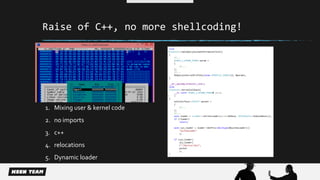
Raise of C++, no more shellcoding! 
1. Mixing user & kernel code 
2. no imports 
3. c++ 
4. relocations 
5. Dynamic loader
Raise of C++, no more shellcoding! 
1. c++ kernel code 
2. Compiled with user mode code 
3. No Imports, but does not impact code
C++ ‘shellcoding’ framework 
▪ no import table 
▪ no need to handle imports by your own 
▪ .py scripts set up all imports 
▪ no need to code position independent code 
▪ fixups resolved by loader 
▪ C++ (partially also std & boost) supported 
▪ no need to ship kernel code as resource, or shellcode 
▪ no need to special coding style to kernel module, classical developing 
▪ All features (c++, imports, fixups..) applies to kernel code as well 
http://www.zer0mem.sk/?p=517 
http://www.hollistech.com/Resources/Cpp/kernel_c_runtime_library.htm 
http://www.codeproject.com/Articles/22801/Drivers-Exceptions-and-C
C++ ‘shellcoding’ framework 
https://github.com/k33nteam/cc-shellcoding 
releasing very soon @K33nTeam
materials 
(not listed in slides before) 
– http://www.codeproject.com/Articles/43586/File-System-Filter-Driver-Tutorial 
– www.bitnuts.de/KernelBasedMonitoring.pdf 
– https://projects.honeynet.org/svn/capture-hpc/capture-hpc/tags/2.5/capture-client/ 
KernelDrivers/CaptureKernelDrivers/FileMonitor/CaptureFileMonitor.c 
– http://www.osronline.com/article.cfm?article=199
Acknowledge Thanks to : 
jfang 
liac 
rafal wojtczuk 
wushi nforest 
NTarakanov 
j00ru 
aionescu 
cesarcer 
dan rosenberg 
krzywix 
maxim
We are hiring! 
▪ #1 vulnerability research team in China 
– http://www.k33nteam.org/cvelist.htm 
– pwn2own 
▪ Enjoying research ? 
– Mobile (Android, iOS, WP) 
– PC (Windows, OS X, Chrome OS, etc.) 
▪ Willing to move to Shanghai ? 
– Beijing ? 
▪ Want to join our team ? 
– Application security 
– Kernel security hr (at) keencloudtech.com
2014 - $500,000 
2015 - $???????? Pick a device, name your own challenge!
follow us 
@K33nTeam 
Thank You. 
Q & A 
peter (at) keencloudtech.com

Attack on the Core

  • 1.
    Attack on the Core! @zer0mem
  • 2.
    #whoami - PeterHlavaty (@zer0mem) [ KEEN TEAM ]  Background  @K33nTeam  Previously ~4 years in ESET  Contact  twitter : @zer0mem  weibo : weibo.com/u/5238732594  blog : http://zer0mem.sk  src : https://github.com/zer0mem
  • 3.
    outline ATTACKER ▪KernelIo tech ▪ Vulnerability cases ▪ Design features (flaws) ▪ State of targets / security DEVELOPER ▪ Point of view ▪ Goal ▪ Environment ▪ C++! no more shellcoding!
  • 4.
    Part 1 ->KernelIo tech
  • 5.
    Privileged cpl3 !=cpl0 [NtQuerySystemInformation] • NtQueryInformation from win8.1 requires elevated privileges • Still callable from user mode • Driver Signing Enforcement does not like installing drivers even from privileged ones … • Privileged are enpowered with good eye sight, kernel leakage
  • 6.
    Read & Writeboosting [windows] • write-where vuln • what => should be above read / write target • Pool address can be sufficient
  • 7.
    Read & Writeboosting [windows]
  • 8.
     KPP isnot here to punish attackers  leak & write-where- (semi)what  patch & use & patch back  turned into full KernelIo  ReadFile alternative just with nt!MmUserProbeAddress Read & Write boosting http://haxpo.nl/wp-content/uploads/2014/01/ D1T2-Bypassing-Endpoint-Security-for-Fun-and-Profit.pdf [windows] https://www.dropbox.com/sh/bkfajegn2mn35ng/AABm_RyD4x9VLzYjI9n9Dl2Wa?dl=0
  • 9.
    Read & Writeboosting [linux / droids] • leak & write-where vuln • what => should be above read / write target • nullptr / pool address can be sufficient http://vulnfactory.org/blog/2011/06/05/smep-what-is-it-and-how-to-beat-it-on-linux/
  • 10.
    [linux / droids]  PXN UDEREF handle it  PXN not in default build of linux  On droids ? XD  turned into full KernelIo Read & Write boosting http://vulnfactory.org/research/stackjacking-infiltrate11.pdf
  • 11.
    Why KernelIo ? ▪ abstraction behind virtual address ▪ what is SMAP / SMEP about ?
  • 12.
    MMU straigforward idea [PoC by MWR Labs] 1. choose address X with isolated page tables 1. To be sure write-where does not hit other used memory 2. mmap (X) 3. Patch S/U bits (write-where) 4. S/U bits need to patch per PXE ! 1. self ref, can help  5. cpl0 memcpy (X, shellcode) 6. Pwn (SMEP, SMAP out of the game) https://labs.mwrinfosecurity.com/blog/2014/08/15/windows-8-kernel-memory-protections-bypass/ http://fluxius.handgrep.se/2011/10/20/the-art-of-elf-analysises-and-exploitations/
  • 13.
    Symbolic cpl0 –cpl3 separators “ The ProbeForRead routine checks that a user-mode buffer actually resides in the user portion of the address space, and is correctly aligned. “  Ok, what about aliasing ?!  and about ret2dir approach ?  https://www.usenix.org/conference/usenixsecurity14/technical-sessions/presentation/kemerlis
  • 14.
    KERNEL- FAIL –SAFE – CHECKS  copy_to/from_user  ProbeForRead/Write  Checking just symbolic values  not cover aliasing…
  • 15.
    Part 2 ->cases
  • 16.
    Out of Boundary 1. Trivial to exploit 2. Generic implementation 3. write/read – where 4. NO -SMAP 5. but sometimes PXN
  • 17.
    Out of Boundary  what if SMAP enabled ?  Is over ?  Read – no problem, just do not try to read from usermode   Write – you have to know where to write – relative positioned structs
  • 18.
    kmalloc under/overflow 1.under/overflowed kmalloc 2. copy_to/from_user 3. search_exception_table for frv, but idea same 4. force copy_to/from_user fail 5. Copied just controlled bytes even in under/overflow situation!
  • 19.
    KASLR • Fromwin8.1 NtQuerySystemInfo is just for privileged user • /proc/kallsyms same, just for privileged ones • Need to info-leak • Read-where vuln • Abusing weak or old mechanism
  • 20.
    KASLR  PageTableconcept is old  That time no hardering needed  Crucial for performance  Timing attacks, PageFault measuring, seems doable, see recent research  A lot of static PHYSICAL addresses, KASLR weakened  MMU mechanism attacks target of recent research, and it works … http://felinemenace.org/~nemo/docs/TR-HGI-2013-001-real.pdf http://labs.bromium.com/2014/10/27/tsx-improves-timing-attacks-against-kaslr/
  • 21.
    Part 3 ->design features (flaws)
  • 22.
    Linked lists •nt!_list_entry / list_head • Lazy list entry assertions • Proper design ? • Manipulating next / prev outside of API ? • Hardening ? • Common member • Intrusive containers • Redirect list • pool leak && write-where • Own content && abussing algo ? http://www.k33nteam.org/blog.htm (nt!list_entry)
  • 23.
    Kernel hidden pointers plenty of c++ alike vtables callbacks ops context func Interesting design features typecast instead of inheritance Plenty data pointers No integrity checks Plenty data structs Sensitive trusted context No hardening Plain pointers http://www.nosuchcon.org/talks/2013/ D3_02_Nikita_Exploiting_Hardcore_Pool_Corruptions_in_Microsoft_Windows_Kernel.pdf
  • 24.
    Kernel ops bydesign • Callback mechanism • open / write / read … • If not implemented NULLPTR • If not implemented no call performed 1. nullptr write vuln 2. null some operation 3. Abuse scoped resource handling logic 4. pwn
  • 26.
    Part 4 ->state of exploitation
  • 27.
    before win8.1 POOL HARDENING SMEP SMAP PLAIN PTRS “KASLR” NtQuerySysInfo even kids … … do pwn
  • 28.
    Era of Windows8.1, earlier and current linux POOL HARDENING SMEP SMAP PLAIN PTRS KASLR  Cool, seems more hardening  More software security features  Access control improved  UEFI  Finally! More hardware features goes implemented SMEP/SMAP, …  SMAP still waiting in some cases ….  Exploiting coming finally challenging! BUT still kernel not hardened enough
  • 29.
    Future of OS? POOL HARDENING SMEP SMAP HARDENED PTRS KASLR Hardware features implemented  Strong complex access control policy Well randomized kernel space  Kicked off obsolete designs Well designed core No plain pointers Data integrity checks
  • 30.
    Rebirth to KE R N E L Developing begins
  • 31.
    CHANGING DIRECTION [everythingis just point of view] Until now you were ATTACKER • NO MATTER HOW, but get EXEC! • hooks, patching, non-safe walkers, etc. Now you are DEVELOPER ! • Pretend to be one of them • Now you deal with KPP and others mitigations
  • 32.
    Kernel windows DEVELOPERview ▪ In kernel, but some obstacles reminds : ▪ PsSet * Routine, ObRegisterCallbacks, etc. – Callback integrity validation! ▪ IoAttachDeviceToDeviceStack, IoQueueWorkItem – DEVICE_OBJECT* needed (own is preferable)
  • 33.
    Kernel DEVELOPing begins [DRIVER/DEVICE_object*] ▪ Kernel loader method, or : ▪ Create your own! – IoCreateDevice – _OBJECT_HEADER + DRIVER_OBJECT
  • 34.
    Kernel monitoring [deviceattaching] ▪ Attach to driver ▪ Filter : – Network communication – File system communication – …
  • 35.
    Kernel monitoring [legacy] ▪ File System Filter Driver ▪ FAST_IO_DISPATCH – Register dropped files – Access to files – … ▪ Also minifilters are option
  • 36.
    Kernel monitoring [IoCompletion] ▪ IoCompletion – Monitor ALPC – Used by resolving host, etc. etc. – Remote process communication – Per process
  • 37.
    Linux, everything isa file 1. Kernel ops 2. Find in which one you are interesting in 3. Register to chain 4. cdev_add ( register_chrdev )
  • 38.
    SELinux, SEAndroid, ACL  Kernel escape  Natural bypass  Feature : 1. Developing superuser deamon 2. does not rely on special syscalls 3. Normal application development, api … 4. Separation of responsibilities 5. Kernel – bypass policy checks 6. Daemon – provide boosted functionality to user
  • 39.
    C++ come on… why shellcoding or pure c ?
  • 40.
    Exploitation means developming! ▪ C++ is about compiler & you skills ▪ You think you can wrote better shellcode than compiler ?  ▪ You can code really close to assembly level – when you know your compiler ▪ c++ well maintainable, scalable, modulable ▪ Design patterns ▪ Complex frameworks http://www.exploit-monday.com/2013/08/writing-optimized-windows-shellcode-in-c.html https://github.com/mattifestation/PIC_Bindshell (Window Shellcode in C)
  • 41.
    Exploiting is development! ▪ Before you can write PoC for exploits as easy as hello world ▪ Things getting complex ▪ Now with same style you can end up with unreadable master piece ▪ Next time you have good time to rewriting lot of the same logic ▪ And at the end you end up with black-boxes chained together with black-magic, somehow working ▪ Something will change … start fixing black-box
  • 42.
    Exploitation framework canbe powerfull ▪ UserCode in kernel allowed! – Kernel code hidden inside binary – Fully c++ driver! ▪ Mixing User & Kernel code – just avoid direct linking imported kernel functions! – Also avoid to mixing um & km headers together in compile time ;) – Compile standalone kernel code as .lib – link kernel code .lib to exploit .exe
  • 43.
    KERNEL as exploitationVECTOR 1. Copy whole PE to RWE kernel page  ExAllocatePool(NonPagedPoolExecute,SizeOfImage); 2. 3. Fix Rellocations 4. resolve kernel part of Import table Ready for exec with CPL0! CPL Teleport
  • 44.
    Raise of C++,no more shellcoding! 1. Mixing user & kernel code 2. no imports 3. c++ 4. relocations 5. Dynamic loader
  • 45.
    Raise of C++,no more shellcoding! 1. c++ kernel code 2. Compiled with user mode code 3. No Imports, but does not impact code
  • 46.
    C++ ‘shellcoding’ framework ▪ no import table ▪ no need to handle imports by your own ▪ .py scripts set up all imports ▪ no need to code position independent code ▪ fixups resolved by loader ▪ C++ (partially also std & boost) supported ▪ no need to ship kernel code as resource, or shellcode ▪ no need to special coding style to kernel module, classical developing ▪ All features (c++, imports, fixups..) applies to kernel code as well http://www.zer0mem.sk/?p=517 http://www.hollistech.com/Resources/Cpp/kernel_c_runtime_library.htm http://www.codeproject.com/Articles/22801/Drivers-Exceptions-and-C
  • 47.
    C++ ‘shellcoding’ framework https://github.com/k33nteam/cc-shellcoding releasing very soon @K33nTeam
  • 48.
    materials (not listedin slides before) – http://www.codeproject.com/Articles/43586/File-System-Filter-Driver-Tutorial – www.bitnuts.de/KernelBasedMonitoring.pdf – https://projects.honeynet.org/svn/capture-hpc/capture-hpc/tags/2.5/capture-client/ KernelDrivers/CaptureKernelDrivers/FileMonitor/CaptureFileMonitor.c – http://www.osronline.com/article.cfm?article=199
  • 49.
    Acknowledge Thanks to: jfang liac rafal wojtczuk wushi nforest NTarakanov j00ru aionescu cesarcer dan rosenberg krzywix maxim
  • 50.
    We are hiring! ▪ #1 vulnerability research team in China – http://www.k33nteam.org/cvelist.htm – pwn2own ▪ Enjoying research ? – Mobile (Android, iOS, WP) – PC (Windows, OS X, Chrome OS, etc.) ▪ Willing to move to Shanghai ? – Beijing ? ▪ Want to join our team ? – Application security – Kernel security hr (at) keencloudtech.com
  • 51.
    2014 - $500,000 2015 - $???????? Pick a device, name your own challenge!
  • 52.
    follow us @K33nTeam Thank You. Q & A peter (at) keencloudtech.com