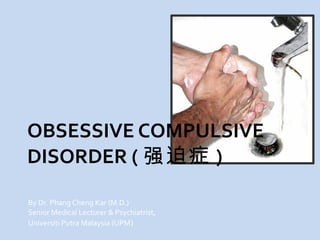
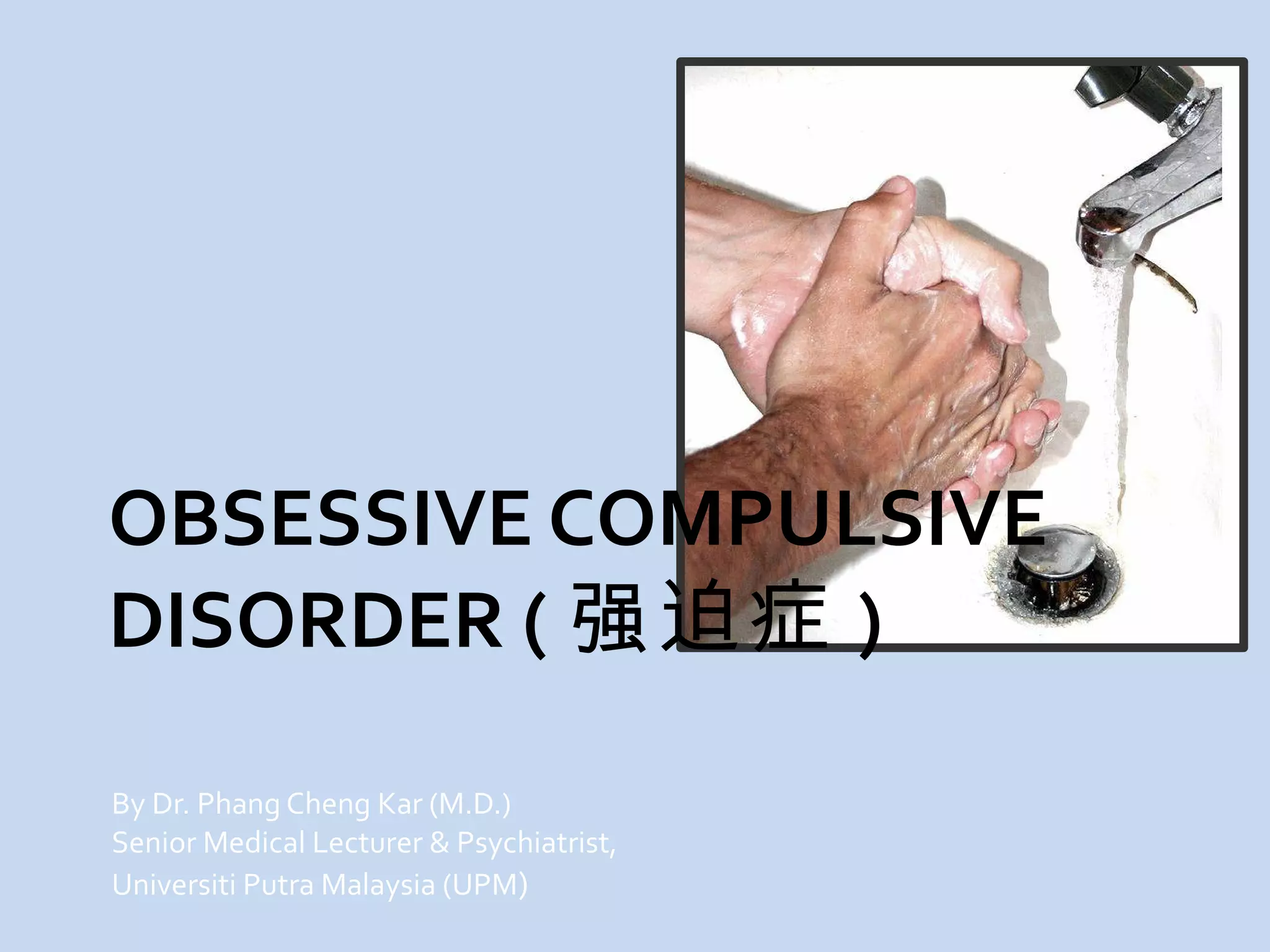
OBSESSIVE COMPULSIVE
DISORDER ( 强迫症 )

By Dr. Phang Cheng Kar (M.D.)
Senior Medical Lecturer & Psychiatrist,
Universiti Putra Malaysia (UPM)
Disclaimer…

 This power point presentation is part of a FREE educational talk
 delivered in KL Buddhist Mental Health Association (BMHA) by
 Dr. Phang Cheng Kar.


 The materials can be reused without permission as long as it’s
 for educational, non-commercial purpose & with good intention.


 This should NOTbe used as substitute for consultation with
 medical or mental health professionals.
Contents…
     Sig
S
g        ns
    S
n
    ig   &
s        Tre
         Ca
         sy
    n
&
    s    at
         use
         mp
s
y
    &    me
         s&
         to
m
    s    nt
         co
         ms
    y
p
    m
         –
         ndi
    p    me
         tio
         Q
o
m
    t    dic
         nin
         &
    o    ati
s
    m    gs
         A,
    s    on
         e.g
         &
         .
         psy
         wh
         ch
         ere
         olo
         to
         gic
         get
         al
         Rx
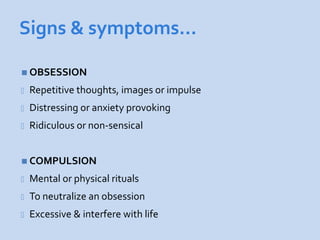
Signs & symptoms…

 OBSESSION

-   Repetitive thoughts, images or impulse
-   Distressing or anxiety provoking
-   Ridiculous or non-sensical


 COMPULSION

-   Mental or physical rituals
-   To neutralize an obsession
-   Excessive & interfere with life
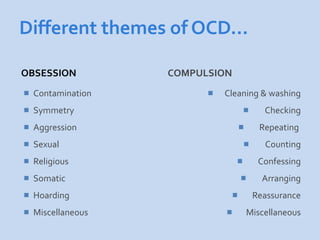
Different themes of OCD…

OBSESSION           COMPULSION
   Contamination            Cleaning & washing
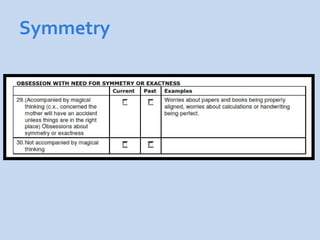
   Symmetry                               Checking
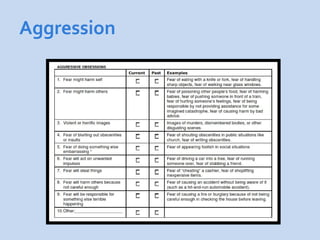
   Aggression                            Repeating
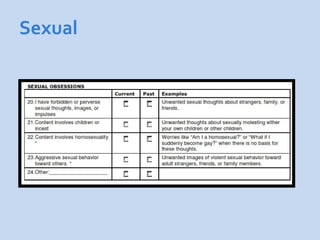
   Sexual                                 Counting
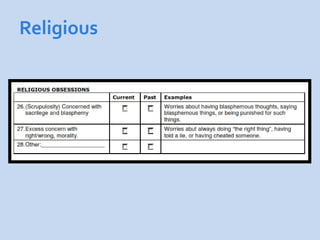
   Religious                             Confessing
   Somatic                                Arranging
   Hoarding                             Reassurance
   Miscellaneous                     Miscellaneous
A
          n

        O
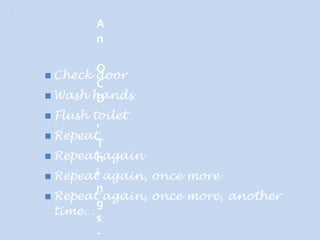
 Check door
        C
 Wash hands
        D
 Flush   toilet
        ‘
 Repeat
        T
 Repeathagain

 Repeati again, once more
        n
 Repeat again, once more, another
        g
  time…
        s
        -
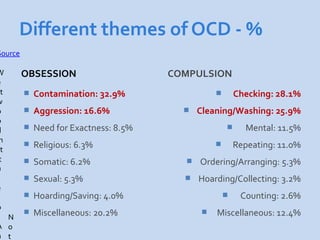
Different themes of OCD - %
Source

W        OBSESSION                      COMPULSION
e
st          Contamination: 32.9%                         Checking: 28.1%
w
o           Aggression: 16.6%               Cleaning/Washing: 25.9%
o
d           Need for Exactness: 8.5%                        Mental: 11.5%
 n
st
            Religious: 6.3%                              Repeating: 11.0%
 t          Somatic: 6.2%                   Ordering/Arranging: 5.3%
u
            Sexual: 5.3%                    Hoarding/Collecting: 3.2%
e
            Hoarding/Saving: 4.0%                         Counting: 2.6%
o
  N
            Miscellaneous: 20.2%                 Miscellaneous: 12.4%
A o
n t
si
u
p
m
o
e
x
nil
 y    y
      a
      r
      o
      p
      m
      e
          e         e
          m         s
O     OCD pcycle…   s
b
          o             A
s                   i
e
          r             n
s                   o
si
          a             x
                    n
o
n         r         C   i
          y         o   e
                    m   t
          R             y
          e         p
          li        u
          e         l
          f         s
                    i
                    o
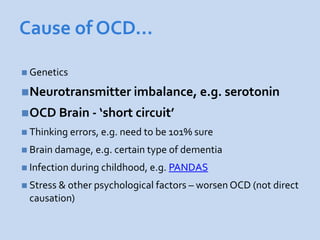
Cause of OCD…

 Genetics

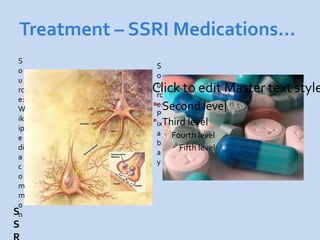
Neurotransmitter imbalance, e.g. serotonin
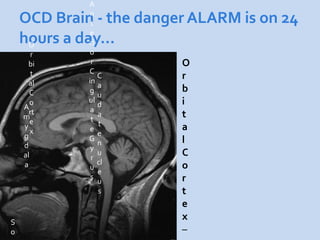
OCD Brain - ‘short circuit’
 Thinking errors, e.g. need to be 101% sure

 Brain damage, e.g. certain type of dementia

 Infection during childhood, e.g. PANDAS

 Stress & other psychological factors – worsen OCD (not direct
 causation)
A

     OCD Brain - the danger ALARM is on 24
               n
               t

     hours a day…
      O
               e
              ri
        r     o
       bi      r          O
        t     C
              in
                 C        r
       al        a
       C      g           b
                 u
     A
        o     ul
                 d        i
       rt      a
     m         t
                 a        t
        e        t
     y
        x      e          a
     g           e
     d
              G
                 n        l
               y
     al        r
                 u        C
     a           cl       o
               u
                 e
               s
                 u        r
                 s        t
                          e
 S
                          x
So                        –
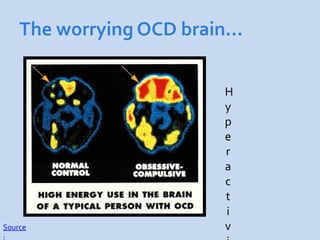
The worrying OCD brain…


                         H
                         y
                         p
                         e
                         r
                         a
                         c
                         t
                         i
Source                   v
:
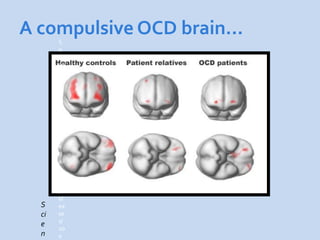
A compulsive OCD brain…
       S
       o
       ur
       ce
       :
       ht
       tp
       ://
       w
       w
       w.
       sc
       ie
       nc
       e
       d
       ail
       y.
       co
       m
       /r
       el
  S    ea
  ci   se
       s/
  e
       20
  n    0
Thinking errors in OCD…
   Thoughts are over-valued.
    ("If I keep thinking this, it must be really important.")

    Doubt is translated into actual danger.
    ("Thinking it is dangerously close to doing it. If I keep thinking it, I must be getting closer to doing it.")

    Thought content must be controlled.
    ("I've got to use will power!")

    Total certainty is not only possible but imperative.
    ("How can I be absolutely sure I won't….")

    Need to avoid culpability.
    ("If I'm careful enough, I can't be held responsible for bad things.")

    Magical power to keep things from happening.
    ("If I can control this bad thought, my loved ones will be safe.")

    Wish to erase all risk.
    ("If I'm careful enough, I can control the risk.")


            S
Treatment – SSRI Medications…
 S
                S
 o
                o
 u
 rc           Click to edit Master text style
                u
                rc
 e:
 W             e:Second level
                P
 ik            ixThird level
 ip
                a ▪ Fourth level
 e
                b
 di                 ▪ Fifth level
                a
 a
                y
 c
 o
 m
 m
 o
Sn
S
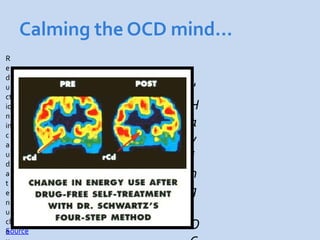
Calming the OCD mind…
R
e
d
u
ct
                    "
io                  H
n
in                  a
c
a                   v
u
d
                    i
a                   n
t
e                   g
n
u
cl
S
e ource
                    O
Psychological Rx of OCD – ‘MR5’

Relabeling – it’s OCD, not me
Refocus – distraction
Relaxation – fun, yoga, qi gonq, meditation
Restraint – exposure & response prevention
Revalue – the good side of OCD, e.g. creativity & responsible


 MINDFULNESS

-   Do it ONCE but with all senses focusing on he ‘here-and-now’
-   Urge surfing
-   Cognitive defusion
Further readings…
   OCD Websites
http://www.geonius.com/ocd/


   International OCD Foundation
http://www.ocfoundation.org/


   OCD Online
http://www.ocdonline.com/defineocd.php


   Dealing with OCD
http://www.anxietyandstress.com/dealingwithocd.html
THANK YOU…
I hope I didn’t say anything wrong that will harm you (318 X)
 Yale-Brown Obsessive Compulsive Scale
Themes of OBSESSION…
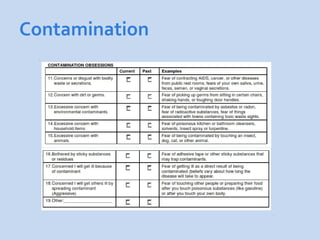
Contamination
Symmetry
Aggression
Sexual
Religious
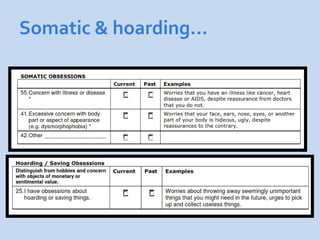
Somatic & hoarding…
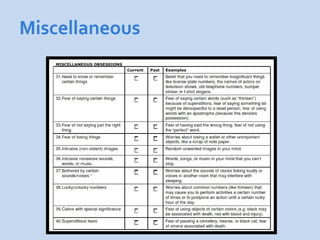
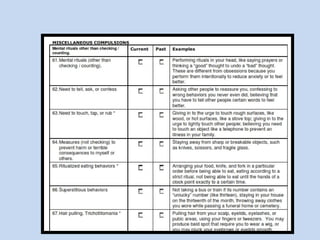
Miscellaneous
Themes of COMPULSION…
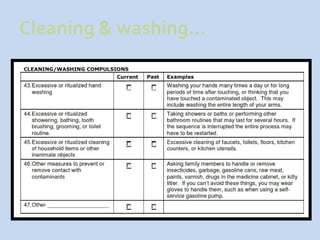
Cleaning & washing…
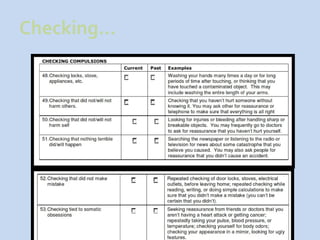
Checking…
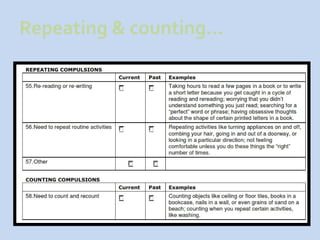
Repeating & counting…
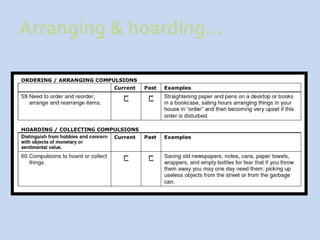
Arranging & hoarding…
Test open office_presentation

Test open office_presentation

  • 1.
    OBSESSIVE COMPULSIVE DISORDER (强迫症 ) By Dr. Phang Cheng Kar (M.D.) Senior Medical Lecturer & Psychiatrist, Universiti Putra Malaysia (UPM)
  • 2.
    Disclaimer…  This powerpoint presentation is part of a FREE educational talk delivered in KL Buddhist Mental Health Association (BMHA) by Dr. Phang Cheng Kar.  The materials can be reused without permission as long as it’s for educational, non-commercial purpose & with good intention.  This should NOTbe used as substitute for consultation with medical or mental health professionals.
  • 3.
    Contents… Sig S g ns S n ig & s Tre Ca sy n & s at use mp s y & me s& to m s nt co ms y p m – ndi p me tio Q o m t dic nin & o ati s m gs A, s on e.g & . psy wh ch ere olo to gic get al Rx
  • 4.
    Signs & symptoms… OBSESSION - Repetitive thoughts, images or impulse - Distressing or anxiety provoking - Ridiculous or non-sensical  COMPULSION - Mental or physical rituals - To neutralize an obsession - Excessive & interfere with life
  • 5.
    Different themes ofOCD… OBSESSION COMPULSION  Contamination  Cleaning & washing  Symmetry  Checking  Aggression  Repeating  Sexual  Counting  Religious  Confessing  Somatic  Arranging  Hoarding  Reassurance  Miscellaneous  Miscellaneous
  • 6.
    A n O  Check door C  Wash hands D  Flush toilet ‘  Repeat T  Repeathagain  Repeati again, once more n  Repeat again, once more, another g time… s -
  • 7.
    Different themes ofOCD - % Source W OBSESSION COMPULSION e st  Contamination: 32.9%  Checking: 28.1% w o  Aggression: 16.6%  Cleaning/Washing: 25.9% o d  Need for Exactness: 8.5%  Mental: 11.5% n st  Religious: 6.3%  Repeating: 11.0% t  Somatic: 6.2%  Ordering/Arranging: 5.3% u  Sexual: 5.3%  Hoarding/Collecting: 3.2% e  Hoarding/Saving: 4.0%  Counting: 2.6% o N  Miscellaneous: 20.2%  Miscellaneous: 12.4% A o n t
  • 8.
    si u p m o e x nil y y a r o p m e e e m s O OCD pcycle… s b o A s i e r n s o si a x n o n r C i y o e m t R y e p li u e l f s i o
  • 9.
    Cause of OCD… Genetics Neurotransmitter imbalance, e.g. serotonin OCD Brain - ‘short circuit’  Thinking errors, e.g. need to be 101% sure  Brain damage, e.g. certain type of dementia  Infection during childhood, e.g. PANDAS  Stress & other psychological factors – worsen OCD (not direct causation)
  • 10.
    A OCD Brain - the danger ALARM is on 24 n t hours a day… O e ri r o bi r O t C in C r al a C g b u A o ul d i rt a m t a t e t y x e a g e d G n l y al r u C a cl o u e s u r s t e S x So –
  • 11.
    The worrying OCDbrain… H y p e r a c t i Source v :
  • 12.
    A compulsive OCDbrain… S o ur ce : ht tp :// w w w. sc ie nc e d ail y. co m /r el S ea ci se s/ e 20 n 0
  • 13.
    Thinking errors inOCD…  Thoughts are over-valued. ("If I keep thinking this, it must be really important.") Doubt is translated into actual danger. ("Thinking it is dangerously close to doing it. If I keep thinking it, I must be getting closer to doing it.") Thought content must be controlled. ("I've got to use will power!") Total certainty is not only possible but imperative. ("How can I be absolutely sure I won't….") Need to avoid culpability. ("If I'm careful enough, I can't be held responsible for bad things.") Magical power to keep things from happening. ("If I can control this bad thought, my loved ones will be safe.") Wish to erase all risk. ("If I'm careful enough, I can control the risk.") S
  • 14.
    Treatment – SSRIMedications… S S o o u rc  Click to edit Master text style u rc e: W e:Second level P ik ixThird level ip a ▪ Fourth level e b di ▪ Fifth level a a y c o m m o Sn S
  • 15.
    Calming the OCDmind… R e d u ct " io H n in a c a v u d i a n t e g n u cl S e ource O
  • 16.
    Psychological Rx ofOCD – ‘MR5’ Relabeling – it’s OCD, not me Refocus – distraction Relaxation – fun, yoga, qi gonq, meditation Restraint – exposure & response prevention Revalue – the good side of OCD, e.g. creativity & responsible  MINDFULNESS - Do it ONCE but with all senses focusing on he ‘here-and-now’ - Urge surfing - Cognitive defusion
  • 17.
    Further readings…  OCD Websites http://www.geonius.com/ocd/  International OCD Foundation http://www.ocfoundation.org/  OCD Online http://www.ocdonline.com/defineocd.php  Dealing with OCD http://www.anxietyandstress.com/dealingwithocd.html
  • 18.
    THANK YOU… I hopeI didn’t say anything wrong that will harm you (318 X)
  • 19.
     Yale-Brown ObsessiveCompulsive Scale
  • 20.
  • 21.
  • 22.
  • 23.
  • 24.
  • 25.
  • 26.
  • 27.
  • 28.
  • 29.
  • 30.
  • 31.
  • 32.

Editor's Notes

  • #2 OCD has a one-month prevalence of 1.3% OCD has a lifetime prevalence of 2.5% Four millions adult Americans have OCD
  • #11 http://www.anxietyspecialist.co.uk/obsessive-compulsive-disorder-bristol.htm
  • #15 Source of graphics: Neurons – Wikipedia Common Medicines - Pixa