welding
Welding positions
• Welding on top surface that is level is known
as welding in the flat position.
• Making a horizontal weld on a vertical surface
is known as welding in the horizontal position.
• Welding vertically up or down on a vertical
surface is called welding in vertical position.
• Welding on the underside of a horizontal
surface is called welding in the overhead position.
• It is easiest to weld in flat position, because in this position
gravity helps to fill the molten metal into the joint. However,
in most cases parts have to be welded in other positions
than the flat position. Even though welding in other
positions is difficult, an operator with good practice can do
acceptable work in other positions also.
Gas welding and cutting
• INTRODUCTION :Gas welding is a fusion welding process in
which heating and melting the metal at the joint area is
achieved by means of a gas flame.
• The hot flame is obtained burning fuel gas with oxygen. This
process is also called oxy-fuel gas welding (OFW). The fuel gas
preferably used in gas wielding is acetylene (C₂H₂), because
oxy-acetylene flame produce highest temperature. This
process is called oxy-acetylene welding (OAW), and is
employed in industries because of the larger sections involved.
• Oxy-acetylene welding is widely employed in industries, and
under certain conditions it is preferable over arc welding. This
process is also employed for repair of worn surfaces and hard
facing.
• Besides oxy-acetylene other combinations are used in gas
welding. The applications of such gas combinations along with
their temperature range are given below.
• In oxy-acetylene welding heat is produced by burning
acetylene in the presence of oxygen at the tip of a
nozzle which is fitted to a torch body.
• The temperature of the oxy-acetylene flame is 3250°C
and is used to melt parent metal to form a weld pool.
Filler materials (if required) is added separately by
feeding of wire or rod into the edge of the weld pool.
• The welder moves the torch to achieve required length
of the weld. No flux is used for gas welding of steel and
the molten metal is protected by the gaseous products
of the flame which displace the air from the vicinity of
the weld.
Principle of gas welding
• Flux : No flux is required for gas welding of mild steel, because oxides formed
melt at lower temperature than steel and dissolved in molten puddle. Gas
welding of cast iron, stainless steel and most of non-ferrous metals generally
require flux.
• The application of flux improves the quality of weld as it protects the weld
against oxidation. Flux also combines with oxides and other impurities to form
slag. Since slag is lighter than the molten metal, it will float on the molten
puddle, and can be removed by chipping or filing after solidification. Borax and
sodium carbonates are good fluxes for ferrous metals. Chlorides of sodium and
potassium are generally applied for non-ferrous metals and alloys.
• Filler rods; Pieces of wires or rods used as filler material in welding are called
filler rods or wielding rods. Good quality filler rods are necessary to reduce
oxidation and to control the mechanical properties. They supply additional
materials to the weld zone during welding. They are made of metals which are
compatible with base metal.
Specifications as per IS 1278-1972
• The size of filler rod is specified by its diameter. The filler rods available in the
following sizes.
Diameter; 1.00, 1.2, 1.6, 2.0, 2.5, 3.15, 4.0, 5.0, 6.3, 8.0, 10.0, 12.5 mm.
Length: 500 mm or 1000 mm.
For leftward technique filler rods upto 4 mm diameter and
for rightward upto 6.3 mm diameter are used.
For welding cast iron filler rods of 6.3 mm diameter and above are used.
Advantages and limitations of gas welding :
• 1. Low capital cost.
• 2. High portability and convenience; can be easily altered (by changing torch)
for brazing, cutting and heating.
• 3. Oxy-acetylene flame is more easily controlled and can be used for all metals
and alloys. The flame is not piercing as electric arc therefore it is extensively
used for sheet metal fabrication and repairs
• Welding skills are relatively easy.
Limitations & Applications
• 1. Takes longer time to weld.
• 2. Heat affected zone and distortion are longer.
• 3. Oxygen and acetylene gases are expensive and there
are safety problems in handlin and storage of these
gases.
• 4. Shielding provided by flame is not effective.
Applications of gas welding;
• Oxy-acetylene welding is a versatile process and can be
used for welding all commercial metals and alloys. Due
to low temperature of gas flame, the process is
employed for welding thin sections. The process is
mostly used in sheet metal fabrication workshops,
aircraft industries, garages and maintenance shops.
OXY-ACETYLENE FLAME
• The combustion of acetylene with oxygen produce a flame which has the
temperature of about 3250°C. The combustion takes place in two stages. In the
first stage, oxygen and acetylene react to produce carbon monoxide and hydrogen.
C₂H₂ + O₂ = 2 CO + H₂ + Heat (18750 kJ/m³ of acetylene)
This provides the most concentrated heat with highest temperature for welding.
In second stage, the products of combustion (carbon monoxide and hydrogen) of first
stage combines with atmosphere oxygen in oxidizing zone and give the following
reaction.
4CO + 2H₂ + 30₂ = 4CO₂ 2H₂O + Heat (35770 kJ/m³ of acetylene)
This reaction give rise to outer bluish flame. Since the heat developed is not
concentrated, the temperature achieved is small (1200 to 2000°C), and this flame
is used for preheating to steel and also provides shielding against oxidation.
The structure of welding flame. It consists of three zone;
1. Inner luminous cone.
2. Reducing zone, and
3. Oxidising zone
• Inner luminous cone consists of the partially decomposed products of acetylene
with the separated solid particles of carbon. It is in the shape of truncated cone.
• Reducing zone is the brightest section of the flame. The highest temperature in
this zone is upto 3250°C. It is in the form of bright white cone.
• In oxidizing zone carbon monoxide and hydrogen combine with atmospheric
oxygen and give rise to outer bluish flame. The gas forms shield preventing direct
contact between the weld pool and air.
Types of Oxy-acetylene Flames
• Types of Oxy-acetylene Flames :The type of flame to be used is adjusted according to the
work materials. This can be achieved by regulating the supply of acetylene and oxygen.
Depending on the relative amounts of oxygen and acetylene, the gas flame can be classified
into three types;
• 1. Oxidising flame
• 2. Neutral flame, and
• 3. Reducing (carburising) flame.
• 1. Oxidising flame: The oxidising flame has an excess of oxygen over the acetylene Its inner
cone is shorter and less luminous and outer flame acquires light bluish colour. It is used for
welding brass, bronze and brazing of ferrous metals. A slightly oxidising is helpful in welding
manganese steel and cast iron. Oxidising flame assures complete combustion, and highest
temperature but has tendency to oxidise metals being welded.
• 2. Neutral flame: The neutral flame has equal quantities of oxygen and acetylene. It is the
most common flame used for welding and cutting of the metal. It has an inner luminous cone
and outer flame with bluish colour as shown in figure. It is used for welding low carbon steel,
stainless steel, cast iron, aluminium, magnesium, copper and bronze. It has no tendency to
react with material being welded.
• 3. Carburising (reducing) flame: The carburising flame has an excess of acetylene over the
oxygen. It has a longer inner cone, an intermediate cone of whitish colour (intermediate
feather) and bluish outer flame. It is used for welding high carbon steel and hard facing of
HSS with satellites and cementedcarbides. The carburising flame does not completely
consume the available carbon, and left over carbon is forced into the metal. Thus, has
carburising effect on steel, causing hard, brittle and weak weld.
OXY-ACETYLENE WELDING EQUIPMENT
• The oxygen and acetylene supply cylinders are connected to torch
(or blow pipe) through pressure regulators and hoses. The torch
mixes the two gases in proper proportions to control the
characteristics of flame and directs the dame to weld area.
• Goggles with coloured lenses are used to protect the eyes from
glare and flying bits of hot metals.
• The following systems are used for gas welding
1. High pressure system, and
2. Low pressure system
In both the systems, the oxygen is supplied from the oxygen
cylinder at high pressure. But acetylene is supplied in cylinders for
high pressure system, and for low pressure system acetylene is
produced in an acetylene generator.
The generator produce acetylene by the chemical reaction between
calcium carbide and water
CaC2 + 2H2O =» C2H2 + Ca(OH)2
the acetylene produced in the generator is taken out through a gas
pipe. There are two methods to produce acetylene in generator.
1. Carbide to water, and
2. Water to carbide
In carbide to water system the portions of calcium carbide are dropped
periodically into a volume of water. This generator provides the highest
yield (95%) from the carbide.
In water to carbide system, the water is periodically fed into the
calcium carbide. It has lower acetylene yield (85-90%) from the
carbide.
• Oxygen cylinder: Oxygen (O₂) is produced by separating the various
constituents of air by liquefaction process. It is a supporter of combustion.
• Oxygen cylinder is made of steel and is painted black for identification. It
contains oxygen at a pressure of 17.5 N/mm² (175 bar). Oxygen cylinder
can store 7 m³ of gas and its mass is about 80 kg when it is full.
• Acetylene cylinder: Acetylene (C₂H₂) is a fuel gas composed of 92.3%
carbon and 7.7% hydrogen. It is the product of chemical reaction between
calcium carbide and water.
• Acetylene cylinder is made of steel and is painted maroon. High pressure
acetylene cylinders contain acetylene at a pressure of 1.5 N/mm² (15 bar).
The lower storage pressure of acetylene is due to the instability of the gas
at a pressure above 0.2 N/mm² (2 bar). Therefore, the acetylene is safely
stored at lower pressure in a dissolved form inside the cylinder. The
normal capacity of acetylene in dissolved state is 6 m³.
Oxy-acetylene set
Method to store acetylene
• The cylinder contains 80% of porous substance such as
charcoal or asbestos which is saturated (completely
filled) with liquid acetone (hydro-carbon liquid).
Acetylene gas is then charged in the cylinder at a
pressure of about 15 bar.
• The liquid acetone dissolves the acetylene gas in large
quantity as safe storage medium; one volume of liquid
acetone can dissolve 25 volumes of acetylene gas for
each bar of pressure. During the charging, one volume
of liquid acetone dissolves 25 x 15 = 375 volume of
acetylene gas under 15 bar pressure at normal
temperature. Hence, the acetylene is safely stored in a
dissolved form inside the cylinder.
Welding torch
• Cylinder valves: The function of cylinder valves is to lock compressed gas in the cylinder Valves for
oxygen cylinder are made of brass and connected to the regulator by means of right-handed coupling
nut. Acetylene cylinder valve is made of steel and connected to regulator by a clip, and the valve is
opened and closed with a special socket wrench.
• Pressure regulators: Pressure regulators are required for acetylene and oxygen cylinders. They reduce
the pressure of the gas in the cylinder to the pressure used in the torch. Regulators used for acetylene
and oxygen are different constructionto maintain different pressures. Pressure regulators are mounted
on the top of the cylinders. Two gauges are provided on the regulators, one for showing the pressure in
the cylinder and the other for pressure being supplied to the torch.
• Hoses: Hoses serve to convey oxygen and acetylene to a welding torch. The hose for welding torches
should be flexible and non-porous. It is made of reinforced rubber. Hoses for acetylene are designed for
a working pressure of upto 0.6 N/mm² and for oxygen the working pressure is upto 1.5 N/mm². The
standard colour for oxygen hose is black, and acetylene hose is coloured maroon. Hoses are connected
to the regulators and torch by means of special hose fittings.
• Nozzle: Nozzle or tip is a device through which gas mixture pass just prior to their ignition and burning.
The gas mixtures come from the tip with a velocity of 100-140 m/s, the mixture is ignited and burns to
produce oxy-acetylene flame having a temperatureof upto 3250°C. Each torch (Fig. 10.6) is provided
with a set of interchangeablenozzles. The tip size determinesthe flow rate of gas mixture.
• Accessories Accessories in oxy-acetylene welding may be used for protection and operation. The
goggles protect the welder from radiation emitted from oxy-acetylene flame and the molten weld
metal; welding goggles also protect the eyes from flying sparks and reduce the glare created by the
flame and molten metal.
• Welding gloves and sleeves are generallyconsidered as protective devices and are used to protect the
hands from the heat and metal splashes. T he accessories which aid in oxy-acetylene welding are
necessary part of the welding system. The spark lighter is sued to ignite the gas mixture at the tip.
Chipping hammer is used to remove metal oxides from welded bead. Wire-brush is employed to clean
the surface of joint before and after welding.
Procedure for starting the system :
1. Close the controls and check that both the gauges on each cylinder are registering
zero pressure.
2. Open both cylinder outlet valves. The pressure inside each cylinder should register on
both gauges.
3. Open the pressure regulating screw by turning them clockwise. The pressure required
is registered on the outlet gauges.
4. Open the acetylene control slightly and ignite the gas. Open the control further so
that flame does not give any black smoke.
5. Open the oxygen control slowly until the type of flame required is obtained
Precautions : Acetylene is a fuel gas and will burn readily. The oxygen supports the
combustion and will cause oil and grease to burn with great intensity. Therefore, it is
important to take care in handling acetylene and oxygen cylinders. The following
precautions should be taken with regard to oxygen and acetylene gas cylinders.
1. Oxygen and acetylene gas cylinders should be kept away from heat and fire.2
2. .Cylinders should be placed in an up-right position and handle cylinders carefully.
Rough handling may damage them or cause leaks.
3. Do not use oil or grease to lubricate various taps on oxygen cylinder.
4. Maintain acetylene at low pressure (below 2 N/mm²)
5. Always draw acetylene through the pressure reducing valve.
6. In case of back-fire or flash-back, immediately turn off the acetylene valve first and
then oxygen valve next.
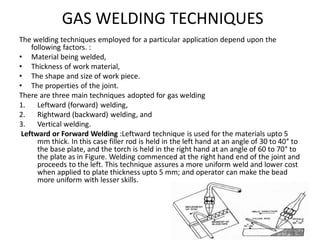
GAS WELDING TECHNIQUES
The welding techniques employed for a particular application depend upon the
following factors. :
• Material being welded,
• Thickness of work material,
• The shape and size of work piece.
• The properties of the joint.
There are three main techniques adopted for gas welding
1. Leftward (forward) welding,
2. Rightward (backward) welding, and
3. Vertical welding.
Leftward or Forward Welding :Leftward technique is used for the materials upto 5
mm thick. In this case filler rod is held in the left hand at an angle of 30 to 40° to
the base plate, and the torch is held in the right hand at an angle of 60 to 70° to
the plate as in Figure. Welding commenced at the right hand end of the joint and
proceeds to the left. This technique assures a more uniform weld and lower cost
when applied to plate thickness upto 5 mm; and operator can make the bead
more uniform with lesser skills.
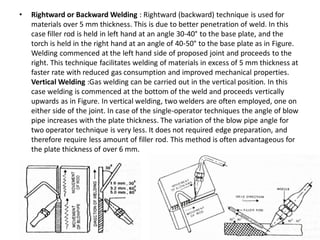
• Rightward or Backward Welding : Rightward (backward) technique is used for
materials over 5 mm thickness. This is due to better penetration of weld. In this
case filler rod is held in left hand at an angle 30-40° to the base plate, and the
torch is held in the right hand at an angle of 40-50° to the base plate as in Figure.
Welding commenced at the left hand side of proposed joint and proceeds to the
right. This technique facilitates welding of materials in excess of 5 mm thickness at
faster rate with reduced gas consumption and improved mechanical properties.
Vertical Welding :Gas welding can be carried out in the vertical position. In this
case welding is commenced at the bottom of the weld and proceeds vertically
upwards as in Figure. In vertical welding, two welders are often employed, one on
either side of the joint. In case of the single-operator techniques the angle of blow
pipe increases with the plate thickness. The variation of the blow pipe angle for
two operator technique is very less. It does not required edge preparation, and
therefore require less amount of filler rod. This method is often advantageous for
the plate thickness of over 6 mm.
EDGE PREPARATION FOR GAS WELDING
• The edges of the workpieces must be clean and free of dirt, oil,
grease, paint or scale formation. For many types of joints chamfers
are needed. Depending upon the length of work pieces and
availability of machinery, chamfers may be produced by milling,
shaping, sawing, filing or flame cutting.
• The edges are flanged for welding the sheet metal upto 1 mm thick.
Square edges are used for metal between 1 and 3 mm for leftward
welding or between 5 and 8 mm for rightward welding. The edges
are separated by a gap equal to the thickness of metal for leftward
welding and gap is equal to half the thickness for rightward welding.
• Single 80° Vee edges are prepared for leftward welding of metal
thickness between 3 and 5 mm. The bottom edges are separated by
a gap of between 2 and 3 mm. Single 60° Vee edges are made for
rightward welding of metal between 8 and 15 mm thickness. The
bottom edges are separated by a gap of 3 to 4 mm.
• FLAME CUTTING :During many manufacturing processes it is often
necessary to cut metal to size and shape their edges. The oxy-acetylene
flame can be used for cutting steel plates. The blow pipe or torch used for
cutting is shown in Fig. 10.10.2. The tip of a cutting torch has a number of
small holes arranged in a circle about a central hole. The outer holes
supply oxygen and acetylene for preheating flame (oxy-acetylene flame)
and central hole supplies oxygen under pressure.
• 1. The welding tip contains only one hole at the centre through which the
mixture of oxy-acetylene gases flow whereas cutting tip has one hole at
the centre for cutting oxygen and number holes (6 to 8) around the central
hole through which the mixture of oxygen and acetylene flow for
preheating flame.
• 2. A welding torch has only two control valves to control the heating flame
whereas cutting torch has two control valves to control the preheating
flame and one lever type control valve to control the flow of cutting
oxygen.
Gass welding

Gass welding

  • 1.
  • 5.
  • 6.
    • Welding ontop surface that is level is known as welding in the flat position. • Making a horizontal weld on a vertical surface is known as welding in the horizontal position. • Welding vertically up or down on a vertical surface is called welding in vertical position. • Welding on the underside of a horizontal surface is called welding in the overhead position. • It is easiest to weld in flat position, because in this position gravity helps to fill the molten metal into the joint. However, in most cases parts have to be welded in other positions than the flat position. Even though welding in other positions is difficult, an operator with good practice can do acceptable work in other positions also.
  • 7.
    Gas welding andcutting • INTRODUCTION :Gas welding is a fusion welding process in which heating and melting the metal at the joint area is achieved by means of a gas flame. • The hot flame is obtained burning fuel gas with oxygen. This process is also called oxy-fuel gas welding (OFW). The fuel gas preferably used in gas wielding is acetylene (C₂H₂), because oxy-acetylene flame produce highest temperature. This process is called oxy-acetylene welding (OAW), and is employed in industries because of the larger sections involved. • Oxy-acetylene welding is widely employed in industries, and under certain conditions it is preferable over arc welding. This process is also employed for repair of worn surfaces and hard facing. • Besides oxy-acetylene other combinations are used in gas welding. The applications of such gas combinations along with their temperature range are given below.
  • 9.
    • In oxy-acetylenewelding heat is produced by burning acetylene in the presence of oxygen at the tip of a nozzle which is fitted to a torch body. • The temperature of the oxy-acetylene flame is 3250°C and is used to melt parent metal to form a weld pool. Filler materials (if required) is added separately by feeding of wire or rod into the edge of the weld pool. • The welder moves the torch to achieve required length of the weld. No flux is used for gas welding of steel and the molten metal is protected by the gaseous products of the flame which displace the air from the vicinity of the weld.
  • 10.
    Principle of gaswelding • Flux : No flux is required for gas welding of mild steel, because oxides formed melt at lower temperature than steel and dissolved in molten puddle. Gas welding of cast iron, stainless steel and most of non-ferrous metals generally require flux. • The application of flux improves the quality of weld as it protects the weld against oxidation. Flux also combines with oxides and other impurities to form slag. Since slag is lighter than the molten metal, it will float on the molten puddle, and can be removed by chipping or filing after solidification. Borax and sodium carbonates are good fluxes for ferrous metals. Chlorides of sodium and potassium are generally applied for non-ferrous metals and alloys. • Filler rods; Pieces of wires or rods used as filler material in welding are called filler rods or wielding rods. Good quality filler rods are necessary to reduce oxidation and to control the mechanical properties. They supply additional materials to the weld zone during welding. They are made of metals which are compatible with base metal.
  • 11.
    Specifications as perIS 1278-1972 • The size of filler rod is specified by its diameter. The filler rods available in the following sizes. Diameter; 1.00, 1.2, 1.6, 2.0, 2.5, 3.15, 4.0, 5.0, 6.3, 8.0, 10.0, 12.5 mm. Length: 500 mm or 1000 mm. For leftward technique filler rods upto 4 mm diameter and for rightward upto 6.3 mm diameter are used. For welding cast iron filler rods of 6.3 mm diameter and above are used. Advantages and limitations of gas welding : • 1. Low capital cost. • 2. High portability and convenience; can be easily altered (by changing torch) for brazing, cutting and heating. • 3. Oxy-acetylene flame is more easily controlled and can be used for all metals and alloys. The flame is not piercing as electric arc therefore it is extensively used for sheet metal fabrication and repairs • Welding skills are relatively easy.
  • 12.
    Limitations & Applications •1. Takes longer time to weld. • 2. Heat affected zone and distortion are longer. • 3. Oxygen and acetylene gases are expensive and there are safety problems in handlin and storage of these gases. • 4. Shielding provided by flame is not effective. Applications of gas welding; • Oxy-acetylene welding is a versatile process and can be used for welding all commercial metals and alloys. Due to low temperature of gas flame, the process is employed for welding thin sections. The process is mostly used in sheet metal fabrication workshops, aircraft industries, garages and maintenance shops.
  • 13.
    OXY-ACETYLENE FLAME • Thecombustion of acetylene with oxygen produce a flame which has the temperature of about 3250°C. The combustion takes place in two stages. In the first stage, oxygen and acetylene react to produce carbon monoxide and hydrogen. C₂H₂ + O₂ = 2 CO + H₂ + Heat (18750 kJ/m³ of acetylene) This provides the most concentrated heat with highest temperature for welding. In second stage, the products of combustion (carbon monoxide and hydrogen) of first stage combines with atmosphere oxygen in oxidizing zone and give the following reaction. 4CO + 2H₂ + 30₂ = 4CO₂ 2H₂O + Heat (35770 kJ/m³ of acetylene) This reaction give rise to outer bluish flame. Since the heat developed is not concentrated, the temperature achieved is small (1200 to 2000°C), and this flame is used for preheating to steel and also provides shielding against oxidation. The structure of welding flame. It consists of three zone; 1. Inner luminous cone. 2. Reducing zone, and 3. Oxidising zone • Inner luminous cone consists of the partially decomposed products of acetylene with the separated solid particles of carbon. It is in the shape of truncated cone. • Reducing zone is the brightest section of the flame. The highest temperature in this zone is upto 3250°C. It is in the form of bright white cone. • In oxidizing zone carbon monoxide and hydrogen combine with atmospheric oxygen and give rise to outer bluish flame. The gas forms shield preventing direct contact between the weld pool and air.
  • 15.
    Types of Oxy-acetyleneFlames • Types of Oxy-acetylene Flames :The type of flame to be used is adjusted according to the work materials. This can be achieved by regulating the supply of acetylene and oxygen. Depending on the relative amounts of oxygen and acetylene, the gas flame can be classified into three types; • 1. Oxidising flame • 2. Neutral flame, and • 3. Reducing (carburising) flame. • 1. Oxidising flame: The oxidising flame has an excess of oxygen over the acetylene Its inner cone is shorter and less luminous and outer flame acquires light bluish colour. It is used for welding brass, bronze and brazing of ferrous metals. A slightly oxidising is helpful in welding manganese steel and cast iron. Oxidising flame assures complete combustion, and highest temperature but has tendency to oxidise metals being welded. • 2. Neutral flame: The neutral flame has equal quantities of oxygen and acetylene. It is the most common flame used for welding and cutting of the metal. It has an inner luminous cone and outer flame with bluish colour as shown in figure. It is used for welding low carbon steel, stainless steel, cast iron, aluminium, magnesium, copper and bronze. It has no tendency to react with material being welded. • 3. Carburising (reducing) flame: The carburising flame has an excess of acetylene over the oxygen. It has a longer inner cone, an intermediate cone of whitish colour (intermediate feather) and bluish outer flame. It is used for welding high carbon steel and hard facing of HSS with satellites and cementedcarbides. The carburising flame does not completely consume the available carbon, and left over carbon is forced into the metal. Thus, has carburising effect on steel, causing hard, brittle and weak weld.
  • 17.
    OXY-ACETYLENE WELDING EQUIPMENT •The oxygen and acetylene supply cylinders are connected to torch (or blow pipe) through pressure regulators and hoses. The torch mixes the two gases in proper proportions to control the characteristics of flame and directs the dame to weld area. • Goggles with coloured lenses are used to protect the eyes from glare and flying bits of hot metals. • The following systems are used for gas welding 1. High pressure system, and 2. Low pressure system In both the systems, the oxygen is supplied from the oxygen cylinder at high pressure. But acetylene is supplied in cylinders for high pressure system, and for low pressure system acetylene is produced in an acetylene generator. The generator produce acetylene by the chemical reaction between calcium carbide and water CaC2 + 2H2O =» C2H2 + Ca(OH)2
  • 18.
    the acetylene producedin the generator is taken out through a gas pipe. There are two methods to produce acetylene in generator. 1. Carbide to water, and 2. Water to carbide In carbide to water system the portions of calcium carbide are dropped periodically into a volume of water. This generator provides the highest yield (95%) from the carbide. In water to carbide system, the water is periodically fed into the calcium carbide. It has lower acetylene yield (85-90%) from the carbide.
  • 19.
    • Oxygen cylinder:Oxygen (O₂) is produced by separating the various constituents of air by liquefaction process. It is a supporter of combustion. • Oxygen cylinder is made of steel and is painted black for identification. It contains oxygen at a pressure of 17.5 N/mm² (175 bar). Oxygen cylinder can store 7 m³ of gas and its mass is about 80 kg when it is full. • Acetylene cylinder: Acetylene (C₂H₂) is a fuel gas composed of 92.3% carbon and 7.7% hydrogen. It is the product of chemical reaction between calcium carbide and water. • Acetylene cylinder is made of steel and is painted maroon. High pressure acetylene cylinders contain acetylene at a pressure of 1.5 N/mm² (15 bar). The lower storage pressure of acetylene is due to the instability of the gas at a pressure above 0.2 N/mm² (2 bar). Therefore, the acetylene is safely stored at lower pressure in a dissolved form inside the cylinder. The normal capacity of acetylene in dissolved state is 6 m³.
  • 20.
  • 21.
    Method to storeacetylene • The cylinder contains 80% of porous substance such as charcoal or asbestos which is saturated (completely filled) with liquid acetone (hydro-carbon liquid). Acetylene gas is then charged in the cylinder at a pressure of about 15 bar. • The liquid acetone dissolves the acetylene gas in large quantity as safe storage medium; one volume of liquid acetone can dissolve 25 volumes of acetylene gas for each bar of pressure. During the charging, one volume of liquid acetone dissolves 25 x 15 = 375 volume of acetylene gas under 15 bar pressure at normal temperature. Hence, the acetylene is safely stored in a dissolved form inside the cylinder.
  • 22.
  • 23.
    • Cylinder valves:The function of cylinder valves is to lock compressed gas in the cylinder Valves for oxygen cylinder are made of brass and connected to the regulator by means of right-handed coupling nut. Acetylene cylinder valve is made of steel and connected to regulator by a clip, and the valve is opened and closed with a special socket wrench. • Pressure regulators: Pressure regulators are required for acetylene and oxygen cylinders. They reduce the pressure of the gas in the cylinder to the pressure used in the torch. Regulators used for acetylene and oxygen are different constructionto maintain different pressures. Pressure regulators are mounted on the top of the cylinders. Two gauges are provided on the regulators, one for showing the pressure in the cylinder and the other for pressure being supplied to the torch. • Hoses: Hoses serve to convey oxygen and acetylene to a welding torch. The hose for welding torches should be flexible and non-porous. It is made of reinforced rubber. Hoses for acetylene are designed for a working pressure of upto 0.6 N/mm² and for oxygen the working pressure is upto 1.5 N/mm². The standard colour for oxygen hose is black, and acetylene hose is coloured maroon. Hoses are connected to the regulators and torch by means of special hose fittings. • Nozzle: Nozzle or tip is a device through which gas mixture pass just prior to their ignition and burning. The gas mixtures come from the tip with a velocity of 100-140 m/s, the mixture is ignited and burns to produce oxy-acetylene flame having a temperatureof upto 3250°C. Each torch (Fig. 10.6) is provided with a set of interchangeablenozzles. The tip size determinesthe flow rate of gas mixture. • Accessories Accessories in oxy-acetylene welding may be used for protection and operation. The goggles protect the welder from radiation emitted from oxy-acetylene flame and the molten weld metal; welding goggles also protect the eyes from flying sparks and reduce the glare created by the flame and molten metal. • Welding gloves and sleeves are generallyconsidered as protective devices and are used to protect the hands from the heat and metal splashes. T he accessories which aid in oxy-acetylene welding are necessary part of the welding system. The spark lighter is sued to ignite the gas mixture at the tip. Chipping hammer is used to remove metal oxides from welded bead. Wire-brush is employed to clean the surface of joint before and after welding.
  • 24.
    Procedure for startingthe system : 1. Close the controls and check that both the gauges on each cylinder are registering zero pressure. 2. Open both cylinder outlet valves. The pressure inside each cylinder should register on both gauges. 3. Open the pressure regulating screw by turning them clockwise. The pressure required is registered on the outlet gauges. 4. Open the acetylene control slightly and ignite the gas. Open the control further so that flame does not give any black smoke. 5. Open the oxygen control slowly until the type of flame required is obtained Precautions : Acetylene is a fuel gas and will burn readily. The oxygen supports the combustion and will cause oil and grease to burn with great intensity. Therefore, it is important to take care in handling acetylene and oxygen cylinders. The following precautions should be taken with regard to oxygen and acetylene gas cylinders. 1. Oxygen and acetylene gas cylinders should be kept away from heat and fire.2 2. .Cylinders should be placed in an up-right position and handle cylinders carefully. Rough handling may damage them or cause leaks. 3. Do not use oil or grease to lubricate various taps on oxygen cylinder. 4. Maintain acetylene at low pressure (below 2 N/mm²) 5. Always draw acetylene through the pressure reducing valve. 6. In case of back-fire or flash-back, immediately turn off the acetylene valve first and then oxygen valve next.
  • 25.
    GAS WELDING TECHNIQUES Thewelding techniques employed for a particular application depend upon the following factors. : • Material being welded, • Thickness of work material, • The shape and size of work piece. • The properties of the joint. There are three main techniques adopted for gas welding 1. Leftward (forward) welding, 2. Rightward (backward) welding, and 3. Vertical welding. Leftward or Forward Welding :Leftward technique is used for the materials upto 5 mm thick. In this case filler rod is held in the left hand at an angle of 30 to 40° to the base plate, and the torch is held in the right hand at an angle of 60 to 70° to the plate as in Figure. Welding commenced at the right hand end of the joint and proceeds to the left. This technique assures a more uniform weld and lower cost when applied to plate thickness upto 5 mm; and operator can make the bead more uniform with lesser skills.
  • 26.
    • Rightward orBackward Welding : Rightward (backward) technique is used for materials over 5 mm thickness. This is due to better penetration of weld. In this case filler rod is held in left hand at an angle 30-40° to the base plate, and the torch is held in the right hand at an angle of 40-50° to the base plate as in Figure. Welding commenced at the left hand side of proposed joint and proceeds to the right. This technique facilitates welding of materials in excess of 5 mm thickness at faster rate with reduced gas consumption and improved mechanical properties. Vertical Welding :Gas welding can be carried out in the vertical position. In this case welding is commenced at the bottom of the weld and proceeds vertically upwards as in Figure. In vertical welding, two welders are often employed, one on either side of the joint. In case of the single-operator techniques the angle of blow pipe increases with the plate thickness. The variation of the blow pipe angle for two operator technique is very less. It does not required edge preparation, and therefore require less amount of filler rod. This method is often advantageous for the plate thickness of over 6 mm.
  • 27.
    EDGE PREPARATION FORGAS WELDING • The edges of the workpieces must be clean and free of dirt, oil, grease, paint or scale formation. For many types of joints chamfers are needed. Depending upon the length of work pieces and availability of machinery, chamfers may be produced by milling, shaping, sawing, filing or flame cutting. • The edges are flanged for welding the sheet metal upto 1 mm thick. Square edges are used for metal between 1 and 3 mm for leftward welding or between 5 and 8 mm for rightward welding. The edges are separated by a gap equal to the thickness of metal for leftward welding and gap is equal to half the thickness for rightward welding. • Single 80° Vee edges are prepared for leftward welding of metal thickness between 3 and 5 mm. The bottom edges are separated by a gap of between 2 and 3 mm. Single 60° Vee edges are made for rightward welding of metal between 8 and 15 mm thickness. The bottom edges are separated by a gap of 3 to 4 mm.
  • 29.
    • FLAME CUTTING:During many manufacturing processes it is often necessary to cut metal to size and shape their edges. The oxy-acetylene flame can be used for cutting steel plates. The blow pipe or torch used for cutting is shown in Fig. 10.10.2. The tip of a cutting torch has a number of small holes arranged in a circle about a central hole. The outer holes supply oxygen and acetylene for preheating flame (oxy-acetylene flame) and central hole supplies oxygen under pressure. • 1. The welding tip contains only one hole at the centre through which the mixture of oxy-acetylene gases flow whereas cutting tip has one hole at the centre for cutting oxygen and number holes (6 to 8) around the central hole through which the mixture of oxygen and acetylene flow for preheating flame. • 2. A welding torch has only two control valves to control the heating flame whereas cutting torch has two control valves to control the preheating flame and one lever type control valve to control the flow of cutting oxygen.