1.
Gas Welding
1. Gas Welding 7
2005
Although the oxy-acetylene process has been introduced long time ago it is still applied for its
flexibility and mobility. Equipment for oxyacetylene welding consists of just a few ele-
ments, the energy necessary for welding can be transported in cylinders, Figure 1.1.
Process energy is obtained from the exothermal chemical reaction between oxygen and a
combustible gas, Figure 1.2. Suitable combustible gases are C2H2, lighting gas, H2, C3H8 and
natural gas; here C3H8 has the highest calorific value. The highest flame intensity from point
of view of calorific value and flame propagation speed is, however, obtained with C2H2.
© ISF 2002
Equipment Components
for Gas Welding
acetylene hose
oxygen cylinder with pressure reducer
welding rod
oxygen hose
welding nozzle
welding torch
acetylene cylinder with pressure reducer
welding flame
workpiece
1
9
7
2
6
4
5
3
8
1
9
7
2
6
4
5
3
8
br-er1-01.cdr © ISF 2002
Properties of Fuel Gas in
Combination with Oxygen
2770
2850
3200
0
200
400
600
645
0
ignition temperature [ C]O
oxygen
air
0.5
1.0
1.5
2.0
2.5
0
density in normal state [kg/m ]3
propane
2.0
0.9
oxygen
1.43
acetylene
1.17
air
1.29
300
335
510
490
645
flame temperature with O2
flame efficiency with O2
flame velocity with O2
KW
/cm
2 cm
/s
43
10.3
8.5
1350
370
330
br-er1-02.cdr
naturalgas
propane
acetylene
naturalgasnaturalgas
propane
acetylene
°C
k
Figure 1.1 Figure 1.2
www.SeminarsTopics.com
1. Gas Welding 8
2005
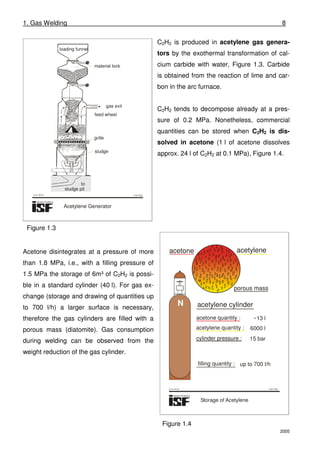
C2H2 is produced in acetylene gas genera-
tors by the exothermal transformation of cal-
cium carbide with water, Figure 1.3. Carbide
is obtained from the reaction of lime and car-
bon in the arc furnace.
C2H2 tends to decompose already at a pres-
sure of 0.2 MPa. Nonetheless, commercial
quantities can be stored when C2H2 is dis-
solved in acetone (1 l of acetone dissolves
approx. 24 l of C2H2 at 0.1 MPa), Figure 1.4.
Acetone disintegrates at a pressure of more
than 1.8 MPa, i.e., with a filling pressure of
1.5 MPa the storage of 6m³ of C2H2 is possi-
ble in a standard cylinder (40 l). For gas ex-
change (storage and drawing of quantities up
to 700 l/h) a larger surface is necessary,
therefore the gas cylinders are filled with a
porous mass (diatomite). Gas consumption
during welding can be observed from the
weight reduction of the gas cylinder.
© ISF 2002
Acetylene Generator
loading funnel
material lock
gas exit
feed wheel
grille
sludge
to
sludge pit
br-er1-03.cdr
Figure 1.3
© ISF 2002
Storage of Acetylene
acetone acetylene
porous mass
acetylene cylinder
filling quantity :
acetone quantity :
acetylene quantity :
~13 l
6000 l
15 bar
up to 700 l/h
cylinder pressure :
br-er1-04.cdr
N
Figure 1.4
1. Gas Welding 9
2005
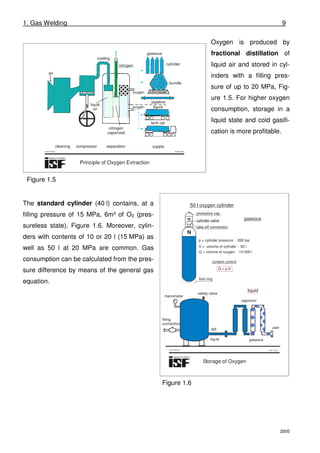
Oxygen is produced by
fractional distillation of
liquid air and stored in cyl-
inders with a filling pres-
sure of up to 20 MPa, Fig-
ure 1.5. For higher oxygen
consumption, storage in a
liquid state and cold gasifi-
cation is more profitable.
The standard cylinder (40 l) contains, at a
filling pressure of 15 MPa, 6m³ of O2 (pres-
sureless state), Figure 1.6. Moreover, cylin-
ders with contents of 10 or 20 l (15 MPa) as
well as 50 l at 20 MPa are common. Gas
consumption can be calculated from the pres-
sure difference by means of the general gas
equation.
© ISF 2002
Principle of Oxygen Extraction
air
cooling
nitrogen
gaseous
cylinder
bundle
oxygen
oxygen
liquid
air
nitrogen
vaporized
liquid
tank car
pipeline
cleaning compressor separation
br-er1-05.cdr
supply
Figure 1.5
br-er1-06.cdr
Storage of Oxygen
50 l oxygen cylinder
protective cap
cylinder valve
take-off connection
gaseous
p = cylinder pressure : 200 bar
V = volume of cylinder : 50 l
Q = volume of oxygen : 10 000 l
content control
Q = p V
foot ring
user
gaseous
still
liquid
vaporizer
manometer
safety valve
filling
connection
liquid
N
Figure 1.6
1. Gas Welding 10
2005
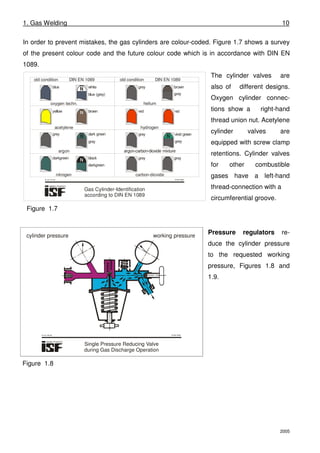
In order to prevent mistakes, the gas cylinders are colour-coded. Figure 1.7 shows a survey
of the present colour code and the future colour code which is in accordance with DIN EN
1089.
The cylinder valves are
also of different designs.
Oxygen cylinder connec-
tions show a right-hand
thread union nut. Acetylene
cylinder valves are
equipped with screw clamp
retentions. Cylinder valves
for other combustible
gases have a left-hand
thread-connection with a
circumferential groove.
Pressure regulators re-
duce the cylinder pressure
to the requested working
pressure, Figures 1.8 and
1.9.
Figure 1.7
© ISF 2002
Single Pressure Reducing Valve
during Gas Discharge Operation
br-er1-08.cdr
cylinder pressure working pressure
Figure 1.8
© ISF 2006
Gas Cylinder-Identification
according to DIN EN 1089
br-er1-07.cdr
old condition DIN EN 1089
oxygen techn.
white
blue (grey)
blue
acetylene
brownyellow
nitrogen
darkgreen
darkgreen
black
argon
dark green
grey
grey
old condition DIN EN 1089
grey
grey
brown
helium
carbon-dioxide
grey grey
grey
grey
argon-carbon-dioxide mixture
vivid green
hydrogen
redred
1. Gas Welding 11
2005
At a low cylinder pressure (e.g. acetylene cylinder) and low pressure fluctuations, single-
stage regulators
are applied; at higher cyl-
inder pressures normally
two-stage pressure regula-
tors are used.
The requested pressure is
set by the adjusting screw.
If the pressure increases
on the low pressure side,
the throttle valve closes the
increased pressure onto
the membrane.
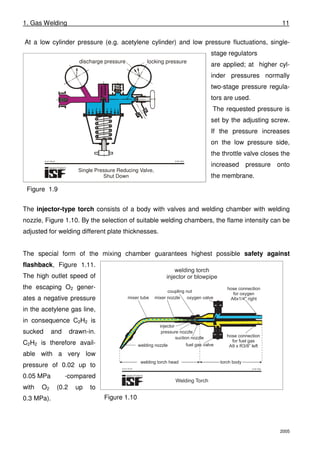
The injector-type torch consists of a body with valves and welding chamber with welding
nozzle, Figure 1.10. By the selection of suitable welding chambers, the flame intensity can be
adjusted for welding different plate thicknesses.
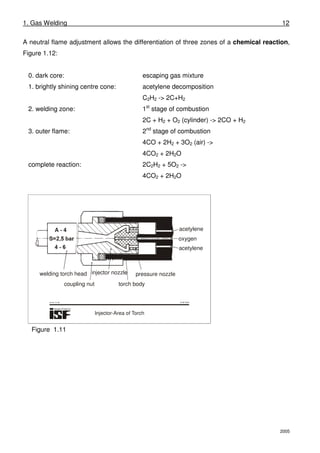
The special form of the mixing chamber guarantees highest possible safety against
flashback, Figure 1.11.
The high outlet speed of
the escaping O2 gener-
ates a negative pressure
in the acetylene gas line,
in consequence C2H2 is
sucked and drawn-in.
C2H2 is therefore avail-
able with a very low
pressure of 0.02 up to
0.05 MPa -compared
with O2 (0.2 up to
0.3 MPa).
© ISF 2002
Single Pressure Reducing Valve,
Shut Down
br-er1-09.cdr
discharge pressure locking pressure
Figure 1.9
© ISF 2002
Welding Torch
br-er1-10.cdr
welding torch
injector or blowpipe
coupling nut
hose connection
for oxygen
A6x1/4" rightmixer tube mixer nozzle oxygen valve
injector
pressure nozzle
suction nozzle
fuel gas valvewelding nozzle
hose connection
for fuel gas
A9 x R3/8” left
welding torch head torch body
Figure 1.10
1. Gas Welding 12
2005
A neutral flame adjustment allows the differentiation of three zones of a chemical reaction,
Figure 1.12:
0. dark core: escaping gas mixture
1. brightly shining centre cone: acetylene decomposition
C2H2 -> 2C+H2
2. welding zone: 1st
stage of combustion
2C + H2 + O2 (cylinder) -> 2CO + H2
3. outer flame: 2nd
stage of combustion
4CO + 2H2 + 3O2 (air) ->
4CO2 + 2H2O
complete reaction: 2C2H2 + 5O2 ->
4CO2 + 2H2O
© ISF 2002
Injector-Area of Torch
br-er1-11.cdr
acetylene
oxygen
acetylene
welding torch head injector nozzle pressure nozzle
coupling nut torch body
Figure 1.11
1. Gas Welding 13
2005
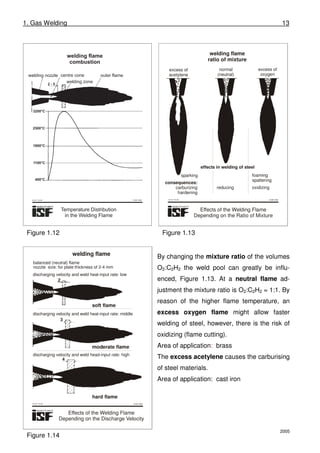
By changing the mixture ratio of the volumes
O2:C2H2 the weld pool can greatly be influ-
enced, Figure 1.13. At a neutral flame ad-
justment the mixture ratio is O2:C2H2 = 1:1. By
reason of the higher flame temperature, an
excess oxygen flame might allow faster
welding of steel, however, there is the risk of
oxidizing (flame cutting).
Area of application: brass
The excess acetylene causes the carburising
of steel materials.
Area of application: cast iron
© ISF 2002
discharging velocity and weld heat-input rate: low
nozzle size: for plate thickness of 2-4 mm
balanced (neutral) flame
welding flame
2
soft flame
moderate flame
hard flame
discharging velocity and weld heat-input rate: middle
discharging velocity and weld head-input rate: high
3
4
br-er1-14.cdr
Effects of the Welding Flame
Depending on the Discharge Velocity
Figure 1.14
© ISF 2002
excess of
acetylene
normal
(neutral)
excess of
oxygen
welding flame
ratio of mixture
effects in welding of steel
sparking foaming
spattering
reducing oxidizing
consequences:
carburizing
hardening
Effects of the Welding Flame
Depending on the Ratio of Mixture
br-er1-13.cdr
Figure 1.13
© ISF 2002
Temperature Distribution
in the Welding Flame
br-er1-12.cdr
welding flame
combustion
welding nozzle
welding zone
centre cone outer flame
3200°C
2500°C
1800°C
1100°C
400°C
2 - 5
Figure 1.12
1. Gas Welding 14
2005
By changing the gas mixture outlet speed the flame can be adjusted to the heat requirements
of the welding job, for example when welding plates (thickness: 2 to 4 mm) with the welding
chamber size 3: “2 to 4 mm”, Figure 1.14. The gas mixture outlet speed is 100 to 130 m/s
when using a medium or normal flame, applied to at, for example, a 3 mm plate. Using a
soft flame, the gas outlet speed is lower (80 to 100 m/s) for the 2 mm plate, with a hard
flame it is higher (130 to 160 m/s) for the 4 mm plate.
Depending on the plate thickness are the working methods “leftward welding” and “rightward
welding” applied, Figure 1.15. A decisive factor for the designation of the working method is
the sequence of flame and welding rod as well as the manipulation of flame and welding rod.
The welding direction itself is of no importance. In leftward welding the flame is pointed at
the open gap and “wets” the molten pool; the heat input to the molten pool can be well con-
trolled by a slight movement of the torch (s ≤ 3 mm).
© ISF 2002
welding-rod flame welding bead
weld-rod flame
Rightward welding ist applied to a plate thickness of 3mm
upwards. The wire circles, the torch remains calm.
Advantages:
- the molten pool and the weld keyhole are easy to observe
- good root fusion
- the bath and the melting weld-rod are permanently protected
from the air
- narrow welding seam
- low gas consumption
Leftward welding is applied to a plate thickness of up to 3 mm.
The weld-rod dips into the molten pool from time to time,
but remains calm otherwise. The torch swings a little.
Advantages:
easy to handle on thin plates
Flame Welding
br-er1-15e.cdr
Figure 1.15
© ISF 2002
gap
preparations denotation sym-
bol
plate thickness
range s [mm]
from to
1,5
1,0
1,0 4,0
3,0 12,0
1,0 8,0
1,0 8,0
1,0 8,0
flange weld
plain butt
weld
V - weld
corner weld
lap seam
fillet weld
1 - 2
1 - 2
Gap Shapes for Gas Welding
s+1~~
r=
s
br-er1-16.cdr
Figure 1.16
1. Gas Welding 15
2005
In rightward welding the flame is directed
onto the molten pool; a weld keyhole is
formed (s ≥ 3 mm).
Flanged welds and plain butt welds can be
applied to a plate thickness of approx.
1.5 mm without filler material, but this does
not apply to any other plate thickness and
weld shape, Figure 1.16.
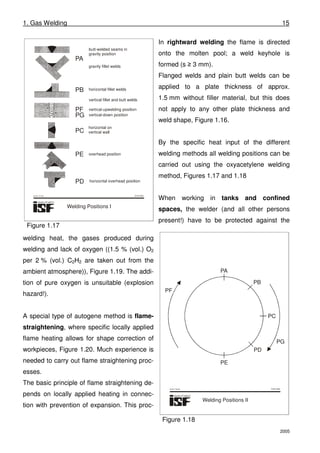
By the specific heat input of the different
welding methods all welding positions can be
carried out using the oxyacetylene welding
method, Figures 1.17 and 1.18
When working in tanks and confined
spaces, the welder (and all other persons
present!) have to be protected against the
welding heat, the gases produced during
welding and lack of oxygen ((1.5 % (vol.) O2
per 2 % (vol.) C2H2 are taken out from the
ambient atmosphere)), Figure 1.19. The addi-
tion of pure oxygen is unsuitable (explosion
hazard!).
A special type of autogene method is flame-
straightening, where specific locally applied
flame heating allows for shape correction of
workpieces, Figure 1.20. Much experience is
needed to carry out flame straightening proc-
esses.
The basic principle of flame straightening de-
pends on locally applied heating in connec-
tion with prevention of expansion. This proc-
© ISF 2002
PA
PB
PF
PG
PC
PE
PD
butt-welded seams in
gravity position
gravity fillet welds
horizontal fillet welds
vertical fillet and butt welds
vertical-upwelding position
vertical-down position
horizontal on
vertical wall
overhead position
horizontal overhead position
Welding Positions I
br-er1-17.cdr
fs
Figure 1.17
© ISF 2002br-er1-18.cdr
PA
PB
PC
PD
PE
PG
PF
Welding Positions II
Figure 1.18
1. Gas Welding 16
2005
ess causes the appearance of a heated zone. During cooling, shrinking forces are generated
in the heated zone and lead to the desired shape correction.
© ISF 2002
5. after welding: Removing the equipment from the tank
4. illumination and electric machines: max 42volt
3. second person for safety reasons
2. extraction unit, ventilation
1. requirement for a permission to enter
protective measures / safety precautions
Hazards through gas, fumes, explosive mixtures,
electric current
Safety in welding and cutting inside of
tanks and narrow rooms
br-er1-19e.cdr
Gas Welding in Tanks and
Narrow Rooms
Figure 1.19
© ISF 2002
welded parts
first warm up both
lateral plates, then belt
butt weld
3 to 5 heat sources
close to the weld-seam
double fillet weld
1,3 or 5 heat sources
Flame straightening
Flame Straightening
br-er1-20.cdr
Figure 1.20

05122013072956 gas-welding-(done)

  • 1.
  • 2.
    1. Gas Welding7 2005 Although the oxy-acetylene process has been introduced long time ago it is still applied for its flexibility and mobility. Equipment for oxyacetylene welding consists of just a few ele- ments, the energy necessary for welding can be transported in cylinders, Figure 1.1. Process energy is obtained from the exothermal chemical reaction between oxygen and a combustible gas, Figure 1.2. Suitable combustible gases are C2H2, lighting gas, H2, C3H8 and natural gas; here C3H8 has the highest calorific value. The highest flame intensity from point of view of calorific value and flame propagation speed is, however, obtained with C2H2. © ISF 2002 Equipment Components for Gas Welding acetylene hose oxygen cylinder with pressure reducer welding rod oxygen hose welding nozzle welding torch acetylene cylinder with pressure reducer welding flame workpiece 1 9 7 2 6 4 5 3 8 1 9 7 2 6 4 5 3 8 br-er1-01.cdr © ISF 2002 Properties of Fuel Gas in Combination with Oxygen 2770 2850 3200 0 200 400 600 645 0 ignition temperature [ C]O oxygen air 0.5 1.0 1.5 2.0 2.5 0 density in normal state [kg/m ]3 propane 2.0 0.9 oxygen 1.43 acetylene 1.17 air 1.29 300 335 510 490 645 flame temperature with O2 flame efficiency with O2 flame velocity with O2 KW /cm 2 cm /s 43 10.3 8.5 1350 370 330 br-er1-02.cdr naturalgas propane acetylene naturalgasnaturalgas propane acetylene °C k Figure 1.1 Figure 1.2 www.SeminarsTopics.com
  • 3.
    1. Gas Welding8 2005 C2H2 is produced in acetylene gas genera- tors by the exothermal transformation of cal- cium carbide with water, Figure 1.3. Carbide is obtained from the reaction of lime and car- bon in the arc furnace. C2H2 tends to decompose already at a pres- sure of 0.2 MPa. Nonetheless, commercial quantities can be stored when C2H2 is dis- solved in acetone (1 l of acetone dissolves approx. 24 l of C2H2 at 0.1 MPa), Figure 1.4. Acetone disintegrates at a pressure of more than 1.8 MPa, i.e., with a filling pressure of 1.5 MPa the storage of 6m³ of C2H2 is possi- ble in a standard cylinder (40 l). For gas ex- change (storage and drawing of quantities up to 700 l/h) a larger surface is necessary, therefore the gas cylinders are filled with a porous mass (diatomite). Gas consumption during welding can be observed from the weight reduction of the gas cylinder. © ISF 2002 Acetylene Generator loading funnel material lock gas exit feed wheel grille sludge to sludge pit br-er1-03.cdr Figure 1.3 © ISF 2002 Storage of Acetylene acetone acetylene porous mass acetylene cylinder filling quantity : acetone quantity : acetylene quantity : ~13 l 6000 l 15 bar up to 700 l/h cylinder pressure : br-er1-04.cdr N Figure 1.4
  • 4.
    1. Gas Welding9 2005 Oxygen is produced by fractional distillation of liquid air and stored in cyl- inders with a filling pres- sure of up to 20 MPa, Fig- ure 1.5. For higher oxygen consumption, storage in a liquid state and cold gasifi- cation is more profitable. The standard cylinder (40 l) contains, at a filling pressure of 15 MPa, 6m³ of O2 (pres- sureless state), Figure 1.6. Moreover, cylin- ders with contents of 10 or 20 l (15 MPa) as well as 50 l at 20 MPa are common. Gas consumption can be calculated from the pres- sure difference by means of the general gas equation. © ISF 2002 Principle of Oxygen Extraction air cooling nitrogen gaseous cylinder bundle oxygen oxygen liquid air nitrogen vaporized liquid tank car pipeline cleaning compressor separation br-er1-05.cdr supply Figure 1.5 br-er1-06.cdr Storage of Oxygen 50 l oxygen cylinder protective cap cylinder valve take-off connection gaseous p = cylinder pressure : 200 bar V = volume of cylinder : 50 l Q = volume of oxygen : 10 000 l content control Q = p V foot ring user gaseous still liquid vaporizer manometer safety valve filling connection liquid N Figure 1.6
  • 5.
    1. Gas Welding10 2005 In order to prevent mistakes, the gas cylinders are colour-coded. Figure 1.7 shows a survey of the present colour code and the future colour code which is in accordance with DIN EN 1089. The cylinder valves are also of different designs. Oxygen cylinder connec- tions show a right-hand thread union nut. Acetylene cylinder valves are equipped with screw clamp retentions. Cylinder valves for other combustible gases have a left-hand thread-connection with a circumferential groove. Pressure regulators re- duce the cylinder pressure to the requested working pressure, Figures 1.8 and 1.9. Figure 1.7 © ISF 2002 Single Pressure Reducing Valve during Gas Discharge Operation br-er1-08.cdr cylinder pressure working pressure Figure 1.8 © ISF 2006 Gas Cylinder-Identification according to DIN EN 1089 br-er1-07.cdr old condition DIN EN 1089 oxygen techn. white blue (grey) blue acetylene brownyellow nitrogen darkgreen darkgreen black argon dark green grey grey old condition DIN EN 1089 grey grey brown helium carbon-dioxide grey grey grey grey argon-carbon-dioxide mixture vivid green hydrogen redred
  • 6.
    1. Gas Welding11 2005 At a low cylinder pressure (e.g. acetylene cylinder) and low pressure fluctuations, single- stage regulators are applied; at higher cyl- inder pressures normally two-stage pressure regula- tors are used. The requested pressure is set by the adjusting screw. If the pressure increases on the low pressure side, the throttle valve closes the increased pressure onto the membrane. The injector-type torch consists of a body with valves and welding chamber with welding nozzle, Figure 1.10. By the selection of suitable welding chambers, the flame intensity can be adjusted for welding different plate thicknesses. The special form of the mixing chamber guarantees highest possible safety against flashback, Figure 1.11. The high outlet speed of the escaping O2 gener- ates a negative pressure in the acetylene gas line, in consequence C2H2 is sucked and drawn-in. C2H2 is therefore avail- able with a very low pressure of 0.02 up to 0.05 MPa -compared with O2 (0.2 up to 0.3 MPa). © ISF 2002 Single Pressure Reducing Valve, Shut Down br-er1-09.cdr discharge pressure locking pressure Figure 1.9 © ISF 2002 Welding Torch br-er1-10.cdr welding torch injector or blowpipe coupling nut hose connection for oxygen A6x1/4" rightmixer tube mixer nozzle oxygen valve injector pressure nozzle suction nozzle fuel gas valvewelding nozzle hose connection for fuel gas A9 x R3/8” left welding torch head torch body Figure 1.10
  • 7.
    1. Gas Welding12 2005 A neutral flame adjustment allows the differentiation of three zones of a chemical reaction, Figure 1.12: 0. dark core: escaping gas mixture 1. brightly shining centre cone: acetylene decomposition C2H2 -> 2C+H2 2. welding zone: 1st stage of combustion 2C + H2 + O2 (cylinder) -> 2CO + H2 3. outer flame: 2nd stage of combustion 4CO + 2H2 + 3O2 (air) -> 4CO2 + 2H2O complete reaction: 2C2H2 + 5O2 -> 4CO2 + 2H2O © ISF 2002 Injector-Area of Torch br-er1-11.cdr acetylene oxygen acetylene welding torch head injector nozzle pressure nozzle coupling nut torch body Figure 1.11
  • 8.
    1. Gas Welding13 2005 By changing the mixture ratio of the volumes O2:C2H2 the weld pool can greatly be influ- enced, Figure 1.13. At a neutral flame ad- justment the mixture ratio is O2:C2H2 = 1:1. By reason of the higher flame temperature, an excess oxygen flame might allow faster welding of steel, however, there is the risk of oxidizing (flame cutting). Area of application: brass The excess acetylene causes the carburising of steel materials. Area of application: cast iron © ISF 2002 discharging velocity and weld heat-input rate: low nozzle size: for plate thickness of 2-4 mm balanced (neutral) flame welding flame 2 soft flame moderate flame hard flame discharging velocity and weld heat-input rate: middle discharging velocity and weld head-input rate: high 3 4 br-er1-14.cdr Effects of the Welding Flame Depending on the Discharge Velocity Figure 1.14 © ISF 2002 excess of acetylene normal (neutral) excess of oxygen welding flame ratio of mixture effects in welding of steel sparking foaming spattering reducing oxidizing consequences: carburizing hardening Effects of the Welding Flame Depending on the Ratio of Mixture br-er1-13.cdr Figure 1.13 © ISF 2002 Temperature Distribution in the Welding Flame br-er1-12.cdr welding flame combustion welding nozzle welding zone centre cone outer flame 3200°C 2500°C 1800°C 1100°C 400°C 2 - 5 Figure 1.12
  • 9.
    1. Gas Welding14 2005 By changing the gas mixture outlet speed the flame can be adjusted to the heat requirements of the welding job, for example when welding plates (thickness: 2 to 4 mm) with the welding chamber size 3: “2 to 4 mm”, Figure 1.14. The gas mixture outlet speed is 100 to 130 m/s when using a medium or normal flame, applied to at, for example, a 3 mm plate. Using a soft flame, the gas outlet speed is lower (80 to 100 m/s) for the 2 mm plate, with a hard flame it is higher (130 to 160 m/s) for the 4 mm plate. Depending on the plate thickness are the working methods “leftward welding” and “rightward welding” applied, Figure 1.15. A decisive factor for the designation of the working method is the sequence of flame and welding rod as well as the manipulation of flame and welding rod. The welding direction itself is of no importance. In leftward welding the flame is pointed at the open gap and “wets” the molten pool; the heat input to the molten pool can be well con- trolled by a slight movement of the torch (s ≤ 3 mm). © ISF 2002 welding-rod flame welding bead weld-rod flame Rightward welding ist applied to a plate thickness of 3mm upwards. The wire circles, the torch remains calm. Advantages: - the molten pool and the weld keyhole are easy to observe - good root fusion - the bath and the melting weld-rod are permanently protected from the air - narrow welding seam - low gas consumption Leftward welding is applied to a plate thickness of up to 3 mm. The weld-rod dips into the molten pool from time to time, but remains calm otherwise. The torch swings a little. Advantages: easy to handle on thin plates Flame Welding br-er1-15e.cdr Figure 1.15 © ISF 2002 gap preparations denotation sym- bol plate thickness range s [mm] from to 1,5 1,0 1,0 4,0 3,0 12,0 1,0 8,0 1,0 8,0 1,0 8,0 flange weld plain butt weld V - weld corner weld lap seam fillet weld 1 - 2 1 - 2 Gap Shapes for Gas Welding s+1~~ r= s br-er1-16.cdr Figure 1.16
  • 10.
    1. Gas Welding15 2005 In rightward welding the flame is directed onto the molten pool; a weld keyhole is formed (s ≥ 3 mm). Flanged welds and plain butt welds can be applied to a plate thickness of approx. 1.5 mm without filler material, but this does not apply to any other plate thickness and weld shape, Figure 1.16. By the specific heat input of the different welding methods all welding positions can be carried out using the oxyacetylene welding method, Figures 1.17 and 1.18 When working in tanks and confined spaces, the welder (and all other persons present!) have to be protected against the welding heat, the gases produced during welding and lack of oxygen ((1.5 % (vol.) O2 per 2 % (vol.) C2H2 are taken out from the ambient atmosphere)), Figure 1.19. The addi- tion of pure oxygen is unsuitable (explosion hazard!). A special type of autogene method is flame- straightening, where specific locally applied flame heating allows for shape correction of workpieces, Figure 1.20. Much experience is needed to carry out flame straightening proc- esses. The basic principle of flame straightening de- pends on locally applied heating in connec- tion with prevention of expansion. This proc- © ISF 2002 PA PB PF PG PC PE PD butt-welded seams in gravity position gravity fillet welds horizontal fillet welds vertical fillet and butt welds vertical-upwelding position vertical-down position horizontal on vertical wall overhead position horizontal overhead position Welding Positions I br-er1-17.cdr fs Figure 1.17 © ISF 2002br-er1-18.cdr PA PB PC PD PE PG PF Welding Positions II Figure 1.18
  • 11.
    1. Gas Welding16 2005 ess causes the appearance of a heated zone. During cooling, shrinking forces are generated in the heated zone and lead to the desired shape correction. © ISF 2002 5. after welding: Removing the equipment from the tank 4. illumination and electric machines: max 42volt 3. second person for safety reasons 2. extraction unit, ventilation 1. requirement for a permission to enter protective measures / safety precautions Hazards through gas, fumes, explosive mixtures, electric current Safety in welding and cutting inside of tanks and narrow rooms br-er1-19e.cdr Gas Welding in Tanks and Narrow Rooms Figure 1.19 © ISF 2002 welded parts first warm up both lateral plates, then belt butt weld 3 to 5 heat sources close to the weld-seam double fillet weld 1,3 or 5 heat sources Flame straightening Flame Straightening br-er1-20.cdr Figure 1.20