PATTERNS
A pattern is a replica of the final metal object that is used to
create the mold cavity for the casting process:
Patterns are made from materials such as wood, plastic, or
metal and are constructed to exacting standards so that they
can be used repeatedly to produce dimensionally acceptable
castings.
some important considerations for patterns are:
•Size
Patterns are always larger than the final casting to allow for contraction
as the metal solidifies and cools.
•Material
Patterns should be sturdy, durable, anti-abrasion, water resistant, and
easy to form.
•Selection
The pattern should be able to withstand rough handling.
•Quality
Patterns play a critical role in determining the quality and perfection of
PATTERN MATERIALS
The materials should be machinable and less susceptible to reactions in
a machining or manufacturing process patterns are used as a principal
tool in this process.
Sometimes, the materials are not intended to be made to certain shapes
(Eg. Tin, Zinc and Lead alloys). In these situations, a process called
casting or metal casting is used
One of the most critical aspects of casting is the creation of a pattern,
which serves as a model for the final product
patterns are typically made of wood, metal, or plastic
Materials for Patterns
•Wood: Commonly used for prototypes; easy to shape but less durable.
•Metal: Durable and precise; ideal for high-volume production.
•Plastic: Lightweight and resistant to moisture.
•Wax: Used in investment casting for creating expendable patterns.
MATERIALS USED FOR PATTERN
The desired shape and size of Pattern is based on Material of Pattern. The basic
requirements of Pattern Materials are
1, should be easily Workable, durable
2, should be maintain dimensional accuracy during in it Service life
3, should be light weight and convenient to handle,
cheap and readily available.
Some of the Materials used for Pattern making are 1, wood 2, Metal 3, alloy 4,
Plastic 5, wax 6, Rubber 7. Steel 8, Aluminium 9, Cast Iron 10, Plaster of Paris etc.
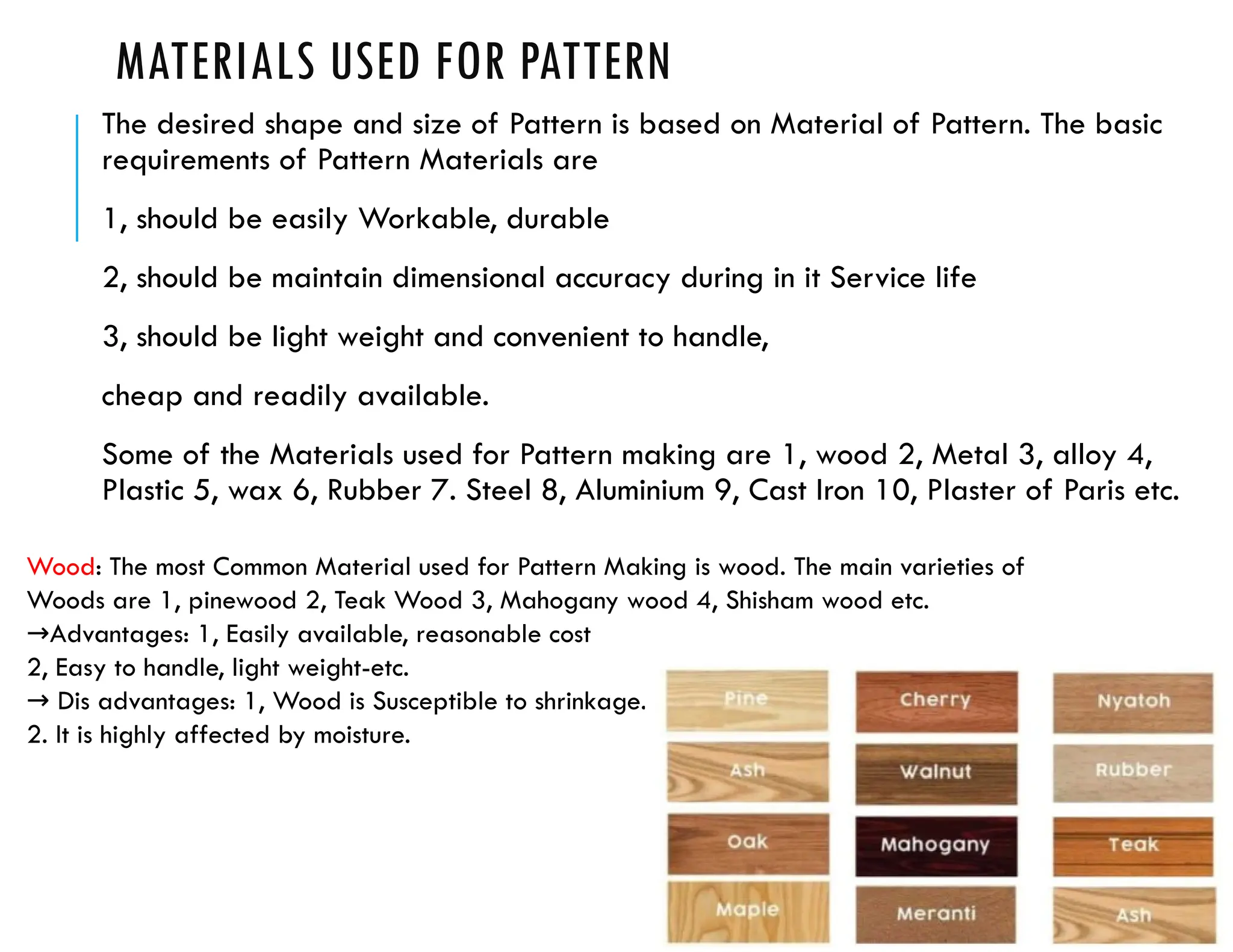
Wood: The most Common Material used for Pattern Making is wood. The main varieties of
Woods are 1, pinewood 2, Teak Wood 3, Mahogany wood 4, Shisham wood etc.
→Advantages: 1, Easily available, reasonable cost
2, Easy to handle, light weight-etc.
→ Dis advantages: 1, Wood is Susceptible to shrinkage.
2. It is highly affected by moisture.
Metal : Metal Pattern are. widely used in mass Production
Advantages:1, High Strength; durable 2, high wear resistance, Stability.
Disadvantages: 1, More Weight, difficult to repair 2, Poor resistance to corrosion.
Plastic: The type of Pattern which is made by Plastic must be very strong and highly
resistance to Wear.
Thermo- Setting resins (Phenolic resin, epoxy resin] have the desired Qualities of Pattern
materials
Metal patterns are used in machine moulding.
Most commonly used metal for making metal patterns are as
follows:
•White metal.
•Cast steel.
•Brass
•Aluminium alloy.
•Cast iron.
•Steel.
White metal: White metal is a lightweight metal that is easily machinable having a low melting point with few
drawbacks such as wear abrasion.
The white metal can be used for patterns without a double shrinkage allowance.
The white metal is soft and can be used for small patterns only. Pattern parts are soldered together.
Brass: Brass is an expensive metal that is soldered and brazed to make small smooth patterns.
Aluminium: Aluminium is a lightweight corrosion-resistance metal used to make medium to large-size
casting, Aluminium comes with shrinkage and wears abrasion drawbacks.
Cast iron: Cast iron as a metal pattern has a fine structure and is more durable than aluminium.
Cast iron is heavy, prone to corrosion, and has a high melting point.
Cast iron is exactly the opposite of aluminium. Is difficult to work with but is cheaper than aluminium for the
metal pattern.
Double shrinkage allowance needs to be considered if the pattern is made of metal.
The plastic pattern is A lightweight material which
provides high dimensional accuracy, and A better finish,
is easy to handle and can produce complex shapes in
the sand casting process
Plastic patterns are low-cost patterns that can be made from injection moulding by injecting
plastic into the die and layering with resin and fiber.
Plastic patterns are also made by pouring plastic in plaster of paris mould and giving the shape.
Laminated plastic patterns are more durable, and resistant to wear and tear than the wood
pattern.
A combination of epoxy, resin, PVC, fibreglass and other materials can be added to make the
pattern more suitable for creating mould cavities in the mould.
Cold-setting epoxy resin with suitable fillers is the best plastic for pattern material.
Plastic materials with the following combination are used for producing a plastic pattern in
casting:
Combination of epoxy, acrylates, polyvinylchloride, phenol formaldehyde, polyester resins,
polyethene and polyacrylates.
Gypsum patterns are made by pouring a slurry of
plaster into the mould-producing master pattern
These gypsum patterns are used for producing casting with complex shapes, close
tolerance and intricate details.
Plaster of Paris and hard metal casting plaster are two types of gypsum used for making
patterns.
Gypsum is soft, mouldable, and has the plasticity to foam any shape best suitable for
producing intricate casting.
Follow boards are made from the plaster in moulding.
A few types of gypsum plaster are as follows:
• Hydrocol.
• Hydrostone.
• Ultracal.
After finishing the pattern by giving various allowances, the next step of the pattern maker is the
shaping of the pieces that are to be used in the construction of the pattern. The method required to
be followed depends upon the size and shape of the pattern and number of costings required.
Procedure for pattern constructions.
1. decide the location of parting surface after studying the layout.
2. after visualizing the shape of the pattern determine the number of separate pieces to be made
and the process to be employed for making them.
3. start construction of pattern from the main part of the body. Keep the direction of wood grains
along the length of the pattern to get accuracy and strength.
4. different parts are provided adequate draft while cutting and shaping.
5. check all the prepared parts finally by placing them over the prepared layout.
6. outside corners should be rounded. assemble different parts in position by guising or by means
of dowels as the case may be:
7. fit all the fillets at desired places.
8. check the relative locations of all the parts assembled on the pattern
9. check whole of the completed pattern for accuracy.
10. finish all the rough surfaces by sanding and give a thin coating of shellac varnish.
11. colour different parts of surfaces with specific colors mixed in shellac or by painting
Construction of a pattern
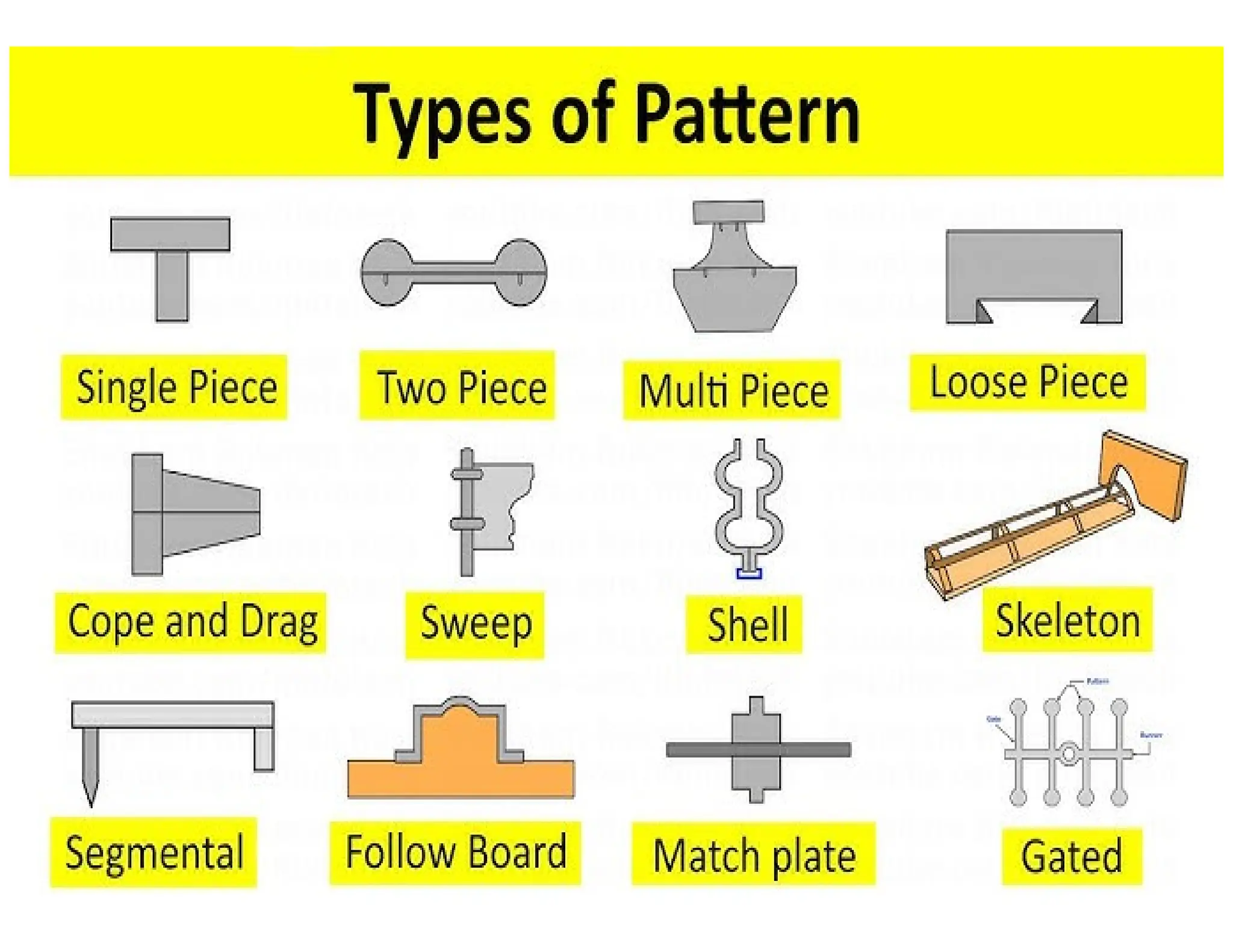
SOLID OR SINGLE PIECE PATTERN
i) It is the simplest form of Pattern
ii) it is inexpensive and used for making large Production in Simple cattigs
iii) It is placed either in cope or drag,
The Shape of solid Pattern is exactly Same as that of Casting.
Ex: Stuffing box of steam engine
SPLIT PIECE PATTERN
i) These are used for intricate Castings.
ii) it is made in 2 Parts, one is Placed on drag and another one is placed on cope.
iii) The exact arrangement. (or) Position will be done with the help of dowel Pins.
iv) The Pattern will be drawn [removed] from the mould before Pouring of molten metal.
Ex: Taps, water stop cocks etc.
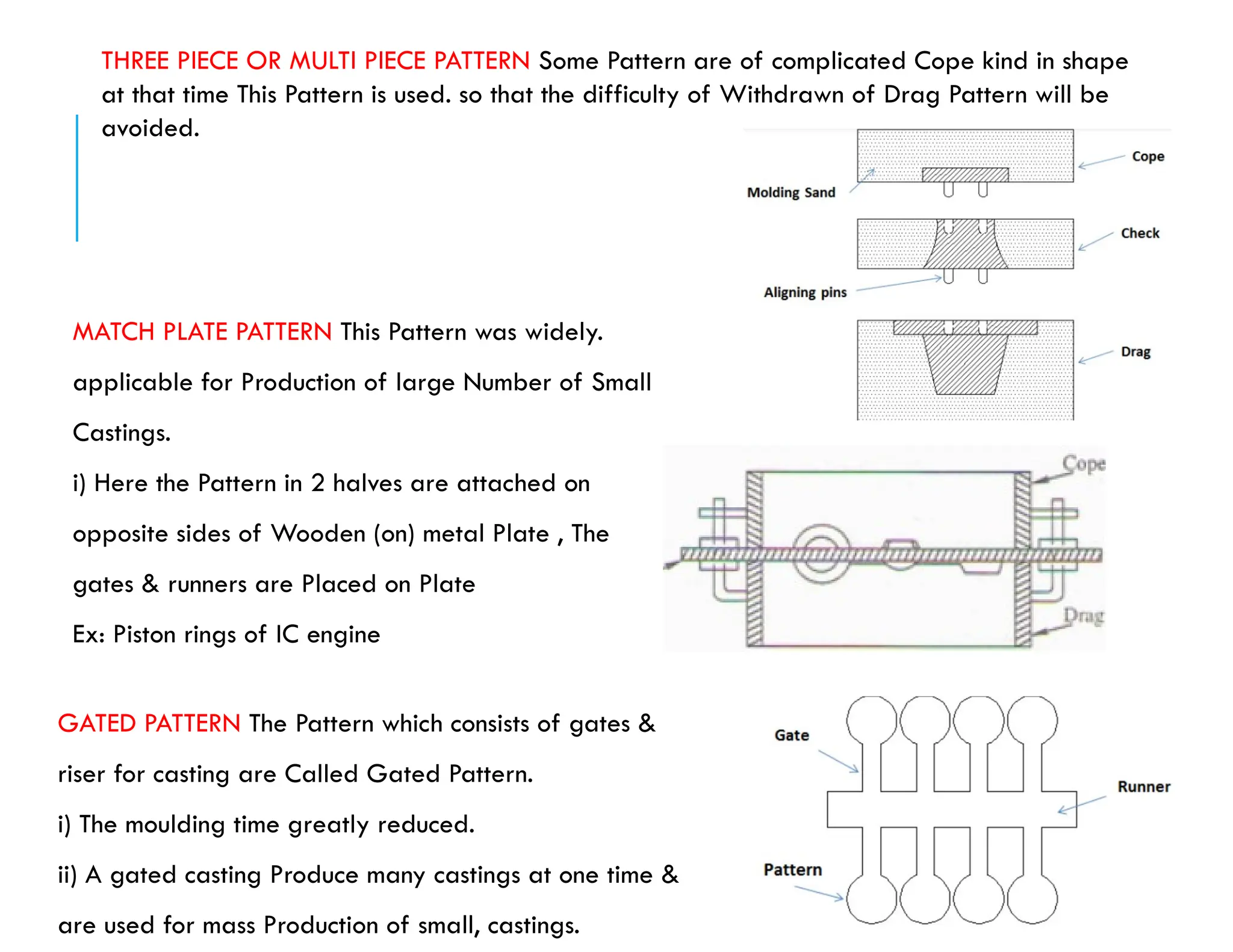
THREE PIECE OR MULTI PIECE PATTERN Some Pattern are of complicated Cope kind in shape
at that time This Pattern is used. so that the difficulty of Withdrawn of Drag Pattern will be
avoided.
MATCH PLATE PATTERN This Pattern was widely.
applicable for Production of large Number of Small
Castings.
i) Here the Pattern in 2 halves are attached on
opposite sides of Wooden (on) metal Plate , The
gates & runners are Placed on Plate
Ex: Piston rings of IC engine
GATED PATTERN The Pattern which consists of gates &
riser for casting are Called Gated Pattern.
i) The moulding time greatly reduced.
ii) A gated casting Produce many castings at one time &
are used for mass Production of small, castings.
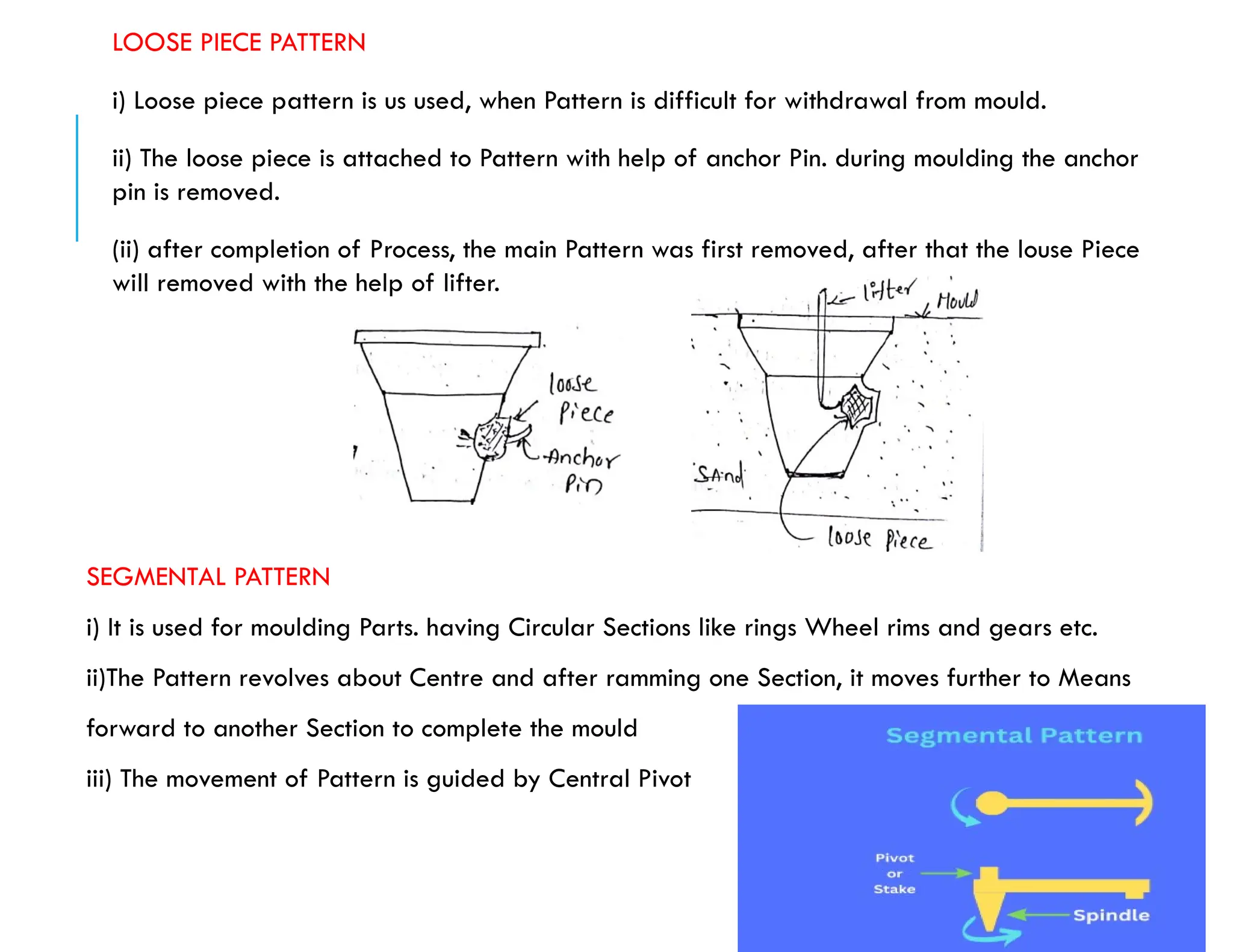
LOOSE PIECE PATTERN
i) Loose piece pattern is us used, when Pattern is difficult for withdrawal from mould.
ii) The loose piece is attached to Pattern with help of anchor Pin. during moulding the anchor
pin is removed.
(ii) after completion of Process, the main Pattern was first removed, after that the louse Piece
will removed with the help of lifter.
SEGMENTAL PATTERN
i) It is used for moulding Parts. having Circular Sections like rings Wheel rims and gears etc.
ii)The Pattern revolves about Centre and after ramming one Section, it moves further to Means
forward to another Section to complete the mould
iii) The movement of Pattern is guided by Central Pivot
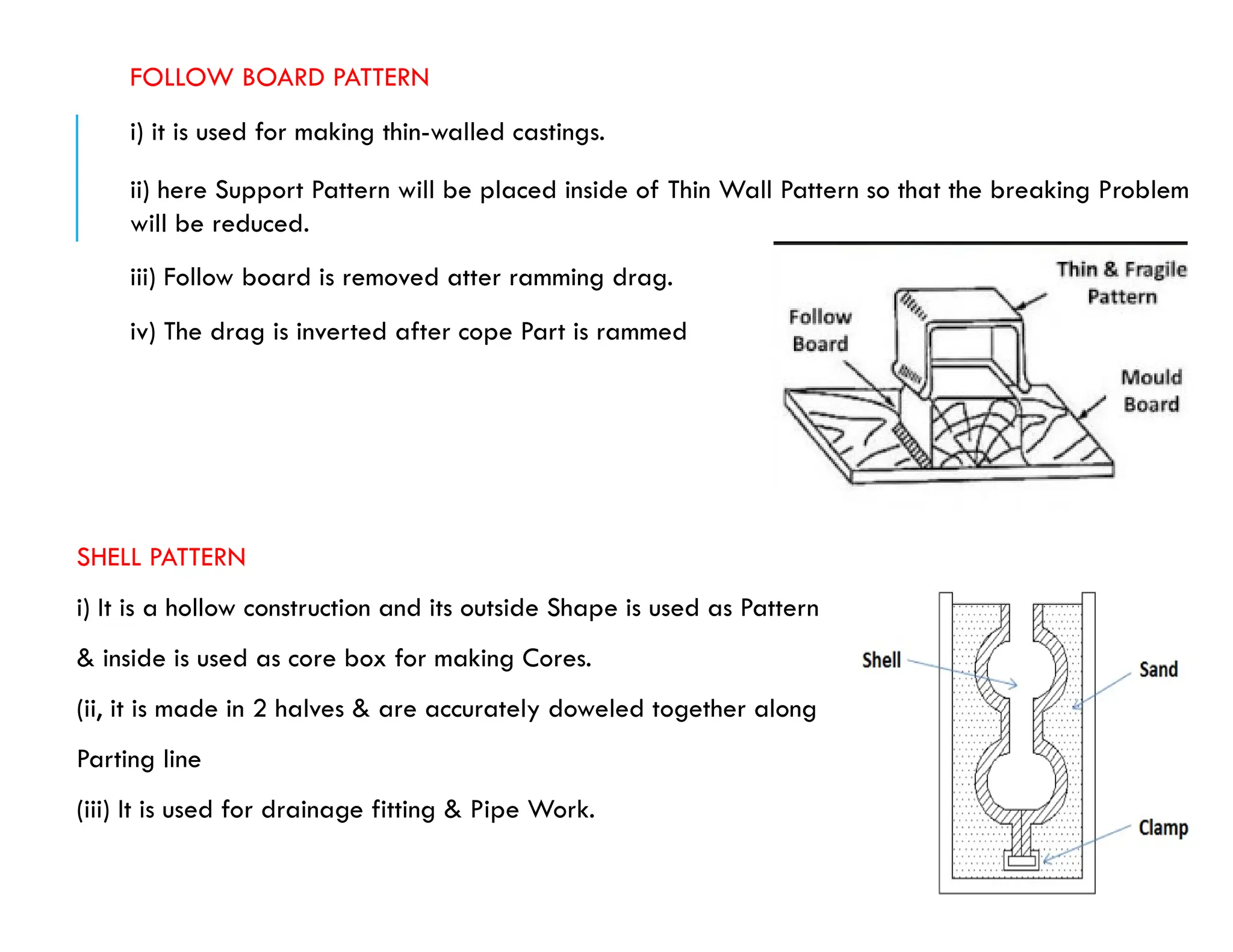
FOLLOW BOARD PATTERN
i) it is used for making thin-walled castings.
ii) here Support Pattern will be placed inside of Thin Wall Pattern so that the breaking Problem
will be reduced.
iii) Follow board is removed atter ramming drag.
iv) The drag is inverted after cope Part is rammed
SHELL PATTERN
i) It is a hollow construction and its outside Shape is used as Pattern
& inside is used as core box for making Cores.
(ii, it is made in 2 halves & are accurately doweled together along
Parting line
(iii) It is used for drainage fitting & Pipe Work.
SWEEP PATTERN
i) These are used for forming Large "Circular moulds of Symmetric kind by revolving
Sweep attached to a spindle
ii), it is suitable for simple castings like wheels, rims, bell shapes.
iii) After forming the mould, the sweep & spindle will be removed before Pouring the
molten metal.
SKELTON PATTERN
Is it is used for making Large Castings in Small number which do not require accurate dimensions.
i) it has a simple, wooden frame outlining the Shape of casting and it is filled with Loam Sand &
rammed
ii) ii) it is Suitable for. geometrical Shape like frames, Pipe fittings & housings.
PATTERN ALLOWANCES
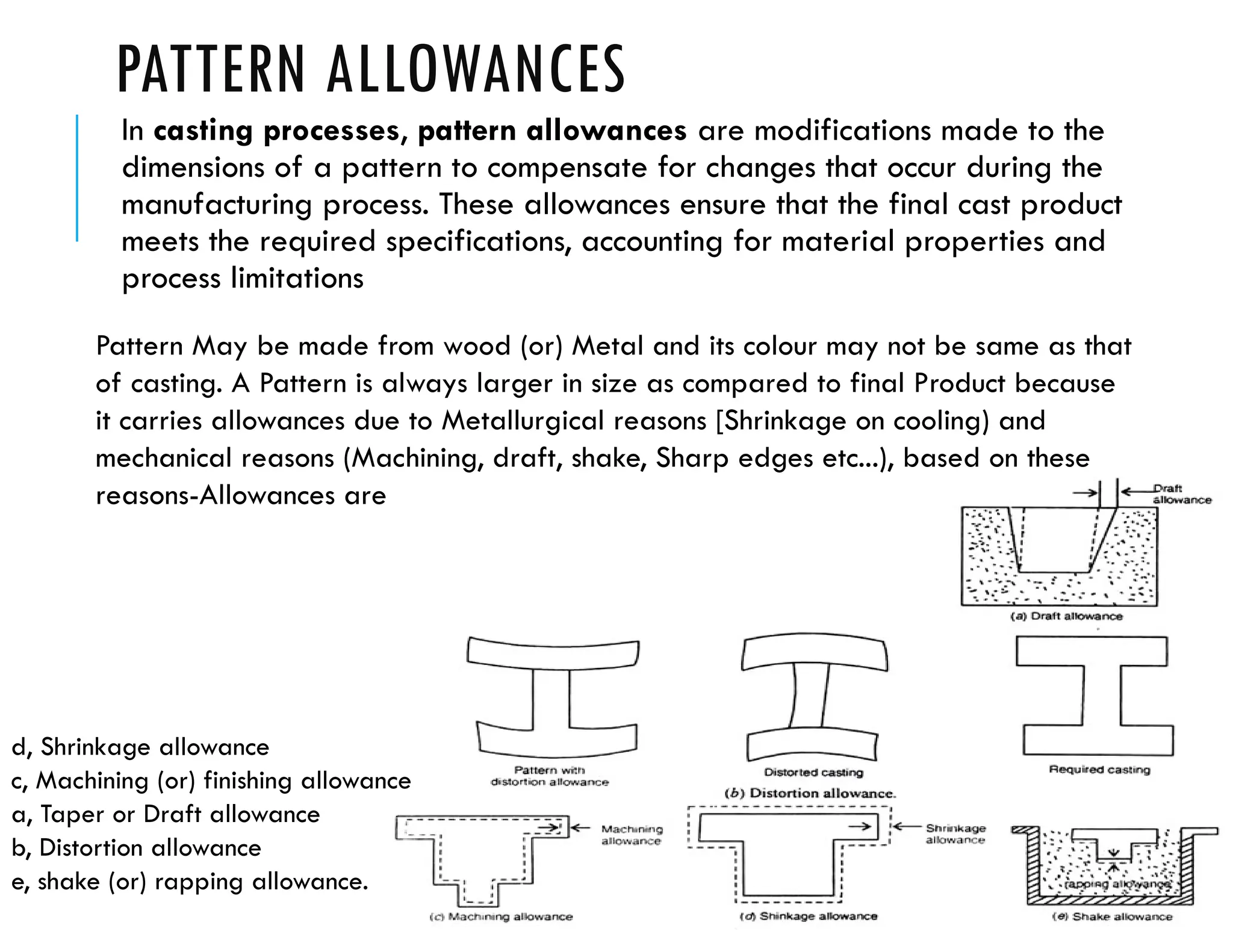
In casting processes, pattern allowances are modifications made to the
dimensions of a pattern to compensate for changes that occur during the
manufacturing process. These allowances ensure that the final cast product
meets the required specifications, accounting for material properties and
process limitations
Pattern May be made from wood (or) Metal and its colour may not be same as that
of casting. A Pattern is always larger in size as compared to final Product because
it carries allowances due to Metallurgical reasons [Shrinkage on cooling) and
mechanical reasons (Machining, draft, shake, Sharp edges etc...), based on these
reasons-Allowances are
d, Shrinkage allowance
c, Machining (or) finishing allowance
a, Taper or Draft allowance
b, Distortion allowance
e, shake (or) rapping allowance.
Shrinkage allowance: The Pattern must be made oversize to compensate for
contraction of metal. based on contraction in volume is divided into 3 Parts.
a, liquid contraction: The contraction during the Period in Which the temperature
of liquid metal falls from Temperature to the liquidus temperature..[ Pouring
Temp- liquidus Temp]
b, Solidifying Contraction: Contraction on Cooling from the Liquidus to Solidus
temperature [Liquidus Temp - solidus Temp)
c, Solid Contraction: Contraction that results after until the temperature reaches
the room temperature.[ Solidus Temp -Room Temp]
Note: Shrinkage is generally greater for "Cast steel" than for Other alloys.
Machining Allowance: It is a Positive allowance given to Compensate for the
amount of Material that is lost in Machining (or-finishing the casting. If this
allowance is not given, the Casting will become undersize" after Machining.
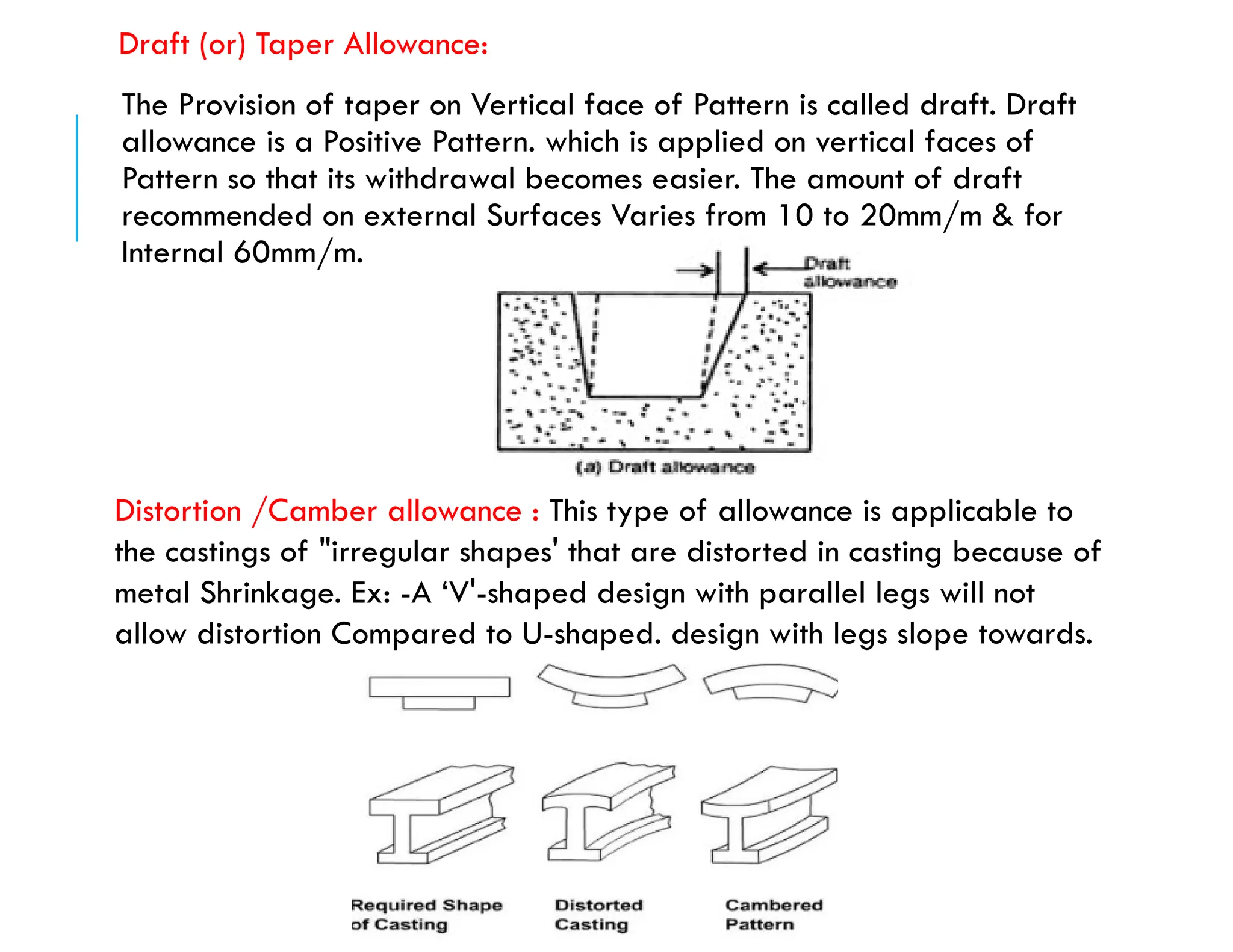
Draft (or) Taper Allowance:
The Provision of taper on Vertical face of Pattern is called draft. Draft
allowance is a Positive Pattern. which is applied on vertical faces of
Pattern so that its withdrawal becomes easier. The amount of draft
recommended on external Surfaces Varies from 10 to 20mm/m & for
Internal 60mm/m.
Distortion /Camber allowance : This type of allowance is applicable to
the castings of "irregular shapes' that are distorted in casting because of
metal Shrinkage. Ex: -A ‘V'-shaped design with parallel legs will not
allow distortion Compared to U-shaped. design with legs slope towards.
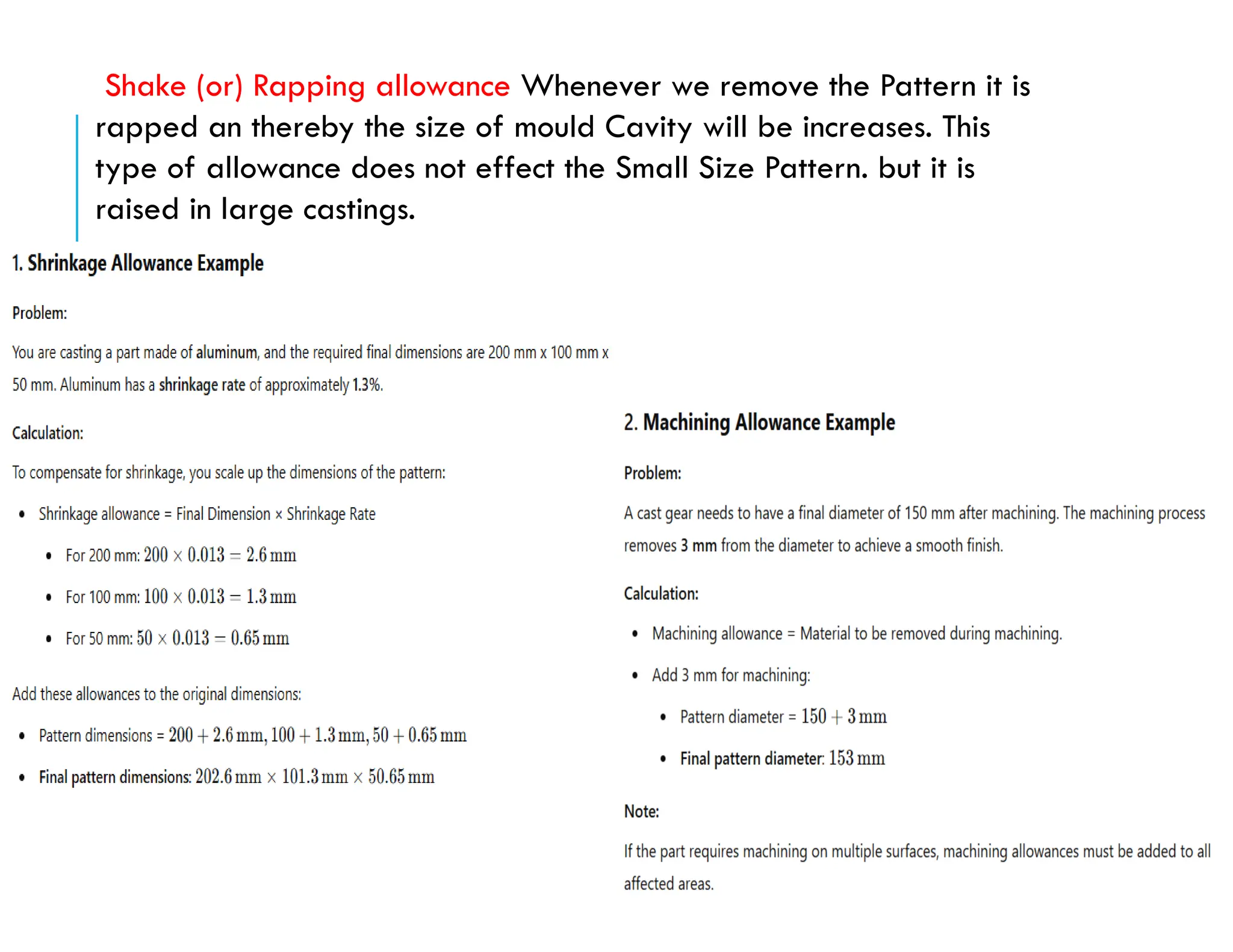
Shake (or) Rapping allowance Whenever we remove the Pattern it is
rapped an thereby the size of mould Cavity will be increases. This
type of allowance does not effect the Small Size Pattern. but it is
raised in large castings.
Patterns, materials, making, allowances.

Patterns, materials, making, allowances.

  • 1.
    PATTERNS A pattern isa replica of the final metal object that is used to create the mold cavity for the casting process: Patterns are made from materials such as wood, plastic, or metal and are constructed to exacting standards so that they can be used repeatedly to produce dimensionally acceptable castings. some important considerations for patterns are: •Size Patterns are always larger than the final casting to allow for contraction as the metal solidifies and cools. •Material Patterns should be sturdy, durable, anti-abrasion, water resistant, and easy to form. •Selection The pattern should be able to withstand rough handling. •Quality Patterns play a critical role in determining the quality and perfection of
  • 2.
    PATTERN MATERIALS The materialsshould be machinable and less susceptible to reactions in a machining or manufacturing process patterns are used as a principal tool in this process. Sometimes, the materials are not intended to be made to certain shapes (Eg. Tin, Zinc and Lead alloys). In these situations, a process called casting or metal casting is used One of the most critical aspects of casting is the creation of a pattern, which serves as a model for the final product patterns are typically made of wood, metal, or plastic Materials for Patterns •Wood: Commonly used for prototypes; easy to shape but less durable. •Metal: Durable and precise; ideal for high-volume production. •Plastic: Lightweight and resistant to moisture. •Wax: Used in investment casting for creating expendable patterns.
  • 3.
    MATERIALS USED FORPATTERN The desired shape and size of Pattern is based on Material of Pattern. The basic requirements of Pattern Materials are 1, should be easily Workable, durable 2, should be maintain dimensional accuracy during in it Service life 3, should be light weight and convenient to handle, cheap and readily available. Some of the Materials used for Pattern making are 1, wood 2, Metal 3, alloy 4, Plastic 5, wax 6, Rubber 7. Steel 8, Aluminium 9, Cast Iron 10, Plaster of Paris etc. Wood: The most Common Material used for Pattern Making is wood. The main varieties of Woods are 1, pinewood 2, Teak Wood 3, Mahogany wood 4, Shisham wood etc. →Advantages: 1, Easily available, reasonable cost 2, Easy to handle, light weight-etc. → Dis advantages: 1, Wood is Susceptible to shrinkage. 2. It is highly affected by moisture.
  • 4.
    Metal : MetalPattern are. widely used in mass Production Advantages:1, High Strength; durable 2, high wear resistance, Stability. Disadvantages: 1, More Weight, difficult to repair 2, Poor resistance to corrosion. Plastic: The type of Pattern which is made by Plastic must be very strong and highly resistance to Wear. Thermo- Setting resins (Phenolic resin, epoxy resin] have the desired Qualities of Pattern materials Metal patterns are used in machine moulding. Most commonly used metal for making metal patterns are as follows: •White metal. •Cast steel. •Brass •Aluminium alloy. •Cast iron. •Steel.
  • 5.
    White metal: Whitemetal is a lightweight metal that is easily machinable having a low melting point with few drawbacks such as wear abrasion. The white metal can be used for patterns without a double shrinkage allowance. The white metal is soft and can be used for small patterns only. Pattern parts are soldered together. Brass: Brass is an expensive metal that is soldered and brazed to make small smooth patterns. Aluminium: Aluminium is a lightweight corrosion-resistance metal used to make medium to large-size casting, Aluminium comes with shrinkage and wears abrasion drawbacks. Cast iron: Cast iron as a metal pattern has a fine structure and is more durable than aluminium. Cast iron is heavy, prone to corrosion, and has a high melting point. Cast iron is exactly the opposite of aluminium. Is difficult to work with but is cheaper than aluminium for the metal pattern. Double shrinkage allowance needs to be considered if the pattern is made of metal.
  • 6.
    The plastic patternis A lightweight material which provides high dimensional accuracy, and A better finish, is easy to handle and can produce complex shapes in the sand casting process Plastic patterns are low-cost patterns that can be made from injection moulding by injecting plastic into the die and layering with resin and fiber. Plastic patterns are also made by pouring plastic in plaster of paris mould and giving the shape. Laminated plastic patterns are more durable, and resistant to wear and tear than the wood pattern. A combination of epoxy, resin, PVC, fibreglass and other materials can be added to make the pattern more suitable for creating mould cavities in the mould. Cold-setting epoxy resin with suitable fillers is the best plastic for pattern material. Plastic materials with the following combination are used for producing a plastic pattern in casting: Combination of epoxy, acrylates, polyvinylchloride, phenol formaldehyde, polyester resins, polyethene and polyacrylates.
  • 7.
    Gypsum patterns aremade by pouring a slurry of plaster into the mould-producing master pattern These gypsum patterns are used for producing casting with complex shapes, close tolerance and intricate details. Plaster of Paris and hard metal casting plaster are two types of gypsum used for making patterns. Gypsum is soft, mouldable, and has the plasticity to foam any shape best suitable for producing intricate casting. Follow boards are made from the plaster in moulding. A few types of gypsum plaster are as follows: • Hydrocol. • Hydrostone. • Ultracal.
  • 9.
    After finishing thepattern by giving various allowances, the next step of the pattern maker is the shaping of the pieces that are to be used in the construction of the pattern. The method required to be followed depends upon the size and shape of the pattern and number of costings required. Procedure for pattern constructions. 1. decide the location of parting surface after studying the layout. 2. after visualizing the shape of the pattern determine the number of separate pieces to be made and the process to be employed for making them. 3. start construction of pattern from the main part of the body. Keep the direction of wood grains along the length of the pattern to get accuracy and strength. 4. different parts are provided adequate draft while cutting and shaping. 5. check all the prepared parts finally by placing them over the prepared layout. 6. outside corners should be rounded. assemble different parts in position by guising or by means of dowels as the case may be: 7. fit all the fillets at desired places. 8. check the relative locations of all the parts assembled on the pattern 9. check whole of the completed pattern for accuracy. 10. finish all the rough surfaces by sanding and give a thin coating of shellac varnish. 11. colour different parts of surfaces with specific colors mixed in shellac or by painting Construction of a pattern
  • 10.
    SOLID OR SINGLEPIECE PATTERN i) It is the simplest form of Pattern ii) it is inexpensive and used for making large Production in Simple cattigs iii) It is placed either in cope or drag, The Shape of solid Pattern is exactly Same as that of Casting. Ex: Stuffing box of steam engine SPLIT PIECE PATTERN i) These are used for intricate Castings. ii) it is made in 2 Parts, one is Placed on drag and another one is placed on cope. iii) The exact arrangement. (or) Position will be done with the help of dowel Pins. iv) The Pattern will be drawn [removed] from the mould before Pouring of molten metal. Ex: Taps, water stop cocks etc.
  • 11.
    THREE PIECE ORMULTI PIECE PATTERN Some Pattern are of complicated Cope kind in shape at that time This Pattern is used. so that the difficulty of Withdrawn of Drag Pattern will be avoided. MATCH PLATE PATTERN This Pattern was widely. applicable for Production of large Number of Small Castings. i) Here the Pattern in 2 halves are attached on opposite sides of Wooden (on) metal Plate , The gates & runners are Placed on Plate Ex: Piston rings of IC engine GATED PATTERN The Pattern which consists of gates & riser for casting are Called Gated Pattern. i) The moulding time greatly reduced. ii) A gated casting Produce many castings at one time & are used for mass Production of small, castings.
  • 12.
    LOOSE PIECE PATTERN i)Loose piece pattern is us used, when Pattern is difficult for withdrawal from mould. ii) The loose piece is attached to Pattern with help of anchor Pin. during moulding the anchor pin is removed. (ii) after completion of Process, the main Pattern was first removed, after that the louse Piece will removed with the help of lifter. SEGMENTAL PATTERN i) It is used for moulding Parts. having Circular Sections like rings Wheel rims and gears etc. ii)The Pattern revolves about Centre and after ramming one Section, it moves further to Means forward to another Section to complete the mould iii) The movement of Pattern is guided by Central Pivot
  • 13.
    FOLLOW BOARD PATTERN i)it is used for making thin-walled castings. ii) here Support Pattern will be placed inside of Thin Wall Pattern so that the breaking Problem will be reduced. iii) Follow board is removed atter ramming drag. iv) The drag is inverted after cope Part is rammed SHELL PATTERN i) It is a hollow construction and its outside Shape is used as Pattern & inside is used as core box for making Cores. (ii, it is made in 2 halves & are accurately doweled together along Parting line (iii) It is used for drainage fitting & Pipe Work.
  • 14.
    SWEEP PATTERN i) Theseare used for forming Large "Circular moulds of Symmetric kind by revolving Sweep attached to a spindle ii), it is suitable for simple castings like wheels, rims, bell shapes. iii) After forming the mould, the sweep & spindle will be removed before Pouring the molten metal. SKELTON PATTERN Is it is used for making Large Castings in Small number which do not require accurate dimensions. i) it has a simple, wooden frame outlining the Shape of casting and it is filled with Loam Sand & rammed ii) ii) it is Suitable for. geometrical Shape like frames, Pipe fittings & housings.
  • 15.
    PATTERN ALLOWANCES In castingprocesses, pattern allowances are modifications made to the dimensions of a pattern to compensate for changes that occur during the manufacturing process. These allowances ensure that the final cast product meets the required specifications, accounting for material properties and process limitations Pattern May be made from wood (or) Metal and its colour may not be same as that of casting. A Pattern is always larger in size as compared to final Product because it carries allowances due to Metallurgical reasons [Shrinkage on cooling) and mechanical reasons (Machining, draft, shake, Sharp edges etc...), based on these reasons-Allowances are d, Shrinkage allowance c, Machining (or) finishing allowance a, Taper or Draft allowance b, Distortion allowance e, shake (or) rapping allowance.
  • 16.
    Shrinkage allowance: ThePattern must be made oversize to compensate for contraction of metal. based on contraction in volume is divided into 3 Parts. a, liquid contraction: The contraction during the Period in Which the temperature of liquid metal falls from Temperature to the liquidus temperature..[ Pouring Temp- liquidus Temp] b, Solidifying Contraction: Contraction on Cooling from the Liquidus to Solidus temperature [Liquidus Temp - solidus Temp) c, Solid Contraction: Contraction that results after until the temperature reaches the room temperature.[ Solidus Temp -Room Temp] Note: Shrinkage is generally greater for "Cast steel" than for Other alloys. Machining Allowance: It is a Positive allowance given to Compensate for the amount of Material that is lost in Machining (or-finishing the casting. If this allowance is not given, the Casting will become undersize" after Machining.
  • 17.
    Draft (or) TaperAllowance: The Provision of taper on Vertical face of Pattern is called draft. Draft allowance is a Positive Pattern. which is applied on vertical faces of Pattern so that its withdrawal becomes easier. The amount of draft recommended on external Surfaces Varies from 10 to 20mm/m & for Internal 60mm/m. Distortion /Camber allowance : This type of allowance is applicable to the castings of "irregular shapes' that are distorted in casting because of metal Shrinkage. Ex: -A ‘V'-shaped design with parallel legs will not allow distortion Compared to U-shaped. design with legs slope towards.
  • 18.
    Shake (or) Rappingallowance Whenever we remove the Pattern it is rapped an thereby the size of mould Cavity will be increases. This type of allowance does not effect the Small Size Pattern. but it is raised in large castings.