FURNACES FOR CASTING
CH. JAYA TEJA M.TECH (Ph. D)
Assistant Professor
Department of Mechanical Engineering
Bonam Venkata Chalamayya Engineering college, Odalarevu
Intro.. Furnaces
A furnace
• A furnace is a device used for high-temperature heating. The heat energy
to fuel a furnace may be supplied directly by fuel combustion, by
electricity such as the electric arc furnace, or through induction heating in
induction furnaces.
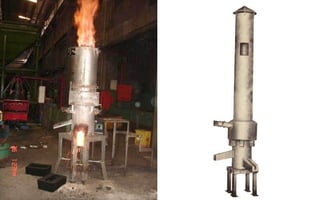
A cupola furnace
• A cupola or cupola furnace is a melting device used to melt cast iron, Ni-
resist iron and some bronzes. The cupola can be made almost any
practical size.
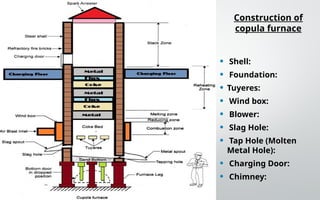
Construction of
copula furnace
• Shell:
• Foundation:
• Tuyeres:
• Wind box:
• Blower:
• Slag Hole:
• Tap Hole (Molten
Metal Hole):
• Charging Door:
• Chimney:
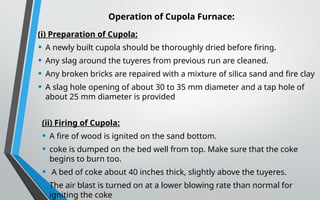
Operation of Cupola Furnace:
(i) Preparation of Cupola:
• A newly built cupola should be thoroughly dried before firing.
• Any slag around the tuyeres from previous run are cleaned.
• Any broken bricks are repaired with a mixture of silica sand and fire clay
• A slag hole opening of about 30 to 35 mm diameter and a tap hole of
about 25 mm diameter is provided
(ii) Firing of Cupola:
• A fire of wood is ignited on the sand bottom.
• coke is dumped on the bed well from top. Make sure that the coke
begins to burn too.
• A bed of coke about 40 inches thick, slightly above the tuyeres.
• The air blast is turned on at a lower blowing rate than normal for
igniting the coke
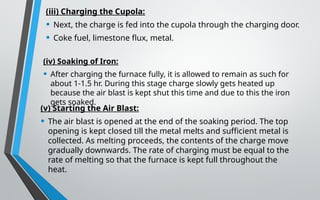
(iii) Charging the Cupola:
• Next, the charge is fed into the cupola through the charging door.
• Coke fuel, limestone flux, metal.
(iv) Soaking of Iron:
• After charging the furnace fully, it is allowed to remain as such for
about 1-1.5 hr. During this stage charge slowly gets heated up
because the air blast is kept shut this time and due to this the iron
gets soaked.
(v) Starting the Air Blast:
• The air blast is opened at the end of the soaking period. The top
opening is kept closed till the metal melts and sufficient metal is
collected. As melting proceeds, the contents of the charge move
gradually downwards. The rate of charging must be equal to the
rate of melting so that the furnace is kept full throughout the
heat.
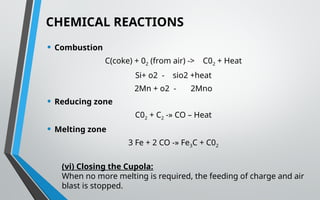
CHEMICAL REACTIONS
• Combustion
C(coke) + 02 (from air) -> C02 + Heat
Si+ o2 - sio2 +heat
2Mn + o2 - 2Mno
• Reducing zone
C02 + C2 -» CO – Heat
• Melting zone
3 Fe + 2 CO -» Fe3C + C02
(vi) Closing the Cupola:
When no more melting is required, the feeding of charge and air
blast is stopped.
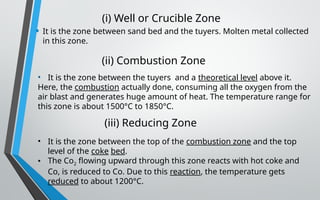
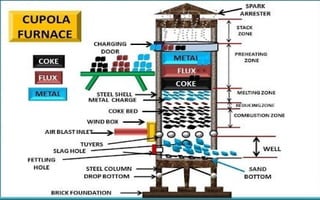
(i) Well or Crucible Zone
• It is the zone between sand bed and the tuyers. Molten metal collected
in this zone.
(ii) Combustion Zone
• It is the zone between the tuyers and a theoretical level above it.
Here, the combustion actually done, consuming all the oxygen from the
air blast and generates huge amount of heat. The temperature range for
this zone is about 1500°C to 1850°C.
(iii) Reducing Zone
• It is the zone between the top of the combustion zone and the top
level of the coke bed.
• The Co2 flowing upward through this zone reacts with hot coke and
Co, is reduced to Co. Due to this reaction, the temperature gets
reduced to about 1200°C.
(iv) Melting Zone
• It is the zone between the first layer of metal charge and above
the reducing zone. The solid metal charge changes to molten
state picks up sufficient carbon in this zone. The temperature
attainable in this zone is in the range of 1600°C to 1700°C.
(v) Preheating Zone
• It is the zone from above the melting zone to the bottom level
of the charging door. Charging materials are fed in this zone. It
is also known as charging zone.
(vi) Stack Zone
• It is the empty portion of this furnace, which extends from above
the charging zone to the top of the furnace. It carries the hot
gases generated within the furnace to the atmosphere.
Advantages of Cupola Furnace
• It is simple in construction and operation.
• Low cast of construction, operation and maintenance.
• It does not require very skilled operators.
• It requires small floor area as compared to other furnaces.
• Composition of melt can be controlled.
Limitations of Cupola Furnace
• Temperature control is difficult to maintain.
• Carbon content increases in the iron product due to the heating of
coke together with metal.
Uses
• A cupola or cupola furnace is a melting device used in foundries
that can be used to melt cast iron and some bronzes.
The cupola can be made almost any practical size
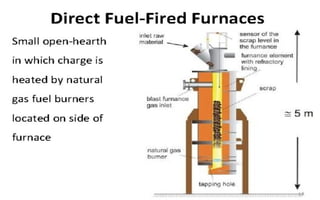
Direct fuel fired furnace
Construction:
The Hot Air Generator is solid fuel fired medium air temperature
hot air generator, which is very compact in construction of
VERTICAL design, with External bottom furnace.
The main body of the Generator is of sturdy Construction made
out of heavy gauge steel and Structure. The body is painted with
epoxy paint to combat corrosive industrial atmosphere.
Salient Features:
1. Clean, Uncontaminated Hot Air available Economically.
2. Hot Air available at temperature up to 1700 C.
3. Multiple passes on air side ensure high thermal efficiency.
4. Lowest operating costs, compared to Electricity, Steam &
thermic oil heating.
5. Vertical design, requires very low floor space.
6. Low motive power requirements.
Direct fired heaters
• Direct fired heaters are similar to a gas barbecue grill or your gas stove
top. With propane or natural gas heating, units force air directly through
the flame to heat the air.
Direct fired heaters
diagram
Benefits to using direct fired heaters
include:
1. Efficiency – Direct fired heaters convert 100% of the fuel being
used to direct heat which lowers fuel consumption and operating
Costs
2. Easy to Transport – Direct fired heaters are fairly simple pieces of
equipment that can be moved to where heat is needed
3. Some units do not require electricity
4. Lower rental costs – Direct Fired Heaters are less expensive
5. Lower Maintenance Costs – Easier to maintain
Some drawbacks to using direct fired
heaters are:
1. Adds moisture and carbon monoxide into the air.
2. Low Operation Cost
3. The rising prices of the fuel oil have made the use of oil as a
heating medium prohibitively costly. In these times of highly
competitive markets, it has become necessary to look at the
other fuel options available.
Trouble free Operation:
The Unit is of Sturdy construction and also there are very few moving
parts; this ensures long life & trouble free operation of the unit.
Induction furnace
What is induction furnace?
• Induction Furnace
• An induction furnace is an
electrical furnace in which the heat is applied by
induction heating of metal.
• Induction furnace capacities range from less than
one kilogram to one hundred tonnes capacity and
are used to melt iron and steel, copper, aluminium
and precious metals.
Construction
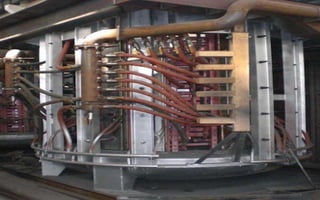
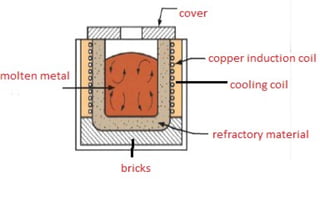
• An induction furnace consists of a nonconductive crucible
holding the charge of metal to be melted, surrounded by a coil
of copper wire.
• A powerful alternating current flows through the wire. The coil
creates a rapidly reversing magnetic field that penetrates the
metal. The magnetic field induces eddy currents, circular
electric currents, inside the metal, by
electromagnetic induction. The eddy currents, flowing
through the electrical resistance of the bulk metal, heat it by
Joule heating.
• Principle
• The principle of induction heating is based on the
following two laws:
• 1. Electromagnetic induction
• 2. The joule effect (the heating that occurs when an
electric current flows through a resistance.)
• The principle of induction melting is that a high voltage
electrical source from a primary coil induces a low
voltage, high current in the metal or secondary coil.
Induction heating is simply a method of transferring
heat energy.
Important points
• The inductor is usually made of copper in order to
limit the electric losses.
• In this furnace type, the charge is melted by heat
generated from an electric arc.
• The coil carries the high frequency current of 500 to
2000 Hz.
Advantages
• · Induction furnace does not need electrodes like
electric arc furnace.
• · Better control of temperature
• · Better control of composition of the melt
Disadvantages
• Disadvantages:
• · An induction installation usually implies a big
investment that must be considered and compared to
alternative heating techniques.
• · Induction heating is preferably used for heating
relatively simple shapes.
Types of Induction furnaces
• Coreless induction furnaces
• The heart of the coreless induction furnace is the coil,
which consists of a hollow section of heavy duty, high
conductivity copper tubing which is wound into a helical
coil.
• To protect it from overheating, the coil is water-cooled,
the water bring recirculated and cooled in a cooling
tower.
• Channel induction furnaces
• The channel induction furnace consists of a
refractory lined steel shell which contains the
molten metal. Attached to the steel shell and
connected by a throat is an induction unit which
forms the melting component of the furnace. The
induction unit consists of an iron core in the form
of a ring around which a primary induction coil is
wound.
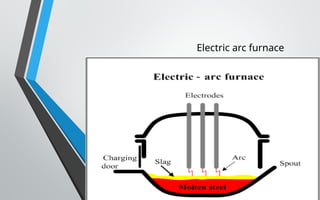
Electric arc furnace
Introduction:
•Electric Arc Furnace is a furnace that
heats the charged material by mean of
an electric arc.
•Arc Furnace range in size from small
units of approximately one ton capacity
up to 400 tons. industrial arc furnace
can be heat up to 1800°C..
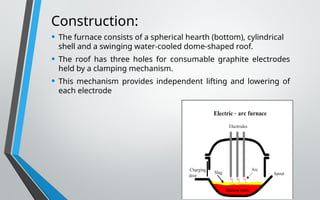
Construction:
• The furnace consists of a spherical hearth (bottom), cylindrical
shell and a swinging water-cooled dome-shaped roof.
• The roof has three holes for consumable graphite electrodes
held by a clamping mechanism.
• This mechanism provides independent lifting and lowering of
each electrode
Operation:
The electric arc furnace operates as a
batch melting process.
•Furnace Charging
•Melting
•Tapping
•Furnace turn-around
Melting:
• The melting period is a heart of Electric arc furnace. The EAF has
evolved into a highly efficient melting apparatus and modern
design are focused on maximizing is accomplished by supplying
energy to the furnace interior. This energy can be electrical or
chemical.
• Electrical energy is supplied via graphite electrodes and is usually
the largest contributor in melting operations. Initially, an
intermediate voltage tap is selected until the electrodes bore into
the scrap. usually light scrap is placed on top of the charge to
accelerate bore-in. approximately 15% of scrap is melted during the
initial bore-in period.
• Heat is transferred to charge material by flame radiation and
convection by the hot products of combustion. Heat is
transferred within the charged material by conduction.
• Large pieces of scrap take longer time to melt into the bath than
smaller pieces. In some operations oxygen is injected via a
consumable pipe lance to “cut” the charged material and burns
iron to produce intense heat.
• This oxygen will react with several components in the bath
including, aluminum , silicon , manganese , phosphorous ,
carbon , and iron all these reactions are exothermic.
Advantage:
• Electric arc furnace can be used as heat treatment furnace.
• It can be used for melting.
• EAF is used for production of steel making by pig iron
• Electric arc furnace provides flexibility, EAFs can be rapidly started and
stopped.
Disadvantages:
• A lot of electricity consumption.

FURNACE FOR CASTING-CUPOLA, DIRECT, INDUCTION, ARC

  • 1.
    FURNACES FOR CASTING CH.JAYA TEJA M.TECH (Ph. D) Assistant Professor Department of Mechanical Engineering Bonam Venkata Chalamayya Engineering college, Odalarevu
  • 2.
    Intro.. Furnaces A furnace •A furnace is a device used for high-temperature heating. The heat energy to fuel a furnace may be supplied directly by fuel combustion, by electricity such as the electric arc furnace, or through induction heating in induction furnaces. A cupola furnace • A cupola or cupola furnace is a melting device used to melt cast iron, Ni- resist iron and some bronzes. The cupola can be made almost any practical size.
  • 3.
    Construction of copula furnace •Shell: • Foundation: • Tuyeres: • Wind box: • Blower: • Slag Hole: • Tap Hole (Molten Metal Hole): • Charging Door: • Chimney:
  • 4.
    Operation of CupolaFurnace: (i) Preparation of Cupola: • A newly built cupola should be thoroughly dried before firing. • Any slag around the tuyeres from previous run are cleaned. • Any broken bricks are repaired with a mixture of silica sand and fire clay • A slag hole opening of about 30 to 35 mm diameter and a tap hole of about 25 mm diameter is provided (ii) Firing of Cupola: • A fire of wood is ignited on the sand bottom. • coke is dumped on the bed well from top. Make sure that the coke begins to burn too. • A bed of coke about 40 inches thick, slightly above the tuyeres. • The air blast is turned on at a lower blowing rate than normal for igniting the coke
  • 5.
    (iii) Charging theCupola: • Next, the charge is fed into the cupola through the charging door. • Coke fuel, limestone flux, metal. (iv) Soaking of Iron: • After charging the furnace fully, it is allowed to remain as such for about 1-1.5 hr. During this stage charge slowly gets heated up because the air blast is kept shut this time and due to this the iron gets soaked. (v) Starting the Air Blast: • The air blast is opened at the end of the soaking period. The top opening is kept closed till the metal melts and sufficient metal is collected. As melting proceeds, the contents of the charge move gradually downwards. The rate of charging must be equal to the rate of melting so that the furnace is kept full throughout the heat.
  • 6.
    CHEMICAL REACTIONS • Combustion C(coke)+ 02 (from air) -> C02 + Heat Si+ o2 - sio2 +heat 2Mn + o2 - 2Mno • Reducing zone C02 + C2 -» CO – Heat • Melting zone 3 Fe + 2 CO -» Fe3C + C02 (vi) Closing the Cupola: When no more melting is required, the feeding of charge and air blast is stopped.
  • 7.
    (i) Well orCrucible Zone • It is the zone between sand bed and the tuyers. Molten metal collected in this zone. (ii) Combustion Zone • It is the zone between the tuyers and a theoretical level above it. Here, the combustion actually done, consuming all the oxygen from the air blast and generates huge amount of heat. The temperature range for this zone is about 1500°C to 1850°C. (iii) Reducing Zone • It is the zone between the top of the combustion zone and the top level of the coke bed. • The Co2 flowing upward through this zone reacts with hot coke and Co, is reduced to Co. Due to this reaction, the temperature gets reduced to about 1200°C.
  • 9.
    (iv) Melting Zone •It is the zone between the first layer of metal charge and above the reducing zone. The solid metal charge changes to molten state picks up sufficient carbon in this zone. The temperature attainable in this zone is in the range of 1600°C to 1700°C. (v) Preheating Zone • It is the zone from above the melting zone to the bottom level of the charging door. Charging materials are fed in this zone. It is also known as charging zone. (vi) Stack Zone • It is the empty portion of this furnace, which extends from above the charging zone to the top of the furnace. It carries the hot gases generated within the furnace to the atmosphere.
  • 10.
    Advantages of CupolaFurnace • It is simple in construction and operation. • Low cast of construction, operation and maintenance. • It does not require very skilled operators. • It requires small floor area as compared to other furnaces. • Composition of melt can be controlled.
  • 11.
    Limitations of CupolaFurnace • Temperature control is difficult to maintain. • Carbon content increases in the iron product due to the heating of coke together with metal. Uses • A cupola or cupola furnace is a melting device used in foundries that can be used to melt cast iron and some bronzes. The cupola can be made almost any practical size
  • 13.
  • 14.
    Construction: The Hot AirGenerator is solid fuel fired medium air temperature hot air generator, which is very compact in construction of VERTICAL design, with External bottom furnace. The main body of the Generator is of sturdy Construction made out of heavy gauge steel and Structure. The body is painted with epoxy paint to combat corrosive industrial atmosphere.
  • 15.
    Salient Features: 1. Clean,Uncontaminated Hot Air available Economically. 2. Hot Air available at temperature up to 1700 C. 3. Multiple passes on air side ensure high thermal efficiency. 4. Lowest operating costs, compared to Electricity, Steam & thermic oil heating. 5. Vertical design, requires very low floor space. 6. Low motive power requirements.
  • 16.
    Direct fired heaters •Direct fired heaters are similar to a gas barbecue grill or your gas stove top. With propane or natural gas heating, units force air directly through the flame to heat the air.
  • 17.
  • 18.
    Benefits to usingdirect fired heaters include: 1. Efficiency – Direct fired heaters convert 100% of the fuel being used to direct heat which lowers fuel consumption and operating Costs 2. Easy to Transport – Direct fired heaters are fairly simple pieces of equipment that can be moved to where heat is needed 3. Some units do not require electricity 4. Lower rental costs – Direct Fired Heaters are less expensive 5. Lower Maintenance Costs – Easier to maintain
  • 19.
    Some drawbacks tousing direct fired heaters are: 1. Adds moisture and carbon monoxide into the air. 2. Low Operation Cost 3. The rising prices of the fuel oil have made the use of oil as a heating medium prohibitively costly. In these times of highly competitive markets, it has become necessary to look at the other fuel options available.
  • 20.
    Trouble free Operation: TheUnit is of Sturdy construction and also there are very few moving parts; this ensures long life & trouble free operation of the unit.
  • 21.
  • 22.
    What is inductionfurnace? • Induction Furnace • An induction furnace is an electrical furnace in which the heat is applied by induction heating of metal. • Induction furnace capacities range from less than one kilogram to one hundred tonnes capacity and are used to melt iron and steel, copper, aluminium and precious metals.
  • 23.
    Construction • An inductionfurnace consists of a nonconductive crucible holding the charge of metal to be melted, surrounded by a coil of copper wire. • A powerful alternating current flows through the wire. The coil creates a rapidly reversing magnetic field that penetrates the metal. The magnetic field induces eddy currents, circular electric currents, inside the metal, by electromagnetic induction. The eddy currents, flowing through the electrical resistance of the bulk metal, heat it by Joule heating.
  • 24.
    • Principle • Theprinciple of induction heating is based on the following two laws: • 1. Electromagnetic induction • 2. The joule effect (the heating that occurs when an electric current flows through a resistance.) • The principle of induction melting is that a high voltage electrical source from a primary coil induces a low voltage, high current in the metal or secondary coil. Induction heating is simply a method of transferring heat energy.
  • 25.
    Important points • Theinductor is usually made of copper in order to limit the electric losses. • In this furnace type, the charge is melted by heat generated from an electric arc. • The coil carries the high frequency current of 500 to 2000 Hz.
  • 28.
    Advantages • · Inductionfurnace does not need electrodes like electric arc furnace. • · Better control of temperature • · Better control of composition of the melt
  • 29.
    Disadvantages • Disadvantages: • ·An induction installation usually implies a big investment that must be considered and compared to alternative heating techniques. • · Induction heating is preferably used for heating relatively simple shapes.
  • 30.
    Types of Inductionfurnaces • Coreless induction furnaces • The heart of the coreless induction furnace is the coil, which consists of a hollow section of heavy duty, high conductivity copper tubing which is wound into a helical coil. • To protect it from overheating, the coil is water-cooled, the water bring recirculated and cooled in a cooling tower.
  • 31.
    • Channel inductionfurnaces • The channel induction furnace consists of a refractory lined steel shell which contains the molten metal. Attached to the steel shell and connected by a throat is an induction unit which forms the melting component of the furnace. The induction unit consists of an iron core in the form of a ring around which a primary induction coil is wound.
  • 32.
  • 33.
    Introduction: •Electric Arc Furnaceis a furnace that heats the charged material by mean of an electric arc. •Arc Furnace range in size from small units of approximately one ton capacity up to 400 tons. industrial arc furnace can be heat up to 1800°C..
  • 34.
    Construction: • The furnaceconsists of a spherical hearth (bottom), cylindrical shell and a swinging water-cooled dome-shaped roof. • The roof has three holes for consumable graphite electrodes held by a clamping mechanism. • This mechanism provides independent lifting and lowering of each electrode
  • 35.
    Operation: The electric arcfurnace operates as a batch melting process. •Furnace Charging •Melting •Tapping •Furnace turn-around
  • 36.
    Melting: • The meltingperiod is a heart of Electric arc furnace. The EAF has evolved into a highly efficient melting apparatus and modern design are focused on maximizing is accomplished by supplying energy to the furnace interior. This energy can be electrical or chemical. • Electrical energy is supplied via graphite electrodes and is usually the largest contributor in melting operations. Initially, an intermediate voltage tap is selected until the electrodes bore into the scrap. usually light scrap is placed on top of the charge to accelerate bore-in. approximately 15% of scrap is melted during the initial bore-in period.
  • 37.
    • Heat istransferred to charge material by flame radiation and convection by the hot products of combustion. Heat is transferred within the charged material by conduction. • Large pieces of scrap take longer time to melt into the bath than smaller pieces. In some operations oxygen is injected via a consumable pipe lance to “cut” the charged material and burns iron to produce intense heat. • This oxygen will react with several components in the bath including, aluminum , silicon , manganese , phosphorous , carbon , and iron all these reactions are exothermic.
  • 38.
    Advantage: • Electric arcfurnace can be used as heat treatment furnace. • It can be used for melting. • EAF is used for production of steel making by pig iron • Electric arc furnace provides flexibility, EAFs can be rapidly started and stopped. Disadvantages: • A lot of electricity consumption.