Gas Welding
Anees Cheema-26
Rashail Saleem-32
Saqib Ali-34
M.Bilal-24
Presented by:
History of Gas Welding
 Oldest method of welding.
 Discovery of (C2H2) gas by Edmund Davy(1836) .
 French chemist Marcellin Berthelot named it as Acetylene(1860).
 French chemist Henry Le Chatelier discovered a flame with a
temperature (about 6,000oF or 3,300oC).
 French engineer Edmond Fouche, produced first oxy-acetylene torch.
 The first oxy-acetylene welding shop in U.S was set up in 1906.
Gases Used in Gas Welding
Oxygen:
 Extracted from air and compressed into cylinders.
Fuel Gases:
Acetylene, Hydrogen, Butane, Propylene, Gasoline.
Acetylene (C2H2):
 Known as fuel gas.
 Cannot be compressed, explodes at high pressure.
 Acetone is used in the cylinders to stabilize the unstable gas.
What happens when these two gases burn?
 At high pressure when oxygen and Acetylene burns produces an
intense flame.
 The temperature of the flame goes upto 3500oC.
 Due to intensity and high temperature it can melt the metals easily.
Definition:
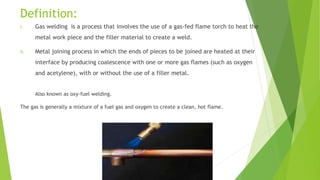
i. Gas welding is a process that involves the use of a gas-fed flame torch to heat the
metal work piece and the filler material to create a weld.
ii. Metal joining process in which the ends of pieces to be joined are heated at their
interface by producing coalescence with one or more gas flames (such as oxygen
and acetylene), with or without the use of a filler metal.
Also known as oxy-fuel welding.
The gas is generally a mixture of a fuel gas and oxygen to create a clean, hot flame.
How it works?
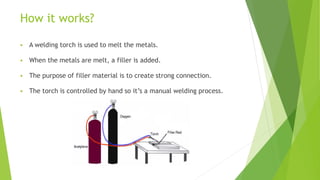
 A welding torch is used to melt the metals.
 When the metals are melt, a filler is added.
 The purpose of filler material is to create strong connection.
 The torch is controlled by hand so it’s a manual welding process.
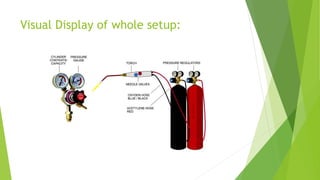
Visual Display of whole setup:
Equipments
Gas Cylinders:
Oxygen Cylinders:
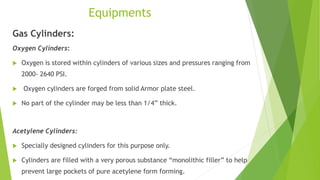
 Oxygen is stored within cylinders of various sizes and pressures ranging from
2000- 2640 PSI.
 Oxygen cylinders are forged from solid Armor plate steel.
 No part of the cylinder may be less than 1/4” thick.
Acetylene Cylinders:
 Specially designed cylinders for this purpose only.
 Cylinders are filled with a very porous substance “monolithic filler” to help
prevent large pockets of pure acetylene form forming.
Equipments
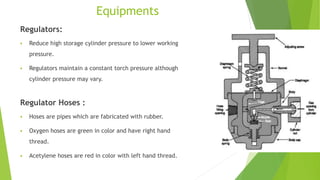
Regulators:
 Reduce high storage cylinder pressure to lower working
pressure.
 Regulators maintain a constant torch pressure although
cylinder pressure may vary.
Regulator Hoses :
 Hoses are pipes which are fabricated with rubber.
 Oxygen hoses are green in color and have right hand
thread.
 Acetylene hoses are red in color with left hand thread.
Equipments
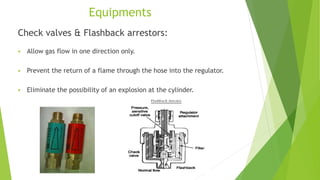
Check valves & Flashback arrestors:
 Allow gas flow in one direction only.
 Prevent the return of a flame through the hose into the regulator.
 Eliminate the possibility of an explosion at the cylinder.
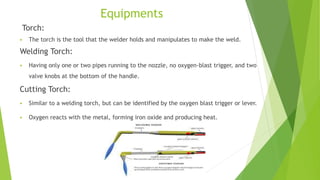
Torch:
 The torch is the tool that the welder holds and manipulates to make the weld.
Welding Torch:
 Having only one or two pipes running to the nozzle, no oxygen-blast trigger, and two
valve knobs at the bottom of the handle.
Cutting Torch:
 Similar to a welding torch, but can be identified by the oxygen blast trigger or lever.
 Oxygen reacts with the metal, forming iron oxide and producing heat.
Equipments
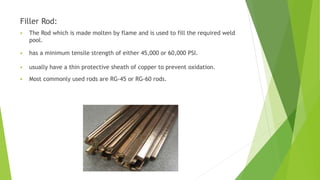
Filler Rod:
 The Rod which is made molten by flame and is used to fill the required weld
pool.
 has a minimum tensile strength of either 45,000 or 60,000 PSI.
 usually have a thin protective sheath of copper to prevent oxidation.
 Most commonly used rods are RG-45 or RG-60 rods.
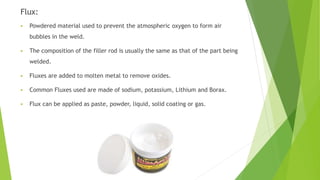
Flux:
 Powdered material used to prevent the atmospheric oxygen to form air
bubbles in the weld.
 The composition of the filler rod is usually the same as that of the part being
welded.
 Fluxes are added to molten metal to remove oxides.
 Common Fluxes used are made of sodium, potassium, Lithium and Borax.
 Flux can be applied as paste, powder, liquid, solid coating or gas.
Flames
There are three types of flames in gas welding.
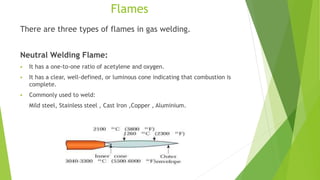
Neutral Welding Flame:
 It has a one-to-one ratio of acetylene and oxygen.
 It has a clear, well-defined, or luminous cone indicating that combustion is
complete.
 Commonly used to weld:
Mild steel, Stainless steel , Cast Iron ,Copper , Aluminium.
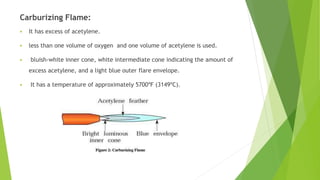
Carburizing Flame:
 It has excess of acetylene.
 less than one volume of oxygen and one volume of acetylene is used.
 bluish-white inner cone, white intermediate cone indicating the amount of
excess acetylene, and a light blue outer flare envelope.
 It has a temperature of approximately 5700ºF (3149ºC).
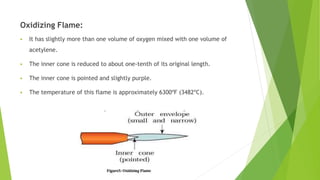
Oxidizing Flame:
 It has slightly more than one volume of oxygen mixed with one volume of
acetylene.
 The inner cone is reduced to about one-tenth of its original length.
 The inner cone is pointed and slightly purple.
 The temperature of this flame is approximately 6300ºF (3482ºC).
Types of gas welding:
Oxy-Acetylene Welding:
 Most commonly used gas welding technique.
 Provides the highest flame temperature(3500oC).
Oxy-Hydrogen Welding:
 Hydrogen is used as fuel gas.
 useful for underwater welding processes.
 used in jewellery making processes.
MAPP Gas Welding:
 Methylacetylene-Propadiene-petroleum (MAPP)
 Much more inert than other gas mixture making it a safer than others.
 high-volume cutting operations.
Where it is used?
Welding:
 It is good for welding steel, cast iron, bronze and other alloys.
 It is not the preferred choice for aluminium or stainless steel.
 It cannot be used to weld titanium or other reactive metals.

Cutting:
 It is also used for cutting of metal purposes.
Advantages
 Portable.
 Less Expensive.
 the process is versatile and simple.
 adapted to many different jobs.
 self sufficient, independent from availability of external energy sources.
Disadvantages
 Skill required to use the torch, the flame and the filler rod.
 Use of fluxes is required for most materials other than low carbon steel.
 Reactive or refractory metals are unsuited to gas welding.
 Finishing is required for neatness.
 Have large heat affected zones , mechanical properties adversely affected by
the welding process.
Questions??
Thank
you

Gas Welding

  • 1.
    Gas Welding Anees Cheema-26 RashailSaleem-32 Saqib Ali-34 M.Bilal-24 Presented by:
  • 2.
    History of GasWelding  Oldest method of welding.  Discovery of (C2H2) gas by Edmund Davy(1836) .  French chemist Marcellin Berthelot named it as Acetylene(1860).  French chemist Henry Le Chatelier discovered a flame with a temperature (about 6,000oF or 3,300oC).  French engineer Edmond Fouche, produced first oxy-acetylene torch.  The first oxy-acetylene welding shop in U.S was set up in 1906.
  • 3.
    Gases Used inGas Welding Oxygen:  Extracted from air and compressed into cylinders. Fuel Gases: Acetylene, Hydrogen, Butane, Propylene, Gasoline. Acetylene (C2H2):  Known as fuel gas.  Cannot be compressed, explodes at high pressure.  Acetone is used in the cylinders to stabilize the unstable gas.
  • 4.
    What happens whenthese two gases burn?  At high pressure when oxygen and Acetylene burns produces an intense flame.  The temperature of the flame goes upto 3500oC.  Due to intensity and high temperature it can melt the metals easily.
  • 5.
    Definition: i. Gas weldingis a process that involves the use of a gas-fed flame torch to heat the metal work piece and the filler material to create a weld. ii. Metal joining process in which the ends of pieces to be joined are heated at their interface by producing coalescence with one or more gas flames (such as oxygen and acetylene), with or without the use of a filler metal. Also known as oxy-fuel welding. The gas is generally a mixture of a fuel gas and oxygen to create a clean, hot flame.
  • 6.
    How it works? A welding torch is used to melt the metals.  When the metals are melt, a filler is added.  The purpose of filler material is to create strong connection.  The torch is controlled by hand so it’s a manual welding process.
  • 7.
    Visual Display ofwhole setup:
  • 8.
    Equipments Gas Cylinders: Oxygen Cylinders: Oxygen is stored within cylinders of various sizes and pressures ranging from 2000- 2640 PSI.  Oxygen cylinders are forged from solid Armor plate steel.  No part of the cylinder may be less than 1/4” thick. Acetylene Cylinders:  Specially designed cylinders for this purpose only.  Cylinders are filled with a very porous substance “monolithic filler” to help prevent large pockets of pure acetylene form forming.
  • 9.
    Equipments Regulators:  Reduce highstorage cylinder pressure to lower working pressure.  Regulators maintain a constant torch pressure although cylinder pressure may vary. Regulator Hoses :  Hoses are pipes which are fabricated with rubber.  Oxygen hoses are green in color and have right hand thread.  Acetylene hoses are red in color with left hand thread.
  • 10.
    Equipments Check valves &Flashback arrestors:  Allow gas flow in one direction only.  Prevent the return of a flame through the hose into the regulator.  Eliminate the possibility of an explosion at the cylinder.
  • 11.
    Torch:  The torchis the tool that the welder holds and manipulates to make the weld. Welding Torch:  Having only one or two pipes running to the nozzle, no oxygen-blast trigger, and two valve knobs at the bottom of the handle. Cutting Torch:  Similar to a welding torch, but can be identified by the oxygen blast trigger or lever.  Oxygen reacts with the metal, forming iron oxide and producing heat. Equipments
  • 12.
    Filler Rod:  TheRod which is made molten by flame and is used to fill the required weld pool.  has a minimum tensile strength of either 45,000 or 60,000 PSI.  usually have a thin protective sheath of copper to prevent oxidation.  Most commonly used rods are RG-45 or RG-60 rods.
  • 13.
    Flux:  Powdered materialused to prevent the atmospheric oxygen to form air bubbles in the weld.  The composition of the filler rod is usually the same as that of the part being welded.  Fluxes are added to molten metal to remove oxides.  Common Fluxes used are made of sodium, potassium, Lithium and Borax.  Flux can be applied as paste, powder, liquid, solid coating or gas.
  • 14.
    Flames There are threetypes of flames in gas welding. Neutral Welding Flame:  It has a one-to-one ratio of acetylene and oxygen.  It has a clear, well-defined, or luminous cone indicating that combustion is complete.  Commonly used to weld: Mild steel, Stainless steel , Cast Iron ,Copper , Aluminium.
  • 15.
    Carburizing Flame:  Ithas excess of acetylene.  less than one volume of oxygen and one volume of acetylene is used.  bluish-white inner cone, white intermediate cone indicating the amount of excess acetylene, and a light blue outer flare envelope.  It has a temperature of approximately 5700ºF (3149ºC).
  • 16.
    Oxidizing Flame:  Ithas slightly more than one volume of oxygen mixed with one volume of acetylene.  The inner cone is reduced to about one-tenth of its original length.  The inner cone is pointed and slightly purple.  The temperature of this flame is approximately 6300ºF (3482ºC).
  • 17.
    Types of gaswelding: Oxy-Acetylene Welding:  Most commonly used gas welding technique.  Provides the highest flame temperature(3500oC). Oxy-Hydrogen Welding:  Hydrogen is used as fuel gas.  useful for underwater welding processes.  used in jewellery making processes. MAPP Gas Welding:  Methylacetylene-Propadiene-petroleum (MAPP)  Much more inert than other gas mixture making it a safer than others.  high-volume cutting operations.
  • 18.
    Where it isused? Welding:  It is good for welding steel, cast iron, bronze and other alloys.  It is not the preferred choice for aluminium or stainless steel.  It cannot be used to weld titanium or other reactive metals. Cutting:  It is also used for cutting of metal purposes.
  • 19.
    Advantages  Portable.  LessExpensive.  the process is versatile and simple.  adapted to many different jobs.  self sufficient, independent from availability of external energy sources.
  • 20.
    Disadvantages  Skill requiredto use the torch, the flame and the filler rod.  Use of fluxes is required for most materials other than low carbon steel.  Reactive or refractory metals are unsuited to gas welding.  Finishing is required for neatness.  Have large heat affected zones , mechanical properties adversely affected by the welding process.
  • 21.
  • 22.