Inter-Metallics,
Materials for cryogenic application,
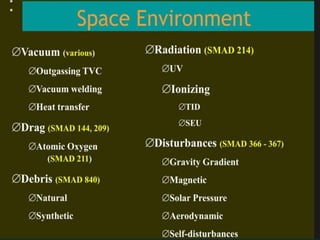
Materials for space environment,
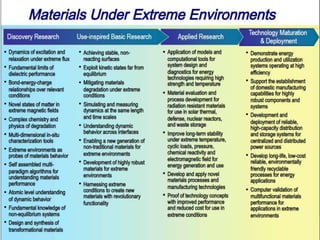
Evaluation of materials for extreme environment,
Introduction to metallic foams
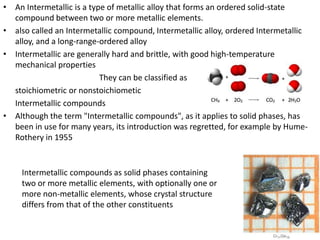
• An Intermetallic is a type of metallic alloy that forms an ordered solid-state
compound between two or more metallic elements.
• also called an Intermetallic compound, Intermetallic alloy, ordered Intermetallic
alloy, and a long-range-ordered alloy
• Intermetallic are generally hard and brittle, with good high-temperature
mechanical properties
They can be classified as
stoichiometric or nonstoichiometic
Intermetallic compounds
• Although the term "Intermetallic compounds", as it applies to solid phases, has
been in use for many years, its introduction was regretted, for example by Hume-
Rothery in 1955
Intermetallic compounds as solid phases containing
two or more metallic elements, with optionally one or
more non-metallic elements, whose crystal structure
differs from that of the other constituents
• Intermetallic compounds are generally brittle at room temperature and have high melting
points.
• Cleavage or intergranular fracture modes are typical of Intermetallic due to limited
independent slip systems required for plastic deformation.
• However, there are some examples of intermetallics with ductile fracture modes such as Nb–
15Al–40Ti. Other intermetallics can exhibit improved ductility by alloying with other
elements to increase grain boundary cohesion.
• Alloying of other materials such as boron to improve grain boundary cohesion can improve
ductility in many intermetallics.
• They often offer a compromise between ceramic and metallic properties when hardness
and/or resistance to high temperatures is important enough to sacrifice some toughness and
ease of processing.
• They can also display desirable magnetic, superconducting and chemical properties, due to
their strong internal order and mixed (metallic and covalent/ionic) bonding, respectively.
Intermetallics have given rise to various novel materials developments.
• Some examples include alnico and the hydrogen storage materials in nickel metal hydride
batteries. Ni3Al, which is the hardening phase in the familiar nickel-base super alloys, and
the various titanium aluminides have also attracted interest for turbine blade applications,
while the latter is also used in very small quantities for grain refinement of titanium alloys.
Silicides, inter-metallic involving silicon, are utilized as barrier and contact layers in
microelectronics.
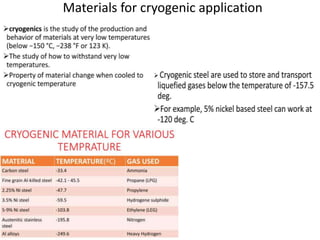
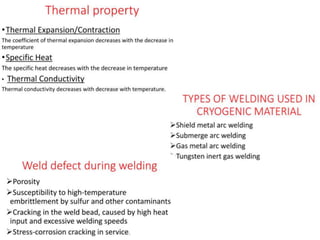
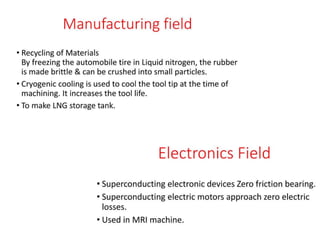
Materials for cryogenic application
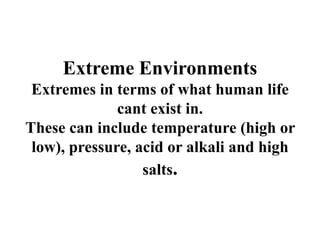
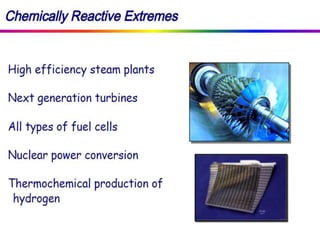
Extreme Environments
Extremes in terms of what human life
cant exist in.
These can include temperature (high or
low), pressure, acid or alkali and high
salts.
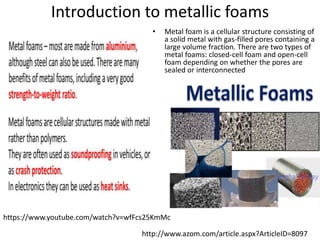
Introduction to metallic foams
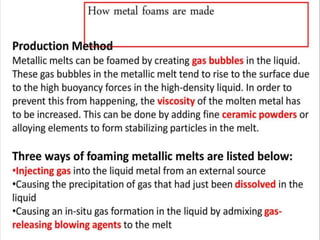
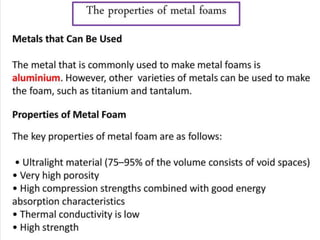
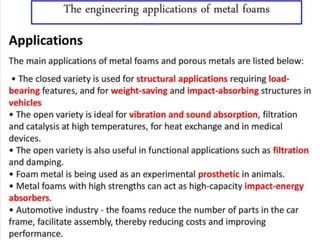
• Metal foam is a cellular structure consisting of
a solid metal with gas-filled pores containing a
large volume fraction. There are two types of
metal foams: closed-cell foam and open-cell
foam depending on whether the pores are
sealed or interconnected
http://www.azom.com/article.aspx?ArticleID=8097
https://www.youtube.com/watch?v=wfFcs25KmMc
inter metalics & criogenics.pptx

inter metalics & criogenics.pptx

  • 1.
    Inter-Metallics, Materials for cryogenicapplication, Materials for space environment, Evaluation of materials for extreme environment, Introduction to metallic foams
  • 3.
    • An Intermetallicis a type of metallic alloy that forms an ordered solid-state compound between two or more metallic elements. • also called an Intermetallic compound, Intermetallic alloy, ordered Intermetallic alloy, and a long-range-ordered alloy • Intermetallic are generally hard and brittle, with good high-temperature mechanical properties They can be classified as stoichiometric or nonstoichiometic Intermetallic compounds • Although the term "Intermetallic compounds", as it applies to solid phases, has been in use for many years, its introduction was regretted, for example by Hume- Rothery in 1955 Intermetallic compounds as solid phases containing two or more metallic elements, with optionally one or more non-metallic elements, whose crystal structure differs from that of the other constituents
  • 4.
    • Intermetallic compoundsare generally brittle at room temperature and have high melting points. • Cleavage or intergranular fracture modes are typical of Intermetallic due to limited independent slip systems required for plastic deformation. • However, there are some examples of intermetallics with ductile fracture modes such as Nb– 15Al–40Ti. Other intermetallics can exhibit improved ductility by alloying with other elements to increase grain boundary cohesion. • Alloying of other materials such as boron to improve grain boundary cohesion can improve ductility in many intermetallics. • They often offer a compromise between ceramic and metallic properties when hardness and/or resistance to high temperatures is important enough to sacrifice some toughness and ease of processing. • They can also display desirable magnetic, superconducting and chemical properties, due to their strong internal order and mixed (metallic and covalent/ionic) bonding, respectively. Intermetallics have given rise to various novel materials developments. • Some examples include alnico and the hydrogen storage materials in nickel metal hydride batteries. Ni3Al, which is the hardening phase in the familiar nickel-base super alloys, and the various titanium aluminides have also attracted interest for turbine blade applications, while the latter is also used in very small quantities for grain refinement of titanium alloys. Silicides, inter-metallic involving silicon, are utilized as barrier and contact layers in microelectronics.
  • 5.
  • 10.
    Extreme Environments Extremes interms of what human life cant exist in. These can include temperature (high or low), pressure, acid or alkali and high salts.
  • 21.
    Introduction to metallicfoams • Metal foam is a cellular structure consisting of a solid metal with gas-filled pores containing a large volume fraction. There are two types of metal foams: closed-cell foam and open-cell foam depending on whether the pores are sealed or interconnected http://www.azom.com/article.aspx?ArticleID=8097 https://www.youtube.com/watch?v=wfFcs25KmMc