1
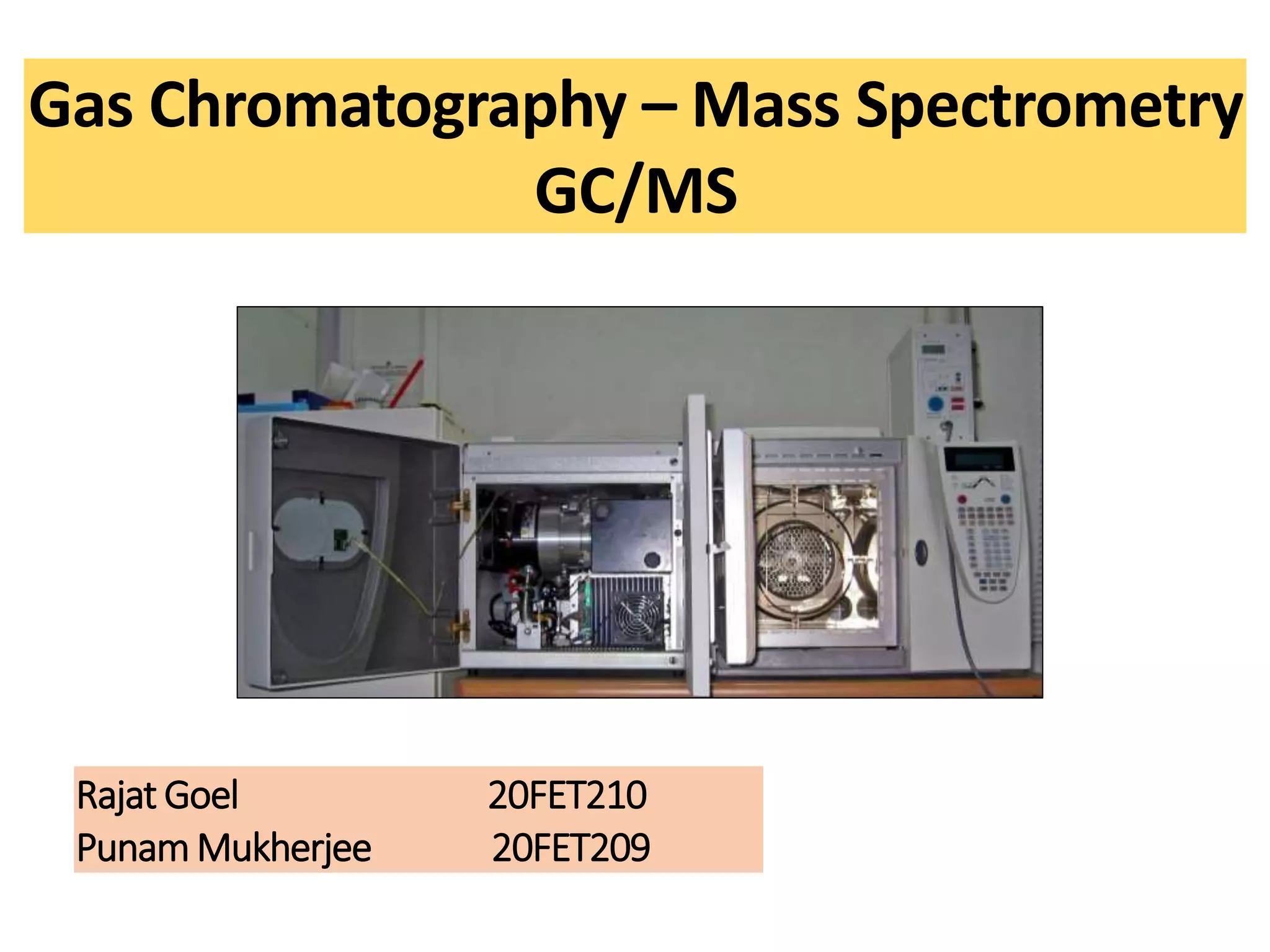
Gas Chromatography – Mass Spectrometry
GC/MS
Rajat Goel 20FET210
Punam Mukherjee 20FET209
 Introduction
 Principle
 Working
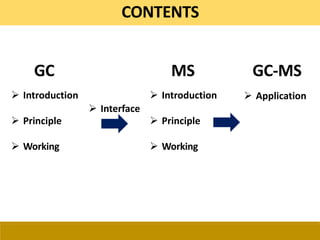
CONTENTS
GC
 Introduction
 Principle
 Working
MS
 Application
GC-MS
 Interface
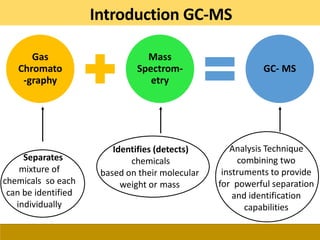
Identifies (detects)
chemicals
based on their molecular
weight or mass
Analysis Technique
combining two
instruments to provide
for powerful separation
and identification
capabilities
Separates
mixture of
chemicals so each
can be identified
individually
Introduction GC-MS
Gas
Chromato
-graphy
Mass
Spectrom-
etry
GC- MS
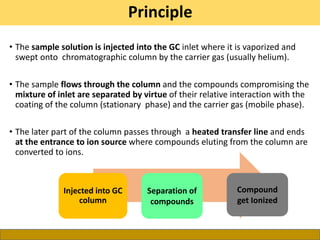
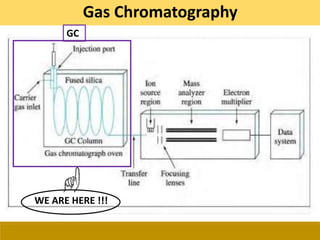
• The sample solution is injected into the GC inlet where it is vaporized and
swept onto chromatographic column by the carrier gas (usually helium).
• The sample flows through the column and the compounds compromising the
mixture of inlet are separated by virtue of their relative interaction with the
coating of the column (stationary phase) and the carrier gas (mobile phase).
• The later part of the column passes through a heated transfer line and ends
at the entrance to ion source where compounds eluting from the column are
converted to ions.
Injected into GC
column
Separation of
compounds
Compound
get Ionized
Principle
GC
Gas Chromatography
WE ARE HERE !!!
Sample Preparation for GC
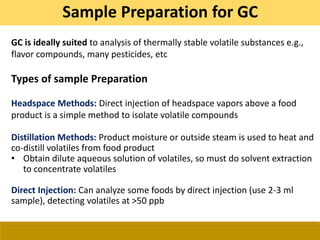
GC is ideally suited to analysis of thermally stable volatile substances e.g.,
flavor compounds, many pesticides, etc
Types of sample Preparation
Headspace Methods: Direct injection of headspace vapors above a food
product is a simple method to isolate volatile compounds
Distillation Methods: Product moisture or outside steam is used to heat and
co-distill volatiles from food product
• Obtain dilute aqueous solution of volatiles, so must do solvent extraction
to concentrate volatiles
Direct Injection: Can analyze some foods by direct injection (use 2-3 ml
sample), detecting volatiles at >50 ppb
Solid-Phase Extraction: Liquid sample is passed through cartridge or filter
with chromatographic material (e.g., ion-exchange resins; reversed- or
normal-phase packings)
Solutes with affinity are retained on stationary phase
Stationary phase is rinsed with water or weak solvent, then with a stronger
solvent to elute the solutes of interest
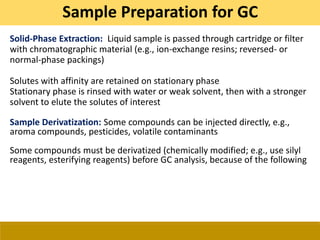
Sample Derivatization: Some compounds can be injected directly, e.g.,
aroma compounds, pesticides, volatile contaminants
Some compounds must be derivatized (chemically modified; e.g., use silyl
reagents, esterifying reagents) before GC analysis, because of the following
Sample Preparation for GC
GC System
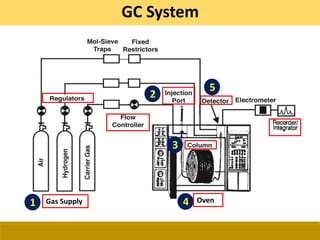
Gas Supply
2
1 4 Oven
3
5
• GC requires at least a carrier gas, usually gases for detector.
• Gases must be high purity
• Regulators, gas lines, and fittings must be of good quality
• Carrier gases: nitrogen, helium, hydrogen
• Carrier gas line should have traps to remove moisture and
contaminants
Gas Supply System
1
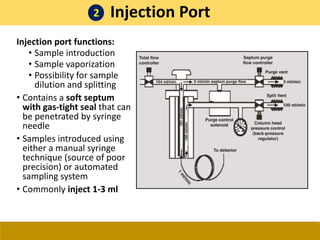
Injection port functions:
• Sample introduction
• Sample vaporization
• Possibility for sample
dilution and splitting
• Contains a soft septum
with gas-tight seal that can
be penetrated by syringe
needle
• Samples introduced using
either a manual syringe
technique (source of poor
precision) or automated
sampling system
• Commonly inject 1-3 ml
Injection Port
2
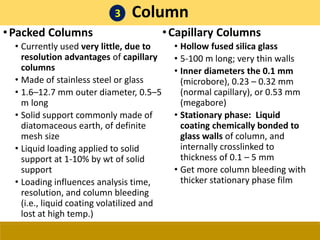
•Packed Columns
• Currently used very little, due to
resolution advantages of capillary
columns
• Made of stainless steel or glass
• 1.6–12.7 mm outer diameter, 0.5–5
m long
• Solid support commonly made of
diatomaceous earth, of definite
mesh size
• Liquid loading applied to solid
support at 1-10% by wt of solid
support
• Loading influences analysis time,
resolution, and column bleeding
(i.e., liquid coating volatilized and
lost at high temp.)
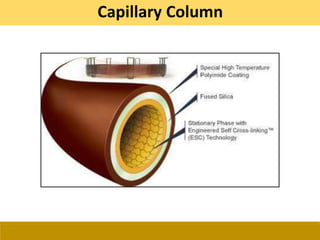
•Capillary Columns
• Hollow fused silica glass
• 5-100 m long; very thin walls
• Inner diameters the 0.1 mm
(microbore), 0.23 – 0.32 mm
(normal capillary), or 0.53 mm
(megabore)
• Stationary phase: Liquid
coating chemically bonded to
glass walls of column, and
internally crosslinked to
thickness of 0.1 – 5 mm
• Get more column bleeding with
thicker stationary phase film
Column
3
Capillary Column
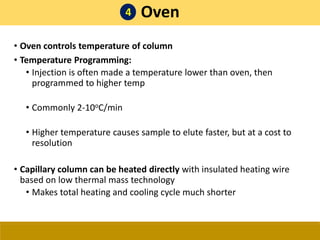
• Oven controls temperature of column
• Temperature Programming:
• Injection is often made a temperature lower than oven, then
programmed to higher temp
• Commonly 2-10oC/min
• Higher temperature causes sample to elute faster, but at a cost to
resolution
• Capillary column can be heated directly with insulated heating wire
based on low thermal mass technology
• Makes total heating and cooling cycle much shorter
Oven
4
5 Detector
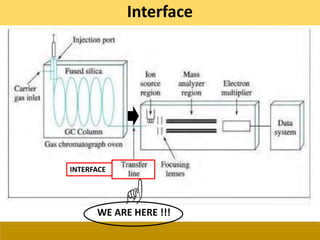
INTERFACE
Interface
WE ARE HERE !!!
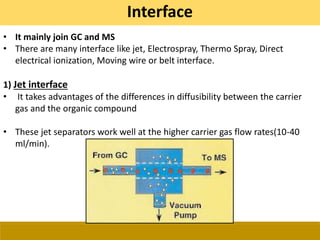
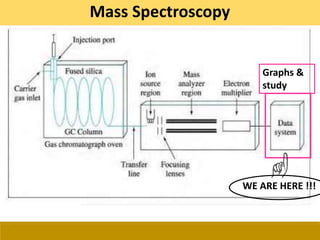
• It mainly join GC and MS
• There are many interface like jet, Electrospray, Thermo Spray, Direct
electrical ionization, Moving wire or belt interface.
1) Jet interface
• It takes advantages of the differences in diffusibility between the carrier
gas and the organic compound
• These jet separators work well at the higher carrier gas flow rates(10-40
ml/min).
Interface
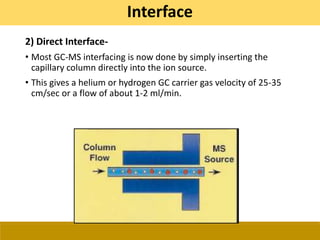
2) Direct Interface-
• Most GC-MS interfacing is now done by simply inserting the
capillary column directly into the ion source.
• This gives a helium or hydrogen GC carrier gas velocity of 25-35
cm/sec or a flow of about 1-2 ml/min.
Interface
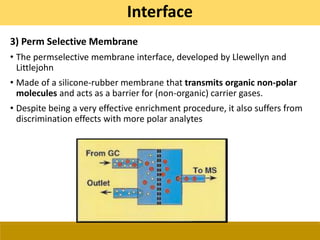
3) Perm Selective Membrane
• The permselective membrane interface, developed by Llewellyn and
Littlejohn
• Made of a silicone-rubber membrane that transmits organic non-polar
molecules and acts as a barrier for (non-organic) carrier gases.
• Despite being a very effective enrichment procedure, it also suffers from
discrimination effects with more polar analytes
Interface
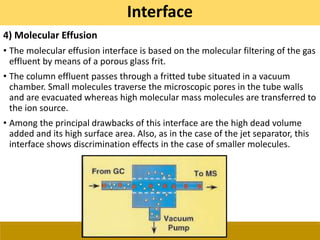
4) Molecular Effusion
• The molecular effusion interface is based on the molecular filtering of the gas
effluent by means of a porous glass frit.
• The column effluent passes through a fritted tube situated in a vacuum
chamber. Small molecules traverse the microscopic pores in the tube walls
and are evacuated whereas high molecular mass molecules are transferred to
the ion source.
• Among the principal drawbacks of this interface are the high dead volume
added and its high surface area. Also, as in the case of the jet separator, this
interface shows discrimination effects in the case of smaller molecules.
Interface
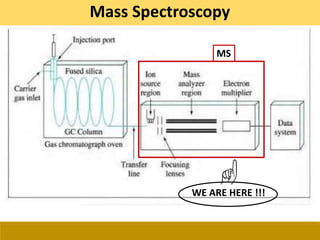
MS
WE ARE HERE !!!
Mass Spectroscopy
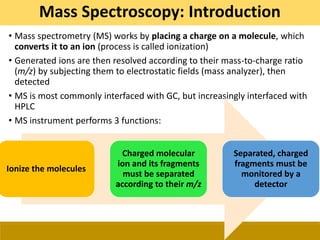
Mass Spectroscopy: Introduction
• Mass spectrometry (MS) works by placing a charge on a molecule, which
converts it to an ion (process is called ionization)
• Generated ions are then resolved according to their mass-to-charge ratio
(m/z) by subjecting them to electrostatic fields (mass analyzer), then
detected
• MS is most commonly interfaced with GC, but increasingly interfaced with
HPLC
• MS instrument performs 3 functions:
Ionize the molecules
Charged molecular
ion and its fragments
must be separated
according to their m/z
Separated, charged
fragments must be
monitored by a
detector
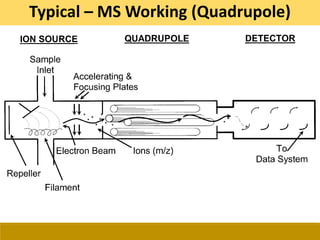
Typical – MS Working (Quadrupole)
Ionization
method
Typical
Analytes
Sample
Introduction
Mass
Range
Method
Highlights
Electron Impact (EI)
Relatively
small
volatile
GC or
liquid/solid
probe
to
1,000
Daltons
Hard
method
versatile
provides
structure
info
Chemical Ionization (CI)
Relatively
small
volatile
GC or
liquid/solid
probe
to
1,000
Daltons
Soft
method
molecular
ion peak
[M+H]+
Electrospray (ESI)
Peptides
Proteins
nonvolatile
Liquid
Chromatography or
syringe
to
200,000
Daltons
Soft
method
ions often
multiply
charged
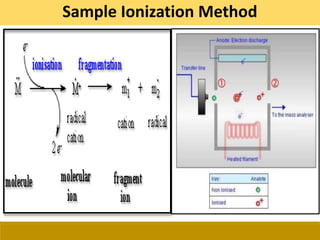
Sample Ionization Method
Quadrap
ole
Time of
Flight
Fourier
Transform
Ion Trap
Isotope
Ratio
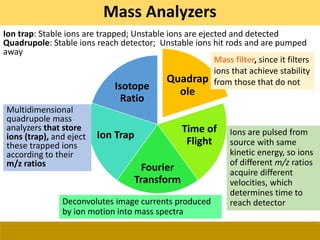
Mass filter, since it filters
ions that achieve stability
from those that do not
Ion trap: Stable ions are trapped; Unstable ions are ejected and detected
Quadrupole: Stable ions reach detector; Unstable ions hit rods and are pumped
away
Ions are pulsed from
source with same
kinetic energy, so ions
of different m/z ratios
acquire different
velocities, which
determines time to
reach detector
Multidimensional
quadrupole mass
analyzers that store
ions (trap), and eject
these trapped ions
according to their
m/z ratios
Deconvolutes image currents produced
by ion motion into mass spectra
Mass Analyzers
Graphs &
study
WE ARE HERE !!!
Mass Spectroscopy
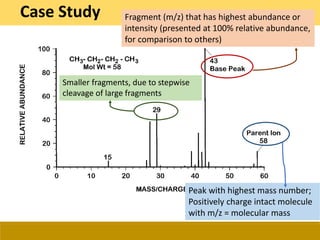
Fragment (m/z) that has highest abundance or
intensity (presented at 100% relative abundance,
for comparison to others)
Peak with highest mass number;
Positively charge intact molecule
with m/z = molecular mass
Smaller fragments, due to stepwise
cleavage of large fragments
Case Study
Example Application:
• Caffeine, theobromine, theophylline
• Catechins
• Compounds of concern: Melamine, Acrylamide,
Furans, Antibiotic residues
• Determine the compounds during kinetics
Application
Advantages
• High sensitivity
• excellent detection limits. Typically low ppb to high ppt
• High selectivity
• identification is based on two parameters not one
(retention time and mass spectrum must match standard)
selects analyte of interest with very high confidence
• Speed
• typical analysis takes from 1/2 hour to approx. 1 hour
analysis can contain upwards of 80 and more pollutants
Disadvantages
• Higher capital cost (approx. $ >85 K vs. $15 K for GC)
• Higher maintenance (time, expertise and money)
• Optimum results requires analyst knowledgeable inboth
• Chromatography and mass spectrometry
Advantages & Disadvantages
THANK YOU !!

Gas Chromatography and Mass Spectroscopy

  • 1.
    1 Gas Chromatography –Mass Spectrometry GC/MS Rajat Goel 20FET210 Punam Mukherjee 20FET209
  • 2.
     Introduction  Principle Working CONTENTS GC  Introduction  Principle  Working MS  Application GC-MS  Interface
  • 3.
    Identifies (detects) chemicals based ontheir molecular weight or mass Analysis Technique combining two instruments to provide for powerful separation and identification capabilities Separates mixture of chemicals so each can be identified individually Introduction GC-MS Gas Chromato -graphy Mass Spectrom- etry GC- MS
  • 4.
    • The samplesolution is injected into the GC inlet where it is vaporized and swept onto chromatographic column by the carrier gas (usually helium). • The sample flows through the column and the compounds compromising the mixture of inlet are separated by virtue of their relative interaction with the coating of the column (stationary phase) and the carrier gas (mobile phase). • The later part of the column passes through a heated transfer line and ends at the entrance to ion source where compounds eluting from the column are converted to ions. Injected into GC column Separation of compounds Compound get Ionized Principle
  • 5.
  • 6.
    Sample Preparation forGC GC is ideally suited to analysis of thermally stable volatile substances e.g., flavor compounds, many pesticides, etc Types of sample Preparation Headspace Methods: Direct injection of headspace vapors above a food product is a simple method to isolate volatile compounds Distillation Methods: Product moisture or outside steam is used to heat and co-distill volatiles from food product • Obtain dilute aqueous solution of volatiles, so must do solvent extraction to concentrate volatiles Direct Injection: Can analyze some foods by direct injection (use 2-3 ml sample), detecting volatiles at >50 ppb
  • 7.
    Solid-Phase Extraction: Liquidsample is passed through cartridge or filter with chromatographic material (e.g., ion-exchange resins; reversed- or normal-phase packings) Solutes with affinity are retained on stationary phase Stationary phase is rinsed with water or weak solvent, then with a stronger solvent to elute the solutes of interest Sample Derivatization: Some compounds can be injected directly, e.g., aroma compounds, pesticides, volatile contaminants Some compounds must be derivatized (chemically modified; e.g., use silyl reagents, esterifying reagents) before GC analysis, because of the following Sample Preparation for GC
  • 8.
  • 9.
    • GC requiresat least a carrier gas, usually gases for detector. • Gases must be high purity • Regulators, gas lines, and fittings must be of good quality • Carrier gases: nitrogen, helium, hydrogen • Carrier gas line should have traps to remove moisture and contaminants Gas Supply System 1
  • 10.
    Injection port functions: •Sample introduction • Sample vaporization • Possibility for sample dilution and splitting • Contains a soft septum with gas-tight seal that can be penetrated by syringe needle • Samples introduced using either a manual syringe technique (source of poor precision) or automated sampling system • Commonly inject 1-3 ml Injection Port 2
  • 11.
    •Packed Columns • Currentlyused very little, due to resolution advantages of capillary columns • Made of stainless steel or glass • 1.6–12.7 mm outer diameter, 0.5–5 m long • Solid support commonly made of diatomaceous earth, of definite mesh size • Liquid loading applied to solid support at 1-10% by wt of solid support • Loading influences analysis time, resolution, and column bleeding (i.e., liquid coating volatilized and lost at high temp.) •Capillary Columns • Hollow fused silica glass • 5-100 m long; very thin walls • Inner diameters the 0.1 mm (microbore), 0.23 – 0.32 mm (normal capillary), or 0.53 mm (megabore) • Stationary phase: Liquid coating chemically bonded to glass walls of column, and internally crosslinked to thickness of 0.1 – 5 mm • Get more column bleeding with thicker stationary phase film Column 3
  • 12.
  • 13.
    • Oven controlstemperature of column • Temperature Programming: • Injection is often made a temperature lower than oven, then programmed to higher temp • Commonly 2-10oC/min • Higher temperature causes sample to elute faster, but at a cost to resolution • Capillary column can be heated directly with insulated heating wire based on low thermal mass technology • Makes total heating and cooling cycle much shorter Oven 4
  • 14.
  • 15.
  • 16.
    • It mainlyjoin GC and MS • There are many interface like jet, Electrospray, Thermo Spray, Direct electrical ionization, Moving wire or belt interface. 1) Jet interface • It takes advantages of the differences in diffusibility between the carrier gas and the organic compound • These jet separators work well at the higher carrier gas flow rates(10-40 ml/min). Interface
  • 17.
    2) Direct Interface- •Most GC-MS interfacing is now done by simply inserting the capillary column directly into the ion source. • This gives a helium or hydrogen GC carrier gas velocity of 25-35 cm/sec or a flow of about 1-2 ml/min. Interface
  • 18.
    3) Perm SelectiveMembrane • The permselective membrane interface, developed by Llewellyn and Littlejohn • Made of a silicone-rubber membrane that transmits organic non-polar molecules and acts as a barrier for (non-organic) carrier gases. • Despite being a very effective enrichment procedure, it also suffers from discrimination effects with more polar analytes Interface
  • 19.
    4) Molecular Effusion •The molecular effusion interface is based on the molecular filtering of the gas effluent by means of a porous glass frit. • The column effluent passes through a fritted tube situated in a vacuum chamber. Small molecules traverse the microscopic pores in the tube walls and are evacuated whereas high molecular mass molecules are transferred to the ion source. • Among the principal drawbacks of this interface are the high dead volume added and its high surface area. Also, as in the case of the jet separator, this interface shows discrimination effects in the case of smaller molecules. Interface
  • 20.
    MS WE ARE HERE!!! Mass Spectroscopy
  • 21.
    Mass Spectroscopy: Introduction •Mass spectrometry (MS) works by placing a charge on a molecule, which converts it to an ion (process is called ionization) • Generated ions are then resolved according to their mass-to-charge ratio (m/z) by subjecting them to electrostatic fields (mass analyzer), then detected • MS is most commonly interfaced with GC, but increasingly interfaced with HPLC • MS instrument performs 3 functions: Ionize the molecules Charged molecular ion and its fragments must be separated according to their m/z Separated, charged fragments must be monitored by a detector
  • 22.
    Typical – MSWorking (Quadrupole)
  • 23.
    Ionization method Typical Analytes Sample Introduction Mass Range Method Highlights Electron Impact (EI) Relatively small volatile GCor liquid/solid probe to 1,000 Daltons Hard method versatile provides structure info Chemical Ionization (CI) Relatively small volatile GC or liquid/solid probe to 1,000 Daltons Soft method molecular ion peak [M+H]+ Electrospray (ESI) Peptides Proteins nonvolatile Liquid Chromatography or syringe to 200,000 Daltons Soft method ions often multiply charged Sample Ionization Method
  • 24.
  • 25.
    Quadrap ole Time of Flight Fourier Transform Ion Trap Isotope Ratio Massfilter, since it filters ions that achieve stability from those that do not Ion trap: Stable ions are trapped; Unstable ions are ejected and detected Quadrupole: Stable ions reach detector; Unstable ions hit rods and are pumped away Ions are pulsed from source with same kinetic energy, so ions of different m/z ratios acquire different velocities, which determines time to reach detector Multidimensional quadrupole mass analyzers that store ions (trap), and eject these trapped ions according to their m/z ratios Deconvolutes image currents produced by ion motion into mass spectra Mass Analyzers
  • 26.
    Graphs & study WE AREHERE !!! Mass Spectroscopy
  • 27.
    Fragment (m/z) thathas highest abundance or intensity (presented at 100% relative abundance, for comparison to others) Peak with highest mass number; Positively charge intact molecule with m/z = molecular mass Smaller fragments, due to stepwise cleavage of large fragments Case Study
  • 28.
    Example Application: • Caffeine,theobromine, theophylline • Catechins • Compounds of concern: Melamine, Acrylamide, Furans, Antibiotic residues • Determine the compounds during kinetics Application
  • 29.
    Advantages • High sensitivity •excellent detection limits. Typically low ppb to high ppt • High selectivity • identification is based on two parameters not one (retention time and mass spectrum must match standard) selects analyte of interest with very high confidence • Speed • typical analysis takes from 1/2 hour to approx. 1 hour analysis can contain upwards of 80 and more pollutants Disadvantages • Higher capital cost (approx. $ >85 K vs. $15 K for GC) • Higher maintenance (time, expertise and money) • Optimum results requires analyst knowledgeable inboth • Chromatography and mass spectrometry Advantages & Disadvantages
  • 30.

Editor's Notes

  • #17 In these separators, the GC Ñow is introduced into an evacuated chamber through a restricted capillary. At the capillary tip a supersonic expanding jet of analyte and carrier molecules is formed and its core area sampled into the mass spectrometer. In an expanding jet, high molecular mass compounds are concentrated in the core Ñow whereas the lighter and more di†usive carrier molecules are dispersed away, in part through collisions. Thus, sampling of the core Ñow produces an enrichment of the analyte. The jet interface is very versatile, inert and efficient, despite disadvantages of reduced efficiency with more volatile compounds and potential plugging problems at the capillary restrictor