What is a Game?
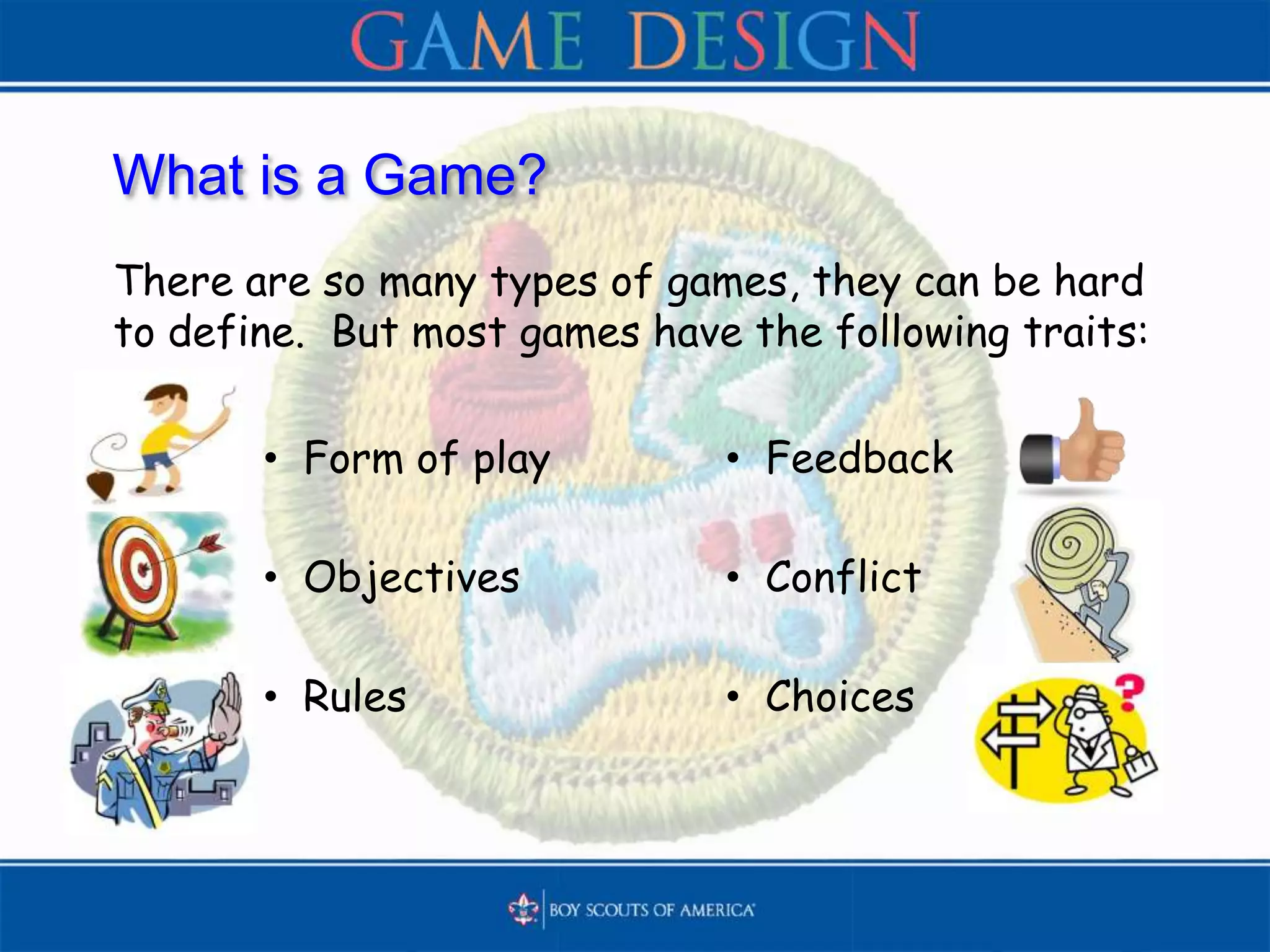
There are so many types of games, they can be hard
to define. But most games have the following traits:
• Form of play
• Objectives
• Rules
• Feedback
• Conflict
• Choices
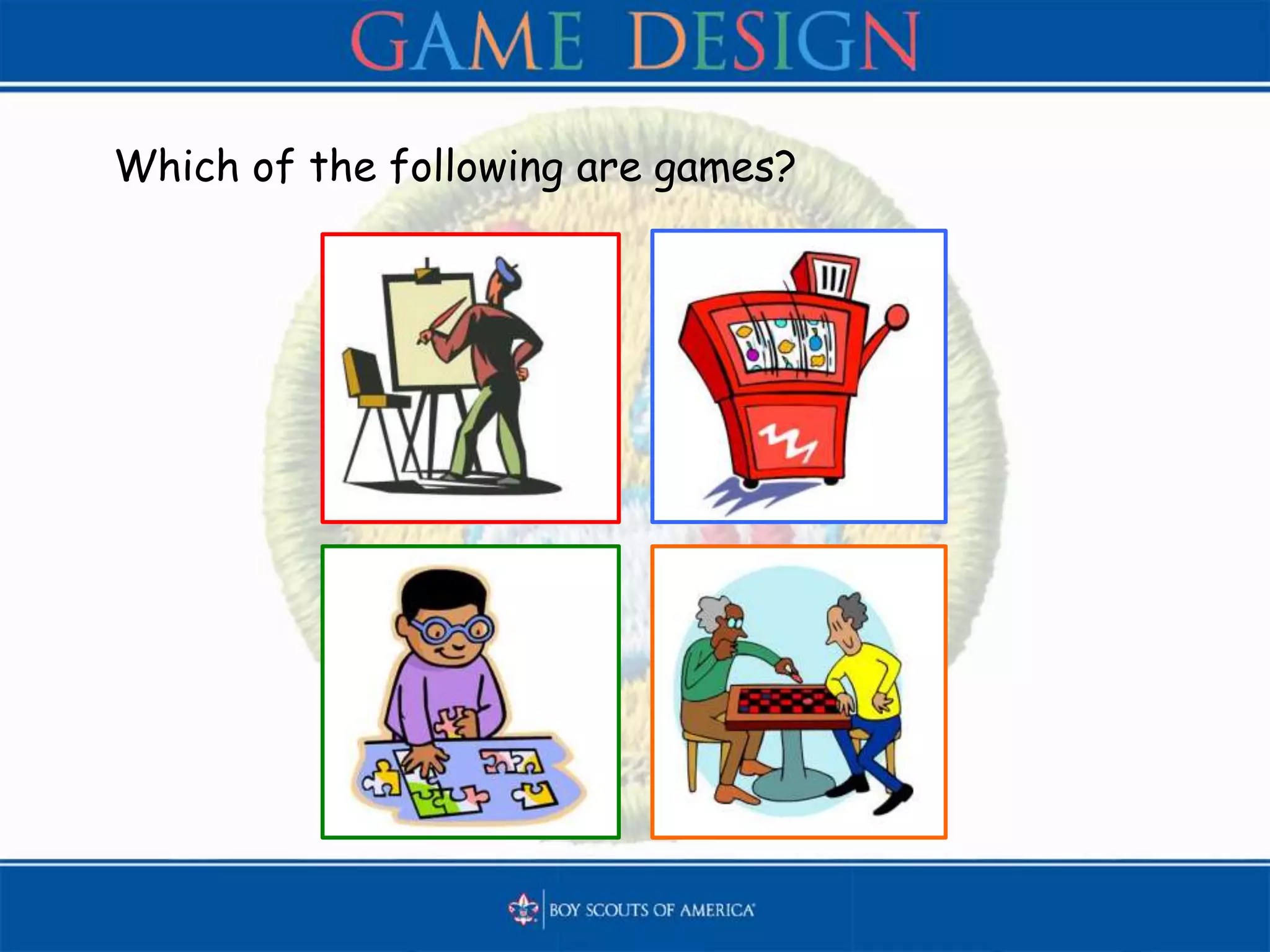
Which of the following are games?
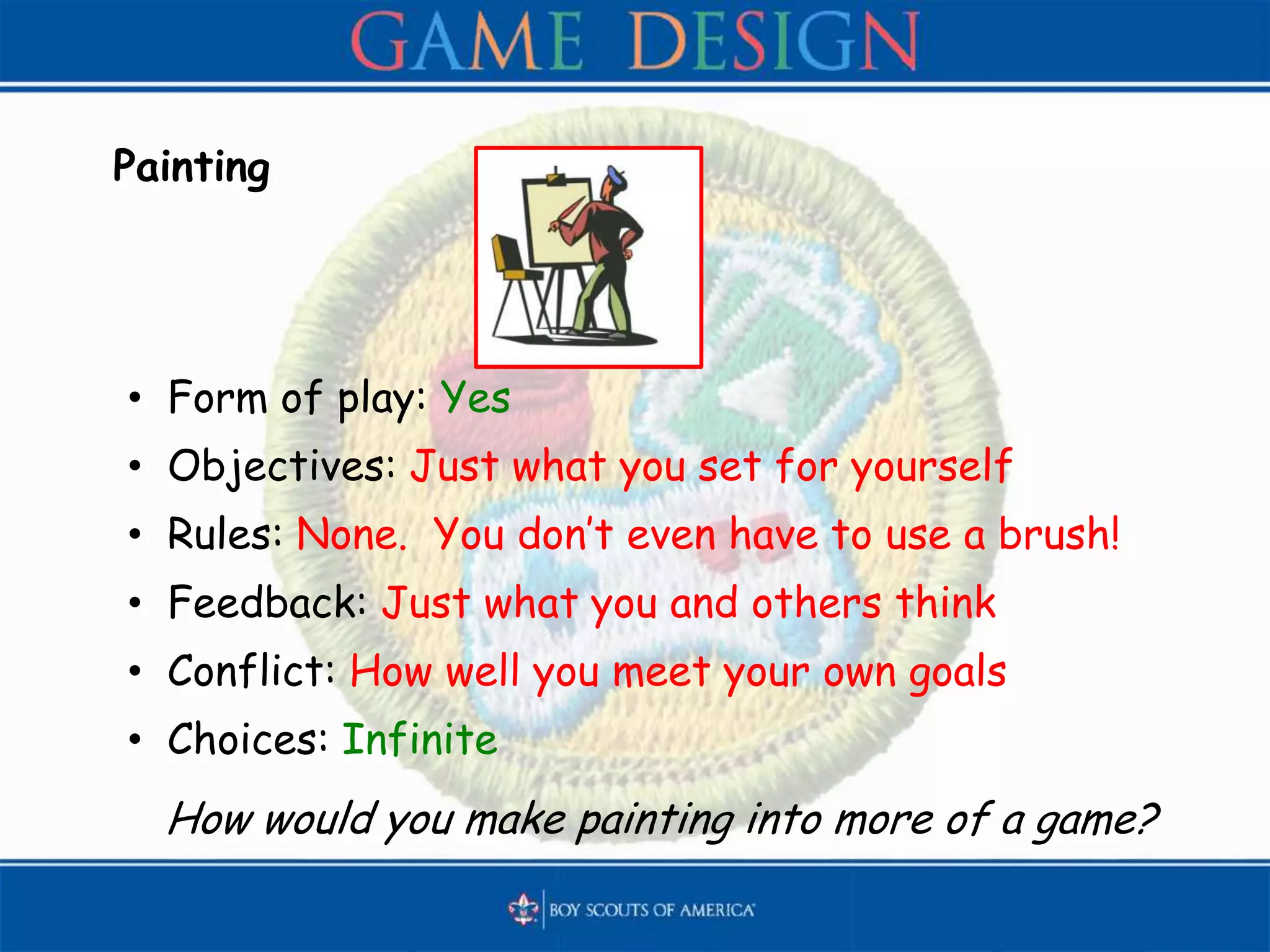
Painting
• Form of play: Yes
• Objectives: Just what you set for yourself
• Rules: None. You don’t even have to use a brush!
• Feedback: Just what you and others think
• Conflict: How well you meet your own goals
• Choices: Infinite
How would you make painting into more of a game?
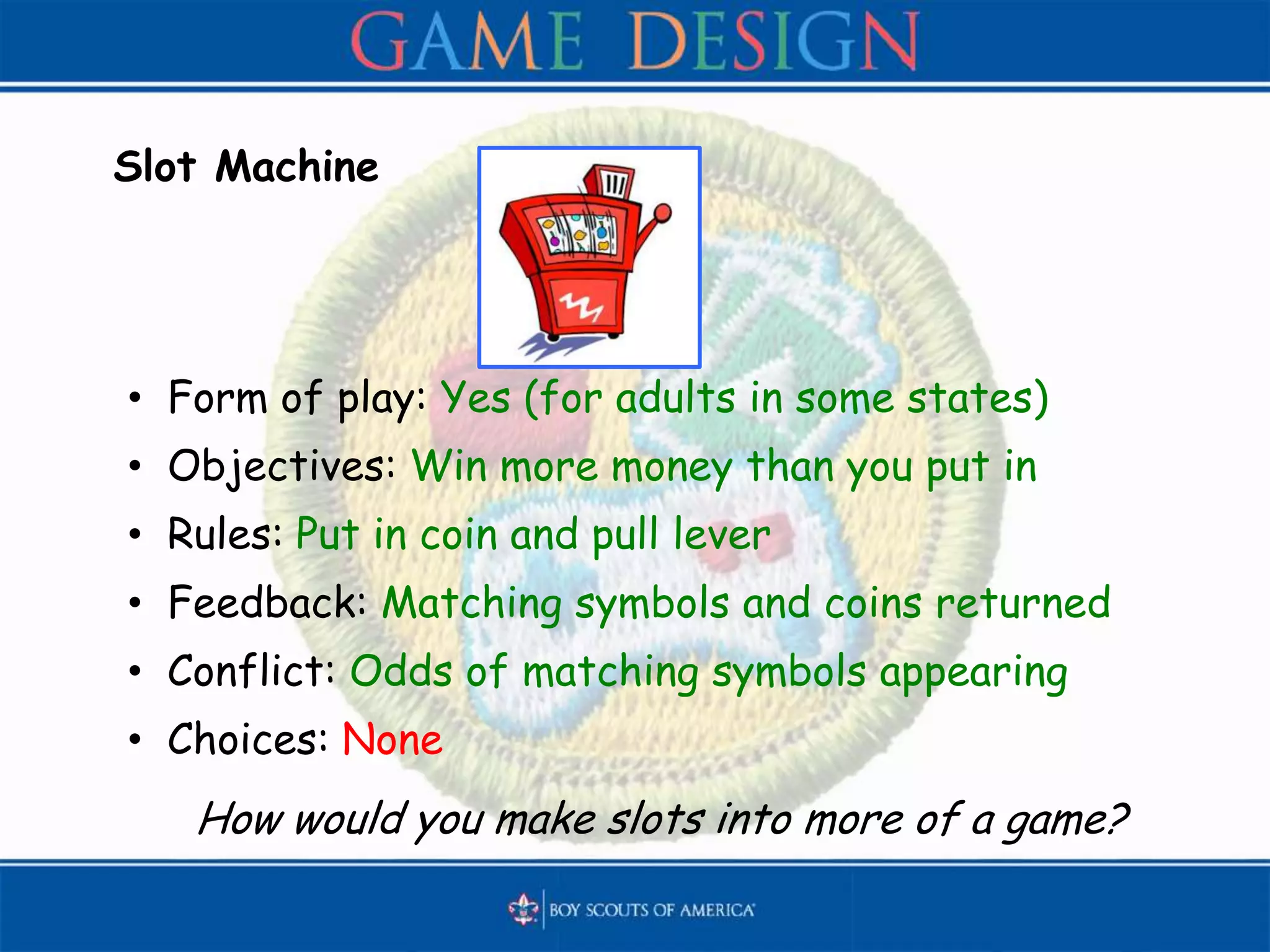
Slot Machine
• Form of play: Yes (for adults in some states)
• Objectives: Win more money than you put in
• Rules: Put in coin and pull lever
• Feedback: Matching symbols and coins returned
• Conflict: Odds of matching symbols appearing
• Choices: None
How would you make slots into more of a game?
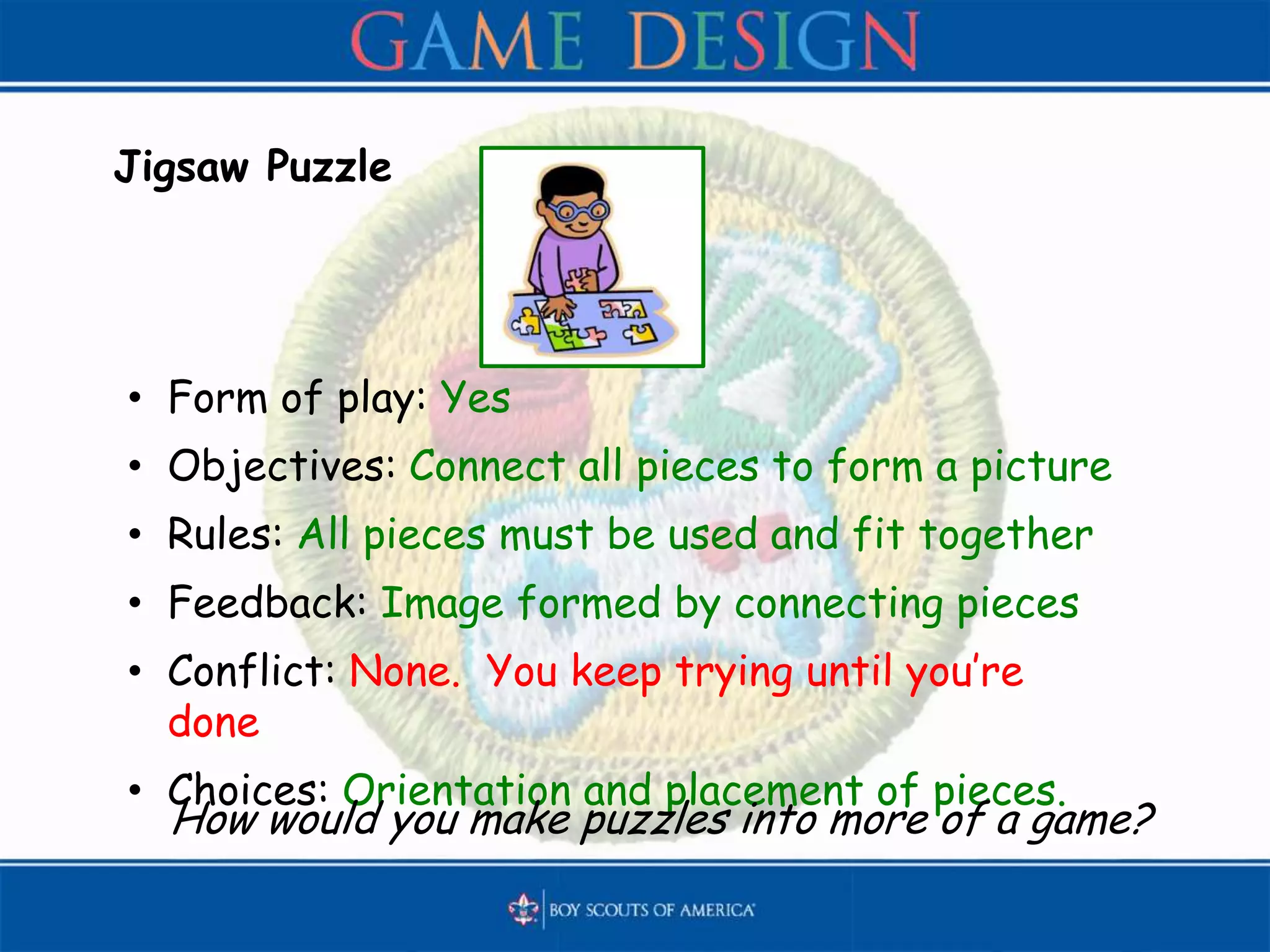
Jigsaw Puzzle
• Form of play: Yes
• Objectives: Connect all pieces to form a picture
• Rules: All pieces must be used and fit together
• Feedback: Image formed by connecting pieces
• Conflict: None. You keep trying until you’re
done
• Choices: Orientation and placement of pieces.
How would you make puzzles into more of a game?
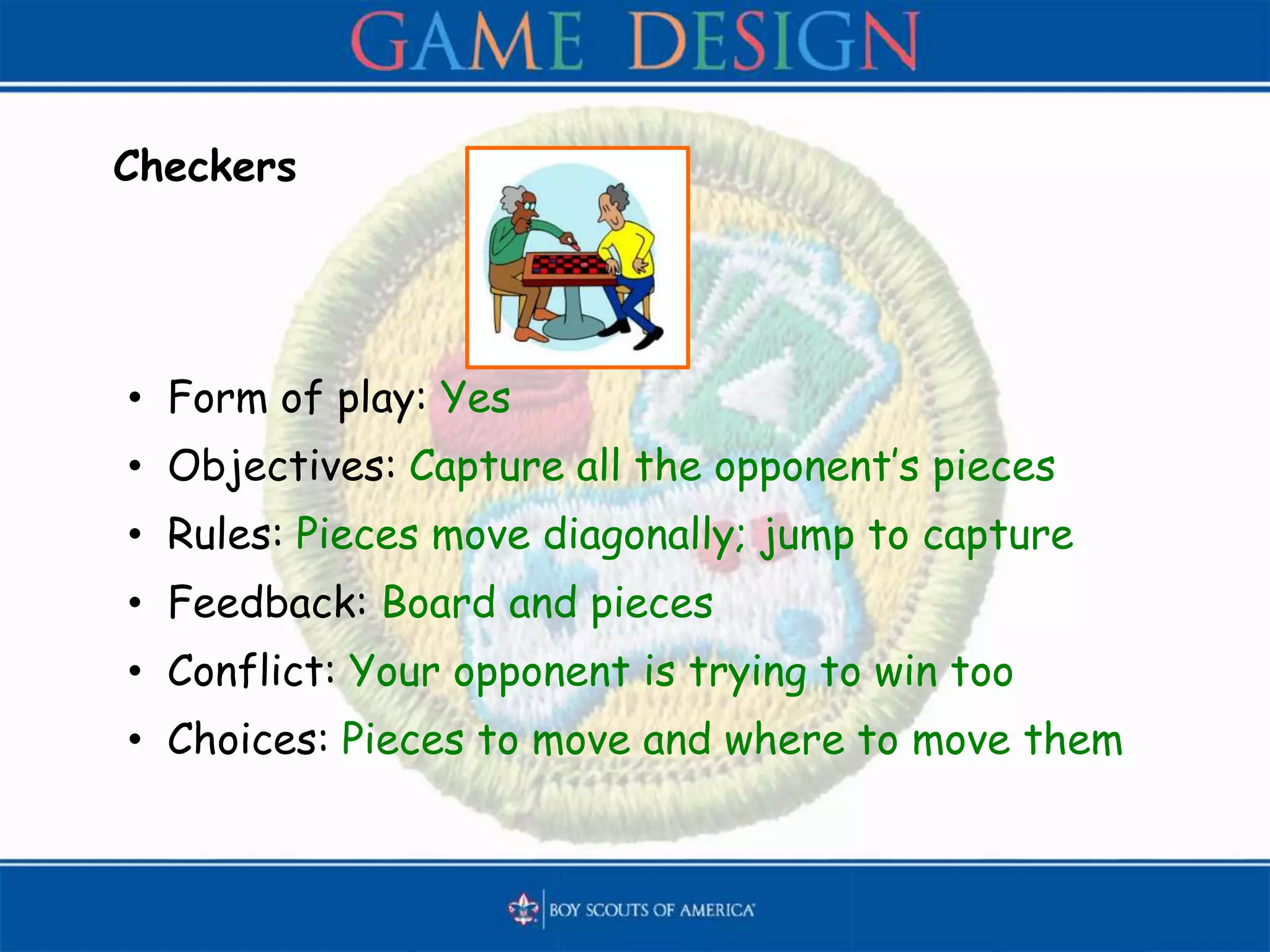
Checkers
• Form of play: Yes
• Objectives: Capture all the opponent’s pieces
• Rules: Pieces move diagonally; jump to capture
• Feedback: Board and pieces
• Conflict: Your opponent is trying to win too
• Choices: Pieces to move and where to move them
Requirement 1a
Analyze four games you have played, each from a
different medium. Identify:
• The Medium
• Player Format
• Objectives
• Rules
• Resources
• Theme (if relevant)
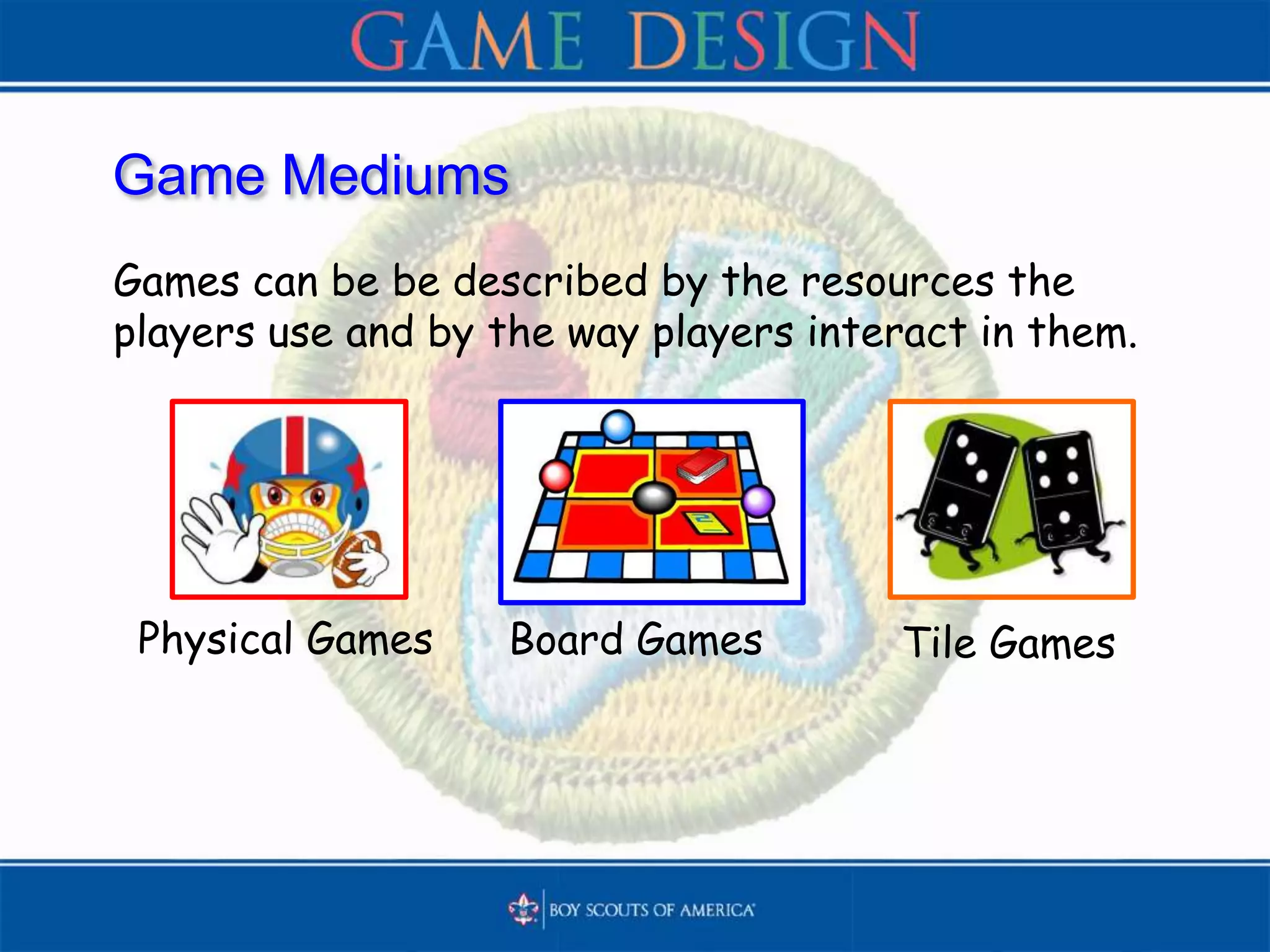
Game Mediums
Games can be be described by the resources the
players use and by the way players interact in them.
Tile GamesBoard GamesPhysical Games
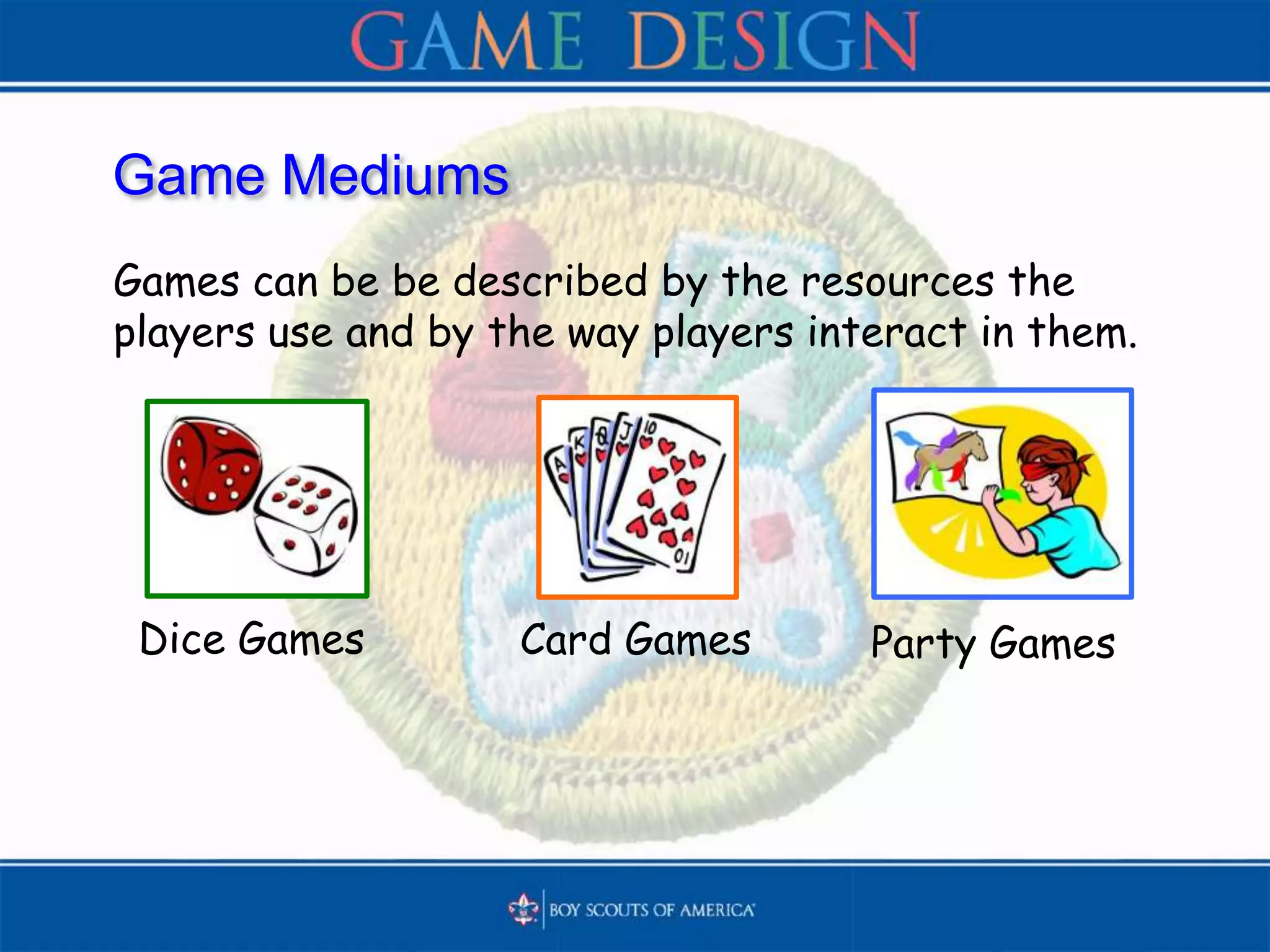
Game Mediums
Games can be be described by the resources the
players use and by the way players interact in them.
Party GamesCard GamesDice Games
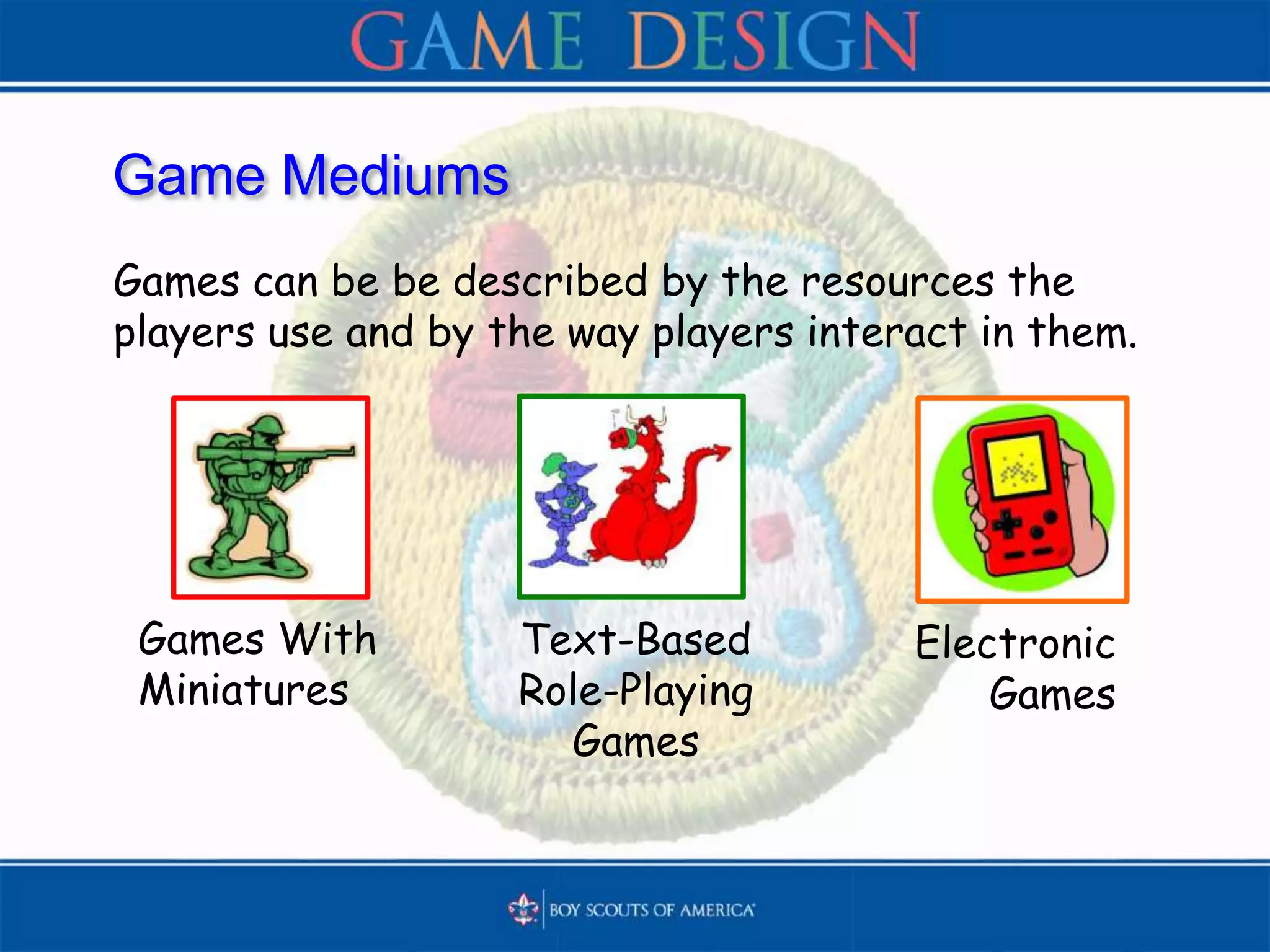
Game Mediums
Games can be be described by the resources the
players use and by the way players interact in them.
Electronic
Games
Text-Based
Role-Playing
Games
Games With
Miniatures
Player Format
The number, arrangement and alignment of players in
a game.
• Single Player: One player vs. game system
• Head-to-Head: One player vs. one player
• Cooperative or PvE: Many players vs. game system
Player Format
The number, arrangement and alignment of players in
a game.
• One Against Many: One player vs. many players
• Free-For-All: One player vs. one player vs. one…
• Team Competition: Many players vs. many players
Player Format
The number, arrangement and alignment of players in
a game.
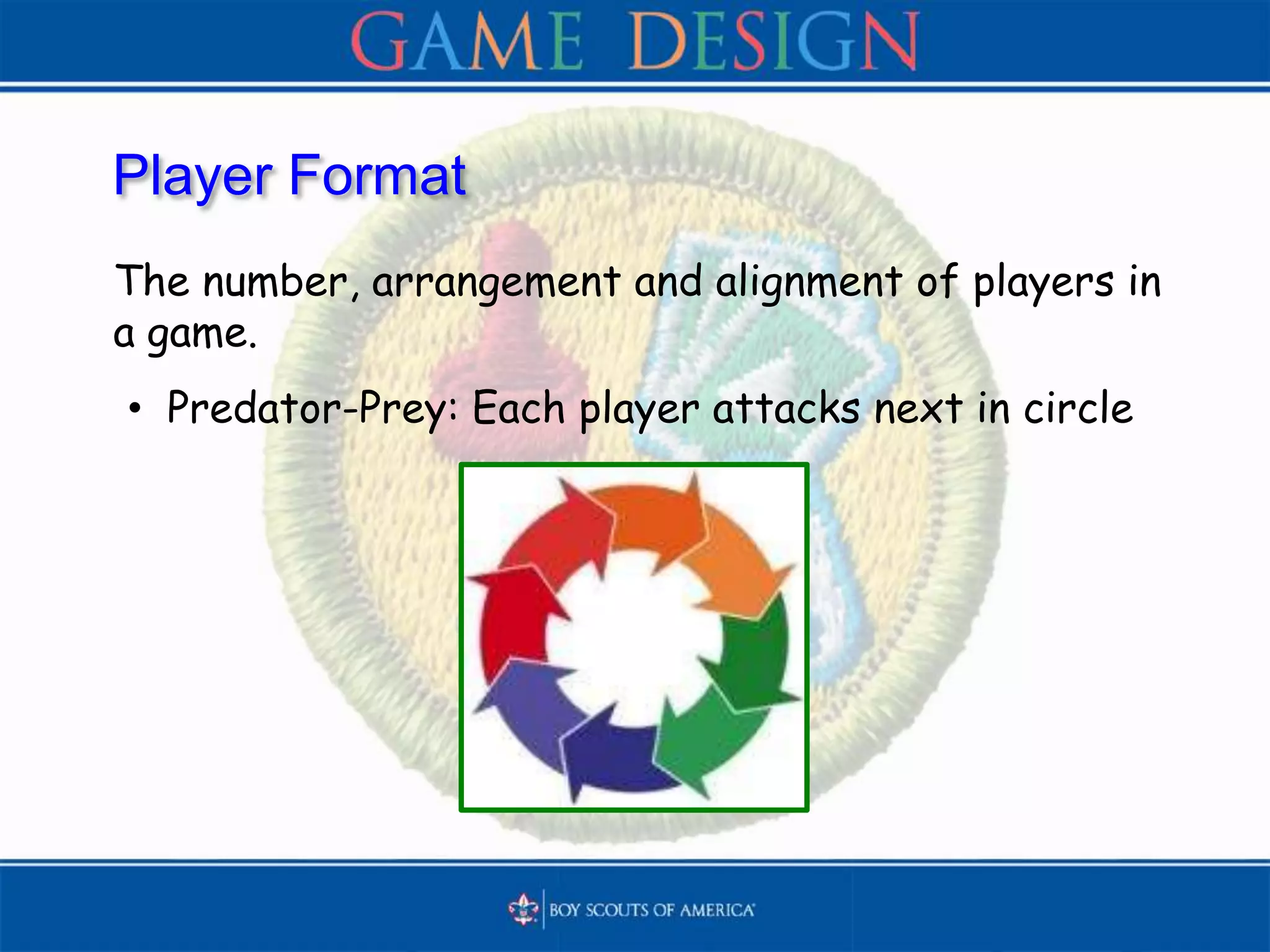
• Predator-Prey: Each player attacks next in circle
Rules
There are three categories of rules in a game.
• Setup: Things you do one at the beginning of the
game.
• Progression of Play: What happens (and usually
repeats) during the game.
• Resolution: The conditions in which the game ends
and how an outcome (usually winning) is
determined.
Objectives (Goals)
Game objectives determine whether a player has
advanced or won a game.
• Score
• Capture/Destroy
• Collection
• Solve
• Chase/Race/Escape
• Spatial Alignment
• Build
• Avoid a Loss
• Advance the Story
• Explore
Resources
All the things under a player’s control and can be
used as a game advances.
• Pieces in Chess
• Health, mana and currency in League of Legends
• Number of questions left in Twenty Questions
• Known information in Clue
• Weapons and power-ups in World of Warcraft
• Turns and time remaining in sports
Theme
Themes include a game’s setting, story and/or
characters. They answer the question, “What is this
game about?”
• Help players become more engaged
• Make a game easier to learn
• Tell a compelling story
Not every game has a theme, but a theme can:
Requirement 1b
Describe four types of play value and provide an
example of a game built around each.
Describe other reasons play games.
Play Value
The reasons why we play a particular game:
• Novelty: Imaginative, new or unexpected
experiences
• Challenge: Tasks that must be practiced and
mastered
• Stimulation: The emotional excitement of play
• Harmony: Player-to-player interaction
• Threat: Tension, danger, and humiliation
Requirement 2
Discuss five of these seventeen game design terms
with your counselor.
For each term you pick, describe how it relates to a
specific game.
Thematic Elements
• Story: The game’s narrative
story or player-created story
• Setting: The fictional
environment in which the game
takes place
• Characters: The people or
creatures that appear in a game
Gameplay Elements
• Play Sequence: The order in which players (or the
game system) take action
• Level Design: Creation of the game environment
• Interface Design: Creating effective methods for
communicating information between players and
games
Game Analysis
• Difficulty: How easy or hard it is to complete the
game objectives
• Balance: The relative strength of the different
resources, mechanics, objectives, or starting
states
• Complexity: The number of rules or elements with
which a player interacts
• Depth: The ability to find enjoyment in a game as
one’s ability improves
Game Analysis
• Pace: The speed of the game
• Play Value: The reason someone plays a game
• Replay Value: The reason someone plays a game
again
• Age Appropriateness: The age or maturity level of
the game’s intended audience
• Depth: The ability to find enjoyment in a game as
one’s ability improves
Related Terms
• Single-player vs. multiplayer
• Cooperative vs. competitive
• Turn-based vs. real-time
• Strategy vs. reflex vs. chance
• Abstract vs. thematic
Requirement 3
Define the term intellectual property.
Describe the types of intellectual property
associated with the computer game industry.
Intellectual Property
Creations of the mind for which the creator has
exclusive rights. For a game, this would be:
• Computer Code
• Visual Displays
• Story
• Characters
• Music
• Voice Recordings
• Game Board
• Game Pieces
• Instruction Manual
• Game Title
• Packaging
• Company Logo
Intellectual Properties
• Copyright: The right to make copies of creative,
literary or artistic works.
• Trademark: Ownership of a word, phrase or
symbol representing the goods or services of a
company.
• Patent: Ownership of an invention or method of
doing something.
• Licensing: A contract between you and a rights
owner to use those rights.
Intellectual Properties
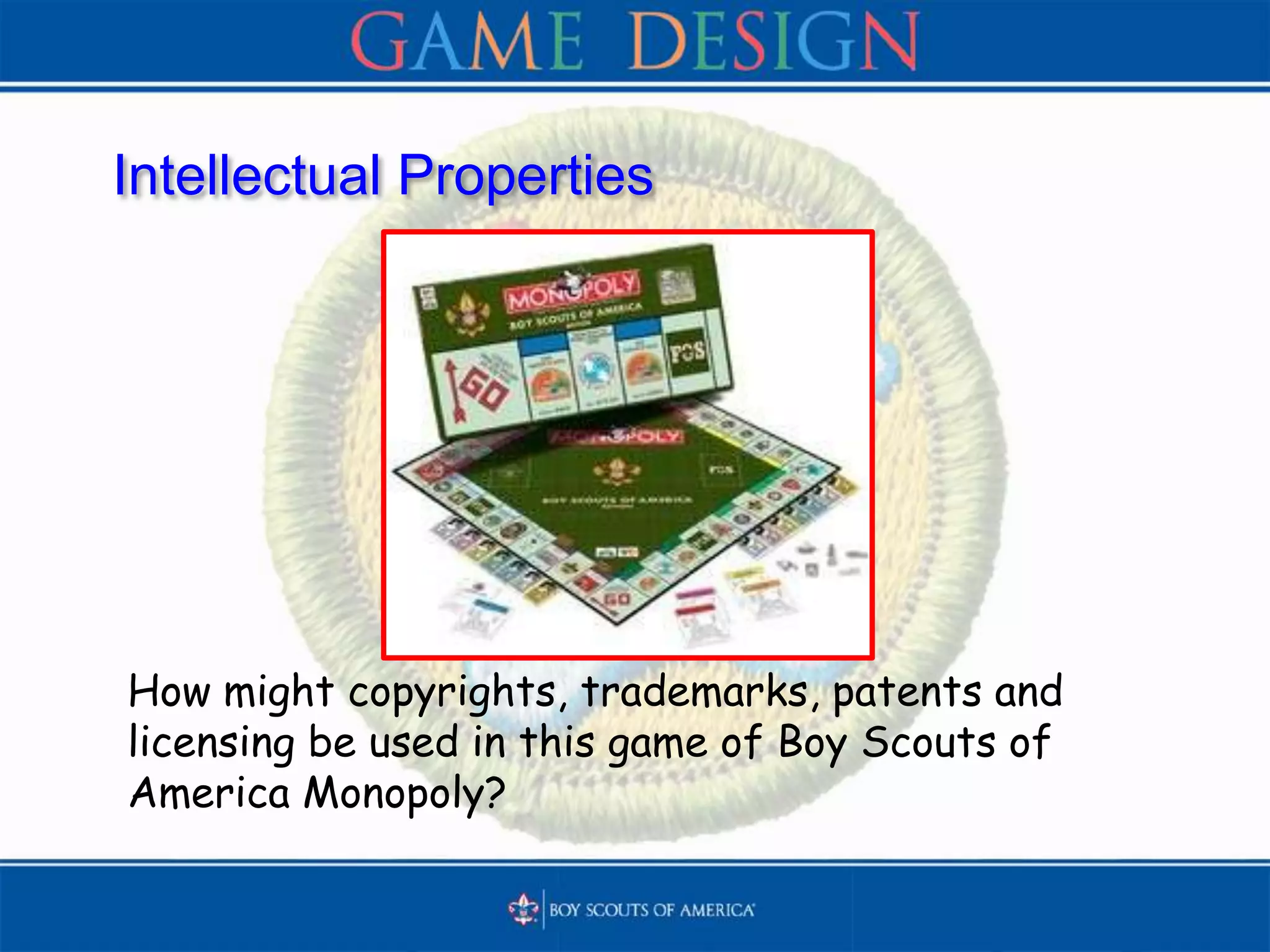
How might copyrights, trademarks, patents and
licensing be used in this game of Boy Scouts of
America Monopoly?
Requirement 4
Pick a game where the players can change the rules
or objectives (basketball, hearts, chess, kickball)
• Briefly summarize the standard rules and play
through the game normally
• Propose changes to several rules or objectives
• Predict how each change will affect gameplay
• Play the game with one change and write down
observations of the players
• Repeat the process with two other changes
• Discuss with counselor
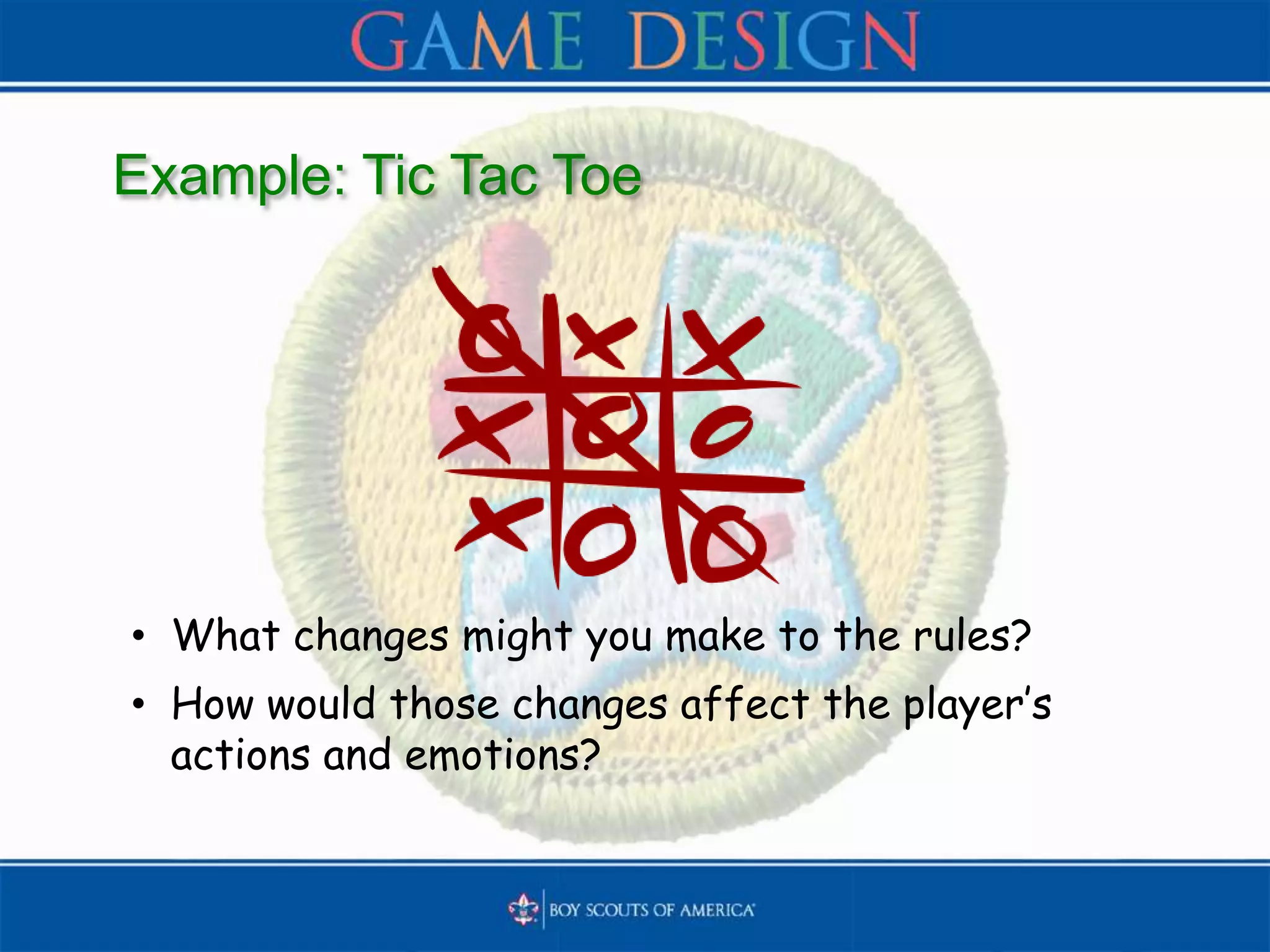
Example: Tic Tac Toe
• What changes might you make to the rules?
• How would those changes affect the player’s
actions and emotions?
Requirement 5
Design a new game in any medium. Record your work
in a game design notebook.
• Write a vision statement
• Identify the medium, player format, objectives,
and theme. If applicable, describe the setting,
story and characters.
• Describe the play value
• Make a preliminary list of rules and define the
game resources
• Draw the game elements
Requirement 6a
Prototype your game from requirement 5. If
applicable, demonstrate to your counselor that you
have addressed player safety through rules and
equipment.
You must have your merit badge counselor’s
approval of your concept before you begin
creating your prototype!
Prototype
An early version of a game, section of game or game
system.
A prototype is:
• Playable
• Quick to make
• Easy to change
• Can use paper to represent the playing area.
• Can use tokens to represent resource attributes
Requirement 6b
Test your prototype with as many people as you need
to meet the player format.
• Compare the play experience to your descriptions
from requirement 5b.
• Correct unclear rules, holes in the rules, dead
ends, and obvious rule exploits.
Requirement 6b
• Change at least one rule, mechanic, or objection
from your first version of the game, and describe
why you are making the change.
• Play the game again.
• Record whether or not your change had the
expected effect.
Requirement 6c
Repeat 6b at least two more times.
First Repetition:
• Test your prototype with as many other people as
you need to meet the player format.
• Compare the player experience to your
descriptions from requirement 5b
• Correct unclear rules, holes in the rules, dead
ends, and obvious rule exploits.
Requirement 6c
Repeat 6b at least two more times.
First Repetition:
• Change at least one rule, mechanic, or objection
from your first version of the game and describe
why you are making the change.
• Play the game again.
• Record whether or not your change had the
expected effect.
Requirement 6c
Repeat 6b at least two more times.
Second Repetition:
• Test your prototype with as many other people as
you need to meet the player format.
• Compare the player experience to your
descriptions from requirement 5b
• Correct unclear rules, holes in the rules, dead
ends, and obvious rule exploits.
Requirement 6c
Repeat 6b at least two more times.
Second Repetition:
• Change at least one rule, mechanic, or objection
from your first version of the game and describe
why you are making the change.
• Play the game again.
• Record whether or not your change had the
expected effect.
Requirement 7
Blind test your game. Do the following:
a. Write an instruction sheet that includes all of the
information needed to play the game.
• Clearly describe how to set up the game, play the
game, and end the game.
• List the game objectives.
Requirement 7
b. Share your prototype from requirement 6a with a
group of players that has not played it or witnessed
a previous playtest.
• Provide them with your instruction sheet(s) and
any physical components.
• Watch them play the game, but do not provide
them with instruction.
• Record their feedback in your game design
notebook.
Requirement 7
b. Share your prototype from requirement 6a with a
group of players that has not played it or witnessed
a previous playtest.
• Provide them with your instruction sheet(s) and
any physical components.
• Watch them play the game, but do not provide
them with instruction.
• Record their feedback in your game design
notebook.
Requirement 7
c. Share your game design notebook with your
counselor.
• Discuss the player reactions to your project and
what you learned about the game design process.
• Based on your testing, determine what you like
most about your game and suggest one or more
changes..
Requirement 8a
With your parent’s permission and your counselor’s
approval:
• Visit with a professional in the game development
industry and ask him or her about his or her job
and how it fits into the overall development
process.
OR
• Meet with a professional in game development
education and discuss the skills he or she
emphasizes in the classroom.
Requirement 8b
• List three career opportunities in game
development.
• Pick one and find out the education, training, and
experience required for this profession.
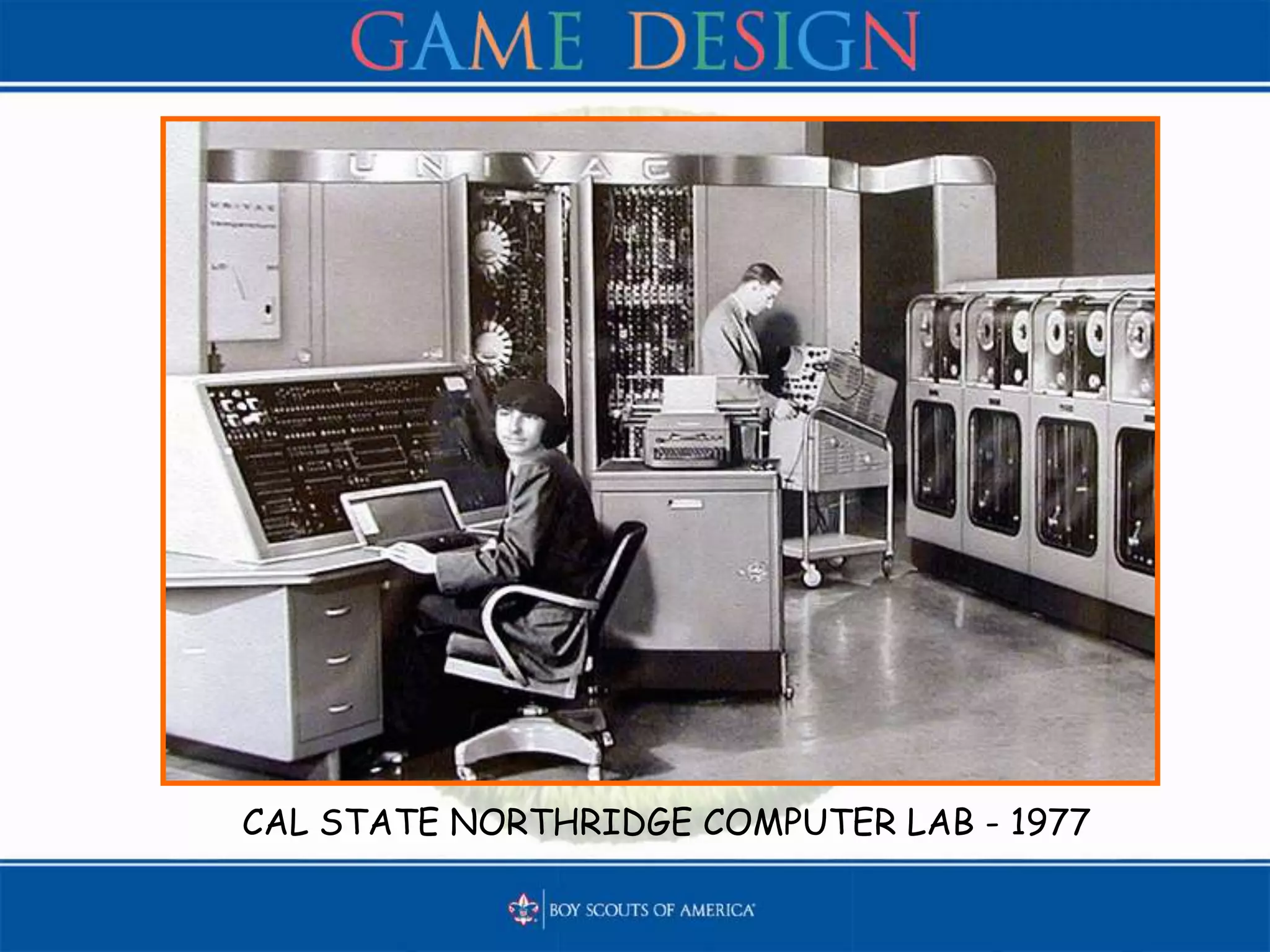
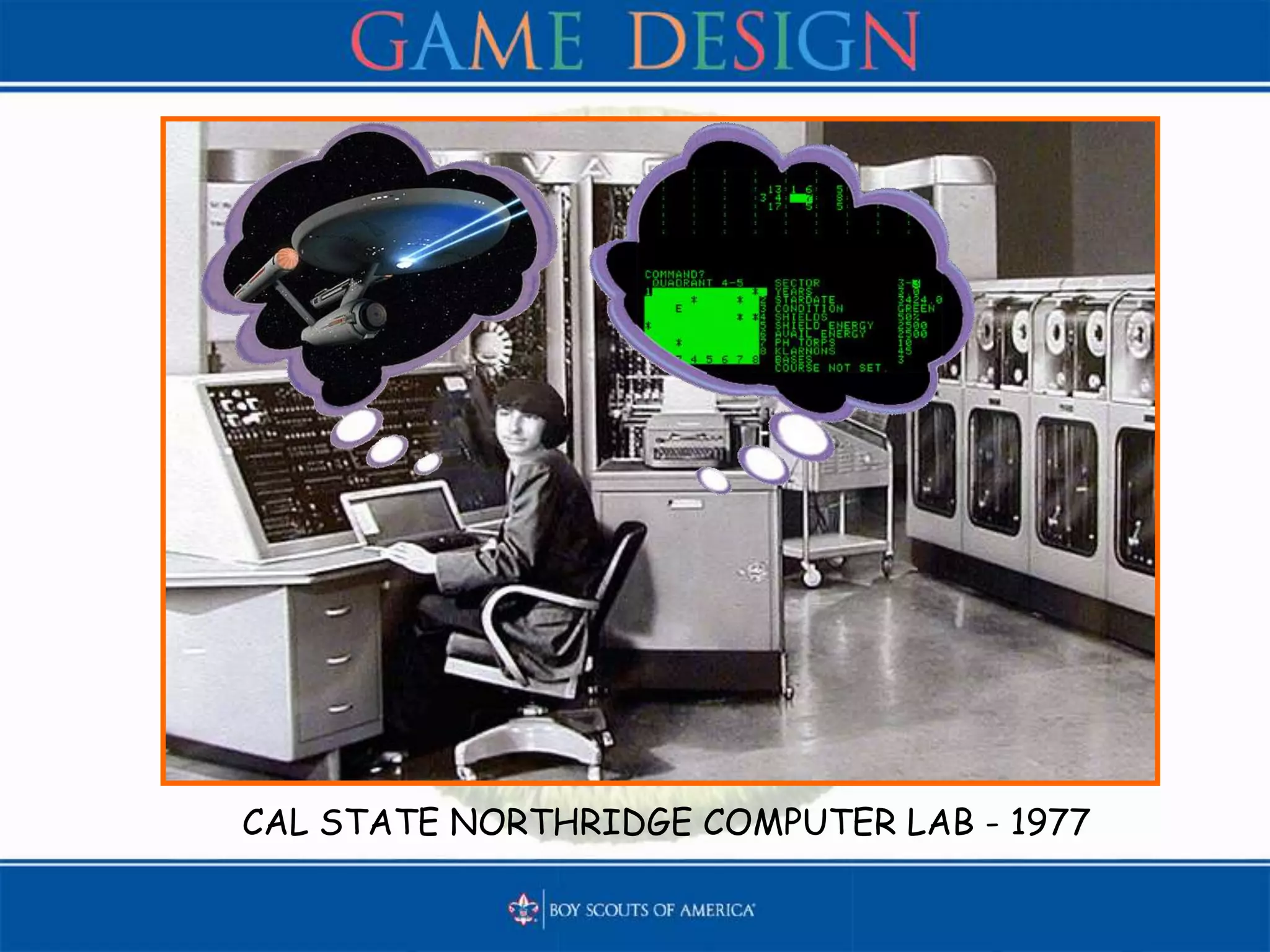
CAL STATE NORTHRIDGE COMPUTER LAB - 1977
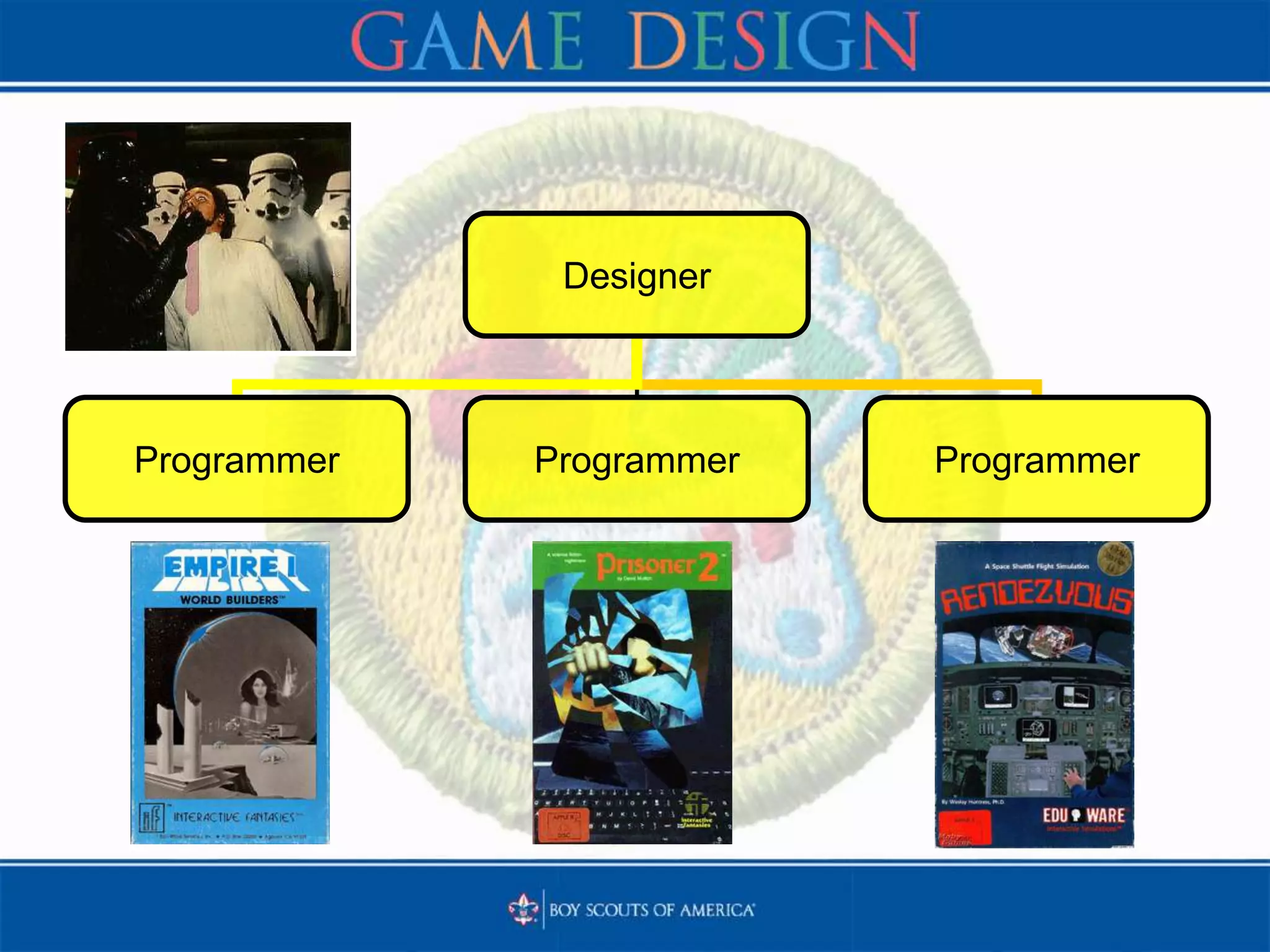
Designer
Programmer Programmer Programmer
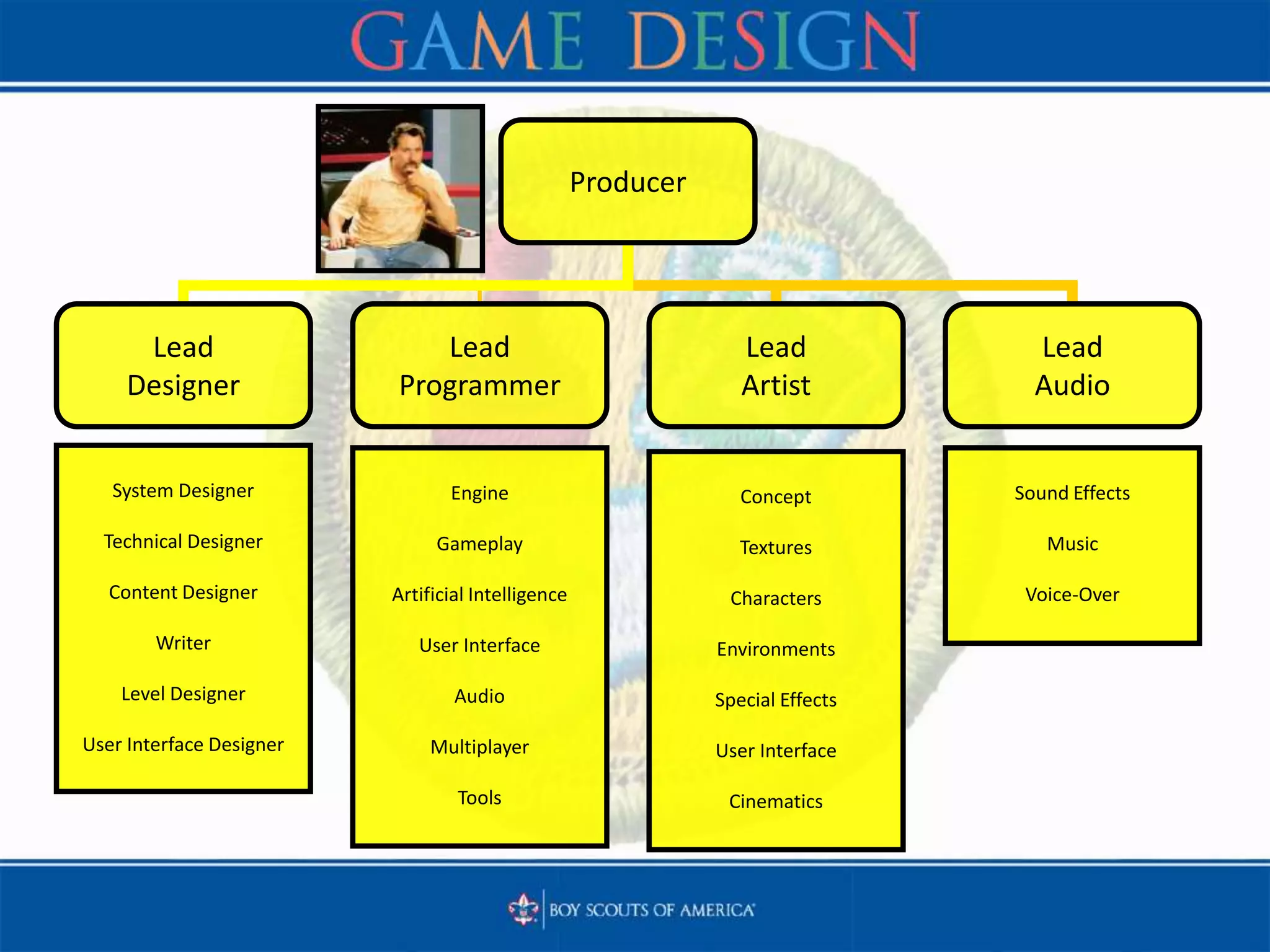
Producer
Lead
Designer
Lead
Programmer
Lead
Artist
Lead
Audio
System Designer
Technical Designer
Content Designer
Writer
Level Designer
User Interface Designer
Engine
Gameplay
Artificial Intelligence
User Interface
Audio
Multiplayer
Tools
Concept
Textures
Characters
Environments
Special Effects
User Interface
Cinematics
Sound Effects
Music
Voice-Over
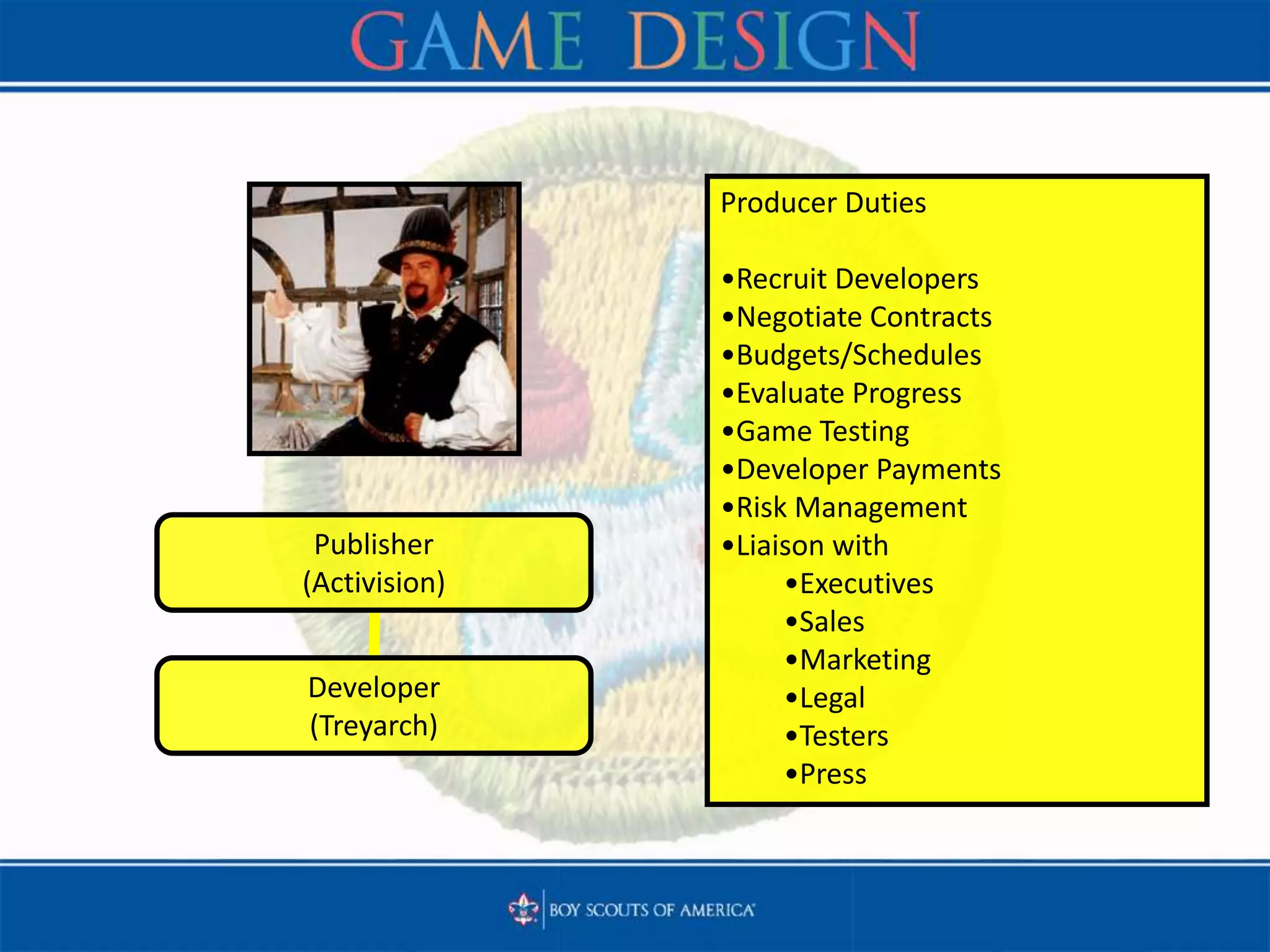
Publisher
(Activision)
Developer
(Treyarch)
Producer Duties
•Recruit Developers
•Negotiate Contracts
•Budgets/Schedules
•Evaluate Progress
•Game Testing
•Developer Payments
•Risk Management
•Liaison with
•Executives
•Sales
•Marketing
•Legal
•Testers
•Press
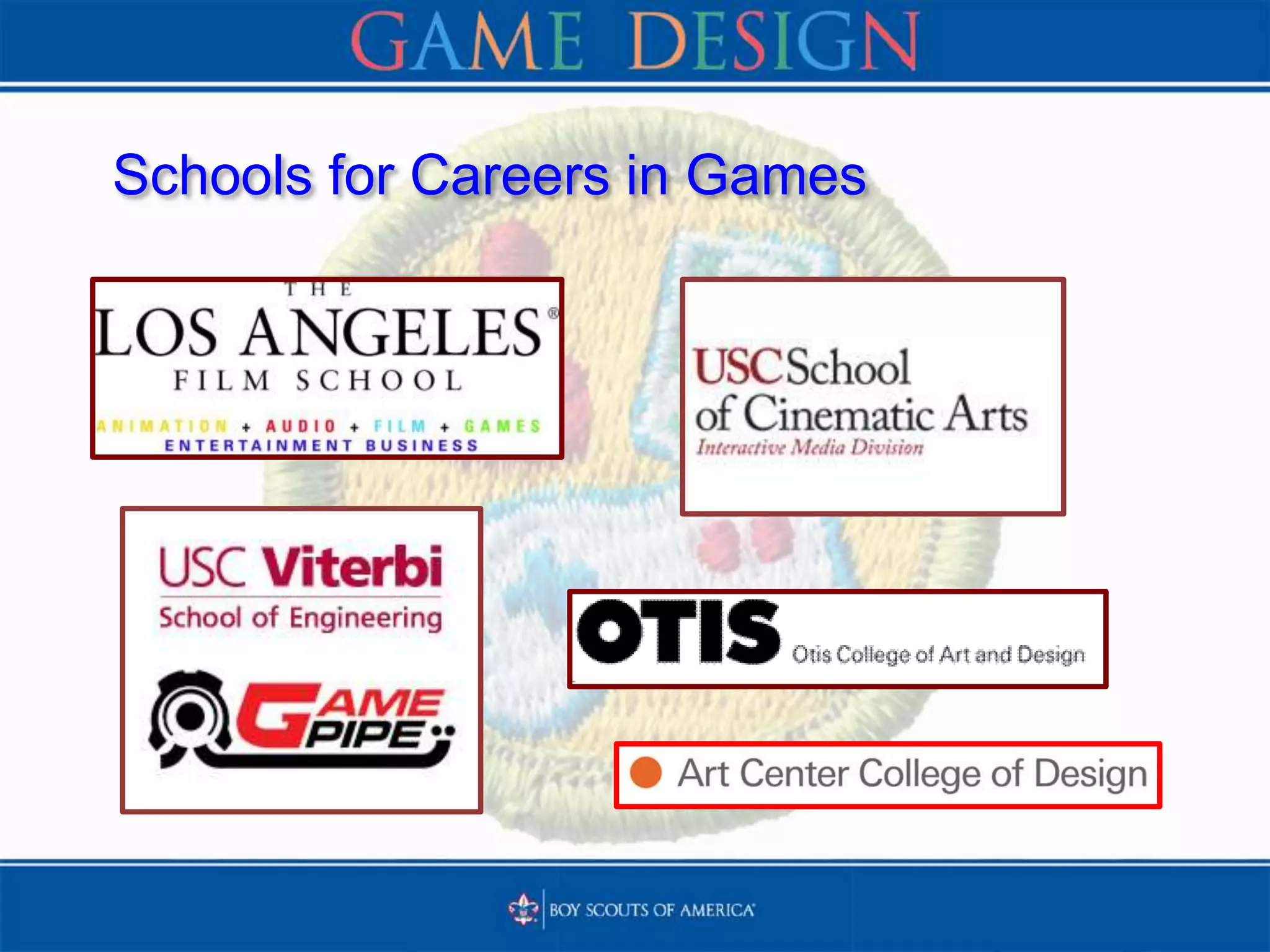
Schools for Careers in Games

BSA Game Design Merit Badge

  • 2.
    What is aGame? There are so many types of games, they can be hard to define. But most games have the following traits: • Form of play • Objectives • Rules • Feedback • Conflict • Choices
  • 3.
    Which of thefollowing are games?
  • 4.
    Painting • Form ofplay: Yes • Objectives: Just what you set for yourself • Rules: None. You don’t even have to use a brush! • Feedback: Just what you and others think • Conflict: How well you meet your own goals • Choices: Infinite How would you make painting into more of a game?
  • 5.
    Slot Machine • Formof play: Yes (for adults in some states) • Objectives: Win more money than you put in • Rules: Put in coin and pull lever • Feedback: Matching symbols and coins returned • Conflict: Odds of matching symbols appearing • Choices: None How would you make slots into more of a game?
  • 6.
    Jigsaw Puzzle • Formof play: Yes • Objectives: Connect all pieces to form a picture • Rules: All pieces must be used and fit together • Feedback: Image formed by connecting pieces • Conflict: None. You keep trying until you’re done • Choices: Orientation and placement of pieces. How would you make puzzles into more of a game?
  • 7.
    Checkers • Form ofplay: Yes • Objectives: Capture all the opponent’s pieces • Rules: Pieces move diagonally; jump to capture • Feedback: Board and pieces • Conflict: Your opponent is trying to win too • Choices: Pieces to move and where to move them
  • 8.
    Requirement 1a Analyze fourgames you have played, each from a different medium. Identify: • The Medium • Player Format • Objectives • Rules • Resources • Theme (if relevant)
  • 9.
    Game Mediums Games canbe be described by the resources the players use and by the way players interact in them. Tile GamesBoard GamesPhysical Games
  • 10.
    Game Mediums Games canbe be described by the resources the players use and by the way players interact in them. Party GamesCard GamesDice Games
  • 11.
    Game Mediums Games canbe be described by the resources the players use and by the way players interact in them. Electronic Games Text-Based Role-Playing Games Games With Miniatures
  • 12.
    Player Format The number,arrangement and alignment of players in a game. • Single Player: One player vs. game system • Head-to-Head: One player vs. one player • Cooperative or PvE: Many players vs. game system
  • 13.
    Player Format The number,arrangement and alignment of players in a game. • One Against Many: One player vs. many players • Free-For-All: One player vs. one player vs. one… • Team Competition: Many players vs. many players
  • 14.
    Player Format The number,arrangement and alignment of players in a game. • Predator-Prey: Each player attacks next in circle
  • 15.
    Rules There are threecategories of rules in a game. • Setup: Things you do one at the beginning of the game. • Progression of Play: What happens (and usually repeats) during the game. • Resolution: The conditions in which the game ends and how an outcome (usually winning) is determined.
  • 16.
    Objectives (Goals) Game objectivesdetermine whether a player has advanced or won a game. • Score • Capture/Destroy • Collection • Solve • Chase/Race/Escape • Spatial Alignment • Build • Avoid a Loss • Advance the Story • Explore
  • 17.
    Resources All the thingsunder a player’s control and can be used as a game advances. • Pieces in Chess • Health, mana and currency in League of Legends • Number of questions left in Twenty Questions • Known information in Clue • Weapons and power-ups in World of Warcraft • Turns and time remaining in sports
  • 18.
    Theme Themes include agame’s setting, story and/or characters. They answer the question, “What is this game about?” • Help players become more engaged • Make a game easier to learn • Tell a compelling story Not every game has a theme, but a theme can:
  • 19.
    Requirement 1b Describe fourtypes of play value and provide an example of a game built around each. Describe other reasons play games.
  • 20.
    Play Value The reasonswhy we play a particular game: • Novelty: Imaginative, new or unexpected experiences • Challenge: Tasks that must be practiced and mastered • Stimulation: The emotional excitement of play • Harmony: Player-to-player interaction • Threat: Tension, danger, and humiliation
  • 21.
    Requirement 2 Discuss fiveof these seventeen game design terms with your counselor. For each term you pick, describe how it relates to a specific game.
  • 22.
    Thematic Elements • Story:The game’s narrative story or player-created story • Setting: The fictional environment in which the game takes place • Characters: The people or creatures that appear in a game
  • 23.
    Gameplay Elements • PlaySequence: The order in which players (or the game system) take action • Level Design: Creation of the game environment • Interface Design: Creating effective methods for communicating information between players and games
  • 24.
    Game Analysis • Difficulty:How easy or hard it is to complete the game objectives • Balance: The relative strength of the different resources, mechanics, objectives, or starting states • Complexity: The number of rules or elements with which a player interacts • Depth: The ability to find enjoyment in a game as one’s ability improves
  • 25.
    Game Analysis • Pace:The speed of the game • Play Value: The reason someone plays a game • Replay Value: The reason someone plays a game again • Age Appropriateness: The age or maturity level of the game’s intended audience • Depth: The ability to find enjoyment in a game as one’s ability improves
  • 26.
    Related Terms • Single-playervs. multiplayer • Cooperative vs. competitive • Turn-based vs. real-time • Strategy vs. reflex vs. chance • Abstract vs. thematic
  • 27.
    Requirement 3 Define theterm intellectual property. Describe the types of intellectual property associated with the computer game industry.
  • 28.
    Intellectual Property Creations ofthe mind for which the creator has exclusive rights. For a game, this would be: • Computer Code • Visual Displays • Story • Characters • Music • Voice Recordings • Game Board • Game Pieces • Instruction Manual • Game Title • Packaging • Company Logo
  • 29.
    Intellectual Properties • Copyright:The right to make copies of creative, literary or artistic works. • Trademark: Ownership of a word, phrase or symbol representing the goods or services of a company. • Patent: Ownership of an invention or method of doing something. • Licensing: A contract between you and a rights owner to use those rights.
  • 30.
    Intellectual Properties How mightcopyrights, trademarks, patents and licensing be used in this game of Boy Scouts of America Monopoly?
  • 31.
    Requirement 4 Pick agame where the players can change the rules or objectives (basketball, hearts, chess, kickball) • Briefly summarize the standard rules and play through the game normally • Propose changes to several rules or objectives • Predict how each change will affect gameplay • Play the game with one change and write down observations of the players • Repeat the process with two other changes • Discuss with counselor
  • 32.
    Example: Tic TacToe • What changes might you make to the rules? • How would those changes affect the player’s actions and emotions?
  • 33.
    Requirement 5 Design anew game in any medium. Record your work in a game design notebook. • Write a vision statement • Identify the medium, player format, objectives, and theme. If applicable, describe the setting, story and characters. • Describe the play value • Make a preliminary list of rules and define the game resources • Draw the game elements
  • 34.
    Requirement 6a Prototype yourgame from requirement 5. If applicable, demonstrate to your counselor that you have addressed player safety through rules and equipment. You must have your merit badge counselor’s approval of your concept before you begin creating your prototype!
  • 35.
    Prototype An early versionof a game, section of game or game system. A prototype is: • Playable • Quick to make • Easy to change • Can use paper to represent the playing area. • Can use tokens to represent resource attributes
  • 36.
    Requirement 6b Test yourprototype with as many people as you need to meet the player format. • Compare the play experience to your descriptions from requirement 5b. • Correct unclear rules, holes in the rules, dead ends, and obvious rule exploits.
  • 37.
    Requirement 6b • Changeat least one rule, mechanic, or objection from your first version of the game, and describe why you are making the change. • Play the game again. • Record whether or not your change had the expected effect.
  • 38.
    Requirement 6c Repeat 6bat least two more times. First Repetition: • Test your prototype with as many other people as you need to meet the player format. • Compare the player experience to your descriptions from requirement 5b • Correct unclear rules, holes in the rules, dead ends, and obvious rule exploits.
  • 39.
    Requirement 6c Repeat 6bat least two more times. First Repetition: • Change at least one rule, mechanic, or objection from your first version of the game and describe why you are making the change. • Play the game again. • Record whether or not your change had the expected effect.
  • 40.
    Requirement 6c Repeat 6bat least two more times. Second Repetition: • Test your prototype with as many other people as you need to meet the player format. • Compare the player experience to your descriptions from requirement 5b • Correct unclear rules, holes in the rules, dead ends, and obvious rule exploits.
  • 41.
    Requirement 6c Repeat 6bat least two more times. Second Repetition: • Change at least one rule, mechanic, or objection from your first version of the game and describe why you are making the change. • Play the game again. • Record whether or not your change had the expected effect.
  • 42.
    Requirement 7 Blind testyour game. Do the following: a. Write an instruction sheet that includes all of the information needed to play the game. • Clearly describe how to set up the game, play the game, and end the game. • List the game objectives.
  • 43.
    Requirement 7 b. Shareyour prototype from requirement 6a with a group of players that has not played it or witnessed a previous playtest. • Provide them with your instruction sheet(s) and any physical components. • Watch them play the game, but do not provide them with instruction. • Record their feedback in your game design notebook.
  • 44.
    Requirement 7 b. Shareyour prototype from requirement 6a with a group of players that has not played it or witnessed a previous playtest. • Provide them with your instruction sheet(s) and any physical components. • Watch them play the game, but do not provide them with instruction. • Record their feedback in your game design notebook.
  • 45.
    Requirement 7 c. Shareyour game design notebook with your counselor. • Discuss the player reactions to your project and what you learned about the game design process. • Based on your testing, determine what you like most about your game and suggest one or more changes..
  • 46.
    Requirement 8a With yourparent’s permission and your counselor’s approval: • Visit with a professional in the game development industry and ask him or her about his or her job and how it fits into the overall development process. OR • Meet with a professional in game development education and discuss the skills he or she emphasizes in the classroom.
  • 47.
    Requirement 8b • Listthree career opportunities in game development. • Pick one and find out the education, training, and experience required for this profession.
  • 48.
    CAL STATE NORTHRIDGECOMPUTER LAB - 1977
  • 49.
    CAL STATE NORTHRIDGECOMPUTER LAB - 1977
  • 51.
  • 53.
    Producer Lead Designer Lead Programmer Lead Artist Lead Audio System Designer Technical Designer ContentDesigner Writer Level Designer User Interface Designer Engine Gameplay Artificial Intelligence User Interface Audio Multiplayer Tools Concept Textures Characters Environments Special Effects User Interface Cinematics Sound Effects Music Voice-Over
  • 54.
    Publisher (Activision) Developer (Treyarch) Producer Duties •Recruit Developers •NegotiateContracts •Budgets/Schedules •Evaluate Progress •Game Testing •Developer Payments •Risk Management •Liaison with •Executives •Sales •Marketing •Legal •Testers •Press
  • 56.