Formal Game Elements
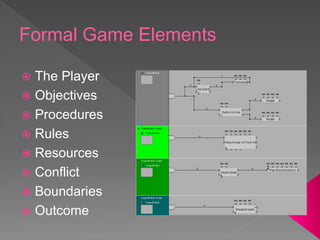
 The Player
 Objectives
 Procedures
 Rules
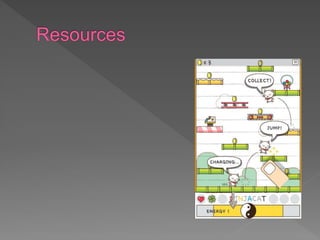
 Resources
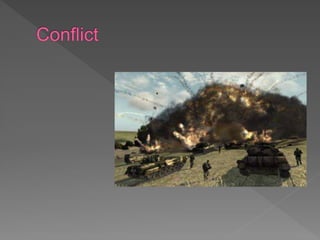
 Conflict
 Boundaries
 Outcome
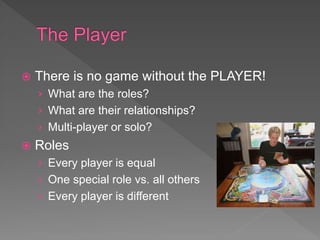
 There is no game without the PLAYER!
› What are the roles?
› What are their relationships?
› Multi-player or solo?
 Roles
› Every player is equal
› One special role vs. all others
› Every player is different
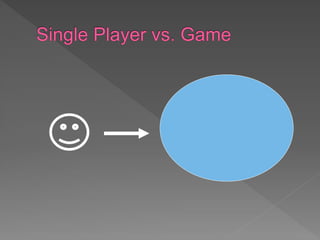
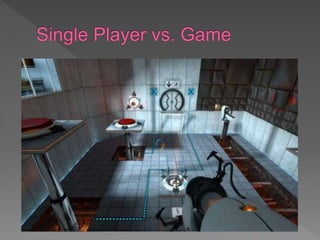
 Single vs. game
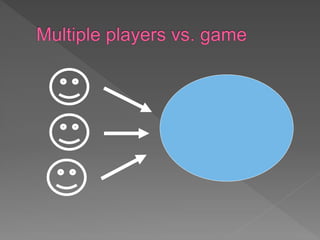
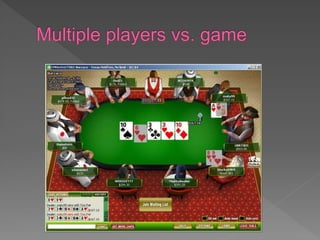
 Multiple players vs. game
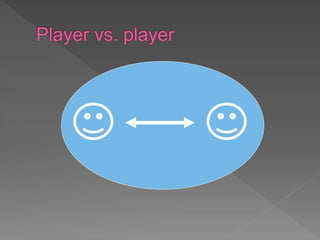
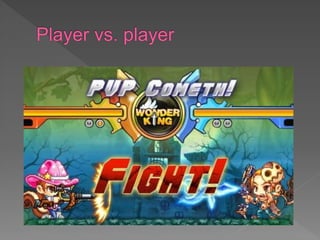
 Player vs. player
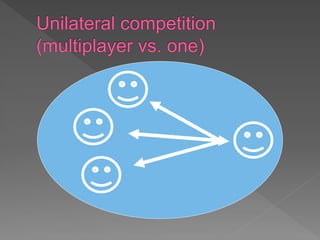
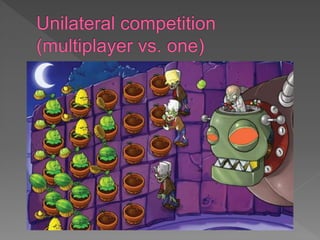
 Unilateral competition (multi vs. one)
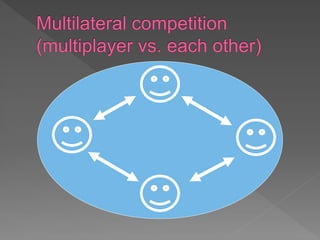
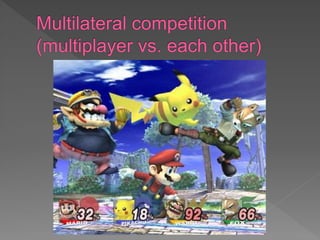
 Multilateral comp. (multi vs. each other)
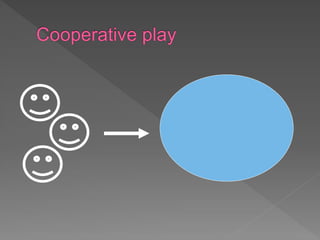
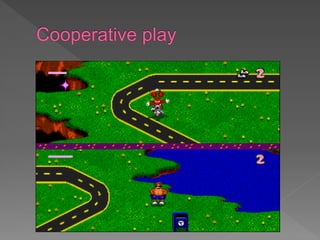
 Cooperative play
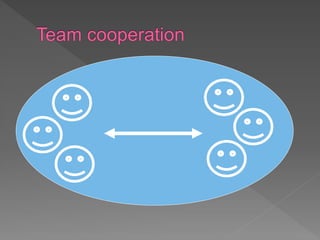
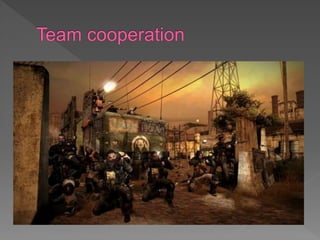
 Team cooperation
 The main point
 The main point
 Tone of the game
 The main point
 Tone of the game
 Genre specific objectives
 The main point
 Tone of the game
 Genre specific objectives
 Multiple objectives
 The main point
 Tone of the game
 Genre specific objectives
 Multiple objectives
 Obvious objectives
 The main point
 Tone of the game
 Genre specific objectives
 Multiple objectives
 Obvious objectives
 Determined by the player
 The main point
 Tone of the game
 Genre specific objectives
 Multiple objectives
 Obvious objectives
 Determined by the player
 Your favorite game’s objectives
 Method of play
 Method of play
 Not the rules
 Method of play
 Not the rules
 Who, what, where, when, and how
 Method of play
 Not the rules
 Who, what, where, when, and how
 Starting Action
 Method of play
 Not the rules
 Who, what, where, when, and how
 Starting Action
 Progression of Action
 Method of play
 Not the rules
 Who, what, where, when, and how
 Starting Action
 Progression of Action
 Special Actions
 Method of play
 Not the rules
 Who, what, where, when, and how
 Starting Action
 Progression of Action
 Special Actions
 Resolving Actions
 Method of play
 Not the rules
 Who, what, where, when, and how
 Starting Action
 Progression of Action
 Special Actions
 Resolving Actions
 Defining the game “environment”
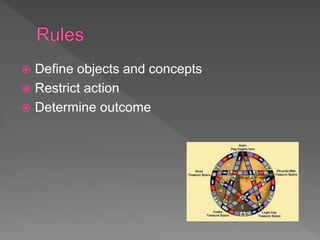
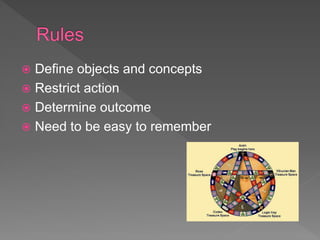
 Define objects and concepts
 Restrict action
 Define objects and concepts
 Restrict action
 Determine outcome
 Define objects and concepts
 Restrict action
 Determine outcome
 Need to be easy to remember
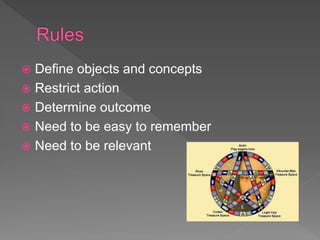
 Define objects and concepts
 Restrict action
 Determine outcome
 Need to be easy to remember
 Need to be relevant
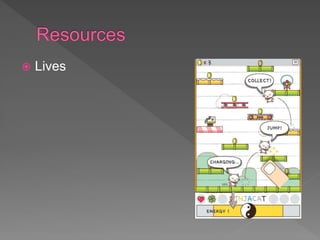
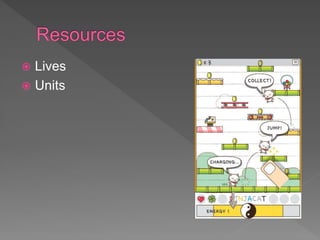
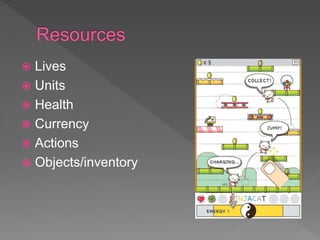
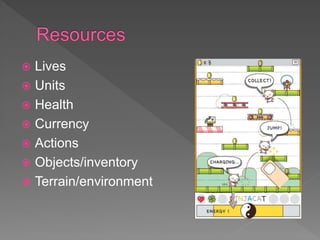
 Lives
 Lives
 Units
 Lives
 Units
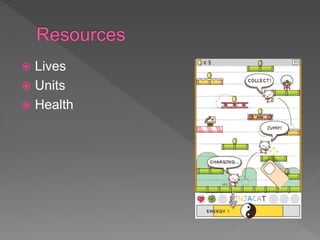
 Health
 Lives
 Units
 Health
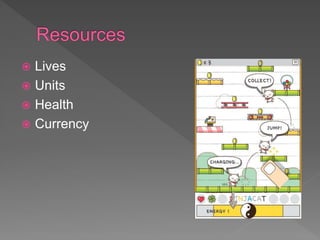
 Currency
 Lives
 Units
 Health
 Currency
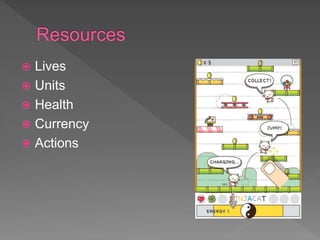
 Actions
 Lives
 Units
 Health
 Currency
 Actions
 Objects/inventory
 Lives
 Units
 Health
 Currency
 Actions
 Objects/inventory
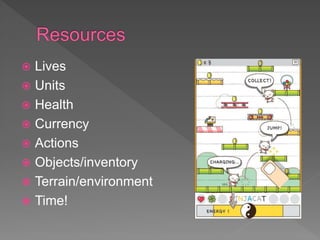
 Terrain/environment
 Lives
 Units
 Health
 Currency
 Actions
 Objects/inventory
 Terrain/environment
 Time!
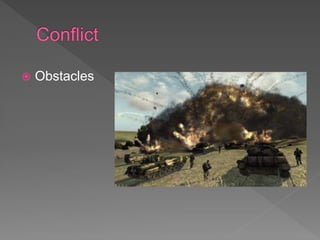
 Obstacles
 Obstacles
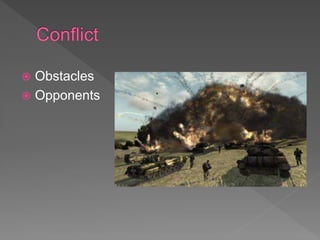
 Opponents
 Obstacles
 Opponents
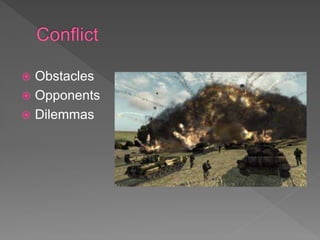
 Dilemmas
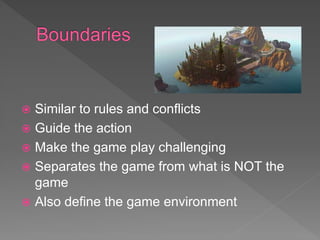
 Similar to rules and conflicts
 Guide the action
 Similar to rules and conflicts
 Guide the action
 Make the game play challenging
 Similar to rules and conflicts
 Guide the action
 Make the game play challenging
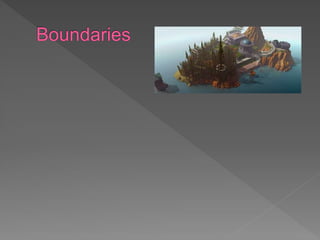
 Separates the game from what is NOT the
game
 Similar to rules and conflicts
 Guide the action
 Make the game play challenging
 Separates the game from what is NOT the
game
 Also define the game environment
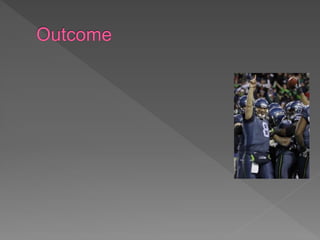
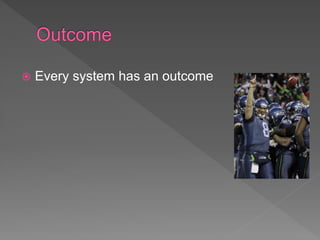
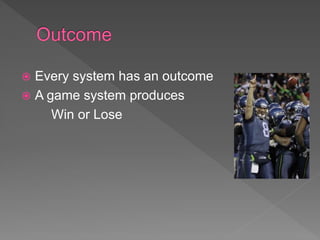
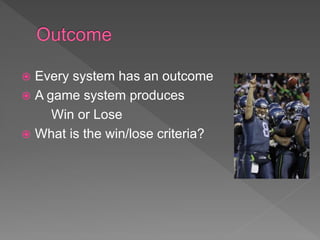
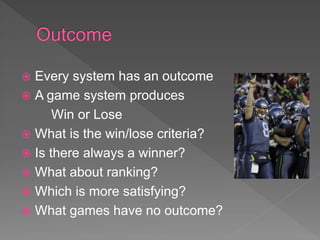
 Every system has an outcome
 A game system produces
Win or Lose
 Every system has an outcome
 A game system produces
Win or Lose
 What is the win/lose criteria?
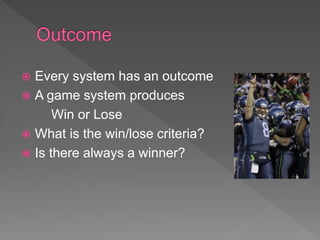
 Every system has an outcome
 A game system produces
Win or Lose
 What is the win/lose criteria?
 Is there always a winner?
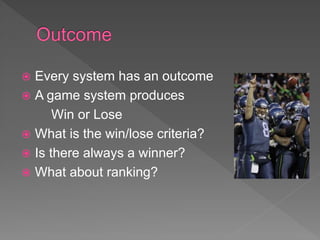
 Every system has an outcome
 A game system produces
Win or Lose
 What is the win/lose criteria?
 Is there always a winner?
 What about ranking?
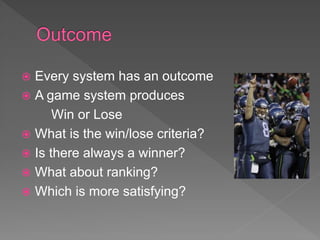
 Every system has an outcome
 A game system produces
Win or Lose
 What is the win/lose criteria?
 Is there always a winner?
 What about ranking?
 Which is more satisfying?
 Every system has an outcome
 A game system produces
Win or Lose
 What is the win/lose criteria?
 Is there always a winner?
 What about ranking?
 Which is more satisfying?
 What games have no outcome?

Formal Game Elements lecture 4 Game Development

  • 2.
    Formal Game Elements The Player  Objectives  Procedures  Rules  Resources  Conflict  Boundaries  Outcome
  • 3.
     There isno game without the PLAYER! › What are the roles? › What are their relationships? › Multi-player or solo?  Roles › Every player is equal › One special role vs. all others › Every player is different
  • 4.
     Single vs.game  Multiple players vs. game  Player vs. player  Unilateral competition (multi vs. one)  Multilateral comp. (multi vs. each other)  Cooperative play  Team cooperation
  • 20.
  • 21.
     The mainpoint  Tone of the game
  • 22.
     The mainpoint  Tone of the game  Genre specific objectives
  • 23.
     The mainpoint  Tone of the game  Genre specific objectives  Multiple objectives
  • 24.
     The mainpoint  Tone of the game  Genre specific objectives  Multiple objectives  Obvious objectives
  • 25.
     The mainpoint  Tone of the game  Genre specific objectives  Multiple objectives  Obvious objectives  Determined by the player
  • 26.
     The mainpoint  Tone of the game  Genre specific objectives  Multiple objectives  Obvious objectives  Determined by the player  Your favorite game’s objectives
  • 28.
  • 29.
     Method ofplay  Not the rules
  • 30.
     Method ofplay  Not the rules  Who, what, where, when, and how
  • 31.
     Method ofplay  Not the rules  Who, what, where, when, and how  Starting Action
  • 32.
     Method ofplay  Not the rules  Who, what, where, when, and how  Starting Action  Progression of Action
  • 33.
     Method ofplay  Not the rules  Who, what, where, when, and how  Starting Action  Progression of Action  Special Actions
  • 34.
     Method ofplay  Not the rules  Who, what, where, when, and how  Starting Action  Progression of Action  Special Actions  Resolving Actions
  • 35.
     Method ofplay  Not the rules  Who, what, where, when, and how  Starting Action  Progression of Action  Special Actions  Resolving Actions  Defining the game “environment”
  • 37.
     Define objectsand concepts
  • 38.
     Define objectsand concepts  Restrict action
  • 39.
     Define objectsand concepts  Restrict action  Determine outcome
  • 40.
     Define objectsand concepts  Restrict action  Determine outcome  Need to be easy to remember
  • 41.
     Define objectsand concepts  Restrict action  Determine outcome  Need to be easy to remember  Need to be relevant
  • 43.
  • 44.
  • 45.
  • 46.
     Lives  Units Health  Currency
  • 47.
     Lives  Units Health  Currency  Actions
  • 48.
     Lives  Units Health  Currency  Actions  Objects/inventory
  • 49.
     Lives  Units Health  Currency  Actions  Objects/inventory  Terrain/environment
  • 50.
     Lives  Units Health  Currency  Actions  Objects/inventory  Terrain/environment  Time!
  • 52.
  • 53.
  • 54.
  • 56.
     Similar torules and conflicts
  • 57.
     Similar torules and conflicts  Guide the action
  • 58.
     Similar torules and conflicts  Guide the action  Make the game play challenging
  • 59.
     Similar torules and conflicts  Guide the action  Make the game play challenging  Separates the game from what is NOT the game
  • 60.
     Similar torules and conflicts  Guide the action  Make the game play challenging  Separates the game from what is NOT the game  Also define the game environment
  • 62.
     Every systemhas an outcome
  • 63.
     Every systemhas an outcome  A game system produces Win or Lose
  • 64.
     Every systemhas an outcome  A game system produces Win or Lose  What is the win/lose criteria?
  • 65.
     Every systemhas an outcome  A game system produces Win or Lose  What is the win/lose criteria?  Is there always a winner?
  • 66.
     Every systemhas an outcome  A game system produces Win or Lose  What is the win/lose criteria?  Is there always a winner?  What about ranking?
  • 67.
     Every systemhas an outcome  A game system produces Win or Lose  What is the win/lose criteria?  Is there always a winner?  What about ranking?  Which is more satisfying?
  • 68.
     Every systemhas an outcome  A game system produces Win or Lose  What is the win/lose criteria?  Is there always a winner?  What about ranking?  Which is more satisfying?  What games have no outcome?