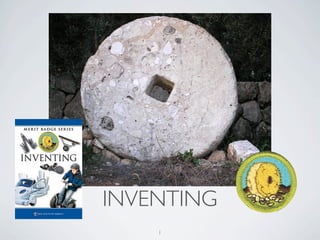
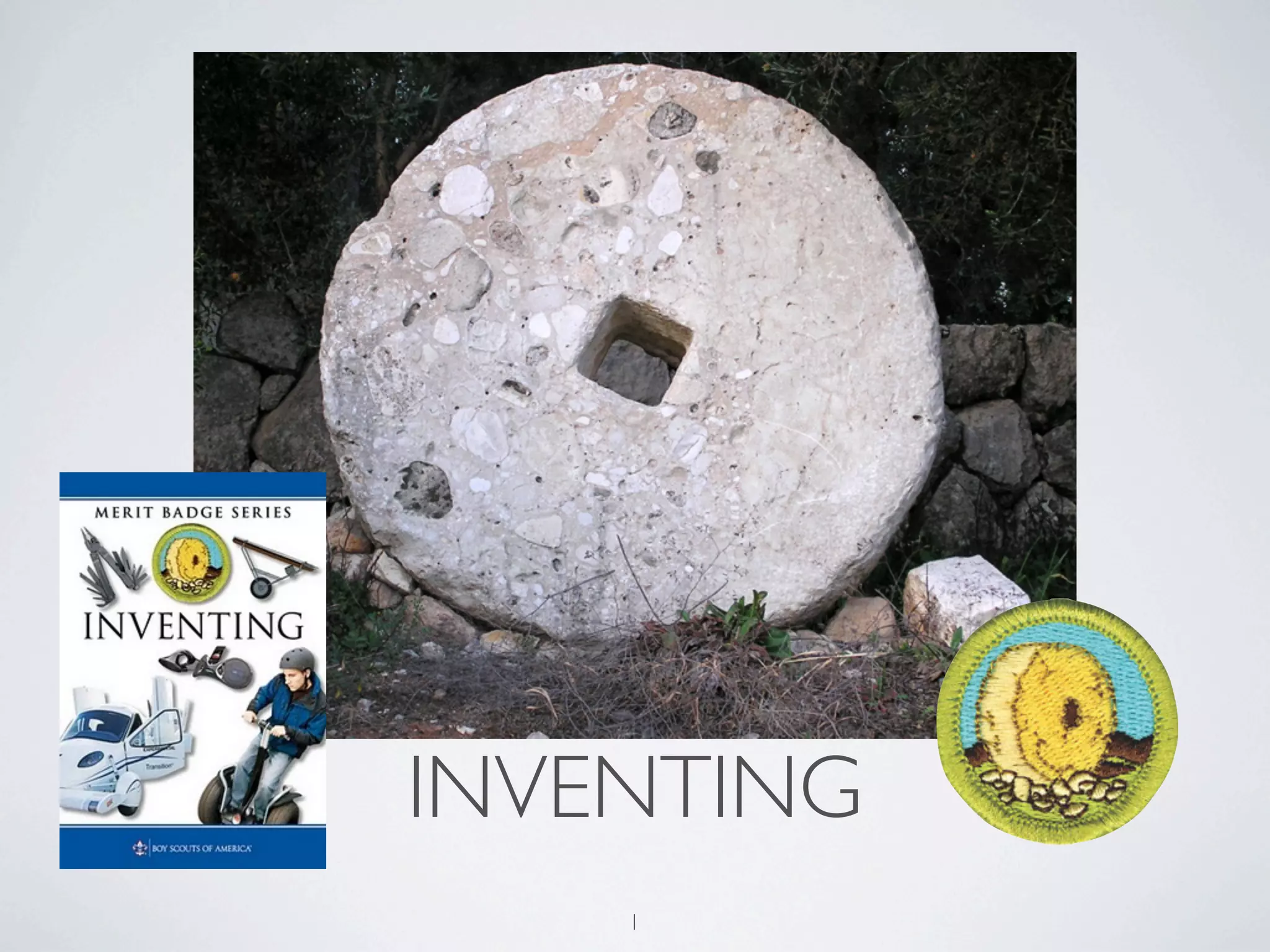
INVENTING
    1
INVENTION MERIT BADGE
• Very     new merit badge in 2010

• Replaces     Invention merit badge

     • Available   from 1911 - 1915

     • Required    patenting a new invention

     • Only    earned by 10 boys

• Still   requires inventing, but no patenting

• Closely    related to a lot of other merit badges
                                       2
RESOURCES

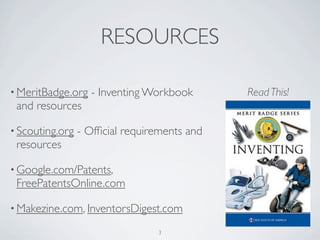
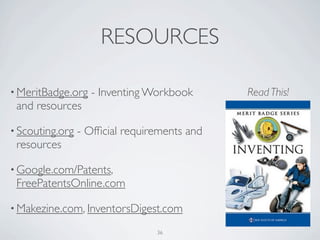
• MeritBadge.org   - Inventing Workbook       Read This!
 and resources

• Scouting.org   - Official requirements and
 resources

• Google.com/Patents,
 FreePatentsOnline.com

• Makezine.com, InventorsDigest.com

                                 3
REQUIREMENTS (COVERED)
1. In your own words, define inventing. Then do          3.b. Explain the components of a patent and
the following:                                          the different types of patents available.

  a. Explain to your merit badge counselor the          3.d. Explain to your counselor the term patent
  role of inventors and their inventions in the         infringement.
  economic development of the United States.
                                                        4. Discuss with your counselor the types of
  b. List three inventions and state how they           inventions that are appropriate to share with
  have helped humankind.                                others, and explain why. Tell your counselor
                                                        about one non-patented or non-copyrighted
2.b. Read about three inventors. Select the one         invention and its impact on society.
you find most interesting and tell your counselor
what you learned.                                       9. Discuss with your counselor the diverse
                                                        skills, education, training, and experience it takes
3.a. Define the term intellectual property.              to be an inventor. Discuss how you can prepare
Explain which government agencies oversee the           yourself to be creative and inventive to solve
protection of intellectual property, the types of       problems at home, in school, and in your
intellectual property that can be protected, how        community. Discuss three career fields that
such property is protected, and why protection          might utilize the skills of an inventor.
is necessary.


                                                    4
REQUIREMENTS (LATER)
3.c. Examine your Scouting gear and find a patent number on              c. Share the idea and the model with your counselor and
a camping item you have used. With your parent’s permission,            potential users of your invention. Record their feedback in
use the Internet to find out more about that patent. Compare             your notebook.
the finished item with the claims and drawings in the patent.
Report what you learned to your counselor.                           7. Build a working prototype of the item you invented for
                                                                     requirement 6*. Test and evaluate the invention. Among the
5. Choose a commercially available product that you have             aspects to consider in your evaluation are cost, usefulness,
used on an overnight camping trip with your troop. Make              marketability, appearance, and function. Describe how your
recommendations for improving the product, and make a                original vision and expectations for your invention are similar
sketch that shows your recommendations. Discuss your                 or dissimilar to the prototype you built. Have your counselor
recommendations with your counselor.                                 evaluate and critique your prototype.

6. Think of an item you would like to invent that would solve        Before you begin building the prototype, you must have your
a problem for your family, troop, chartered organization,            counselor’s approval, based on the design and building plans you
community, or a special-interest group. Then do EACH of the          have already shared.
following, while keeping a notebook to record your progress:
                                                                     8. Do ONE of the following:
   a. Talk to potential users of your invention and determine
   their needs. Then, based on what you have learned, write a           a. Participate with a club or team (robotics team, science
   statement describing the invention and how it would help             club, or engineering club) that builds a useful item. Share
   solve a problem. This statement should include detailed              your experience with your counselor.
   sketch of the invention.
                                                                        b. Visit a museum or exhibit dedicated to an inventor or
   b. Create a model of the invention using clay, cardboard,            invention, and create a presentation of your visit to share
   or any other readily available material. List the materials          with a group such as your troop or patrol.
   necessary to build a prototype of the invention.


                                                                 5
WHAT IS INVENTING?
 To create something new or improved
        that is useful or helpful.


                  6                    1
HOW TO BE AN INVENTOR

• Ask Why, How     & What if?

• Not   be satisfied with the way things are.

• See   problems as opportunities.

• Keep   a written record of problems, ideas, research, etc.

• Always   keep learning!

                                  7
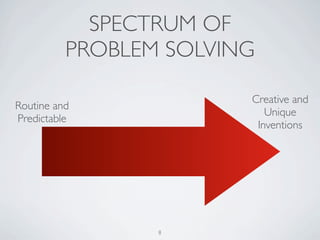
SPECTRUM OF
          PROBLEM SOLVING

                        Creative and
Routine and
                           Unique
Predictable
                         Inventions


                 8
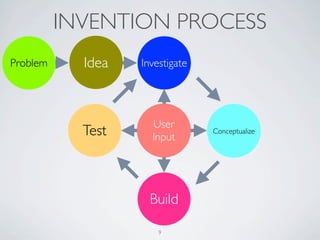
INVENTION PROCESS
Problem     Idea   Investigate


                     User
            Test     Input
                                 Conceptualize


                     Build

                       9
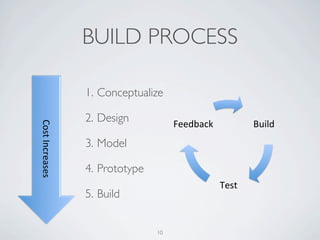
BUILD PROCESS

                  1. Conceptualize

                  2. Design           +((%,-./&           !"#$%&
!"#$%&'()*+#*#%


                  3. Model

                  4. Prototype
                                                  '()*&
                  5. Build


                                 10
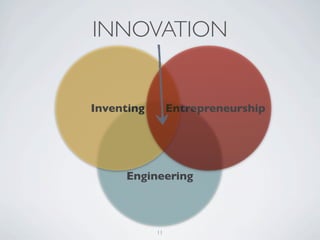
INNOVATION


Inventing        Entrepreneurship


     Engineering


            11
HOW DOES INNOVATION
    HELP THE U.S. ECONOMY?

• Create    new products to sell

• More   efficient ways to do things

• Extend    and improve life of citizens

• Provide   more leisure time for recreation

• Macroinventions   lead to new industries and Microinventions

                                   12                            1.a
FAMOUS INVENTIONS
• Mechanical   Reaper - Cyrus McCormick (1809 - 1884)

• Integrated   Circuit - Microchip - Jack Kilby (1923 - 2005)

• Air   Plane - powered flight - Wright Brothers (1867 - 1948)

• Moving Assembly     Line - Henry Ford (1863-1947)

• Electronic Television   - Philo T. Farnsworth (1906 - 1971)

• World Wide Web       - Hyper Text - Tim Berners-Lee (1955 - )

• Bright   Blue LED - Shuji Nakamura (1954 - )

• Wheel    - Ancient Mesopotamians - 5000 B.C.
                                         13                       1.b
FAMOUS INVENTIONS
  How have they helped humankind?


                14                  1.b
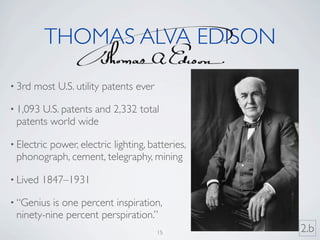
THOMAS ALVA EDISON

• 3rd   most U.S. utility patents ever

• 1,093U.S. patents and 2,332 total
 patents world wide

• Electric
       power, electric lighting, batteries,
 phonograph, cement, telegraphy, mining

• Lived   1847–1931

• “Genius is one percent inspiration,
 ninety-nine percent perspiration.”
                                         15   2.b
THOMAS ALVA EDISON

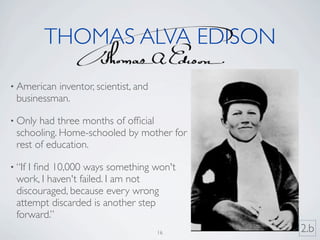
• American inventor, scientist, and
  businessman.

• Only  had three months of official
  schooling. Home-schooled by mother for
  rest of education.

• “IfI find 10,000 ways something won't
  work, I haven't failed. I am not
  discouraged, because every wrong
  attempt discarded is another step
  forward.”
                                      16   2.b
THOMAS ALVA EDISON

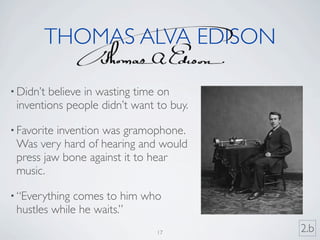
• Didn’tbelieve in wasting time on
 inventions people didn’t want to buy.

• Favoriteinvention was gramophone.
 Was very hard of hearing and would
 press jaw bone against it to hear
 music.

• “Everything comes to him who
 hustles while he waits.”
                               17        2.b
THOMAS ALVA EDISON
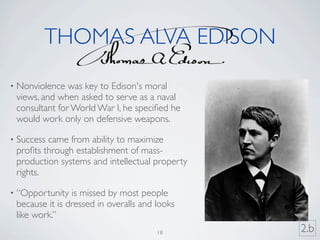
•   Nonviolence was key to Edison's moral
    views, and when asked to serve as a naval
    consultant for World War I, he specified he
    would work only on defensive weapons.

•   Success came from ability to maximize
    profits through establishment of mass-
    production systems and intellectual property
    rights.

•   “Opportunity is missed by most people
    because it is dressed in overalls and looks
    like work.”
                                          18       2.b
THOMAS ALVA EDISON

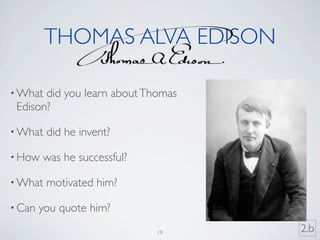
• What did you learn about Thomas
 Edison?

• What   did he invent?

• How   was he successful?

• What   motivated him?

• Can   you quote him?
                             19     2.b
INTELLECTUAL PROPERTY

• Legal
      recognition of property (as an idea, invention, or
 process) that derives from the work of the mind or intellect

•A work or invention that is the result of creativity, such as a
 manuscript or a design, to which one has rights and for which
 one may apply for a patent, copyright, trademark, etc.

• Gives   owners limited exclusive rights in exchange.

• Usually   requires full disclosure.
                                    20                          3.a
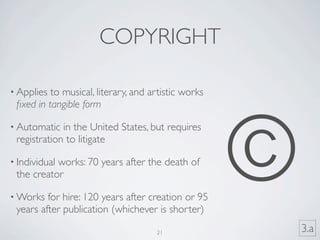
COPYRIGHT

• Applies to musical, literary, and artistic works
 fixed in tangible form


                                                     ©
• Automatic  in the United States, but requires
 registration to litigate

• Individual
           works: 70 years after the death of
 the creator

• Works  for hire: 120 years after creation or 95
 years after publication (whichever is shorter)

                                     21                  3.a
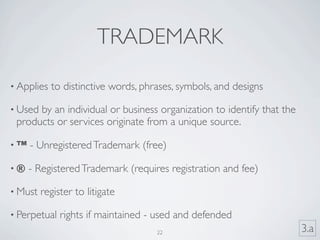
TRADEMARK

• Applies   to distinctive words, phrases, symbols, and designs

• Usedby an individual or business organization to identify that the
 products or services originate from a unique source.

•™   - Unregistered Trademark (free)

•®   - Registered Trademark (requires registration and fee)

• Must   register to litigate

• Perpetual   rights if maintained - used and defended
                                     22                                3.a
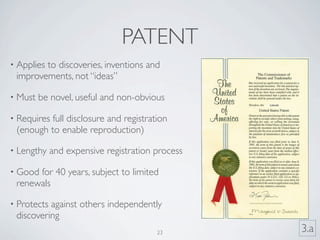
PATENT
• Applies
        to discoveries, inventions and
 improvements, not “ideas”

• Must   be novel, useful and non-obvious

• Requiresfull disclosure and registration
 (enough to enable reproduction)

• Lengthy    and expensive registration process

• Goodfor 40 years, subject to limited
 renewals

• Protectsagainst others independently
 discovering
                                        23        3.a
TRADE SECRETS

• Similarto patents, but kept a total secret instead of fully
 disclosed.

• Only      protected as long as kept a secret.

• Must      have economic value and be used commercially.

• Illegal
      to disclose trade secrets protected under non-disclosure
 agreement.

• Lost   if discovered independently by someone else
                                     24                         3.a
U.S. PATENT
       AND TRADEMARK OFFICE

• uspto.gov

• Part
    of Department of
 Commerce

• No  international or global
 jurisdiction.


                                25   3.a
U.S. COPYRIGHT OFFICE


• copyright.gov

• Part   of Library of Commerce

• No  international or global
 jurisdiction.


                                  26   3.a
REVIEW IP

• Which government agencies oversee the
 protection of intellectual property?

• What


• How

• Why
       types of intellectual property that
 can be protected?

        is such property is protected?

        is protection necessary?
                                             ?
                                   27            3.a
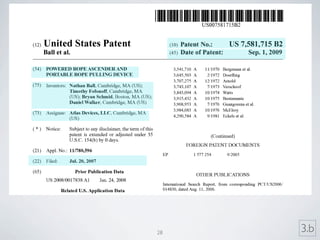
28   3.b
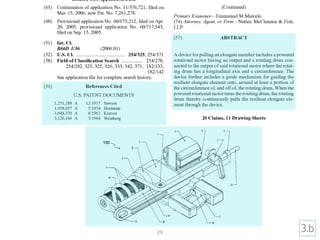
29   3.b
TYPES OF PATENTS

• Utility
       Patents - Useful process, machine, device, or
 improvement thereof (includes software patents, etc.)

• Design    Patents - Ornamental design of a functional item

• Plant   Patent - For discovery or creation of new variety of
 plant

• Business   method patent - New way of doing business

                                  30                             3.b
PATENT INFRINGEMENT

• Manufacturing, usingor selling a patented invention without
 license (permission) to do so

• Does   not require knowledge of patent

• Specific   to territorial jurisdiction of patent

• Specific   claims are listed for each patent

                                    31                          3.d
SHARING vs. PROTECTING

• Open     source - Linux, Open Office, etc. (Copyleft)   ©
• Creative   Commons - Wikipedia, Academic Earth,

• Contributed    for general good - non-patented inventions

• Public   domain - Project Gutenberg, Shakespeare

• Standard   information - Lists, calendars, measures, etc.

                                  32                          4
WHEN AND WHY TO SHARE?

• When   would you not get a patent?

• What are the advantages of not getting


                                            ?
 a patent?

• How  can you share a creative work that
 is subject to copyright?

• Name a non-patented or freely licensed
 work. How does it impact society?
                               33               4
INVENTING AS A CAREER

• Typically
          a inventor is a creative and innovative in the field of
 their profession and interests.

• What    toys and hobbies help you be more inventive?

• What    school classes might be useful to an inventor?

• Find   academic and creative clubs and organizations

• Business    skills are important to profit from inventions
                                   34                              9
INVENTIVE CAREER FIELDS

• Engineer

• Scientist

• Biotechnology

• Software    developer

• Horticulturist


                          35   9
RESOURCES

• MeritBadge.org   - Inventing Workbook       Read This!
 and resources

• Scouting.org   - Official requirements and
 resources

• Google.com/Patents,
 FreePatentsOnline.com

• Makezine.com, InventorsDigest.com

                                 36

Inventing merit badge

  • 1.
  • 2.
    INVENTION MERIT BADGE •Very new merit badge in 2010 • Replaces Invention merit badge • Available from 1911 - 1915 • Required patenting a new invention • Only earned by 10 boys • Still requires inventing, but no patenting • Closely related to a lot of other merit badges 2
  • 3.
    RESOURCES • MeritBadge.org - Inventing Workbook Read This! and resources • Scouting.org - Official requirements and resources • Google.com/Patents, FreePatentsOnline.com • Makezine.com, InventorsDigest.com 3
  • 4.
    REQUIREMENTS (COVERED) 1. Inyour own words, define inventing. Then do 3.b. Explain the components of a patent and the following: the different types of patents available. a. Explain to your merit badge counselor the 3.d. Explain to your counselor the term patent role of inventors and their inventions in the infringement. economic development of the United States. 4. Discuss with your counselor the types of b. List three inventions and state how they inventions that are appropriate to share with have helped humankind. others, and explain why. Tell your counselor about one non-patented or non-copyrighted 2.b. Read about three inventors. Select the one invention and its impact on society. you find most interesting and tell your counselor what you learned. 9. Discuss with your counselor the diverse skills, education, training, and experience it takes 3.a. Define the term intellectual property. to be an inventor. Discuss how you can prepare Explain which government agencies oversee the yourself to be creative and inventive to solve protection of intellectual property, the types of problems at home, in school, and in your intellectual property that can be protected, how community. Discuss three career fields that such property is protected, and why protection might utilize the skills of an inventor. is necessary. 4
  • 5.
    REQUIREMENTS (LATER) 3.c. Examineyour Scouting gear and find a patent number on c. Share the idea and the model with your counselor and a camping item you have used. With your parent’s permission, potential users of your invention. Record their feedback in use the Internet to find out more about that patent. Compare your notebook. the finished item with the claims and drawings in the patent. Report what you learned to your counselor. 7. Build a working prototype of the item you invented for requirement 6*. Test and evaluate the invention. Among the 5. Choose a commercially available product that you have aspects to consider in your evaluation are cost, usefulness, used on an overnight camping trip with your troop. Make marketability, appearance, and function. Describe how your recommendations for improving the product, and make a original vision and expectations for your invention are similar sketch that shows your recommendations. Discuss your or dissimilar to the prototype you built. Have your counselor recommendations with your counselor. evaluate and critique your prototype. 6. Think of an item you would like to invent that would solve Before you begin building the prototype, you must have your a problem for your family, troop, chartered organization, counselor’s approval, based on the design and building plans you community, or a special-interest group. Then do EACH of the have already shared. following, while keeping a notebook to record your progress: 8. Do ONE of the following: a. Talk to potential users of your invention and determine their needs. Then, based on what you have learned, write a a. Participate with a club or team (robotics team, science statement describing the invention and how it would help club, or engineering club) that builds a useful item. Share solve a problem. This statement should include detailed your experience with your counselor. sketch of the invention. b. Visit a museum or exhibit dedicated to an inventor or b. Create a model of the invention using clay, cardboard, invention, and create a presentation of your visit to share or any other readily available material. List the materials with a group such as your troop or patrol. necessary to build a prototype of the invention. 5
  • 6.
    WHAT IS INVENTING? To create something new or improved that is useful or helpful. 6 1
  • 7.
    HOW TO BEAN INVENTOR • Ask Why, How & What if? • Not be satisfied with the way things are. • See problems as opportunities. • Keep a written record of problems, ideas, research, etc. • Always keep learning! 7
  • 8.
    SPECTRUM OF PROBLEM SOLVING Creative and Routine and Unique Predictable Inventions 8
  • 9.
    INVENTION PROCESS Problem Idea Investigate User Test Input Conceptualize Build 9
  • 10.
    BUILD PROCESS 1. Conceptualize 2. Design +((%,-./& !"#$%& !"#$%&'()*+#*#% 3. Model 4. Prototype '()*& 5. Build 10
  • 11.
    INNOVATION Inventing Entrepreneurship Engineering 11
  • 12.
    HOW DOES INNOVATION HELP THE U.S. ECONOMY? • Create new products to sell • More efficient ways to do things • Extend and improve life of citizens • Provide more leisure time for recreation • Macroinventions lead to new industries and Microinventions 12 1.a
  • 13.
    FAMOUS INVENTIONS • Mechanical Reaper - Cyrus McCormick (1809 - 1884) • Integrated Circuit - Microchip - Jack Kilby (1923 - 2005) • Air Plane - powered flight - Wright Brothers (1867 - 1948) • Moving Assembly Line - Henry Ford (1863-1947) • Electronic Television - Philo T. Farnsworth (1906 - 1971) • World Wide Web - Hyper Text - Tim Berners-Lee (1955 - ) • Bright Blue LED - Shuji Nakamura (1954 - ) • Wheel - Ancient Mesopotamians - 5000 B.C. 13 1.b
  • 14.
    FAMOUS INVENTIONS How have they helped humankind? 14 1.b
  • 15.
    THOMAS ALVA EDISON •3rd most U.S. utility patents ever • 1,093U.S. patents and 2,332 total patents world wide • Electric power, electric lighting, batteries, phonograph, cement, telegraphy, mining • Lived 1847–1931 • “Genius is one percent inspiration, ninety-nine percent perspiration.” 15 2.b
  • 16.
    THOMAS ALVA EDISON •American inventor, scientist, and businessman. • Only had three months of official schooling. Home-schooled by mother for rest of education. • “IfI find 10,000 ways something won't work, I haven't failed. I am not discouraged, because every wrong attempt discarded is another step forward.” 16 2.b
  • 17.
    THOMAS ALVA EDISON •Didn’tbelieve in wasting time on inventions people didn’t want to buy. • Favoriteinvention was gramophone. Was very hard of hearing and would press jaw bone against it to hear music. • “Everything comes to him who hustles while he waits.” 17 2.b
  • 18.
    THOMAS ALVA EDISON • Nonviolence was key to Edison's moral views, and when asked to serve as a naval consultant for World War I, he specified he would work only on defensive weapons. • Success came from ability to maximize profits through establishment of mass- production systems and intellectual property rights. • “Opportunity is missed by most people because it is dressed in overalls and looks like work.” 18 2.b
  • 19.
    THOMAS ALVA EDISON •What did you learn about Thomas Edison? • What did he invent? • How was he successful? • What motivated him? • Can you quote him? 19 2.b
  • 20.
    INTELLECTUAL PROPERTY • Legal recognition of property (as an idea, invention, or process) that derives from the work of the mind or intellect •A work or invention that is the result of creativity, such as a manuscript or a design, to which one has rights and for which one may apply for a patent, copyright, trademark, etc. • Gives owners limited exclusive rights in exchange. • Usually requires full disclosure. 20 3.a
  • 21.
    COPYRIGHT • Applies tomusical, literary, and artistic works fixed in tangible form © • Automatic in the United States, but requires registration to litigate • Individual works: 70 years after the death of the creator • Works for hire: 120 years after creation or 95 years after publication (whichever is shorter) 21 3.a
  • 22.
    TRADEMARK • Applies to distinctive words, phrases, symbols, and designs • Usedby an individual or business organization to identify that the products or services originate from a unique source. •™ - Unregistered Trademark (free) •® - Registered Trademark (requires registration and fee) • Must register to litigate • Perpetual rights if maintained - used and defended 22 3.a
  • 23.
    PATENT • Applies to discoveries, inventions and improvements, not “ideas” • Must be novel, useful and non-obvious • Requiresfull disclosure and registration (enough to enable reproduction) • Lengthy and expensive registration process • Goodfor 40 years, subject to limited renewals • Protectsagainst others independently discovering 23 3.a
  • 24.
    TRADE SECRETS • Similartopatents, but kept a total secret instead of fully disclosed. • Only protected as long as kept a secret. • Must have economic value and be used commercially. • Illegal to disclose trade secrets protected under non-disclosure agreement. • Lost if discovered independently by someone else 24 3.a
  • 25.
    U.S. PATENT AND TRADEMARK OFFICE • uspto.gov • Part of Department of Commerce • No international or global jurisdiction. 25 3.a
  • 26.
    U.S. COPYRIGHT OFFICE •copyright.gov • Part of Library of Commerce • No international or global jurisdiction. 26 3.a
  • 27.
    REVIEW IP • Whichgovernment agencies oversee the protection of intellectual property? • What • How • Why types of intellectual property that can be protected? is such property is protected? is protection necessary? ? 27 3.a
  • 28.
    28 3.b
  • 29.
    29 3.b
  • 30.
    TYPES OF PATENTS •Utility Patents - Useful process, machine, device, or improvement thereof (includes software patents, etc.) • Design Patents - Ornamental design of a functional item • Plant Patent - For discovery or creation of new variety of plant • Business method patent - New way of doing business 30 3.b
  • 31.
    PATENT INFRINGEMENT • Manufacturing,usingor selling a patented invention without license (permission) to do so • Does not require knowledge of patent • Specific to territorial jurisdiction of patent • Specific claims are listed for each patent 31 3.d
  • 32.
    SHARING vs. PROTECTING •Open source - Linux, Open Office, etc. (Copyleft) © • Creative Commons - Wikipedia, Academic Earth, • Contributed for general good - non-patented inventions • Public domain - Project Gutenberg, Shakespeare • Standard information - Lists, calendars, measures, etc. 32 4
  • 33.
    WHEN AND WHYTO SHARE? • When would you not get a patent? • What are the advantages of not getting ? a patent? • How can you share a creative work that is subject to copyright? • Name a non-patented or freely licensed work. How does it impact society? 33 4
  • 34.
    INVENTING AS ACAREER • Typically a inventor is a creative and innovative in the field of their profession and interests. • What toys and hobbies help you be more inventive? • What school classes might be useful to an inventor? • Find academic and creative clubs and organizations • Business skills are important to profit from inventions 34 9
  • 35.
    INVENTIVE CAREER FIELDS •Engineer • Scientist • Biotechnology • Software developer • Horticulturist 35 9
  • 36.
    RESOURCES • MeritBadge.org - Inventing Workbook Read This! and resources • Scouting.org - Official requirements and resources • Google.com/Patents, FreePatentsOnline.com • Makezine.com, InventorsDigest.com 36