Gallstone Disease
Overview Gallstone pathogenesis Definitions Differential Diagnosis of RUQ pain 7 Cases
Gallstone Pathogenesis Bile = bile salts, phospholipids, cholesterol Also bilirubin which is conjugated b4 excretion Gallstones due to imbalance rendering cholesterol & calcium salts insoluble Pathogenesis involves 3 stages: 1. cholesterol supersaturation in bile 2. crystal nucleation 3. stone growth
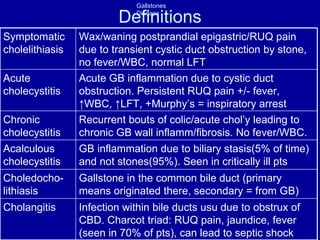
Definitions Infection within bile ducts usu due to obstrux of CBD. Charcot triad: RUQ pain, jaundice, fever (seen in 70% of pts), can lead to septic shock Cholangitis Gallstone in the common bile duct (primary means originated there, secondary = from GB) Choledocho-lithiasis GB inflammation due to biliary stasis(5% of time) and not stones(95%). Seen in critically ill pts Acalculous cholecystitis Recurrent bouts of colic/acute chol’y leading to chronic GB wall inflamm/fibrosis. No fever/WBC. Chronic cholecystitis Acute GB inflammation due to cystic duct obstruction. Persistent RUQ pain +/- fever,  ↑WBC, ↑LFT, +Murphy’s = inspiratory arrest Acute cholecystitis Wax/waning postprandial epigastric/RUQ pain due to transient cystic duct obstruction by stone, no fever/WBC, normal LFT Symptomatic cholelithiasis
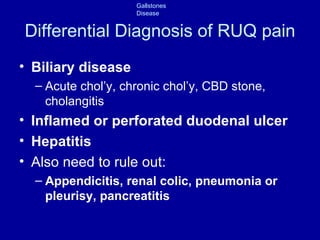
Differential Diagnosis of RUQ pain Biliary disease Acute chol’y, chronic chol’y, CBD stone, cholangitis Inflamed or perforated duodenal ulcer Hepatitis Also need to rule out: Appendicitis, renal colic, pneumonia or pleurisy, pancreatitis
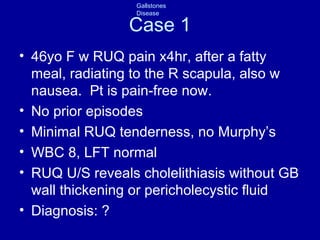
Case 1 46yo F w RUQ pain x4hr, after a fatty meal, radiating to the R scapula, also w nausea.  Pt is pain-free now. No prior episodes Minimal RUQ tenderness, no Murphy’s WBC 8, LFT normal RUQ U/S reveals cholelithiasis without GB wall thickening or pericholecystic fluid Diagnosis: ?
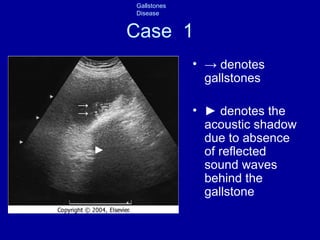
Case  1 ->  denotes gallstones ►   denotes the acoustic shadow due to absence of reflected sound waves behind the gallstone -> -> ►
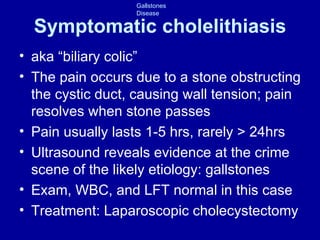
Symptomatic cholelithiasis aka “biliary colic” The pain occurs due to a stone obstructing the cystic duct, causing wall tension; pain resolves when stone passes Pain usually lasts 1-5 hrs, rarely > 24hrs Ultrasound reveals evidence at the crime scene of the likely etiology: gallstones Exam, WBC, and LFT normal in this case Treatment: Laparoscopic cholecystectomy
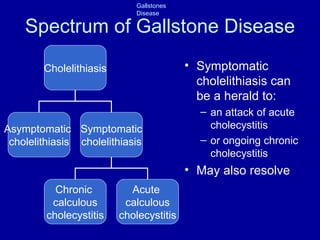
Spectrum of Gallstone Disease Symptomatic cholelithiasis can be a herald to: an attack of acute cholecystitis or ongoing chronic cholecystitis May also resolve Cholelithiasis Asymptomatic  cholelithiasis Symptomatic cholelithiasis Chronic  calculous cholecystitis Acute  calculous cholecystitis
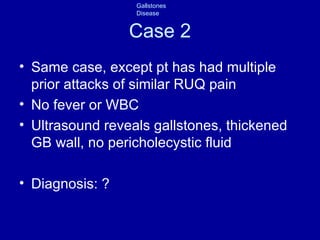
Case 2 Same case, except pt has had multiple prior attacks of similar RUQ pain No fever or WBC Ultrasound reveals gallstones, thickened GB wall, no pericholecystic fluid Diagnosis: ?
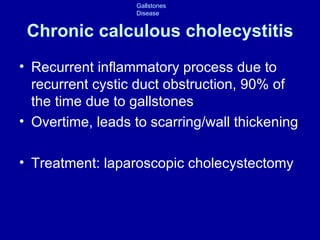
Chronic calculous cholecystitis Recurrent inflammatory process due to recurrent cystic duct obstruction, 90% of the time due to gallstones Overtime, leads to scarring/wall thickening Treatment: laparoscopic cholecystectomy
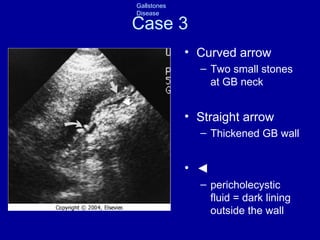
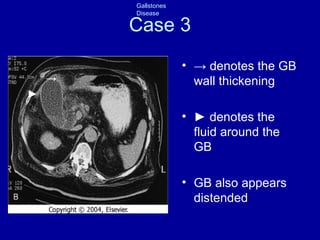
Case 3 Same pt, now > 24hrs of RUQ pain radiating to the R scapula, started after fatty meal, a/w nausea, vomiting, fever Exam: Palpable, tender gallbladder, guarding, +Murphy’s = inspiratory arrest WBC 13, Mild  ↑LFT U/S: gallstones, wall thickening (>4mm), GB distension, pericholecystic fluid, sonographic Murphy’s sign (very specific) Diagnosis: ?
Case 3 Curved arrow Two small stones at GB neck Straight arrow Thickened GB wall ◄   pericholecystic fluid = dark lining outside the wall ◄
Case 3 ->  denotes the GB wall thickening ►  denotes the fluid around the GB GB also appears distended -> ►
Acute calculous cholecystitis Persistent cystic duct obstruction  leads to  GB distension, wall inflammation & edema Can lead to: empyema, gangrene, rupture Pain usu. persists >24hrs & a/w N/V/Fever Palpable/tender or even  visible  RUQ mass Nuclear  HIDA  scan shows nonfilling of GB If U/S non-diagnostic, obtain  HIDA Tx : NPO, IVF, Abx (GNR & enterococcus) Sg: Cholecystectomy usu within 48hrs
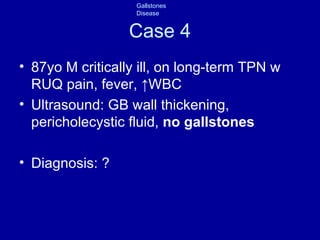
Case 4 87yo M critically ill, on long-term TPN w RUQ pain, fever,  ↑WBC Ultrasound: GB wall thickening, pericholecystic fluid,  no gallstones Diagnosis: ?
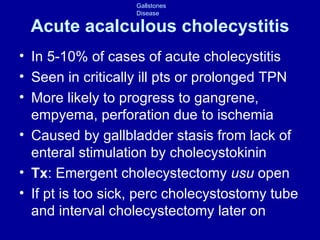
Acute acalculous cholecystitis In 5-10% of cases of acute cholecystitis Seen in critically ill pts or prolonged TPN More likely to progress to gangrene, empyema, perforation due to ischemia Caused by gallbladder stasis from lack of enteral stimulation by cholecystokinin Tx : Emergent cholecystectomy  usu  open If pt is too sick, perc cholecystostomy tube and interval cholecystectomy later on
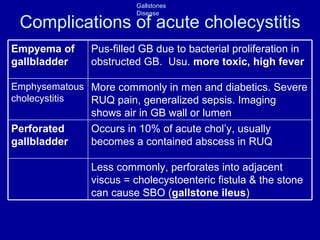
Complications of acute cholecystitis Less commonly, perforates into adjacent viscus = cholecystoenteric fistula & the stone can cause SBO ( gallstone ileus ) Occurs in 10% of acute chol’y, usually becomes a contained abscess in RUQ Perforated gallbladder More commonly in men and diabetics. Severe RUQ pain, generalized sepsis. Imaging shows air in GB wall or lumen Emphysematous cholecystitis Pus-filled GB due to bacterial proliferation in obstructed GB.  Usu.  more toxic, high fever Empyema of gallbladder
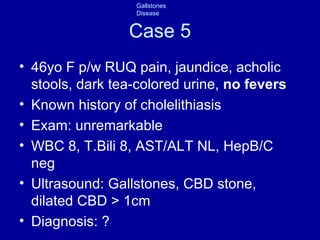
Case 5 46yo F p/w RUQ pain, jaundice, acholic stools, dark tea-colored urine,  no fevers Known history of cholelithiasis Exam: unremarkable WBC 8, T.Bili 8, AST/ALT NL, HepB/C neg Ultrasound: Gallstones, CBD stone, dilated CBD > 1cm Diagnosis: ?
Choledocholithiasis Can present similarly to cholelithiasis, except with the addition of jaundice DDx: cholelithiasis, hepatitis, sclerosing cholangitis, less likely CA with pain Tx : Endoscopic retrograde cholangiopancreatography (ERCP) Stone extraction and sphincterotomy Interval cholecystectomy after recovery from ERCP
Case 6 46yo F p/w  fever, RUQ pain, jaundice  ( Charcot’s triad ) If also  altered mental status  and signs of  shock  =  Raynaud’s pentad VS tachycardic, hypotensive ABC’s, Resuscitate 2 large bore IV, Foley, Continuous monitor 1-2L fluid bolus, repeat until resuscitated Diagnosis: ?
Cholangitis Infection of the bile ducts due to CBD obstruction 2ndary to stones, strictures Charcot’s triad seen in 70% of pts May lead to life-threatening sepsis and septic shock ( Raynaud’s pentad ) Tx : NPO, IVF, IV Abx Emergent decompression via ERCP or  perc transhepatic cholangiogram (PTC) Used to require emergency laparotomy
Case 7 46yo F p/w persistent epigastric & back pain Known history of symptomatic gallstones No EtOH abuse Exam: Tender epigastrum Amylase 2000, ALT 150 Ultrasound: Gallstones Diagnosis: ?
Gallstone pancreatitis 35% of acute pancreatitis 2ndary to stones Pathophysiology  Reflux of bile into pancreatic duct and/or obstruction of ampulla by stone ALT > 150 (3-fold elevation) has 95% PPV for diagnosing gallstone pancreatitis Tx : ABC, resuscitate, NPO/IVF, pain meds Once pancreatitis resolving, ERCP w stone extraction/sphincterotomy Cholecystectomy before hospital discharge
Take Home Points As always, ABC & Resuscitate before Dx Understanding the definitions is key Is this acute cholecystitis? (fever, WBC, tender on exam with positive Murphy’s) Or simply cholelithiasis vs ongoing chronic cholecystitis? (no fever/WBC) Is patient sick or toxic-appearing, to suspect empyema, gangrene or even perforation? Elicit h/o jaundice, acholic stools, tea-colored urine Rule out cholangitis, because this will kill the patient unless dx & tx early

Gallstone+disease

  • 1.
  • 2.
    Overview Gallstone pathogenesisDefinitions Differential Diagnosis of RUQ pain 7 Cases
  • 3.
    Gallstone Pathogenesis Bile= bile salts, phospholipids, cholesterol Also bilirubin which is conjugated b4 excretion Gallstones due to imbalance rendering cholesterol & calcium salts insoluble Pathogenesis involves 3 stages: 1. cholesterol supersaturation in bile 2. crystal nucleation 3. stone growth
  • 4.
    Definitions Infection withinbile ducts usu due to obstrux of CBD. Charcot triad: RUQ pain, jaundice, fever (seen in 70% of pts), can lead to septic shock Cholangitis Gallstone in the common bile duct (primary means originated there, secondary = from GB) Choledocho-lithiasis GB inflammation due to biliary stasis(5% of time) and not stones(95%). Seen in critically ill pts Acalculous cholecystitis Recurrent bouts of colic/acute chol’y leading to chronic GB wall inflamm/fibrosis. No fever/WBC. Chronic cholecystitis Acute GB inflammation due to cystic duct obstruction. Persistent RUQ pain +/- fever, ↑WBC, ↑LFT, +Murphy’s = inspiratory arrest Acute cholecystitis Wax/waning postprandial epigastric/RUQ pain due to transient cystic duct obstruction by stone, no fever/WBC, normal LFT Symptomatic cholelithiasis
  • 5.
    Differential Diagnosis ofRUQ pain Biliary disease Acute chol’y, chronic chol’y, CBD stone, cholangitis Inflamed or perforated duodenal ulcer Hepatitis Also need to rule out: Appendicitis, renal colic, pneumonia or pleurisy, pancreatitis
  • 6.
    Case 1 46yoF w RUQ pain x4hr, after a fatty meal, radiating to the R scapula, also w nausea. Pt is pain-free now. No prior episodes Minimal RUQ tenderness, no Murphy’s WBC 8, LFT normal RUQ U/S reveals cholelithiasis without GB wall thickening or pericholecystic fluid Diagnosis: ?
  • 7.
    Case 1-> denotes gallstones ► denotes the acoustic shadow due to absence of reflected sound waves behind the gallstone -> -> ►
  • 8.
    Symptomatic cholelithiasis aka“biliary colic” The pain occurs due to a stone obstructing the cystic duct, causing wall tension; pain resolves when stone passes Pain usually lasts 1-5 hrs, rarely > 24hrs Ultrasound reveals evidence at the crime scene of the likely etiology: gallstones Exam, WBC, and LFT normal in this case Treatment: Laparoscopic cholecystectomy
  • 9.
    Spectrum of GallstoneDisease Symptomatic cholelithiasis can be a herald to: an attack of acute cholecystitis or ongoing chronic cholecystitis May also resolve Cholelithiasis Asymptomatic cholelithiasis Symptomatic cholelithiasis Chronic calculous cholecystitis Acute calculous cholecystitis
  • 10.
    Case 2 Samecase, except pt has had multiple prior attacks of similar RUQ pain No fever or WBC Ultrasound reveals gallstones, thickened GB wall, no pericholecystic fluid Diagnosis: ?
  • 11.
    Chronic calculous cholecystitisRecurrent inflammatory process due to recurrent cystic duct obstruction, 90% of the time due to gallstones Overtime, leads to scarring/wall thickening Treatment: laparoscopic cholecystectomy
  • 12.
    Case 3 Samept, now > 24hrs of RUQ pain radiating to the R scapula, started after fatty meal, a/w nausea, vomiting, fever Exam: Palpable, tender gallbladder, guarding, +Murphy’s = inspiratory arrest WBC 13, Mild ↑LFT U/S: gallstones, wall thickening (>4mm), GB distension, pericholecystic fluid, sonographic Murphy’s sign (very specific) Diagnosis: ?
  • 13.
    Case 3 Curvedarrow Two small stones at GB neck Straight arrow Thickened GB wall ◄ pericholecystic fluid = dark lining outside the wall ◄
  • 14.
    Case 3 -> denotes the GB wall thickening ► denotes the fluid around the GB GB also appears distended -> ►
  • 15.
    Acute calculous cholecystitisPersistent cystic duct obstruction leads to GB distension, wall inflammation & edema Can lead to: empyema, gangrene, rupture Pain usu. persists >24hrs & a/w N/V/Fever Palpable/tender or even visible RUQ mass Nuclear HIDA scan shows nonfilling of GB If U/S non-diagnostic, obtain HIDA Tx : NPO, IVF, Abx (GNR & enterococcus) Sg: Cholecystectomy usu within 48hrs
  • 16.
    Case 4 87yoM critically ill, on long-term TPN w RUQ pain, fever, ↑WBC Ultrasound: GB wall thickening, pericholecystic fluid, no gallstones Diagnosis: ?
  • 17.
    Acute acalculous cholecystitisIn 5-10% of cases of acute cholecystitis Seen in critically ill pts or prolonged TPN More likely to progress to gangrene, empyema, perforation due to ischemia Caused by gallbladder stasis from lack of enteral stimulation by cholecystokinin Tx : Emergent cholecystectomy usu open If pt is too sick, perc cholecystostomy tube and interval cholecystectomy later on
  • 18.
    Complications of acutecholecystitis Less commonly, perforates into adjacent viscus = cholecystoenteric fistula & the stone can cause SBO ( gallstone ileus ) Occurs in 10% of acute chol’y, usually becomes a contained abscess in RUQ Perforated gallbladder More commonly in men and diabetics. Severe RUQ pain, generalized sepsis. Imaging shows air in GB wall or lumen Emphysematous cholecystitis Pus-filled GB due to bacterial proliferation in obstructed GB. Usu. more toxic, high fever Empyema of gallbladder
  • 19.
    Case 5 46yoF p/w RUQ pain, jaundice, acholic stools, dark tea-colored urine, no fevers Known history of cholelithiasis Exam: unremarkable WBC 8, T.Bili 8, AST/ALT NL, HepB/C neg Ultrasound: Gallstones, CBD stone, dilated CBD > 1cm Diagnosis: ?
  • 20.
    Choledocholithiasis Can presentsimilarly to cholelithiasis, except with the addition of jaundice DDx: cholelithiasis, hepatitis, sclerosing cholangitis, less likely CA with pain Tx : Endoscopic retrograde cholangiopancreatography (ERCP) Stone extraction and sphincterotomy Interval cholecystectomy after recovery from ERCP
  • 21.
    Case 6 46yoF p/w fever, RUQ pain, jaundice ( Charcot’s triad ) If also altered mental status and signs of shock = Raynaud’s pentad VS tachycardic, hypotensive ABC’s, Resuscitate 2 large bore IV, Foley, Continuous monitor 1-2L fluid bolus, repeat until resuscitated Diagnosis: ?
  • 22.
    Cholangitis Infection ofthe bile ducts due to CBD obstruction 2ndary to stones, strictures Charcot’s triad seen in 70% of pts May lead to life-threatening sepsis and septic shock ( Raynaud’s pentad ) Tx : NPO, IVF, IV Abx Emergent decompression via ERCP or perc transhepatic cholangiogram (PTC) Used to require emergency laparotomy
  • 23.
    Case 7 46yoF p/w persistent epigastric & back pain Known history of symptomatic gallstones No EtOH abuse Exam: Tender epigastrum Amylase 2000, ALT 150 Ultrasound: Gallstones Diagnosis: ?
  • 24.
    Gallstone pancreatitis 35%of acute pancreatitis 2ndary to stones Pathophysiology Reflux of bile into pancreatic duct and/or obstruction of ampulla by stone ALT > 150 (3-fold elevation) has 95% PPV for diagnosing gallstone pancreatitis Tx : ABC, resuscitate, NPO/IVF, pain meds Once pancreatitis resolving, ERCP w stone extraction/sphincterotomy Cholecystectomy before hospital discharge
  • 25.
    Take Home PointsAs always, ABC & Resuscitate before Dx Understanding the definitions is key Is this acute cholecystitis? (fever, WBC, tender on exam with positive Murphy’s) Or simply cholelithiasis vs ongoing chronic cholecystitis? (no fever/WBC) Is patient sick or toxic-appearing, to suspect empyema, gangrene or even perforation? Elicit h/o jaundice, acholic stools, tea-colored urine Rule out cholangitis, because this will kill the patient unless dx & tx early